Self-Assessment Questionnaire on CSR/Sustainability for Automotive Sector Suppliers - SUPPLIER HANDBOOK - Drive Sustainability
←
→
Page content transcription
If your browser does not render page correctly, please read the page content below
Self-Assessment Questionnaire on CSR/Sustainability
          for Automotive Sector Suppliers

            - SUPPLIER HANDBOOK -

                               Authors:
                               Prof. Dr. Julia SCHWARZKOPF
                               Tabea DORWALD
Table of Contents
List of Abbreviations ................................................................................................................ III
1. Introduction.................................................................................................................. - 1 -
2. Supply Chain Sustainability in the Automotive Industry................................................ - 3 -
2.1 Major drivers of SSCM............................................................................................... - 3 -
2.2 Drive Sustainability .................................................................................................... - 4 -
2.2.1 Partners ............................................................................................................. - 5 -
2.2.2 Purpose ............................................................................................................. - 5 -
2.2.3 Strategy ............................................................................................................. - 5 -
2.2.4 Activities ............................................................................................................ - 6 -
3. The Drive Sustainability Self-Assessment Questionnaire............................................. - 7 -
3.1 General information ................................................................................................... - 7 -
3.2 Structure .................................................................................................................... - 8 -
4. Sustainability topics covered by the SAQ, version 4.0 ................................................. - 9 -
4.1 Company management (Questions 1-4) .................................................................... - 9 -
4.1.1 Responsible management person ...................................................................... - 9 -
4.1.2 CSR/Sustainability Report ................................................................................ - 10 -
4.1.3 Code of Conduct.............................................................................................. - 11 -
4.1.4 Grievance Mechanism ..................................................................................... - 12 -
4.2 Working conditions and human rights (Questions 5-6) ............................................. - 13 -
4.2.1 Focus human rights .......................................................................................... - 13 -
4.2.2 Background ...................................................................................................... - 13 -
4.2.3 Recommendations for action ............................................................................ - 15 -
4.2.4 Benefits ............................................................................................................ - 17 -
4.3 Health and Safety (Questions 7-8)........................................................................... - 18 -
4.3.1 Focus................................................................................................................ - 18 -
4.3.2 Background ...................................................................................................... - 19 -
4.3.3 Recommendations for action ............................................................................ - 19 -4.3.4 Benefits ............................................................................................................ - 19 -
4.4 Business ethics (Question 9) ................................................................................... - 20 -
4.4.1 Focus................................................................................................................ - 20 -
4.4.2 Background ...................................................................................................... - 21 -
4.4.3 Recommendations for action ............................................................................ - 21 -
4.4.4 Benefits ............................................................................................................ - 22 -
4.5 Environment (Questions 10-14) ............................................................................... - 23 -
4.5.1 Focus................................................................................................................ - 23 -
4.5.2 Background ...................................................................................................... - 24 -
4.5.3 Recommendations for action ............................................................................ - 25 -
4.5.4 Benefits ............................................................................................................ - 27 -
4.6 Supplier management (Question 15) ....................................................................... - 28 -
4.6.1 Focus................................................................................................................ - 28 -
4.6.2 Background ...................................................................................................... - 28 -
4.6.3 Recommendations for action ............................................................................ - 29 -
4.6.4 Benefits ............................................................................................................ - 31 -
4.7 Responsible sourcing of raw materials (Question 16) .............................................. - 32 -
4.7.1 Focus................................................................................................................ - 32 -
4.7.2 Background ...................................................................................................... - 33 -
4.7.3 Recommendations for action ............................................................................ - 34 -
4.7.4 Benefits ............................................................................................................ - 35 -
4.8 Overview of requested documents .......................................................................... - 36 -
List of References ............................................................................................................. - 39 -
IIList of Abbreviations
BMUB German Federal Ministry for the Environment, Nature Conservation, Building
and Nuclear Safety
COP Communication on Progress
CSR Corporate Social Responsibility
DRC Democratic Republic of the Congo
EMAS EU Eco-Management and Audit Scheme
EMS Environmental Management System
EU European Union
GCNG Global Compact Network Germany
GDPR General Data Protection Regulation
GRI Global Reporting Initiative
IEEE Institute of Electrical and Electronics Engineers
ILO International Labour Organization
IMDS International Material Data System
ISO International Organization for Standardization
NGO Non-governmental Organization
OECD Organisation for Economic Cooperation and Development
OEM Original Equipment Manufacturer
REACH Registration, Evaluation, Authorisation, and Restriction of Chemicals
RoHS Restriction of Hazardous Substances
SAQ Self-Assessment Questionnaire
SDG Sustainable Development Goals
SEC US Securities and Exchange Commission
SME Small and medium-sized Enterprises
SSCM Sustainable Supply Chain Management
SASB Sustainability Accounting Standards Board
UBA German Environment Agency
UDHR Universal Declaration of Human Rights
UN United Nations
UNFCCC United Nations Framework Convention on Climate Change
UNGC United Nations Global Compact
3TG Tin, tantalum, tungsten and gold
III1. Introduction
Our mission is to drive sustainability throughout the global auto-
motive supply chain by integrating sustainability in the overall
procurement process.
- CSR Europe on behalf of Drive Sustainability, Mission
Many companies set strategic goals aiming to achieve sustainability. Such strategies often in-
clude the sustainability-oriented management of companies’ suppliers1, and this leads to the
implementation of, for example, supplier assessment tools2 (Gimenez & Tachizawa, 2012). Ac-
cording to Seuring and Müller (2008, p. 1007), SSCM is “the management of material, infor-
mation and capital flows as well as cooperation among companies along the supply chain while
taking goals from all three dimensions of sustainable development, i.e., economic, environmen-
tal and social, into account which are derived from customer and stakeholder requirements”.
Such activities are partially driven by expectations from various stakeholders, including custom-
ers, non-governmental organizations (NGOs), government regulation or employees, who de-
mand companies to integrate Corporate Social Responsibility (CSR) also into their supply
chains (Seuring and Müller, 2008a).
While the automotive industry is considered one of the most environmentally conscious indus-
tries (Peiró-Signes, Payá-Martínez, Segarra-Oña & de-Miguel-Molina, 2014), it also broadened
its collaborative efforts for SSCM, especially through the activities of Drive Sustainability, a part-
nership between eleven leading car manufactures to enhance supply chain sustainability in au-
tomotive supply chains. This is especially relevant for the automotive industry’s original equip-
ment manufacturers (OEMs), as traditionally this industry involves suppliers in the early stages
of product development and production (Peiró-Signes et al., 2014). Based on the Drive Sustain-
ability Guiding Principles, the members of Drive Sustainability have developed a joint self-as-
sessment questionnaire evaluating the sustainability 3 performance of OEM suppliers.
Therefore, this handbook focuses on this Self-Assessment Questionnaire (SAQ) and aims to
explain its content, as well as to support OEM suppliers in addressing the issues indicated by
this specific SAQ.
1
Referred to as Sustainable Supply Chain Management (SSCM) in the future context of this document.
2
The Self-Assessment Questionnaire addressed in this handbook is one possible tool of such activities.
3
Throughout this handbook, CSR and sustainability are regarded as one overall “process for companies
to integrate social, governance, environmental and supply chain sustainability into operations and corpo-
rate strategy” (CSR Europe, 2018a, p. 1).
1With this handbook, Drive Sustainability provides support for all suppliers along the automotive
supply chain, who are either asked to complete this questionnaire, independent of their size,
their company structure and their level of knowledge, or who wish to use this SAQ for their own
purposes.
22. Supply Chain Sustainability in the Automotive Industry
2.1 Major drivers of SSCM
As indicated above, companies integrate sustainability into their supply chain management for
various reasons, either being it derived from their own business strategy, or it being partially
motivated by stakeholder demands (Seuring and Müller, 2008a), which is also supported by the
aim to avoid reputational damages. In order to identify and manage potentially negative aspects,
facets of SSCM shall be integrated in companies’ purchasing (and likely development) activities.
While there is a tendency to focus on challenging and persistent issues in (automotive) supply
chains, SSCM also addresses and identifies clear businesses opportunities, not only with regard
to potential increases in resource efficiency.
Since consumer-facing, brand-owning companies are generally held responsible for issues
identified in their supply chains, they largely have implemented SSCM, addressing at least their
1st-tier suppliers (e.g. assessing their sustainability performance via the SAQ). As the issues
occurring in their supply chains also take place at lower levels, such companies aim to cascade
SSCM beyond the 1st-tier level, and to leverage the benefits inherent in SSCM.
Governments in general are an important stakeholder for businesses. They expect businesses
to follow laws, including regulations and standards concerning the three dimensions of sustain-
ability (Saeed, Waseek & Kersten, 2017). While on the one hand, many countries have estab-
lished a variety of regulations, on the other hand, a considerable lack of enforcement exists
(Seuring & Müller, 2013). This may explain why, according to the CEO Study on Sustainability
(Hayward et al., 2013), only 27 percent of the 1,000 CEOs interviewed report that pressure from
governments and regulators is driving them to act on sustainability issues (see Figure1).
3Which factors are currently driving you, as a CEO, to take
action on sustainability issues?
Brand, trust and reputation 69%
Potential for revenue growth/cost reduction 49%
Consumer/customer demand 47%
Personal motivation 41%
Employee engagement and recruitment 38%
Governmental/regulatory environment 27%
2013
Figure 1: Major Drivers for SSCM 2013 (Hayward et al., 2013, p. 37)
Due to various reasons, OEMs of the automotive industry ask their suppliers for closer collabo-
ration on sustainability. Suppliers are requested to prepare self-assessments such as the SAQ,
to prove that policies and management systems are in place and to show commitment towards
sustainability by communicating to their staff and training their employees on sustainability-ori-
ented practices (CSR Europe, 2018a). In addition, the first-tier suppliers are committed to sign
the individual OEM’s supplier code of conduct and encouraged to develop a code of conduct
(and other practices) of their own, which first-tier suppliers shall then pass on to their own sup-
pliers.
2.2 Drive Sustainability
Drive Sustainability is a partnership of automotive OEMs, facilitated independently by CSR Eu-
rope, the leading European business network for CSR (CSR Europe, 2018b). The history of
Drive Sustainability dates back to 2007, when engaged companies started to meet informally
before uniting into an official group in 2011. The next step was the public launch of the European
Automotive Working Group on Supply Chain Sustainability in April 2013. Almost four years later,
in March 2017, the working group became Drive Sustainability (CSR Europe, 2018c).
42.2.1 Partners
Drive Sustainability brings together global automotive companies which are differentiated by
their membership. They are considered either Lead partners4 or Partners (CSR Europe, 2018d).
LEAD PARTNERS PARTNERS
BMW Group Ford
Daimler Honda
Scania Jaguar Land Rover
Volkswagen AG Toyota
Volvo Group FCA Group
Volvo Car Corporation
Table 1: Partners of Drive Sustainability as of April 2020
2.2.2 Purpose
The partners of Drive Sustainability agree that the “people and the environment are the auto-
motive industry’s most important resources” (CSR Europe, 2018d, para. 1). Due to this fact,
each OEM member commits to establishing a cooperative supply chain management approach
around the globe. They cooperate in order to send a common message to their suppliers and
other stakeholders concerning sustainability.
2.2.3 Strategy
In 2020 Drive Sustainability launched a common long-term strategy aiming at enhancing sus-
tainability throughout the automotive industry (CSR Europe, 2020a). Drive Sustainability part-
ners believe that sustainable supply chains build the foundations for addressing any other sus-
tainability challenges. The main four ambitions of the OEMs in the partnership are sustainable
raw materials, workforce wellbeing, carbon neutrality and circular value chain.
4
Lead Partners have double voting rights.
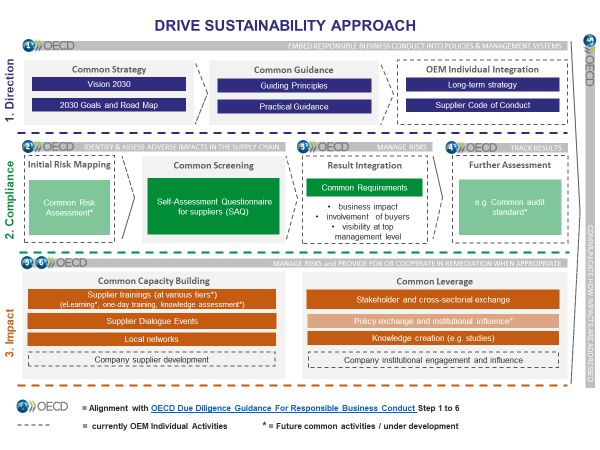
52.2.4 Activities
This global approach to supply chain sustainability in the automotive sector is based on the
following three pillars and core workstreams: 1) Direction, 2) Compliance and 3) Impact, with all
three pillars building on one another (See Figure 2).
The Direction is set by the common strategy and the internal guidelines, such as the Guiding
Principles, that apply along the supply chain in addition to the international regulation (Automo-
tive Industry Action Group & CSR Europe, 2017a). All suppliers are expected to uphold these
standards and to request their subcontractors and suppliers to do the same.
The Compliance process assesses organisational adherence of automotive suppliers to inter-
national regulations and standards in the area of sustainability. Currently, more than 25,000
suppliers in over 100 countries have been assessed using the SAQ (CSR Europe, 2018g).
The Impact work stream summarizes two activity areas, focused on capacity building, with more
than 2,000 suppliers engaged in supplier training, and leveraging of a common voice.
Besides that, the members of Drive Sustainability form smaller working groups to address cer-
tain topics throughout the year, such as raw materials.
Figure 2: Drive Sustainability approach
63. The Drive Sustainability Self-Assessment Questionnaire
3.1 General information
“To assess the sustainability performance of automotive suppliers, Drive Sustainability devel-
oped a common Self-Assessment Questionnaire (SAQ). Focus is placed on social and environ-
mental sustainability, business conduct and compliance, and supplier management. It is aligned
with the Global Automotive Sustainability Guiding Principles. The SAQ is globally applicable for
all suppliers in the Automotive supply chain including sourcing, manufacturing, logistics, assem-
bly or retail” (CSR Europe, 2018f, para. 2). The public launch of the first version of ‘Self-Assess-
ment Questionnaire on CSR/Sustainability for Automotive Sector Suppliers’ took place in April
2014 (CSR Europe, 2018a). The SAQ since then has been constantly revised. This process
includes a consultation with respective suppliers in order to incorporate their feedback. Mean-
while, version 4.0 (CSR Europe, 2020b) is available in the following 13 languages:
- English
- Chinese-Mandarin
- French
- German
- Italian
- Japanese
- Spanish
- Turkish
- Russian
- Hungarian
- Polish
- Czech
- Portuguese
The questionnaire is used by all partners5, however, it is rolled out on different online platforms:
NQC platform: BMW Group, Daimler AG, Ford, Honda, Scania CV AB, Toyota Motor
Europe, Volkswagen Group, Volvo Cars and Volvo Group
Achilles platform: Jaguar Land Rover
5
OEMs using the SAQ: BMW Group, Daimler AG, Ford, Honda, Jaguar Land Rover, Scania CV AB,
Toyota Motor Europe, Volkswagen Group, Volvo Group, Volvo Cars
7The suppliers usually get invited via email to complete the self-assessment questionnaire (CSR
Europe, n.d.). On each platform, suppliers need to complete the SAQ only once per location
and they can share it with all the OEMs using the same platform.
3.2 Structure
The questionnaire relates to both parent companies and the site level: parent company refers
to the “group/holding the supplier is part of”, site refers to “the industrial location where produc-
tion takes place”, while headquarters refers to “the local administrative centre of the enterprise”
(CSR Europe, 2020b). On its 20 pages, the questionnaire covers the areas company manage-
ment, working conditions and human rights, health and safety, business ethics, environment,
supplier management and the responsible sourcing of raw materials. Each area follows a con-
sistent question set structure (See Figure 3).
Figure 3: Design of the SAQ
The suppliers are requested to answer questions about company policies (number one in figure
3) and implemented management systems (number two in figure 3), which cover general com-
pliance topics. Questions on internal KPIs (number three in figure 3) and employee training
(number four in figure 3) focus on general sustainability topics.
The SAQ clearly indicates for which questions the upload of evidence in the form of documents
or certificates is demanded. If evidence is requested, the supplier will only get a positive score
if the correct document is uploaded.
84. Sustainability topics covered by the SAQ, version 4.0
Each section of the SAQ provides background information on, for example, relevant laws, stand-
ards, certification schemes or other relevant documents related to the respective topic. F. The
provided background information shall be seen as support to the suppliers filling out the ques-
tionnaire and also for their internal and external communication of the requirements. All tables
are merged for an overview in section 4.7.
In the following sections, each topic of the questionnaire is portrayed using a table, which is
followed by a description of the relevant questions and by explaining relevant terms. To gain a
better understanding, the background and thus the importance of the addressed topic are further
explained. Each section includes examples from documents of the OEMs to illustrate possible
ways to address certain topics. Furthermore, each section contains recommendations for action
and points out possible benefits for the supplier.
4.1 Company management (Questions 1-4)
External documents (e.g.
Questions refer to Internal documents management systems,
certifications and others)
- General sustainability Sustainability/CSR re- If applicable, assur-
management responsi- port ance letter for the sus-
bilities Code of Conduct of the tainability/CSR report
- Sustainability reporting company
following global stand- Proof of training of em-
ards ployees on the Code of
- Code of Conduct of the Conduct
company Access to grievance
- Grievance mechanism mechanism
Table 2: Overview of the Company Management section of the SAQ 4.0 (Own representation)
4.1.1 Responsible management person
“Companies are expected to appoint a senior management representative, who irrespective of
other responsibilities, serves as a management person responsible for ensuring that the com-
pany meets its commitments related to social sustainability, business ethics and environmental
sustainability.” (CSR Europe, 2020b, p. 3) Such management persons are expected to be ex-
istent for Social Sustainability, Compliance and Environmental Sustainability.
“Social sustainability relates to practices that contribute to the quality of life of both employees
and communities that could be impacted by the company’s operations. Companies should re-
9spect the human rights of workers and treat all people with dignity as recognised by the interna-
tional community. Examples of social topics to address include non-discrimination, freedom of
association, health and safety, etc. (See section B of the SAQ).
Compliance relates to the principles that guide business conduct in its relations towards its
business partners and customers. Companies are expected to uphold the highest standards of
integrity and to operate honestly and equitably throughout the supply chain in accordance with
local laws and avoid unethical business practices. Examples of unethical business practice include
corruption, unfair competition, conflicts of interest, etc. (See section C of the SAQ).
Environmental sustainability relates to practices that contribute to the quality of the environ-
ment on a long-term basis. Companies are expected to support a proactive approach to envi-
ronmental responsibility by protecting the environment, conserving natural resources and re-
ducing the environmental footprint of their production, products and services throughout their
life-cycle. Examples of company practices include greenhouse gas emissions, waste reduction
programmes, etc. (See section D of the SAQ)” (CSR Europe, 2020b, p. 3).
4.1.2 CSR/Sustainability Report
“A CSR/sustainability report is an organisational report that gives information about economic,
environmental, social and ethical performance” (CSR Europe, 2020b, p. 4). It is important to
track the progress of the company’s activities and to communicate the corresponding efforts
with the help of a sustainability report or integrated in the annual report (GCGN, 2015). The EU
directive on non-financial and diversity information disclosure, and national law respectively (e.g.
CSR-RLUG in Germany), requires large companies with more than 500 employees to include a
non-financial statement in their annual report (European Parliament & Council of the EU, 2014).
This statement shall contain “information to the extent necessary for an understanding of the
undertaking's development, performance, position and impact of its activity, relating to, as a
minimum, environmental, social and employee matters, respect for human rights, anti-corruption
and bribery matters” (European Parliament & the Council of the EU, 2014, p. 4).
A materiality analysis helps to identify and prioritize sustainability issues, which are substantial
and relevant for the company as well as for its stakeholders (Mayer, 2017). The findings ob-
tained can be summarised in a matrix (see Figure 4).
10Expectations from
stakeholders
Strategic
activity
high
fields
low
Relevance for
the company
low high
Figure 4: Materiality Matrix (Mayer, 2017, p. 42 based on GRI, 2018)
It quickly becomes apparent, which areas of activity are significant for the organization and its
stakeholders. The management should emphasize on those topics and report on progress
(Mayer, 2017). According to the EU directive on non-financial and diversity information disclo-
sure the companies are free to draw their sustainability reports upon national, EU-based or
international frameworks such as the Global Reporting Initiative (European Commission, 2017).
In the course of its GRI standard, there are ten reporting principles for achieving transparency
in sustainability reports, which are helpful even if the report does not rely on the GRI standards
(GRI, 2018). In broad terms, a supplier has to report on their management approaches and their
strategies relating to CSR/sustainability (GRI, 2018; Mayer, 2017). Furthermore, they have to
describe the measures implemented to reduce negative impacts. It is important to set measur-
able targets to ensure that changes can be evaluated over time (Mayer, 2017). Further infor-
mation is provided in section 4.3.
4.1.3 Code of Conduct
The code of conduct is a compilation of rules of behaviour inside a company (Rößler, 2016). It
contains the company’s essential values and core beliefs. The observance of the code is a
voluntary commitment taken on by the company (Rößler, 2016). Here one must differentiate
between the code of conduct towards employees (internal), which is indicated in sections 4.2 to
114.4 and the code of conduct towards suppliers6, sometimes named supplier code of conduct
(external), which is covered in sections 4.5 and 4.6.
Training for employees on the Code of Conduct refer to training sessions organized by compa-
nies to enhance the understanding of social, ethical and environmental issues covered in the
Code of Conduct.
4.1.4 Grievance Mechanism
According to the UN “Protect, Respect and Remedy” or “Ruggie-“Framework (UN 2010; UN
2011), companies are responsible to respect human rights and are expected to provide a rem-
edy if their operations caused or contributed to adverse human rights impacts. Operational-level
grievance mechanisms for those potentially impacted by enterprises’ activities are recom-
mended as an effective process through which companies can enable remediation. In general,
it is expected of companies who are following, for example the UN “Protect, Respect and Rem-
edy” Framework to pay equal attention for providing access to grievance mechanisms not only
for their own employees, but also for stakeholders potentially impacted by the companies’ ac-
tivities, including suppliers (for a further explanation on human rights, please see the next sec-
tion).
6
From the OEM’s point of view, these are sub-suppliers.
124.2 Working conditions and human rights (Questions 5-6)
External documents (e.g.
Questions refer to Internal documents management systems,
certifications and others)
- Universal Declaration of Working conditions and ISO 26000 Guidance
Human Rights human rights policy Social Responsibility
- UN Guiding Principles Proof of training of em- SA8000 Social
on Business and ployees on working Management System
Human Rights conditions and human Human Rights Compli-
- Automotive Industry rights ance Assessment
Guiding Principles to
Enhance Sustainability
Performance in the
Supply Chain
- ILO Declaration on
Fundamental Principles
and Rights at Work
- OECD Guidelines for
Multinational Enter-
prises (chapter IV)
- UK Modern Slavery Act
- UNGC Principles 1-6
- Sustainable Develop-
ment Goals (SDG)
Table 3: Questions on working conditions and human rights (Own representation)
4.2.1 Focus human rights
The questions five and six from the SAQ focus on working conditions and human rights and
assess whether the supplier has policies and management systems in place to address these
issues.
“Human rights are a set of rules that defines how people should be treated, … [including] rights
related to political participation and liberty … and rights related to quality of life and well-being”
(Baab, 2016, p. 3).
It is obvious that some human rights, like the right to work or the right to equal pay for equal
work, are directly influenced by the company’s actions (United Nations General Assembly,
1948). Some others are rather indirectly influenced, but generally businesses can have an im-
pact on almost every human right (Baab, 2016). Therefore, it is important that everybody is
aware of the company’s impacts. Working conditions are directly linked to the respect of human
rights. The term refers to issues such as child labour, working hours and non-discrimination
(CSR Europe, 2020b).
4.2.2 Background
The 30 articles concerning the rights of all human beings are written down in the Universal
Declaration of Human Rights (UDHR), which was proclaimed by the United Nations General
13Assembly in 1948. At that time, “the most profound violation of human rights in history had
mainly been committed by governments” (Baab, 2016, p. 3). Therefore, the UDHR became a
historical milestone. The defined articles are universal and apply to every human being through-
out the world. They were and are adopted by governments and extended to the private sector
(Baab, 2016). This extension caused a debate on businesses’ responsibilities, leading to the
development and the adoption of the UN Guiding Principles on Business and Human Rights in
2011. According to these UN Guiding Principles, governments have to ensure that companies
do not have a negative impact on the residents of the country they are operating in. At the same
time, companies have to guarantee that nobody’s human rights are violated through their activ-
ities (Baab, 2016; UN, 2011; UN, 2010).
The state duty to
PROTECT
human rights
The corporate
Access to effective responsibility to
REMEDY RESPECT
human rights
Figure 5: UN “Protect, Respect and Remedy” Framework (Own representation based on UN, 2011)
Besides the mentioned responsibilities, both the state and the business must make sure that
victims of human rights abuses have access to remedy through effective grievance mecha-
nisms, judicial and non-judicial (UN, 2010). This is especially relevant, as 38% of globally ques-
tioned citizens7 agree that “they do not know very much or nothing at all about human rights”
(Ipsos Public Affairs, 2018a, p. 2). This leads to the circumstance that people potentially being
affected by human rights infringements are not realizing that their rights are abused. They also
7
Base: 23,249 people across 28 countries (Ipsos Public Affairs, 2018a).
14likely do not know whom to address these infringements to. Likewise, businesses may not be
aware of these infringements (Baab, 2016).
As fair working conditions are a measure to protect human rights at work, the ILO in 1998
adopted the ILO Declaration on Fundamental Principles and Rights at Work. The declaration
contains subjects such as “[the] freedom of association and the effective recognition of the right
to collective bargaining; the elimination of all forms of forced or compulsory labour; the effective
abolition of child labour; and the elimination of discrimination in respect of employment and
occupation” (ILO, 2018, para. 3).
Social standards such as the Social Accountability SA 8000 are essentially based on the UDHR
and the mentioned ILO Declaration (Gogoll & Wenke, 2017). They can be used to implement a
system to organize the social responsibility of a company. Some of the most important elements
are minimum wage, the limitation of working hours, the prohibition of child labour and forced
labour as well as the implementation of a management system which guarantees a permanent
monitoring of the company’s defined standards (Gogoll & Wenke, 2017).
4.2.3 Recommendations for action
The identification and prevention of the company’s social impacts is an ongoing process, which
is designated as human rights due diligence (Baab, 2016). The illustration below shows six main
steps to understand and avoid the violation of human rights (see Figure 6).
15Step 1: Commit to respect human rights and
Step 6: Communicate about
embed the commitment in your company
what you are doing your business
Step 2: Identify your
Step 5: Track your progress
human rights risks
Step 3: Take action to avoid and
address the risks you identify
Step 4: Enable remedy for those affected, if
you are directly involved in a negative impact
Grievance Mechanism
Figure 6: Six steps towards respecting human rights (Own representation based on European Commis-
sion, n.d., p. 6)
The first step is a public commitment to respect human rights written by the company owner or
the management. This should be integrated into the supplier’s code of conduct or be part of the
company policies, for example, a working conditions and human rights policy and a health and
safety policy (European Commission, n.d.). According to CSR Europe (2018a) “a company pol-
icy refers to a business approach to a given issue and contains general principles and/or prac-
tical how-to-do items. A policy may include components such as prohibited behaviours, rights
and dispute procedures” (p. 5).
“We respect, protect and promote all regulations in force to protect human rights and chil-
dren’s rights (hereinafter called human rights) as a fundamental and general requirement
throughout the world. We reject all use of child labor [sic] and forced or compulsory labor [sic]
as well as all forms of modern slavery and human trafficking. This applies not only to coop-
eration within our Company but also as a matter of course to the conduct of and toward
business partners.” (Volkswagen AG, 2017, p. 9)
16The employees should be trained on human rights issues to raise their awareness (UNGC,
2012). A basic knowledge is needed to accomplish a first analysis of possible risks and social
issues (Global Compact Network Germany (GCNG), 2015). Through mapping the main busi-
ness activities and relationships one is enabled to identify people whose rights might be im-
pacted (GCGN, 2015).
Another way is to use existing material from databases, trade unions, NGOs or civil society
reports “to understand what they think are potential impacts for ... [the] sector” (GCNG, 2015, p.
17) the supplier is operating in. It is recommended to integrate the assessment of human rights
impacts into an implemented risk management system or a health and safety management sys-
tem, based on a social standard such as the SA 8000 (European Commission, n.d.).
Suppliers can control human rights issues appearing within their own processes and take ac-
tions to avoid those (Baab, 2016), including the appointment of a person in charge (GCNG,
2015). These actions could refer to the introduction of minimum wage, safety training for new
employees and personal protective equipment (Baab, 2016). Also, problems such as the dis-
crimination within the recruiting process or sexual harassment at work should be addressed
(GCGN, 2015). According to Baab (2016) “the important element … is to establish communica-
tion channels with the people who are affected by … [the business’] operations and to leave
those channels open for an ongoing dialogue” (p.7). A suggestions box for employees or a public
email address for individuals from outside the company are possible ways to enable the dialogue
(UNGC, 2012; European Commission, n.d.). It is important to track the progress of the com-
pany’s activities and to communicate it with the help of a sustainability report or the annual report
(GCGN, 2015).
4.2.4 Benefits
The advantages of the compliance with human rights and social standards are sometimes not
immediately evident but can be decisive for long-term sustainability (Gogoll & Wenke, 2017). Of
course, following the law avoids punishment, but respecting human rights means much more
than that (Baab, 2016).
The fair treatment of employees regarding their working and payment conditions leads to a
greater satisfaction (UNGC, 2018d)8. The staff remains loyal to the employer and the average
rate of absences declines (UNGC, 2018d; UNGC, 2018e). Especially the introduction of health
and safety measures has a positive impact on the number of accidents at work and the sick
days in the long run. The possibility to lose know-how is minimized and the productivity rises. A
8
For a general analysis of the link between (environmental) supply chain practices and firm performance
see Golicic und Smith (2013).
17good working climate lowers the staff turnover what automatically reduces hiring and training
costs (Baab, 2016). The employer attractiveness as well as the company’s general reputation
reaches a higher level because CSR/sustainability gains in importance, not only for jobseekers.
Stakeholders, such as customers and investors, more easily identify themselves with the com-
pany when human rights violations are prevented. In such cases, business relationships be-
come stronger (UNGC, 2018d). The proper handling of social issues is also a competitive ad-
vantage and can enable organizations to access new markets (Baab, 2016). A good position
within the industry facilitates the customer acquisition and secures the continued existence of
the company.
4.3 Health and Safety (Questions 7-8)
External documents (e.g.
Questions refer to Internal documents management systems,
certifications and others)
- Universal Declaration of Health and safety policy Occupational Health
Human Rights Employee manual and Safety Assessment
- UN Guiding Principles Proof of training of em- Series (OHSAS) 18001
on Business and ployees on working (BS OHSAS 18001)
Human Rights conditions an ISO 45001 Occupa-
- Automotive Industry tional Health and Safety
Guiding Principles to SA8000 Social
Enhance Sustainability Management System
Performance in the
Supply Chain
- ILO Declaration on
Fundamental Principles
and Rights at Work
- OECD Guidelines for
Multinational Enter-
prises (chapter IV)
Table 4: Questions on health and safety (Own representation)
4.3.1 Focus
Following health and safety procedures is essential when pursuing successful business ideas.
Following such procedures is not only essential to avoid governmental fines and penalties in
some countries, but also to be an attractive employer to both the potential and current workforce.
Health and safety issues are closely interlinked with the issue of human rights above, as they,
for example, support the well-being of employees who generally desire to work in a safe and
protected workplace. Procedures relating to health and safety shall ensure the long-time well-
being of employees, which includes next to physical also the mental well-being.
184.3.2 Background
As fair working conditions are a measure to protect human rights at work, the ILO in 1998
adopted the ILO Declaration on Fundamental Principles and Rights at Work, which have been
specified to address issues of health and safety for example via the ILO’s Promotional Frame-
work for Occupational Safety and Health Convention. The ILO recognizes that continuous efforts
are necessary, for example via health and safety management schemes, to reduce occupational
injuries, diseases and deaths. In general, the purpose of such management schemes and efforts
in the field of health and safety shall be to contribute to the “protection of workers from hazards
and to the elimination of work-related injuries, ill health, diseases, incidents and deaths” (ILO,
2001), following a continuous improvement approach. A certifiable management system ad-
dressing health and safety would be the ISO 45001. In addition, the above-mentioned Social
Accountability SA 8000 also addresses health and safety and could be used as a certification
scheme to address such issues.
4.3.3 Recommendations for action
It is strongly recommended that suppliers are in control of health and safety requirements at
their own processes and sites, while at the same time also reach out to their suppliers to address
health and safety issues. For their own processes, appointing a person in charge for health and
safety management is appropriate. Ideally, KPIs are defined which measure accident rates, ab-
sentee rates caused by health and safety infringements. The person in charge for health and
safety shall ensure that relevant procedures are established and followed. This includes a reg-
ular training of employees/workers and a documentation thereof. Such trainings are not only
necessary for new workers, but existing staff also shall be (re-)trained on a regular basis. It must
also be ensured that enough personal protective equipment is available for the workers in need
of it. Such equipment shall be provided by the company to the workers free of charge.
4.3.4 Benefits
The advantages of the compliance with health and safety procedures is linked with a productive
work environment, as for example learned and standardized work routines create efficiency. In
general, in safe work environments employees are more satisfied with their employer and fees
for health and safety related insurances are lower when the number of accidents is low or on a
decline. In general, it is assumed, that (severe) accidents related to a non-compliant health and
safety procedure potentially also lead to business disruptions, which could have severe conse-
quences.
19The introduction of health and safety measures has a positive impact on the number of accidents
at work and the sick days in the long run. The possibility to lose know-how is minimized and the
productivity rises. A good working climate lowers the staff turnover what automatically reduces
hiring and training costs (Baab, 2016).
4.4 Business ethics (Question 9)
External documents (e.g.
Questions refer to Internal Documents management systems, certi-
fications and others)
- The United Nations Business conduct ISO 37001 Anti-Bribery
Convention Against and compliance Management System
Corruption policy (formerly BS 10500)
- Universal Declaration of Anti-corruption ISO 26000 Guidance
Human Rights policy Social Responsibility
- EU Directive on Non-Fi- Code of conduct ISO 19600 Compliance
nancial and Diversity Proof of training of Management System
Information Disclosure employees on busi- Institute of Electrical and
2014/95 ness ethics Electronics Engineers
- US Foreign Corrupt (IEEE) Principles of
Practices Act business conduct
- U.K. Bribery Act compliance certificate
- EU General Data
Protection Regulation
(GDPR) 2016/679
- OECD Guidelines for
Multinational Enter-
prises (chapter VI)
- Automotive Industry
Guiding Principles
- UNGC Principle 10
- SDGs
Table 5: Questions on business ethics (Own representation)
4.4.1 Focus
The next section of the SAQ focuses on business ethics. This term refers to the expectation
towards companies “to uphold the highest standards of integrity and to operate honestly and
equitably throughout the supply chain in accordance with local laws” (Automotive Industry Action
Group & CSR Europe, 2017a). In this context, the supplier is asked whether a formal policy
covers the following subjects, which are shortly explained in the SAQ.
- Privacy - Fair competition and anti-trust
- Counterfeit parts - Corruption, extortion & bribery
- Conflicts of interest - Export controls & economic sanctions
20- Whistleblowing and protection against re-
- Intellectual property
taliation
- Disclosure of information - Financial responsibility (Accurate Records)
At this point, the author only delves into some of the topics listed.
4.4.2 Background
The intent is to act in a transparent manner and to provide stakeholders with access to the
company’s financial and non-financial information. The objective of the disclosure is to ensure
lasting stakeholder satisfaction (Behringer, 2018). The EU directive on non-financial and diver-
sity information disclosure requires large companies with more than 500 employees to include
a non-financial statement in their annual report (European Parliament & Council of the EU,
2014). This is supposed to contain “information to the extent necessary for an understanding of
the undertaking's development, performance, position and impact of its activity, relating to, as a
minimum, environmental, social and employee matters, respect for human rights, anti-corruption
and bribery matters” (European Parliament & the Council of the EU, 2014, p. 4).
Corruption is still a major problem around the world (Lennerfors, 2018), although the fighting
against it has increased in the last 15 years (Sampson, 2018). The first international convention
addressing this topic was the Inter-American Convention against corruption, which has been
adopted in 1996 (UN, 2004). It took almost ten more years until the UN Convention against
Corruption, the only legally binding instrument to fight corruption, entered into force in 2005
(United Nations Office on Drugs and Crime, 2018). The NGO Transparency International
(2018a) defines corruption as “the abuse of entrusted power for private gain” (para. 1). Trans-
parency International provides information, that can be used to find out more about global cor-
ruption, for example, the Corruption Perceptions Index (Transparency International, 2018b) or
the Global Corruption Barometer (Transparency International, 2018c).
4.4.3 Recommendations for action
Risks in the abuse of power exist in almost every company (Lennerfors, 2018; Sampson, 2018).
Even helping a family member to get a job in the same company (Sampson, 2018) or accepting
a gift from a customer (Lennerfors, 2018) are considered forms of corruption. Therefore, the
challenge is not only to raise awareness, but to teach employees which behaviour might have
negative consequences for the company as well as for employees (Sampson, 2018). This in-
cludes information on how to avoid such behaviour or how to address it when getting caught in
a potentially unethical situation. Sometimes, the implementation of an incentive system has a
greater effect than the attempt to change people’s basic values (Sampson, 2018). One basic
step is to introduce an anti-corruption policy or a business conduct and compliance policy in
21addition to the commitment of ethical behaviour in the supplier’s code of conduct for employees9
(UNGC, 2018f). Referring to the examples given above, one aspect could be a strict no-gifts
policy, which applies to every member of the company (Lennerfors, 2018).
Honda continuously carries out initiatives to strengthen compliance in order to reinforce the
trust established with society. Persons who work at Honda are also required to comply with
relevant laws, regulations, and policies while acting ethically. (Honda Motor Co., Ltd, n.d.)
Furthermore, it is advisable to join a sectoral network to scale up anti-corruption efforts (UNGC,
2018f). The shared experiences can promote the understanding of the own impacts and facili-
tate the process of reporting. As mentioned before, the sustainability report focuses on several
subjects, not exclusively on corruption. The reporting should follow the principle of materiality,
which implies to concentrate on the important and relevant information by leaving out the minor
details (Mayer, 2017).
4.4.4 Benefits
A standardized (non-financial) reporting allows the comparison between companies (Mayer,
2017). The transparency reduces the risk of criminal activities and builds trust among stake-
holders (Behringer, 2018). A higher credibility leads to more growth and employment (Mayer,
2017; European Commission, 2017). Ethical values become more important for investors (Beh-
ringer, 2018), so that “transparent business management is also consistent with longer-term
investment” (European Commission, 2017, p. 2). Besides the reputational aspects, the organi-
zation avoids lawsuits and criminal charges (Sampson, 2018). Particularly, fighting and prevent-
ing corruption decreases financial costs (Sampson, 2018; UNGC, 2018f). An efficient compli-
ance management system ensures that compliance violations do not threaten the supplier’s
existence (Behringer, 2018).
9
From the OEM’s point of view, these are sub-suppliers.
224.5 Environment (Questions 10-14)
External documents (e.g.
Questions refer to Internal Documents management systems, certifi-
cations and others)
- The Rio Declaration on Code of Conduct ISO 14001:2015
Environment and Devel- Environmental Environmental
opment (Agenda 21) policy Management System
- Kyoto protocol and Proof of training of ISO14064 GHG
Paris Agreement employees on envi- PAS2060 Carbon neutrality
- Automotive Industry ronmental issues PAS2050 Carbon footprint
Guiding Principles
EU Eco-Management and
- REACH (Registration, Audit Scheme (EMAS)
Evaluation, Authorisa-
ISO 5001 Energy Manage-
tion, and Restriction of
ment
Chemicals) and RoHS
(Restriction of Hazard-
ous Substances)
- OECD Guidelines for
Multinational Enter-
prises (chapter V)
- UNGC Principles 7-9
- SDGs
- CDP
Table 6: Questions on the environment (Own representation)
4.5.1 Focus
The planet as well as those inhabiting it must be protected to ensure a viable future for all.
Therefore, questions 10 to 14 from the SAQ focus on the protection of the environment, the
climate and natural resources. The suppliers are asked, following the structure of previous sec-
tions, whether they have management systems such as those mentioned in Table 6 in place.
Particular attention is paid to the handling of restricted substances, the use of the International
Material Data System (IMDS database) and the supplier’s CDP performance (formerly Carbon
Disclosure Project) score (CSR Europe, 2018a). Furthermore, in the aim to achieve carbon neu-
tral supply chains, the % of renewable energy used at sites is now added as a question.
The CDP, founded in London in 2002, is an international charity with the aim to improve the
environmental reporting of companies around the world (CDP Worldwide, 2018a). They collect
data from regions, states, cities and companies to analyse their environmental performance and
to score them from A to D (CDP Worldwide, 2018a; CDP Worldwide, 2018b). “Investors, busi-
nesses and policy makers use [the] data and insights to make better decisions, manage risk
23and capitalize on opportunities” (CDP Worldwide, 2018b). CDP has different scoring methodol-
ogies for the following three categories: climate change, water security and deforestation. Some
of the Drive Sustainability partners reached the climate change A-list as well as the water A-list
in 2017 (CDP Worldwide, 2018a; CDP Worldwide, 2018b). The majority of the partners are CDP
supply chain members (CDP Worldwide, 2018c).
The partners BMW, Daimler, Ford, VW and Volvo were part of the development of the IMDS
which is the automobile industry’s material database. The system records and tracks all mate-
rials present in finished automobile manufacturing to meet the requirements of national and
international laws, regulations and standards. With more than 400,000 users within the automo-
bile sector the IMDS became a global standard for material reporting (DXC 2017a; DXC, 2017b).
4.5.2 Background
Due to the population growth, the world today faces a problem in the overconsumption of natural
resources (Schönmayr, 2017). The first sustainability issues came to light in 1972 when The
Club of Rome published its report ‘The Limits of Growth’ (Mayer, 2017). In the same year, one
of the first steps “toward a sustainable society providing good living conditions for all while re-
specting ecological limits” (Baumgartner, 2017, p. xii) was the UN Conference on the Human
Environment, also known as the Stockholm Conference. Another important milestone is the UN
Conference on Environment and Development, which took place in Rio de Janeiro in 1992
(Mayer, 2017). As a result, the Declaration on Environment and Development provides a basis
for many other conventions and agreements such as the Convention on Biological Diversity and
the United Nations Framework Convention on Climate Change (UNFCCC) (Mayer, 2017).
The objective of the UNFCCC is “to achieve … stabilization of greenhouse gas concentrations
in the atmosphere at a level that would prevent dangerous anthropogenic interference with the
climate system” (UN, 1992, p.5). In 1997, the Conference of the Parties to the UNFCCC was
held in Kyoto, Japan. To reduce greenhouse gas emissions, 150 nations adopted the Kyoto
Protocol which entered into force in 2005. Consequently, the protocol was ratified by 192 nations
until 2013 (UN, 1998). The international Paris Agreement was adopted in 2015 by 195 countries
at the Paris climate conference (COP21) (Mayer, 2017). Its central aim is to limit global warming
to 2 degrees Celsius above pre-industrial levels (Secretariat of the UNFCCC, 2018).
“The ten warmest years on record have all occurred since 1998, with the four warmest years
occurring since 2014” (Sánchez-Lugo, Morice, Berrisford & Argüez, 2018, p. S12). A research
on 11,944 papers shows that almost all of them (97.1 percent) lead to the conclusion that hu-
mans are causing global warming (Cook et al., 2013). Therefore, it is important that every mem-
ber of the supply chain is sensitized towards the reduction of greenhouse gas emissions. In
general, everybody needs access to information on how to do business in accordance with the
24environment. Especially, aspects such as recycling systems, pollution prevention, material re-
strictions and resource efficiency deserve consideration (econsense, 2013).
4.5.3 Recommendations for action
“To protect human health and the environment from unacceptable risks posed by chemicals”
(European Chemicals Agency (ECHA), 2017, para. 1), the use of chemical substances, which
are listed in the regulations REACH and RoHS, is restricted. Companies are not just facing
these two regulations. That is why every supplier’s first step should be researching environmen-
tal laws, regulations and standards affecting their business operations. These can be used as a
starting point to identify their impacts on the environment and to map out a strategy to increase
the environmental performance. The websites of the OEMs and their information tools, such as
the supplier portals and the IMDS, are helpful in this process (Daimler AG, 2018). A commitment
to care for the environment should be included in the supplier’s code of conduct. Another pos-
sibility is to develop and implement an environmental policy (UNGC, 2018g), and ultimately a
(certified) environmental management system.
As a commercial enterprise, we bear responsibility for the environmental compatibility and
sustainability of our products, locations and services. We focus on environmentally friendly,
advanced and efficient technologies, which we implement throughout the entire lifecycle of
our products. Starting with the early phases of development and production, we make sure
we manage natural resources carefully and steadily reduce the environmental impact to com-
ply with environment protection laws and regulations. (Scania, 2017, p. 18)
To ensure the consistent application of the strategy, a company guideline should be developed.
Furthermore, one person or group has to assume the responsibility to oversee environmental
precautions (UNGC, 2018h). A steady process to prevent risks in sensitive fields is needed. The
key factor to do so is transparent communication with all stakeholders in both directions. On the
one hand, there is a need to raise environmental awareness throughout the company and to
inform external partners about management’s commitment (UNGC, 2018h). In this context, one
suggestion is to organize mandatory employee trainings on environmental protection (UNGC,
2012), as well as respective company policies and regulations. On the other hand, all stake-
holders must be given the chance to address environmental violations through a grievance
mechanism, for example, multi-stakeholder dialogues (UNGC, 2018h).
The primary objective of an EMS is the continuous enhancement of the company’s environmen-
tal performance (Förtsch & Meinholz, 2018). The ISO 14001 is a globally accepted and applied
standard with around 363,000 certified companies (Umweltbundesamt, 2018). It is based on the
following repetitive processing steps (see Figure 7).
25You can also read


