Senior Course Guide Years 12 & 13 2021 - SUBJECT SELECTION INFORMATION BOOKLET - Macleans College
←
→
Page content transcription
If your browser does not render page correctly, please read the page content below
Senior Course Guide
       Years 12 & 13

        SUBJECT SELECTION
      INFORMATION BOOKLET

                    Cambridge Assessment
                    International Education

                  National Certificate in
                 Educational Achievement

                               2021
JON/Senior Course Guide 2021                  Page i
Table of Contents
     How to enter your option subjects online:                        3
     Introduction                                                     4
     Choosing a Pathway                                               4
     Choosing Subjects                                                4
     Year 12 & 13 NCEA Subject Progression from Year 11:              5
     Year 12 & 13 CAIE Subject Progression from Year 11:              6
     NCEA Subject Notes and Important Information                     7
     CAIE Subject Notes and Important Information                     8
     Notes from the Careers Department                                9
     Careers Subject Choice Guide                                     9
     Choosing Your Subjects                                          11
     People Who Can Help                                             12
     ESOL Courses                                                    13
     University Entrance Literacy                                    13
     Literacy for Students from non-English Speaking Backgrounds     13
     MACLEANS COLLEGE SUBJECT OUTLINE 2021                           14
     Qualification Pathways at Macleans College                      15
      National Certificate of Educational Achievement (NCEA)         15
      Cambridge Assessment International Education (CAIE)            16
     Pathway Choices for Year 11 & 12 Students:                      17
      Comparison between NCEA and CAIE                               18
     Combining NCEA and CAIE Pathways                                18
     Multi-Level Pathways                                            18
     Vocational Pathways                                             19
     NCEA Employment Focused Subjects                                19
     Gateway, STAR and Trades Academy Programmes                     19
     Gaining Entry to the Next Year Level                            20
     Compulsory Subjects / Number of Option Subjects                 21
     Year 12 Subject Choice Flowchart for 2020 to 2021               22
     Year 13 Subject Choice Flowchart                                22
     Re-assessment / Absences / Trips / Appeals                      23
     Examination Entry and Fees                                      23
     Scholarship Examinations                                        24
     Entry to Certificate and Diploma Courses                        25
     Entry to New Zealand Universities                               25
JON/Senior Course Guide 2021                                       Page i
Combining NCEA and CAIE Pathways                                                         25
     Limited Entry Degree Courses                                                             25
     Entry to Overseas Universities                                                           25
     NCEA – University Entrance (UE)                                                          26
     NCEA Approved Subjects:                                                                  26
     NCEA Requirements for Entry to New Zealand Universities in 2021 (Rank Scores)            27
     NCEA: Additional requirements for some courses:                                          28
     CAIE – University Entrance                                                               30
     CAIE Approved Subjects:                                                                  30
     CAIE Requirements for Entry to New Zealand Universities in 2020 (UCAS Tariff Scores)     31
     CAIE: Additional Requirements for some courses:                                          32
     Recommended Senior School Subjects for Degree Majors:                                    34
     Entry to Medicine                                                                        38
     Useful Websites for Career Research:                                                     39
     Subject Details                                                                          40
     Subject Lists – NCEA Level 2 Subjects:                                                   40
     Subject Lists - NCEA Level 3 Subjects:                                                   41
     Subject Lists – Cambridge International AS Subjects:                                     42
     Subject Lists – CAIE A Level (A2) Subjects:                                              42
     Location of Faculty Heads                                                                43
     Check List for Choosing Year 12 & 13 Subjects:                                           43

 Year 11, 12 & 13 Subject Details
          Macleans College Senior Course Guides 2021
                   www.macleans.school.nz
                     On the Home Page>
              Academic> Course Guides> Senior Subject Details 2021

JON/Senior Course Guide 2021                                                                Page ii
How to enter Year 12 & 13 subject choices online:
All Year 11 and 12 students will have subject selection video talks during Term 3. You and your
parents/caregivers will choose your 2021 subjects for Year 12 and 13 through the Parent Portal on the school
website: www.macleans.school.nz.
• At the top of the Home page go to My Tools > Parent Portal, enter your username (student ID number)
and any of your passwords.
• Login then choose Course Selection. Follow the instructions to enter the subjects you wish to select.
• You must choose your FOUR or FIVE subjects, IN ORDER OF PREFERENCE, plus ONE alternate (reserve) subject.
• You can Preview Selection then Confirm Selection or SAVE at the end.
• To be completed by Friday 18th September.
Some subject choices may depend on confirmation by Heads of Faculty or SMT – please see the notes on the
next pages and read the subject details on the school website.
Before you make your choices please read the information and follow the instructions in this booklet, read the
notes and restrictions on pages 6 and 8 and check the Subject Details on the school website;
www.macleans.school.nz on the Home Page > Academic > Course Guides.
• Choose your FOUR or FIVE subjects from the lists of subjects, EACH from a DIFFERENT column IN YOUR
ORDER OF PREFERENCE. Also choose an alternate (reserve) subject in the last column.
• For Year 12 you must include an English course as one of your options.
There are no compulsory subjects in Year 13.
• NCEA students may be able to pick a CAIE subject not offered in NCEA. CAIE students may be able to pick
one NCEA subject not offered in CAIE. Where appropriate, this may be English, ESOL or Mathematics.
• To choose a mixed pathway, students must seek permission from the Year 12 or 13 Dean - Mrs Thompson
for Year 12 or Mr Mackenzie for Year 13. International students should see Mr McGuire-Barnes.
• Subjects are listed by Faculty: English, Mathematics & Science subjects / NCEA subjects / CAIE subjects.
Year 12 NCEA students must choose (Subject 1):
Step 1: 12ENG NCEA Level 2 English or
12ENL NCEA Level 2 English (Literacy) or
12ESL NCEA Level 2 ESOL
Step 2: Choose four other subjects in order of preference (Subjects 2, 3, 4 & 5).
Step 3: Choose one alternate (reserve) subject in the last column.
Year 12 CAIE students must choose (Subject 1):
Step 1: 12ELC AS English Literature or
12ENC AS English Language or
12ENG NCEA Level 2 English or
12ESL NCEA Level 2 ESOL
Step 2: Choose three other subjects, in order of preference, (Subjects 2, 3 & 4). Leave Subject 5 blank.
NOTE: Students who wish to choose a 5th subject must see Mrs Thompson for permission.
Step 2: Choose one alternate (reserve) subject in the last column.
In Year 12 all NCEA and most CAIE students will also have core Physical Education (12PED) and study
classes – these will be added automatically after your subject choices.
Scholarship:
Year 13 NCEA students: Students who wish to be considered
Step 1: Choose five subjects, in order of preference, (Subjects 1, 2, 3, 4 & 5). for Scholarship Subjects should
Step 2: Choose one alternate (reserve) subject in the last column. indicate this by selecting it at the
very bottom of the subject lists.
Year 13 CAIE students:
Step 1: Choose four option subjects, in order of preference, (Subjects 1, 2, 3 & 4). Leave Subject 5 blank.
NOTE: Students who wish to choose five subjects must see Mr Mackenzie for permission.
Step 2: Choose one alternate (reserve) subject in the last column.
All students: Please enter your subjects online in the Parent Portal before Friday 18th September.
JON/Senior Course Guide 2021 Page 3Introduction
This information booklet is provided to assist Senior students to select your subjects for next year. It includes
important general information, advice and references. It should be used along with the Subject Details for all
courses offered in Years 12 and 13. These are available on the school website, www.macleans.school.nz on the
Home page > Academic > Course Guides > Senior Subject Details 2021. You are urged to research and consider
your career and subject choices thoroughly.
Year 11 students study English or ESOL, Mathematics and a Science subject plus three option subjects. While
assessment is important, the emphasis in Year 11 is on learning. Students select a Year 11 MCERT programme
which will prepare them for the subjects they wish to study in Years 12 and 13. From 2020 NCEA Level 1 will only
be offered to selected students in 11ENL: English (Literacy), 11ESL: ESOL and 11MNU: Mathematics (Numeracy) so
current Year 11 students will choose their pathway, either NCEA or Cambridge International to start in Year 12.
Current Year 12 chose a qualification pathway in Year 11, either NCEA or CAIE. Some changed this pathway at the
start of Year 12. Students will usually continue their Year 12 pathway into Year 13. In Years 12 and 13 you study
subjects which help to prepare you for your career goals. Many students at Macleans College plan to study for
degrees at university, however, it should be noted that, while this is an excellent goal for many, it is not necessarily
the best or most appropriate choice for all students. Preparation for worthwhile, interesting and rewarding careers
is available through work, through polytechnic degree courses, diploma and certificate courses at polytechnics and
private tertiary providers, apprenticeships and other training programmes. There are also many opportunities to
“staircase” up to degree level after successful completion of certificates and diplomas
You should choose subjects and work towards careers that reflect your interests, skills, abilities, personal qualities,
learning styles and values. The Bulls-Eye quiz can help you to identify career pathways and related school subjects.
Choosing a Pathway
Most Year 11 students at Macleans College are currently studying an MCERT course which provides the background
for Year 12 subjects offered in both NCEA and Cambridge International and will enable them to choose from either
qualification pathway, for Year 12. They have had a subject choice talk from Mrs Thompson and taken home a
printed booklet to assist with their decisions. There are notes and comparisons to help on pages 15 to 19.
• Think about your style of learning
• Ask yourself which assessment style suits you best
• Consider the availability of the subjects you wish to study
• Think about where you hope to study and work when you leave school
• Students generally continue their Year 12 pathway into Year 13
Choosing Subjects
• Complete the check list at the back of this booklet.
• Carefully read the Careers Department information on pages 9 and 10.
• Study the Careers Subject Choice Guide on pages 9 and 10.
• Track the progress of subjects from Year 9 through to Year 13 in the Subject Outline on page 14 and the
Subject Lists on pages 5 and 6.
• Check what results you need to be able to progress to the next year level on page 20.
• Research the career possibilities that interest you, courses available at university and polytechnic, other
training providers, apprenticeships and on-the-job training.
• Check the entry requirements for jobs, apprenticeships, cadetships and tertiary courses. Some information
is on pages 25 to 38.
• Ask for help if you need it. The people who can help you are listed on page 12.
• Read the Subject Details in the Senior Course Guide 2021 on the website. They include course descriptions,
assessment details and recommended background.
• Refer to the 2021 Subject Lists and attached notes on page 5 to 8 for details of courses available.
JON/Senior Course Guide 2021 Page 4Year 12 & 13 NCEA Subject Progression from Year 11:
In the NCEA pathway Year 11 MCERT subjects lead to NCEA Level 2 subjects in Year 12 and on into NCEA Level 3 subjects
in Year 13. See page 15 for further information about the NCEA pathway.
Year 11 - MCERT
NCEA SUBJECTS OFFERED IN 2021
Year 12 – NCEA Level 2 Year 13 – NCEA Level 3
ENGLISH
English 11ENG
English 12ENG English 13ENG
English (Extension) 11ENA
English (Literacy) 11ENL English (Literacy) 12ENL
ESOL (English for Speakers
11ESL ESOL 12ESL
of Other Languages)
Media Studies 12MDS Media Studies 13MDS
MATHEMATICS
Mathematics (Extension) 11MAA
Mathematics (Calculus) 13MCA
Mathematics (Continuing) 12MAT
Mathematics 11MAT Mathematics 13MAT
or Mathematics (Statistics) 12MST
or Mathematics (Numeracy) 11MNU
SCIENCE
Science 11SCI
Biology 12BIO Biology 13BIO
Biology 11BIO
Science 11SCI
Chemistry 12CHE Chemistry 13CHE
Chemistry 11CHE
Science 11SCI
Physics 12PHY Physics 13PHY
Physics 11PHY
SOCIAL SCIENCES
Geography 11GEO Geography 12GEO Geography 13GEO
History 11HIS History 12HIS History 13HIS
Classical Studies 13CLS
Social Studies 13SOS
*Travel and Tourism 12TRT *Travel and Tourism 13TRT
PHYSICAL EDUCATION & HEALTH
Physical Education 11PEA Physical Education (NCEA) 12PEA Physical Education (NCEA) 13PEA
*Challenge Course 11CHG *Outdoor Education 13ODE
Phys Ed & Heath (Core) 11PED Phys Ed & Health (Core) / Study 12PED
LANGUAGES
Chinese (Mandarin) 11CHI Chinese 12CHI Chinese 13CHI
Te Reo Māori 11MAO Te Reo Māori 12MAO Te Reo Māori 13MAO
Japanese 11JAP Japanese 12JAP Japanese 13JAP
Spanish 12SPA Spanish 12SPA Spanish 13SPA
TECHNOLOGY
*Engineering (Mechanical) 11TEM *Engineering (Mechanical) 12TEM *Engineering (Mechanical) 13TEM
*Construction 11CON *Construction 12 TCO
*Hospitality 11TFD *Hospitality 12HPY
Design & Visual Communication 11DVV Design & Visual Communication 12DVV Design & Visual Communication 13DVV
CREATIVE ARTS
Art Painting 11ART Art (Painting) 12APA Art (Painting) 13APA
Art (Design) 12ADE Art (Design) 13ADE
Art & Design 11ADP
Art (Photography) 12APH Art (Photography) 13APH
Textiles 11TEX Textiles 12TEX Textiles 13TEX
JON/Senior Course Guide 2021 Page 5PERFORMING ARTS
Drama 11DRA Drama 12DRA Drama 13DRA
Music 11MUS Music 12MUS Music 13MUS
COMPUTER SCIENCE
Digital Design Technology 11DDT
Digital Technology (Media) 12DTG Digital Technology (Media) 13DTG
Computer Science 11CMS
COMMERCE
Accounting 11ACT Accounting 12ACT Accounting 13ACT
Business Studies 12BUS Business Studies 13BUS
Commerce 11COM
Economics 12ECO Economics 13ECO
*Financial Literacy 13FNL
VOCATIONAL STUDIES
*Early Childhood Studies 12ECE *Early Childhood Studies 13ECE
*Vocational Pathway Studies 12VPS *Vocational Pathway Studies 13VPS
*Police Studies 13PLS
Year 12 & 13 CAIE Subject Progression from Year 11:
For students who choose the CAIE pathway in Year 12 their Year 11 Macleans Certificate subjects will lead into CAIE
subjects at AS and/or A Level in Years 12 and 13. See page 15 for further information about the CAIE Pathway.
CAIE SUBJECTS OFFERED IN 2021
Year 11 - MCERT Years 12 & 13
CAIE - AS CAIE - A Level
ENGLISH
English 11ENG English Literature 12ELC English Literature 13ELC
English (Extension) 11ENA English Language 12ENC English Language 13ENC
MATHEMATICS
Mathematics (Extension) 11MAA
Mathematics 12MTC Mathematics 13MSC
Mathematics 11MAT
Further Mathematics 13MFC
SCIENCE
Biology 11BIO Biology 12BIC Biology 13BIC
Chemistry 11CHE Chemistry 12CHC Chemistry 13CHC
Physics 11PHY Physics 12PYC Physics 13PYC
SOCIAL SCIENCES
Geography 11GEO Geography 12GEC Geography 13GEC
History 12HIC History 13HIC
History 11HIS
Classical Studies 12CLC
PHYSICAL EDUCATION & HEALTH
Physical Education 11PEA Physical Education 12PEC
Phys Ed & Heath (Core) 11PED Phys Ed & Health (Core) / Study 12PED
LANGUAGES
Chinese (Mandarin) 11CHI Chinese Language 12CNC Chinese 13CNC
Japanese 11JAP Japanese Language 12JPC
Spanish 12SPA Spanish Language 12SPC Spanish 13SPC
TECHNOLOGY
Design & Visual Communication 11DVV Design & Technology 12DGC Design & Technology 12DGC
CREATIVE ARTS
Art Painting 11ART Fine Art (Painting) 12APC Fine Art (Painting) 13APC
Art & Design 11ADP Art (Digital Design & Photography) 12AYC Art (Digital Design & Photography) 13AYC
Textiles 11TEX Textiles 12AXC Textiles 13AXC
PERFORMING ARTS
Music 11MUS Music 12MUC Music 13MUC
COMPUTER SCIENCE
Computer Science 11CMS
Computer Science 12CPC Computer Science 13CPC
Digital Design Technology 11DDT
COMMERCE
Accounting 11ACT Accounting 12ACC Accounting 13ACC
Business 12BSC Business 13BSC
Commerce 11COM
Economics 12ECC Economics 13ECC
JON/Senior Course Guide 2021 Page 6NCEA Subject Notes and Important Information
Course credit values may differ from subject to subject and year to year. Students must carefully check the Senior Course
Guide for subject details and entry requirements – www.macleans.school.nz
1 Availability of all courses is subject to student numbers and staffing.
2 Some courses will not be available if numbers are too small.
3 Some classes may be combined by year level (eg, Year 11 and 12 in one class), or by qualification (eg, NCEA Level 2
and CAIE AS in one class), if numbers do not make separate classes viable.
4 Whilst a wide-range of options is offered, it may not be possible to accommodate all choices and combinations.
5 Parents/Caregivers and students need to satisfy themselves that a chosen course meets the student’s goals for the
following year and beyond school.
6 ART / DESIGN & VISUAL COMMUNICATION: students can only study one of Art Painting or Art & Design in Year 11
and a maximum of two Art (Design, Painting or Photography) or Design & Visual Communication options in one
year at Level 2 or Level 3. For Level 2 See Mrs Thompson, Year 12 Dean or Level 3 see Mr Mackenzie, Year 13 Dean.
International students should see Mr McGuire-Barnes.
7 ENGLISH: Level 2 English, English (Literacy), and ESOL include literacy credits for NCEA. Students who study 11ENL:
Year 11 English (Literacy) in Year 11 usually select 12ENL: NCEA Level 2 English (Literacy) in Year 12.
8 LANGUAGES: NCEA Level 3 Chinese is a course for experienced speakers of Chinese.
NCEA Level 2 & 3 Te Reo Māori will be taught by correspondence.
9 MATHEMATICS: 11MNU: NCEA Level 1 Mathematics (Numeracy) – is a Year 11 only course containing Numeracy
credits. It does NOT lead to either of the Level 2 Mathematics courses.
Students who plan to study Year 12 Mathematics must select 11MAT or 11MAA: MCERT Mathematics in Year 11.
10 12MAT: NCEA Level 2 Mathematics leads to 13MCA: NCEA Level 3 Mathematics (Calculus) and/or 13MAT:
Mathematics. 12MST: NCEA Level 2 Mathematics (Statistics) is a terminating course which does NOT lead to either
of the Level 3 Mathematics courses.
Students who plan to study Year 13 Mathematics must select 12MAT: NCEA Level 2 Mathematics in Year 12.
11 PHYSICAL EDUCATION: Students may only choose one of 13PEA: NCEA Level 3 Physical Education OR 13ODE: NCEA
Level 3 Outdoor Education.
12 SCHOLARSHIP: Scholarship Examination subjects are available to interested students studying appropriate subjects
at NCEA Level 3. Please select Scholarship Subjects in the Portal if you wish to be considered. A senior staff member
will see students who are successful with their application. Scholarship class lists will be confirmed after CAIE and
NCEA results are finalised.
13 *SHADED COURSES: Courses that are shaded are suited to employment focused students. They may include a
mixture of Level 2 and Level 3 credits from unit standards. They are not or do not lead to approved subjects for
University Entrance. Students choosing MORE THAN ONE of these subjects must have their course selection approved
by Mrs Thompson, Year 12 Dean or Mr Mackenzie, Year 13 Dean.
14 TECHNOLOGY: Students usually study only one Technology option in any one year. Students wishing to study TWO
Technology subjects must seek permission from Mrs Thompson, Year 12 Dean or Mr Mackenzie, Year 13 Dean.
15 VOCATIONAL PATHWAY STUDIES: Students will be selected for 12VPS or 13VPS after an interview.
See Mrs Thompson, Year 12 Dean or Mrs Bushe, Career Advisor.
16 UNIVERSITY ENTRANCE: NCEA Level 3: Outdoor Education, Engineering (Mechanical), Financial Literacy, Police
Studies and Travel & Tourism are NOT approved subjects for University Entrance. However, the Level 3 credits can
be counted towards gaining an NCEA Level 3 Certificate which is needed for UE.
JON/Senior Course Guide 2021 Page 7CAIE Subject Notes and Important Information
Course details and requirements may change from year to year. Students must carefully check the Senior Course
Guide for subject details and entry requirements – www.macleans.school.nz
1 Availability of all courses is subject to student numbers and staffing.
2 Some courses will not be available if numbers are too small.
3 Students should view their AS and A Level course as a two year programme.
4 AS subjects are available to Year 13 students.
5 Some classes may be combined by year level (eg, Year 11 and year 12 in one class), or by qualification (eg AS
and NCEA Level 2 in one class) if numbers do not make separate classes viable.
6 Whilst a wide-range of options is offered, it may not be possible to accommodate all choices and combinations.
7 Parents/Caregivers and students need to satisfy themselves that a chosen course meets the student’s goals
for the following year and beyond school.
8 A LEVELS: students can only study an A Level if they gain Grade A, B or C at AS in that subject.
9 ART / GRAPHICS: Students can only study a maximum of two of: Fine Art (Painting), Art (Digital Design &
Photography) or Design & Technology (Graphics) at AS or A Level, in one year. See Mrs Thompson, Year 12
Dean, Mr Mackenzie, Year 13 Dean or Mr McGuire-Barnes for International Students.
10 COMMERCE: for university entrance, only two of Accounting, Business Studies and Economics can be counted
towards the minimum required three D grades at AS or A Level. All three, however, can be counted towards
a UCAS total. Students usually only study a maximum of two of these subjects in any one year.
11 ENGLISH: 11ENG, MCERT English leads to 12ENG: NCEA Level 2 English or 12ELC or 12ENC: AS English
Literature or Language. 11ESL: NCEA Level 1 ESOL leads to 12ESL: NCEA Level 2 ESOL. See Mrs Thompson, for
permission to take NCEA English or ESOL in a CAIE course or Mr McGuire-Barnes for International Students.
12 LANGUAGES: Chinese A Level is a course for experienced speakers of Chinese.
13 MATHEMATICS: Students who intend to study AS Mathematics in Year 12 need very good marks in 11MAT:
MCERT Mathematics (Core) or 11MAA: MCERT Mathematics (Extension). Students should check the online
Senior Course Guide for details of the entry criteria for the 12MTC: AS Mathematics course.
14 13MXX, University Mathematics and/or Further Mathematics are offered subject to confirmation. Students
must have already completed A Level Mathematics with very high grades.
See Head of Faculty: Mathematics, Mr Buckley to be considered for these courses.
15 SCHOLARSHIP: Interested students studying appropriate subjects at AS/A Level can apply to take Scholarship
Examination subjects. Please select Scholarship Subjects in the Portal if you wish to be considered. A senior
staff member will see students who are successful with their application. Scholarship class lists will be
confirmed after CAIE and NCEA results are finalised at the start of next year.
16 SCIENCES: Year 11 students will usually only study a maximum of TWO Science subjects in one year. Students,
with appropriate results in their Year 10 examinations, might be able to pick all three individual Sciences:
Biology, Chemistry and Physics with permission from the Year 11 Dean and Head of Faculty: Science.
See online Subject Details for entry criteria and page 20 in this booklet for more details.
JON/Senior Course Guide 2021 Page 8Notes from the Careers Department
The Careers Department in the Student Advisory Services (SAS) is available to all students and has information on
polytechnic and university courses in New Zealand, plus other career and subject related information. These give
details of subject requirements and recommendations which will assist students to choose subjects. Career
Counsellors Mrs Woods and Mrs Jones and Gateway/STAR and Career Advisor, Mrs Bushé are there to assist.
It is important when choosing subjects to look ahead and consider the subjects you may wish to take in future years.
Some subjects are difficult to pick up if they have not been studied earlier while other subjects can be started at
any level. Look at the Subject Outline and the Subject Lists which show how subjects progress through the school.
CAREER CENTRAL: https://app.careercentral.school.nz/sso?moe=41
Is the career education software available to all students at Macleans College. Year 11 and 12 students have been
introduced to it. Students can log-in through the school website. On the home page > My Tools > Career Central.
There are many useful tools and activities including the Bulls-Eye quiz. Career events at school, online and
elsewhere are advertised in the Career Central calendar. The Macleans Virtual Career Expo is found under
Resources and has been put together in place of the annual Careers Evening which unfortunately had to be
cancelled this year. https://app.careercentral.school.nz/resources/page/4459
CAREERS INFORMATION: www.macleans.school.nz - click on Student Life > Student Support > Careers Department,
to find links to tertiary and other useful career related websites, information sheets, CV and interview resources,
information on scholarships, New Zealand and overseas universities, polytechnics and other tertiary providers.
Careers Subject Choice Guide
• ENGLISH communication skills in speaking, reading and writing are essential for all careers.
• Literacy for all degree courses and many Diplomas and Certificates is usually gained in Year 12 English or ESOL.
Either: NCEA Level 2 or, CAIE AS English (Literature) or AS English Language.
• English is not compulsory in Year 13 but many New Zealand and overseas universities and polytechnics require
English or another writing subject e.g. History, Geography, Classics for entry to courses such as Law, Health
Science, Nursing, Architecture and Communication Studies.
• MATHEMATICS should not be given up lightly. Mathematics or Statistics are required or recommended for
many university and polytechnic courses and many careers.
• Numeracy for all degree courses and many diplomas and certificates is gained in Year 11 Mathematics. For
current Year 11 or 12 students either NCEA Level 1 (or Level 2 or 3) or, CAIE IGCSE (or AS) Mathematics.
• IT and COMPUTER skills are relevant to all careers. To study at tertiary level Mathematics is strongly
recommended, Physics, Computer Science and Digital Technology are recommended but not required.
• SCIENCE courses build on what is learned the year before. If you are considering dropping Science subjects in
Year 12 think carefully about the areas you plan to work in. Many apprenticeships require Year 11 Science,
some require Year 12 Physics
• SCIENCE CAREERS: Year 11 students interested in study and work in the Sciences should choose two or three
Year 11 single Sciences or General Science. In Year 12 and 13 students should choose at least two, preferably
three, of Biology, Chemistry, Physics and Mathematics.
• ENGINEERING: To enter degree courses students must attain very good results in NCEA Level 3 Mathematics
(Calculus) and Physics or full A Levels in CAIE Mathematics and Physics. Chemistry, at least NCEA Level 2 or
AS is recommended for most specialisations.
JON/Senior Course Guide 2021 Page 9• HEALTH and CLINICAL CAREERS: Students interested in Health Science or Biomedical Science degrees need a
strong background in Chemistry and Biology, also Physics, Mathematics and English. Selection for limited
places to study for degrees in Medicine at New Zealand or overseas universities is extremely competitive
requiring all-round high ability, achievement, leadership and involvement. See page 38.
• PSYCHOLOGY: May be studied in a Science, Health or Arts degree. There are no required subjects but Biology,
Mathematics (Statistics) and English or another language rich subject are recommended.
• ARCHITECTURE: Students interested in Architecture need high academic results and should take Visual Art
subjects to Year 13. Graphics and Physics, at least to Year 12 level are useful and recommended. Also
Mathematics and language rich subjects. Auckland University require a Table A and a Table B subject.
• COMMERCE: Students intending to study Business degrees should have a good background in English or other
writing subjects and Mathematics preferably at Year 13 level. Economics, Accounting and Business Studies
are useful and recommended. (CAIE students can only count two of these for University Entrance.)
• ART and DESIGN: Most tertiary Art and Design courses require a portfolio of creative work to be submitted
for selection. Competitive entry degree courses will be unlikely to select a student who has not taken Visual
Art subjects at Year 11, 12 and 13.
• LANGUAGE studies (Chinese, Japanese, Spanish & Maori) build on what is learned the year before. Once
dropped it is difficult to pick these subjects up in the senior school. Year 13 background is essential for
advanced courses. However, introductory courses are available at University and other tertiary providers. It
is possible to begin a language at tertiary level but it will take longer to major in these subjects.
• LAW: To enter the first year of Law, students generally need to be accepted into another degree first, so need
appropriate subjects, also English and other writing subjects such as History, Geography & Classical Studies.
• PERFORMING ARTS: For students interested in Performing Arts courses, a strong theoretical and practical
background from studying Drama, Dance and/or Music, plus involvement in extra-curricular performance
activities, will increase the ability to succeed at audition.
• APPRENTICESHIPS: Entry for Apprenticeships vary, depending on the trade, but sound results in English,
Mathematics, Science and Technology subjects at Year 11 and 12 are preferred. Also, a Drivers’ Licence.
• CERTIFICATES & DIPLOMAS: Entry level Certificate courses at Polytechnics or private training providers require
at least three years of secondary education i.e. Year 11. Evidence of ability to study in English will also be
required. Diploma and some Certificate courses at polytechnics or private training providers, require
successful completion of Year 12 with specified numbers of NCEA Level 2 credits or AS passes. Some courses
require, or recommend, particular Year 12 subjects. Literacy and Numeracy will also be required.
This is only a brief outline. We urge students to make use of websites and visits by organisations and online events
during the school year. The Year 11 Option Talk in Term 3 and Year 12 Career Ambassadors and video in Term 2
encouraged students to use Career Central and think about their career ideas, skills and interests, what questions
to ask and where to go for answers. You will have course selection talks. We can help you with choices and options
but the final choice is yours and you should make careful, informed decisions.
• Complete the check list at the back of this booklet.
• Think about your skills, interests and values.
• Read brochures, prospectuses and publications in the SAS foyer.
• Research Careers using Career Central tools, information on the school website and
other websites on page 39.
• Regularly check https://app.careercentral.school.nz/sso?moe=41 for the Career Central
Calendar for details of events offered at school, online and at other places.
• Attend tertiary open days and info evenings both online and on campus.
• Watch videos on the Macleans Virtual Career Expo, which and has been put together in place of the
annual Careers Evening which, unfortunately, had to be cancelled this year.
https://app.careercentral.school.nz/resources/page/4459
JON/Senior Course Guide 2021 Page 10Choosing Your Subjects To choose your subject options you need to think about these things: Interests: • What do you enjoy? • You are more likely to work hard and do well in a course that interests you. Skills and abilities: • Which subjects are you good at? • Assessment results will help you to determine your ability. • Discuss this with your parents and subject teachers. Learning style: • Do you prefer reading and writing, listening and discussing, practical work, creative work? • Are you good at sitting exams or do you prefer to complete assessments throughout the year? Which subjects will you need? • Consider university, polytechnic and other courses, apprenticeships, cadetships and work. • Carefully check web-sites and prospectuses for essential required subjects which you must take. • Consider recommended subjects which are useful to study. • Remember your school studies provide a platform of skills and knowledge for your future learning. • What you learn is important, not just your number of credits or UCAS points. Career choices: • At which year level do you plan to leave school? • What do you plan to do when you leave? • What are your short-term plans? • What are your long-term goals? Range of subjects: • Keep your options open, especially if you are undecided about future course or career plans. • Some subjects complement each other and go well together to form useful “clusters”. Pre-requisites for further study: • Look at the subjects you wish to study in future years. • Some subjects, if dropped early, may prove difficult to take up again later. • See Subject Details for the prerequisites / recommended background for each subject. • Some subjects can be started at any year level. What is involved in studying the subjects that interest you – read the Subject Details on the school website and, for Year 12 courses, watch the Student Voice videos: • What skills do you need / will you learn? • Will you have to read a lot of books? • Will you have to write many essays? • Will you need to do practical experiments? • Will you need to make things? • Will the subject involve discussion with other people in the class or group work? • What topics does the subject cover? • Will the subject involve field trips, projects, performances? • How is the subject assessed – end of year exams, assignments, internal assessments? JON/Senior Course Guide 2021 Page 11
People Who Can Help
At Macleans College we are committed to helping you with your option choices. Read this Senior Course
Guide thoroughly, access further information and Subject Details on the school website and ask questions.
The Careers Department in the SAS, the Year Level Deans, your Form Teacher, House Leader, subject teachers
and Heads of Faculties and Departments are all available to talk to you.

                                      • How do I enter my subject selections on-line?
 Form Teachers
                                      • Where do I find the Kamar parent portal?

                                      • How well do you think I am doing at school, overall?
                                      • How do I contact a Head of Faculty, Head of Department or
 House Leaders
                                         Teacher to discuss a subject requirement?
                                      • General advice about leaving or returning to school.

                                      • What is involved in studying the next level of a subject?
 Heads of Faculties                   • Do I have the ability to study at the next level?
 Heads of Departments                 • Can I pick this subject up if I have not studied it before?
 Subject Teachers                     • Can I combine subjects at different year levels, depending on
 Director of Extension Studies           my strengths?
 • Mrs J McDougall                    • What happens if my previous year’s results are not as good as
                                         expected?
                                      • What is involved in studying a subject at an accelerated level?

                                      • Assessing interests, skills and possible career options.
 Careers Department                   • Which school qualification pathway should I study?
                                      • What subjects should I study for a particular career?
 • Mrs E Woods                        • What do I need for University, Polytechnic or other training?
 • Mrs B Jones
 • Mrs K Bushé                        • Which option choices are best for me?
                                      • Option changes*

 SMT, Year Level Deans                • Which school qualification pathway should I study?

 • Year 13 Mr A Mackenzie             • Can I study a mixed school qualification pathway?
 • Year 12 Mrs M Thompson             • Can I study a multi-level course?
 • Year 11 Mrs K Bigwood              • Can I study an extra subject?
 International Students               • Can I study a reduced programme?
 • Mr M McGuire-Barnes                • Course / qualification / option changes*

* Choose your subjects carefully.
   Option changes are only allowed in exceptional circumstances once a course has been commenced.

JON/Senior Course Guide 2021                                                                          Page 12
ESOL Courses The school offers ESOL classes for all age groups. The ESOL programme is designed to assist and support students for whom English is not their first language, to give them the best possible opportunity to reach their full potential in learning English. This programme covers reading, writing, speaking and listening to English and is designed to enable students to cope with classes in the mainstream curriculum and to communicate confidently. Details of ESOL classes can be found on the school website; www.macleans.school.nz. Subject Details of 11ESL: NCEA Level 1 ESOL and 12ESL: NCEA Level 2 ESOL are found in the Senior Subject Details 2021. You must successfully complete 11ESL: NCEA Level 1 ESOL in Year 11 or 12 (achieving at least 10 credits) to prepare for and proceed to 12ESL: NCEA Level 2 ESOL in Year 12 or 13. University Entrance Literacy The minimum NCEA Level 2 University Entrance Literacy requirement is 10 credits – 5 credits in Reading (R) and 5 credits in Writing(W) gained in 12ESL: NCEA Level 2 ESOL or 12ENG: NCEA Level 2 English. However, students are strongly advised to aim for a total of at least 17 credits from NCEA Level 2 (or 3) English Achievement Standards as this is the academic English standard (AELR) required by the University of Auckland. The NCEA Level 2 ESOL course includes 14 internal credits as well as a further 8 external credits. The minimum Cambridge International English AS University Entrance Literacy requirement is a Grade E in either English Literature or English Language AS. However, students are strongly advised to achieve grade D or better as this is the academic English standard (AELR) required by the University of Auckland. Students who achieve the minimum University Entrance Literacy, achieve University Entrance, Rank Score or UCAS and other entry requirements but do not meet the AELR will still be admitted to the university but will be required to take an Academic English course in their first semester at university. Please note that, gaining the English NCEA Level 2 Reading and Writing literacy credits (or the English Literature or English Language AS equivalent), is ESSENTIAL to satisfy literacy requirements for ALL students from New Zealand high schools applying to study for degrees at New Zealand universities. It is possible to gain literacy credits from some Achievement Standards in some NCEA Level 2 and/or 3 subjects other than English. These are indicated in the Subject Details (R, W or R/W.) Literacy for Students from non-English Speaking Backgrounds In New Zealand gaining the NCEA Level 2 Reading and Writing credits, (or the English AS equivalent), is ESSENTIAL to satisfy literacy requirements for ALL students applying to study for degrees at New Zealand universities. It is NOT possible for either domestic students or international, foreign fee-paying students, who attend New Zealand high schools, to substitute IELTS, TOEFL or other English language qualifications. Most Australian universities will expect NCEA Level 3 English for literacy. They do not accept mixed entry qualifications so will require CAIE students to satisfy their literacy requirements with either AS or A Level English or (for International Students) to supply results for IELTS or TOEFL English language qualifications. Generally, AS English Literature or AS English Language Grade C is the minimum grade sufficient for literacy for Australian universities but some courses may require a Grade A and some may require A Level English. Students must check carefully for the up-to-date requirements for courses that interest them. Other overseas universities will have their own literacy and English requirements depending on the course applied for and the course and subjects the student is studying at high school. Students must research thoroughly and check carefully for the up-to-date requirements for courses that interest them. JON/Senior Course Guide 2021 Page 13
MACLEANS COLLEGE SUBJECT OUTLINE 2021
Faculties Year 9 Year 10 Year 11 MCERT Year 12 NCEA 2 / CIE AS Year 13 NCEA 3 / CIE A Level
Bold = Compulsory subject Plain = Option subject Underlined = Both NCEA & CIE subject Plain = NCEA subject
KEY:
Italics = CIE subject *Shaded = Vocational subject
English English (Core) English (Core) English (Literature, Language) English (Literature, Language)
ESOL English (Extension) English (Extension)
ENGLISH English Supplementary ESOL ESOL ESOL
English Supplementary English (Literacy) English (Literacy)
Media Studies Media Studies Media Studies
Mathematics Mathematics (Core) Mathematics Mathematics
Mathematics (Extension) Mathematics (Continuing) Mathematics (Calculus)
Mathematics
MATHEMATICS
Further Mathematics
Mathematics (Statistics)
Mathematics Numeracy Mathematics Numeracy Mathematics Numeracy
Science Science (Core) Science (Core) Biology, Chemistry and/or Physics
Biology Biology Biology
SCIENCES
Science (Extension) Chemistry Chemistry Chemistry
Physics Physics Physics
Social Studies Social Studies (Core) Social Studies
Māori Studies Social Studies (Extension)
SOCIAL History History History History
SCIENCES Geography Geography Geography
Classical Studies Classical Studies
*Travel & Tourism *Travel & Tourism
Physical Education & Physical Education Physical Education Physical Education & Health / Study
PHYSICAL
Health & Health & Health
EDUCATION
Physical Education Physical Education Physical Education
& HEALTH *Outdoor Education
*Challenge Course
Japanese Japanese Japanese Japanese Japanese
Spanish Spanish Spanish Spanish Spanish
LANGUAGES
Te Reo Māori Te Reo Māori Te Reo Māori Te Reo Māori Te Reo Māori
Chinese (Beginners/Advanced) Chinese Chinese Chinese Chinese
Food & Nutrition Technology Food & Nutrition Technology *Hospitality *Hospitality
Multi Materials Technology *Construction *Construction
Multi Materials Technology
TECHNOLOGY *Engineering Mechanical *Engineering Mechanical *Engineering Mechanical
Design & Visual Communication Design & Visual Communication
Design Technology Design Technology Design & Visual Communication Design Technology
Design Technology
Art Art Art Painting Art Painting Fine Art (Painting) Art Painting Fine Art (Painting)
Art & Design Art Design Art Design
VISUAL ARTS Digital Design & Photography Digital Design & Photography
Art Photography Art Photography
Textiles Textiles Textiles Textiles Textiles
Music or Music (Advanced) Music or Music (Advanced) Music Music Music
PERFORMING
Drama Drama Drama Drama Drama
ARTS
Dance Dance
Financial Literacy *Financial Literacy
Enterprise Studies Commerce Commerce Economics Economics
COMMERCE
Business Studies Business Studies
Accounting Accounting Accounting
Computer Science Computer Science Computer Science
COMPUTING Computer Science
Digital Design Technology Digital Technology (Media) Digital Technology (Media)
*Vocational Pathway Studies *Vocational Pathway Studies
VOCATIONAL *Early Childhood Studies *Early Childhood Studies
*Police Studies
JON/Senior Course Guide 2021 Page 14Qualification Pathways at Macleans College
Macleans College offers two qualification pathways:
• National Certificate of Educational Achievement (NCEA)
• Cambridge Assessment International Education (CAIE)
National Certificate of Educational Achievement (NCEA)
NCEA is New Zealand’s national qualification.
Further details are available by visiting www.ncea.govt.nz
NCEA is offered at three levels.
(From 2020, at Macleans College, only two levels, NCEA Level 2 & 3, will generally be offered.)
• Year 12 NCEA Level 2
• Year 13 NCEA Level 3 and Scholarship
• Each subject is divided into a number of Achievement Standards and/or Unit Standards (worth
varying numbers of credits). There are approximately 6 to 9 standards in each subject.
• Each subject is worth approximately 20 to 24 credits.
• A full five subject course totals approximately 100 to 130 credits.
• Four ‘grades’ are possible for each Achievement standard: Satisfactory work will gain Achievement
(A), Good work will gain Achievement with Merit (M) and Excellent work will be awarded
Achievement with Excellence (E). Work which does not meet the required standard will be recorded
Not Achieved (NA), if not attempted it will be recorded (SNA).
• Many achievement standards have external examinations sat in November.
• Some NCEA subjects include Unit standards. These are all assessed internally (by the school or other
providers). Two grades are possible: A = Achieved or NA = Not Achieved.
• Some subjects are made up entirely of Unit standards.
• All NCEA subjects include some standards which are internally assessed (by the school or other
providers). These may be Achievement standards or Unit standards.
• No traditional marks or percentages are awarded.
• University Entrance (UE) is gained using Level 3 credits from approved subjects. (see page 26).
• Discretionary entry MAY be possible using Level 2 credits after Year 12, if achievement is very high.
• Students intending to study at university are strongly recommended to choose approved subjects
with all or most of their credits from Achievement standards.
• Within the NCEA pathway are a number of subjects, particularly suited to those students more
comfortable with practical learning. These are *shaded on the Subject Outline and Notes. A course
including more than one of these subjects is NOT suitable for students intending to go to university.
Students taking these subjects, work towards gaining their NCEA Level 2 and Level 3 certificates.
NCEA Certificates may be built up over a number of years.
It is not necessary to achieve a Level 1 Certificate before working towards a Level 2 Certificate.
• An NCEA Level 1 Certificate is awarded to students who have achieved 80 Level 1 credits including
10 credits in Level 1 Literacy and 10 in Level 1 Numeracy.
• An NCEA Level 2 Certificate requires achievement of 80 credits: up to 20 from Level 1 and at least 60 from
Level 2 or above. Students must also have achieved at least NCEA Level 1 Numeracy and Literacy.
• An NCEA Level 3 Certificate requires 80 credits: up to 20 from Level 2 and at least 60 from Level 3.
Students must also have achieved at least NCEA Level 1 Numeracy and Literacy.
• Students are able to earn endorsed certificates. Students require 50 Excellence credits at the appropriate
level to gain an NCEA endorsed with Excellence, and 50 Merit or Excellence credits at the level to gain
an NCEA endorsed with Merit.
• Course Endorsements: Students are able to gain Merit or Excellence endorsement in a course if they gain
14 or more credits at Merit or Excellence or Excellence for that course in a single year. (For most subjects
at least 3 of these credits must be from externally assessed standards and 3 from internally assessed
standards in that course.)
JON/Senior Course Guide 2021 Page 15Cambridge Assessment International Education (CAIE)
The CAIE qualifications are run by Cambridge International Assessment
Education, United Kingdom.
The qualifications are widely accepted internationally.
CAIE offers examinations at three levels.
(From 2020, at Macleans College, only two levels of courses, AS and A Level, will be offered.)
• Year 12 & 13 Advanced Subsidiary (AS)
• Year 13 Advanced (A Level)
Additional information can be obtained from either the CAIE website https://www.cambridgeinternational.org/
or the CAIE pages on the Macleans website.
Notes:
• Each subject follows a syllabus laid down in the CAIE prescription for that subject.
• A Levels take two years to complete by combining the percentage marks from the AS examinations
gained in one year and the A2 examinations in the following year.
• The A2 examination for an A Level must be sat within 13 months of sitting the AS examination.
• Once an AS grade has been used in an A Level grade it is not counted separately in UCAS totals.
• Some local courses have been written around the New Zealand curriculum.
• CAIE is examined externally at the end of the year. Most external examinations are held in
October/November but some are held in May/June.
• A few subjects have internally assessed components.
• CAIE is reported as percentages and across 6 or 7 grades.
Grades for AS are:
o A (80-100%), B (70-79%), C (60-69%), D (50-59%) and E (40-49%)
Grades for A Level are:
o A* (90 -100%), A (80-89%), B (70-79%), C (60-69%), D (50-59%), E (40-49%)
Candidates who fail to reach the standard required will receive U = Ungraded
• University entrance is gained from AS and/or A Level accumulated over a maximum of 6 best subject
units during Years 12 and 13. An AS grade in a subject counts as 1 unit, an A Level grade counts as 2
units (See page 30).
UCAS Tariff Score
Grade % Marks
AS A Level
A* 90 – 100 - 140
A 80 – 100 60 120
B 70 – 79 50 100
C 60 – 69 40 80
D 50 – 59 30 60
E 40 – 49 20 40
JON/Senior Course Guide 2021 Page 16Pathway Choices for Year 11 & 12 Students:
National Certificate of Educational Cambridge Assessment International
Achievement (NCEA) Education (CAIE)
• A New Zealand based qualification. • An international qualification.
• Wide range of subjects, including practical as • Wide range of traditional academic subjects.
well as academic courses.
• Suits students who perform well in external
• Suits students who like to work on and examinations.
achieve internal assessments throughout
the course. • Some courses are internally assessed.
• Less reliance on external examinations at the • Broad programme is possible by choosing a
end of the year. range of AS and A Level subjects over two
years.
• Need to work on assessments throughout
the year. • Motivated students are able to aim for high
percentages and A or A* grades.
• Motivated students aim for achievement
with Merit or Excellence in Achievement • Students usually study a total of four AS or A
Standards. Level subjects in Year 12 and 13
• Students study 5 subjects in Year 12 and 13. • Achieving high grades in AS and A Level is
demanding and will provide challenge for able
• Achievement with Merit or Excellence at students.
NCEA Levels 2 and 3 is demanding and will
provide challenge for able students. • Most CAIE students in Year 13, study a mix of
AS and A Levels.
• Students are able to earn NCEA Certificates
endorsed with Merit or Excellence • Studying CAIE at A Level is demanding and will
provide challenge for able students.
• Students are also able to gain Excellence or
Merit endorsement in an in individual • Students must have a high level of
subject course. achievement in a Year 12 subject at AS, to
proceed to A Level in that subject.
• Studying Level 3 Achievement Standards is
demanding. A good level of achievement at • Year 11 results in MCERT give a good
Level 2 in a subject, or in some cases, similar indication of a student’s ability to progress to
subjects, is required to proceed to Level 3 in AS and A Level study or to NCEA Level 2.
an Achievement Standard based subject. • MCERT provides the background content to
• Year 11 results in MCERT give a good support students who choose the Cambridge
indication of a student’s ability to proceed to International pathway, AS in Year 12 and AS
NCEA Level 2. and /or A Level in Year 13.
• MCERT provides the background content to • Some students who choose CAIE for Year 12
support students who choose the NCEA may be advised to choose NCEA instead,
pathway, Level 2 in Year 12 and Level 3 in based on their results in their MCERT exams in
Year 13. Term 3 and 4. The final decision will rest with
the school and will take into consideration
• There are no NCEA fees for Domestic each student’s ability, learning style and
Students (NZ citizens and Permanent previous academic success and the availability
Residents). Current fees for International of courses.
Students are $383.30 for all NZQA standards.
• Cambridge International fees are the same for
Domestic and International Students. Details
can be found on the school website. They vary
each year. As an indication, the 2020 fee for
4 x AS subjects is from $546.00.
JON/Senior Course Guide 2021 Page 17Comparison between NCEA and CAIE
National Certificate of Educational Achievement Cambridge Assessment International Education
(NCEA) (CAIE)
New Zealand qualification International qualification
Administered by The New Zealand Qualifications Administered by Cambridge Assessment
Authority (NZQA) International Education
Taught and assessed as a number of Achievement Taught and assessed as whole subject syllabuses
Standards and / or Unit Standards
All courses have some internally assessed work All subjects have external examinations
Results given as 4 grades Results given as 6 or 7 grades and percentages
Moderation by New Zealand management panels Moderation by international benchmarking
University Entrance gained from Level 3 credits in University Entrance gained from AS and A Level
approved subjects subjects equivalent to approved subjects
CAIE / NCEA
• Guidelines for the minimum standards required to proceed from a year level to the next in either
pathway can be found on page 20.
• Course outlines, and details of prerequisites, recommended and required entry standards, for
subjects offered at Macleans College, are on the school website.
• It is essential that you check the subject details carefully and use the information to help you make
your subject choices.
• Both qualification pathways lead to University Entrance.
• Both qualifications can be used to apply for overseas universities.
Combining NCEA and CAIE Pathways
• Usually it is preferable that students do not study a mixture of CAIE and NCEA.
• NCEA Level 3 and CAIE AS/A Level results cannot be combined to meet the general standard for
University Entrance or to calculate rank scores or UCAS totals.
• There is some flexibility in using NCEA Literacy and Numeracy standards in a CAIE pathway
• In Years 12 and 13 students will generally choose all their subjects from one pathway.
• Changing from CAIE to NCEA in Year 13 is not recommended.
• Students who do change from CAIE to NCEA in Year 13, who hope to gain University Entrance, will
need to make sure that they gain at least 80 credits (60 from Level 3, 20 from Level 2 or 3). Also 10
Level 1 (or higher) Numeracy credits and 10 Level 2 (or higher) UE Literacy credits (5 Reading, 5
Writing) by the end of Year 13 so that they achieve their NCEA Level 3 Certificate and University
Entrance.
Multi-Level Pathways
• It may be possible to study subjects from different levels.
• Many CAIE students study a mix of AS and A Level in Years 12 and 13.
• Consult the Careers staff and your subject teachers and Heads of Faculties.
• You may be advised to study one or more of your subjects at a lower level, eg NCEA Level 2 in Year 13.
• In special cases it may be possible to study some subjects at a higher level, eg CAIE AS in Year 11
• Final approval rests with the appropriate Deputy Principal, Year Level Dean.
JON/Senior Course Guide 2021 Page 18Vocational Pathways
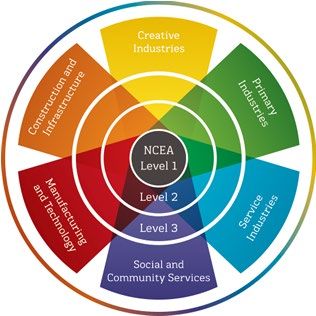
The Vocational Pathways are a tool that provides a clear framework for
vocational options. There are six pathways which represent ways to
structure and achieve NCEA Level 2. The pathways will help students to
develop their education plan, so they are better informed and able to
make better choices to meet their goals.
There are a range of tools, including a Profile Builder at:
www.youthguarantee.net.nz/start-your-journey
NCEA Employment Focused Subjects
• Within the NCEA pathway there are a number of subjects that have been *shaded.
• These courses are largely made up of internally assessed Unit Standards. They may include some
achievement standards.
• They are generally open entry i.e. they may be picked up without prior learning (with permission).
• These subjects are NOT intended to prepare students for University or other degree study and are NOT
(or do not lead to) approved subjects for University Entrance.
• A course including 2 or more of these shaded subjects is suited to Year 12 and 13 students who do
NOT intend to go to University, or study at degree level, when they leave school.
• Students work towards achieving their NCEA Level 2 and Level 3 Certificates.
• These subjects combine to form a vocational pathway with practical learning. They help prepare
students for entry into certificate and diploma level courses, apprenticeships and employment.
Subject Year 11 Level 2 Level 3
*Construction
*Early Childhood Studies
*Engineering (Mechanical)
*Financial Literacy
*Hospitality
*Outdoor Education
*Travel and Tourism
*Vocational Pathway Studies
*Police Studies
Gateway, STAR and Trades Academy Programmes
The Gateway programme offers structured workplace learning opportunities to selected senior students. It
is designed to strengthen the pathway from school to work or further study by providing students with first-
hand experience of potential career pathways. Students complete a work placement and have their learning
assessed to gain Unit Standards (approximately 20 credits).
Twenty-seven students each year are placed with various local employers for one day a week over a six to
ten-week period. In 2020 these included: Buckland Beach Kindergarten, The Learning Ladder, Kinetic
Electrical, Robson Builders, Auckland Plumbing Group and Modus Construction.
The STAR programme offered by the Careers Department is for selected students who go out of school to
STAR courses run by tertiary providers. Courses are always related to a career area of interest to the student
and may offer Unit Standards. They may be one day Taster Courses or Full Courses run one day a week for
several weeks. In 2020 courses included programmes in: Travel & Tourism, Workplace First Aid, Broadcasting
and Journalism and Safety in Action.
Trades Academy is a Level 2 tertiary partnership with MIT. As part of the Level 2 Vocational Pathway Studies
class students choose a course at MIT which they attend one day a week for the full year. Some courses
offered are: Building and Electrical, Building, Engineering Cad, Business Administration, Hospitality and
Automotive Engineering. Courses are made up of approximately 30 NCEA Level 2 credits.
JON/Senior Course Guide 2021 Page 19You can also read


