Sentiment Analysis of Customer Reviews on Laptop Products for Flipkart
←
→
Page content transcription
If your browser does not render page correctly, please read the page content below
International Research Journal of Engineering and Technology (IRJET)                                         e-ISSN: 2395-0056
         Volume: 05 Issue: 03 | Mar-2018                      www.irjet.net                                           p-ISSN: 2395-0072

      Sentiment Analysis of Customer Reviews on Laptop Products for
                                 Flipkart
                              Janhavi N L1, Santhosh Kumar K L2, Jharna Majumdar3
          1M.Tech     Student, Dept. of M.Tech Computer Science & Engineering, NMIT, Bangalore, Karnataka
        2Assistant    Professor, Dept. of M.Tech Computer Science & Engineering, NMIT, Bangalore, Karnataka
   3Dean R&D, Professor & Head, Dept. of M.Tech Computer Science & Engineering, NMIT, Bangalore, Karnataka

---------------------------------------------------------------------***---------------------------------------------------------------------
Abstract - E-commerce is rising rapidly now a days,                      positive, negative or neutral. Opinion mining comes under
purchasing items on online has grown to be more and more                 web content mining.
fashionable outstanding of more options like lower in price,
better supply system, therefore buyers plan to do Online                          In this work, we are extracting Laptop product
shopping. User’s comments are useful information to estimate             reviews from Flipkart online shopping website, extracted
product quality. This paper has a tendency to analyze the                data is store in CSV file. Clustering done on extracted data
fundamentals of opinion mining. It consist different                     that is pre-processed laptop products Reviews (CSV) file.
approaches including Extraction, Clustering and Classification.          Using classification technique, the reviews are classified as
Extracting reviews from the website using flipkart product               positive and negative and performance measured.
API, using product API we can easily fetch the brand name,
reviews, rating and other related things for product, clustering         2. Literature Survey
using ROCK and using CART algorithm to classify reviews as
positive and negative words from the comments and finally                        The ongoing research work related to the Opinion
they come to know which product having more percentage of                mining and Sentiment Analysis is given in this section. In [1],
positive reviews.                                                        focuses tools and techniques used in opinion mining. The
                                                                         process of opinion summarization has three main steps, such
Key Words: Product API, Data Mining techniques,                          as “Opinion Retrieval, Opinion Classification and Opinion
Machine Learning algorithm, ROCK, CART.                                  Summarization.” User comments are retrieved from review
                                                                         websites. These comments contain subjective information
1. INTRODUCTION                                                          and they are classified as positive or negative review.
                                                                         Depending upon the frequency of occurrences of features
         Online shopping is a way of buying products and                 opinion summary is created.
services from the vendors over the internet by different
browsers and apps. User can search their wishing product in                       In [2], focuses on review mining and sentiment
a different websites by looking around the different webpage             analysis on Amazon website. Users of the online shopping
of e-commerce of various vendors of same product, its                    site Amazon are encouraged to post reviews of the products
availability and price. There will be difference in price,               that they purchase. Amazon employs a 1-to-5 scale for all
specification of product and availability in different vendors.          products, regardless of their category, and it becomes
Users consider reviews of other buyers while buying also                 challenging to determine the advantages and disadvantages
concentrate on few recommendations and interact with                     to different parts of a product. In [3], focuses only on the
different search engines.                                                reviews taken from Amazon website analyze the results
                                                                         using three different algorithms such as Naïve Bayes,
          “The process of finding user opinion about the                 Logistic Regression and SentiWordNet.
topic or product or problem is called as opinion mining.” Or
“It can also be defined as the process of automatic extraction                   In [4], Decision Making and Analysis on Customer
of knowledge by means of opinions expressed by the user                  Reviews using Sentiment Analysis Dictionary (DMA) Tools
who is currently using the product is called as opinion                  developed for both customer and manufacturer or seller to
mining.” The motivation of opinion mining is toward build                check whether the selected product is a good or bad and
system to identify and convey sentiments in reviews.                     same has been tested on the Humanoid robot for the Human-
                                                                         Robot Interaction.
          Sentiment analysis is valuable in several ways. It
helps vendors measure the occurrence of fresh product                             In [5], focuses on analyzing reviews from different
initiate, verify the range of a products or services is on               E-Shopping Websites. The main focus of the system is to
demanding and identify the statistics of like or dislike                 analyze reviews for online shopping services. The reviews
particular product features. Sentiment analysis is a way of              are classified according to positive, negative and neutral.
finding users opinion about exacting matter or a problem or              These results help to select particular site for e-shopping,
product and aim is to determine expressed reviews are                    based on maximum number of positive reviews and rating.
                                                                         Firstly collect the E-shopping websites dataset which
© 2018, IRJET        |   Impact Factor value: 6.171           |    ISO 9001:2008 Certified Journal             |     Page 629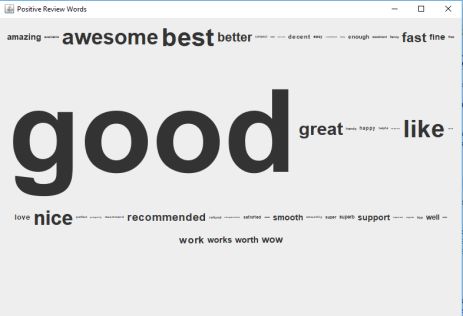
International Research Journal of Engineering and Technology (IRJET)                                   e-ISSN: 2395-0056
        Volume: 05 Issue: 03 | Mar-2018                 www.irjet.net                                          p-ISSN: 2395-0072

contains review related to the services of particular                points, clusters are requires sampled points; those points are
websites. Then apply some preprocessing methods on                   utilized to allocate left over data points on database to
datasets for removing undesirable things and arranging data          proper clusters.
in proper manner. After that we use POS tagger for assigning
tags to each word according to its role. It uses “sentiwordnet                In [9], survey concentrates on decision tree
dictionary” for finding score of each words. Then sentiments         algorithm techniques for classification in data mining. The
are classified as positive, negative and neutral. The analysis       most popular classification technique is decision tree
of the services according to positive and negative reviews           methods. The basic learning strategy divide and conquer
can be shown in the graphical format.                                technique is used in decision tree. A decision trees are
                                                                     similar to tree structure, every implicit node represents
         In [6], focuses on Sentimental Analysis of Flipkart         attribute, every branch represents an output of the test, and
reviews using algorithms Naïve Bayes and Decision Tree.              class label is represented by each leaf node. Algorithms of
Using users reviews about product and review about                   different types of trees are ID3, C4.5 and CART. [10]
retailers from Flipkart as dataset and classifies review by
subjectivity/objectivity and negative/positive opinion of            ID3 (Iterative Dichotomiser 3) Algorithm: ID3 algorithm
buyer. Such reviews are helpful to some extent, promising            is to build the decision tree by utilizing a top-down, greedy
both the shoppers and products makers. It presents an                search via the known sets to test data every attribute tree
empirical study of efficacy of classifying product review by         node. This method uses information gain to regulate
semantic meaning. Classifying comments employs hybrid                reasonable belongings for every node of decision tree.
algorithm combining Decision Trees and Naïve Bayes
algorithm.                                                           C4.5 Algorithm: C4.5 is used for classification technique and
                                                                     also C4.5 is referring as statistical classifier and this
         The procedure of Web mining has 4 stages, those             algorithm uses information gain. Categorical or numerical
are: Data collection, Data preprocessing, Pattern discovery,         values both are accepted in this algorithm. In order to hold
Pattern analysis as shown in the figure 1.                           continues data values is produced by threshold and after
                                                                     that divide attributes based on threshold value and these
                                                                     values can lower or equivalent to the threshold value.
                                                                     Handling missing values is easy by C4.5 algorithm, and lost
                                                                     attributes are not used in information gain.

                                                                     CART Algorithm: CART acronym is Classification And
                                                                     Regression Trees. CART was invented in 1984 by Breiman. In
                                                                     CART algorithm there are two things classification and
                                                                     regression. Classification is for binary splitting of the
                                                                     attributes and it also uses Gini index for splitting calculate in
                                                                     choosing the splitting attribute. Regression is to predict a
                                                                     reliant variable known as group of variables among certain
                                                                     amount of given time. CART algorithm uses continuous and
                                                                     nominal attribute value and has average speed of processing.
           Fig 1: Process of web data mining
                                                                     3. Methodology
        In [7], concentrate on Different Clustering
Algorithms and methodology on Amazon Reviews.                        The basic purpose of analyzing the review is to help buyer to
Customers of online shopping site like Amazon, showing               decide whether product is good or what. Usually if we want
thousands of customer comments earlier than purchasing               to buy anything online we will first go to the website and see
product may be a challenging assignment. Using                       how many people have recommended the product? How
unsupervised machine learning methods are used for                   many people have rated the product as 5*? What are the
analyze the preprocessed data from online shopping                   pros and cons of the product? Etc. Nowadays websites also
websites to supply consumers with enhanced customers                 provide compare options, which will allow the user to
knowledge earlier than buying product. K-means and Peak-             compare two or more products and take decision if the
searching clustering algorithms are to perform clustering of         buyer is in confusion. Current work uses data mining
product on Amazon reviews.                                           algorithm, such as ROCK for clustering and for classification
                                                                     CART algorithm along with various mechanisms.
        In [8] “ROCK: A Robust Clustering Algorithm for
Categorical Attributes”, ROCK clustering algorithm is a                      The need of this application is to show an analysis of
hierarchical clustering technique and it relates to group of         customer opinions on decision making. It will help the
agglomerative hierarchical clustering algorithms. Rock               customer to decide whether the product is good or bad and
algorithm randomly takes sample dataset retrieved by                 which product is best and customer to choose among variety
database. Hierarchical clustering technique uses links to the        of product by seeing reviews of the products. Detailed work
© 2018, IRJET      |    Impact Factor value: 6.171       |       ISO 9001:2008 Certified Journal         |    Page 630
International Research Journal of Engineering and Technology (IRJET) e-ISSN: 2395-0056
Volume: 05 Issue: 03 | Mar-2018 www.irjet.net p-ISSN: 2395-0072
flow diagram of proposed system is shown in figure 2. The 3.1 Extraction
system architecture of proposed method is shown in figure
3. Input: flipkart product API.
An API product is a collection resource in order to
provide a specific level of access and functionality for client
application developers using Json and Jsoup. In order to
fetch the laptop product details like brand name, link, rating,
stars and other details of product.
Output: Fetched reviews from website are stored in CSV file.
3.2 Clustering
On the extracted data ROCK algorithm is applied. ROCK
algorithm along with the steps carried out in performing it is
as below:
3.2.1 ROCK
Clustering technique can be used for the information
among Boolean and categorical attributes. Clustering is a
method of collecting data points; these data points are in a
cluster or group having same characteristics and while data
points in separate clusters are different. For instance,
assume the database of market basket consist one
transaction per consumer, every transaction consist a group
of product consumer purchased.
Fig. 2: Flowchart of the proposed system
ROCK clustering technique used link for data
concerning links among two points and while making
decision on those points to be combined into one cluster.
For example, link (i,j) can be the listing familiar
neighbors among i and j. From the meaning of links, it follow
that if link (i,j) is greater, then it is further probable that i
and j feel right to the similar cluster.
This approach deals with overall difficulty of
clustering. It catches the world wide facts of surrounding
data points into connection among pair of points.
Consequently, ROCK algorithm uses the data concerning
links among points focuses when decision creation on those
points to be combined into one cluster, it is exceptionally
robust.
ROCK algorithm is divided into three general parts:
1. Obtaining a random sample of the data.
2. Performing clustering on the data with the link
agglomerative method. A goodness measure is use to
establish which pair off of points is combined at every
step.
3. Using clusters the left data on disk are assigned to them.
Fig. 3: System Architecture of the Proposed Method
© 2018, IRJET | Impact Factor value: 6.171 | ISO 9001:2008 Certified Journal | Page 631International Research Journal of Engineering and Technology (IRJET) e-ISSN: 2395-0056
Volume: 05 Issue: 03 | Mar-2018 www.irjet.net p-ISSN: 2395-0072
ROCK Algorithm Steps Insert_(Qi,Wi,q[Wi])
1. ROCK Algorithm takes input as dataset DS of num data Deallocate(q[ui])
points could be clustered, along with the group of
preferred clusters cl. Input: extracted data that is pre-processed laptop products
Reviews file (CSV file).
Rock_clus_alg(DS,cl)
Output: Each Cluster data stored in the different CSV/Excel
2. Algorithm process starts with performing links among formats.
pair of points.
3.3 Classification
li = compute_link(DS)
Classification is a data mining technique that assigns dataset
3. Initially every data point is individual cluster. in a group to object categories or classes.
4. Every separate cluster i, construct local_heap c[i]. c[i] Classification and Regression Tree (CART) is a type
having each cluster like li[pi,pj] is non zero value and j of the decision tree algorithms. CART algorithm is used for
cluster with c[i] arranged in decreasing manner. building both Classification and Regression Decision Trees,
CART classification algorithm is applied for classifying the
for i to DS c[i]=build_lheap(li,i)
reviews either positive or negative words with the help of
5. Including local_heaps c[i] for every cluster i, and also dictionary words. The impurity (or purity) measure used in
maintain another global heap Qi having all cluster. building decision tree in CART is Gini Index.
Qi= build_lheap (DS, c) Classification Tree
6. Later on, clusters in Qi are sorted g1(j1,max(q[j1])) for Classification tree is used, when decision or target variable is
arranging clusters j1 in Qi, when emax(q[j1]), the categorical. Example: Predicting the food choices of the
maximum element in q[j1], is the finest cluster to customers (nominal variable) using set of independent
combine with cluster j1. variable.
while Size(Qi)>cl Regression Tree
ui=emax(q[j1]) Regression decision tree is used, when the decision or target
variable is continuous variable. Example: Predicting house
vi= max(q[ui]) prices using attributes of houses such as size, type and
others. These variables can be continuous and categorical.
7. Every iteration in loop, maximum cluster j1 within Qi
and the maximum clusters q[j1] are the good pair of
Generally in recursive partitioning approach and
cluster could be combined and find the best cluster to
CART, split each of the input nodes into two child nodes, in
merge.
other term CART is a Binary Decision Tree
Wi=mergec(ui,vi)
CART Algorithm Steps
8. Clusters ui and vi clusters combined; data in ui and vi are
removed if it is not necessary from Qi and Clusters ui This involves few simple steps as follows:
and vi are combined to generate a cluster Wi having
ui+vi point. Update Qi in every x. 1. Input dataset: Target Variable and a list of Independent
Variables
for x to q[ui] & q[vi] li[x,Wi]=li[x,ui]+li[x,vi]
2. Best Split: Find Best Split for each of the independent
9. Evaluate one time clusters ui and vi are combined, variables
primary if for each clusters to having ui or vi is in
local_heap, ui and vi to be changing by means of the 3. Best Variable: Select the Best Variable for the split
latest combined cluster w and the local_heap wants to be
restructured and a local heap w get generated. List of 4. Split the input data into Left and Right Nodes
links among clusters x and w is addition number of links
5. Continue step 2-4 on each of the nodes until meet
among x & u and x & v.
stopping criteria
Insert_c(q[x],Wi,gi(x,w))
6. Decision Tree Pruning : Steps to prune Decision Tree
Update_c(Qi,x,q[x]) built
© 2018, IRJET | Impact Factor value: 6.171 | ISO 9001:2008 Certified Journal | Page 632International Research Journal of Engineering and Technology (IRJET) e-ISSN: 2395-0056
Volume: 05 Issue: 03 | Mar-2018 www.irjet.net p-ISSN: 2395-0072
4. Experimental Results
Online connection is established to the webpage of
flipkart.com for laptop details using flipkart product API
using Json.
The Laptop details are fetched using product API.
The class name of element is specified to get the required
Laptop details. The extracted data of laptop details is stored
in CSV file format. It contains six attributes such as Star
Rating, Reviews, Brand, Link and Review Text. ROCK
algorithm is applied on the extracted CSV files. It forms five Fig 5: Word Cloud display of positive words
clusters based on the algorithm. Each cluster stores in
separate CSV files. The graphical representation of clusters is
shown in figure 4:
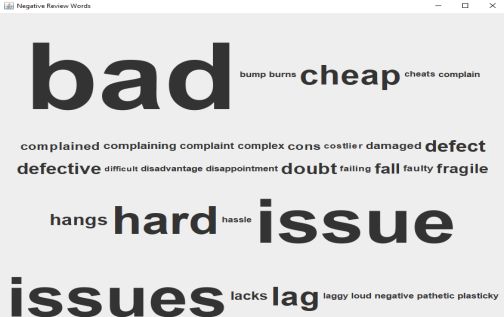
Fig 6: Word Cloud display of negative words
CONCLUSION AND FUTURE WORK:
In this paper, the Classification and Analysis of
laptop product reviews for the flipkart website is achieved
Fig 4: Visualization of Clusters by using ROCK and CART algorithms. The Laptop details are
extracted by using flipkart product API. This work classifies
In laptop dataset there are 59 instances, the positive and negative words from reviews and it calculates
instances are clustered into five clusters. The table 1, shows percentage of positive and negative words. Therefore the
the number of instances and its result in percentage in each result analysis of review percentage it helps the user to
cluster. conclude based on the positive review percentage of the
product. Future work can be concentrated on mining of
Clusters 1 2 3 4 5 reviews from multiple website and multiple products etc.
Instances 29 21 1 4 4 The same work can be extended to incorporate many more
classification algorithms which will help us to decide or to
Table 1: Result of Clusters choose the best classifier for opinion mining and sentiment
analysis.
On the clustered data CART algorithm is applied, it
compares the dictionary words with the dataset of clustered ACKNOWLEDGEMENT:
data and then classifies the review text into their positive
and negative words. Table 2 shows the result in positive Our sincere thanks go to the Vision Group on
opinion percentage of nine different brands. Science and Technology (VGST), Karnataka to acknowledge
our research and provide us the financial support to carry
Laptop out the research at NMIT. Finally, our sincere gratitude goes
1 2 3 4 5 6 7 8 9
Brands to Prof. N R Shetty, Director NMIT and Dr. H C Nagaraj,
Instances 90 67 77 60 90 93 100 60 85 Principal NMIT for providing the infrastructure support and
whole-hearted encouragement to carry out the research at
Table 2: Result of positive percentage of laptop brands NMIT.
Word Cloud class shows the prominence of the REFERENCES
individually classified word by highlighting words in diverse
font styles. Figure 5 and 6 shows the word cloud for positive [1] G.Angulakshmi, R.ManickaChezian, “An Analysis on
and negative words respectively. Opinion Mining: Techniques and Tools.” International
© 2018, IRJET | Impact Factor value: 6.171 | ISO 9001:2008 Certified Journal | Page 633International Research Journal of Engineering and Technology (IRJET) e-ISSN: 2395-0056
Volume: 05 Issue: 03 | Mar-2018 www.irjet.net p-ISSN: 2395-0072
Journal of Advanced Research in Computer and
Communication Engineering, Vol. 3, Issue 7, July 2014
[2] Callen Rain, “Sentiment Analysis in Amazon Reviews
Using Probabilistic Machine Learning”, Swarthmore
College Compter Society, November 2013
[3] Santhosh Kumar K L, Jayanti Desai, Jharna Majumdar
“Opinion Mining and Sentiment Analysis on Online
Customer Review”, 2016 IEEE International Conference
on Computational Intelligence and Computing Research
at Agni College of Technology, Chennai during December
15th to 17th 2016
[4] Gurunath H Naragund, Santhosh Kumar K L, Jharna
Majumdar “Development of Decision Making and
Analysis on Customer Reviews using Sentiment
Dictionary for Human-Robot Interaction”, International
Journal of Advanced Research in Computer and
Communication Engineering (IJARCCE), Volume 4, Issue
8, August 2015
[5] U Ravi Babu, Narsimha Reddy, “Sentiment Analysis of
Reviews for E-Shopping Websites”, International Journal
of Engineering And Computer Science, ISSN: 2319-7242
Volume 6 Issue 1 January. 2017
[6] Gurneet Kaur, Abhinash Singla, “Sentimental Analysis of
Flipkart reviews using NaïveBayes and Decision Tree
algorithm”, International Journal of Advanced
Researching Computer Engineering & Technology
(IJARCET) Volume5, January 2016
[7] Chantal Fry, Sukanya Manna, “Can we Group Similar
Amazon Reviews: A Case Study with Different Clustering
Algorithms”, IEEE Tenth International Conference on
Semantic Computing 2016
[8] Sudipto Guha, Rajeev Rastogi, Kyuseok Shim, “ROCK: A
Robust Clustering Algorithm for Categorical Attributes”,
International Journal of Science, Engineering and
Technology Research (IJSETR), 2015
[9] Delveen Luqman Abd AL-Nabi, Shereen Shukri Ahmed,
“Survey on Classification Algorithms for Data
Mining:(Comparison and Evaluation)”, Computer
Engineering and Intelligent Systems(IISTE) Vol.4 , 2013
[10] Himani Sharma, Sunil Kumar, “A Survey on Decision
Tree Algorithms of Classification in Data Mining”,
International Journal of Science and Research (IJSR)
2015
© 2018, IRJET | Impact Factor value: 6.171 | ISO 9001:2008 Certified Journal | Page 634You can also read


