SETTING THE PACE EXPANDING OPPORTUNITY FOR AMERICA'S STUDENTS UNDER RACE TO THE TOP
←
→
Page content transcription
If your browser does not render page correctly, please read the page content below
a

SETTING THE PACE
EXPANDING OPPORTUNITY FOR
 AMERICA’S STUDENTS UNDER
     RACE TO THE TOP

        March 2014
Setting the Pace: Expanding Opportunity for America’s Students under Race to the Top   1

Setting the Pace: Expanding Opportunity for America’s
Students under Race to the Top

 “The reason I’m here is to make sure that we are giving ... all our children
 the pathways they need to make the most of their abilities; to make the most
 of their opportunities; to make the most of their lives. I am absolutely con-
 fident that if I do my part, if [Secretary] Arne [Duncan] does his part, if
 our teachers do their part, if you do yours, if the American people do theirs,
 then we will not only strengthen our economy over the long run, and we will
 not only make America’s entire education system the envy of the world, but
 we will launch a Race to the Top that will prepare every child, everywhere in
 America, for the challenges of the 21st century.”
 						—President Barack Obama
 						 July 24, 2009

Promoting Innovation, Reform and Excellence in America’s Schools
    Five years ago, President Obama took office at a time when the American education
system was at a crossroads. While the No Child Left Behind law had forced some
important, hard conversations around issues like accountability and equity for all students,
highlighting achievement gaps, it also had unintended and unfortunate consequences.
Some of these consequences included creating incentives for states to lower standards,
mandating one-size-fits-all remedies, and putting standardized testing ahead of a well-
rounded curriculum.
     Starting with its signature education reform initiative – Race to the Top – the Obama
Administration set a new agenda that put state-level innovation at center stage. Race
to the Top served as an invitation for states’ best ideas on raising standards to prepare
all students for college and careers, investing in America’s teachers and school leaders,
turning around the lowest-performing schools, and using data to inform support for
educators and decision-making. With an investment of $4.35 billion – less than 1 percent
of total education spending in America – this relatively small component of the American
Recovery and Reinvestment Act of 2009 has unleashed enormous positive change,
empowering state and local leaders, educators, and communities to put their best ideas
into action.
2 Setting the Pace: Expanding Opportunity for America’s Students under Race to the Top
The Race to the Top program has proved that the best and most innovative ideas
do not come from Washington. After the program’s launch in 2009, dozens of leaders
in communities throughout the country answered the call to action and designed new
approaches that would better support educators to ensure that students graduate
ready for college and careers, enabling students to become productive citizens and
out-compete any worker, anywhere in the world. These plans also aimed to better
support disadvantaged students and those who have been traditionally underserved,
such as low-income and minority students, students with disabilities, and English
learners.
In 2010, 11 states and Washington, D.C. received funding
“We’ve become this vast under the Race to the Top program. An additional seven states
collaborative network, which received a total of $200 million in 2011 to put their plans
into motion. In states that won Race to the Top grants and in
has been amazing. We’re states that did not, state leaders and educators embraced the
celebrating each other’s challenge to bring forward their best ideas to improve education,
successes, and when we fail, we with determination, courage and vision.
pick each other up and provide Today, the reach of this comparatively small part of the
nation’s education budget is striking.
extensive support.”
Race to the Top grantees serve 22 million students and
— Christopher Bowen, middle- 1.5 million teachers in more than 40,000 schools. These states
school science teacher from Johnson represent 45 percent of all students and a similar percentage of
City, Tenn., on his relationships with all low-income students.
his fellow Core Coaches as they
Now – four years after the Obama administration announced
help their peers implement new, the first Race to the Top grants, awarded to Tennessee
higher standards and Delaware – many state and local leaders, educators,
and communities are deep in the hard work of education
improvement. And, amid this climate of reform, the nation is
seeing progress. At 80 percent, America’s high school graduation rate is the highest on
record. Student test scores on the National Assessment of Educational Progress (NAEP)
are the highest since the test was first given 20 years ago. There have been double-
digit gains on state tests at some of the lowest-performing schools – many of which had
not seen any improvement for decades. And some of the largest gains have come in the
places that have done the most to embrace reform, such as Tennessee and the District of
Columbia. In 2014, the signs of state-led progress are clear, as is the catalytic power of
Race to the Top in supporting states’ growth.Setting the Pace: Expanding Opportunity for America’s Students under Race to the Top 3
Race to the Top States and Award Amounts
(in millions)
NY: $697
PA: $41
OH:
IL: $43 $400
CO: $18 MA: $250
RI: $75
KY: $17 NJ: $38
AZ: $25 NC: $400 DE: $119
TN:$250
DC: $75
GA: MD: $250
$400
LA:
$17 FL: $700
HI: $75
Phase 1
Phase 2
Phase 3
Note: This graphic has been updated from a previous version. Updated on May 30, 2014.
State Strategies
Over the past four years, states have taken action to develop strategies that have
created more opportunities for America’s students. Race to the Top has unleashed these
leaders’ creativity and innovation to better support their educators, close achievement
gaps, and ensure all students are prepared to succeed in college and careers.
To take action on their ideas, state leaders began to design plans and create the
conditions for reform. As the Race to the Top competition got underway, many states
changed laws to increase their ability to intervene in their lowest-performing schools
or to improve teacher quality, including alternative certification and systems to support
educators and evaluate their effectiveness. To date, 46 states and Washington, D.C.
have chosen to adopt high college- and career-ready standards, and several states
have altered laws or policies to create or expand the number of charter schools. In the
end, not all of these states received grants, but the opportunity to compete helped spur
much of this change.4 Setting the Pace: Expanding Opportunity for America’s Students under Race to the Top
The states that won Race to the Top grants continued to lay the groundwork in
the early years of the program, transitioning from predominantly compliance-driven
organizations into systems that invest in comprehensive supports and tools for their
school districts and educators. Now, states and school districts are collaborating in new
ways, using data to make informed decisions and developing comprehensive systems to
provide feedback and support to teachers and principals. Teachers and school leaders
have more resources, like access to data dashboards that let them see a variety of
information, job-based coaching support and mentoring, professional development
to transition to new standards and assessments, and opportunities to collaborate with
their peers that did not exist before. Students have more access to rigorous learning
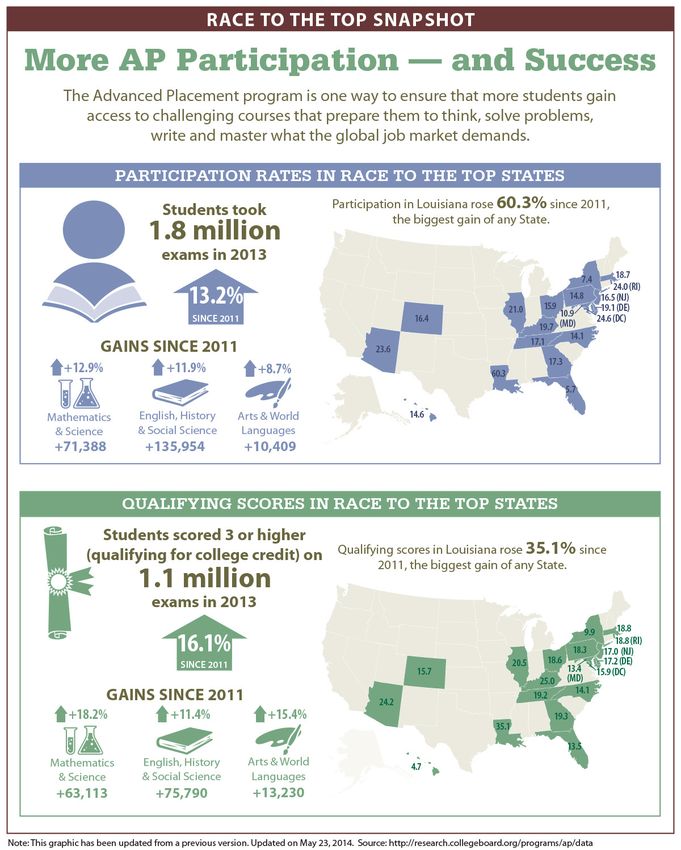
opportunities, college-level courses, Advanced Placement (AP) classes, and science,
technology, engineering and math (STEM) education, as well as more opportunities to
learn outside of school hours. States have created new systems of support for their
lowest-performing schools, targeting significant resources at their improvement, and have
created training and development programs to prepare school leaders for success in
turning these schools around.
Despite pockets of doubt and debate in state legislatures and at the national level,
state and district leaders have had the courage to put these ideas into action. They know
their children cannot wait. Teachers and principals have shown up day after day with the
same goal that every community shares: making sure each student is prepared to have a
successful future and has the opportunity to pursue the American dream.
Ohio Transforms Schools through Innovative
Redesign Options
At Winton Woods High School outside of Cincinnati, a junior named Aunay is
setting her mind to combatting the problem of child labor around the world for a school
project. Meanwhile, in Cleveland, Yasmine, who is a junior at Lincoln West High School,
is arguing on behalf of Sierra Leone, the African country her group chose to represent
in Model United Nations debates.
The opportunities these schools are providing Aunay, Yasmine, and other students
were set in motion by Ohio’s Race to the Top program. These schools have won grants
over the past two years, enabling them to adopt one of five innovative school redesign
models endorsed by the state. Models include early college high schools, which allow
students to earn college credits even as they attend high school, and technology-enabled
collaborative projects.
The redesigned schools are having a broader impact on the state because they’re
demonstrating what’s possible for students, said Pamela VanHorn, director of the Ohio
Network for Innovation and Improvement. Early progress at the schools that adopted the
models has created additional demand from other low-performing schools, and 118 now
operate one of the models with support from the state. Encouraged by the interest and
initial results, the Ohio legislature has allocated state funding to expand the program.Setting the Pace: Expanding Opportunity for America’s Students under Race to the Top 5
Race to the Top Has Focused Schools on College- and Career-Readiness
for All Students
Under Race to the Top, states spearheaded efforts to create plans tailored to their
students’ needs. Many states also collaborated with each other in new ways to create
more opportunities for students, including those who have been traditionally underserved,
to achieve their fullest potential. More students now have expanded access to rigorous
coursework and the chance to develop stronger critical thinking skills as part of states’
efforts to adopt higher standards. States have worked with teachers and school leaders
to help prepare educators to meet these new, challenging demands; and while there is
still room to improve, there are encouraging signs that the hard work of educators and
students is paying off.
States also have designed plans to turn around some of their
lowest-performing schools using new ideas that engage students “Before [the Academy of
and transform school culture. In addition, states are providing
more access to courses that are designed to prepare students for Global Studies], I worked
life after high school, such as language immersion, career and more independently. Now I can
technical training opportunities, STEM courses, and AP classes.
communicate better with others.
For example, by the end of the 2012-2013 school year:
We have a family environment.
Hawaii launched a new College and Career Ready diploma We are all together, and we all
two years ahead of schedule to help more students be
prepared to pursue their education after high school. It also support each other.”
has started two new “High Tech High Schools” to support
state-of-the-art curriculum and learning in STEM education.
— Aunay, a junior enrolled in
the Academy of Global Studies at
Massachusetts provided more students with access to AP Winton Woods High School outside
classes by training more than 1,100 middle and early of Cincinnati
high school teachers to prepare their students for new,
high academic standards. Initial findings from the external
evaluation of Massachusetts’ college- and career-readiness initiatives indicate
patterns of increased AP course-taking, exam-taking, and exam performance. It also
has supported work in five school districts to provide extensive wraparound services
for students, such as after-school tutoring and additional learning opportunities, and
created STEM Early College High Schools in six school districts.
Tennessee awarded grants or provided Tennessee Academic Specialists to address
performance gaps at the 167 schools identified as Focus Schools based on significant
achievement gaps in school year 2011-2012. Based on 2012-2013 state assessment
results, the state made progress closing achievement gaps in these 167 schools.
Georgia created two non-traditional schools to accommodate high school students at
risk of dropping out.6 Setting the Pace: Expanding Opportunity for America’s Students under Race to the Top
Maryland developed and translated five STEM curriculum modules for use in
language programs statewide. Six districts participating in Maryland’s world
languages project began implementation of elementary school STEM-focused
programs to ensure students are proficient in STEM content and languages other than
English, including Chinese, Arabic, and Spanish.
Florida Provides STEM Opportunities to Rural Students
Phidell, a high school senior who lives in a thinly populated area of the Florida
Panhandle, had two adventures in the summer of 2012.
He spent four days alongside some of the nation’s top scientists as part of a
group analyzing nanomaterials, tiny particles with special characteristics. He also
attended a forum of engineers representing various industries, where he learned that
mechanical engineers have skills that can be useful in the field of animation, which
Phidell has been considering as a career.
Both opportunities came about because Phidell is one of hundreds of students
from rural communities in Florida who are STEM Scholars – part of a new state
initiative to expose more students to opportunities in STEM through Florida’s Race to
the Top grant.
In Florida, business leaders indicate that nearly nine out of 10 new jobs that
become available over the next decade will be in STEM fields. The need for an
increased emphasis on STEM is particularly acute in rural areas, where many schools
are not able to hire fulltime teachers in these fields. Students in the STEM Scholars
Program are paired with mentors and receive intensive hands-on experiences with
STEM professionals, rigorous courses, leadership training, and opportunities to
collaborate with other students.
More than 1,000 high school students have participated in the STEM Scholars
program since 2012. Enrollments are up 49 percent since 2009. In some rural
counties, students received industry certifications for the first time in 2013.
“Funds from Florida’s Race to the Top award have expedited efforts already
underway to better prepare students for college and careers,” said Brenda Crouch,
program manager for the FloridaLearns STEM Scholars Program. “It is a win for
Florida’s economic future.”Setting the Pace: Expanding Opportunity for America’s Students under Race to the Top 7
Race to the Top Has Supported Hard-working Educators in New Ways
Race to the Top has focused on providing better support and resources for America’s
most important leaders: teachers and principals. Under these grants, schools and districts
are making sure we have excellent principals leading our schools and skilled teachers
who inspire students. Through Race to the Top, grantees are developing new tools and
resources, by promoting rigorous plans to develop, support, and evaluate teachers and
principals, and by recognizing and rewarding their success. In addition, Race to the Top
states also have been creative and thoughtful in developing strategies for recruiting
and retaining great teachers and leaders who will ensure that states continue to make
progress.
Thanks to new systems and collaboration, states have rolled out a number of new
tools and opportunities for educators to use in their classrooms to create additional
learning opportunities and tailor instruction to their students’ unique needs. For example,
in the 2012-2013 school year:
Ohio expanded alternative certification pathways for teachers and principals;
developed 800 curriculum resources aligned to higher standards; and trained
24,000 teachers to use those resources.
Hawaii created and launched a STEM portal to provide resources and opportunities
for collaboration to educators statewide, and assigned STEM resource teachers to
serve as math and science mentors and provide training. It also has provided data
coaches to provide feedback to school leaders and teachers.
Florida is investing in programs to get the best and brightest educators to the
highest-needs areas. Programs from Florida Atlantic University and the University of
South Florida recruit and train high-performing teachers and assistant principals to
become assistant principals and principals. The goal is to prepare 160 new principals
and assistant principals for employment in partner school districts as effective
leaders. Through Race to the Top, the state also funds a school district that has joined
forces with higher education officials to recruit minority students to become teachers.
Rhode Island had more than 400 first-year and 40 second-year teachers engage
with the state’s new teacher induction program, which includes weekly coaching and
professional development.
Delaware launched the Delaware Talent Cooperative, which provides retention
awards – between $2,500 and $10,000 over two years – to highly effective
educators and leaders willing to work and stay in schools with the highest needs.
North Carolina created Home Base, a technology tool that will help educators
manage professional resources and data to improve instruction, reducing the burden
on school districts.8 Setting the Pace: Expanding Opportunity for America’s Students under Race to the Top
Setting the Pace: Expanding Opportunity for America’s Students under Race to the Top   9

New York offers a growing set of materials, resources, and videos at EngageNY.
org, which provides tools aligned to new, career- and college-ready standards
and is available to educators, principals, parents, and students across the country.
The site also includes parent and family resources to support their child’s learning.
For educators, the site includes training modules, webinars, and roadmaps for key
decisions about local teacher and leader evaluation systems.

      Tennessee Coaches 30,000 Educators to Support
               Transition to New Standards

    In an ambitious and comprehensive effort, Tennessee provided 30,000 teachers
with intensive summer training as part of its transition to the Common Core State
Standards—more rigorous academic standards in English language arts and
mathematics.
    The sessions were led by 700 teacher coaches, known as “Core Coaches,” who
were selected from 1,250 applicants based on their record of classroom success and a
round of interviews. Prior to leading the statewide training for their peers, the teacher-
coaches received two weeks of intensive training from the state and experts in the
standards.
    The sessions and coaching were made possible by Tennessee’s Race to the Top
grant as the state identified the need for a more hands-on training approach to
support educators in transitioning to the Common Core. The coaches have had
significant positive effects on how teachers taught and how much students learned,
according to a rigorous evaluation of the 2012 sessions by the State Department
of Education. The quality of their questions, the feedback they gave to students
and the instruction they gave in problem-solving techniques all improved, based on
observer ratings. Student test scores also rose more quickly in participants’ classrooms
compared to those of non-participants, the evaluation found.
     Though the summer sessions are over, many of the coaches are continuing to help
their districts and fellow teachers with the transition to the new standards.
10 Setting the Pace: Expanding Opportunity for America’s Students under Race to the Top
Continuing to Accelerate Progress for America’s Students
The United States is in the midst of historic education reform, with a focus on results
for all students. While there is a lot of work left to do, leading Race to the Top states
demonstrate what is possible with the perseverance of America’s educators and leaders.
Race to the Top was a catalyst for unleashing locally developed ideas and
empowering state leaders to set their plans into action. Race to the Top has sparked
dramatic changes in not only these grantees but in other states across the country –
including those that did not receive a Race to the Top grant.
The progress seen in this flagship grant program for states
“Every teacher, every principal, has helped to spark other Obama Administration initiatives – also
every superintendent cites under the Race to the Top banner – which have sought to bring
forth America’s best ideas for improvement and transformation
the professional learning in education. These include: Race to the Top Assessment, which
communities as a core reason supports state consortia to design assessments aligned to new,
higher standards; Race to the Top-Early Learning Challenge,
they have seen gains over the which promotes system-building around early learning
past three years.” opportunities; and Race to the Top-District, which supports local
ideas about how to tailor learning to the needs of individual
– Christopher Ruszkowski, chief students.
officer of the Delaware Department
All of these programs empower leaders outside of the
of Education’s Teacher and Leader
federal government to take action to improve education in ways
Effectiveness Unit that make sense for their students. And the success of the Race
to the Top family of programs so far has led to the Obama
administration’s fiscal year 2015 budget request for $300 million for Race to the Top-
Equity and Opportunity. This proposed program would support states and districts in
identifying and closing educational opportunity and achievement gaps and ensure that
all students – particularly those with the highest needs – graduate from high school
ready for college and careers.
Supporting States to Improve Assessment
In 2010, the Obama administration invested $350 million under Race to the
Top to support two consortia of states that are developing a series of new, next-
generation assessments aligned to college- and career-ready standards. These
will serve as an important tool to move away from poor quality, fill-in-the-bubble
assessments and avoid one-size-fits-all approaches. And in spring 2014, many
states and school districts will try out these new assessments, which will better capture
what our students know and what they’re able to do.Setting the Pace: Expanding Opportunity for America’s Students under Race to the Top 11
State and local leaders will always know best what their students need and how
to equip school principals, teachers and staff. These leaders have continued to show
encouraging progress and inspiring determination to continuing this work – for years
after the money will run out. Under Race to the Top, states have established a foundation
for long-term success. While there have been – and will continue to be – bumps in the
road, these states have shown a commitment to doing what’s best for their kids and have
stayed the course.
To support their work, for the first time, the U.S. Department of Education created
a team that was charged with better partnering with states. Called the Implementation
and Support Unit (ISU), this team works with state officials by providing support and
feedback in a whole new way, recognizing the burdens that many states often face from
the federal government, and the support states need in implementing these bold, new,
and difficult reforms. The Department has also provided increased opportunities for
collaboration among states, which is helpful for problem-solving similar challenges and
learning from what other states have tried.
A recent report by the U.S. Government Accountability Office, an independent,
nonpartisan agency that works for Congress, found that, overall, most states are
happy with the new process the Department has been using and believe it is helpful
in supporting their efforts. And in March 2014, the Thomas B. Fordham Institute noted
that the credit for much of the progress under Race to the Top so far is thanks to this
collaboration between the Department and state leadership.
The achievements that states have made under Race to the Top will provide benefits
for years to come. Below are a few examples of the work underway for the remaining
period of their grants:
Ohio will implement a performance-based funding policy to hold teacher
preparation programs accountable for graduate success.
Tennessee is scaling up its Achievement School District, which supports the state’s
lowest-performing schools, and plans to include 35 schools by 2015.
The District of Columbia will launch the STEM Learning Network, which will provide
tools to help educators to provide quality STEM learning experiences.
Encouraged and supported by Race to the Top, states are taking major steps forward
for our nation’s students. There will never be a moment to declare victory in this race –
the work will continue for many years to come. But America’s educators remain committed
to support all our children on their path to a prosperous future. State and local leaders
share that commitment. Staying on course is critical while this hard work is underway.You can also read


