SHARING ECONOMY INDEX - LATIN AMERICA 2021 - Written by: Maria Chaplia, Anna Arunashvili and Julio Clavijo - Consumer Choice Center
←
→
Page content transcription
If your browser does not render page correctly, please read the page content below

SHARING
                  ECONOMY
                    INDEX
                   LATIN AMERICA 2021

Written by: Maria Chaplia, Anna Arunashvili and Julio Clavijo
Executive Summary
LATAM Sharing Economy Index 2021 was created in
collaboration with Somos Innovacion in order to provide
consumers in Latin America and globally with concise and
relevant information about the availability and accessibility of
sharing economy Index services.

INTRODUCTION
When it comes to sharing economy, all eyes should be on Latin America. The region’s
digital lag, combined with generally low trust in government institutions and problems
inherent to developing economies, such as low wages, and corruption, make it especially
receptive to innovative solutions. Along with slowly generating its own tech startups
(e.g. Rappi, a Colombian delivery platform currently evolving into multiple services, or
Loggi, the Brazilian delivery service), Latin America has also been approaching the
regulation of the existing ones in a consumer-friendly way.

According to a 2019 study conducted by Americas Market Intelligence (AMI), 56
percent of millennials in Mexico prefer Airbnb apartments and homes over hotels.
In 2020, three Latin American cities – Guadalajara (Mexico), Cali, (Colombia), and
Ubatuba (Brazil) respectively – made it to Airbnb’s annual Top 20 destinations list.

Ridesharing apps such as Uber have also been making the most out of the opportunity
to expand their services and bring economic prosperity to Latin American consumers.
Having recognised that some groups of society don’t have credit cards and/or have
poor access to the internet, Uber has allowed the use of cash payments and developed
Uber Lite, a version of the app tailored to serve users in underdeveloped areas.

As a global consumer advocacy group, we at the Consumer Choice Center believe that
consumer choice is pivotal, and services that bring value to consumers – be it Uber,
AirBnB, ShareNow, or E-scooters – should be endorsed and encouraged. Inspired by
our first Sharing Economy Index and Latam Most Passenger-Friendly Airport Index,
we examined 44 Latin American cities to see which are the most sharing economy
friendly.

The LATAM Sharing Economy Index 2021 seeks to rank 44 biggest and most dynamic
cities in Latin America to provide a valuable guide for consumers on the sharing
economy services available to them. For most countries, the ranking includes the
capital and a second-largest city. However, due to the particularities of the economic
development and political systems of Argentina, Mexico, and Brazil and Costa Rica,
we also included more cities.

For this task in Latin America the Consumer Choice Center teamed up with two
regional networks:

Somos Innovación (SI) is a network formed by a group of individuals and institutions
from Mexico to Argentina and Chile who are convinced that innovative solutions are
the best way to inspire people to work together to solve complex problems, SI wants to
be the voice of a vibrant civil society that progresses through innovation, the adoption
of new technologies and human creativity.

                                                                                      3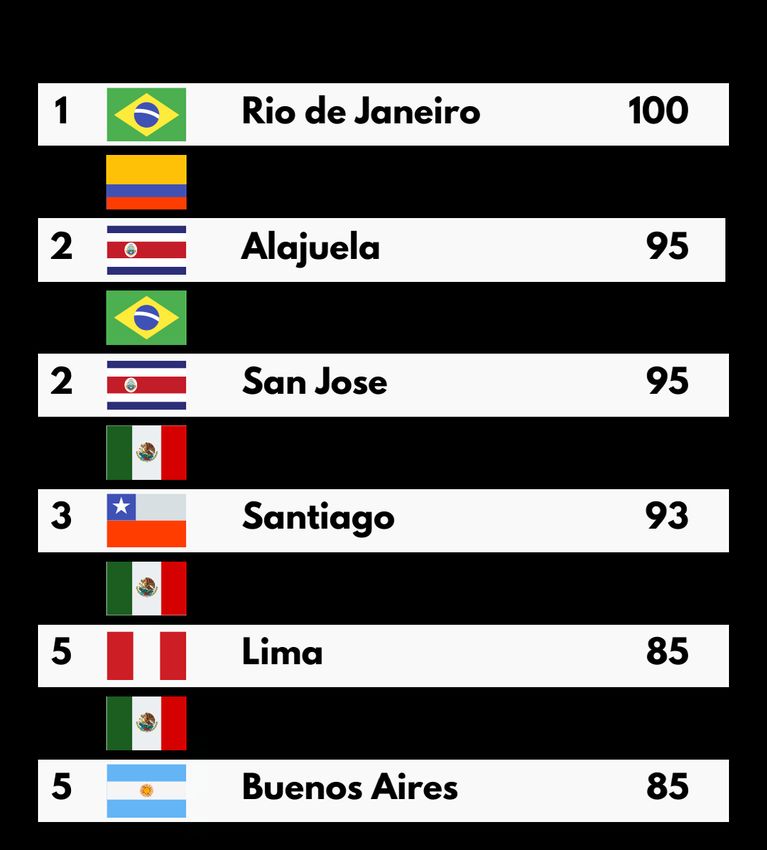
This SI claim was corroborated by the largest innovation survey in Latin America. So
much so that according to this poll of over 5,000 people in Argentina, Brazil, Chile,
Colombia and Mexico, public opinion is clear: people want more innovation in their
lives, whether it’s access to a more diverse range of goods and services, or creation
of interesting career opportunities and better paying jobs. In brief, Latin American
consumers enjoy the opportunities that innovation brings to their lives.

Latin American Liberal Network RELIAL is the most representative union of classical
liberal organizations in the region. The network consists of 43 organisations, including
think tanks, foundations, institutes and political parties, and has members in 17 Latin
American countries. Committed to the progress and development of their countries,
its members disseminate and implement liberal principles to improve the quality of life
of their citizens.

Incidentally, RELIAL joined the publication of this Index due to the historical relationship
with Fundación Internacional Bases, which is not only a proud member of RELIAL but
also a founder of the Somos Innovación network. The partnership is an outstanding
example of collaboration and synergy aimed at turning Latin America into a fertile land
for innovation and testing of new solutions.

For the purposes of this Index, we considered sharing economy services in Latin
America as legal, or allowed, unless they were explicitly banned through legislation.

Research Note: We strive to improve the quality of the underlying data of this index
year by year, and aim to refine its methodology moving forward. We sometimes faced
contradictory information and indicators provided by different online sources. We ask
the readers of this index to acknowledge the difficulties of working with heterogeneous
data and caution users of this index to be aware of the underlying data complications.
The time span of dates ranges between 2018 and 2021.

                                                                                          4
RANKING: but this trend breaks in many of the top 10
cities.
TOP CITIES For example, Puebla de Zaragoza – also
in the top 10 – checks all the boxes in
terms of ridesharing and flat-sharing, but
it ranks lower because E-scooters are
not allowed and there is a tax imposed on
flatsharing.
The economic benefits brought about
by the sharing economy in Brazil, and in
particular in Rio, have been astonishing.
In 2015, for example, host income and
guest spending in Rio generated an
economic activity of $160 million, helping
lift up communities that have not yet had
extensive economic growth.
Flatsharing has revolutionised the home
sharing market in Mexico as well. Three
Mexican cities – Mexico city, Puebla de
Rio de Janeiro (Brazil) leads the way as
Zaragoza, Puebla de Zaragoza, and
the most sharing economy friendly city in
Monterrey – topped this year’s CCC’s
Latin America. The city has demonstrated
Sharing Economy Index list. Between
an outstanding openness to all of the peer-
2015 and 2018, the number of Airbnb
to-peer economy services examined.
guests in Mexico travelling within the
Unlike some of its Latin American
country jumped up from 24 per cent to 61
neighbours, São Paulo does not impose
per cent. However, compared to Brazil,
taxes on online hosting nor does it require
Mexico is slightly more restrictive because
a permit system for those keen on renting
of its three per cent tax on online hosting.
on flat-sharing platforms, such as Airbnb.
On the ridesharing front, Mexican
Across Latin American cities, peer-to-
consumers, even those who don’t have
peer car sharing/car rental, professional
smartphones, have also been at the front
car sharing, gym sharing apps are scarce,
of the queue for economic benefits. In
5order to guarantee inclusion in Mexico,
Uber installed physical totems in malls and BENEFITS OF
stadiums where customers can request a
ride. THE INDEX FOR
In 2016, San Jose (Costa Rica) became
CONSUMERS?
home to the first Center for Excellence
The Sharing Economy Index provides a
created by Uber to incubate new products
valuable overview of many of the services
for the Latin American market. There are
that are greatly enjoyed by consumers.
only 12 such centres globally, and Uber’s
More is always better, and the availability
Center of Excellence in Costa Rica is the
of various sharing economy services
second largest. JUMP, a service of electric
ensures consumers are able to have
bikes and scooters that Uber launched
plenty of options wherever they go. Our
in Latin America, is one example of the
index gives you a glimpse into a diversity
products created there.
of ways your stay in a particular city can
be better.
In Chile, whose capital also made it to the
top of our list, approximately 11.6 percent
For instance, if you are considering a
of Chilean Internet users as of 2018
holiday in Puebla de Zaragoza and are
claimed that providing services through
a big fan of E-scooters, you might be
sharing economy platforms was their
disappointed to find out they’re banned.
main source of income.
In a similar fashion, our index shows
where you can earn extra income in
All 10 cities rank high on ride and flat-
Latin America by driving Uber, Cabify, or
sharing, which is great news for consumers
another service without having to obtain
in Latin America and beyond. However,
special permits. The Sharing Economy
in some of those cities, E-scooters are
Index is a one-of-its-kind compilation of
not allowed and there are no available
applications you can use to improve your
professional car sharing apps. It is clear
city experience.
that the sharing economy is booming in
Latin America and we should expect to
On the other hand, our index also deals
see more developments in the upcoming
with access to these platforms. If you are
years.
considering renting out your apartment via
Airbnb or VRBO, or you want to become a
rideshare driver in one of the 44 cities we
examined, the Sharing Economy Index
will come in handy as well. The same
applies to ride-hailing services, carpooling
and peer-to-peer car rentals.
It is important to stress that in terms
of accessibility, we only considered
In Puerto Limón, Salto, and San Miguelito
requirements set by apps. In Cordoba
which are among the least sharing
and Rosario, for example, there is a de
economy friendly cities in Latin America,
facto penalty for drivers engaging in
ride-sharing services and e-scooters
ridesharing services without licence.
aren’t available. In four out of five worst
However, ridesharing apps don’t require
cities, gym-sharing apps aren’t available.
any.
6CONCLUSION
Instead of picking losers and winners in the marketplace, governments should
create and sustain the conditions under which both traditional services and platform
businesses can compete on equal and fair terms. It should be up to the consumer to
decide which service to use.
Sharing economy services have been flourishing in some of Latin America’s most
dynamic cities, many of which have chosen innovation and consumer choice over
the paternalism favoured by their European counterparts. Inefficient public transport
and the government’s inherent inability to predict how innovation will evolve, along
with high levels of corruption and low wages are some of the reasons why the sharing
economy has managed to scale and deliver for consumers.
In order to provide consumers with a comprehensive overview of the sharing economy
services available in the region, we also looked at delivery apps (please see the
Appendix). As we found, these are available in all of the cities analysed. Some of the
most spread ones include Rappi, Glovo, Uber eats, and Pedidos ya. The pandemic
has contributed to the rising popularity of these apps, and the value they have created
cannot be underestimated. Even once things return to normality, there is every reason
to expect the innovation in this sector to expand.
Overall, it can be concluded that although there is room for improvement, the sharing
economy is flourishing in Latin America is flourishing. Platforms have shown great
flexibility and willingness to adapt to the particularities on the ground in order to provide
Latin American consumers with more choice.
7METHODOLOGY
Availability: The Index provides an overview of the sharing economy services available to
consumers in 44 cities.
Access: The Index examines the access to the sharing economy services on the supply side.
The maximum possible score for a city is 105.
Special permits for the services requirement have been evaluated only by the apps requirements, and not by government
regulatory mandates.
RIDE-HAILING SERVICES
A city receives a maximum of 25 points for being the most friendly to ride-hailing
services.
• Ride-hailing services availability: Ride-hailing service available: 10 points
• Access to the services: No special permit/license required by the app: 5
points
• Ride-hailing services taxation: No taxes on ride-sharing other than VAT or
income tax: 5 points
• A city can get an additional 5 points if carpooling apps are available.
FLATSHARING SERVICES:
A city receives a maximum of 25 points for being the most friendly to flatsharing
services.
• Flatsharing service availability: Flatsharing available: 10 points
• Flatsharing available all year long: 5 points
• Access to the service: No permit to share a flat/entire flat required by the
app: 5 points
• Flatsharing service taxation: No taxes on flatsharing other than rental
income tax or VAT: 5 points
E-SCOOTERS:
A city receives a maximum of 15 points for being one of the most E-scooter
friendly.
• E-scooters availability: E-scooter service available: 10 points
• Possibility of being used on sidewalks: 5 points
CARSHARING APPS:
A city receives a maximum of 30 points for being carsharing-friendly.
• A city recieves an additional 15 points if professional carsharing apps
are available.
• A city receives an additional 15 points if peer-to-peer carsharing among
private owners is available.
GYMSHARING:
A city receives an additional 10 points if gymsharing apps are available.
8ABOUT THE AUTHORS:
Maria Chaplia
Research Manager
Maria holds a degree in law and studied econometrics and political science at the London
School of Economics. Maria’s views have been featured in the Financial Times, The
Parliament Magazine, The Brussels Times, Huffington Post, CapX, Spiked, and many more.
International trade is one of Maria’s greatest passions, but she’s also particularly keen on the
sharing economy, feminism, and lifestyle economics.
In 2016, Maria co-organised a protest in Ukraine against taxpayer-funded stipends outside
the Ministry of Education and Ministry of Finance. She has also co-founded two Ukrainian
educational charities. She put together multiple large-scale events and was awarded the
European Students For Liberty Student of the Year Award.
Anna Arunashvili
Knowledge Management Associate
Anna holds a master’s degree in public policy and management from Corvinus University
of Budapest. She is passionate about spreading ideas of liberty and has been an active
member of Georgian Students for Liberty, where she successfully co-organised multiple
campaigns and events and co-hosted one of the biggest regional conferences.
She is an advocate for the sharing economy and believes shift from traditional models gives
consumers more choice and makes everyday life more affordable.
Julio Clavijo
Latin American Affairs Manager
Previously, Julio worked as a Senior Public Policy advisor in the national assembly of Ecuador
and also as an economic researcher at the think tank Fundacion Ecuador Libre where he
recently was appointed as a member of the advisory board. Julio is also highly experienced
in grassroots activism, political campaigns, and community development. He is a Founding
Curator for Global Shapers Guayaquil Hub an initiative of the World Economic Forum and
also the Co-Founder of Teach for Ecuador member of the Teach for All Network.
Julio is a Chevening Scholar and has a Master in Economics from the University of
Manchester, previously he completed his B.S in Economics at UEES University in Ecuador.
He has additional training in the London School of Economics for survey design and analysis;
Sciences Po Paris exchange program and was selected for the Georgetown University
Global Leadership Competitiveness Program McDonough School of Business.
9COMPLETE RANKING
RANKING CITY COUNTRY OVERALL SCORE
1 Rio de Janeiro Brazil 100
1 Bogotá Colombia 100
2 Alajuela Costa Rica 95
2 São Paulo Brazil 95
2 San José Costa Rica 95
2 Puebla de Zaragoza Mexico 95
3 Santiago Chile 93
4 Mexico city México 90
5 Lima Peru 85
5 Monterrey Mexico 85
5 Buenos Aires Argentina 85
6 Panamá city Panama 80
6 Guadalajara México 80
6 Santo Domingo Dominican Republic 80
6 Medellín Colombia 80
7 Quito Ecuador 75
7 Guayaquil Ecuador 75
7 Guatemala City Guatemala 75
8 Gran Valparaíso Chile 70
8 Santiago de Cali Colombia 70
8 Montevideo Uruguay 70
9 Asunción Paraguay 65
9 Ciudad del Este Paraguay 65
9 Arequipa Peru 65
9 San Salvador El Salvador 65
9 Soyapango El Salvador 65
9 Mixco Guatemala 65
9 Tegucigalpa Honduras 65
9 San Pedro Sula Honduras 65
9 Managua Nicaragua 65
9 León Nicaragua 65
9 Colón Panama 65
9 Santiago de los Caballeros Dominican Republic 65
9 Rosario Argentina 65
9 Mar del Plata Argentina 65
9 Córdoba Argentina 65
10 Puente Alto Chile 63
11 Barranquilla Colombia 60
11 Santa cruz Bolivia 60
11 Tijuana Mexico 60
12 La Paz Bolivia 50
12 Puerto Limón Costa Rica 50
13 Salto Uruguay 45
13 San Miguelito Panama 45
10APPENDIX
Availability of delivery services
In this appendix, you will find information on the availability of delivery services across
Latin America.
Delivery apps have gained rapid popularity in the Latin American market which shows
that there is massive demand for these services. The trend has also been enforced by
the pandemic. In order to provide a better overview of how these services operate in
LatAm, and what can be done to guarantee more consumer choice, we will examine
them in greater detail in future reports.
CITY COUNTRY AVAILABILITY OF DELIVERY SERVICES
Rio de Janeiro Brazil yes
Bogotá Colombia yes
Alajuela Costa Rica yes
São Paulo Brazil yes
San José Costa Rica yes
Puebla de Zaragoza Mexico yes
Santiago Chile yes
Mexico city México yes
Lima Peru yes
Monterrey Mexico yes
Buenos Aires Argentina yes
Panamá city Panama yes
Guadalajara México yes
Santo Domingo Dominican Republic yes
Medellín Colombia yes
Quito Ecuador yes
Guayaquil Ecuador yes
Guatemala City Guatemala yes
Gran Valparaíso Chile yes
Santiago de Cali Colombia yes
Montevideo Uruguay yes
Asunción Paraguay yes
Ciudad del Este Paraguay yes
Arequipa Peru yes
San Salvador El Salvador yes
Soyapango El Salvador yes
Mixco Guatemala yes
Tegucigalpa Honduras yes
San Pedro Sula Honduras yes
Managua Nicaragua yes
León Nicaragua yes
11APPENDIX CONTINUES
Availability of delivery services
CITY COUNTRY AVAILABILITY OF DELIVERY SERVICES
Colón Panama yes
Santiago de los Caballeros Dominican Republic yes
Puente Alto Chile yes
Barranquilla Colombia yes
Santa cruz Bolivia yes
Tijuana Mexico yes
Rosario Argentina yes
Mar del Plata Argentina yes
Córdoba Argentina yes
La Paz Bolivia yes
Puerto Limón Costa Rica yes
Salto Uruguay yes
San Miguelito Panama yes
12info@consumerchoicecenter.org
www.consumerchoicecenter.org
700 12th St N.W Suite 700 PMB 94982
Washington, DC 20005You can also read


