Slido - The Balanced System
←
→
Page content transcription
If your browser does not render page correctly, please read the page content below
Slido
   We are going to be using some interactive polls
   and quizzes so please be ready registering to
   vote!

   Download slido app on your phone
   Or go to https://www.sli.do
   Log into event with code #072672

   Or follow link
   https://app.sli.do/event/bowehvdy

© BETTER COMMUNICATION CIC, 2021
Housekeeping
   • Please can you ensure you have a name
     to help with sending to break out rooms!
   • Camera and mic off unless making a
     contribution
   • Questions in the chat please as we go
     along
   • Hands up if you want to contribute during
     the discussion slots

© BETTER COMMUNICATION CIC, 2021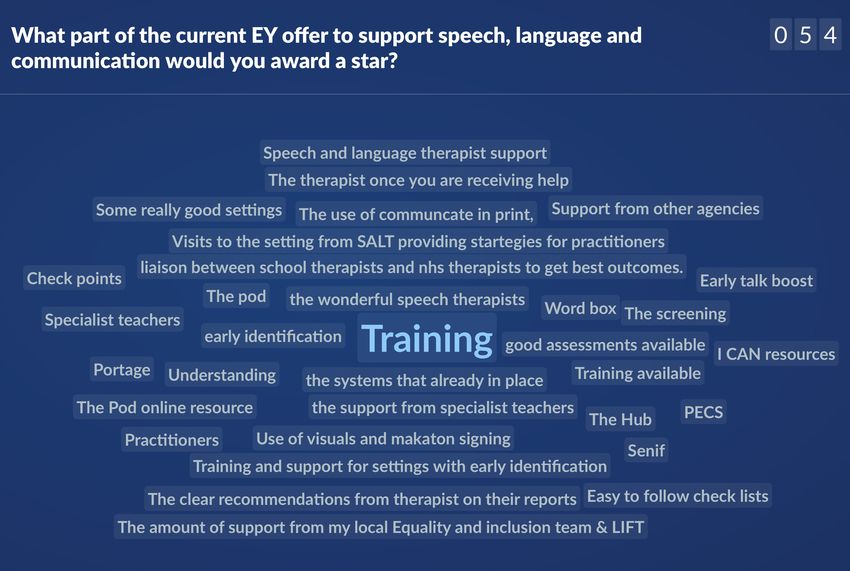
Supporting children and young
          people with speech, language
           and communication needs in
                       Kent
                                    Early Years
                                   13th July, 2021
© BETTER COMMUNICATION CIC, 2021
Slido trial poll

                                           How are you
                                           feeling today?

© BETTER COMMUNICATION CIC, 2021
Today
   • Interactive session
   • Overview of the SLCN workstream in
     response to the Kent Written Statement of
     Action (WSoA)
   • Brief introduction to the Balanced
     System®
   • Opportunity to think about supporting
     children in the Early Years as part of an
     integrated approach

© BETTER COMMUNICATION CIC, 2021
Slido
                                                    Element of the current EY
                                                    offer to support SLC that
                                                    you would award a ‘star’

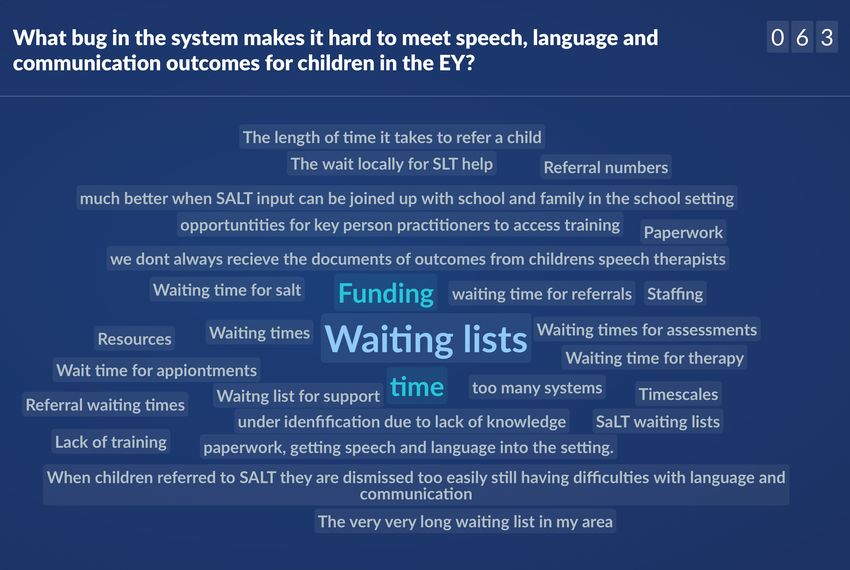
        ‘Bug’ in the system that makes
        it hard to meet speech,
        language and communication
        outcomes for children in the EY

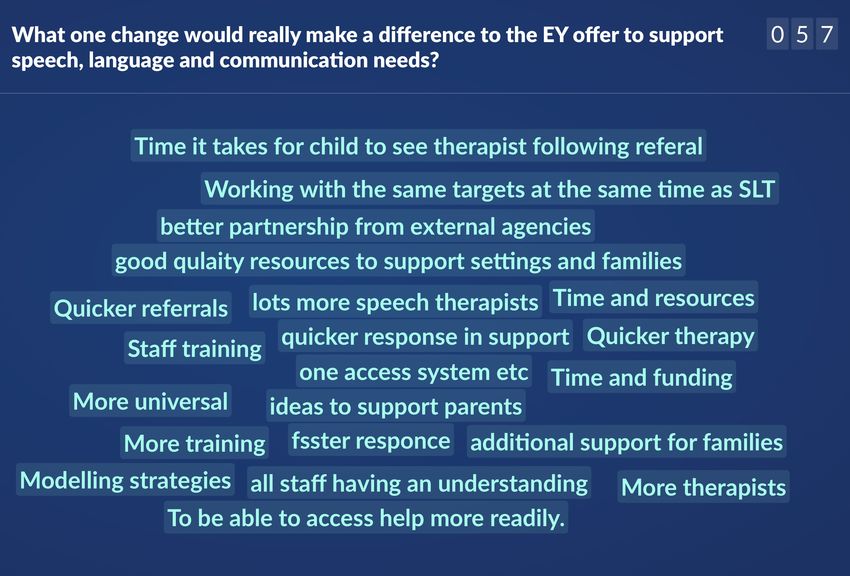
                                          Reach for the ‘moon’ – one
                                          change that would really make a
                                          difference to the EY offer to
                                          support speech, language and
                                          communication needs

© BETTER COMMUNICATION CIC, 2021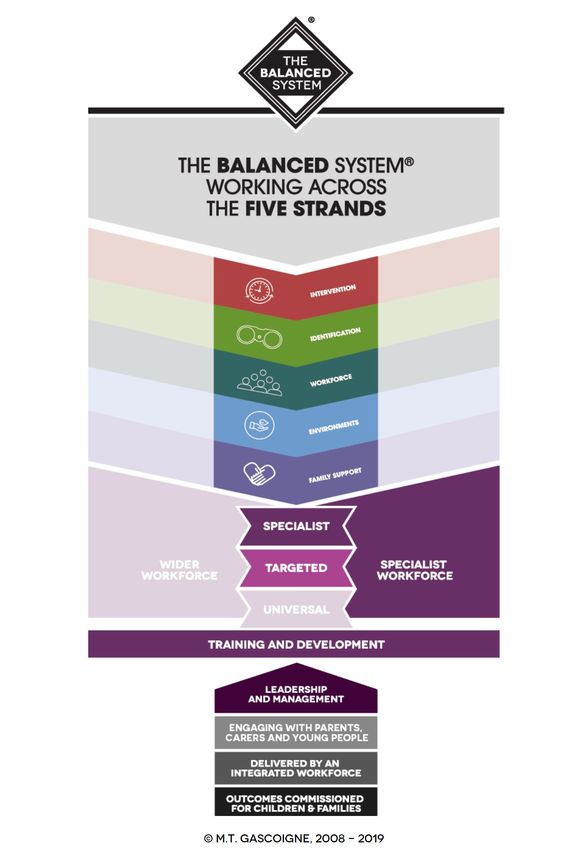
Journey so far….

      2014–2016                            2018–2019                             2020–2025
      Needs analysis and mapping           Joint specification across all        Current work across Kent
      of KCC commissioned SLT              CCGs and KCC developed in
                                           draft form

                                           Ofsted/CQC inspection

                         Extension to include needs of
                         whole CYP population and             Request for a five year plan for
                         contribution of NHS providers        transformation of provision for
                         First of 60 schools began the        CYP 0-25 with SLCN
                         Balanced System Scheme for           Delayed in implementation by
                         Schools & Settings                   COVID

                         2016–2017                            2019–2020

© Better Communication CIC, 2020
Programme of change – Vision for Kent
• A comprehensive understanding of speech, language and
  communication needs across Kent 0-25
• Joint commissioning specification for SLCN support across Kent
• A seamless universal, targeted & specialist offer for speech,
  language and communication (SLC) including those with SLCN that
  is informed by needs & tailored to deliver equity of outcome
  geographically
• Schools and settings that are confident in their role in developing
  SLC skills and supporting SLCN
• Families and young people that are confident in the SLC support
  available

© Better Communication CIC, 2021

Strands of work supported by
                              Better Communication CIC
1.     Needs analysis
     –      Refresh 0-18 work from 2016 – 2018
     –      Addition of new needs analysis focusing on 16-25
2. Implementation of Balanced System® service delivery model
    across Kent footprint including all SLT providers working with
    the wider system towards shared outcomes
3. Extension of Balanced System® Scheme for Schools &
    Settings offer working with additional 40 schools and settings
4. Train up to four local Licensed Mentors to embed the schools
   and settings’ support locally for long term systemic change -
   ideally two educators and two speech and language
   therapists

© Better Communication CIC, 2021
Timeline
   • Needs analyses
        – ongoing to July, 2021
   • Re-design and begin implementation with
     providers across the Kent system
        – May 2021 – Jan 2022
   • Support and impact measurement for
     implementation
        – Ongoing to August, 2025

© Better Communication CIC, 2019
Timeline
• Scheme for Schools & Settings
– School & setting recruitment – ongoing with a view to
preliminary workshops summer term and beginning
scheme in September, 2021
– Work towards accreditation September 21 – July 22
– Accredited status and building local community of
practice for SLCN ongoing to 2025
– License Mentor recruitment and training – ongoing
with a view to being in place as soon as possible but
no later than September, 2021
© Better Communication CIC, 2019Some common questions
• Defining universal, targeted and specialist offer?
• What might a Balanced System® delivery model
look like across Kent for Early Years?
• How does Balanced System® Scheme for
Schools and Settings fit in?
© BETTER COMMUNICATION CIC, 2021Anything else?
Pop any other
questions in the chat
and if we can we will
cover and if not reply
in a later session
© BETTER COMMUNICATION CIC, 2021Slido
• How much do you
know about the
Balanced System®
principles for
supporting children
and young people
with SLCN?
© BETTER COMMUNICATION CIC, 2021“Prove it!” “What?”
“So what?”
© M.T.Gascoigne, 2020Improvement Methodology © M.T.Gascoigne, 2020
© M.T.Gascoigne, 2020
© M.T.Gascoigne, 2020
THE BALANCED SYSTEM® HIGH LEVEL OUTCOMES FOR SPEECH,
 THE BALANCED SYSTEM® HIGH LEVEL OUTCOMES
                           LANGUAGE       FOR
                                      AND COMMUNICATION NEEDS
 SPEECH, LANGUAGE AND COMMUNICATION NEEDS

   FAMILY SUPPORT                             ENVIRONMENT                                WORKFORCE                                     IDENTIFICATION                             INTERVENTION

   FS3. Specialist - Parents and carers of    EE3. Specialist - Places where             WW3. Specialist - Knowledge skills and        ID3. Specialist - Children with            IN3. Specialist - Children and young
   children with specialist SLCN receive      children and young people with             expertise are developed in identified         specialist SLCN have their needs           people needing specialist intervention
   specific specialist support to ensure      specialist and complex SLCN spend          members of the wider workforce in             identified effectively and quickly. This   for their SLCN receive appropriate and
   confidence in their role as a key          their time for learning and leisure        order to ensure that, working with            includes multidisciplinary assessment      timely provision in the most functionally
   communication partner for their child      are communication friendly. The            specialist support, there are staff           where appropriate.                         appropriate context for their needs.
   and to increase their understanding        necessary adaptations are in place         that are confident and competent                                                         Progress measures will include activity,
   of the specific communication              to maximise access in addition to the      to support the delivery of specialist                                                    participation and well-being goals in
   challenges associated with their child’s   enhancements expected at a universal       interventions including individual and                                                   addition to goals relating to their core
   needs. Young people with SLCN are          and targeted levels.                       small group work, support parents,                                                       SLC impairment.
   enabled to be active participants                                                     adapt the environment and identify
   decisions about their support.                                                        children who need specialist support.

   FS2. Targeted - Parents and carers         EE2. Targeted - Places where children      WW2. Targeted - The wider workforce           ID2. Targeted - Efficient and accessible   IN2. Targeted - Children and young
   of children with identified speech,        and young people with identified           is supported to develop specific              processes are in place that support the    people benefiting from targeted
   language and communication needs           SLCN spend their time for learning and     knowledge and skills to support children      identification of more specific SLCN.      interventions will have access to
   (SLCN) access additional specific          leisure are communication friendly.        and young people with identified SLCN.        The wider workforce, setting and school    evidence based targeted interventions
   support to ensure confidence in their      Appropriate additional enhancements        Setting and school staff are confident        staff are supported to be confident        to develop core speech, language
   role as a key communication partner        are made that enable children and          and competent to deliver targeted             and competent to identify children         and communication skills delivered
   and educational support for their child.   young people with identified SLCN          interventions, support parents, adapt         and young people who may require           in the most appropriate functional
   Families and young people with SLCN        to more easily understand and to           the environment and identify children         targeted support and/or referral to        context. These might include 1:1 and
   are supported to make choices and          express themselves.                        who need additional support.                  specialist services for their SLCN.        / or small group interventions that
   access services.                                                                                                                                                               are typically designed by specialist
                                                                                                                                                                                  practitioners and delivered by those
                                                                                                                                                                                  with appropriate training.

   FS1. Universal - All parents and carers    EE1. Universal - Places where children     WW1. Universal - The wider workforce          ID1. Universal - Early identification      IN1. Universal - Homes, settings and
   are supported with information and         and young people spend their               is supported to have a good basic             of children and young people               schools are supported to develop
   resources to encourage their role as       time for learning and leisure are          understanding of speech, language             whose speech, language and                 the language and communication
   effective primary communicative            communication friendly. Environments       and communication including                   communication needs may require            skills of all children and young people
   partners for their children. Families      have appropriate enhancements              supportive strategies. Setting and            targeted or specialist support is as       through language enrichment and
   and young people are able to make          that make it easier for all children and   school staff are confident in their role as   efficient and accessible as possible.      supportive activities.
   proactive choices with respect to their    young people to understand and             facilitators of communication. The wider      Preidentification information and
   child’s or own needs.                      express themselves.                        workforce has access to appropriate           advice is available in a given area,
                                                                                         training around speech, language              school or setting.
                                                                                         and communication.

 © M.T GASCOIGNE, 2008 - 2019

© M.T.Gascoigne, 2020
WHY OUTCOMES FIRST?
INPUTS FROM ONE
SIDE
INPUTS FROM ONE
SIDE
POOR
OUTCOME
© M.T.Gascoigne, 2020What we know so far © BETTER COMMUNICATION © M.T.Gascoigne, 2020 CIC, 2021
Break out group

   • Identify a scribe and facilitator volunteer!

   • Use the template you have been given and think about
     what you would like to see available in the whole system
     to support speech, language and communication for
     children in the EY across the five strand, three levels
     framework

   • Tell us about things you do as well as things that don’t
     happen that you think would be a good idea

© M.T.Gascoigne, 2020
© M.T.Gascoigne, 2020
© M.T.Gascoigne, 2020
© M.T.Gascoigne, 2020
What’s in a level?
• Universal

• Targeted

• Specialist
Quiz
                  Universal, Targeted or Specialist
   1. Health visitor ASQ and ELIM
   2. Listening activity in setting
   3. Supporting a specific programme designed for a
      child by a speech and language therapist
   4. Signposting a family to resources such as Tiny
      Happy People or Hungry Little Minds
   5. Working with a group of children on a language
      programme following training from Early Years
      consultants
   6. Using first words checklists to capture progress

© BETTER COMMUNICATION CIC, 2021
RELATIONSHIP BETWEEN POPULATION,
INTERVENTION AND WORKFORCE
Few Specialist Specialist
Enhanced
Some Targeted skills in
specific area
All children and Wider
young people Universal workforce
Population of CYP Intervention Workforce
© M.T.Gascoigne, 2020LOCAL AREA AND
SERVICE LEVEL
• Strategic self-evaluation tool
• Curated data for needs analysis
• Qualitative mapping across five
strands and three levels
• Model of service delivery that is
functional and schools and
settings based
• Impact and evidence capture
• School allocation tool based on
need
• Resource allocation tool
© M.T.Gascoigne, 2020Whole Systems Approach All component parts have an essential role to play Pick and mix does not work! © M.T.Gascoigne, 2020
PATHWAYS, TRAIN TRACKS AND
                             STEPPING STONES

© M.T.Gascoigne, 2020
PATHWAYS, TRAIN TRACKS AND
STEPPING STONES
Outcome
B
A
© M.T.Gascoigne, 2020EQUALITY VS EQUITY
DIFFERENT INPUTS REQUIRED TO
ACHIEVE SIMILAR OUTCOMES
© M.T.Gascoigne, 2020OUTCOME MEASUREMENT FRAMEWORK
QUANTITY QUALITY
Level 1 Level 3
Input Implementation
EFFORT
How much did we do? How well did we do it?
Traditional measures of Measuring whether the inputs
activity and inputs were of a high quality
Level 2 Level 4
Reach Impact
EFFECT
Is anyone better off? Did it make a difference?
Measuring access to the For the individual?
inputs delivered For a group?
For a population
© M.T.Gascoigne, 2020 After Freidman, 2005 and “Turning
the Curve” (DCSF, 2008)Implementing change in a
whole systemPRINCIPLES OF BALANCED SYSTEM®
SERVICE DELIVERY
• The system is the focus to ensure that for every child or
young person the most facilitating stepping stones are
available
• Functional outcomes are key
• Simplest and easiest access and journey through the system
• Delivered in most relevant place for child or young person
development and learning
• Outcomes continually appraised for delivery of impact
• Development of strong universal and targeted provision is
key
• This facilitates access to specialist as and when needed for a
finite time
• Working across Balanced System® Five Strands to effect
sustainable whole system change
© M.T.Gascoigne, 2020Balanced System® in
Early Years
• Link therapist for clusters of early years settings linked with
community bases such as Children’s Centres
• Close working with Health Visiting colleagues re early
identification
• Easy access for families to advice and support and regular
drop-in sessions for initial advice and signposting and where
appropriate direction to more detailed assessment
• Development of targeted offer in locality systems for early
years
• The support we offer needs to be focused on functional
outcomes that are the priority for the individual and their family
at that time
© M.T.Gascoigne, 2020SCHEME FOR
SCHOOLS AND
SETTINGS
• School and setting improvement
cycle
• Facilitates strategic approach to
SLC & SLCN
• Mentor support for understand,
plan, do, review
• Three-year accreditation in
conjunction with NAPLIC and
Afasic
• Community of practice with other
schools, settings and services
© M.T.Gascoigne, 2020© M.T.Gascoigne, 2020
Hear from a setting
Small Group discussion
 • Take some time to consider what we have covered
 • Identify one thing each that feels ‘relatively’ easily
   achievable – a chance for change?
 • What help would you need to make that change?

© Better Communication CIC, 2019
Word cloud

                                        One chance for
                                        change?

© BETTER COMMUNICATION CIC, 2021
Word cloud
How are you
feeling?
© BETTER COMMUNICATION CIC, 2021You can also read


