Social Impacts of Gambling in the South Waikato District: Independent Assessment - Prepared for South Waikato District Council by APR Consultants ...
←
→
Page content transcription
If your browser does not render page correctly, please read the page content below
Social Impacts of Gambling
in the South Waikato District:

Independent Assessment

Prepared for
South Waikato District Council

by
APR Consultants Ltd

Updated 30 September 2021
Social Impacts of Gambling in the South Waikato District 2021

Legislative compliance
This report was developed to support decision-making around South Waikato District Council’s
compliance with Section 102 of the Gambling Act 2003 (adoption and review of Class 4
gambling venue policy), Section 97 of the Racing Industry Act 2020 (adoption and review of
TAB venue policy) and Part 6 of the Local Government Act 2002 (planning, decision-making,
and accountability).

Disclaimer
Care has been taken in the production of this report to ensure its contents are as accurate as
possible, however neither APR Consultants nor South Waikato District Council take
responsibility for any incorrect information or decisions by any persons based on the
information in this report.

Further information
Council contact                                 Consultant contact
Lavinia Laaiva                                  Deryck Shaw
Environmental Health Technical Officer          Director
South Waikato District Council                  APR Consultants Ltd
(07) 885 0562                                   (07) 349 8333
Lavinia.Laaiva@southwaikato.govt.nz             http://aprconsultants.co.nz

                                                                                                 ii
Social Impacts of Gambling in the South Waikato District 2021

EXECUTIVE SUMMARY
    Gambling in the South Waikato District

•   Every three years, South Waikato Council (the District) is required to review its policy on
    whether any additional clubs, hotels and taverns should be allowed to have electronic
    gambling machines, whether existing venues can apply for additional machines (within
    legal limits), any conditions if a gambling machine venue needs to relocate, and whether
    stand-alone TAB venues can be established in the District.

•   In adopting its gambling policy, Council must have regard to the social impact of gambling
    within the District. This report provides facts and figures to support this.

•   Since Council adopted a ‘sinking lid’ gambling venue policy in 2004, the number of
    venues in the South Waikato has reduced from 14 to 10 and the number of machines
    from 206 to 160, a decline of over 20%. Of the remaining venues, 7 are in Tokoroa and
    3 in Putaruru.

•   Despite reductions, South Waikato still has more than twice as many machines per
    10,000 people as the national average (85 per 10,000 adults compared to 38 nationally).
    Most venues in the District are licensed to operate a maximum of 18 machines.

•   Around 78% of the gambling machines in South Waikato District are owned by gaming
    trusts for charitable fundraising. The remainder are owned and operated by the Tokoroa
    Club and Tokoroa Cosmopolitan Club to benefit their membership.

•   In 2020, annual net gambling expenditure on gambling machines in the South Waikato
    District was approximately $5.4 million. This was the lowest for many years, down from
    $7.4 million in 2019.

•   During COVID-19 lockdown, gambling expenditure was diverted online. However, the
    final three months of 2020 saw a record high quarterly amount spent on gambling
    machines nationally.

•   In 2020, gambling machine expenditure in the South Waikato was an average of $287
    per 10,000 adults compared to national average of $206 per 10,000 adults. These
    averages are underpinned by a large range, with many people not spending any money
    on gambling machines and a small percentage spending a lot.

•   Gambling machine proceeds are distributed in four main ways: at least 40% is required to
    be returned to local communities for community purposes, approximately 20% goes
    toward administrational expenses for the societies that own and operate the machines,
    16% to bars and clubs as a contribution toward venue operating expenses, 23% to the
    Government as taxes and duties and 0.78% as a problem gambling levy to support public
    health initiatives.

•   In response to the COVID-19 pandemic, the 40% minimum requirement for charitable
    distribution was suspended for the 2020 and 2021 financial years to support the financial
    viability of operators.

                                                                                                iii
Social Impacts of Gambling in the South Waikato District 2021

    Benefits of gambling for South Waikato

•   In economic terms, the main benefit from gambling is the entertainment value for
    gamblers. By revealed preference, this was worth at least $5.4 million in 2020.

•   Gambling machines are estimated to create employment for approximately 25 full-time
    equivalent positions in the District.

•   In 2020, the 16% payment to venues toward operating expenses equated to $0.9 million
    in the South Waikato.

•   In 2020, the 23% payment for Government taxes and duties equated to $1.2 million in the
    South Waikato.

•   In the absence of the COVID-19 waiver, community funding benefits of pokie machines
    would have been nominally equivalent to $2.2 million in the South Waikato in 2020,
    including benefits to club members and society grants to community organisations.

•   Latest 2019 estimates show approximately $1.8 million in grants were paid to 77 South
    Waikato District organisations including sports and recreation clubs, schools, health
    organisations and other charitable purposes.

•   Benefits accruing to local community and voluntary organisations from gambling machine
    proceeds include being able to focus on the core purpose of their organisation and
    knowing there is community money available for a range of community projects.

•   Many sports and community organisations in the South Waikato are reliant on the
    proceeds from gaming machines, and neither the Council nor Government has funding to
    replace these grants.

    Costs of gambling for South Waikato

•   A disproportionately high amount of gambling expenditure is borne by a minority of
    gamblers.

•   Based on 2020 estimated adult population and conservative assumptions about problem
    gambling prevalence rates, approximately 30-40 people in the South Waikato are current
    problem gamblers, a further 300-350 are at moderate risk of problem gambling and 800-
    900 at low risk of problem gambling.

•   South Waikato is estimated to have a high-risk community gambling profile based on its
    high annual presentation rates at problem gambling services, high percentage of Māori
    and Pacific Island residents, high levels of relative social deprivation, and high number of
    gambling machines and expenditure per person.

•   A small survey of community stakeholders in August 2021 identified concerns about the
    social costs of gambling in South Waikato, for example gamblers spending time away
    from their families and having less money to pay for essential goods and services.

•   Apart from the impacts of problem gambling, other economic costs of gambling machines
    include diversion of expenditure from industries with higher income and employment
    multiplier effects; and regressive tax impact on lower-income households.

    Having regard to the social impact of gambling in South Waikato

•   Council’s challenge is to acknowledge the benefits of recreation and community funding
    from gambling machines, while seeking to mitigate the social costs of problem gambling.

                                                                                                 iv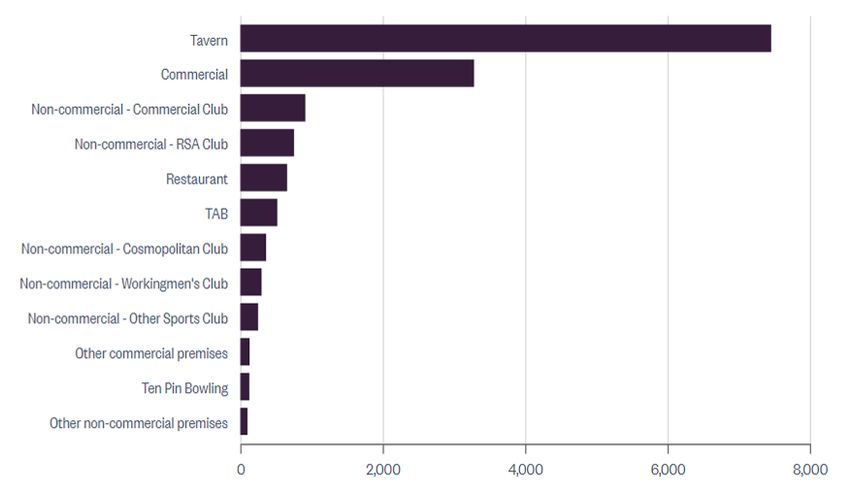
Social Impacts of Gambling in the South Waikato District 2021

CONTENTS
1.     INTRODUCTION .............................................................................................................................................. 1
2.     DEFINITION OF GAMBLING VENUES ....................................................................................................... 1
3.     REGULATORY ENVIRONMENT FOR CLASS 4 GAMBLING ................................................................ 1
  3.1 NATIONAL REGULATORY ENVIRONMENT ...................................................................................................... 1
  3.2 COUNCIL POLICIES ON GAMBLING VENUES .................................................................................................... 2
  3.3 SOUTH WAIKATO GAMBLING VENUE POLICY ............................................................................................... 2
  3.4 STAKEHOLDER CONSULTATION REQUIREMENTS............................................................................................ 3
4. CLASS 4 GAMBLING IN NEW ZEALAND .................................................................................................. 3
  4.1 SHORT HISTORY OF GAMBLING IN NEW ZEALAND ......................................................................................... 3
  4.2 GAMBLING VENUES AND MACHINES .............................................................................................................. 4
  4.3 GAMBLING MACHINE EXPENDITURE .............................................................................................................. 6
  4.4 COVID-19 IMPACTS ON GAMBLING .............................................................................................................. 7
5. CLASS 4 GAMBLING IN SOUTH WAIKATO ............................................................................................. 7
  5.1 RECENT HISTORY OF CLASS 4 GAMBLING VENUES IN SOUTH WAIKATO ........................................................ 7
  5.2 GAMBLING VENUES AND MACHINES .............................................................................................................. 8
  5.3 GAMBLING MACHINE EXPENDITURE .............................................................................................................. 9
6. BENEFITS OF CLASS 4 GAMBLING IN SOUTH WAIKATO ................................................................ 11
  6.1 ENTERTAINMENT VALUE FOR GAMBLERS .................................................................................................... 11
  6.2 COMMUNITY BENEFITS FROM GAMBLING MACHINE FUNDING ..................................................................... 11
  6.3 ECONOMIC BENEFITS FROM EMPLOYMENT AND INCOME ............................................................................. 15
  6.4 GOVERNMENT REVENUE FROM GAMING DUTY ............................................................................................ 15
  6.5 ECONOMIC BENEFITS FROM TOURISM? ........................................................................................................ 16
7. COSTS OF CLASS 4 GAMBLING IN SOUTH WAIKATO ....................................................................... 16
  7.1 PRIVATE AND SOCIAL COSTS OF PROBLEM GAMBLING ................................................................................. 16
  7.2 ECONOMIC COSTS OF DIVERSION OF EXPENDITURE (NEGATIVE NET IMPACT) .............................................. 25
  7.3 REGRESSIVE TAX EFFECT ............................................................................................................................ 25
8. NEARBY DISTRICTS – POLICY COMPARISON ..................................................................................... 26
9.     THE EFFECTIVENESS OF COUNCIL POLICIES ................................................................................... 26
10. SURVEY RESULTS ........................................................................................................................................ 27
  10.1 CAVEAT (SMALL, UNREPRESENTATIVE SAMPLE) ......................................................................................... 27
  10.2 RESPONDENT LIST (ALPHABETICAL) ............................................................................................................ 27
  10.3 SHOULD COUNCIL ALLOW ANY ADDITIONAL VENUES?................................................................................ 27
  10.4 SHOULD COUNCIL CONTINUE TO ALLOW RELOCATIONS? ............................................................................ 28
  10.5 THOUGHTS ON GAMBLING BENEFITS AND COSTS? ....................................................................................... 29
  10.6 THOUGHTS ON COUNCIL DECISION-MAKING? .............................................................................................. 31
11. WEIGHING THE EVIDENCE ....................................................................................................................... 33
  11.1 GAMBLING BENEFITS AND COSTS ................................................................................................................ 33
  11.2 POLICY OPTIONS – BENEFITS AND COSTS ..................................................................................................... 34
  11.3 CONCLUSION ............................................................................................................................................... 34
12. REFERENCES ................................................................................................................................................. 35
APPENDIX 1: GAMBLING ACT 2003 ................................................................................................................. 39
APPENDIX 2: RACING INDUSTRY ACT 2020 .................................................................................................. 42
APPENDIX 3: LOCAL GOVERNMENT ACT 2002 ........................................................................................... 44
APPENDIX 4: SOUTH WAIKATO DISTRICT GAMBLING VENUE POLICY ............................................ 46
APPENDIX 5: SOUTH WAIKATO GAMBLING VENUES AND MACHINES .............................................. 53
APPENDIX 6: RECENT HISTORY OF GAMBLING IN SOUTH WAIKATO ............................................... 54

                                                                                                                                                                  v
Social Impacts of Gambling in the South Waikato District 2021
1. INTRODUCTION
This report was prepared to help independently inform South Waikato District Council and key
stakeholders of the positive and negative social impacts of Class 4 gambling as part of
Council’s 2021 Gambling Venue Policy review.
The report includes historical trends in electronic gambling venues, machine numbers,
research on problem gambling prevalence and other information that may be considered
relevant by Council as part of considering social impact.
Throughout this report, electronic gambling machines are variously referred to as Class 4
gambling machines, non-casino gambling machines, NCGMs, EGMs, gaming machines, pokie
machines or pokies.
2. DEFINITION OF GAMBLING VENUES
Class 4 covers all non-casino gambling machines. The term refers to frequency and duration of
gambling opportunities and associated risk of social harm. Under the Gambling Act 2003,
Class 4 gambling may only be conducted by a club or corporate society and only to raise
money for authorised community purposes:
• Most machines are operated in hotels and pubs whereby gaming trusts own and operate
them for philanthropic purposes and typically distribute the proceeds on application
through community grants. Other machines are owned by chartered clubs, sports clubs
and RSAs which operate them for the benefit of their membership (e.g., toward club
operating costs). Gaming machines are also located in licensed casinos for entertainment
and commercial profit, with some of proceeds typically distributed for community benefit
and promotional purposes.
• A public concern with pokie machines is that they enable high frequency gambling over
potentially long durations, which can lead to financial and other issues for people
predisposed to pathological gambling. Research and anecdotal evidence suggest
problem gambling leads to significant social harm in local communities. The level of
secrecy associated with problem gambling means its effects are largely unseen and
unmeasured.
Of lesser concern from a public perspective are TAB venues. A stand-alone TAB venue is any
premises owned or leased by the TAB NZ where the main business is racing and sports
betting. These are different from smaller TAB outlets or betting agencies that are ancillary to
the main activities of a hotel or tavern. There are no TAB venues currently in the South Waikato
District.
3. REGULATORY ENVIRONMENT FOR CLASS 4 GAMBLING
3.1 National regulatory environment
All pokie machine venues (hotels, pubs and clubs) licensed prior to the Gambling Act 2003
have existing use rights to operate up to either 18 or 9 machines depending on when they were
licensed. Clubs can potentially have up to 30 machines if a merger has taken place.
Gambling in New Zealand is primarily regulated by the Department of Internal Affairs (DIA).
Rules issued by the DIA define how each venue should operate its machines, handle cash and
banking, ensure key events are recorded and respond to player issues. Harm minimisation
regulations specify how venues should manage their statutory obligations to have trained staff
on duty to deal with possible problem gamblers. From 2007, all individual bets in non-casino
1Social Impacts of Gambling in the South Waikato District 2021
gambling machine have been recorded and monitored by a nation-wide electronic monitoring
system to provide an additional layer of assurance.
The DIA Secretary is empowered under the legislate to suspend for up to six months, or cancel
entirely, a Class 4 venue licence if they are satisfied that any of a range of grounds are no
longer being met, for example:
• if there is more than a minimal possibility of persons under 18 years of age gaining
access to the venue;
• dissatisfaction with suitability of venue management; and/or
• breaches of conditions preventing ‘gambling shops’ (i.e., pokie machines must not be the
venue’s primary activity).
3.2 Council policies on gambling venues
Local government’s role in Class 4 gambling regulation is limited compared to central
government’s role. Council has no retrospective authority over venues which have already
received consent, and existing venues do not require approval to continue operations provided
they are not seeking to increase their number of machines.
Any new applicants, or existing venues seeking to merge or relocate, are required to seek local
council consent as well as Ministerial licensing approval.
Council policies must specify whether any new Class 4 venues may be established within their
jurisdiction and, if so, where they may be located. Venues that require local government
consent include:
• Any new prospective new Class 4 gambling venue.
• Any existing Class 4 gambling venue whose licence has lapsed for six months or more
and which is seeking reinstatement.
• Any existing Class 4 gambling venue wishing to increase its gambling machines from its
existing licensed maximum, including clubs seeking to merge their operations into one
location.
• Any society or club wishing to relocate to a different venue than that to which its current
Class 4 venue licence applies.
Table 1: Summary of key agencies responsible for administering the Gambling Act 2003
Agency Responsibilities
Department of Internal Administer gambling legislation; license gambling activities (except casino gambling); ensure
Affairs compliance with legislation; and provide public information and education.
Provide data and statistics: https://www.dia.govt.nz/Gambling-statistics
Ministry of Health Fund and co-ordinate problem gambling services: www.health.govt.nz/our-work/mental-health-
and-addictions/problem-gambling.
Provide problem gambling data and statistics: www.health.govt.nz/nz-health-statistics/health-
statistics-and-data-sets/problem-gambling-data-and-stats
Gambling Commission Determine applications for casino operators’ licenses and renewal of casino venue licenses; deal
with any complaints about the way the DIA handles its role in relation to Class 4 gambling; and
advise Ministers on the setting of the Problem Gambling Levy.
Territorial authorities Regulate the scale and location of any proposed new Class 4 gambling venue or TAB venue,
including any conditions around relocations.
Source: Adapted from information on the DIA website, accessed 10 July 2006. Table reviewed 26 June 2021.
3.3 South Waikato Gambling Venue Policy
Under the Gambling Act 2003, Council must have a Class 4 gambling venue policy, and under
the Racing Industry Act 2020 it must have a TAB venue policy, each to be reviewed three-
yearly. Council’s current policy objectives include:
2Social Impacts of Gambling in the South Waikato District 2021
• To reduce the number of venues and machines throughout the district by way of a
‘sinking lid’ regime.
• To contribute to the minimisation of harm caused by gambling, including problem
gambling, in South Waikato District.
• To facilitate community access to information about the distribution and operations of
Class 4 venues within the district.
• To provide registered corporate societies which manage Class 4 Venue and Racing
Board venues in South Waikato District with opportunities to generate funds for the
purpose of distribution for local, regional and national community benefit.
• To enable people who are entitled to participate in Class 4 and TAB gambling in South
Waikato District to do so.
• To provide relocation provisions to safeguard existing venue operators when continued
business is affected through no fault of their own.
3.4 Stakeholder consultation requirements
Section 102 of the Gambling Act 2003 and section 97 of the Racing Industry Act 2020 each
require Council’s gambling venue policy to be adopted in accordance with the special
consultative procedure in the Local Government Act 2002.
Under the Gambling Act 2003, Council must give notice of its proposed policy to each
corporate society that holds a Class 4 venue licence in the District, as well organisations
representing Māori in the District.
Table 2: Gambling stakeholder groups
Favourable perceptions of gambling Unfavourable perceptions of gambling
• Societies that own gambling machines • Iwi/Māori, Pacific Islands and Asian
located in the District. community organisations.
• Chartered clubs, hotels and taverns with • Health organisations, including mental
gambling machines in the District. health groups.
• Associations and industry groups • Other social service providers and
representing Class 4 gambling clubs and community groups (e.g., budget advisory
hospitality providers (e.g., Community services).
Gaming Association). • Churches and youth groups.
• Sports groups, not-for-profit and other • Lobby groups formed to fight merger
community-based organisations that receive proposals, promote community-based harm
funding from the proceeds of gambling. minimisation and other activities seeking to
decrease problem gambling harm in the
community.
Source: APR Consultants
4. CLASS 4 GAMBLING IN NEW ZEALAND
4.1 Short history of gambling in New Zealand
From the 1980s to the early 2000s there was a proliferation of new forms of gambling in New
Zealand and other countries underpinned by technological progress, societal and policy
changes. Today, gambling is a relatively normalised activity for most of the adult population:
• According to findings from the Health Promotion Agency’s (HPA) 2018 Health and
Lifestyles Survey, 11.3% of New Zealand adults aged 15 years and older had played
gaming machines at a pub or club within the last 12 months.
• A 2020 Fact Sheet from the Problem Gambling Foundation (PGF) suggests that 1.3%
of adults in New Zealand use pokie machines at least once a week.
3Social Impacts of Gambling in the South Waikato District 2021
The Gambling Act 2003 seeks to balance the positive aspects of recreation and community
funding from pokie machines against the negative consequences of problem gambling for a
minority of people.
Table 3: Short history of gambling in New Zealand
Year Description
1929 Golden Kiwi lottery commences
1951 TAB commences
1951- Most gambling opportunities involve a visit to the TAB or track or buying a Golden Kiwi ticket. Others include community fundraising
1987 (e.g., housie/raffles) and amusement parlour games
1987- • Lotto introduced 1987; Electronic gambling machines introduced 1988; Instant Kiwi introduced September 1989, replacing
1997 Golden Kiwi; Lotto Strike introduced March 1993; Daily Keno introduced October 1994
• Christchurch Casino opens November 1994; Auckland Casino opens January 1996
• Telebingo introduced July 1996
• Sports betting introduced 1996, managed by the TAB
• Gambling machines become available in clubs/hotels/bowling alleys
• National increase in gambling machine licenses approved from approximately 8,000 to 15,000
• Maximum number of gambling machines per site increased from 12 to 18
• Jackpots from gambling machines raised from $100 to $500
• 7-day horse and/or dog racing introduced
• Trackside TV channel introduced
• Pub TAB’s introduced
• Telephone gambling games introduced
1997- • Gambling machines account for more than half of all gambling expenditure in New Zealand
2003 • Casino room formats are set up in pubs, incorporating both TAB and gambling machines
• TAB betting on the internet commences June 1998
• TAB phone bets make up more than one-third of the TAB’s total racing and sports turnover
• Licensing approval is granted for two casinos in Queenstown, one in Dunedin and one in Hamilton
• Proliferation of new gambling websites on the Internet
• NZ Lotteries Commission introduces Lotto Powerball
• Keno extended to Saturdays and Sundays
• NZ Lotteries Commission introduces a second Bonus Ball to Lotto
2003 Gambling Act 2003 adopted
2004 to • Keno extended with a 1pm and 6pm draw every day of the week
2006 • NZ Lotteries Commission introduces a range of new products (e.g., Big Wednesday and Winning Wheel) and announces plans
for Internet gambling
• Lotto First Division is now at least $1 million every week; Second Division Prize has increased from an average of $4,000 to an
average $20,000; average prize values in all other Divisions also increase; second Bonus Ball phased out due to customer
demand for simplicity
• Gambling is recognised as one of the largest sources of turnover on the Internet, at an estimated minimum US$10 billion globally
per annum, and possibly much higher
• Number of non-casino pokie machines falls from 25,221 (Sept 2003) to 20,302 (Mar 2007) following the introduction of a new
regulatory environment under the Gambling Act 2003
2007 to • From March 2007 all individual bets in non-casino gambling machine are recorded and monitored by a nation-wide electronic
2013 monitoring system.
• Lotto tickets become available online in 2008
• From 1 July 2009 all pokie machines must have Player Information Displays which inform the gambler how long they have been
playing, how much they have lost and encourage them to take breaks
• From 15 September 2011, Class 4 gaming societies may establish multi-year grant arrangements subject to compliance with the
legislation
• In May 2013 the Government announces it will allow Skycity Auckland casino to install an additional 230 pokie machines and 40
new gambling tables in exchange for a convention centre
• Faster and more ubiquitous Internet access enables new online gambling experiences
Source: Compiled by APR Consultants from a range of sources including DIA information and Wikipedia (predominantly ‘Gambling
in New Zealand’).
4.2 Gambling venues and machines
Since the passing of the Gambling Act 2003, the number of Class 4 gambling machines has
decreased by over 40% (see below). There has been a steady annual decrease in hotels, pubs
and clubs with pokie machines, particularly smaller, less financially viable venues. In some
cases, venues have continued their trading with no machines, while in other cases the venue
has become insolvent in conjunction with losing their venue license. These trends are a result
of many factors including:
• Pressure on venue viability because of requirements for societies to return a minimum of
40% to authorised purposes.
• Limited returns to venue operators on venue expense reimbursements.
4Social Impacts of Gambling in the South Waikato District 2021
• Costs of investment in equipment.
• Tighter enforcement by DIA on gambling shops (i.e., Class 4 gambling must not be the
dominant purpose of the venue and the business must not be dependent on Class 4
gambling to survive, otherwise it can be penalised).
• Falling levels of Class 4 gambling activity within the community (including due to COVID-
19 lockdowns).
• To a limited extent, attrition associated with ‘sinking lid’ venue policies in some territorial
authorities.
As at 31 March 2021, there were 14,732 pokie machines in bars and clubs throughout New
Zealand based at 1,063 venues including hotels, pubs, RSAs, sports clubs, restaurants and
other venues (excluding approximately 3,300 machines in the six casinos). Approximately half
the machines are in taverns.
Figure 1: Class 4 gambling machine numbers in New Zealand – Jun 1994 to Mar 2021
Source: Data from DIA website: https://www.dia.govt.nz/gambling-statistics?OpenDocument. Note: Class 4 gambling
machine numbers in New Zealand peaked at 25,221 in June 2003, prior to the Gambling Act 2003 being passed into
law in September 2003.
Figure 2: Class 4 gambling machines in New Zealand by class of venue, June 2020
Source: DIA https://figure.nz/chart/cp9PSxkPnaKvSZRL
5Social Impacts of Gambling in the South Waikato District 2021
4.3 Gambling machine expenditure
In the 2019/20 financial year, New Zealanders spent $2.3 billion dollars on the four main forms
of gambling – pokie machines, TAB betting, casinos and lotteries:
• In inflation-adjusted terms, total gambling expenditure has remained at a similar overall
level for the past decade.
• Expenditure on pokie machines has been declining as a percentage of total gambling
expenditure over this period, from 43% in 2010/11 to 36% in 2019/20.
Figure 3: Gambling expenditure in NZ 2010/11-2019/20 inflation-adjusted ($m)
Source: Data from DIA website
Notes: Excludes additional Internet gambling. Figures shown are inflation-adjusted dollars (General CPI, Q2 of each
year) for gambling operators’ financial year, or the gross amount wagered minus amount paid out or credited as
prizes or dividends. Expenditure lost by gamblers is equivalent to the proceeds from gambling.
Taking population growth into account shows that in inflation-adjusted terms, expenditure on
gaming machines outside casinos declined from $287 per person per annum in 2010/11 to
$204 in 2019/20 (–29%). The number of Class 4 machines declined by approximately 19%
over the same period, which illustrates that the rate of decline in expenditure per capita has
been faster than the decline in machine numbers.
Figure 4: Gambling expenditure per capita for NZ inflation-adjusted ($)
Source: Data from DIA website
6Social Impacts of Gambling in the South Waikato District 2021
4.4 COVID-19 impacts on gambling
According to a DIA fact sheet on how New Zealanders gambled during COVID-19:1
• Lotto experienced the largest turnover ever as New Zealanders took to gambling online
during lockdown.
• Clubs and venues saw an 18% decrease in pokies spend per adult over the 2019-20 full-
year period.
• Despite an overall decrease in proceeds for pokies over the full-year period, New
Zealanders spent an unprecedented amount from October to December 2020. Quarterly
gaming machine profits (GMP) for December 2020 of $252 million were the highest
quarterly figure documented since records began in 2007.
• The June and December 2020 quarters had a slight increase in pokie machines despite
historic trends showing a gradual reduction of venues and machines over time.
5. CLASS 4 GAMBLING IN SOUTH WAIKATO
5.1 Recent history of Class 4 gambling venues in South Waikato
Since introduction of Council’s sinking lid policy in 2004, the number of pokie venues in the
South Waikato has reduced from 14 to 10 and the number of pokie machines from 206 to 160,
a decline of over 20%. Any gambling venue that ceases operation or is closed and does not
resume gambling activities within six months will not be granted consent. An exception may be
made under some circumstances if an existing venue is required to relocate.
According to DIA data, the Putaruru Arms Motor Inn stopped operating its 5 machines after
June 2006 and the Oxford Royal Hotel stopped operating its 15 machines after
September 2012.
More recently, The Olde Establishment stopped operating its 9 machines after December 2018
and also the Putaruru District Services Memorial Club after March 2019. This followed a failed
merger proposal between The Olde Establishment, Putaruru District Services Memorial Club
and Pockets 8-Ball to create a new 30-machine pokie venue in Tokoroa’s Bridge Street. The
attempt was discontinued in 2018 following long delays in the DIA approval process. Pockets 8
Ball Club went into liquidation and machines at their former two venues are now operated by
The Lion Foundation (Nexus Wine and Café at 38 Bridge Street) and Youthtown Ltd (Kina’s
Sports Bar at 42 Mannering Street). The Olde Establishment Tokoroa closed in late 2018 and
Putaruru District Services Memorial Club went into liquidation in early 2019.
Table 4: South Waikato Class 4 gambling venues and machine numbers 2004, 2018, 2021
Town Venue name Address Society name 2004 2018 2021
Tokoroa Retox Sports Bar 204-206 Rosebery Pub Charity Ltd 18 18 18
Street
Nexus Wine and Café 38 Bridge Street The Lion Foundation 18 18 18
(formerly Pockets 8 Ball
Club)
Kina's Sports Bar (formerly 42 Mannering Street Youthtown Inc 16 16 16
Pockets 8 Ball Club 2)
H2O Tokoroa 233 Leith Place Grassroots Trust Ltd 18 18 18
The Trees Tavern Corner Balmoral Drive One Foundation 18 18 18
and Browning Street Limited
Tokoroa Club* 53 Chambers Street Tokoroa Club Inc 18 18 18
Tokoroa Cosmopolitan 275 Balmoral Drive Tokoroa Cosmopolitan 18 18 18
Club* Club Inc
The Olde Establishment 220-222 Mannering Nil as at March 2021 8 9 0
Street
1
www.dia.govt.nz/diawebsite.nsf/Files/Gambling-Statistics/$file/factsheet-how-aotearoa-gambled-during-covid-19.pdf
7Social Impacts of Gambling in the South Waikato District 2021
Town Venue name Address Society name 2004 2018 2021
Putaruru The Crown & Anchor 4 Princes Street Grassroots Trust Ltd 9 9 9
Hog and Hounds Sports 57-61 Tirau Street The Lion Foundation 9 9 9
Bar
Putaruru District Services 35 Buckland Street Nil as at March 2021 18 9 0
Memorial Club
Putaruru Hotel 79 Princes Street Dragon Community 18 18 18
Trust Ltd
Putaruru Arms Motor Inn 94 Tirau Street Nil as at March 2021 5 0 0
Tirau Oxford Royal Hotel State Highway 1 Nil as at March 2021 15 0 0
Total venues 14 12 10
Total machines 206 178 160
Source: Compiled from information downloaded from Department of Internal Affairs website (www.dia.govt.nz):
www.dia.govt.nz/gambling-statistics-historical-data-venues-machine-numbers#quarterly-lists
5.2 Gambling venues and machines
As at 31 March 2021 there were 10 Class 4 venues in the District operating 160 machines.
Since the last review in 2018, there has been a reduction of 9 machines from the former
Putaruru District Services Memorial Club and 9 from The Olde Establishment in Tokoroa.
Around 78% (124 out of 160) of the electronic gambling machines in South Waikato District are
owned by gaming trusts for charitable fundraising and operated by hotels and taverns in
Tokoroa and Putaruru, with the remainder owned and operated by the Tokoroa Club and
Tokoroa Cosmopolitan Club for the benefit of their members.
As at 31 March 2021, South Waikato was home to 0.9% of New Zealand’s Class 4 gambling
venues and 1.1% of machines. By comparison, South Waikato is home to approximately 0.5%
of the national population aged 18 and over. This means that despite reductions recent years,
South Waikato continues to have a higher ratio of pokie machines and expenditure per person
than many other parts of New Zealand.
Based on 2020 estimated population data for people aged 18 and over, South Waikato
currently has almost twice as many venues per 10,000 people as the national average and
more than twice the national average number of machines per 10,000 population.
Figure 5: South Waikato vs NZ average – venues and machines per adult, March 2021
Source: Gambling data from DIA website, June 2020 estimated usually resident population data for
years 18 and over calculated from Statistics NZ website. This estimation assumes that the age group 18-
19 years is 40% of the reported number of residents in the age group 15-19 years.
8Social Impacts of Gambling in the South Waikato District 2021
Based on 2020 estimated population data for people aged 18 and over, South Waikato has the
5th highest number of gambling machines per 10,000 adult population of the 67 territorial and
unitary authorities in New Zealand.
Table 5: Ranked order of machines per capita for NZ territorial authorities, March 2021
EGMs Est adult population Machines per 10,000
18 years and over adult population
Ruapehu district 89 9,648 92
Buller district 72 7,874 91
Thames-Coromandel district 236 26,630 89
Wairoa district 58 6,554 88
South Waikato district 160 18,734 85
… … … …
New Zealand average 14,732 3,927,172 38
Source: DIA gaming machine figures for March 2021 and Stats NZ population estimates for June 2020 (estimated
for population 18 years and over)
5.3 Gambling machine expenditure
Monitoring data from gambling machines in the South Waikato shows expenditure in the 2020
calendar year of $5.4 million, down considerably from a peak of $8.7 million in 2013.
Figure 6: Class 4 gambling expenditure per annum in the South Waikato 2007-2020 ($m)
Source: DIA gaming expenditure figures by calendar year. Figures shown are nominal dollars (non-inflation
adjusted).
In 2020, Class 4 gambling expenditure in the South Waikato was an average of $287 per
10,000 adults compared to national average of $206 per 10,000 adults. Note these averages
are underpinned by a large range, with many people not spending any money on pokie
machines and a small percentage spending a lot. Research findings on problem gambling
prevalence are discussed later in this report.
9Social Impacts of Gambling in the South Waikato District 2021
Figure 7: South Waikato vs NZ average expenditure per adult in 2020 ($)
Source: Source: DIA gaming expenditure figures for 2020 calendar year, June 2020 estimated usually resident population
data for years 18 years and over, from Statistics NZ
According to the 2018 Census, the median income of South Waikato residents aged 15 and
over was $24,900, lower than New Zealand’s overall median income of $31,800. Expenditure
per adult on Class 4 gambling in the South Waikato is therefore around 1.2% of median income
compared to 0.6% for New Zealand overall.
Figure 8: Class 4 gambling expenditure as a % of median income, South Waikato vs NZ
Source: Source: DIA gaming expenditure figures for 2020 calendar year, June 2020 estimated usually resident population
data for 18 years and over, from Statistics NZ website. Median income from 2018 Census results, Statistics NZ
10Social Impacts of Gambling in the South Waikato District 2021
6. BENEFITS OF CLASS 4 GAMBLING IN SOUTH WAIKATO
6.1 Entertainment value for gamblers
The fact that people pay money to gamble rather than some other commodity or service may
be seen as proof (by revealed preference) that the entertainment from gambling is considered
valuable by those who participate.
Electronic monitoring results show that overall personal expenditure on Class 4 gambling in the
South Waikato District in 2020 was around $5.4 million, hence by revealed preference the
entertainment value of gambling machines for South Waikato residents at least this much.
This assessment assumes that gambling is a rational behaviour in an economic sense, i.e., that
gamblers value the activity more than the money they are spending and hence their net utility is
optimised. This underpinning assumption is questionable with regard to problem gamblers who
contribute a disproportionate amount of the expenditure.
6.2 Community benefits from gambling machine funding
Hotel and tavern-based gambling machines in the South Waikato District are owned by a
variety of societies including (as at March 2021) Grassroots Trust (x 2), The Lion Foundation
(x 2), Pub Charity, Dragon Community Trust, Youthtown and One Foundation. The Tokoroa
Club and Tokoroa Cosmopolitan Club operate gambling machines for their members.
According to data compiled by KPMG, in 2019 there were 77 South Waikato organisations
which received grant funding from 9 societies in total, including the six above plus The
Southern Trust, Oxford Sports Trust and New Zealand Racing Board (now referred to as TAB
NZ as of 2020).
Benefits that accrue to community and voluntary organisations throughout the South Waikato
from access Class 4 gambling proceeds include:
• Being able to focus on the core purpose of the organisation rather than expending
substantial efforts on fund raising.
• Knowing there is money available for community projects.
Regulation 10 of the Gambling (Class 4 Net Proceeds) Amendment Regulations 2016 requires
gaming trusts to distribute 40% of the gaming proceeds for authorised purposes, though not
necessarily to applicants from within the District limits. Authorised purposes are defined in the
Gambling Act 2003 as a charitable or non-commercial purpose beneficial to the whole or a
section of the community. The most recently available DIA (2012) report on the distribution of
non-casino gaming machine proceeds in New Zealand confirmed that sporting organisations
continued to receive around half of the total allocation by gambling machine societies.
In response to the COVID-19 pandemic the 40% minimum requirement for charitable
distribution was suspended for the 2020 and 2021 financial years. This was one of several
remedies introduced to support the financial viability of operators during this period.
Based on 2020 annual gambling machine proceeds of $5.4 million in the South Waikato
District, the community benefit for local organisations from gambling expenditure would have
been worth approximately $2.2 million without the waiver. Given 2020 had lower expenditure
than usual, this should be seen as a conservative estimate of ongoing annual funding levels.
11Social Impacts of Gambling in the South Waikato District 2021
Table 6: Distribution of proceeds from gambling in South Waikato 2020 *
Regulation requirements South Waikato 2020
Charitable funding* 40.00% $2,151,731
Society expenses** 20.22% $1,087,700
Maximum venue payments 16.00% $860,692
Gaming duty 23.00% $1,237,245
Problem gambling levy 0.78% $41,959
Total 100.00% $5,379,327
Notes: * In response to the COVID-19 pandemic the 40% minimum requirement for charitable distribution was
suspended for the 2020 and 2021 financial years. ** Society expenses are calculated here as residual amount after
deducting all other allocations.
Figure 9: Distribution of proceeds from gambling in South Waikato 2020 ($m) *
Notes: * Refer previous table.
There is broad agreement that sport clubs and other not-for-profit and community-based
organisations are increasingly reliant on gambling grants as a source of funding. To avoid
conflicts of interest and minimise fraud, the Gambling Act 2003 requires separation between
gambling trusts, gambling machine venues and grant recipients, and requires the application
and distribution of grants to be transparent (refer Manch 2008).
It is not possible to quantify all the underlying reasons for South Waikato District’s recent
reduction in pokie machine expenditure. However, the measured reduction in expenditure from
$8.7 million in 2013 to $5.4 million 2020 equates to a loss in annual community finding of
approximately $1.3 million per annum (based on distribution of at least 40% for charitable
purposes).
The DIA does not keep a central repository of all grants paid by gambling societies. However,
both the Problem Gambling Foundation (PGF) and, more recently, the Gambling Machine
Association of New Zealand (GMANZ) have collated grant information as a supplement to their
core services.
12Social Impacts of Gambling in the South Waikato District 2021
PGF summary of 2015-2020 grants data
The information below comes from a PGF Group database of 629 grants made to the South
Waikato District Council area for the period 1 January 2015 to 31 May 2021. PGF notes that:
‘Every care has been taken to ensure the demarcation of grants to each Territorial Local
Authority (TLA) is as accurate as possible, but information published by some Trusts can
be inconsistent. The grant data provided in this report is only as accurate as its original
source and the PGF Group holds no responsibility for errors in published information.
Although every effort is made to make our database an all-inclusive list of grants, we
cannot guarantee that all grants made under Class 4 gambling legislation have been
identified and included in our database. For this reason, the grant figures for the 2020
calendar year should be regarded as an overview only.’
The figures below suggest that the major charitable beneficiaries of pokie machine funding in
the South Waikato, in addition to clubs that have machines for their own benefit, are community
services (particularly education) and various sports.
Table 7: Pokie machine grants to South Waikato community organisations, 2014-2020 ($)
2014 2015 2016 2017 2018 2019 2020
Community Groups 139,122 154,369 233,809 199,678 265,741 405,786 26,564
Arts 4,000 10,738 30,472 800
Community Groups 102,821 141,536 95,285 124,928 218,571 195,342 17,418
Faith Based 5,000 7,407
Māori 36,301 3,833 138,524 74,750 36,432 179,972 940
Community Services 161,027 97,968 238,433 231,423 227,454 584,777 244,307
Ambulance Services 2,185 4,510
Community Services 37,992 27,425 37,601 17,052 36,588 117,039
Education 120,685 70,543 173,342 178,911 173,593 363,010 220,963
Health Related 54,155
Kindergartens / Child Care
/ Plunket 2,351 27,490 35,460 17,273 48,387 18,834
Sport 370,068 273,536 347,796 193,452 253,224 428,197 247,339
Athletics 5,000 16,725 10,383 3,540
Bowling 23,765 62,216 28,833 15,032 30,000 12,389
Community Group 18,898
Cricket 8,384 1,291 17,506 13,213 3,478 7,200 29,750
Cultural 11,200
Cycling 5,000 4,818 137,900 7,202
Equestrian / Pony Clubs 2,554 12,000 18,084
League 64,383 19,059 18,896 17,283 16,872 46,186 54,291
Motorsports 11,100 6,000 3,501 8,734
Netball 8,099 5,582 8,995 14,757 13,201 1,500
Other Sports 98,018 58,177 73,705 90,633 87,755 109,295 21,919
Racing 65,000
Racquets 7,861 39,028 77,354 7,500 37,408 5,684 47,437
Rugby 74,904 66,059 79,638 49,792 34,067 39,615 29,058
Soccer 29,693
Special Olympics / Sports
for the disabled 1,000
Water Sports 17,124 20,143 10,185 2,761 8,000
Total 670,217 525,873 820,038 624,554 746,419 1,418,759 518,211
Source: Table provided by PGF.
13Social Impacts of Gambling in the South Waikato District 2021
Figure 10: PGF summary of grants provided to South Waikato community organisations
Source: PGF.
GMANZ summary of 2017-2019 grants data
The information below comes from a spreadsheet database collated by GMANZ which provides
details of each individual reported grant for 2017, 2018 and 2019 including the amount, society
and recipient. The database was gathered from gaming machine societies by KPMG and
collated. Key points include, for 2019:
• Approximately $1.8 million in local South Waikato grants were made in 2019 (higher than
the PGF estimate of $1.4 million).
• Number of societies approving grants = 9
• Number of organisations/entities receiving grants = 77
• Grants approved from the two largest providers: Pub Charity Ltd ($690,000) and One
Foundation Ltd ($518,000).
• Five largest grants approved: Tokoroa Mountain Bike Club (approximately $113,000), Te
Ara Metua Punanga Reo Kuki Airani Inc ($93,000), Tokoroa Central School Board of
Trustees ($65,000), Tokoroa and District Community Hospice Trust Fund ($60,000) and
Nga Waka Māori Reservation Trust ($58,000).
14Social Impacts of Gambling in the South Waikato District 2021
Figure 11: GMANZ and PGF estimates of annual grants to South Waikato organisations
Source: Graph compiled by APR Consultants using data collated by PGF and GMANZ.
6.3 Economic benefits from employment and income
The Gambling Act 2003 permits societies to reimburse venues for the actual, reasonable and
necessary costs. It is not the intention of the legislation or regulations that Class 4 venues
should make profits from hosting Class 4 gambling operations. The Gambling Commission has
emphasised that any venue payments made in excess of actual, reasonable and necessary
costs would be an illegal use of net proceeds and therefore a misuse of community money.
Exact figures on employment in the Class 4 gambling industry in South Waikato District are not
available. A rough estimate is that approximately 2.5 full-time equivalent positions are created
by each Class 4 gambling venue (not counting staff that would be employed at each venue for
hospitality and management), or approximately 25 employees in total for the District.
According to the Community Gaming Association, the majority of Class 4 gambling venue
operations are undertaken by people employed as managers because of the significant risks
involved in compliance and operational failures. A 2013 DIA research report found more than
44% of venue staff nationally were paid $35+ per hour.
The 16% maximum venue payments cap applies to the total amount a corporate society can
pay all of its venues and acts to ensure minimisation of costs and maximisation of returns. In
2020, the 16% cap equated to $0.9 million in the South Waikato.
Note that these employment and income estimates are at least partially offset by an opportunity
cost to district-wide income and employment due to the diversion of expenditure from other
industries. This is discussed later in this report.
6.4 Government revenue from gaming duty
Around one-quarter of Class 4 gambling proceeds are paid to the Government as duties and
taxes. In 2020, approximately $1.2 million was collected in taxes and duties each year from
Class 4 gambling in the South Waikato District (based on 23% of proceeds).
This aspect is further discussed under costs in relation to the regressive tax effect of Class 4
gambling.
15Social Impacts of Gambling in the South Waikato District 2021
In addition, each year the gambling industry pays the equivalent of 0.78% of gambling
expenditure toward a problem gambling levy so the Ministry of Health can implement the
national Gambling Harm Strategic Plan. The problem gambling levy rate is reviewed every
three years.
6.5 Economic benefits from tourism?
Some stakeholders argue there are tourism benefits from Class 4 gambling. However, on
balance Class 4 gambling is unlikely to be seen as a major tourism attraction for the District,
and only a minority of visitors might be dissuaded from travelling to the South Waikato if
gambling machines were not accessible. This report does not attempt to quantify these
potential impacts and treats them as immaterial.
7. COSTS OF CLASS 4 GAMBLING IN SOUTH WAIKATO
7.1 Private and social costs of problem gambling
Most of the community share of gambling is borne by a minority of problem gamblers. There is
evidence that intermittent gratification from gambling machines, including visual and auditory
feedback, is more addictive than other forms of gambling such as lottery tickets.
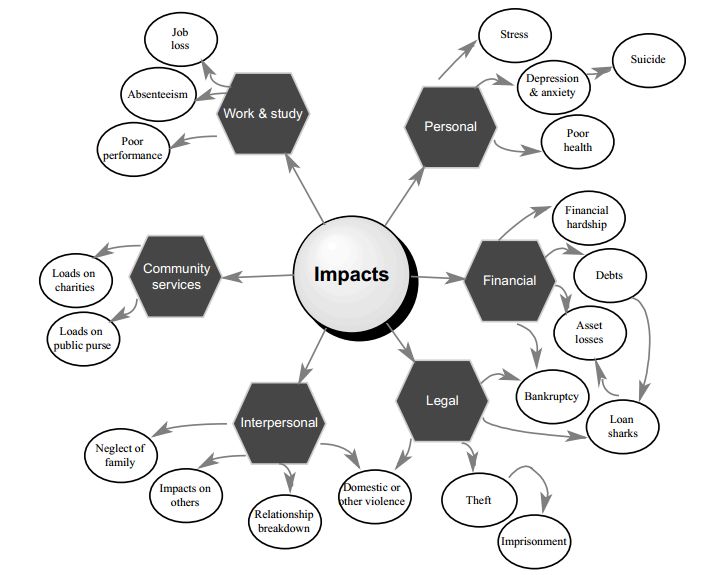
Problem gambling defined
Problem gambling is characterised by symptoms such as loss of control over one’s gambling,
preoccupation with gambling and lying to people to conceal the extent of gambling. Feelings of
anxiety, depression, guilt, lack of control and suicidal ideation have been noted by problem
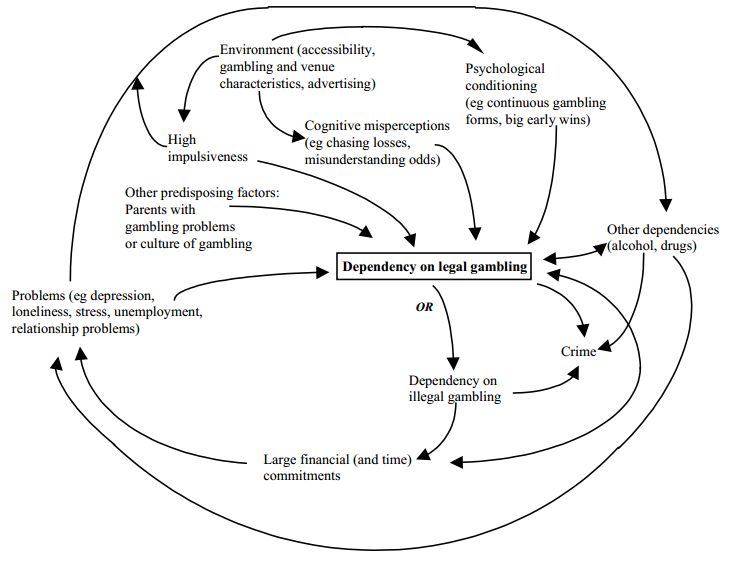
gambling agencies when dealing with clients. Possible causal pathways for problem gambling
are illustrated below.
Figure 12: Conceptual framework of gambling related harm
Source: Ministry of Health (2017)
16Social Impacts of Gambling in the South Waikato District 2021
Figure 13: Causal pathways and problem gambling
Source: Australian Productivity Commission, 1999, p 7.4
High-risk and problem gambling prevalence rates
Problem gambling prevalence is not directly measurable and relies on research estimates
which are contingent on survey methodologies and definitions, and potentially subject to a high
level of non-reporting levels by problem gamblers.
Information from agencies such as PGF, budget services and the justice system indicate that
some individual problem gamblers contribute tens and even hundreds of thousands of dollars
per year through Class 4 gambling machines.
According to prior Canadian research, up to 96% of the total share of gambling is borne by
25% of all pokie players (Hayward and Colman 2004, p 22). A 2010 Australian Productivity
Commission report (cited in True, 2013) estimated that problem gamblers’ share of total
expenditure on gambling machines was approximately 40%, while other researchers suggest it
could be as low as 10-20%. A 2020 Fact Sheet from PGF says that 30% of all Class 4 pokie
losses come from 1.8% of adults who are moderate or severe gamblers. According to the AUT
Gambling and Addictions Research Centre (2018), problem and moderate-risk gamblers
account for around a quarter of total expenditure, and adults experiencing lower levels of
gambling-related harm account for a further quarter.
There is evidence that problem gambling prevalence rates are higher for Māori, people with no
formal educational qualifications and people with lower-status occupations (e.g., SHORE
2008). According to information from PGF, Council gambling policies should prioritise the
needs of Māori, Pacific and Asian peoples because these populations experience twice the rate
of moderate and severe gambling harm than the general population.
17Social Impacts of Gambling in the South Waikato District 2021
According to findings from the Health Promotion Agency’s (HPA) 2018 Health and Lifestyles
Survey, 1.9% of New Zealand adults are classified as moderate-risk or problem gamblers.
More recent evidence is summarised in a 2020 problem gambling fact sheet compiled by the
NZ Community Trust:2 This suggests that 0.2% of the adult population are current problem
gamblers, a further 1.8% at moderate risk of problem gambling and 4.6% at low risk of problem
gambling. Similarly, a 2020 Fact Sheet from PGF suggests that 1.8% of adults in New Zealand
are moderate or severe gamblers.
Allowing for uncertainty around the NZCT estimates, this would translate to approximately 30-
40 people in the South Waikato who are current problem gamblers, a further 300-350 at
moderate risk of problem gambling and 800-900 at low risk of problem gambling.
Figure 14: Estimated prevalence of gambling risk in the South Waikato (point estimates)
Source: APR Consultants using prevalence rates from NZCT fact sheet ‘problem gambling 2020’ and June 2020
estimated usually resident population data for 18 years and over, from Statistics NZ website
South Waikato community gambling risk profile
The South Waikato has a:
• High prevalence of people ‘at risk’ of being problem gamblers in the District, based on
place of residence of people who present as intervention clients to problem gambling
services each year.
• High percentage of Māori and Pacific Island people living in the District.
• High level of relative social deprivation in the Tokoroa and Putaruru communities.
• High number of gambling machines and expenditure per person in the District.
Prevalence rate of people at risk of problem gambling
The number of people who presented as intervention clients to problem gambling services
illustrates that:
• The annual number of clients presenting at problem gambling services nationally has
fallen from a peak of 13,244 in 2009/10 to 9,502 in 2019/20; and
• In most years, around 20 to 40 people from the South Waikato District present as
problem gambling service clients.
In the graph below, the scale for South Waikato clients is shown on the right axis and the scale
for New Zealand overall is on the left axis. The trend over time for South Waikato is volatile,
which is not unexpected for data from a small area.
2 www.nzct.org.nz/assets/Factsheets/NZCT-Problem-Gambling-Fact-Sheet-2020.pdf
18Social Impacts of Gambling in the South Waikato District 2021
Figure 15: Problem gambling clients per annum – South Waikato and NZ
Source: Compiled by APR Consultants from Ministry of Health intervention client data (online data).
The national rate of seeking help in New Zealand is 9.3% (based on results of the NZ Health
Survey) which suggests that more than 90% of problem gamblers in New Zealand do not
present as clients of problem gambling services and are not reflected in the figures below.
Ethnicity profile
According to a range of research studies, Māori and Pacific populations are more likely to
experience gambling related harm. Hence, districts with higher proportions of Māori and Pacific
residents may be at risk of greater social harm. Census results show the South Waikato has a
higher proportion of both Māori and Pacific Islands residents to the national average.
Ward et al (2019) found that controlling for socio-economic deprivation and the geographic
location of EGMs, the association between ethnicity and expenditure per capita was weak. This
suggests that the high prevalence of gambling amongst Māori and Pacific Islands people is due
to their lower average socio-economic status rather than their ethnicity.
Table 8: South Waikato vs NZ ethnicity profile
South Waikato New Zealand
Māori % 35.3% 16.5%
Pacific % 12.8% 8.1%
Source: 2018 Census, Statistics New Zealand
Note Denominator is ‘total people stated’ (excludes non-responses)
Relative social deprivation
Research suggests that communities with higher rates of deprivation are more likely to
experience gambling harm, and the level of gambling risk is increased if gambling venues are
located in close proximity to higher deprivation communities.
Community social deprivation can be measured using the New Zealand Deprivation 2018 Index
(NZDep2018) which is calculated from nine Census items reflecting an absence of social and
economic means (e.g., unemployment rate, low-income households). A score of 1-3 on the
19You can also read


