South African Banking Sentiment Index 2018 - Global Event Portfolio
←
→
Page content transcription
If your browser does not render page correctly, please read the page content below
South African Banking Sentiment Index 2018
SOUTH AFRICAN BANKING SENTIMENT INDEX 2018

Contents

Executive summary                            1

Foreword                                     3

Introduction                                 5

Methodology                                  7

Headline sentiment analysis                  9

Topic analysis                               11

Digital index                                17

Churn analysis                               23

Brand content performance                    31

Conclusion                                   33

Appendix – individual bank performances      35
SOUTH AFRICAN BANKING SENTIMENT INDEX 2018

Executive summary

The 2018 South African Banking Sentiment Index analysed consumer social media
posts about the five major retail banks from September 2017 to August 2018.

Capitec emerged as the top-ranking bank by net sentiment, but FNB made significant
improvements on their 2017 net sentiment. Standard Bank replaced Absa as the
lowest ranked bank.

In an analysis of digital banking conversation, FNB outperformed competitor banks
overall, a trend largely driven by the brand’s use of technological innovation.

Digital conversation comprised 24% of overall topic conversation. FNB had the highest
overall net sentiment (+42.6%) across key digital indicators – digital safety, banking
app, online banking and business and technological innovation. The latter indicator
largely drove the bank’s success in this regard, with consumers responding positively
to several innovative products and services being introduced in 2018. Conversely,
Standard Bank had the lowest net sentiment for digital themes at -72.7%, with
complaints about their app, as well as disruption to online banking services dominating
conversation around this area. Nedbank received high levels of negative sentiment for
business or technological innovation, a development triggered by consumer backlash
against the impact of proposed technological innovations on jobs at the bank.

Over 30 000 consumers spoke about leaving their bank over the last year. Nedbank
and Standard Bank clients most frequently threatened to leave their banks, while
Capitec had the lowest proportion of consumers demonstrating intent to cancel. The
most frequently cited reasons across the industry for cancelling with a bank were
poor turnaround times, accusations of unethical behavior, billing or payments, as well
as telephonic interactions.

While Capitec had the lowest volume of conversation about cancelling, FNB received
the highest number of positive comparisons to other banks. Furthermore, when
consumers claimed that they intended to leave their banks, FNB was most frequently
cited in the conversation as an alternative option for consumers.

                                                                                     1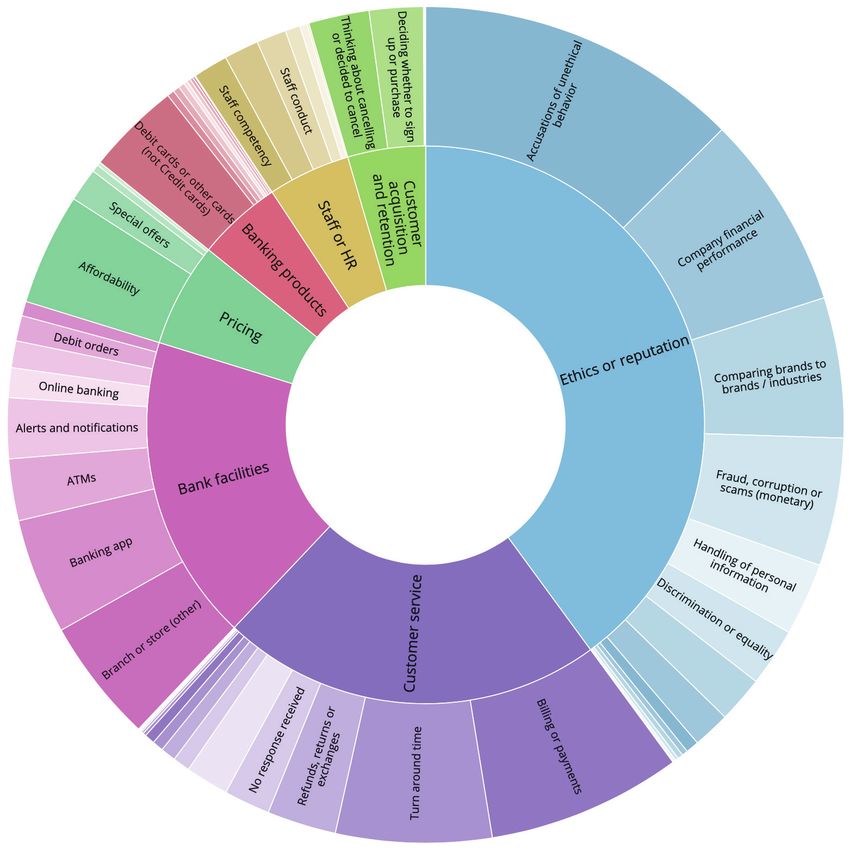
SOUTH AFRICAN BANKING SENTIMENT INDEX 2018

Foreword

The effects of digital transformation and exponential technologies are being felt by
businesses in every industry, in every country. Digital is no longer only about systems
or apps. It is fundamentally shifting the way we work, live and communicate. At
the centre of this transformation are customers, whose shifting expectations and
increased demand for empowerment are forcing traditionally siloed corporations to
relook their strategies, processes, and platforms.

In the past, the banking sector in South Africa was a leader in innovation, and it is
becoming clear that the pace at which a bank evolves to better serve its customers
often drives how customers feel about the brand. The burning question is: are South
African banks doing enough, in the minds of their consumers, to provide products,
services and digital innovation at the pace they expect?

In the 2017 South African Banking Sentiment Index, BrandsEye was able to effectively
demonstrate the far-reaching effects that public sentiment has on customer experience,
and even business performance. By analysing the underlying needs customers
expressed online and categorising them into topics, BrandsEye was able to provide
some of the insights required to drive process optimisation and strategic change in the
business. The 2018 index further reinforces this, and emerging sentiment data on digital
innovation contained in the report is in line with global trends.

As strategic consulting partners to banks all over Africa, Deloitte deeply understand
the value of customer insights in financial services. The data and analysis that
BrandsEye has provided in the 2018 index, and extended in our partnership with
them are invaluable to the strategic consulting work we provide to our clients.

Karoly Kramli
Digital Financial Services Ecosystem Lead
Deloitte Consulting Africa

                                                                                      3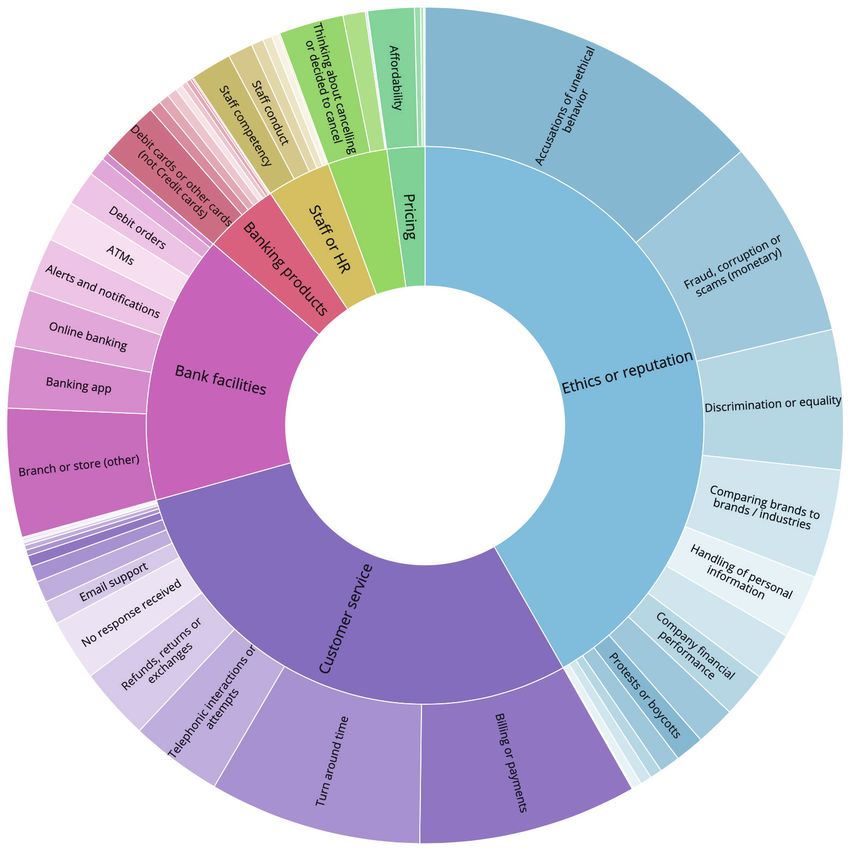
SOUTH AFRICAN BANKING SENTIMENT INDEX 2018

Introduction

BrandsEye’s annual South African Banking Sentiment Index assessed consumer
sentiment towards the five main banks in South Africa on social media. Social media
is a valuable source of volunteered consumer feedback. Unlike other consumer
research methodologies reliant on questionnaires or focus groups, social data is
unsolicited and captures the lived experience of consumers with banking services
and products at scale.

For the 2018 index, BrandsEye has prioritised exploring major topics and events
influencing positivity and negativity among consumers, as well as understanding the
scope and drivers for churn among banks. The index also includes a focus on digital
banking themes, given that the South African banking industry is expected to face
significant digital disruption in 2019, with several new digital entrants set to launch.

                          JUNE 2017      DECEMBER 2017            JUNE 2018         YOY CHANGE
                                                                                                  Source: Business Tech –
Absa                     8.65 million                   -                   -                 -
                                                                                                  https://businesstech.co.za/
Capitec                   9.0 million        9.87 million        10.2 million           +13.0%
                                                                                                  news/banking/269891/
FNB                      7.84 million                   -        8.15 million            +4.0%
                                                                                                  is-capitec-now-the-biggest-
Nedbank                   7.8 million         7.5 million        7.65 million             -1.9%
                                                                                                  bank-in-south-africa/
Standard Bank             8.5 million        8.22 million        8.12 million             -4.7%
                                                                                                  Absa’s customer numbers
The table above shows the latest publicly available customer numbers for the five major banks’    were not included in
retail clients.                                                                                   its June 2018 interim
                                                                                                  report and Absa have not
                                                                                                  included them since its
                                                                                                  2017 interim results.

                                                                                             5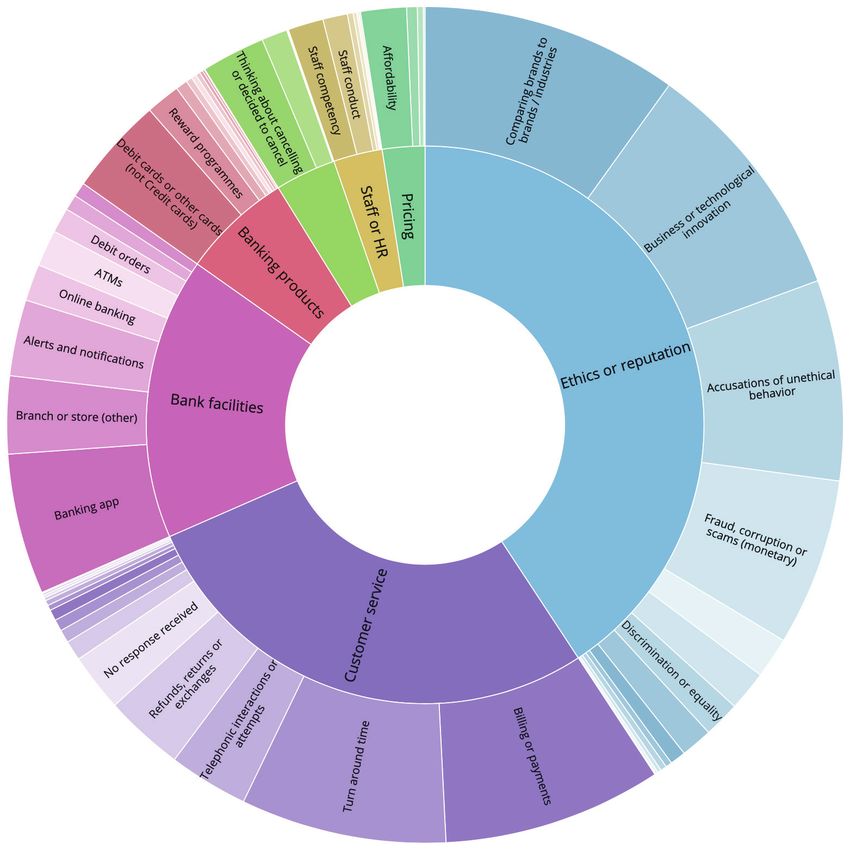
SOUTH AFRICAN BANKING SENTIMENT INDEX 2018

Methodology

BrandsEye retrieved 1 720 810 social media posts pertaining to South Africa’s five
largest retail banks for the period 1 September 2017 to 31 August 2018. The banks
analysed in this study were Absa, Capitec, FNB, Nedbank and Standard Bank. Data
sources include all main social networks including Twitter, Facebook and Instagram
as well as multiple other online sources. Branded/marketing posts made by the banks
were excluded from the analysis.

Sentiment methodology

To carry out sentiment analysis with a 95% confidence level and an overall 0.1%
margin of error, a random sample of 521 326 of these posts were processed through
BrandsEye’s Crowd for sentiment verification. Social posts were assigned sentiment
scores of positive, negative or neutral, or in some cases, both positive and negative.

Topic analysis methodology

Topic analysis enables a granular understanding of the specific issues driving
consumer sentiment.

A sample of 159 822 sentiment-bearing posts (only positive and negative) were
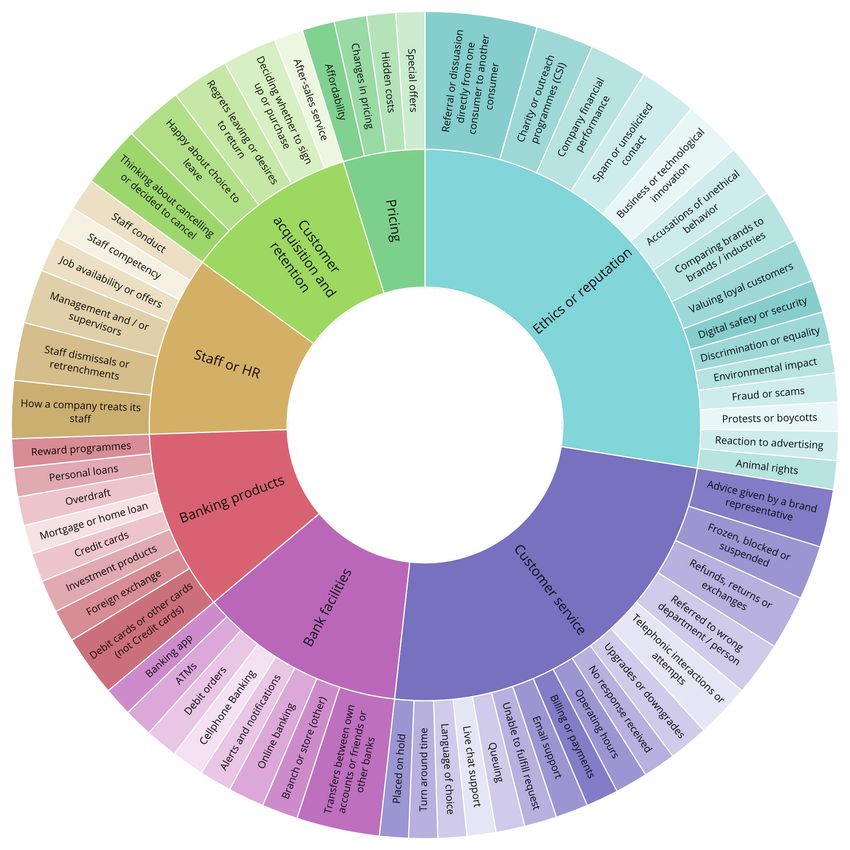
sent to the Crowd, who identified which of the 70 pre-defined banking topics were
contained in each post.

Seven broader conversation themes encompass the 70 pre-defined topics. The
broader themes were: reputation, customer service, banking products, banking
facilities, customer acquisition and retention, pricing, and staffing or HR.

                                                                                         7
SOUTH AFRICAN BANKING SENTIMENT INDEX 2018
Available
topics
Topic wheel illustrates the seven broad themes and the 70 banking topics they encompass.
In this index, net sentiment was calculated by deducting negative sentiment from
positive sentiment. Weighted net sentiment is calculated by multiplying net sentiment
by the total conversation volume. For example, if the conversation volume is 24 839,
and net sentiment is -3.4%, the weighted net sentiment would be -845.
8SOUTH AFRICAN BANKING SENTIMENT INDEX 2018
Headline sentiment analysis
2015 2016 2017 2018
20%
13.5%
10%
6.1%
4.0% 4.2%
0.9%
0%
-0.2%
-3.4%
-5.8% -6.0%
-7.6% -7.7%
-10% -8.5%
-11.3%
-14.1%
-16.1% -16.0% -16.2%
-20% -17.9%
-19.5%
-24.5%
-30%
Absa Capitec FNB Nedbank Standard Bank
Net sentiment comparison 2015 – 2018
Capitec received the highest net sentiment in 2018, despite dropping by over 9
percentage points. It remains the only bank with positive overall net sentiment, i.e.
it received more praise than complaints. Capitec was followed by FNB, whose net
sentiment increased by 12.6% from -16% in 2017 to -3.4% in 2018. Nedbank placed
third at -7.7%, recording a 1.9 percentage point decrease in net sentiment. Absa’s net
sentiment improved by 8.4 points, moving it out of the lowest net sentiment position.
At -16.2%, Standard Bank recorded the lowest net sentiment and the largest drop in
sentiment between 2017 and 2018.
Capitec, Nedbank and FNB showed increases in share of voice compared to 2017,
rising by 7.4, 1.9 and 1.7 perecentage points respectively. Both Absa and Standard
Bank conversation declined compared to their share of voice for 2017. Standard
Bank’s share of voice declined by 8.6 percentage points, while Absa’s conversation
dropped by 2.3 points.
9SOUTH AFRICAN BANKING SENTIMENT INDEX 2018
2015 2016 2017 2018
40%
34.9%
32.6% 33.7%
29.5%
30% 27.8%
26.3%
24.0%
22.7%
19.2%
20% 18.4% 18.8% 18.4%
14.6% 14.0% 14.1%
13.7%
11.4% 11.8%
9.1%
10%
5.1%
0%
Absa Capitec FNB Nedbank Standard Bank
Share of voice (excluding posts by banks)
There were three major volume spikes in conversation over the year in the banking
industry. The first spike took place in November 2017, when consumers engaged with
calls for graduate employment opportunities at FNB. The second spike in December
was driven by FNB consumers complaining about unauthorised debit orders. Finally,
in January 2018, the publication of the Viceroy report generated significant volumes of
conversation. Viceroy conversation accounted for 21.6% of total Capitec conversation
in January.
Absa Capitec FNB Nedbank Standard Bank
80 000
72 791
60 000 56 954 56 967
40 000
20 000
0
Sep Oct Nov Dec Jan Feb Mar Apr May Jun Jul Aug
2017 2018
Monthly conversation volume (excluding posts by banks)
10SOUTH AFRICAN BANKING SENTIMENT INDEX 2018
Topic analysis
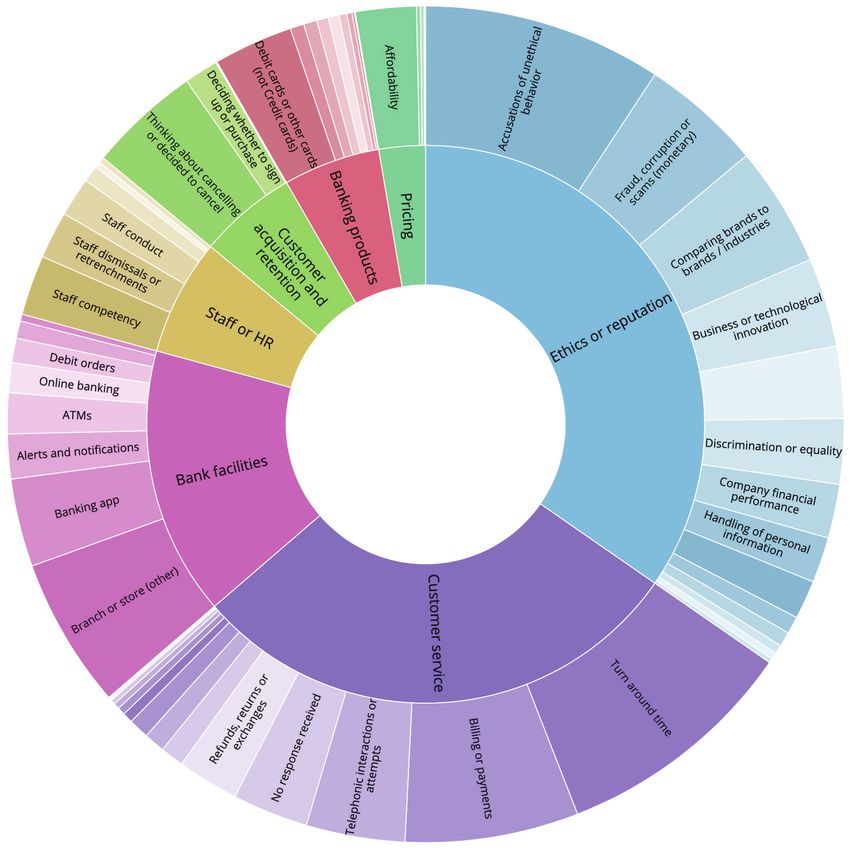
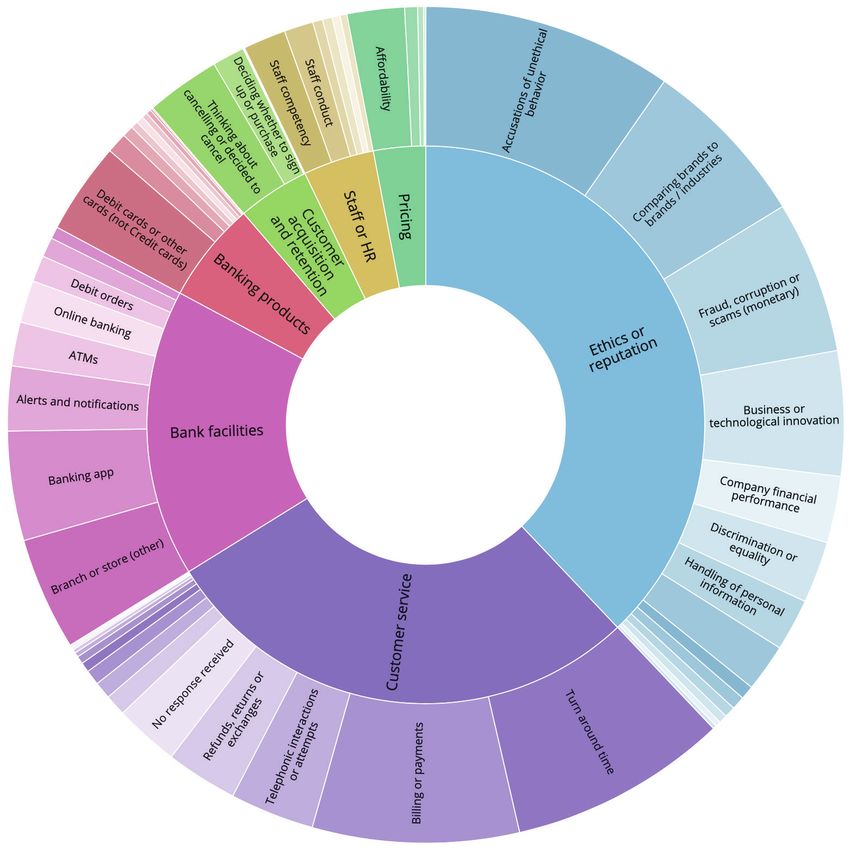
Topic analysis is made possible by the BrandsEye Crowd of human contributors who
are able to enrich the sentiment data by surfacing the specific topics contained in
sentiment-bearing posts. By identifying specific topics contained in conversation we
are able to understand not just how people feel, but what specific issues are driving
them to feel that way.
Absa
Capitec
11SOUTH AFRICAN BANKING SENTIMENT INDEX 2018
FNB
Nedbank
Standard Bank
12SOUTH AFRICAN BANKING SENTIMENT INDEX 2018
Primary conversation themes analysis
In terms of primary conversation themes, ethics or reputation contributed the highest
share of conversation for Absa, Capitec, FNB and Nedbank. While customer service was
the second highest conversation theme overall, it comprised the largest topic for Standard
Bank. Banking facilities and products were the third and fourth largest discussion points
among consumers.
Absa Capitec FNB Nedbank Standard Bank
80%
67.5%
55.9%
54.1%
53.1%
60%
50.1%
44.3%
43.0%
41.4%
41.1%
36.9%
34.9%
32.7%
31.9%
31.8%
40%
28.2%
27.6%
27.3%
24.5%
21.7%
21.2%
20.1%
15.1%
12.0%
20%
9.5%
9.1%
8.4%
8.8%
6.4%
5.8%
5.3%
0%
Ethics or Customer Bank facilities Banking Pricing Staff or HR
reputation service products
Primary conversation themes as a percentage of the topic conversation
The sentiment towards the major themes was overwhelmingly negative. Only Capitec
and Nedbank had net positive sentiment for their conversation about pricing.
Absa Capitec FNB Nedbank Standard Bank Industry average
50%
37.3%
31.2%
25%
0%
-19.1%
-8.9%
-14.7%
-16.6%
-25%
-22.1%
-37.8%
-37.9%
-31.6%
-35.3%
-41.8%
-50%
-42.3%
-54.4%
-56.3%
-44.6%
-45.7%
-45.7%
-49.4%
-54.3%
-52.6%
-54.8%
-53.5%
-67.4%
-57.8%
-58.6%
-61.4%
-63.1%
-62.8%
-75%
-67.0%
-69.0%
-71.2%
-75.2%
-77.4%
-77.1%
-79.3%
-100%
Ethics or Customer Bank facilities Banking Pricing Staff or HR
reputation service products
Overall sentiment for major themes
13SOUTH AFRICAN BANKING SENTIMENT INDEX 2018
Main positive and negative themes
Capitec performed consistently higher than industry averages in terms of positive
topics, with an average of 10.5 percentage points higher positive sentiment than the
industry. Both Absa and Standard Bank’s positive theme conversation fell below the
industry average, with -11.7% and -8.0% respectively.
Overall, pricing was the most positive theme in 2018 across all banks, with Capitec
generating the highest positive sentiment, followed by Nedbank.
Ethics or reputation was also a secondary driver for positive sentiment with an
industry average of 26.9%. Both FNB and Capitec’s positive sentiment around this
theme were higher than the industry average. Banking products represent the third
most positive theme, where FNB received the highest share of positive sentiment out
of all the banks.
Main positive themes
INDUSTRY Absa Capitec FNB Nedbank Standard Bank
Customer service 12.6% 7.0% 24.4% 9.4% 14.5% 7.5%
Ethics or reputation 26.9% 13.8% 37.7% 43.2% 22.2% 17.7%
Banking products 26.7% 11.3% 29.2% 39.6% 34.6% 18.8%
Banking facilities 17.5% 9.6% 22.0% 28.9% 18.8% 8.1%
Pricing 36.3% 9.7% 65.0% 23.7% 62.1% 20.9%
Staff or HR 18.4% 16.9% 23.0% 14.7% 19.9% 17.4%
INDUSTRY AVERAGE DIFFERENCE -11.7% +10.5% +3.5% +5.6% -8.0%
Higher than industry average Lower than industry average
Main negative themes
INDUSTRY Absa Capitec FNB Nedbank Standard Bank
Customer service 80.0% 84.4% 66.7% 84.6% 77.3% 86.8%
Ethics or reputation 64.7% 76.9% 54.3% 52.1% 67.9% 72.5%
Banking products 64.6% 78.3% 60.8% 54.3% 56.7% 73.1%
Banking facilities 73.8% 80.8% 66.6% 64.2% 72.3% 85.2%
Pricing 55.4% 78.7% 27.7% 69.4% 30.9% 70.3%
Staff or HR 72.8% 74.7% 64.7% 76.0% 72.5% 76.0%
INDUSTRY AVERAGE DIFFERENCE +10.4% -11.8% -1.8% -5.6% +8.8%
Higher than industry average Lower than industry average
Across the industry, customer service, banking facilities and staffing or HR were the
most negative primary topics. In terms of overall performance, Capitec performed
better than the industry average across major negative themes, followed by Nedbank
and FNB. Both Absa and Standard Bank’s negative sentiment for these areas was
worse than the industry average, suggesting greater consumer grievances with
products and services for these banks.
14SOUTH AFRICAN BANKING SENTIMENT INDEX 2018
Issues driving customer service complaints
INDUSTRY Absa Capitec FNB Nedbank Standard Bank
Turnaround time 44.8% 42.2% 36.7% 40.3% 52.8% 52.0%
Billing or payments 41.4% 44.3% 42.8% 47.5% 38.7% 33.9%
Accusations of unethical behaviour 26.6% 28.2% 27.0% 31.9% 26.2% 19.5%
Fraud or scams 24.2% 29.1% 24.7% 31.3% 20.0% 15.9%
Telephonic interactions 18.0% 19.1% 10.6% 17.2% 22.7% 20.4%
Branches 19.8% 18.9% 19.9% 16.8% 24.9% 18.4%
Refunds, returns or exchanges 14.7% 14.6% 17.3% 17.6% 13.9% 10.3%
No response received 15.0% 13.7% 11.9% 13.1% 19.3% 16.8%
Debit cards or other cards 9.6% 7.8% 7.7% 10.7% 11.6% 10.3%
Alerts and notifications 9.3% 9.6% 9.9% 8.2% 8.9% 9.9%
INDUSTRY AVERAGE DIFFERENCE +0.4% -1.5% +1.1% +1.5% -1.5%
Higher than industry average Lower than industry average
As customer service was the most negative theme overall, we investigated the issues
raised when consumers made customer service complaints. The table above displays
co-occurrence of other topics with customer service complaints to show drivers of
this type of consumer grievance.
On average across the industry, the complaints most commonly linked to customer
service were turnaround time, billing or payments, accusations of unethical behaviour,
as well as fraud or scams.
Both Standard Bank and Nedbank were above the industry average in terms
of customer service complaints that referenced turnaround times. This finding
corresponds with the finding that the same banks had an above average volume of
complaints about consumers not receiving a response.
On the other hand, Absa, Capitec and FNB’s customer service grievances around
billing or payments exceeded the industry average. FNB had the highest proportion
of customer service complaints pertaining to billing or payments, a result largely
driven by unauthorised debit orders during December 2017.
15SOUTH AFRICAN BANKING SENTIMENT INDEX 2018
Digital index
40% Percentages in the
36.0%
graph reflect the share
30% of conversation about
digital themes within
20.7% topical conversation for
19.7%
20%
16.9%
15.5% each bank.
10%
0%
Absa Capitec FNB Nedbank Standard Bank
Digital themes comprised 24% of overall topic conversation
Four digital themes were analysed over the reporting period, namely: (i) digital safety
and security, (ii) online banking, (iii) banking apps and, (iv) business or technological
innovation. These themes comprised 24.1% of topic conversation across all banks.
FNB had the highest share of conversation around this theme with 36%, while
Capitec’s conversation was the lowest at 15.5%.
Online banking 13.4%
App 29.0%
Business innovation 40.2%
Digital safety 17.4%
Digital conversation across the industry was driven by innovation developments
More than 40% of conversation within this digital theme focused on business or
technological innovations. Discussions around banking apps followed at 29%,
while only 13.4% of consumers spoke about online banking. This suggests that
app experience and functionality is a higher priority for consumers. Digital safety
comprised 17.4% of overall digital conversation.
17SOUTH AFRICAN BANKING SENTIMENT INDEX 2018
Digital safety Business or Banking app Online banking
or security technological innovation
Absa Capitec FNB Nedbank Standard Bank
Absa -84.6% 4.6% -69.2% Percentages
-83.7% indicate
Online banking 25% 11% 9% 12% 26%
Capitec -45.2% -0.4% -30.6% conversation
-29.0% volume
App 26% 45% 23% 33% 37%
FNB -79.6% 86.8% 9.1% -57.5%
Business innovation 18% 15% 58% 37% 16%
Nedbank -72.9% -48.2% -9.3% -65.3%
Digital safety 31% 29% 10% 19% 21%
Standard Bank -81.8% -25.5% -76.5% -84.3%
INDUSTRY
ConsumersAVERAGE
spoke about -72.8%
different digital themes across 3.5%
banks -35.3% -64.0%
Digital safety Business or Banking app Online banking
or security technological
innovation
Percentages indicate
Absa -84.6% 4.6% -69.2% -83.7%
conversation sentiment
Capitec -45.2% -0.4% -30.6% -29.0%
FNB -79.6% 86.8% 9.1% -57.5%
Nedbank -72.9% -48.2% -9.3% -65.3%
Standard Bank -81.8% -25.5% -76.5% -84.3%
INDUSTRY AVERAGE -72.8% 3.5% -35.3% -64.0%
Consumers were most negative about digital safety
When segmenting components of the digital index by bank, it was evident that
different themes were more prominent than others for different banks. For Absa, the
primary topic was digital safety at 31% of conversation. Capitec’s main digital theme
was the banking app, comprising 45% of conversation. Business or technological
innovation was FNB’s primary digital topic at 58% of conversation. Similarly, business
or technological innovation comprised 37% of Nedbank’s conversation. Standard
Bank’s digital conversation focused on the banking app (37%), followed by online
banking (26%).
Conversation about banking apps
In 2018, making payments remained the primary conversation theme about banking
apps, despite showing a slight decrease from 2017. Other functions, such as buying
electricity, changing limits, sending cash and buying forex all saw increases. This
suggests that consumers are increasingly engaging with more complex app functions
that are not directly related to making or receiving payments.
18SOUTH AFRICAN BANKING SENTIMENT INDEX 2018
2017 2018
Payments 52.0% Percentages indicate the
46.5%
distribution of known
17.3% reasons and are not a
Airtime
16.7%
representation of the
10.7%
Electricity overall contribution to
13.0%
total conversation related
4.3%
View balance to the App.
7.2%
4.6%
Add beneficiaries
3.6%
1.0%
Change limit
3.6%
1.9%
Forex
3.2%
0.6%
Cash send
2.6%
2.3%
Lotto
2.3%
5.0%
Redeeming vouchers
1.3%
0.3%
Share trading
0.1%
Categorisation of conversation about banking apps
FNB takes the lead on digital themed conversation
60% The digital index to the
42.6%
left is comprised of net
40% sentiment towards four
topic areas regarding
digital banking: digital
20%
safety, banking app, online
banking and business or
0% technological innovation.
-20%
Industry average
-32.3% -34.2%
-40%
-44.8%
-60%
-64.0%
-72.7%
-80%
Absa Capitec FNB Nedbank Standard Bank
Overall FNB had the highest net sentiment for digital conversation themes.
19SOUTH AFRICAN BANKING SENTIMENT INDEX 2018
Business innovation was the key theme driving positivity around FNB’s digital
innovation. Several developments over 2018 bolstered positive consumer
sentiment, including the announcement that customers could open an account
with a selfie, the launch of eWallet Xtra, the integration of ATMs using biometric
technology, FNB Connect services along with the launch of branded phones,
ConeXis X2 and ConeXis A2.
Positive sentiment was also driven by FNB winning the title of South Africa’s Best Digital
Bank for 2017 in June 2018. Conversation around this development comprised over
80% of conversation within the business or technological innovation topic category.
FNB clients won’t have to go to the bank anymore, even for the Hey @StandardBankZA why does your business online look like
“stamped” account confirmation letter, they just introduced FNB Windows 95? Please check @FNBSA version and just steal it.
Letter Generation functionality.
Well done @FNBSA @Rbjacobs 5:58 AM - Nov 22, 2017
5:05 PM - Mar 19, 2018 35 25 people are talking about this
195 58 people are talking about this
First National bank(FNB)as innovators of cell phone banking in Oh wow, I’m speechless ...
SA and other banking digital platforms. They are the best bank No longer is taking a selfie an act of vanity! FNB makes your
currently in SA especially for youth and businesses. Absa, time worthwhile, you can now use that selfie to open or switch
Nedbank, Standard and Capitec have complicated digital your bank account.
banking. Please ask FNB how it's done! Smile and #LoveFNB because this is #HelpfulInnovation
7:22 AM - Apr 13, 2018 pic.twitter.com/iaLTLsvICY
See other Tweets 10:27 AM - May 16, 2018
371 115 people are talking about this
Example tweets
20SOUTH AFRICAN BANKING SENTIMENT INDEX 2018
Standard Bank’s online experience and banking app
received the most complaints
Why is it with @StandardBankZA app you can change your daily So app is down and cellphone banking too? @StandardBankZA
limit but you cannot change/activate electronic account payment how is one supposed to live?
option? I'm so frustrated right now to say the least 11:03 AM - Aug 19, 2018 · Centurion, South Africa
11:52 AM - Aug 21, 2018 · Pretoria, South Africa See other Tweets
See other Tweets
Example tweets
0
-50
-100
-150
-200
-250
-300
-350
Sep Oct Nov Dec Jan Feb Mar Apr May Jun Jul Aug
2017 2018
Weighted consumer sentiment towards Standard Bank’s online experience and banking app
Standard Bank’s cumulative net sentiment for internet and app-based banking totaled
-78.8%, well below the industry average of -43.1%. This suggests that online customer
experience and services are not meeting consumer expectations. Digital banking
downtime in late February and May further contributed to negative sentiment around
Standard Bank’s online services and app.
Nedbank’s advances cause consumer backlash
Reports in March that Nedbank’s introduction of “software robots” would result in
3 000 job cuts at the bank was one of the primary drivers of negative sentiment for the
bank over the year. Over 55% of conversation about Nedbank’s innovation focused
on staff dismissals, with a -98% net sentiment around the issue. Furthermore, 31.2%
of conversations where consumers expressed an intent to cancel with Nedbank also
referenced business innovation, indicating that the development triggered a threat of
customer churn.
21SOUTH AFRICAN BANKING SENTIMENT INDEX 2018
Consumer backlash over the socio-economic consequences of technological and
business innovation suggests that while there is consumer appetite for digital
solutions, there is potential for significant resistance to any collateral impact on
human or labour capital.
Then its high time we close accounts with Nedbank. I will not Nedbank is in the process of replacing workers with Robots.
support any entity that will replace a man with a Robot... Y'all have noted FNB's swift move to virtual banking. Pick'n Pay
#JesoBuya is currently trialling a self service checkout machine to replace
cashiers. The sooner the Land returns the better, with Land,
Kgoshi Ya Lebowa @Marcellomj people can feed themselves
Nedbank to fire 3000 workers and replace them with robots 7:07 AM - Mar 4, 2018
9:41 AM - Mar 5, 2018 172 189 people are talking about this
9 See other Tweets
Example tweets
Bank
facil
ities
R
rH
ffo
Sta
g
kin
app
Sta retr
ban
r)
(othe
store ch or
Banking
ff d enc
s o en
g
kin
ne
.
ATMs
nt e
r..
ism hm
.
ou tw
r..
an
pho
Bran
he
...
cc s be
eb
iss ent
to
ot
Cell
er
als s
n a fer
lin
or
h
et
ow ans
On
ds
or
Cu
h
ar
w
Tr
tc
sto
ng
bi
di
m
i
De
ec
Re D er
fer a
cq
ral uii
or siti
per dis
son su
on
al i Hand a..
. bou
t
nfo lin ga
a
rm g of kin g or
nd
Frau a t ion h in
T cell toin
rete
d, c can ided
orru
Envir ptio dec cel
ntion
onm n...
enta can
l imp
...
Comparin
to brands g brands
/industrie
s
Company financial...
.
outreach.. Billing or payme
Charity or nts
Ope
ratin
Que g ho
uein urs
ice
Ref g
und
serv
Tel s, r
ep etu
ho rns
nic or..
mer
int .
Tu era
ct..
sto
rn .
ar
ou
Cu
nd
tim
e
va ic r
no og s o
tio al
in nol es
n
n
ch si
te Bu
Ac ethic ur
un havio
Et
cu
be
hi
sat al
cs
an
ion
ep
d
r
ut
so
at
f
io
n
The chord diagram shows co-occurrence of business and technological innovation and other
topic themes for Nedbank.
22SOUTH AFRICAN BANKING SENTIMENT INDEX 2018
Churn analysis
Consumers frequently compare brands, products and services on social media; retail
banks are no exception. This chart below illustrates each bank’s positive and negative
comparative conversation (where consumers compared two or more banks).
FNB had the highest positive sentiment when consumers compared them to other
banks, followed by Capitec. On the other hand, Absa had the lowest positive sentiment
in terms of comparisons, as well as the highest negative sentiment.
100% Negative percentages
78.6% for each brand pertain
58.4% to consumers negatively
50% comparing the brand to
Favourably
compared
21.0% 20.9% another bank.
17.6%
0% Positive percentages for
each brand pertain to
Unfavourably
compared
-17.4% consumers positively
-31.7%
-50% comparing the brand to
another bank.
-63.3% -61.6% -63.0%
Neutral sentiment excluded
-100%
from analysis.
Absa Capitec FNB Nedbank Standard Bank
Examining consumer conversation that favourably and negatively compares banks to one
another.
23SOUTH AFRICAN BANKING SENTIMENT INDEX 2018
1 726 543 417 500 30 478
mentions negative potential churn
Visualising the scale of potential churn conversation
Overall, an estimated 417 500 consumers expressed negative sentiment towards
banks in 2018. Approximately 7.3% of these consumers expressed intent to cancel,
equating to 30 478 potential churn instances within the year. While this poses a
retention risk to South African banks, it also represents a significant acquisition
opportunity to major players and new entrants to the industry.
11.4%
10% 9.3%
7.6% Industry average
7.5%
5.2%
5% 4.2%
Percentages reflect the
contribution of intent to
cancel to overall negative
0% topic conversation for
Absa Capitec FNB Nedbank Standard Bank each bank.
Standard Bank and Nedbank consumers threatened to leave more frequently
Nedbank had the highest share of consumers expressing intent to cancel,
3.9 percentage points above the industry average. Standard Bank and FNB’s churn
conversation followed in terms of share of topic conversation. Capitec’s share of
consumers talking about cancelling was the lowest at 4.2%, 3.3 percentage points
below the industry average.
24SOUTH AFRICAN BANKING SENTIMENT INDEX 2018
40%
27.7%
20%
12.8% Average positive
6.2% 8.1% 5.8% 12.1%
0%
-20%
-40%
-60% -57.7%
Average negative
-80% -77.8%
-73.3%
-82.1% -83.4%
-88.8%
-100% Negative mentions for
Absa Capitec FNB Nedbank Standard Bank each brand denote
consumers expressing
Which bank did customers want to join or leave?
intent to leave or cancel.
The chart above illustrates how much of each bank’s churn-related conversation was Positive mentions for each
brand denote consumers
either negative (consumers expressing an intent to cancel) or positive (consumers
expressing intent to sign
expressing an intent to become a customer).
up or join in relation to
cancellation conversation.
Standard Bank received the highest negative sentiment in terms of consumers
expressing intent to cancel, followed by Nedbank and Absa. These banks were above Excludes neutral
conversation.
the 77.8% industry average for negative sentiment around this theme. Both Capitec
and FNB were below the industry average negative sentiment and were also above
the overall average positive sentiment.
Positive churn sentiment refers to consumers talking about signing up with a bank
while referring to an intent to cancel with another.
25SOUTH AFRICAN BANKING SENTIMENT INDEX 2018
Analysing why customers leave or threaten to leave
their banks
Bank fac
or HR ilities
Staff
The chord diagram shows the
Alerts and notifica...
Ban
.. . ki..
Pri percentage of co-occurrence
or retrenc
.
(other) or store
Staff dism
Staff
t... r
e
Staff co
between negative sentiment
ing
t cr oth
com
ank
Va
edi
(no ds or
hments
Branch
towards the topic ‘thinking about
lui
issals
ne b
pete
Aff
nduct
ng
Re
er
r
ord
car bit ca
loy
cancelling or has cancelled’ with
fe
se o eth
pe
Onli
ncy
rra
ab
al
rs
ha p h
ds
rc n u w
r
l
on
cu
De
ilit
or
other topic themes.
pu sig ign
Ha for
al
sto
y
di
Cu
in
to ecid
nd ma
ss of
...
Fr
sto
au
lin tio
ua
D
sc d, c
m
g n
...
er
am or
s ( rup
a
m tio
cq
on n
uis
on
et or
ar
ti
itio
y)
uta
n
C
to ompa
rep
and
bra
nd ring b
s or
s/in ra
rete
du nds
str
Ethic
ies
ntion
Bus
techn iness or
olo
inno gical
vatio
n
Thinking about
cancelling or
decided to
Accusations of cancel
unethical behaviour
e
tim
d
oun
ar
rn
Tu
Bil
lin
or a ractio ic
ttem ns
inte lephon
go
pts
No resp
s
or exchanges
received
rp
Refunds, return
ay
Te
me
nts
seon
Cus
tom
er se
rv ice
Topics that co-occurred with consumers’ threats to cancel
Turnaround time comprised the largest churn driver for the industry, with 30.3% of
consumers expressing intent to cancel citing slow turnarounds as reasons to leave
their bank.
Accusations of unethical behavior was the second largest issue prompting consumers
to express intent to cancel. Most issues pertained to consumers alleging that banks
intentionally allowed unauthorised debit orders and fees to be deducted in order to
secure reversal charges.
This was closely linked to the third primary driver for churn: billing or payments. Incorrect
billing and debit orders prompted consumers to threaten to leave their banks.
26SOUTH AFRICAN BANKING SENTIMENT INDEX 2018
ABSA
In keeping with the industry average, turnaround time was the primary issue co-
occurring with consumers threatening to cancel with Absa (34.1%). This co-occurrence
was nearly 4 percentage points higher than the industry average.
Complaints around billing or payments were the second highest reason for consumers
claiming that they intended to leave Absa (25.8%).
While accusations of unethical behavior was the third most frequently cited reason
for considering cancelling (20.4%), Absa was below the industry average (25.3%). In
fact, this theme was the only area where Absa was below the industry’s average for
intent to cancel.
Absa branches were mentioned in 19.1% of conversation expressing intent to cancel,
above the industry average of 16.3%.
CAPITEC
The three primary themes in conversation expressing an intent to cancel were
turnaround times, accusations of unethical behaviour and billing or payments.
However, there were only three areas where Capitec’s co-occurrences exceeded the
industry average: billing or payments, fraud or scams, as well as branches.
FNB
The three primary themes in conversation indicating intent to cancel were turnaround
times, accusations of unethical behaviour and billing or payments.
Consumers expressed frustration with resolution time on issues around fraudulent
or unauthorised debit orders, as well as overall responses to complaints.
Consumers expressing intent to cancel due to ethical issues primarily cited
unauthorised debit orders; 33% of this conversation included mentions of debits.
Similarly, conversation about intending to cancel and billing or payments focused
on debits.
Consumers also cited telephonic interactions and fraud or scams as reasons for
cancellation.
27SOUTH AFRICAN BANKING SENTIMENT INDEX 2018
NEDBANK
Compared to other banks, Nedbank’s churn conversation included relatively more
consumer accusations of unethical behaviour.
Key churn drivers were business or technological innovation (31.2%), as well as staff
dismissals or retrenchments (29.7%). This conversation was almost exclusively driven
by conversation around Nedbank’s plan to reduce the number of staff employed in
exchange for automated software. This issue is analysed further in the digital index
section of the report.
Turnaround time was a secondary issue, with consumers complaining about cards
in 14% of churn conversation citing delays with Nedbank’s card cancellations and
collection procedures in particular.
STANDARD BANK
For Standard Bank, the three primary themes co-occurring with intent to cancel were
turnaround times, billing or payments and accusations of unethical behaviour.
At least 28% of conversation about cancelling and turnaround time included a
reference to telephonic interactions, suggesting potential bottlenecks at the customer
service call centre. Similar to other banks, billing or payments was a key issue in driving
consumers to cancel.
Accusations of unethical behaviour was the third most common reason for consumers
threatening to leave. Poor customer service and billing issues were the primary
allegations made against the bank.
28SOUTH AFRICAN BANKING SENTIMENT INDEX 2018
INDUSTRY Absa Capitec FNB Nedbank* Standard Bank
Turnaround time 30.3% 34.1% 24.2% 33.9% 25.4% 33.9%
Accusations of unethical behavior 25.3% 20.4% 24.0% 23.8% 40.2% 18.3%
Billing or payments 23.3% 25.8% 24.0% 27.5% 16.0% 23.4%
Telephonic interactions 16.6% 18.5% 11.0% 20.8% 15.0% 17.6%
Branches or stores 16.3% 19.1% 17.7% 11.2% 16.1% 17.5%
Fraud or scams 14.3% 15.5% 20.5% 20.4% 3.9% 11.0%
No response received 11.6% 14.0% 10.5% 12.2% 9.1% 12.1%
Higher than industry average Lower than industry average
Topics driving customer churn * Nedbank – business
or tech innovation
The table above shows the percentage of co-occurrence between negative sentiment co-occurred with churn
conversation: 31.2%
towards the topic ‘thinking about cancelling or has cancelled’ with other topic themes.
Given that mentions can be assigned multiple topics, percentages do not equal 100%.
JOINING
LEAVING Absa Capitec FNB Nedbank Standard Bank
Absa — 7.5% 14.5% 6.8% 3.1%
Capitec 3.8% — 14.5% 4.7% 4.7%
FNB 5.0% 9.7% — 5.2% 5.4%
Nedbank 2.3% 4.2% 6.3% — 2.4%
Standard Bank 3.3% 6.1% 19.0% 3.6% —
Standard Bank conversation showed the largest number of consumers expressing intent to move
to another bank.
In terms of churn losses and gains, Standard Bank conversation showed the largest
number of consumers expressing intent to move to another bank, with 32% of
conversation expressing intent to cancel while referencing other banks. Meanwhile,
FNB had the highest number of customers wanting to join, followed by Capitec.
29SOUTH AFRICAN BANKING SENTIMENT INDEX 2018
Brand content performance
VOLUME OTS ENGAGEMENT UNIQUE AUTHORS ENGAGEMENT / POST Primary brand accounts
Absa 1 485 955 865 005 34 702 18 248 23.3 on Twitter, Facebook and
Capitec 4 713 4 271 803 412 76 624 44 148 16.2 Instagram included in
analysis.
FNB 2 376 8 459 179 154 90 521 45 736 38.1
Nedbank 3 729 315 293 955 15 314 6 875 4.1
Volume for brand content
Standard Bank 6 015 694 448 708 34 396 13 671 5.7
excludes enterprise reshares,
replies and direct messages.
Brand content performance
Engagement score is limited
to consumer engagement
FNB received the highest consumer engagement on brand content, followed by Absa with brand content.
and Capitec. Despite having the highest volume of brand content compared to its
Automated brand posts to
competitors, Standard Bank generated the second lowest level of average consumer
individual consumers were
engagement. excluded from this analysis.
VERFIIED SAMPLE SIZE NEGATIVE POSITIVE
Absa 9 179 -20.5% 15.6%
Capitec 23 534 -10.2% 57.6%
FNB 32 468 -9.4% 79.3%
Nedbank 6 242 -10.9% 23.4%
Standard Bank 12 078 -21.6% 12.8%
Consumer responses to banks’ brand content
When looking at sentiment on consumer reshares and replies to brand content, FNB
generated the highest positivity, as well as the lowest negative sentiment. On the
other hand, Standard Bank’s brand content generated the highest negative sentiment
and lowest positive engagement from consumers. For both Standard Bank and Absa,
consumers frequently used brand content posts as a platform to complain about
other issues with the bank.
31SOUTH AFRICAN BANKING SENTIMENT INDEX 2018
Conclusion
South African banking consumers have a growing demand for innovation but, by and
large, demand more from their banks. In total, around 417 500 consumers expressed
negative sentiment towards banks on social media in 2018. An estimated 7.3% of
these consumers expressed some intent to cancel, equating to more than 30 000
potential instances of churn.
These figures represent a great opportunity for the new digitally-focused banks
that are expected to launch at the end of 2018 and 2019. Unrestrained by legacy
infrastructure and the siloed operations of incumbents, the new entrants will likely
compete for market share with dependable, personalised and easy-to-use digital
products and services.
FNB’s leading performance on the digital index suggests that South African consumers
have a growing appetite for these products and will respond well to the new entrants’
offerings. To compete with new entrants, the incumbents must continue to improve
their digital products and crucially, must focus on meeting the basic needs of their
customers.
As we found in 2017, consumers expect continuous and reliable service from their
banks. When they cannot access a particular service like a banking app, they quickly
threaten to leave and find a new service provider.
Capitec, who lead on overall net sentiment for a fourth consecutive year, is seemingly
unmatched in fulfilling the basic banking needs of their clients. Unlike other banks
whose marketing promises so often mismatch customer experience, Capitec has
consistently delivered on the basic needs of their customers and have subsequently
established the largest retail client base in the country.
As new entrants look to aggressively compete for market share, incumbents should
look to FNB and Capitec as examples of how to survive and excel in a banking
landscape that is ripe for disruption. The demand is greater than ever for innovative,
reliable banking services. Consumers are asking for it. This time next year, we will be
able to assess if the banks are listening.
33SOUTH AFRICAN BANKING SENTIMENT INDEX 2018
Appendix – individual bank
performances
Absa
Weighted sentiment Industry average
2 000 Weighted net sentiment
reflects the actual volumes
0 of total conversation.
-2 000
-4 000
-6 000
-8 000
-10 000
-12 000
Sep Oct Nov Dec Jan Feb Mar Apr May Jun Jul Aug
2017 2018
Absa weighted net sentiment
Negative sentiment spiked in June 2018 over an Absa tweet polling users about how
they perceive ‘black tax’. The poll prompted consumers to accuse Absa of being
complicit in maintaining racial inequality in South Africa, over-simplifying a complex
issue, and of singling out black South Africans in the poll. Net sentiment dropped from
-24.7% in May to -35.7% in June. Conversation about this incident comprised 15.5% of
Absa’s volume for the month.
35SOUTH AFRICAN BANKING SENTIMENT INDEX 2018
Black Tax is a result of you and many other companies being Replying to @Absa
founded and funded by blood money from the apartheid It's not for them to ask, 1 and two the category trivialized and
Government at the expense of the Black poor South African mocked the whole struggle. How do you put poverty and proud
majority in the same sentence? The idea of black tax means blacks will
never have financial liberation which means we will never cut
Absa South Africa @AbsaSouthAfrica the cycle of poverty.
#BlackTax is... 10:14 PM - Jun 12, 2018
7:43 PM - Jun 12, 2018 30 See other Tweets
2,627 2,208 people are talking about this
Replying to @AbsaSouthAfrica @Absa
Replying to @AbsaSouthAfrica and 2 others I love how they have the audacity to throw the concept of ‘Black
I think Black tax is the Amount Absa adds on loan premiums and Tax’ around when their history was complicit in its very own
bank chagers of Black customers. creation. pic.twitter.com/aCyoCPNQaD
8:07 PM - Jun 12, 2018 6:40 PM - Jun 12, 2018
26 See other Tweets 85 54 people are talking about this
Example tweets
The July 2018 spike in volume was associated with the Absa rebrand. Although the
rebrand generated 35.4% positive sentiment, it also contributed 35.1% negative
sentiment. The rebrand campaign was impacted by consumer complaints about poor
design and failure to resolve operational issues with the bank. As such, the campaign
had mixed sentiment overall. Furthermore, the majority of positive sentiment comprised
retweets of Absa’s Twitter content.
Capitec
Weighted sentiment Industry average
15 000 Weighted net sentiment
reflects the actual
10 000 volumes of total brand
conversation excluding
5 000 enterprise.
0
-5 000
- 10 000
Sep Oct Nov Dec Jan Feb Mar Apr May Jun Jul Aug
2017 2018
Capitec weighted net sentiment
36SOUTH AFRICAN BANKING SENTIMENT INDEX 2018
15 725
4 162
1 593
January February March
Viceroy conversation volume
The November 2017 increase in conversation and positive sentiment was driven in
part by engagement with press sources citing BrandsEye’s 2017 Banking Sentiment
Index. Other positive engagement was triggered by consumer appreciation of Capitec
communication about responsible consumerism on Black Friday.
Negative Positive
100%
75%
50%
25%
0%
29 Jan 5 Feb 12 Feb 19 Feb 26 Feb 5 Mar 12 Mar 19 Mar 26 Mar
2018
Viceroy report triggers mixed sentiment for Capitec
The Viceroy report was published on 29 January, describing Capitec as a predatory
lender and calling for the bank to be placed under curatorship. Capitec’s share price
dropped in the immediate aftermath of the report’s publication.
Initial furore around the release of the Viceroy report dissipated quickly. While a
significant proportion of sentiment around the release of the report was negative
towards Capitec (41.1%), 13.4% of consumers either expressed support for Capitec,
or questioned the report’s findings.
Capitec quickly responded to the report, denying the allegations. Reports and
statements from the South African Treasury through February asserted that Viceroy’s
findings are speculative. Consumer conversation turned towards allegations that
Viceroy was attempting to undermine the bank’s share price.
37SOUTH AFRICAN BANKING SENTIMENT INDEX 2018
In early March, Viceroy submitted names and alleged evidence of Capitec’s
questionable loan practices to Parliament’s Standing Committee on Finance. Negative
sentiment increased with this development.
In late March, Capitec’s CEO, Gerrie Fourie, announced an 18% increase in headline
earnings as a result of client growth and fee income. This further drove positive
sentiment around Capitec’s performance.
Viceroy Research is telling us that Capitec is a loan shark; but White people are quick to defend Capitec by questioning
for real now, which bank is not? All banks dig their claws deep Viceroy's identify & credibility. When Gupta emails were leaked
into the backs of working class people, whilst denying them of no one cared about the authenticity or who leaked them. All
the ultimate ability to own any property. Mxm The solution is a Whites believed they were true, but because Capitec is White
State Bank, period! Viceroy's identity is questioned
12:28 PM - Jan 30, 2018 9:31 PM - Jan 30, 2018
2,017 1,096 people are talking about this 162 179 people are talking about this
Example tweets
Over May and June, conversation and increased positive engagement was associated
with Capitec reaching 10 million clients. Capitec’s 10 million client mosaic was a popular
campaign. This dovetailed with the release of the Publisher Audience Measurement
Survey, which found that Capitec had the largest client base.
FNB
Weighted sentiment Industry average
20 000 Weighted net sentiment
reflects the actual
10 000 volumes of total brand
conversation excluding
0 enterprise.
-10 000
-20 000
-30 000
Sep Oct Nov Dec Jan Feb Mar Apr May Jun Jul Aug
2017 2018
FNB weighted net sentiment
38SOUTH AFRICAN BANKING SENTIMENT INDEX 2018
Absa Capitec FNB Nedbank Standard Bank
4 500
4 146
4 000
3 500
3 000
2 500
2 000
1 500
1 000
500
0
Sep Oct Nov Dec Jan Feb Mar Apr May Jun Jul Aug
2017 2018
Monthly volume of conversation about unauthorised debit orders
60%
55.3%
40%
20%
14.2%
12.1%
8.7% 9.7%
0%
Absa Capitec FNB Nedbank Standard Bank
Percentage share of all unauthorised debit order converstion
FNB had the largest share of consumer complaints about unauthorised debit orders
(55.3%) over 2018. An apparent FNB system problem on 1 December 2017 prompted
a significant increase in complaints, with clients alleging that the bank intentionally
carried out the debits. 7.3% of conversation in December pertained to the issue,
compared to an average of 1.2% among FNB’s competitors.
Sentiment improved in February after FNB agreed to drop the fee to cancel
unauthorised debit orders, as well as offering biometric services for passports and
ID cards. Consumers also shared news from UK publication, The Banker that FNB
surpassed Standard Bank in ranking of the most valued banking brand in South Africa.
39SOUTH AFRICAN BANKING SENTIMENT INDEX 2018
On 25 March FNB users took to social media to complain about limited access to
online services. Consumers also complained about bank charges, with complaints of
hidden costs increasing after the announcement of the VAT increase.
The launch of the eWallet Xtra drove positive engagement in April. The June increase
in sentiment was linked to FNB being named the best digital bank in South Africa.
Nedbank
Weighted sentiment Industry average
2 000
Weighted net sentiment
1 000 reflects the actual volumes
of total brand conversation
0 excluding enterprise.
-1 000 Decline in sentiment in
March 2018 is explored in
-2 000
the digital index section of
-3 000 this report.
-4 000
-5 000
Sep Oct Nov Dec Jan Feb Mar Apr May Jun Jul Aug
2017 2018
Nedbank weighted net sentiment
The November 2017 spike in negative sentiment pertains to the publication of a
report by the Organised Crime and Corruption Reporting Project which alleged that
Nedbank participated in transactions in partnership with Gupta-linked companies
(Regiments and Trillian) to extract money from Transnet, a state-owned enterprise.
The sentiment recovery in January 2018 was caused by 0%
positive engagement with the “Unlocked.me” campaign and
the prizes that included a R50 000 student bursary. -5%
In March consumers responded negatively to reports that -10%
Nedbank’s software upgrades would allow it to decrease its
employee pool by 3 000. -15%
-15.6%
7.2% of Nedbank’s overall conversation in August pertained
-20%
to the racist video made by Adam Catzavelos. Consumers -20.6%
alleged that Nedbank had promoted Catzavelos on its
-25%
business accelerator programme.
Net sentiment Net sentiment
excluding Catzavelos
40SOUTH AFRICAN BANKING SENTIMENT INDEX 2018
The incident comprised 20.4% of negative conversation over the month, with a
number of consumers threatening to close their Nedbank accounts if the bank did
not sever all ties with Catzavelos. The backlash decreased Nedbank’s net sentiment
for August by -5%.
The event surpassed negative conversation around Nedbank’s response to land
expropriation, which in comparison only contributed 5.4% towards negative volume
for the month.
Standard Bank
Weighted sentiment Industry average
2 000 Weighted net sentiment
reflects the actual volumes
1 000
of total brand conversation
0 excluding enterprise.
-1 000 Decline in sentiment in March
is explored in the digital index
-2 000
section of this report.
-3 000
-4 000
-5 000
-6 000
-7 000
Sep Oct Nov Dec Jan Feb Mar Apr May Jun Jul Aug
2017 2018
Standard Bank weighted net sentiment
The November 2017 spike in positive sentiment (19.8%) was sparked by the news
that Standard Bank was partnering with Cassper Nyovest to hold a concert at the
FNB Stadium in Nasrec, Soweto. Consumers expressed positivity around the fact that
the partnership was comprehensive, including financial sponsorship and marketing
support for the event.
In February and March 2018 negative conversation increased over issues with
Standard Bank’s app and online systems being down. This is covered in greater depth
in the digital index section.
Positive consumer engagement increased in April 2018 linked to the finale of Your
Next Million, a Standard Bank sponsored television game show.
41SOUTH AFRICAN BANKING SENTIMENT INDEX 2018
In May 2018, negative sentiment was associated in part with a former Standard Bank
employee sharing her negative experience of working at the bank. The thread included
other alleged past employees commiserating with her and echoing her sentiments
about the “toxic” workplace environment. The conversation included allegations of
racism, a general lack of sensitivity towards mental health problems, as well as failure
to address employee concerns around stress management.
Furthermore, consumers also engaged negatively with news that Standard Bank’s
CEO Sim Tshabalala earned R48.5 million in 2017. Other complaints pertained
to customer service issues, technical issues with the app, as well as claims of
unauthorised debit orders.
42About BrandsEye BrandsEye is the world’s leading opinion mining company. We use using a proprietary mix of search algorithms, AI and crowd-sourcing to mine and structure online conversation for sentiment. BrandsEye’s Crowd of human contributors enrich the sentiment data by surfacing the specific topics driving sentiment. BrandsEye provides this data to organisations around the world to help them make customer-centred operational and strategic improvements. AUTHORS Data analysis: Lara Sierra-Rubia, Lara Basson Editorial team: Nic Ray, Julian Kesler, Patrick Gordon Design: Michael Mee
The Opinion Mining Company

Cape Town            +27 21 467 5960
Dubai                +971 4 372 1352
Johannesburg         +27 11 017 4250
London              +44 56 0386 4907

www.brandseye.com
You can also read


