SpaceX launches mega rocket, lands all three boosters - Phys.org
←
→
Page content transcription
If your browser does not render page correctly, please read the page content below
SpaceX launches mega rocket, lands all
three boosters
12 April 2019, by Marcia Dunn

                                                        commentator exclaimed. "Three for three boosters
                                                         today on Falcon Heavy, what an amazing
                                                         accomplishment."

                                                        The Falcon Heavy soared from NASA's Kennedy
                                                        Space Center, using the same pad that shot Apollo
                                                        astronauts to the moon a half-century ago and later
                                                        space shuttle crews.

                                                        Nearby beaches and other prime viewing spots
                                                        were packed with tourists and locals eager to catch
                                                        not just the launch but the rare and dramatic return
                                                        of twin boosters, accompanied by sonic booms.
                                                        The roads were also jammed for Wednesday
                                                        night's launch attempt, which was scuttled by high
                                                        wind.
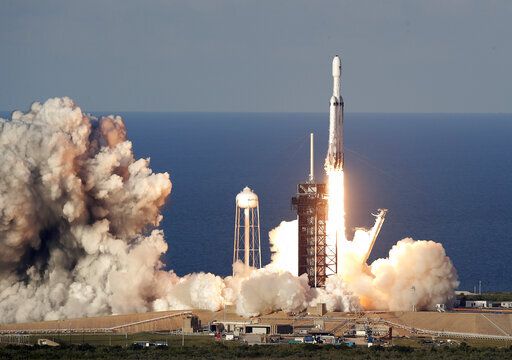
A SpaceX Falcon Heavy rocket carrying a
communication satellite lifts off from pad 39A at the
Kennedy Space Center in Cape Canaveral, Fla.,
Thursday, April 11, 2019. (AP Photo/John Raoux)

SpaceX launched its second supersized rocket
and for the first time landed all three boosters
Thursday, a year after sending up a sports car on
the initial test flight.

The new and improved Falcon Heavy thundered
into the early evening sky with a communication
satellite called Arabsat, the rocket's first paying
customer. The Falcon Heavy is the most powerful
rocket in use today, with 27 engines firing at
liftoff—nine per booster.

Eight minutes after liftoff, SpaceX landed two of
the first-stage boosters back at Cape Canaveral,
side by side, just like it did for the rocket's debut
last year. The core booster landed two minutes
later on an ocean platform hundreds of miles
offshore. That's the only part of the first mission
that missed.

"What an amazing day," a SpaceX flight

                                                                                                     1/4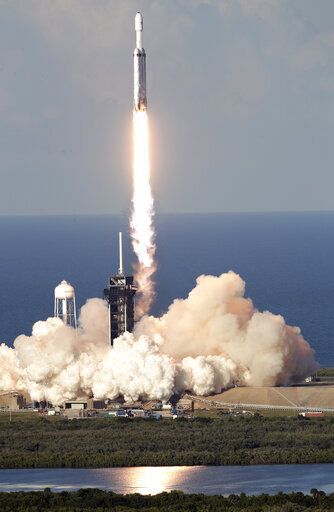
The Roadster is thought to be on the other side of
A SpaceX Falcon Heavy rocket carrying a                 the sun from us right now, about three-quarters of
communication satellite lifts off from pad 39A at the   the way around its first solar orbit, said Jon
Kennedy Space Center in Cape Canaveral, Fla.,           Giorgini, a senior analyst at NASA's Jet Propulsion
Thursday, April 11, 2019. (AP Photo/John Raoux)
                                                        Laboratory in Pasadena, California.

                                                        A couple dozen ground telescopes kept tabs on the
                                                        car during its first several days in space, but it
Because this was an upgraded version of the             gradually faded from view as it headed out toward
rocket with unproven changes, SpaceX chief Elon         the orbit of Mars, Giorgini noted.
Musk cautioned in advance things might go wrong.
But everything went exceedingly well and the            The Roadster could still look much the same as it
satellite ended up in the proper orbit. SpaceX          did for the Feb. 6, 2018, launch, just not as shiny
employees at company headquarters in Southern           with perhaps some chips and flakes from the
California cheered every launch milestone and           extreme temperature swings, according to Giorgini.
especially the three touchdowns.                        It will take decades if not centuries for solar
                                                        radiation to cause it to decompose, he said.
"The Falcons have landed," Musk said in a tweet
that included pictures of all three boosters.           SpaceX plans to launch its next Falcon Heavy later
                                                        this year on a mission for the U.S. Air Force. The
NASA offered swift congratulations. "From our           boosters for that flight may be recycled from this
iconic launch pads at @NASAKennedy, we will             one.
continue to support the growing commercial space
economy," NASA tweeted. Musk replied with three
red hearts.

Musk put his own Tesla convertible on last year's
demo. The red Roadster—with a mannequin,
dubbed Starman, likely still at the wheel—remains in
a solar orbit stretching just past Mars.

                                                        A SpaceX Falcon Heavy rocket carrying a
                                                        communication satellite lifts off from pad 39A at the
                                                        Kennedy Space Center in Cape Canaveral, Fla.,
                                                        Thursday, April 11, 2019. (AP Photo/John Raoux)

A SpaceX Falcon Heavy rocket carrying a
communication satellite lifts off from pad 39A at the
Kennedy Space Center in Cape Canaveral, Fla.,
Thursday, April 11, 2019. (AP Photo/John Raoux)

                                                                                                           2/4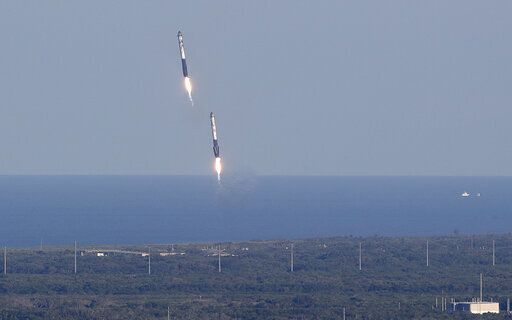
Eight minutes after liftoff, SpaceX lands two of the first-
stage boosters side by side at the Kennedy Space
Center in Cape Canaveral, Fla., Thursday, April 11,
2019. (AP Photo/John Raoux)

                                                              A SpaceX Falcon Heavy rocket carrying a
                                                              communication satellite lifts off from pad 39A at the
                                                              Kennedy Space Center in Cape Canaveral, Fla.,
                                                              Thursday, April 11, 2019. (AP Photo/John Raoux)
Eight minutes after liftoff, SpaceX lands two of the first-
stage boosters side by side at the Kennedy Space
Center in Cape Canaveral, Fla., Thursday, April 11,
2019. (AP Photo/John Raoux)                                   NASA Administrator Jim Bridenstine last month
                                                              suggested possibly using a Falcon Heavy—and
                                                              another company's big rocket—to get the space
                                                              agency's Orion capsule around the moon, minus a
                                                              crew, in 2020. But the preferred method remains
                                                              NASA's own Space Launch System mega rocket—if
                                                              it can be ready by then.

                                                              Bridenstine said everything is on the space table as
                                                              NASA strives to meet the White House's goal of
                                                              landing astronauts back on the moon by 2024.

                                                              NASA's Saturn V rockets, used for the Apollo moon

                                                                                                                 3/4
shots, are the all-time launch leaders so far in size
                                    and might.

                                   SpaceX typically launches Falcon 9 rockets. The
                                   Falcon Heavy is essentially three of those single
                                   rockets strapped together.

                                   Until SpaceX came along, boosters were discarded
                                   in the ocean after satellite launches. The company
                                   is intent on driving down launch costs by recycling
                                   rocket parts.

                                   © 2019 The Associated Press. All rights reserved.
                                   APA citation: SpaceX launches mega rocket, lands all three boosters (2019, April 12) retrieved 15 April
                                   2019 from https://phys.org/news/2019-04-spacex-mega-rocket-boosters.html

                                   This document is subject to copyright. Apart from any fair dealing for the purpose of private study or research, no
                                   part may be reproduced without the written permission. The content is provided for information purposes only.

                                                                                                                                                4/4

Powered by TCPDF (www.tcpdf.org)
You can also read


