Special Olympics Minnesota 2018 Basketball Handbook
←
→
Page content transcription
If your browser does not render page correctly, please read the page content below
SOMN.org   SOMN.ORG

      Special Olympics
      Minnesota
      2018 Basketball
      Handbook

                         1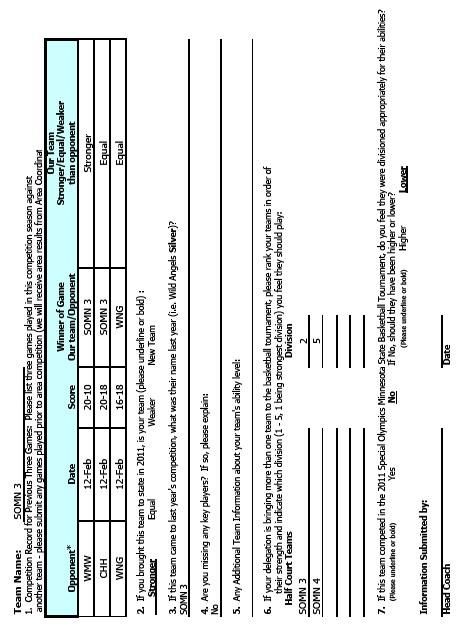
SOMN.ORG
CONTENTS
Rules ........................................................................................................3
Full Court ................................................................................................3
Half Court ...............................................................................................4
Unified Basketball .................................................................................6
Unified Individual Skills ........................................................................7
Individual Skills Information and Score Sheet ..................................8
Event Information .................................................................................9
Basketball Divisioning ..........................................................................11
Example Registration Form ................................................................12
New in 2018!
Unified Roster Change
Half Court Roster Change
Full Court Game Play
Assessing Technical Fouls
Coaching Parameters
Games Reports
Practice ideas, skill development and basketball rules can be found in the SOI Basketball
Quick Start Guide and SOI Basketball Rules at www.specialolympics.org/sports.aspx
2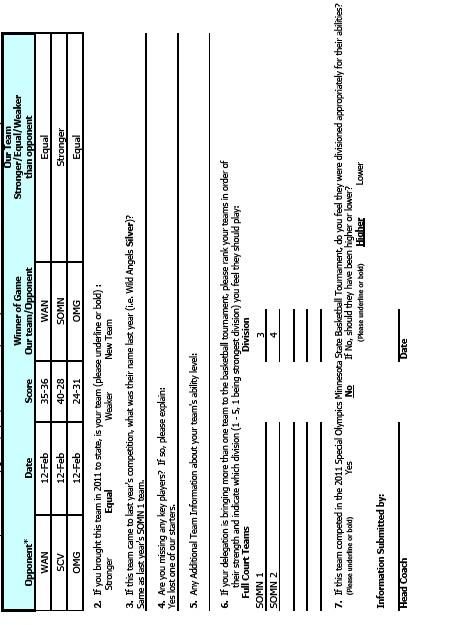
SOMN.ORG

    Special Olympics
    Minnesota
    Basketball Handbook

    RULES
    The Official Special Olympics Sports Rules for Basketball shall govern all Special Olympics
    competitions. As an international sports program, Special Olympics has created these rules based upon
    Federation Internationale des Quilleurs (FIQ) Rules. Special Olympics Minnesota adheres to Special
    Olympics Sports Rules for Basketball except in instances highlighted below.

    Full Court
    Game Play
•         Two– 18 minute halves, first half run time (clock will only stop on timeouts and injury),
          second half run time with last two minutes stop time.
          Timeouts- four- 30 second time outs per game. No carry over in overtime. One-30 second
          timeout for overtime.
          Official game ball- size 7 men’s

•          Athletes must enter the game. There is no minimum time requirement that an athlete is
           required to play.

•          If point differential exceeds 20 points in the second half, the game will go to running time
           until the differential becomes 10 points or less

•          Overtime– three minutes, stop time in the last minute. If tied after that, sudden death will
           be played and first team to score wins.

•          Substitutions on dead balls only.

•          Travel– an extra step is given, as long as it doesn’t give an advantage (example – towards the
           basket or out of a double team

•          Stop time – the clock is stopped whenever the ball goes out of bounds, a foul is called, free
           throws are being shot, and during time outs. When the ball is inbound, the clock starts once a
           player touches the ball.

    Jump Ball

    •      Starts the game
                                                                                                            3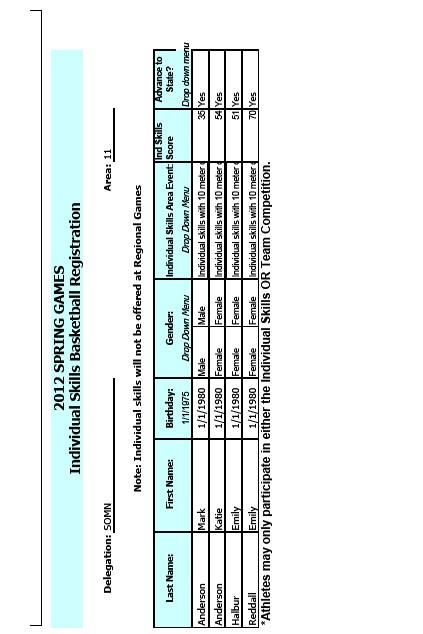
SOMN.ORG
•       Held ball results in possession awarded to alternating teams.

Time-outs

•       Four time-outs per game (no carryover to overtime), one time-out per overtime

Fouls

•        Shooting fouls results in fouled player attempting free throws
•        Fifth personal foul player is out of the game, seventh team foul shoot bonus (one and one),
        and tenth team foul shoot double bonus (two shots)
•       Technical foul results in two free throws and the procession of ball.

Violations

•       Inbound – five seconds, crossing half-court – 10 seconds, offensive lane – three seconds
•       Travel – an extra step is given, as long as it doesn’t give an advantage (example – towards the
        basket or out of a double team). Double dribble – is called.

Defense

•       All types of defenses are allowed at any time: zone, man-to-man, full and half court presses
•       No full court press is allowed after 20 point difference

Additional Items

•       No foul language
•       No jewelry, watches, or hats during play. Medical alerts allowed but must be taped down.
•       Warm up your team off the court. Only if time allows can you do a warm up on the court.
•       Recommended jersey numbers for full, half and Unified: 0-5, 10-15, 20-25, 30-35, 40-45, 50-55
•       All coaches must coach from their team bench. Only one standing coach allowed. Only the appropriate
        number of coaches (based on athlete-coach ratio) will be allowed on the bench
•       Only registered coaches are allowed to approach score table or referees. Spectators will be warned and at
        the discretion of referees and games committee will be ejected from competition.
•       A team needs to start the game with the minimum number of required positions filled to avoid a forfeit. If
        an injury occurs during a game, they can drop to one short and continue that game.

                                                                                                          4
SOMN.ORG
Half Court
Game Play
• Maximum of 7 players per roster
• A team needs to start the game with the minimum number of required positions filled to avoid a forfeit. If
an injury occurs during a game, they can drop to one short and continue that game.
• Game begins with a coin flip.
• Twenty minutes or 20 points whichever comes first. Stop time only in the last minute.
• Stop time – the clock is stopped whenever the ball goes out of bounds, a foul is called, free throws are being shot, and
during time outs. When the ball is inbound, the clock starts once a player touches the ball.
• Athletes must enter the game at least once. There is no minimum time requirement that an athlete is
required to play.
• Overtime – three-minute, stop time only in the last minute. If tied after OT, then first basket
wins sudden death.
• Substitutions on dead balls only.
• Travel/Double Dribble – see Full Court rule.
• Time-outs – two per game, one in OT (no carryover). Game clock stops during time-outs.
• Field goals – Two-point field goals and three-point field goals are awarded.
• Technical fouls will be assessed for teams who excessively cross the free throw extended line at the
referee’s discretion. 2 points will be awarded and possession of the ball retained.
Fouls
• Players cannot foul out
• No free throws in half court. If a player is fouled on a shot that goes in, the basket counts
and the offensive team retains possession of the ball.
Possession Changes
• The ball must be put in play after any dead ball by a pass only. A dead ball occurs when there
has been a foul, out of bounds, a basket has been scored or there has been a violation such
as traveling, double dribbling, etc. Any time the referee blows their whistle it is a dead ball.
The offensive player will have five seconds to put the ball in play to a teammate and the pass
does not need to cross the free-throw line extended.
• The throw-in location is always from the top of the half-circle above the free throw line. The defense
cannot cross the free-throw line to defend the offensive player and must stay at the free
throw line until the offensive player has passed the ball to a teammate. Once the ball has
been passed the defense can guard anywhere on the court.
• On any live-ball change of possession (i.e. steal, rebound of missed shot, etc.), the team
gaining possession of the ball must have one foot or the ball cross an imaginary or taped
5SOMN.ORG
line that extends through the free-throw line to both side lines. During the course of taking
the ball back past this line, and in the course of bringing the ball back across the line toward
the basket, the opposing team may defend the player(s) handling the ball at any time during
this transition.
• Therefore, teams are not allowed “free backs” on a live-ball change of possession.
• The defense is entitled to take any legal actions to try and regain possession of the
ball, however, should they gain possession of the ball, they will be required to bring it
back past the line to reestablish their possession and make a legal attempt to score.
• Points will not be scored by illegal put-backs during change of possession. Team making the illegal
shot will result in a turn over- change of possession
Coaching
• During Half court games, one coach from each team may coach from the baseline. The second coach will need
to coach from the bench.
• Only registered coaches are allowed to approach score table or referees. Spectators will be warned and at the
discretion of referees and games committee will be ejected from competition.
6SOMN.ORG
Unified Basketball
Roster & Lineup
Maximum 16, Minimum six person roster. Must have five players to start the game (three Athletes
and two Unified Partners at all times, failure to adhere to this ratio will result in a forfeit). Teams
must register at least three Unified Partners. Unified Partners may not exceed the number of
athletes. All Athletes must at least enter the game, no minimum minutes of playing time required
though.
Unified State Basketball Color Model & Scoring Ratio
Unified color model is often not enforced at Area competition during the divisioning process due to the number
participating teams. Unified Partners are still required to meet the 25% scoring ratio.
GREEN – no scoring ratio
Athletes and partners should be of similar skill level and ability. Does not matter how many points are scored by
the athletes or partners. Athletes or partners may score a majority of a team’s total points.
YELLOW – Unified Partners 50% max
In general, Unified Partners are at a higher skill level. Partners can score up to 50% of their team’s total score. At
the conclusion of the game, if partners score more than 50% of their team’s total points then the scorer’s table will
subtract partners’ points from the team’s total until it is a 50-50 ratio with the athletes points scored.
RED – Unified Partners 25% max
Unified Partners are at a higher skill level. Partners can score up to 25% of their team’s total score. At the
conclusion of the game, if partners score more than 25% of their team’s total points then the scorer’s table will
subtract partners’ points from the team’s total until it is a 25-75 ratio with the athletes points scored.
Contesting Scoring Ratio
Coaches may contest the ratio of the score but this must take place within five minutes of the conclusion of the
game. Tournament director must be present for any contest. A team will not automatically lose a game if a partner
falls outside of the approved ratio (which has happened in previous years). Now if teams fall outside of their color
level’s scoring ratio their team’s total points will be adjusted according to the color they are in.
EXAMPLE: Team A is in the YELLOW level and partners score 18 out of their teams 30 total points. At the conclusion of the game
event staff would subtract points from the partners until they fall in the approved ratio. As a result, Team A’s final score would be
24 points (6 pts subtracted from the partners original 18 scored means the updated approved scoring allows the partners to score
12 of the teams total 24 points).
7SOMN.ORG
Coaches & Unified Partners Roles
Any individual that is registered to coach at the Unified competition cannot participate as a Unified
Partner. Coaches are only allowed to coach.
Game Play Rules (same as full court rules)
Registering for Color Model?
HOD/Coaches register for their color level on the quota form. Once registration closes we may need to
move a team to a different color level based on divisioning and the number of teams that registered;
but our emphasis will be to make sure that a team’s experience and skill level are similar to the teams
they will compete against.
Unified Individual Skills
Individuals will practice as a unified pair. Both athlete and unified partner will go through the skills event
together. Teammates will not be allowed to physically assist athletes during the skills drills. Both athlete
and partner will go through skills together but receive separate skills scores which will be combined for
a final team score.
Registering for Unified Individual Skills?
Athletes and unified partners will be registered as a pair with two separate assessment scores. Unified
pairs will be divisioned based upon combined team scores and age.
8SOMN.ORG
EVENT INFORMATION
New in 2018: In an effort to reduce the number of day-of event registration and roster errors, we are asking for the HOD
or Head Coach for each sport to reply to the email you receive from your program staff acknowledging you have
reviewed the games reports & team rosters and all the information listed is correct. Please also double check to make
sure no one is missing.
Area Competitions
Area Date Location City Register Contact
By
Area 1/2 March 15 BSU Gillett Wellness Center Bemidji Feb. 28 dani.druse@somn.org
Unified
Area 3 April 21 Lincoln Park Middle School Duluth April 6 dani.druse@somn.org
Area 4 April 26 Kennedy Secondary School Fergus Falls April 12 leah.wolkow@somn.org
Area 5 April 18 Staples Motley HS Staples April 4 leah.wolkow@somn.org
Area 5 March 14 Pierz Healy HS Pierz Feb 28 leah.wolkow@somn.org
Unified
Area 6/8 April 7 Wilmar High School Wilmar March 25 leah.wolkow@somn.org
Area 7 April 7 Rogers High School Rogers March 26 emily.garness@somn.org
Area 9/10 April 21 St. Clair School Mankato April 8 zak.armstrong@somn.org
Unified
Area 11 April 14 Bloomington Jefferson Bloomington April 2 sam.leidholt@somn.org
Area 12 April 28 Hastings High School Hastings April 15 sarah.richardson@somn.org
Area 13 April 29 Stillwater High School Stillwater April 15 emily.garness@somn.org
Regional Basketball (not a qualifier for State)
Date Location Register Contact
By
March 17 Hastings & Monticello March 4 devin.kaasa@somn.org
May 13 Hastings & St. Michael- April 30 devin.kaasa@somn.org
Albertville Activity Center
Regional competition includes: Full Court, Half Court, and Unified. If delegations have athletes participating in
full court along with unified, scheduling conflicts may occur in which the athlete will need to choose which game
to play in. Athletes participating in half court are only allow to participate in half court due to schedule conflicts.
9SOMN.ORG
Summer Games
Basketball Date Location
Unified June 22-23 Anderson Athletic and Recreation Complex, University of St. Thomas
Ind. Skills June 22 Anderson Athletic and Recreation Complex, University of St. Thomas
Full Court June 22-24 Anderson Athletic and Recreation Complex, University of St. Thomas
Half Court June 22-24 Anderson Athletic and Recreation Complex, University of St. Thomas
Competition Details
• Quota due March 25, 2018
• Registration due May 29, 2018
• Celebration Ceremonies will be on Friday night
• Full Court Roster Size – five minimum, 16 maximum
• Half Court Roster Size – three minimum, 7 maximum
• Unified Roster Size – three unified partners minimum, six players minimum, 16 maximum
• Teams are guaranteed at least three games
• Awards are presented as divisions finish
• Athletes cannot compete in multiple sports
• Athletes can only participate in one basketball event due to conflicting schedules
10SOMN.ORG
INDIVIDUAL SKILLS INFORMATION AND SCORE SHEET
Athletes that compete in Individual Skills must participate in Individual Skills at practice and record
their score on the registration form. Each athlete must complete the Target Pass, Spot Shot, and
Dribble (Ten-meter dribble or Speed dribble, the speed station is for athletes that are not physically
capable of doing the ten-meter dribble). The layout and scoring for each skill station are listed on
the Individual Skills score sheet below as well as the SOI Basketball Rulebook.
Target Pass
a) The athlete receives three points for hitting the wall inside the square.
b) The athlete receives two points for hitting the lines of the square.
c) The athlete receives one point for hitting the wall but not in or on any part of the square.
d) The athlete receives one point for catching the ball in the air or after one or more bounces while standing in the box.
e) The athlete receives zero points if the ball bounces before hitting the wall.
The athlete’s score will be the sum of the points from all five passes. Sum
1 2 3 4 5
Ten-meter Dribble
a) The athlete begins from behind the start line and between the cones.
b) The athlete starts dribbling and moving when the official signals.
Conversion Chart c) The athlete dribbles the ball with one hand for the entire 10 meters (32 feet 9 3/4 inches).
Seconds Points d) A wheelchair athlete must alternate, taking two pushes followed by two dribbles for legal dribbling.
0–2 30 e) The athlete must cross the finish line between the cones and must pick up the basketball to stop the dribble.
2.1–3 28
3.1–4 26 f) If an athlete loses control of the ball, the clock continues to run. The athlete can recover the ball. However, if the ball goes
4.1–5 24 outside the 1.5 meter lane, the athlete can either pick up the nearest back-up basketball or recover the errant ball to continue the
5.1–6 22 event.
6.1–7 20
7.1–8 18 Scoring
8.1–9 16
9.1–10 14 a) The athlete will be timed from the signal “Go” to when he/she crosses the finish line between the cones and picks up the
10.1–11 12 basketball to stop the dribble.
11.1–12 11
12.1–14 10
b) A one-second penalty will be added every time the athlete illegally dribbles (e.g., two-hand dribbles, carries the ball, etc.).
14.1–16 8 c) The athlete will receive two trials. Each trial is scored by adding penalty points to the time elapsed and converting the total to
16.1–18 6 points based on the Conversion Chart.
18.1–20 4
20.1–22 2
d) The athlete’s score for the event is his/her best of the two trials converted into points. (In case of a tie, the actual time will be
Over 22 1 used to differentiate place).
Please record Time and Score for both trials
Best
1 2
Time Score Time Score
OR
Speed Dribble
a) Athlete may use only one hand to dribble.
b) Athlete must either be standing or be sitting in a wheelchair or another type of chair with similar dimensions while competing.
c) Athlete starts and stops dribbling at the sound of the whistle.
d) There is a 60-second time limit imposed. The objective is to dribble the ball as many times as possible during this period.
e) Athlete must stay in the designated circle while dribbling.
Scoring Score
a) Athlete receives one point per legal dribble within the 60 seconds.
b) Counting stops and the event ends when the basketball rolls out of the circle for the third time.
Spot Shot
Six spots are marked on the floor. Start each measurement from a spot on the floor under the front of the rim. The
spots are marked as follows:
a) #1 & #2 =1.5 meter (4 feet11 inches to the left and right plus 1 meter (3 feet 3 1/2 inches) out.
b) #3 & #4 =1.5 meter (4 feet11 inches to the left and right plus 1.5 meter (4 feet 11 inches) out.
c) #5 & #6 = 1.5 meter (4 feet 11 inches to the left and right plus 2 meters (6 feet 6 3/4 inches) out.
Scoring
a) For every field goal made at spots #1 and #2, two points are awarded.
b) For every field goal made at spots # 3 and #4, three points are awarded.
c) For every field goal made at spots # 5 and #6, four points are awarded
d) For any field goal attempt that does not pass through the basket but does hit either the backboard and/or the ring, one point is awarded.
e) The athlete’s score will be the sum of the points from all 12 shots.
Sum
1 2 3 4 5 6 7 8 9 10 11 12
Final Score
The athlete’s final score for the Individual Skills Contest is determined by
adding together the scores achieved in each of the three events.
11SOMN.ORG
BASKETBALL DIVISIONING
State Basketball Divisioning
• Coaches complete individual assessment scores for each athlete and add scores to
determine team assessment score. Assessment scores are submitted on the
registration form.
• At State, divisioning is based on assessment scores and the results from previous
competitions. When divisioning for State much more emphasis is put on common
opponents, coach notes, previous game results, and competitions.
• Divisioning is done by SOMN staff, coach feedback, and a divisioning committee consisting
of coaches from all Areas. The committee will meet for one to two hours either in person or
via conference call two weeks before Summer Games.
• If you or someone from your delegation is interested in being a part of the State basketball
divisioning committee please contact Jasmine Jones jasmine.jones@somn.org
Divisioning Team Sports
The divisioning process for team sports is much different, and much harder, than individual sports.
Unlike most individual sports, team sports do not have concrete distances or times that can be used,
although we do have teams submit assessment scores for individual players. Once a game starts,
however, the information contained in the assessments often takes a back seat to the dynamics at
play minute-by-minute, play-by-play on the court or field.
The challenge with divisioning team sports is that there are many factors that affect how a team
performs on any given day — missing players, illness, penalties, behavior, coaching, who’s hot and
who’s not, individual match ups, etc. With divisioning in team sports, much more emphasis is put on
game results, common opponents, coach rankings and coach notes. There is not a perfect science to
ensure that all divisions will have close games, which is why we have developed a process for
team sports that includes divisioning committees. The divisioning committees allow for more coach
involvement, better team evaluation and improved divisioning. We recognize there may be some
games during a competition that are not competitive, but we hope that the team sports divisioning
process creates the most equal divisions possible.
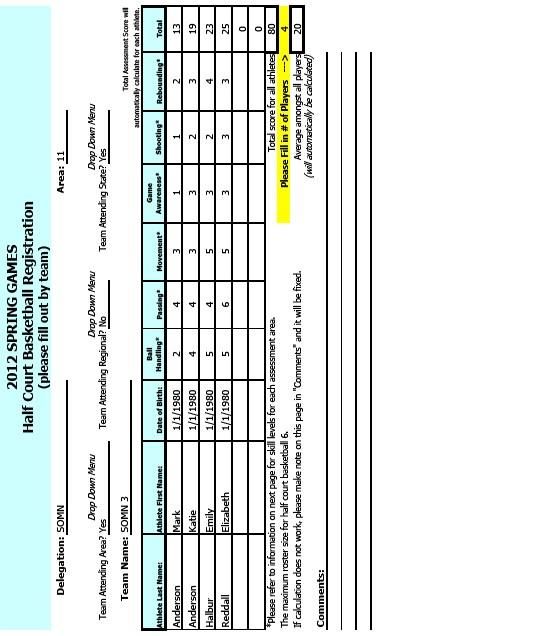
12EXAMPLE REGISTRATION FORM
SOMN.ORG
Basketball Assessment Tool
Delegation Area:
Team Attending Area? Team Attending Regional? Team Attending State?
Team Name:
Ball Game
Athlete Last Name: Athlete First Name: Date of Birth: Handling* Passing* Movement* Awareness* Shooting* Rebounding* Total
*Please refer to information on next page for skill levels for each assessment area. Total score for all athletes
The maximum roster size for full court basketball 16. Please Fill in # of Players --->
Average amongst all players
Comments:
1112
13
14
15
16
You can also read


