Spy Kids: Code Talkers - Dane G. Hansen Foundation - Eisenhower Foundation
←
→
Page content transcription
If your browser does not render page correctly, please read the page content below
World War II Remembered
           Field Trip Enhancement Program

 Spy Kids:
Code Talkers

      Generously Sponsored by the
   Dane G. Hansen Foundation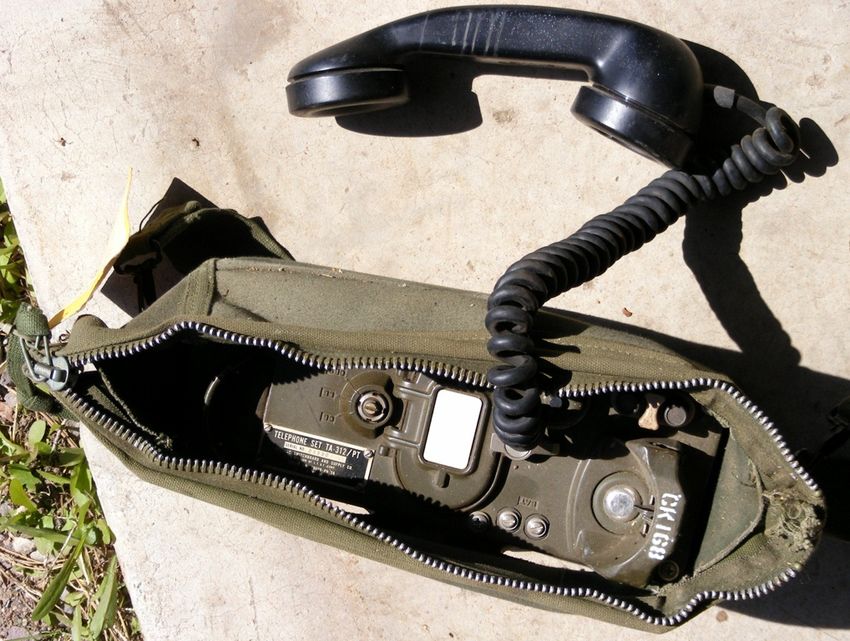
Spy Kids: Code Talkers

INTRODUCTION                                      CONTENTS

Crucial sources of enemy information              3-4  Lesson Plan
were obtained by surveillance, code               5    Mission 1 worksheet
breaking, and subterfuge throughout               6     Mission 2 worksheet
WWII. Intelligence agencies helped the
                                                  7-32 Mission 3 worksheets and
Allies win the war by slipping behind                  coordinating information cards
enemy lines to serve as spies, or working
                                                  33   Mission 4 worksheet
to break Axis message codes and steal
critical information. In this program,            34   Navajo Dictionary Alphabet
students will try out their decoding skills       35-36 ATTACK flow chart
and examine the tools and manpower the            37-38 Need A Word For That?
Allies used to defeat the enemy.                  39-40 Sources
                                                  NATIONAL CURRICULUM STANDARDS
OBJECTIVES
                                                  All lesson plans meet numerous national
                                                  Common Core State Standards for Literacy in
• Students will gain knowledge of
                                                  History/Social Studies, Science and Technical
  American Indian code talkers during             Subjects, as well as National Curriculum
  World War II.                                   Standards for Social Studies.

• Students will use higher level thinking          Common Core St Standards                6th-8th
  skills to encode and decode messages.
                                                              RI - Reading Informative
                                                                                              4, 7
                                                  Standards

• Students will summarize and present                                   Text
  information gained.                                            SL - Speaking and
                                                                                            1, 2, 4
                                                                     Listening
TARGET AUDIENCE: Grades 6-8
                                                               RH - History/Social
TIME REQUIREMENT: 1 hour                                                                   2, 3, 4, 7
                                                                     Studies

ACKNOWLEDGEMENTS                                        Natl. Curriculum Standards for Social Studies

                                                                     1: Culture           Middle Grades
This unit was produced in February 2014
by the Eisenhower Foundation. Donna                            2: Time, Continuity, and   Middle Grades
                                                  Themes

Reynolds and Mitzi Bankes Gose, writers.                               Change

Thanks to the Dane G. Hansen Foundation                       4: Individual
                                                                                          Middle Grades
for funding and the Eisenhower                                Development and Identity
Presidential Librar y, Museum and
Boyhood Home for support.                                     8: Science Technology,      Middle Grades
                                                              and Society

                                              2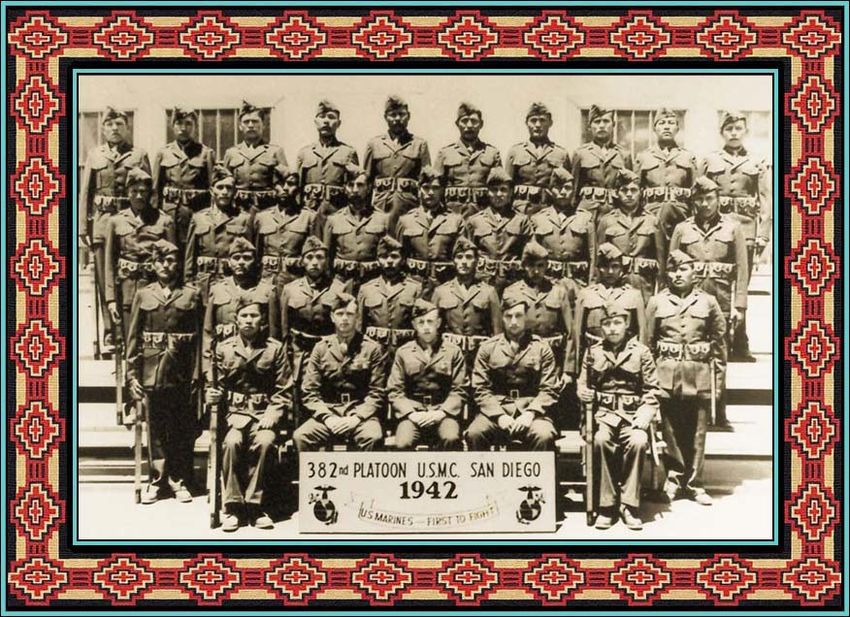
Lesson Plan

PREPARATION:
Students are to be paired up; each pair is given                 talker would translate the coded
a Top Secret folder containing:                                  message back into English
      *Navajo Dictionary Alphabet                                (DECODE), circle the first
      *ATTACK flow chart                                         letters of each English word,
      *Need A Word For That?                                     and then give the final message
      *Mission worksheet 1                                       to its intended recipient.
      *Mission worksheet 2
      *Mission worksheet 3 (note that                    4. Have students find the sheet titled
       this sheet is different for each folder)          Need a Word For That? in their Top
      *Mission worksheet 4                               Secret folder. Use it to direct students
Have copies prepared of the information cards            through the following information: The
that coordinate with the Mission 3                       c o d e b e c a m e m o r e c o mp l i c a t e d
worksheets.                                              because many of the words needed
                                                         simply did not exist in the American
FACILITATION:                                            Indian languages. There had never
                                                         been “tanks” or “battleships” in their
1. Deliver background information to the                 past lives, so no word existed. As a
students. (see page 4)                                   result, the Indians developed special
                                                         words for these new terms by looking
2. Have students open their Top Secret folder            at pictures of the items and choosing
and look at the Navajo Dictionary Alphabet.              words they knew that seemed to to fit
Show how the alphabet was coded: In English,             the pictures. For example, tanks
“A” is the first letter for the word “ant,” and in       reminded them of turtles, so the native
Navajo the word for “ant” is “WOL-LA-CHEE.”              word for turtle, WAKAREE’E, was
And so on through the alphabet.                          adopted. A battleship was called LO-
You may want to tell students that the real              TSO, meaning “whale.”
Navajo Dictionary Alphabet used up to three              Ask students: What animal or word
different words for each letter, just to                 from nature would you use to describe
complicate the code. (It can be found online.)           a fi g h t e r p l a n e ? ( U s e t h e fi n a l
We are using a simplified version to quickly             hummingbird image to divulge the
learn how to use the code.                               answer.)

3. Have students find the ATTACK flow chart              5. Direct students to find the Mission
in their Top Secret folder. Use it to direct             1 worksheet in their Top Secret folder.
students through the encoding and decoding               Guide students through completing
process. The following informational script              this encoding exercise.
may be helpful:
      First, code talkers were given a                   6. Direct students to flip over to the
      message in English from their                      Mission 2 side of the worksheet. Guide
      commanders which they translated into              students through completing this
      code (ENCODE) and then transmitted                 decoding exercise.
      by walkie-talkie or field phone on to
      another code talker. This second code

                                                     3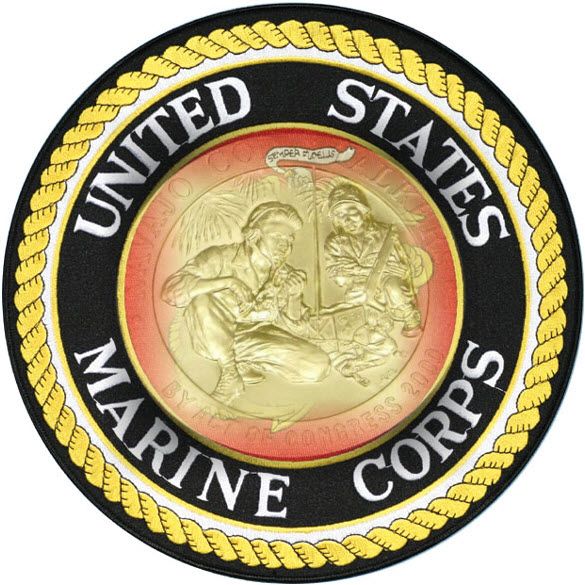
7. Have students find the Mission 3
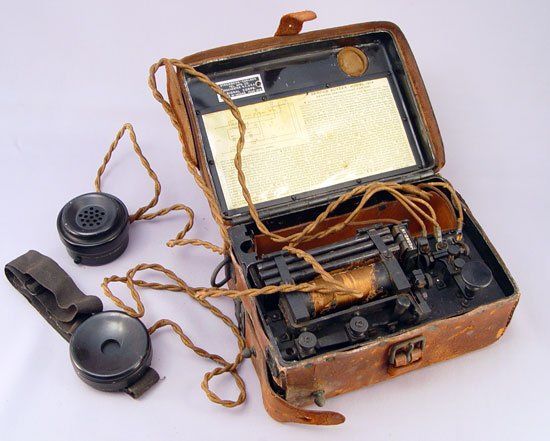
worksheet in their Top Secret folder. Direct            Look for World War
students to decode their folder’s unique                II signal corps
Mission 3 message and bring it to you. If               equipment at local
they have completed it correctly, give them             museums, antique
the coordinating information card.                      stores, or online
                                                        sellers to let
8. They are to read that information and use            students get their
it to complete the top portion of the Mission           hands on this
4 worksheet (It should be copied onto the               history!
backside of Mission 3).
Note that there is another activity on the
bottom portion of the Mission 4 worksheet
for students who have extra time.

9 . H ave s t u d e n t p a i r s p r e s e n t t h e
information they learned with Missions 3
and 4. Become familiar with the information
on their cards so you can enhance their
presentation for the class.

                   BACKGROUND INFORMATION FOR THE FACILITATOR
Today we are going back in time to the early 1940’s, during WWII. World War II was made
up of two teams: the Allies and the Axis. Three main countries made up the Allied forces.
They were the U.S., Great Britain, and the USSR. Dwight D. Eisenhower was chosen to be a
Supreme Allied Commander of these Allied forces. The main Axis countries were Germany,
Japan, and Italy. However, over 100 other countries were involved (making it a “world
war”), but these were the most influential.

Military information needed to be shared and every country involved had secrets they
wanted to keep—and information they wanted to steal—from the enemy. Keep in mind that
this time period was before the invention of computers, cell phones, and other modern
communication devices.      Most importantly—messages needed to be top secret. The
methods used to accomplish this were numerous. We are going to spend the next hour
learning about one specific and very successful way that the United States military was
able to keep their messages a secret from the enemy during World War II: Code Talkers.

Code talkers were American Indian men who served in the U.S. military and used their
native tribal languages as a means of secret communication during the war. Code talkers
transmitted secret tactical messages over military telephone or radio networks. American
Indian languages worked well because few people outside of each tribe had ever learned to
speak the language. Therefore, it would be enough to speak in their own language, but they
went a step farther and put their language into a code. Let’s take a look!

                                                    4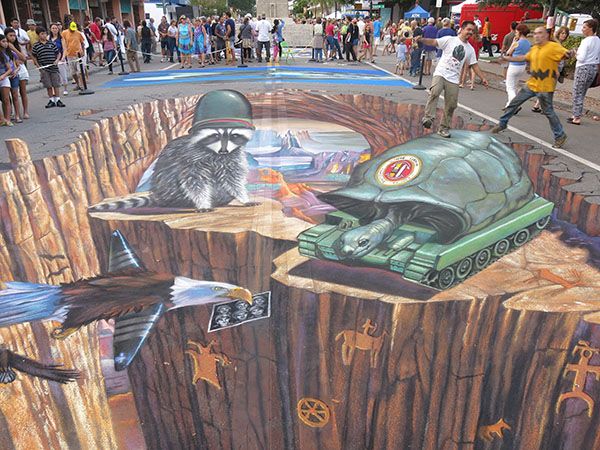
MISSION 1:
Your Commanding Officer has given you the following message to
encode and transmit:
                                      ENEMY IS NEAR

       1ST LETTER        ENGLISH WORD            NAVAJO WORD

           E             EAR                       AH-JAH

           N             NEEDLE

           E

              o m ple    te
          n c
   missio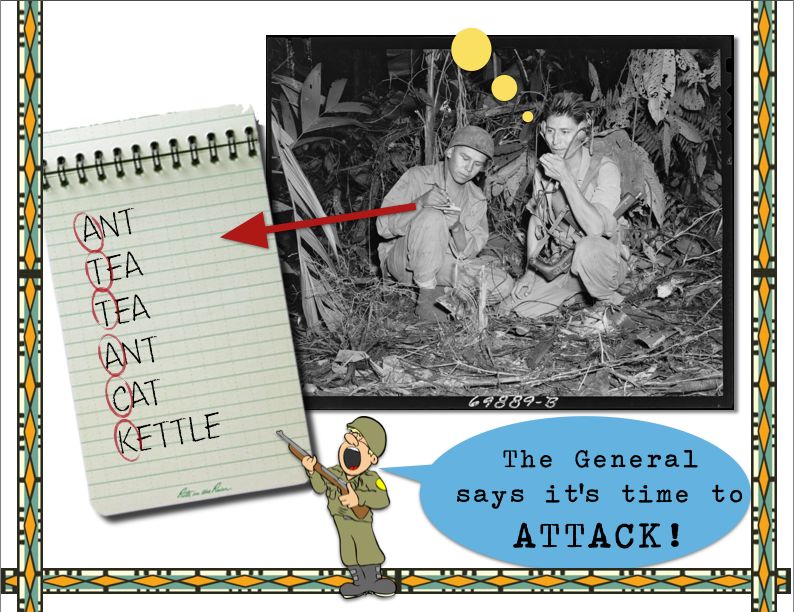
MISSION 2
You have received the following incoming message to decode and give
to your troop’s commander.

                                             DIBEH AH-JAH TSAH BE
                                             TSE-GAH AH-JAH DIBEH-
                                             YAZZIE CLA-GI-AIH

         NAVAJO WORD             ENGLISH WORD            FIRST LETTER

       DIBEH                    SHEEP                      S

       AH-JAH                   EAR

       TSAH

                   The General says

                                                                 o m p l ete
                                                               c
                                                       mission
1.

                         MISSION 3
     You have received the following incoming message to decode. When you have
     completed this, give to your troop’s commander (the teacher) who will
     exchange it for a larger message that you will report to your class.

          MOASI GAH WOL-LA-CHEE BESH-DO-TLIZ TSAH-AS-ZIH
          GLOE-IH TSE-GAH TKIN D-AH AH-JAH
          TSIN-TLITI WOL-LA-CHEE TSAH

            NAVAJO WORD            ENGLISH WORD          FIRST LETTER

                                  Decoded Message:

                             _____       _____      ___
1.

                             CRAZY WHITE MAN
     Comanche Indians of the 4th Signal Company created a
     dictionary of over 100 code terms using words in their
     own languages. Using a substitution method similar to
     the Navajo, the Comanche word for tank was “turtle,”
     the machine gun was a “sewing machine,” and Adolf
     Hitler was “crazy white man.” Because the Navajo's
     native language had no word for the military terms
     needed for communication, they also made up a unique
     blend of words to designate words they needed. This
     helped make the code more complex and difficult for
     enemies to break. Even other untrained members of
     their own tribes could not make sense of it. Can you
     spot some of these examples in the chalk drawing
     below? It was created as a tribute to the code talkers.
     colonel = silver eagle
     pyrotechnic = fancy fire
     hand grenade = potato
     gofasters = running shoes
     ink sticks = pens
     bomber = buzzard
     scout = short raccoon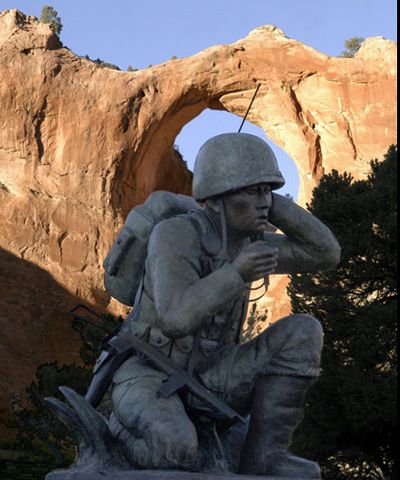
2

                       MISSION 3
    You have received the following incoming message to decode. When you have
    completed this, give to your troop’s commander (the teacher) who will
    exchange it for a larger message that you will report to your class.

          WOL-LA-CHEE BE A-KHA DIBEH-YAZZIE CHUO
          TSE-GAH TKIN D-AH DIBEH-YAZZIE AH-JAH GAH

         NAVAJO WORD            ENGLISH WORD           FIRST LETTER

                           Decoded Message:

                          _____ ______
2

                                ADOLF HITLER
    Adolf Hitler knew about the successful use of code talkers during WWI, so he sent
    a team of anthropologists to learn Native American languages before the
    outbreak of WWII. The many languages and dialects made it too difficult for them
    to learn much, but because of Hitler’s attempts, the U.S. Army did not implement
    a large-scale code talker program in the European Theatre. The majority of code-
    talkers were used in the Pacific Theatre against the Japanese.
3
MISSION 3
You have received the following incoming message to decode. When you have
completed this, give to your troop’s commander (the teacher) who will
exchange it for a larger message that you will report to your class.
SHI-DA D-AH WOL-LA-CHEE TSE-GAH
NA-HASH-CHID AH-JAH WOL-LA-CHEE MOASI TSE-GAH
NAVAJO WORD ENGLISH WORD FIRST LETTER
Decoded Message:
____ _____3
UTAH BEACH
General Eisenhower was the Supreme Allied Commander for the European
Theater. Under his command, on June 6, 1944, 160,000 Allied troops landed
along a 50-mile stretch of heavily-fortified French coastline to fight Nazi Germany
on the beaches of Normandy, France. The invasion was a success, and by day’s
end, the Allied gained a foot-hold in Normandy and began the march across
Europe to defeat Hitler.
Among those Allied troops were fourteen Comanche code talkers serving with the
4th Infantry Division, 4th Signal Company. Under heavy German fire on Utah
Beach (one of the Normandy invasion sites), they laid communications lines and
began sending messages in coded Comanche. Theodore Roosevelt, Jr. was the
commanding officer of the 4th Infantry Division on Utah Beach. Roosevelt’s
driver and radio man was Private First Class Larry Saupitty, a Comanche code
talker. He sent the first coded message: “We made a good landing. We landed in
the wrong place. We are five miles right of the designated area. Five miles inland.
The fighting is getting fierce and we need help.”4
MISSION 3
You have received the following incoming message to decode. When you have
completed this, give to your troop’s commander (the teacher) who will
exchange it for a larger message that you will report to your class.
TSAH A-KHA GAH D-AH TSE-GAH
WOL-LA-CHEE CHUO GAH TKIN MOASI WOL-LA-CHEE
NAVAJO WORD ENGLISH WORD FIRST LETTER
Decoded Message:
_____ ______4
NORTH AFRICA
Under the leadership of General Eisenhower, the Americans made their first
large-scale appearance with the Allied forces in when they landed in North
Africa in November 1942. Several Meskwaki code talkers were among the
soldiers serving in the 168h Infantry, 34th Red Bull Division who made those
initial advances on the beaches of Algiers, North Africa. The code talkers saved
many lives using their unique language to communicate vital military messages
about enemy troop movements, battlefield tactics, and directions for artillery
fire. Eisenhower called them his “eyes and ears.”
With the support of the vast American fleet, airpower, and
ground troops, the Allies gained territory in North Africa
and then launched attacks on the coast of Italy in
September 1943. The Meskwaki code talkers continued
with this Italian campaign, fighting the mighty German
defenses through the mountains north of Naples, and finally
liberating Rome on June 4, 1944.
These are the eight
Meskwaki Indians from
the Sac & Fox tribe in
Tama, Iowa who became
code talkers with the
Army’s 34th Infantr y
Division in the North
Africa campaign, known
as Operation TORCH.5
MISSION 3
You have received the following incoming message to decode. When you have
completed this, give to your troop’s commander (the teacher) who will
exchange it for a larger message that you will report to your class.
SHI-DA TSAH NA-HASH-CHID GAH A-KAH JAD-HO-LONI AH-JAH TSAH
NAVAJO WORD ENGLISH WORD FIRST LETTER
Decoded Message:
________5
UNBROKEN
The codes developed and used by the code talkers were never broken by enemy
cryptographers. In the spring of 1942, twenty-nine Navajo men volunteered to
join the US Marine Corps. They were trained as soldiers and became the 382nd
Platoon. This group created the Navajo code, which was first tested on
untrained Navajos who were not
able to break it. By the end of the
war, there were 420 Navajo code
talkers. They sent and received
thousands of critical messages and
not one was deciphered. Part of
the code’s complexity is that every
syllable in the Navajo language
means something different and
must be pronounced correctly.
Subtle differences can completely
change the meaning. Chester Nez
(on left), is one of the original
Navajo men who developed and
used this unbroken code.6
MISSION 3
You have received the following incoming message to decode. When you have
completed this, give to your troop’s commander (the teacher) who will
exchange it for a larger message that you will report to your class.
BE AH-JAH MOASI DIBEH-YAZZIE WOL-LA-CHEE DIBEH DIBEH
TKIN CHUO TKIN AH-JAH BE
NAVAJO WORD ENGLISH WORD FIRST LETTER
Decoded Message:
____________6
DECLASSIFIED
Because the military thought they might need to use the code in future military
engagements, the Navajo code talkers were sworn to secrecy and the code was
classified as Top Secret. In fact, some Navajo code talkers were used in the
Korean war in the 1950's and in Vietnam in the 1960’s. It wasn’t until 1968
that the government finally declassified the program.
“When we got out, discharged, they told us this thing you that you guys did
is going to be a secret. When you get home you don’t talk about what you did;
don’t tell your people, your parents, family, don’t tell them what your job was. This
is going to be a secret; don’t talk about it. Just tell them you were in the service,
defend your country and stuff like that. But, the code, never, never, don’t
mention; don’t talk about it. Don’t let people ask you, try to get that out of you
what you guys did. And that was our secret for about 25, 26 years. Until August
16th, 1968. That’s when it was declassified; then it was open. I told my sister, my
aunt, all my families what I really did.” —Chester Nez, Navajo Code Talker,
National Museum of the American Indian interview, 20047
MISSION 3
You have received the following incoming message to decode. When you have
completed this, give to your troop’s commander (the teacher) who will
exchange it for a larger message that you will report to your class.
AH-TAD A-KHA DIBEH-YAZZIE BE
TSIN-TLITI AH-JAH BE WOL-LA-CHEE DIBEH-YAZZIE
NAVAJO WORD ENGLISH WORD FIRST LETTER
Decoded Message:
____ _____7
GOLD MEDAL
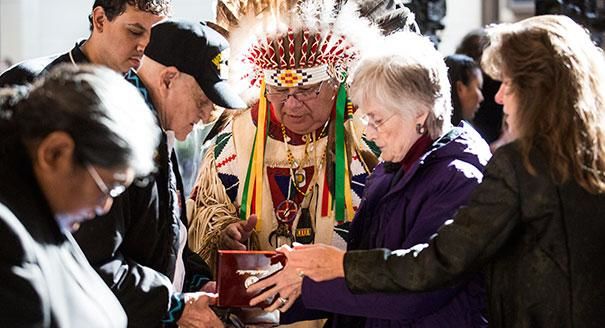
Congressional Gold Medals were awarded to Navajo code talkers in 2000. All
other tribes received medals in 2008. Several Code Talkers were wounded in
battle but all survived the war. Each tribe’s gold medal had a different design.
These valiant soldiers are credited with saving the lives of thousands of
American and Allied service men. In 2013 Congress and President Obama
honored the code talkers and their descendants at a reception in Washington D.C.
They will be forever remembered by a grateful nation.8
MISSION 3
You have received the following incoming message to decode. When you have
completed this, give to your troop’s commander (the teacher) who will
exchange it for a larger message that you will report to your class.
AH-YA-TSINNE WOL-LA-CHEE CLA-GI-AIH WOL-LA-CHEE TSAH
NAVAJO WORD ENGLISH WORD FIRST LETTER
Decoded Message:
_____8
JAPAN
Code talkers participated in all of the major battles in the Japanese-
controlled Pacific Theatre including Guadalcanal, New Georgia, Bougainville,
Tarawa, Cape Gloucester, New Britain, Kwajalenin, Roi-Namur, Enewetok Atoll,
Saipan, Tinia, Guam, Peleliu, Iwo Jima, Okinawa.
The speed and accuracy of the Navajo code talkers was amazing. At the
Battle of Iwo Jima, Major Howard Connor had six Navajo code talkers working
around the clock during the first two days of the battle. These six sent and
received over 800 messages, all without error. Connor later stated, “Were it not
for the Navajos, the Marines would never have taken Iwo Jima” from the
Japanese.
Former code talker Bill Toledo, recalled an incident on Iwo Jima when his
battalion commander told him to request an artillery barrage on a nearby hill
that sat atop a pillbox and a tunnel. Toledo encoded the request and sent it to his
Navajo counterpart about a mile away. The attack was launched, and Marines
took advantage of the dust to lob in hand grenades and dynamite to destroy the
hill. “Elapsed time: six to eight minutes,” Toledo said. “The system was efficient.”
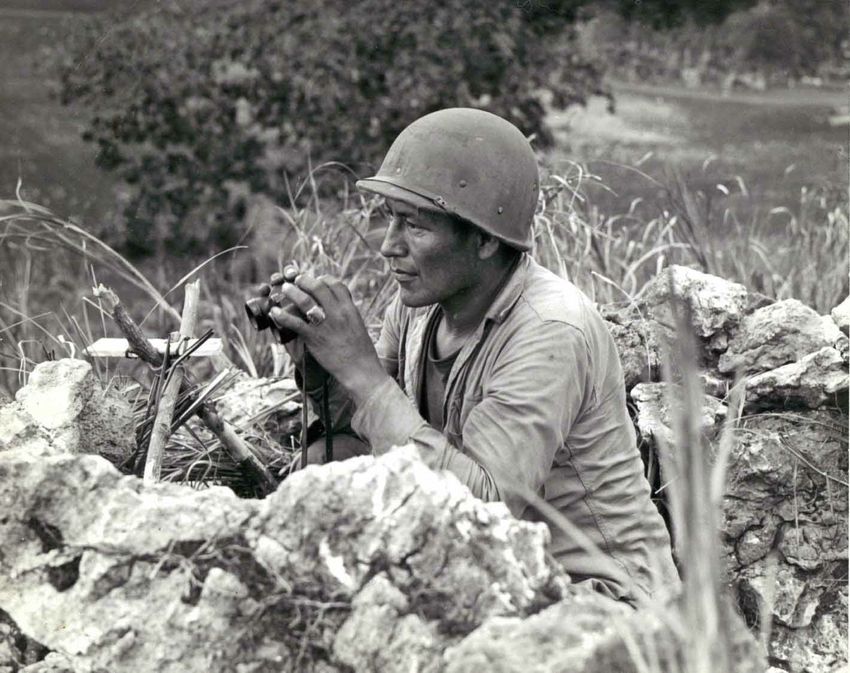
Code talker William Dean Wilson (below) is standing in front of the memorial
statue based of Marines raising the flag at Iwo Jima.
Below right:
Code talker William
Private First Class
Dean Wilson (right) is
George H. Kirk,
standing in front of the
USMC and Private
memorial statue based
First Class John V.
of Marines raising the
Goodluck, USMC.
flag at Iwo Jima.
Below left:
Unknown Marine
code talker in
foxhole with
communication
equipment.9
MISSION 3
You have received the following incoming message to decode. When you have
completed this, give to your troop’s commander (the teacher) who will
exchange it for a larger message that you will report to your class.
DIBEH TKIN AH-TAD TSAH WOL-LA-CHEE DIBEH-YAZZIE
MOASI A-KHA GAH CLA-GI-AIH DIBEH
NAVAJO WORD ENGLISH WORD FIRST LETTER
Decoded Message:
______ _____9
SIGNAL CORPS
Following basic military training, a Code Talker completed extensive
training in communications and memorizing the code. Code Talkers did more
than speak into a hand-held radio or phone. They had to know how to operate
both wire and radio equipment, and often had to cary it on their backs. They had
to know how to set up and maintain the electronic communication wires or lines.
The work of sending and receiving messages on the
battlefield made the difference of life and death.
After they memorized more than 200 Navajo-
based code terms and their English equivalents, the code
talkers were put into combat units and sent into battle,
armed with their rifles — and their radios, telephones,
pens and notebooks.
“While we were shooting and the radio or
telephone rang, we put down our rifles and took the
messages,” former code talker Samuel Tso said.
With 40 pounds of communication gear on his
back, “I was ready to send a message or receive a
message anytime, regardless of what was going on
around me,” said code talker Keith Little, who served on
the Marshall Islands, Saipan and Iwo Jima.
“When a message came in, you start writing it
down right there, or you send a message right there,” he
said. “You don’t wait. You stop what you’re doing. What
you’re doing is receiving and sending messages. That’s
your job.”10
MISSION 3
You have received the following incoming message to decode. When you have
completed this, give to your troop’s commander (the teacher) who will
exchange it for a larger message that you will report to your class.
TSAH WOL-LA-CHEE A-KEH-DI-GLINI WOL-LA-CHEE
AH-YA-TSINNE A-KHA
NAVAJO WORD ENGLISH WORD FIRST LETTER
Decoded Message:
______10
NAVAJO
There were three different areas or “theaters” where World War II took
place: Europe, Pacific, and North Africa. The Navajo and Hopi were assigned to
service in the Pacific in the war against Japan. The Comanches fought the
Germans in Europe, and the Meskwakis fought them in North Africa. In all,
thirteen different American Indian tribes were used as code talkers to send
secret military messages in the different theaters of WWII. While twelve of these
tribes had from two to 20 men who served (from each tribe), the Navajo tribe
had about 420 men who served, so we tend to hear more about the Navajo code
talkers in the media. It is hard to estimate the number of American lives they
saved and it is almost certain that America would not have been able to win the
war in the Pacific without the Navajo Code Talkers.
Left: General Douglas MacArthur
was the Commander of the Allied
Forces in the Southwest Pacific.
He is shown in this photo with
code talker representatives from
four different American Indian
tribes serving in the U.S. Army:
Pima, Pawnee, Chitzatcha, and
Navajo.
Below: Navajo Code Talker
Monument at
Window Rock, Arizona.11
MISSION 3
You have received the following incoming message to decode. When you have
completed this, give to your troop’s commander (the teacher) who will
exchange it for a larger message that you will report to your class.
GLOE-IH WOL-LA-CHEE GAH GAH TKIN A-KHA GAH DIBEH
NAVAJO WORD ENGLISH WORD FIRST LETTER
Decoded Message:
________11
WARRIOR
American Indian men have protected their people and lands for
thousands of years. They would do anything, including laying down their own
lives, to help their people survive. Boys were trained to develop the spiritual and
physical strength to become warriors. It was this warrior tradition of protecting
their people called many American Indians to serve in the U.S. military.
Despite warring against the United States in their recent history, and only
having just been granted citizenship in 1924, it may be surprising to learn that a
high percentage of Indians—more than 44,000 out of a population of less than
350,000—joined the United States armed services during WWII. It has been
noted that, historically, Native Americans have the highest record of service per
capita in comparison to other ethnic groups. The reasons are deeply rooted in
the warrior tradition of American Indian culture.
The warrior tradition includes a willingness to engage the enemy in battle
and is best exemplified by the qualities of strength, honor, pride, devotion, and
wisdom that are revered in the American Indian cultures. This cultural desire to
be a warrior also provides American Indian men an important step in gaining
status in Native America culture.
Charles Chibitty (left and
below) saw plenty of fighting
during the landings at Utah
Beach during the D-Day, and
saw a lot more action during
the Battle of the Bulge. He and
his unit were among the first
Americans to liberate Paris
and later to enter Germany.
A f t e r t h e w a r, C h i b i t t y
received many honors from
the U.S. government and a
respected Chief of the
Comanche tribe.
When I went to Germany, I never thought
about war honors, or the four "coups" which
an old-time Crow warrior had to earn in
battle....But afterwards, when I came back and
went through this telling of war deeds
ceremony... lo and behold I [had] completed
the four requirements to become a chief. —
Crow World War II Veteran12
MISSION 3
You have received the following incoming message to decode. When you have
completed this, give to your troop’s commander (the teacher) who will
exchange it for a larger message that you will report to your class.
TSIN-TLITI WOL-LA-CHEE GAH TKIN TSAH AH-JAH
MOASI A-KHA GAH CLA-GI-AIH DIBEH
NAVAJO WORD ENGLISH WORD FIRST LETTER
Decoded Message:
______ _____12
MARINE CORPS
Philip Johnston initiated the Marine Corps's program to enlist and train
Navajos as messengers. Johnston, the son of a missionary, grew up on a Navajo
reservation and became familiar with the people and their language.
In early 1942, Navajo soldiers demonstrated to the Marine Corps that
they could encode, transmit, and decode a three-line English message in 20
seconds, versus the 30 minutes required by machines at that time. The Marine
Corps agreed, and a code book (or dictionary) was developed. This code book
was for classroom purposes only and was never to be taken into the battlefield
so it could not fall into enemy hands. The Code Talkers were required to
memorize the whole code book.13
MISSION 3
You have received the following incoming message to decode. When you have
completed this, give to your troop’s commander (the teacher) who will
exchange it for a larger message that you will report to your class.
DIBEH GLOE-IH WOL-LA-CHEE DIBEH D-AH TKIN JAD-HO-LONI
WOL-LA-CHEE
NAVAJO WORD ENGLISH WORD FIRST LETTER
Decoded Message:
________13
SWASTIKA
The swastika symbol has a long history. It was used at least 5,000 years before
Adolf Hitler designed the Nazi flag. It had been used by cultures throughout the
ancient world and had numerous meanings. To American Indian tribes, most
notably the Navajo, it was a good luck symbol. Adolf Hitler learned of the symbol’s
association with the ancient Aryan culture (the Germans’ ancestry that he
thought was the only “pure” race), and decided to use it on the flag for the Nazi
party that went on to cause so much hatred, violence, and murder during World
War II. Because American Indians felt that the symbol was desecrated by the evil
that Hitler—and therefore the swastika—represented, they decreed that the
thunderbird would take the place of the swastika on their artwork and
architecture.MISSION 4
Write down three facts you learned about code talkers in Mission 3
that you can share with the rest of the class.
1.
2.
3.
If you have finished and are waiting on others, use the Navajo
alphabet code to write your name or a message to a friend.REVISED AS OF 15 JUNE,
1945.
A WOL-LA-CHEE ANT
B NA-HASH-CHID BADGER
C MOASI CAT
D BE DEER
E AH-JAH EAR
F CHUO FIR
G AH-TAD GIRL
H TSE-GAH HAIR
I TKIN ICE
J AH-YA-TSINNE JAW
K JAD-HO-LONI KETTLE
L DIBEH-YAZZIE LAMB
M TSIN-TLITI MATCH
N TSAH NEEDLE
O A-KHA OIL
P CLA-GI-AIH PANT
Q CA-YEILTH QUIVER
R GAH RABBIT
S DIBEH SHEEP
T D-AH TEA
U SHI-DA UNCLE
V A-KEH-DI-GLINI VICTOR
W GLOE-IH WEASEL
X AL-NA-AS-DZOH CROSS
34Sources
The following are recommended sources of content, primary sources, or
artifact replicas suitable for classroom use.
Books
Aaseng, Nathan. Navajo Code Talkers: America’s Secret Weapon in World
War II. New York, Walker and Co., 1992.
Bennett, Mary. “Meskwaki Code Talkers.” Msswarriors.org. Meskwaki
Settlement School. February 12, 2014. .
WarriorsWWIICodeTalkers.htm>.
Kawano, Kenji and Carl Gorman. Warriors: Navajo Code Talkers. Flagstaff,
Arizona: Northland Publishing, 1990.
Nez, Chester. Code Talker. New York: Berkley Caliber, 2011.
Websites and Online Sources
Burns, Ken and Lynn Novick. “The War: Fighting for Democracy: Latino &
Native Americans.” Pbs.org. February 1, 2014. .
“Code Talker.” Wikipedia. Wikimedia Foundation, Inc. February 16, 2014.
.
“Comanche Code Talkers.” ComancheMuseum.com. Comanche National
Museum and Cultural Center. January 30, 2014. .
Commons.wikimedia.org
Jevec, Adam. “Semper Fidelis, Code Talkers.” Archives.gov. Prologue
Magazine: Winter 2001, Vol. 33, No.4. National Archives and Records
Administration. February 26, 2014. .
Lyle , Amaani. “Word Power: How code Talkers Helped to Win Wars.”
Defense.gov. U.S. Department of Defense. November 19, 2013. .
Moon Cronk, Terri. “Native American Code Talkers Get Congressional Gold
Medal.” Defense.gov. U.S. Department of Defense. November 20, 2013.
.
“Native Words, Native Warriors.” Nmai.si.edu. Smithsonian National
Museum of the American Indian. February 2, 2014. .
“Navajo Code Talkers and the Unbreakable Code.” Cia.gov. U.S. Central
Intelligence Agency. February, 3 2014. .
Navajocodetalkers.org
39Sources continued
“Origins of the Navajo Code Talkers.” Nsa.gov. National Security Agency.
February 20, 2014. .
“Protecting the Army’s Communications: Army Code Talkers.” Army.mil.
U.S. Army. February 17, 2014. .
Shaffer, Mark. “Forgotten Heroes: Non Navajo Code Talkers Seek Equal
Recognition.” Turtletrack.org. Canku Ota. January 13, 2001. .
Seelinger, Matthew. “124th Signal Battalion.” National Museum, United
States Army. The Army Historical Foundation. February 13, 2014.
.
“Teaching with Documents: Memorandum Regarding the Enlistment of
Navajo Indians.” Archives.gov. National Archives and Records
Administration. February 22, 2014. .
Vergun, David. “Pentagon Exhibit Highlights American Indian Wartime
Achievements.” Army.mil. United States Army. November 13, 2013.
.
40You can also read


