St Joseph's School Southern Cross Curriculum Plan 2021
←
→
Page content transcription
If your browser does not render page correctly, please read the page content below

St Joseph’s School
  Southern Cross

Curriculum Plan 2021
Part A
This part supports schools in meeting Chapter 1 - Observance of Registration Standards

Part A
(Section 4. Observance of Registration Standards)
St Joseph's School is a dynamic, co-educational, composite primary school, catering for students
from Pre-Kindergarten to Year 6. (16 girls/14 boys). 20% of students are Catholic, 13% other religion
and 67% non-Catholic. 10% of students have a background other than English, mainly from India.
There are no Aboriginal students currently enrolled at the school. Our ISCEA value is 992, and our
SES is 90. Since 2017 there has seen an increase in enrolments in the early years. Continued growth
in this area projects well for the longevity of school. Enrolments are heavily dependent on mining
and agricultural.
The school’s location is in the town of Southern Cross, 371 kilometres east of the state capital Perth
in the Goldfields region of the Yilgarn Shire. Our vision for St Joseph's is to create a welcoming
Catholic community where all our students will come to grow in their relationship with Jesus Christ
and reach their full potential in a supportive and engaging environment. Innovative curriculum
based on promoting student success with a strong emphasis on developing creative and critical
thinking skills. The school is an Office365 for Education School and hosts a 1:1 iPad program.
Quality teaching and learning focus on educating for the 21st century. A friendly, family
atmosphere, which is supported by a supportive School Board and Parents and Friends Association
permeates the school. It enjoys close and cooperative relationships with the Parish. Positive
relationships and interaction with other schools in the Shire of Yilgarn and the wider community
are ongoing.
In providing the best educational opportunities possible for all students, the staff at St Joseph’s
pride themselves on knowing their learners. Currently, the following data is gathered:
   •   National Assessment Plan - Literacy and Numeracy (Years 3 & 5) – Cancelled in 2020
   •   National Quality Standards (K-Year 2)
   •   Bishops Religious Literacy Assessment (Years 3 & 5) – Cancelled in 2020
   •   On Entry Assessment Pre Primary
   •   Maths Assessment Interview (MAI) (Data Wall)
   •   Running Record Reading Levels (Data Wall)
   •   PAT – Maths
   •   PAT – Comprehension
   •   PAT – Vocabulary
   •   South Australian Spelling (1-6)
   •   Brightpath (Data Wall)
Year     Number of ATSI                 LBOTE          IEP            SWD            NCCD
 Group    Students
 Pre K        5          0                    0               0              0             0
 Kindy        4          0                    0               0              0             0*
 PP           2          0                    0               0              0             0
 Year 1       4          0                    0               0              0             0
 Year 2       3          0                    1               2              0             2
 Year 3       5          0                    1               3              0             3
 Year 4       2          0                    0               0              0             0
 Year 5       3          0                    0               2              1             2
 Year 6       2          0                    1               0              0             0
A school could use the reference summary from the My School website.
Note: Aboriginal students are required to have a Personalised Learning Plan (PLP).

Part B
This part supports schools in meeting Chapter 2, Standard 1 – Curriculum

At St Joseph’s Catholic Primary School, Religious Education is the first learning area in the
curriculum. A religious dimension is expected to be evident in all learning areas across the
curriculum. All classroom teachers are expected to teach from the Catholic Education Religious
Education Units of Work which is promulgated by the diocesan Bishop. In Kindy to Year One year
levels, a minimum of fifteen minutes each day of Religious Education lessons. From Year Two to
Year Six, a minimum of thirty minutes each day of Religious Education lessons.
St Joseph’s Catholic Primary School is also involved in the following pastoral care initiatives:
   •   Caritas Project Compassion
   •   LifeLink
   •   Wheelchair for Kids
The Pre-primary to Year 10 Western Australian curriculum provides a coherent and comprehensive
set of prescribed content and achievement standards which St Joseph’s uses to plan student
learning programs, assess student progress and report to parents.

St Joseph’s utilises the assessment snapshots (SCSA) as a starting point for discussion of the
assessment principles. The judging standards are used as part of moderation alongside Brightpath
writing samples. The school utilises Data Walls and Case Management Meetings to assist teachers
informed judgements on student success and to identify areas that require further development .

St Joseph’s implements the Western Australian Curriculum and Assessment Outline (the Outline)
as mandated by The School Curriculum and Standards Authority (the Authority) to inform
curriculum delivery and planning, and to meet the learning needs of students from Pre-Primary to
Year Six.
Language studies for students in Years Three to Six are Chinese via online link to Beijing using the
online mychinesetutor program. Students in Pre-Primary are immersed in the ELLA program where
they experience and learn Chinese using iPad APPS called the Polyglots.
For the Arts and Technology area, students are involved in a range of hands-on learning. Students
participate in Dance once a week and perform at the Catholic Performing Arts Festival each year.
There is a variety of robotics and programming tools for students to utilise as well as specialist
STEM learning.
The Kindergarten Curriculum Guidelines guide educators to develop a kindergarten curriculum for
Western Australian children. St Joseph’s utilises the Early Years Learning Framework (EYLF)
Belonging, Being and Becoming to guide educators to develop curriculum that supports and
enhances young children's learning. It draws from the key ideas and related content from the EYLF
to construct curriculum to ensure that all children in the Early Years’ (Pre-Kindergarten to Year
Two) experience quality teaching and learning.

Part C
This part supports schools in meeting Chapter 2 - Standard 10 Child Abuse Prevention

All staff have attended a one day Keeping Safe: Child Protection Curriculum workshop which is the
protective behaviours curriculum supported by CEWA. Extensive resources are available online for
teachers. Teachers also undertake an online refresher training course once a year.
During the Beginning Year, Parent Information Evening parents are presented the Child safe
Framework specifically catered for parents which is available via the Child Safe Framework on
Teams. Parents are also informed of the Keeping Safe Protection Curriculum during parent
information sessions.
There is evidence in teacher programming and daily work pads that the Keeping Safe Curriculum
is delivered to all students from Pre Kindy to Year Six. This program is age, culturally and
developmental-stage appropriate, is integrated into the curriculum, includes e-safety education
and builds practical self-protective skills and strategies.
We are committed to continual ongoing professional learning and providing parents with relevant
information.
St Joseph’s Code of Conduct is available on the school’s website and was given to all families upon
enrolment and at the commencement of the school year. Any frequent contractors to the school
also have a copy. All visitors to the school, at sign in, acknowledge their acceptance of the school’s
Code of Conduct. Constant professional learning is carried out with staff in regard to
understanding and adhering to the Code of Conduct.

Staff undertake regular professional development on the Staff Code of Conduct throughout the
year which is minuted in the Staff Minutes. It is also addressed at the commencement of each year
and is part of a new staff induction process.

All staff at St Joseph’s complete their mandatory reporting training each year.

Links: CEWA Child Protection Policy and Child Safe Framework Website
Part D
This part supports schools in meeting
Chapter 1 – School Governance, Accountability

The school Board is regularly informed during Board meetings and via Principal section in the
school newsletter regarding Curriculum data so that decisions for resourcing can be made
accordingly.
The school’s Curriculum Plan links to our current School Strategic Plan (2018-2020) under all areas
such as Learning (use data), Engagement (pastoral care), Accountability (professional learning) and
Discipleship (Evangelisation Plan).
St Joseph’s Evangelisation Plan addresses three areas: staff, student & community. The
Evangelisation process contains a number of essential elements. They are: Christian Witness,
Primary Proclamation and Catechesis. The Evangelisation Plan is regularly reviewed to ensure that
as a school we are offering experiences for the building and nurturing of faith in our community.
The Curriculum Plan links to our School Improvement Plan, NQS, QIP, Aboriginal Education Plan.

 SCHOOL IMPROVEMENT PLAN FOCUS AREA

 Evangelisation Plan Focus               Provide a holistic approach to the faith formation and total
                                         development of all students and staff.

 Aboriginal Education Plan Focus         Aboriginal Education Improvement Map (AEIM)
                                         Aboriginal Perspectives across the curriculum

 Early Years Focus                       NQS 1.2.2 Responsive teaching and scaffolding
                                         NQS 3.2.2 Resources support play based learning

 Curriculum Plan Focus                   Enhance classroom pedagogy and data informed practices
                                         to influence a differentiated approach to learning.
                                         Enhance writing teaching practices to directly invluence
                                         student writing outcomes

 Staff and Student Well Being            Develop a whole school wellbeing approach
                                            - SEARCH model for staff
                                            - Mindfulness
St Joseph’s acknowledges Aboriginal people are the original inhabitants of Australia. St Joseph’s recognises
that we have a responsibility to create an understanding and appreciation of Aboriginal people, their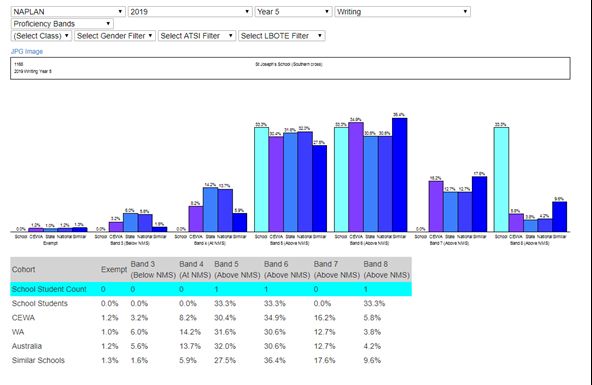
histories, cultures and spirituality. St Joseph’s in consultation with the school community has developed an
Aboriginal Education Plan which is consistent with guidelines provided by national and state agreements.

Part E
This part supports schools in meeting Section 3 - Standard of Education
This part supports Early Childhood Education

In Part E the school should provide a short statement referencing the National Quality Standards
(NQS). This needs to include:

•       a statement evidencing when the audit was undertaken by the school Principal
•       a statement evidencing the key focus areas for the current year
•       a statement referencing the process of reflective practice

Each year St Joseph’s carry out a National Quality Standards Audit against the seven quality areas in the
Early Years. Staff complete a self-assessment and group assessment which is followed by an internal audit
by the principal. Following the assessment of programs and practices, a Quality Improvement Plan is
generated to celebrate strengths and identify areas for improvement.

The Principal undertook an audit of the Early Years Learning in November 2020.
Key focus areas for 2021:
Quality Area 1:
  • Children’s interests will be more visible in daily programs.
  • Encourage children to make more choices.
    •   Promote enquiry based learning.
    •   Educators respond to children’s ideas and play and extend children’s learning through
        open-ended questions, interactions and feedback.
Quality Area 3:
    •  Resources, materials and equipment allow for multiple uses, are sufficient in number, and
       enable every child to engage in play-based learning.
  • Outdoor and indoor spaces are organised and adapted to support every child's
       participation and to engage every child in quality experiences in both built and natural
       environments.
Quality Area 4:
    •   Professional Collaboration Management, educators and staff work with mutual respect
        and collaboratively and challenge and learn from each other, recognising each other’s
        strengths and skills.
Quality Area 5:
    •   Encourage positive educator to child interactions to help build trusting relationships
        which engage and support each child to feel confident and supported with their learning
        needs.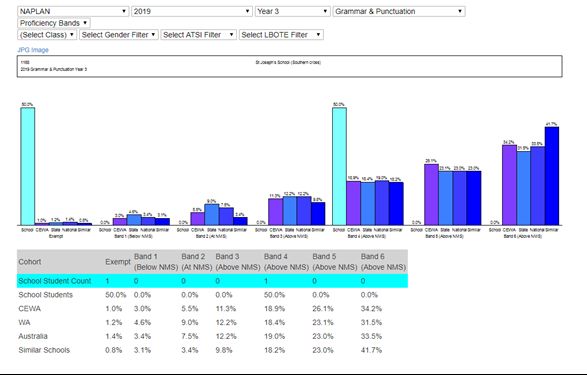
•   Each child is supported to regulate their own behaviour, respond appropriately to the
       behaviour of others and communicate effectively to resolve conflicts.
Quality Area 6:
   •   The service builds relationships and engages with its community.
Quality Area 7:
   •   A statement of philosophy guides all aspects of the service’s operations.

Early Years teachers utilise the NQS Self Reflection tool and Group Reflection Tool to ensure that
they are working at standard or striving to meet the standards.
Professional Learning Communities are used to discuss and reflect on current practices and how
we as a school can improve on them.

Part F
This part supports schools in meeting Section 3 - Standard of Education

St Joseph’s has a yearly assessment schedule that the class teachers need to follow. (Please see
Appendix)
Whole school testing is undertaken throughout the year. Data is analysed during Professional
Learning Communities (PLCs) to inform future teaching and learning. An online Data Wall is
accessible to all staff members via TEAMS. Data Walls capturing PMI Running Records and Informal
Prose Reading, Brightpath Writing and MAIs are located in the staffroom and regularly addressed
during Case Management meetings. It is the responsibility of each teacher to move students on
each Data Wall as growth occurs.
Students who are at risk or have a disability have a Individual Education Plan. A differentiated
curriculum is provided by the class teacher and plans are revised bi-annually. An Education
Assistant provides additional one-to-one support to those students, particularly in the areas of
Numeracy and Literacy. Reading Support was utilized in 2020 and will continue this year.
The school utilizes the Bishops Religious Literacy Assessment as a guide to inform teaching,
although there is no data for 2020 due to the Covid-19 Pandemic. The school has a small cohort
of Year Three and Year Five students and generally students do not perform well, however, analysis
of student results and questions used during assessments are utilized to ensure that programming
aligns with expectations of student’s religious knowledge at each year level.
As the school has a small cohort of Year Three and Year Five students, St Joseph’s utilises PAT
Maths, Reading and Vocabulary to support NAPLAN data. Running Records are regularly
undertaken by teachers from Years 1-6. Mathematic Assessment Inventory (MAI) is also assessed
from Years PP-6.
Teachers in Years 1-2 conduct the Early Years Literacy and Numeracy Development assessment
and also for those students in Year 3 that are at risk. The school will continue to carry out these
assessments in 2020 as it provides valuable feedback to class teachers and parents.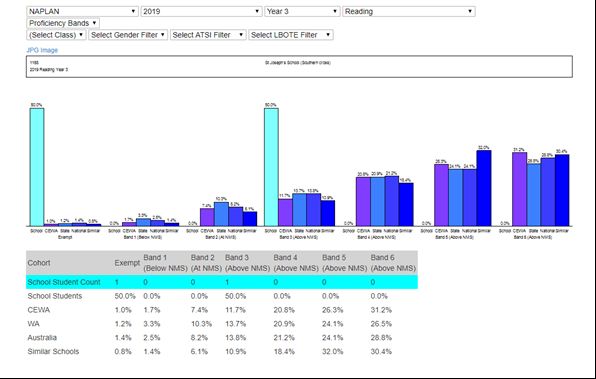
The Pre Primary teacher conducts the Online Entry Assessment twice a year. This assessment
provides a parent feedback form outlining a student’s progress. Parents value this feedback.
Students naratives, persuasive and recount texts were moderated using the Brightpath ruler. There
has been some growth, however, in 2020 Writing is still a key focus particularly in the area of
grammar and punctuation.
There was no NAPLAN data for 2020 due to its cancellation for Covid-19 reasons.

Assessment and Reporting

Schools are encouraged to use hyperlinks where possible.

Primary Schools need to include the Assessment and Reporting Policy and the Annual Assessment
Schedule.

 Testing Schedule  Assessment and
    2020.docx     Reporting Policy .docx

   The 2019 data was the latest NAPLAN data received but will be compared to the 2021 data
   to track trends and determine areas of further development and focus. Data in 2020 includes
   school based testing

   Spelling – SA Spelling Test, November 2020

                                           The data for our junior classes shows the majority of
                                           students at or below spelling age.
                                           The data for our middle/senior classes shows that the
                                           majority of students are at or above their spelling age.
                                           Students who are below are on intervention plans.

                                           Intervention plans are in place for students below their
                                           spelling age and will continue to be monitored.

   PAT Vocab Years 3-6, November 2020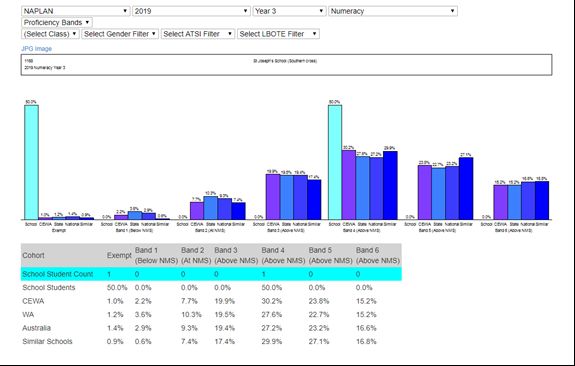
The vocab results for our middle/senior students shows that the
                             majority of students achieved 60% or higher. The majority of
                             students who are below the expected level are students identied
                             with learning difficulties and are on IEPs

PAT- R Comprehension
Students in our junior classes have demonstrated below expected stanines with the majority
of students stanine 4 or below. Students in the middle to upper classes achieved at or above
expected levels (stanine 4)

PAT Maths
Students have achieved pleasing results across all year levels in the Pat Maths testing with
all students achieving stanine 4 or above (excluding 3 students who sat a lower than year level
test. These students are on IEPs)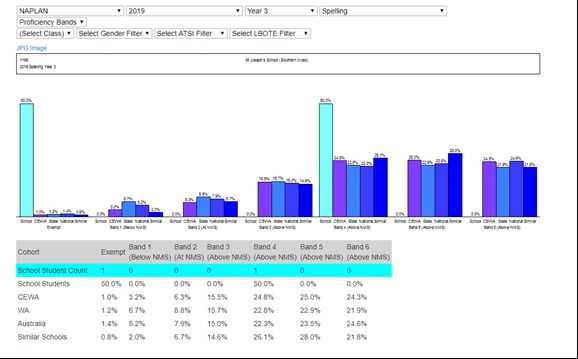
Maths Assessment Interview 2020
      Overall pleasing results in this area with most students demonstrating significant growth across most
      areas. Place value will need to be an area of focus in the early years in 2021

                                          2020 Maths Assessment Interview Results, Pre Primary - 6

Student Name             Growth Points          Counting         Place Value       Addition and      Multiplication and
                                                                                   Subtraction            Division
     Pre Primary        Tm 1     Tm 4     Tm 1       Tm 4      Tm 1    Tm 4      Tm 1      Tm 4      Tm 1        Tm 4

                          N/A     2111     N/A             2    N/A        1      N/A        1         N/A         1
                          N/A     5231     N/A             5    N/A        2      N/A        3         N/A         1
                          N/A     1110     N/A             1    N/A        1      N/A        1         N/A         0
                          N/A     1111     N/A             1    N/A        1      N/A        1         N/A         1
                          N/A     3231     N/A             3    N/A        2      N/A        3         N/A         1
       Year One
                          N/A     1001     N/A             1    N/A        0      N/A        0         N/A         1
                          N/A     3222     N/A             3    N/A        2      N/A        2         N/A         2
                          N/A     4242     N/A             4    N/A        2      N/A        4         N/A         2
        Year 2
                          N/A     5353     N/A             5    N/A        3      N/A        5         N/A         3
                         1222     3132      1              3     2         1        2        3          2          2
                         1012     3142      1              3     0         1        1        4          2          2
                          N/A     4342     N/A             4    N/A        3      N/A        4         N/A         2
                         4242     5243      4              5     2         2        4        4          2          3
Year 3
4243 5454 4 5 2 4 4 5 3 4
4422 5454 4 5 4 4 2 5 2 4
6354 6556 6 6 3 5 5 5 4 6
Year 4
N/A 6455 N/A 6 N/A 4 N/A 5 N/A 5
5353 5455 5 5 3 4 5 5 3 5
4253 4253 4 4 2 2 5 5 3 3
Year 5
5353 6365 5` 6 3 3 5 6 3 5
5453 6565 5 6 4 5 5 6 3 5
7466 6566 7 6 4 5 6 6 6 6
4443 6566 4 6 4 5 4 6 3 6
Year 6
6666 6566 6 6 6 5 6 6 6 6
BrightPath 2020
The majority of students in Years 1-6 have made progress in each narrative and persuasive
assessment. Our Year 1 students did not make expected progress in either narrative or
persuasive writing and some Year 2 students did not demonstrate progress in persuasive
writing. These students will need continued monitoring and support.
Our Pre Primary students demonstrated pleasing growth in their Oral Narrative and Recounts
over the year.As there was no NAPLAN in 2020, the data from 2019 has been included as the most current data. Year Five NAPLAN Data
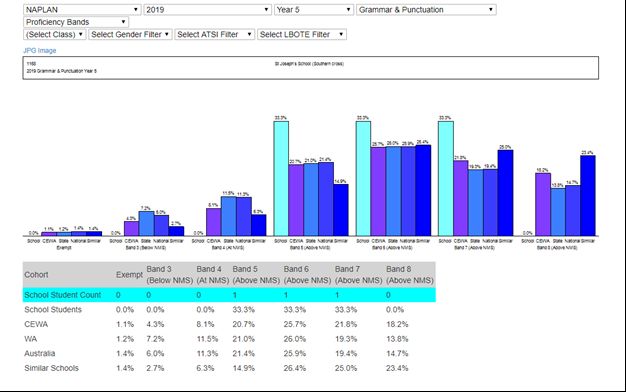
All students ranked above the national minimum standard. National Growth average from Year 3 to
Year 5 was 60. School mean was 32. Data indicates that grammar and punctuation needs to be a key
focus area in 2020.

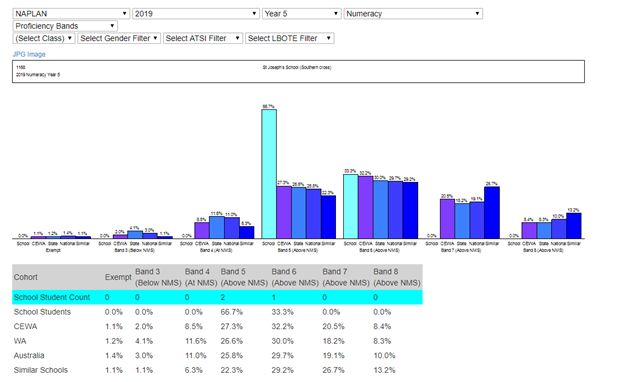
All students ranked above the national minimum standard. National Growth average from Year 3 to
Year 5 was 86. School mean was 96. The positive growth in Numeracy indicates that teaching and
learning practices using MAI Inventory testing is successful.
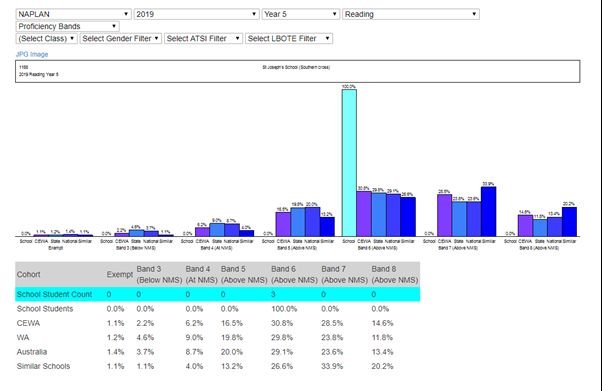
All students ranked above the national minimum standard. National Growth average from Year 3 to
Year 5 was 75. School mean was 80. The positive growth in Reading indicates utilising Data Walls and
case management meetings to drive teaching and learning has a positive impact on student growth.

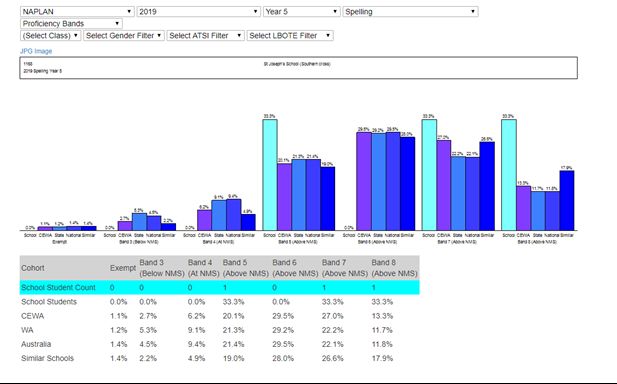
All students ranked above the national minimum standard. National Growth average from Year Three
to Year Five was 85. School mean was 98.
All students ranked above the national minimum standard. St Joseph’s adopted Brightpath as a
moderating tool in 2018 which has seen a marked improvement in student results.

Year 3 NAPLAN Data
There were only three children in Year Three in 2019. Only one child sat the NAPLAN tests, there was
one exemption and one withdrawal, however, they did rank above the National Minimum standard in
all tests.

Students in Year One who participated in the Early Years Literacy and Numeracy Data ranked mostly
above CEWA standards in the different tests. Areas where students ranked below was in Concepts
about Print, Dictation and the Duncan Word Test. Students ranked above in most areas of Numeracy
including Addition and Subtraction, Counting (like), Multiplication and Place Value.
You can also read


