Strategic outlook for Sainsbury's - Full year 2018/19 results update May 19 - IGD.com
←
→
Page content transcription
If your browser does not render page correctly, please read the page content below

Strategic outlook for Sainsbury’s
                     Full year 2018/19 results update

                                   May 19

© IGD 2019
Key numbers
                                 2017/18                   2018/19               % Change              2017/18 Op   2018/19 Op        % Change
                                 Sales (£m)1, 2            Sales (£m)1                                 profit       profit
                                                                                                       (£m)         (£m)
     Retail                      27,944                    28,466                1.9                   625          692               10.7

     Financial                   515                       541                   5.0                   69           31                (55.1)
     services
     Total                       28,459                    29,007                1.9                   694          723               4.2

      Notes: 1 Ex VAT, inc. fuel        2   Excludes (£3m) acquisition adjustment for fair unwind of loans

                                                                     Mike Coupe, Group CEO
                                                                     “I am pleased to report that we have increased profits, reduced net debt and
                                                                     increased the dividend.”
                                                                     We completed the integration of Argos that we set out in 2016, delivering £160
                                                                     million in synergies ahead of schedule. We completed a major transformation
                                                                     of how we run Sainsbury’s stores and have made significant improvements to
                                                                     store standards in recent months, which remain a focus. Customers continue
                                                                     to rate us top for quality food and we are growing our premium ranges. We are
                                                                     also focused on reducing costs so that we can invest to make commodity
                                                                     products better value for our customers.
                                                                     “I am confident in our strategy and also clear on what we need to do to
                                                                     continue to evolve the business in a highly competitive market where shopping
                                                                     habits continue to change.”
© IGD 2019 Source: Sainsbury’s, IGD Research                                                                                                          Page 3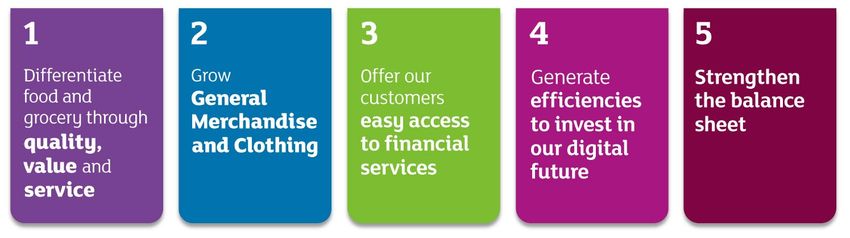
Annual results                                              +2.1%                        +0.4%                           -0.2%
    in brief                                                    Underlying
                                                                retail sales                 Retail sales                      LFL
                                                                                                  exc..fuel
     Profits resilient despite trading                             Inc..fuel                                                 exc. fuel
     pressures

     Underlying retail sales increased by 2.1%        Solid trading in 2018/19
     to £27.9bn, lifted by 12.3% growth in fuel
     sales, reflecting both higher pump prices and   3.0%
     volume growth.
                                                     2.0%
     Retail sales rose 0.4%, driven by a 0.6%
     sales increase from net new space. Within       1.0%
     this, grocery contributed 0.6%, GM sales
     were flat and clothing decreased -0.8%.         0.0%

     LFL sales declined b 0.2%. Trading              -1.0%
     weakened through the year from +0.6% in
     H1 to -1.0% in H2.                              -2.0%
     Underlying profit before tax rose by 7.8%
                                                     -3.0%
     to £635m, driven by a solid performance in
                                                             15/16                  16/17                 17/18              18/19
     food, delivery of Argos synergies ahead of               Q1 Q2     Q3     Q4    Q1 Q2   Q3      Q4    Q1 Q2   Q3   Q4    Q1 Q2      Q3   Q4
     schedule and reduced interest costs.
                                                                                        Mike Coupe, CEO
     Profit after tax fell 29%, pushed lower by a
     doubling of one off costs to £396m. Key          Financial Services profits more than halved to £31m in line with previous
     items included changes to pension costs,         guidance, mainly due to bad debt charges, but also due to a more cautious
     Sainsbury’s Bank transition costs, retail        approach to unsecured lending.
     restructuring costs and the Asda transaction.
                                                      Net debt fell by £222m but remains high at over £1.6bn. Sainsbury’s will now
     £220m of cost savings were achieved              focus more on cash generation to reduce debt faster.
     during the year helping to offset the impact
     of cost inflation and pay increases.
© IGD 2019 Source: Sainsbury’s, IGD Research                                                                                                   Page 4
Sainsbury’s six
    strategic
    drivers
                                  1   Creating a more distinctive food offer

                                  2   Delivering on value

                                  3   Upgrading supermarkets

                                  4   Driving convenience growth

                                  5   Expanding online grocery

                                  6   Achieving Argos’ potential

© IGD 2019 Source: IGD Research                                                Page 5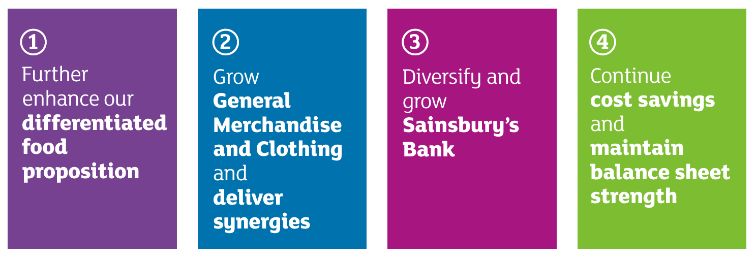
Updated                       New priorities for a new era

    Priorities
                                  Following the integration of Argos, Sainsbury’s has updated the priorities that
                                  have guided its strategy since November 2014.
                                  The four existing priorities have been adjusted to reflect the current position
                                  of the business and areas of focus. The new addition is “Strengthen the
                                  balance sheet” which sees Sainsbury’s targeting a £600m reduction in net
                                  debt over the next three years through a more disciplined approach to cash
                                  generation and capital allocation.

© IGD 2019 Source: IGD Research                                                                                     Page 6
Supplier 1
Engage with
‘Destination
To ensure the relevance of its large stores
to changing shopper needs, Sainsbury’s is
looking to a wider range of partners, as well
implications Sainsbury’s’ as its Argos subsidiary, to create more
compelling retail destinations.
Sainsbury’s is bringing differentiation to its
Opportunities for
2 offer with limited numbers of specialist
‘unique’ brands
brands to add additional excitement to
specific categories.
Sainsbury’s private label ranges remain the
Target private key vehicle for its quality credentials,
3 label innovation especially in food, where it aims to reflect,
and lead on, evolving consumer tastes and
aspirations.
Opportunities in The rapid rollout of much improved beauty
4 beauty and departments and new wellness aisles to
wellness many more stores in 2019 create significant
opportunities for suppliers.
In the drive to meet the competitive
Focus on challenges from discount and online and
5 efficiency reduce debts, Sainsbury’s has ambitious
goals for cost saving across the supply chain
to ensure the business is fit for the future.
© IGD 2019 Source: IGD Research Page 7You can also read


