MT Impact - Horizon 2020 (and beyond) - Rudy Tirry President EUATC Country Manager LIONBRIDGE BELGIUM
←
→
Page content transcription
If your browser does not render page correctly, please read the page content below

MT Impact – Horizon 2020 (and beyond)
Rudy Tirry
President EUATC
Country Manager LIONBRIDGE BELGIUM

Agenda

•   MT usage today
•   NMT vs SMT
•   Post-editing
•   MT usage tomorrow
•   Machine vs Human
MT usage
2017 Language Industry Survey - Trends

35%

      30%
30%

25%         23%

20%

15%               13%
                        11%
10%

                              4%   3%
5%                                      3%   3%   3%
                                                       2%   2%
0%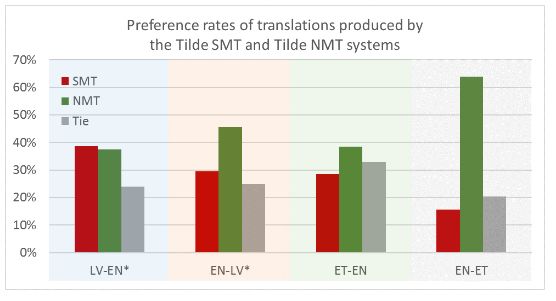
2018 – the year of MT

     No MT usage     2016                     2017            2018 (prel.)
     LSP’s           80%                      57%             36%
     Freelancers     69%                      67%             48%
                                                Source: European Language Industry Survey
                     No MT
     100%
     80%
     60%
     40%
     20%
      0%
            2016           2017        2018 (prel)
               Companies     Individuals
What about Neural ?
Neural MT – why the hype ?
Where do you find neural MT today?

•   Google Translate
•   Skype Translate
•   Microsoft Translator Live
•   Facebook
•   Amazon
…
•   DeepL
•   Omniscien
•   SDL
•   Systran
•   KantanMT
•   Tilde
…

                The new Wild Wild West in machine translation
SMT vs NMT : main differences
Statistical Machine Translation (SMT) Neural Machine Translation (NMT)
• Phrase-based • Uses (recurrent) neural networks (« deep »
• Separate language model, translation model and NMT uses several layers of neural networks)
reordering model • Sentence-based
• Fast training • One single sequencing model – simpler than
SMT approach
• ‘Predicts’ next word
• Restricted vocabulary (max. 50,000)
• More time needed for training
• No easy solution for terminology
• Less tolerant for low quality source
• More pre- and post-processing requiredIs it really that good ?
Findings Tilde (www.tilde.com/about/news/316)
Findings DFKI/QT21 Project
   Phenomenon          Occurrences      Percentage correct
                                     NMT                Moses
Formal address             138       90%                  86%
Genitive                   114       92%                  68%
Modal construction         290       94%                  75%
Negation                   101       93%                  86%
Passive voice              109       83%                  40%
Predicate adjective        122       81%                  75%
Prepositional phrase       104       81%                  75%
Terminology                330       35%                  68%
Tagging                    145       83%                 100%
Sum/average               1453       89%                  73%
Findings DFKI/QT21 Project Source: MultiLingual Jan ’18, John Tinsley
So, is it better ?

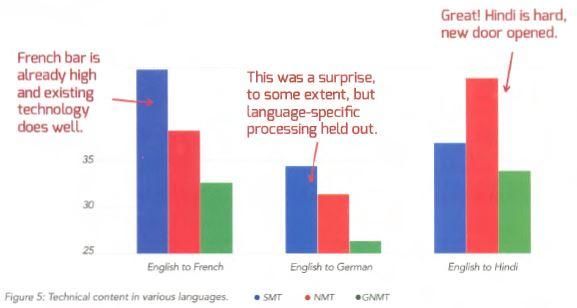
•   NMT makes 3 to 5 times less errors in
     – Word ordering
     – Morphology
     – Syntax
     – Agreements
     Source: Tilde (EN>ET)
     This leads to more fluent translations, mainly on ‘difficult’ languages

•   BUT
     –    Older techniques (RBMT, trained SMT) can perform better on ambiguity
          (source:PBML, Aljoscha Burchardt et al., June 2017), terminology and tagging
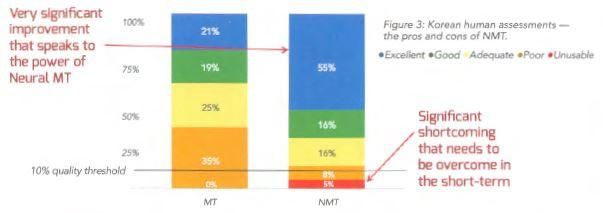
     –    Still quite some ‘dangerous’ errors, such as negation (although better than SMT)
     –    Traditional automated evaluation methods (BLUE score) do not always agree with
          human evaluation results
     –    Uneven results, depending on language pair
Let’s talk Post-editing
Post-editing levels

•   Full MTPE
    – No distinction with full human translation
•   Light MTPE
    –   Correct understanding
    –   No effort on stylistic aspects
    –   Varying practices regarding linguistic accuracy
    –   Run automated QA rules (ex. check for missing negation)
•   Focused MTPE
    – Specific rules
         • Specific – highly visible – parts of the content
         • Check important elements like numbers, names, etc.
         • …
Traps • Higher fluency misleads post-editor • Terminology • Tag order issues • « Target first » approach not ideal
So where does that lead us ?
MT penetration – a personal view
                                                                                                         100%
                              Basic procedural
                  2030        content

                                                 Complex procedural   Basic editorial
                                                 content              content
                                   2030

                                                      2030                  2030        Complex
                                                                                        editorial
      2018                         2020                                                 content
                  2018                                                                  (marketing
                                                                                        brochures)
                                                      2020                  2020
                                                                                          2030
                 Standard-
                 ized              2018                                                   2020
                 content                                                                             Creative
User-generated   Controlled                           2018                  2018                     content
content          language                                                                 2018       (ads)
Future role(s) of translator
« Machine translation will replace only those translators
that translate like a machine »
« The machine will take care of the keystrokes.
The translator will add the human dimension - the cherry on the cake.»
• Non-MT content (Translator = Post-editor = [Augmented Translator] ?
• Do we need the same profile ?
• Editorial translation
• Full post editing
• Light post editing (cf software testing)
• Do we need the same training ?
• Creative writing
• Pattern recognition (search for typical MT errors)
• Eye for detail and critical sense
• General (world) knowledge: disambiguation, logical errorsWorkable MT is here. Are we ready to work with it ?
Will translation buyer expectations become realistic ?
Will translators embrace technology ?
Will translation companies find a workable business model ?
Will universities adapt training programmes to prepare future generations ?
Will translation tool providers be able to integrate and standardise ?
Come and see in 2, or rather 12 years !Q&A rudy.tirry@lionbridge.com
You can also read


