The ECD Quality Tool 2019 - COVER PAGE INFORMATION OF YOUR CHOICE - Bridge
←
→
Page content transcription
If your browser does not render page correctly, please read the page content below
The ECD Quality
       COVER PAGE INFORMATION OF YOUR CHOICE

Tool 2019
The Great Reveal

• Who has been involved in the debates about
  quality and the reflection tool, gave written input,
  or was part of the pilot?

• Who has heard of the Quality Tool (through
  BRIDGE presentations or knowledge products)
  but is not really familiar with it?

• Who has never heard of it until today?

ECD Quality Tool Timeline
              Quality                          Mediator
              Dimensions      ECD Quality
What is                                        Feedback &     Securing
              & Reflection    Toolkit Pilot:
quality in                                     October        funding for
              Questions       • Mediator                                      Sharing
ECD?                                           2016 CoP       Phase 2
                                 Training                                     and
                                               meeting:
              9 Pilot         • Resource                                      distribution
CoP                                            Options for    Writing up
              partners:          Packs                                        of Quality
Inputs,                                        Phase 2        Q Tool,
              Pilot           • Site Visits                                   Tool
iterations,                                                   illustrations
              planning        • Data
research                                       Pilot Report   & layout
              began              analysis
                                               published

                                 Jan–             August         2018-
                 Nov                                                           ECD CoP
   2015                          July             – Nov          March
                 2015                                                            2nd
                                 2016              2016          2019
                                                                                April
                          Ongoing updates & iterations..                        2019
Pilot Aims
1. To refine/ adapt the reflection tool by testing whether the questions encourage
practitioners/teachers:
•   To reflect on own practice
•   To estimate own areas of strengths and weakness
•   To identify potential areas for of change

2. To test self-reflection methodology in the ECD sector [not testing impact in this
pilot]

3. To refine mediator pack and process & implementation guidelines

4. To gather data on practitioner views on dimensions of quality in which they
need assistance/ resources / guidance

5. To use data to inform a subsequent phase of implementation: e.g. using the
Reflection Tool for self-improvement , developing a planning tool for practitioners,
for training ….
The Pilot

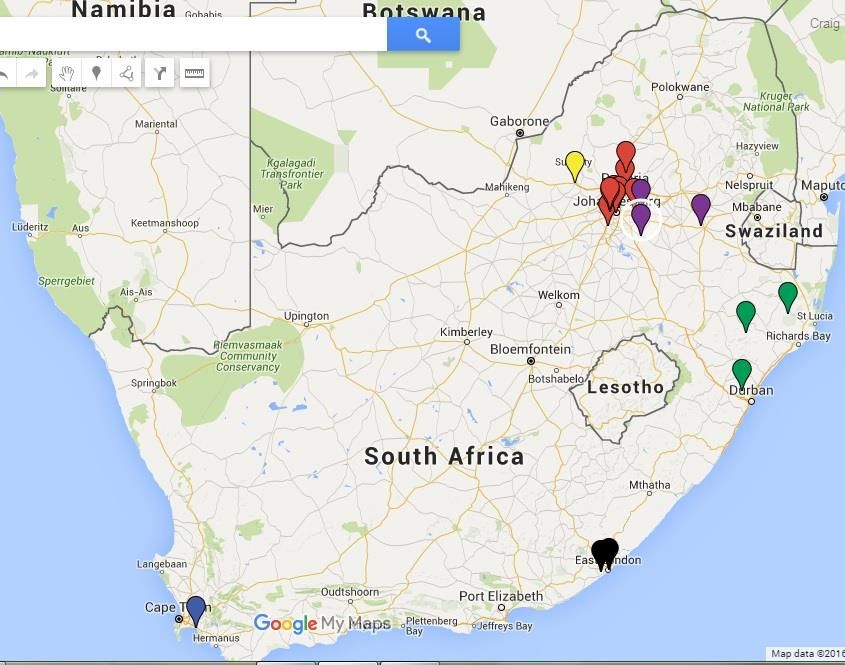
• BRIDGE & 9 partner organisations from ECD CoP
• Mediators visited 21 different types of sites (ages
  0-6) in 6 provinces (March-May 2016)
• Held conversations with practitioners using the
  self-reflection tool questions
• Observed classroom practice
• Submitted reports
• Data analysis
• Final report completed November 2016
Partner Organisation                 Sites                  Province
Tools for Schools                 Linguamites
                                  Pett's Preschool
Motheo Training Institute Trust   Red Cross Day Care Centre

                                  Ekuthuthukeni Day Care Centre

Afrika Tikkun                     Alexandra                           Gauteng
                                  Areokopaneng - Orange Farm

                                  Uthando - Braamfontein
ECD Upliftment Projects           Poppins Pre School
                                  Arlene's Daycare
Cotlands                          Dept. of corrections early
                                                                   Eastern cape- EL
                                  learning playgroup
                                  Chris Hani Park Early Learning
                                                                    Western Cape
                                  Playgroup
                                  Hlambanyathi                          KZN
                                  Shaga farm Early learning
                                                                    Mpumalanga
                                  playgroup
VVOS                              Lebone College                     North West
                                  Rakkers Keuterskool               Mpumalanga
New Beginnings Training and       Thandeka Creche
                                                                        KZN
Development Organisation          Khulani
PIFF                              Pathways Roodepoort                 Gauteng
                                  Bophelong Stimulation Center      Mpumalanga
Joint Aid Management              Pfula Ma Vhoko Day Care            Gauteng-
                                                                   Hammanskraal
                                  Site 2                           East London- EC

                                                                                      21 Sites in 6 provinces
Recommendations
from CoP members
• User-friendly
• Visuals
• Simpler language
• Target practitioners
• Supporting resources
• Consciousness-raising
• Practical print format
• Use tool to build up resources
• Version into other languagesPart 1: INTRODUCTION The introduction explains what self-reflection is,
and how to use this Quality Reflection Tool. It
also gives you a dictionary of common terms.
Part 2: ECD QUALITY AREAS
Section A: Teaching and Learning This is where you will keep notes of your own
reflections. You are given guidelines on what
Section B: ECD Environment quality might mean in different aspects of ECD
care and teaching. These ‘reflection questions’
Section C: ECD Policy Framework
will help you to think about what you know and
Section D: Leadership and Management do in your own work.
Part 3: PLANNING and RESOURCES This section helps you plan for your own growth
and professional development, and provides
some resources which you can build up.In Part 2 of your file each Quality Area has a separate section, set out as follows:
A Title of Section [e.g. Section A: Teaching and Learning]
1 What is [this section]? You will find a brief description of this area and what it is
about, and an explanation of any specialist vocabulary
or terminology.
2
My Reflections In this part you will find:
Reflection Questions on the topic
Some ideas to help you think about this topic
Space to write down your own experiences, views
and thoughts on the topic and your own practice.
You can add extra pages into the file as you need to.
3 Looking at my You can use the answers you have given to the reflection
strengths and questions to help you think about your own strengths
weaknesses and weaknesses in this area. There are also some ideas
about where you might find support.GROUP WORK: Applications and contexts for using the QT • Who, how, when, where • Different categories of users – see newsprint • Different ways of using it Gallery Walk
You can also read


