F10: Parallel Computing for Actuaries - Matthew Evans - EMC Actuarial and Analytics Jan Iwanik - Iwanik Limited
←
→
Page content transcription
If your browser does not render page correctly, please read the page content below

F10: Parallel Computing for Actuaries
Matthew Evans - EMC Actuarial and Analytics
Jan Iwanik - Iwanik Limited

17 October 2018

F10: Parallel Computing for Actuaries
From Excel to GPU Clusters

17 October 2018
Agenda
• Introduction
     – What is parallel processing and which processes are susceptible?
     – Why are we talking about this now?

• Performance gains
     – Excel, R, to C++ on GPUs

• Example Pricing Applications
     – Personal Lines Impact Analysis
     – Commercial Lines Claim Simulation

• Concluding remarks

17 October 2018                                                           3
Introduction
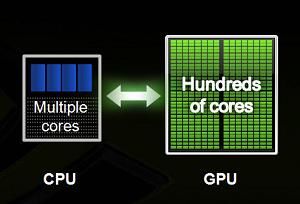
• Parallel processing in CPU cores and
  GPU cores

     – A CPU has a handful of cores for
       processing multiple independent threads

     – A GPU has hundreds or cores for
       processing multiple similar threads in
       parallel

17 October 2018                                  4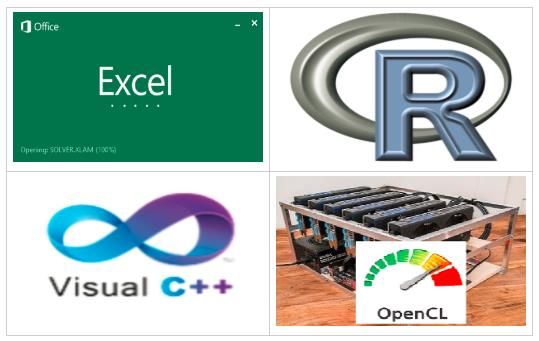
Introduction
• Susceptible Processes
     – Cannot be “sequential”
     – Must permit separate calculation of elements, then later combination

• Examples for actuaries
     – Monte Carlo, including Cat modelling and other loss simulation
     – GLM fitting
     – Cross-Validation for testing model fits
     – Machine Learning

17 October 2018                                                               5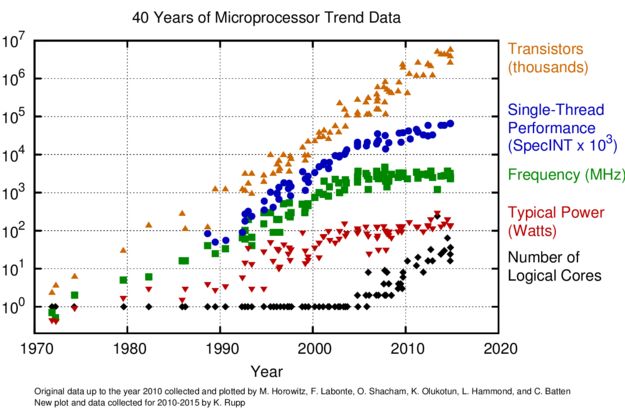
Introduction
• Why are we talking about this now?

17 October 2018                        6
Performance Gains

• These days, most computers
  have 4 or more CPU
  processor cores
• They also have additional
  GPU processor cores

17 October 2018                7

Parallel calculations in Excel
• Excel always attempts to use all
  available CPU cores…
• …so you don’t have to do
  anything to benefit

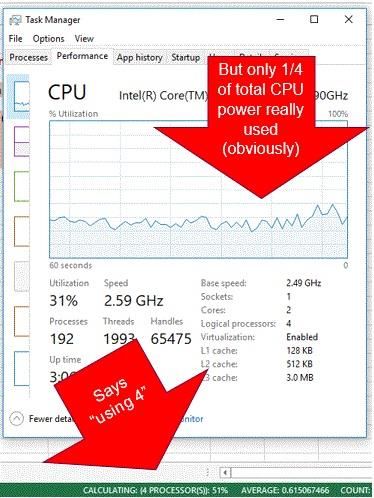
• However, when Excel reports
  utilising all CPU cores…
• … it may not be true!

17 October 2018                      8
How about more advanced tools?

17 October 2018                  9
Personal Lines Pricing Example: Impact Analysis
• The objective – predict the distribution of possible outcomes after a
  hypothetical rate change.

• Method – GLM-free prediction methodology (GIRO 2015, PS 2017).

• Parallel component – simulate by bootstrapping a portfolio of 262,144 motor
  policies. Then apply the predictive calculation.

17 October 2018                                                                 10
Personal Lines Pricing Example: Impact Analysis

• We test the following approaches:
     – Excel
     – R
     – C++
     – C++ with BLAST
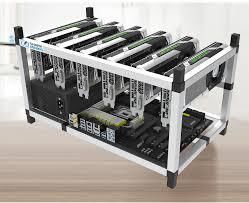
     – C++ with mining rig

17 October 2018                                   11
Personal Lines Pricing Example: Impact Analysis
Tool Cores utilised Time
Excel, disable multi-threaded calculations 1 CPU 59 s
Excel, default settings 4 CPU 51 s
R, clean code using vectors 1 CPU 171 ms x300 faster
C++ 1 CPU 160 ms
C++, BLAST routines 1 CPU 41 ms
x1000 faster
C++, OpenCL 4 CPU + 4 GPU 7 ms
C++, OpenCL on mining rig 2 CPU + 6 x 36 GPU = 218 0.16 ms
17 October 2018 12Personal Lines Pricing Example: Impact Analysis
Calculations per second
10,000,000,000 • Note the speed increases once
1,000,000,000
100,000,000 multi-threading is deployed at scale
10,000,000
1,000,000
100,000
10,000 • Difference between mining-rig and
1,000
100
typical (good) office PC using R is
10 still a factor of 1000.
1
Excel, Excel, R, clean C++ C++, C++, C++,
no multi default code BLAST OpenCL OpenCL
settings using routines on
vectors mining
rig
17 October 2018 13Commercial Lines Pricing Example: Claim Simulations • Monte Carlo claims simulation for aggregate layer pricing • Our C# system takes 120 seconds to simulate 1,000,000,000 Generalised Pareto Distribution claims and put through a layer structure • Using C++ on laptop’s 4 CPU cores gives a factor of 6 improvement in speed (18 seconds) • Processing on laptop’s 20 GPU cores gives a further factor of 1.5 improvement (12 seconds) • Mining rig gives further factor of 5 (2.5 seconds) 17 October 2018 14
Commercial Lines Pricing Example: Claim Simulations
• A full mining rig may not be practical…

• …but material improvements are possible with standard, cheap GPU
  hardware, that in many cases is already present.

• This approach offers a way to improve speed, price higher layers more
  accurately, and extend the life of computer hardware.

17 October 2018                                                           15
Concluding Remarks
• Computer graphics technology is a gift to actuaries and data scientists
     – We can test more interactions, run more simulations, include more data…

• Limitations of the approach
     – Only some processes are susceptible
     – GLMs show only marginal benefits with R multi-threading packages
     – Interactions (3 way for 10/10 is 720,000 models) still numerous..!
     – Specialist Technical Expertise required

• Quick wins: Monte Carlo; Cross-validation; R & Python tools.
• Slow wins: Exhaustive model interaction testing; Any others..?

17 October 2018                                                                  16
Concluding Remarks
• A note on crypto-currencies
Peak of
“mania”
• BTC cannot be mined Amateur investors
enter market
profitably with GPUs
• GPU miners choose ETH or
others
• Price has collapsed!
• But good for gamers, data
scientists and actuaries?
17 October 2018 17About Us
• Jan Iwanik • Matthew Evans
– Pricing – Pricing
– Free Pricing Tools – Reserving
– GPU Programming – Data Science
– InsurTech
• jan.iwanik@gmail.com • matthew@emc-actuarial.com
• Iwanik Limited • EMC Actuarial & Analytics
17 October 2018 18Questions Comments The views expressed in this [publication/presentation] are those of invited contributors and not necessarily those of the IFoA. The IFoA do not endorse any of the views stated, nor any claims or representations made in this [publication/presentation] and accept no responsibility or liability to any person for loss or damage suffered as a consequence of their placing reliance upon any view, claim or representation made in this [publication/presentation]. The information and expressions of opinion contained in this publication are not intended to be a comprehensive study, nor to provide actuarial advice or advice of any nature and should not be treated as a substitute for specific advice concerning individual situations. On no account may any part of this [publication/presentation] be reproduced without the written permission of the IFoA [or authors, in the case of non-IFoA research]. 17 October 2018 19
You can also read


