Strengthening Regional Ocean Governance for the High Seas - Opportunities and Challenges to Improve the Legal and Institutional Framework of the ...
←
→
Page content transcription
If your browser does not render page correctly, please read the page content below

Strengthening Regional
Ocean Governance for the
       High Seas
  Opportunities and Challenges to
 Improve the Legal and Institutional
Framework of the Southeast Atlantic
       and Southeast Pacific
Strengthening Regional Ocean Governance for the High Seas

    Citation
    Durussel, C., Wright, G., Wienrich, N., Boteler, B., Unger, S., Rochette, J., 'Strengthening Regional
    Ocean Governance for the High Seas: Opportunities and Challenges to Improve the Legal and In-
    stitutional Framework of the Southeast Atlantic and Southeast Pacific', STRONG High Seas Project,
    2018.

    Authors
    Dr. Carole Durussel, Co-Lead STRONG High Seas, Institute for Advanced Sustainability Studies (IASS)

    Glen Wright, Research Fellow, International Ocean Governance, Institute for Sustainable Develop-
    ment and International Relations (IDDRI)

    Nicole Wienrich, Project Manager STRONG High Seas, Institute for Advanced Sustainability Studies
    (IASS)

    Ben Boteler, Co-Lead STRONG High Seas, Institute for Advanced Sustainability Studies (IASS)

    Sebastian Unger, Lead, Ocean Governance Research, Institute for Advanced Sustainability Studies
    (IASS)

    Dr. Julien Rochette, Ocean Programme Director, Institute for Sustainable Development and Inter-
    national Relations (IDDRI)

    Design and Layout
    Sabine Zentek

    Editing
    Ben Boteler, Carole Durussel, Stefanie Hansen, Nicole Wienrich and Glen Wright

    Supported by:

    based on a decision of the German Bundestag

    The STRONG High Seas project is part of the International Climate Initiative
    (IKI; www.international-climate-initiative.com/en/). The Federal Ministry for the Environment,
    Nature Conservation and Nuclear Safety (BMU) supports this initiative on the basis of a decision
    adopted by the German Bundestag.

    The STRONG High Seas project contributes to the work of the Partnership for Regional Ocean
    Governance (PROG), a partnership hosted by UN Environment, the Institute for Advanced
    Sustainability Studies (IASS), the Institute for Sustainable Development and International Relations
    (IDDRI), and TMG – Think Tank for Sustainability.

    © STRONG High Seas 2018. STRONG High Seas, an independent scientific project, is responsible
      for the content of this publication. This report does not necessarily reflect the views of the
      funding agencies.

    www.prog-ocean.org/our-work/strong-high-seas/

    DOI: 10.2312/iass.2018.025
    © Cover Photo: Matt Howard (248418)/Unsplash

2
Acknowledgements

The authors would like to thank the following reviewers for their valuable input and feedback:

Abidjan Convention Secretariat

Alex Benkenstein, Programme Head of the Governance of Africa’s Resources Programme, South
African Institute of International Affairs (SAIIA)

Colombian National Section to the Permanent Commission for the South Pacific (CPPS)

Kristina Gjerde, Senior High Seas Policy Advisor, IUCN Global Marine and Polar Programme

Tim Packeiser, Senior Policy Advisor Ocean Governance, International WWF – Centre for Marine
Conservation, WWF Germany

Peruvian National Section to the Permanent Commission for the South Pacific (CPPS)

Permanent Commission for the South Pacific (CPPS)

Dr. Lizette Voges, Executive Secretary of the South East Atlantic Fisheries Organisation (SEAFO)

Osvaldo Urrutia, Director of the Centro de Derecho del Mar PUCV (Chile) and Chairperson of the
Commission of the South Pacific Regional Fisheries Management Organisation (SPRFMO)

                                                                                                   3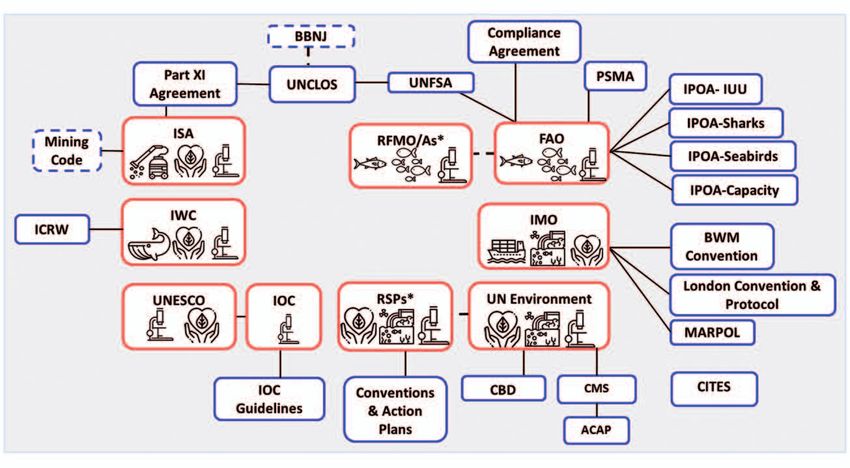
Strengthening Regional Ocean Governance for the High Seas

    Table of Contents

    Acknowledgements                                                                           3

    Table of Contents                                                                          4

    Abbreviations                                                                              6

    Executive Summary                                                                          8

    1. Introduction                                                                            10

    2. Ocean Governance                                                                        12
      2.1 Major Challenges in Ocean Governance                                                 14
      2.2 Sector-based Ocean Governance Framework                                              15
      2.3 Ocean Governance at the Regional Level                                               18
      2.4 Development of an International Legally Binding Agreement on BBNJ                    20
      2.5 Linking the Global and Regional Levels                                               22
      2.6 International Process on Global Ocean Sustainability                                 23

    3. Ecology and Regional Governance of ABNJ                                                 25
      3.1 Southeast Atlantic                                                                   27
      3.2 Southeast Pacific                                                                    31

    4. Conservation and Sustainable Use of Biodiversity in ABNJ in the                         35
       Southeast Pacific and Southeast Atlantic
      4.1 BBNJ Element: Area-based Management Tools (ABMTs)                                    35
         4.1.1 ABMTs in the Southeast Atlantic                                                 37
         4.1.2 ABMTs in the Southeast Pacific                                                  39
      4.2 BBNJ Element: Environmental Impact Assessments (EIAs)                                41
         4.2.1 EIAs in the Southeast Atlantic                                                  43
         4.2.2 EIAs in the Southeast Pacific                                                   44
      4.3 BBNJ Element: Marine Genetic Resources (MGRs)                                        45
         4.3.1 MGRs in the Southeast Atlantic                                                  46
         4.3.2 MGRs in the Southeast Pacific                                                   46
      4.4 BBNJ Element: Capacity Building and Transfer of Marine Technology                    47
         4.4.1 Capacity Building and Transfer of Marine Technology in the Southeast Atlantic   48
         4.4.2 Capacity Building and Transfer of Marine Technology in the Southeast Pacific    50

4
4.5 SDG 14.1: Marine Pollution                                                               51
     4.5.1 Marine Pollution in the Southeast Atlantic                                          52
     4.5.2 Marine Pollution in the Southeast Pacific                                           52
  4.6 SDGs 14.2 and 14.5: Management and Protection of Marine Ecosystems in ABNJ               54
      4.6.1 Management and Protection of Marine Ecosystems in ABNJ of the Southeast Atlantic   55
      4.6.2 Management and Protection of Marine Ecosystems in ABNJ of the Southeast Pacific    57
  4.7 SDG 14.4: IUU Fishing                                                                    59
     4.7.1 Combatting IUU Fishing in the Southeast Atlantic                                    61
     4.7.2 Combatting IUU Fishing in the Southeast Pacific                                     63

5. Regional Organisations in the Southeast Atlantic without a Specific Mandate for ABNJ        65
  5.1 Abidjan Convention                                                                       66
  5.2 Regional Fisheries Bodies                                                                68
  5.3 Benguela Current Commission                                                              70

6. Strengthening Regional Ocean Governance for the High Seas in the Southeast Atlantic         71
   and the Southeast Pacific
  6.1 Key features of Regional Ocean Governance Frameworks for the High Seas in the            71
      Southeast Atlantic and the Southeast Pacific
  6.2 Options for Strengthening Regional Ocean Governance for the High Seas in the             72
      Southeast Atlantic and Southeast Pacific

Annex I: Selected Agreements Relevant to the Conservation and Sustainable Use of BBNJ          77

Annex II: Key Regional Organisations of the Southeast Atlantic with an ABNJ Mandate            78

Annex III: Membership and Treaty Ratification of Southeast Atlantic Coastal States             80

Annex IV: Key Regional Organisations of the Southeast Pacific with an ABNJ Mandate             82

Annex V: Membership and Treaty Ratification of Southeast Pacific Coastal States                86

Annex VI: Membership of RFMOs Covering the Southeast Atlantic and Southeast                    88
          Pacific Regions

                                                                                                    5
Strengthening Regional Ocean Governance for the High Seas

    Abbreviations

    ABMT                     Area-based Management Tool
    ABNJ                     Areas Beyond National Jurisdiction
    ABS                      Access and Benefit Sharing
    ACAP                     Agreement on the Conservation of Albatrosses and Petrels
    AIDCP                    Agreement on the International Dolphin Conservation Program
    APEI                     Area of Particular Environmental Interest
    ATLAFCO                  Ministerial Conference on Fisheries Cooperation Among African States Bordering
                             the Atlantic
    AU                       African Union
    BBNJ                     Biodiversity Beyond National Jurisdiction
    BCC                      Benguela Current Commission
    BCLME                    Benguela Current Large Marine Ecosystem
    BWM Convention           International Convention for the Control and Management of Ships' Ballast Water
                             and Sediments
    CBD                      Convention on Biological Diversity
    CCAMLR                   Commission for the Conservation of Antarctic Marine Living Resources
    CCSBT                    Commission for the Conservation of Southern Bluefin Tuna
    CECAF                    Fishery Committee for the Eastern Central Atlantic
    CIC                      Centre Interrégional de Coordination/Interregional Coordination Centre for the Im-
                             plementation of Regional Strategy for Maritime Safety and Security in Central and
                             West Africa
    CITES                    Convention on International Trade in Endangered Species of Wild Fauna and Flora
    CMM                      Conservation and Management Measure
    CMS                      Convention on the Conservation of Migratory Species of Wild Animals
    COP                      Conference of Parties
    COREP                    Regional Fisheries Committee for the Gulf of Guinea
    CRESMAC                  Centre Régional de Securité Maritime de l’Afrique Centrale/Regional Maritime
                             Safety Centre for Central Africa
    CRESMAO                  Centre Régional de Sécurité Maritime de l'Afrique de l'Ouest/Regional Maritime
                             Safety Centre for West Africa
    CPPS                     Comisión Permanente del Pacífico Sur/Permanent Commission for the
                             South Pacific
    EBFM                     Ecosystem-based Fisheries Management
    EBSA                     Ecologically or Biologically Significant Marine Area
    ECCAS                    Economic Community of Central African States
    ECOWAS                   Economic Community of West African States
    EEZ                      Exclusive Economic Zone
    EIA                      Environmental Impact Assessment
    ERA                      Ecosystem Risk Assessment
    FAD                      Fish Aggregating Device
    FAO                      Food and Agriculture Organization
    FCWC                     Fishery Committee for the West Central Gulf of Guinea
    GEF                      Global Environment Facility
    IATTC                    Inter-American Tropical Tuna Commission
    IBA                      Important Bird and Biodiversity Area
    ICCAT                    International Commission for the Conservation of Atlantic Tunas
    ICRW                     International Convention for the Regulation of Whaling
    IGC                      Intergovernmental Conference

6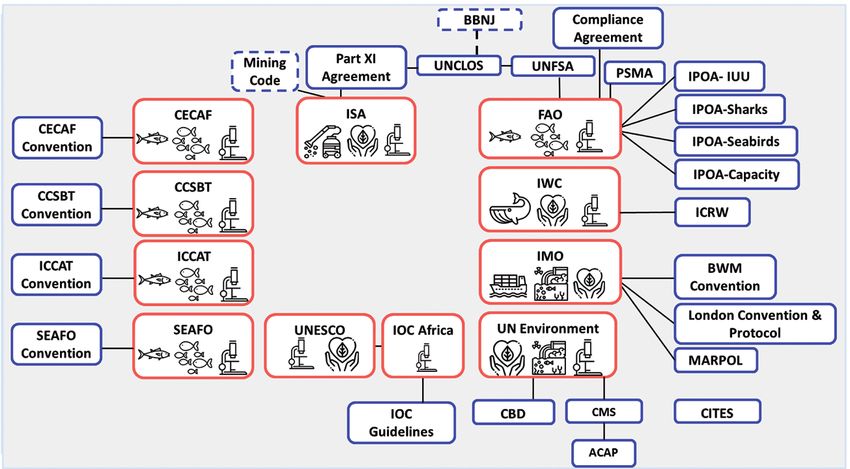
IMMA         Important Marine Mammal Area
IMO          International Maritime Organisation
IOC-UNESCO   Intergovernmental Oceanographic Commission of the United Nations Educational,
             Scientific and Cultural Organization
IOTC         Indian Ocean Tuna Commission
IPOA         International Plan of Action
ISA          International Seabed Authority
IUU          Illegal, Unreported and Unregulated (Fishing)
IWC          International Whaling Commission
KBA          Key Biodiversity Area
LME          Large Marine Ecosystem
MARPOL       International Convention for the Prevention of Pollution form Ships
MCS          Monitoring, Control and Surveillance
MGR          Marine Genetic Resources
MoU          Memorandum of Understanding
MPA          Marine Protected Areas
MSP          Marine Spatial Planning
MSY          Maximum Sustainable Yield
NEAFC        North East Atlantic Fisheries Commission
OLDEPESCA    Organización Latinoamericana de Desarrollo Pesquero/Latin American
             Organisation for Fisheries Development
OSPAR        Convention for the Protection of the Marine Environment of the North-East Atlantic
PrepCom      Preparatory Committee
PSMA         Agreement on Port State Measures to Prevent, Deter and Eliminate Illegal,
             Unreported and Unregulated Fishing
PSSA         Particularly Sensitive Sea Area
REMP         Regional Environmental Management Plan
RFMA         Regional Fisheries Management Agreement
RFMO         Regional Fisheries Management Organisation
RFB          Regional Fisheries Body
RSP          Regional Seas Programme
SDG          Sustainable Development Goal
SEA          Strategic Environmental Assessment
SEAFO        South East Atlantic Fisheries Organisation
SOI          Sustainable Ocean Initiative
SPRFMO       South Pacific Regional Fisheries Management Organisation
SRFC         Sub-Regional Fisheries Commission
SSC          Scientific Sub-Committee
TAC          Total Allowable Catch
TAE          Total Allowable Effort
UN           United Nations
UNCLOS       United Nations Convention on the Law of the Sea
UNEA         United Nations Environment Assembly
UNESCO       United Nations Educational, Scientific and Cultural Organization
UNFSA        United Nations Agreement for the Implementation of the Provisions of the United
             Nations Convention on the Law of the Sea of 10 December 1982 Relating to the
             Conservation and Management of Straddling Fish Stocks and Highly Migratory
             Fish Stocks
UNGA         United Nations General Assembly
VME          Vulnerable Marine Ecosystem
VMS          Vessel Monitoring System
WAEMU        West African Economic and Monetary Union
WCPFC        Western and Central Pacific Fisheries Commission
WSSD         World Summit on Sustainable Development
                                                                                                  7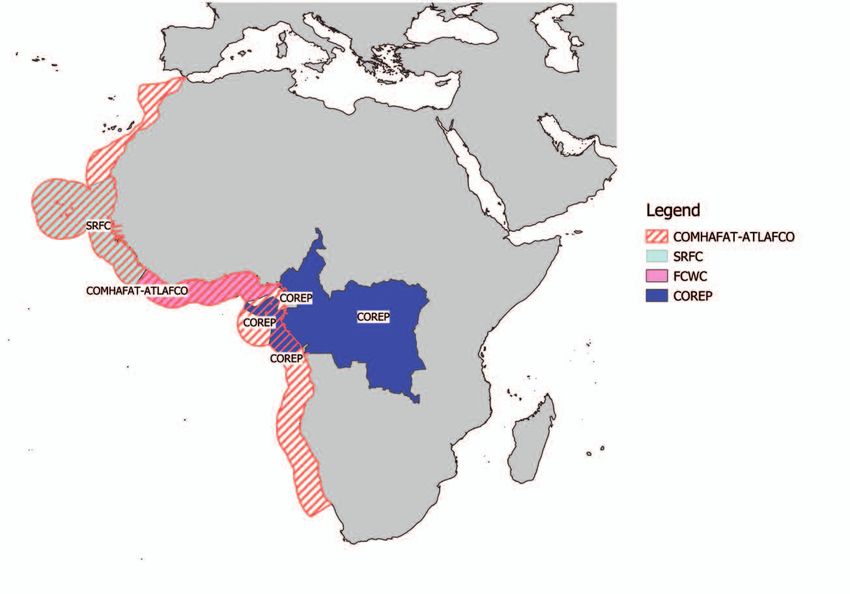
Strengthening Regional Ocean Governance for the High Seas

    Executive Summary

    The Southeast Atlantic and Southeast Pacific            tle coordination between competent organisa-
    regions are both characterised by their high            tions.
    biological productivity, supported by impor-
    tant oceanic currents. Recognising the need to          When looking at the two regions in detail, the
    ensure conservation and sustainable use of this         assessment showed that:
    biodiversity, coastal States in these regions
    cooperate through regional organisations to             ≥ Member States within the two regions are di-
    improve ocean governance, including in Areas                verse in terms of culture, language and avail-
    Beyond National Jurisdiction (ABNJ).                        able capacity – this is particularly the case in
                                                                the Southeast Atlantic region;
    Within these two regions, members of the
    Permanent Commission for the South Pacific              ≥ There exists varied and uneven participation
    (CPPS) signed the 2012 Galapagos Commit-                    in regional and global agreements within
    ment, in which they commit to promote coordi-               both regions, making it difficult to fully ad-
    nated action ‘regarding their interests in living           dress BBNJ issues without an adequate legal
    and non-living resources in ABNJ’; and in the               basis or, in the case of the Southeast Atlantic,
    Southeast Atlantic, member States of the Abid-              also an institutional basis;
    jan Convention requested that the Secretariat
    set up a working group to study all aspects of          ≥ Organisations within the regions have vary-
    the conservation and sustainable use of BBNJ                ing and non-comprehensive or limited man-
    within the framework of the Convention.                     dates to address issues related to BBNJ;

    This report is intended to provide a review of          ≥ There is limited cross-sectoral cooperation
    the relevant governance frameworks currently                within the regions, with individual organisa-
    in place for the management of high seas bio-               tions adopting their own principles, resolu-
    diversity in these regions. The report uses the             tions and recommendations for addressing
    issues under discussion in the ongoing negotia-             BBNJ challenges.
    tions for a new legally binding BBNJ agreement
    under the United Nations, as well as selected           Some preliminary ideas for options to strength-
    Sustainable Development Goal (SDG) 14 targets,          en the role of regional ocean governance for the
    as a lens through which to assess progress              high seas are offered, including:
    towards conservation and sustainable use.
                                                            ≥ Advancing cross-sectoral cooperation and
    The report finds that considerable efforts have             coordination between organisations to en-
    been made to advance conservation and sus-                  sure the implementation of the ecosystem-
    tainable use of BBNJ and that States have been              based approach to manage marine resources
    active in addressing issues such as Illegal, Un-            and ensure conservation and sustainable use
    reported and Unregulated (IUU) fishing, marine              of BBNJ. Various options such as joint pro-
    pollution as well as promoting scientific coop-             grammes, Memoranda of Understanding,
    eration. Nonetheless, legal and implementation              and participation in events exist and could be
    gaps remain that hamper efficient and effective             a first step in building cooperation;
    management of ecosystems and resources in
    ABNJ. In particular, there is limited adoption of       ≥ Coastal States in the Southeast Atlantic and
    legally binding management measures outside                 Southeast Pacific could choose to implement
    those adopted in relation to fisheries, and lit-            a common approach or policy for the region

8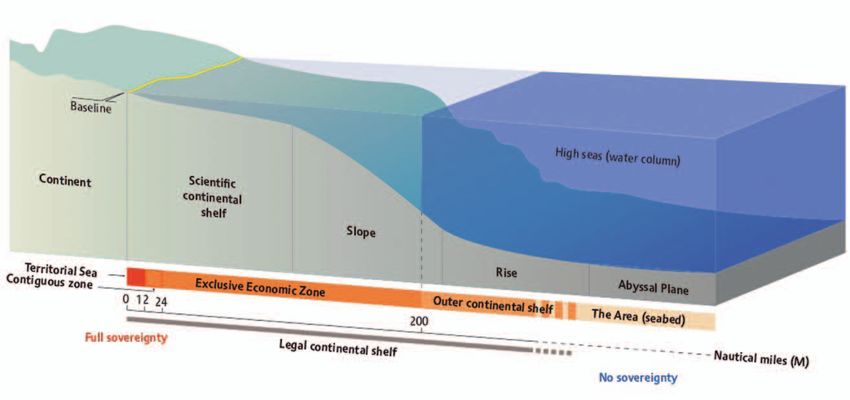
on conservation priorities by championing         ≥ The expansion of efforts to coordinate on
  flag State responsibility to impose regulations     BBNJ issues by empowering regional seas
  regarding areas or activities that are not cur-     programmes to consider ABNJ could support
  rently covered by a competent management            a coordinated, regional approach to conser-
  authority; impose stricter standards than re-       vation and sustainable management;
  quired by a competent management author-
  ity; and provide regulation where the relevant    ≥ A robust scientific basis and developed capac-
  RFMO or sectoral management body has not            ity for taking action could also be supported
  adopted measures;                                   to ensure the establishment of conservation
                                                      and management measures and ensure the
≥ Challenges to cross-sectoral cooperation can        complementarity of sectoral measures.
  be eased if more States in the regions be-
  come parties to the key international and re-     States could also consider that the negotiation
  gional agreements, including a future BBNJ        of a new BBNJ agreement is an opportunity to
  agreement for BBNJ. Indeed, such participa-       bring coherence to a fragmented governance
  tion may be seen as a priority, as this would     regime, provide additional support for improved
  provide a shared basis for common action;         cross-sectoral cooperation and allow for the
                                                    establishment or strengthening of regional inte-
≥ Coastal States could form coalitions to pro-      gration mechanisms. The negotiation of a new
  mote mutual interest in specific BBNJ-relat-      agreement, therefore offers a mode by which to
  ed issues within existing processes and in the    support and achieve many of the above men-
  negotiations for a new treaty;                    tioned options for strengthening regional ocean
                                                    governance.
≥ States could promote conservation and sus-
  tainable use of BBNJ by voicing their views
  and proposing management actions at
  global and regional fora. States could, for ex-
  ample, make efforts to advance ecosystem-
  based management within RFMOs by advo-
  cating that they put a greater emphasis on
  assessment of non-target species and man-
  agement of bycatch;

                                                                                                       9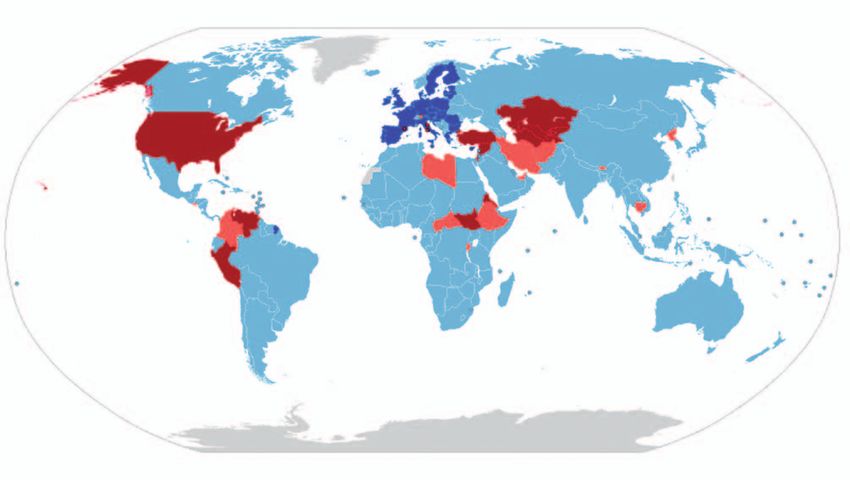
Strengthening Regional Ocean Governance for the High Seas

     1. Introduction

     The Southeast Atlantic and Southeast Pacific                        est to regional organisations provide a lens for
     regions are both characterised by their high                        discussion, namely: SDG 14 targets on marine
     biological productivity, supported by impor-                        pollution (14.1), management and protection of
     tant oceanic currents. Recognising the need                         marine ecosystems (14.2) and Illegal, Unreport-
     to ensure conservation and sustainable use of                       ed and Unregulated (IUU) fishing (14.4).
     this biodiversity, coastal States in these regions
     cooperate through regional organisations to                         This report was prepared as part of the Strength-
     strengthen ocean governance, including in Ar-                       ening Regional Ocean Governance for the High
     eas Beyond National Jurisdiction (ABNJ) (often                      Seas (‘STRONG High Seas’) project, based on an
     simply referred to as the ‘high seas’).                             extensive literature review, detailed analysis of
                                                                         legal and policy documents, engagement with
     This report provides a review of the relevant gov-                  stakeholders through regional workshops and
     ernance frameworks currently in place for the                       expert opinion. It builds on previous studies,
     management of high seas biodiversity in these                       particularly in relation to the Southeast Pacific.2
     regions and discusses the challenges and op-                        The report was reviewed by ocean governance
     portunities for advancing conservation and sus-                     experts and by members of the STRONG High
     tainable use. Building on this review, the report                   Seas project Advisory Board. The report is tar-
     highlights important lessons learned and iden-                      geted towards policy and decision-makers as
     tifies some possible options for strengthening                      well as others working on issues of ocean gov-
     management and regional cooperation.1                               ernance, particularly in the Southeast Atlantic
                                                                         and Southeast Pacific regions.
     The discussion in this report is structured
     around two important ongoing international                          An in-depth description of the current global
     processes: the ongoing negotiations within the                      ocean governance framework is provided in
     United Nations (UN) for an international legally                    Chapter 2, including a review of relevant inter-
     binding instrument on the conservation and                          national organisations. Chapter 3 provides an
     sustainable use of marine biodiversity beyond                       overview of the ecology and governance frame-
     national jurisdiction (BBNJ); and Sustainable                       works of these regions, Chapter 4 focuses on
     Development Goal (SDG) 14. The BBNJ negotia-                        the abovementioned BBNJ elements and SDG
     tions cover marine genetic resources (MGRs), ar-                    targets. Chapter 5 assesses linkages to other
     ea-based management tools (ABMTs), environ-                         regional organisations that do not have a man-
     mental impact assessments (EIAs), and capacity                      date to work in ABNJ and how they can contrib-
     building and the transfer of marine technology,                     ute to conservation and sustainable use. Finally,
     while selected SDG targets of particular inter-                     Chapter 6 discusses the results of these assess-

     1
       In this report, an international organisation is defined as an organisation with an international scope. A regional organisa-
       tion is defined as an organisation which can incorporate an international membership but operates regionally. A sectoral
       organisation is an organisation that has a clear sectoral mandate but which operates either regionally or internationally.
     2
       See: Durussel, Carole Claire, Challenges in the conservation of high seas biodiversity in the Southeast Pacific, Doctor of Philos-
       ophy thesis, Australian National Centre for Ocean Resources and Security (ANCORS) – Faculty of Law, Humanities and the Arts,
       University of Wollongong, 2015. http://ro.uow.edu.au/theses/4415; Durussel, C., Soto Oyarzún, E., Urrutia S., O. (2017): Strength-
       ening the legal and institutional framework of the Southeast pacific: Focus on the BBNJ package elements. – International
       journal of marine and coastal law, 32, 4, p. 635 – 671.DOI: http://doi.org/10.1163/15718085-12324051; UNEP-WCMC (2017). Govern-
       ance of areas beyond national jurisdiction for biodiversity conservation and sustainable use: Institutional arrangements and
       cross-sectoral cooperation in the Western Indian Ocean and the South East Pacific. Cambridge (UK): UN Environment World
       Conservation Monitoring Centre. 120 pp.

10
ments and provides possible options for improv- Southeast Atlantic and Southeast Pacific will be
ing governance in the Southeast Atlantic and published by the STRONG High Seas project on
Southeast Pacific. Additional background infor- topics such as the ecological state of the high
mation and detailed assessments are provided seas, socioeconomic importance of the high
in the Annexes. seas, options for management measures and
recommendations for stakeholder engagement
This report is part of a series of reports covering and capacity building in ocean governance.
issues of ocean governance with a focus on the These reports will be made available through
high seas of the Southeast Pacific and South- the STRONG High Seas project website.3
east Atlantic. Further reports focusing on the
3
Available at: https://www.prog-ocean.org/our-work/strong-high-seas/.
11Strengthening Regional Ocean Governance for the High Seas
2. Ocean Governance
The legal framework for governance of the international basis upon which to pursue the
ocean is provided by, among various other in- protection and sustainable development of ma-
struments, the United Nations Convention of rine and coastal environment and its resources’.5
the Law of the Sea (UNCLOS).4 UNCLOS, to- UNCLOS has been widely ratified and some of
gether with a wide-range of international and the provisions in UNCLOS reflect customary in-
regional instruments, lays down the principles, ternational law and are therefore applicable to
rules, regulations, and norms for governing the both Parties and non-Parties of UNCLOS (see
uses of the ocean. This framework forms ‘the Figure 1).6
Parties Parties also represented by the EU Signatories Non-Parties
Figure 1: States Parties to UNCLOS7 (Source: Wikimedia)
4
United Nations Convention on the Law of the Sea, opened for signature 10 December 1982, ATS 31 (entered into force 16
November 1994) (‘UNCLOS’). A historical overview of the development of UNCLOS and related regimes and principles can
be found for instance here: https://worldoceanreview.com/en/wor-1/law-of-the-sea/a-constitution-for-the-seas/ (accessed:
December 2018).
5
United Nations General Assembly, Report of the United Nations Conference on Environment and Development, Conference
on Environment and Development, A/CONF.151/26 (Vol. II) (13 August 1992) chapter 17 (‘Protection of the Oceans, All Kinds of
Seas, Including Enclosed and Semi-Enclosed Seas, and Coastal Areas and the Protection, Rational Use and Development of
their Living Resources’), para 17.1.
6
There are currently 168 Parties to UNCLOS and the UN General Assembly has regularly stressed its goal of universal participa-
tion in its resolutions on oceans and the law of the sea. However, it is important to note that, although UNCLOS is recognised
as a fundamental international treaty on oceans and plays a leading role in the regulation of marine issues, not all States are
Parties to this Convention. The following States have not ratified (* denotes States that have nonetheless signed): Afghani-
stan*, Andorra, Bhutan*, Burundi*, Cambodia*, Central African Republic*, Colombia*, El Salvador*, Eritrea, Ethiopia*, Holy See,
Iran (Islamic Republic)*, Israel, Kazakhstan, Korea (People’s Democratic Republic), Kyrgyzstan, Libya*, Liechtenstein*, North Ko-
rea*, Peru, Rwanda*, San Marino, South Sudan, Syrian Arabic Republic, Tajikistan, Turkey, Turkmenistan, United Arab Emirates*,
the United States, Uzbekistan, and Venezuela. A chronological list of ratifications is available at: http://www.un.org/Depts/los/
reference_files/chronological_lists_of_ratifications.htm (accessed: December 2018).
7
Source: Wikimedia, available at: https://commons.wikimedia.org/wiki/File:United_Nations_Convention_on_the_Law_of_the_
Sea_parties.svg (accessed: December 2018).
12Under UNCLOS, the ocean is divided into juris- to all states, whether coastal or land-locked’,
dictional zones, each with a different legal sta- and ensures freedoms such as navigation, over-
tus and subject to different rights and obliga- flight, laying of submarine cables, building of ar-
tions (see Figure 2). By determining a baseline tificial islands, fishing and scientific research.10
based on their coastline, States can define a 200 In the Area, the principle of the common herit-
nautical mile Exclusive Economic Zone (EEZ). age of mankind applies, which entails, inter alia:
They have the exclusive right to exploit, explore, shared ownership and management of the area
conserve and manage all marine resources.8 and its mineral resources, the equitable sharing
of benefits for current and future generations;
Areas beyond national jurisdiction comprise: and the responsibility of States, through the
the water column, known as the ‘high seas’; International Seabed Authority (ISA), to act on
and the seabed, called ‘the Area’.9 On the high behalf of mankind as a whole, including future
seas, UNCLOS applies the principle of freedom generations.11
of the high seas, i.e. that ‘the high seas are open
Figure 2: Maritime Zones under UNCLOS12 (Source: Riccardo Pravettoni, GRID-Arendal [2010])
8
UNCLOS, art. 56.
9
UNCLOS, arts. 1 and 86. Under UNCLOS art. 76, States can furthermore claim an extended continental shelf up to 350 nautical
miles or up to 100 nautical miles from the 2,500-metre isobath. In these cases, the extended continental shelf is part of the
national jurisdiction of States whereas the water column above it is beyond national jurisdiction.
10
UNCLOS, art. 87. UNCLOS makes exercise of these freedoms subject to a range of obligations and responsibilities to other
States and to the marine environment. These freedoms have been further qualified by the development of international law
through the imposition of new treaty obligations, for example in relation to fisheries under the UNFSA, and the application
of modern legal principles, such as the precautionary principle.
11
UNCLOS, arts. 133, 136 and 140; Jaeckel, A., Gjerde, K.M., Ardron, J.A., (2017). ‘Conserving the Common Heritage of Human-
kind – Options for the Deep Seabed Mining Regime’, Marine Policy 78, 150-157; Jaeckel, A., Ardron, J.A., Gjerde, K.M (2016).
Sharing benefits of the common heritage of mankind – Is the deep seabed mining regime ready? Marine Policy, http://dx.doi.
org/10.1016/j.marpol.2016.03.009.
12
Source: Riccardo Pravettoni, GRID-Arendal (2010), available at: http://www.grida.no/graphicslib/detail/marittime-zones_
e96c (accessed: December 2018).
13Strengthening Regional Ocean Governance for the High Seas
2.1 Major Challenges in Ocean ience and enhancing productivity. Global
Governance standards for sectoral and cross sectoral
ABMTs and decision-making for globally le-
While UNCLOS establishes general rules for gally binding MPAs are similarly lacking;
States to cooperate and puts forth the legal ba-
sis for the protection of the marine environment ≥ Uncertainty surrounding the legal status of
and the conservation of marine living resources marine genetic resources (MGRs) in ABNJ in-
on the high seas, it does not comprehensively cluding questions of sharing of benefits;
address the conservation and sustainable use of
high seas biodiversity.13 The fragmented govern- ≥ Lack of global practicable criteria and stand-
ance regime leaves numerous gaps and poses ards for the implementation of general
challenges to an integrated approach to the UNCLOS rules to conduct and report on en-
conservation and sustainable use of high seas vironmental impact assessments (EIAs) and
biodiversity, notably: strategic environmental assessments (SEAs),
under which human activities and their indi-
≥ No comprehensive suite of overarching gov- vidual and cumulative pressures can be as-
ernance principles exists to guide decision- sessed in a comprehensive manner to inform
making, such as precaution, cooperation, ac- decision-making;
countability, transparency, intergenerational
and intra-generational equity, the ecosystem ≥ Limited capacity building and technology
approach, and stewardship; transfer, suggesting that the provisions in
UNCLOS on this element are not adequately
≥ The current institutional framework is frag- addressed or monitored. It is widely recog-
mented and lacks adequate mechanisms nised that improved implementation mecha-
for global coordination, cooperation or co- nisms are needed; and
herence among existing regional and global
competent organisations. Due to this frag- ≥ Uneven spatial and species coverage by high
mentation, not all human activities in ABNJ seas fisheries management bodies has fre-
are adequately regulated; not all regions are quently been highlighted as a specific chal-
fully covered; and some organisations exer- lenge, due to the primary focus of high seas
cise their mandate with limited reference to fisheries management on regional level im-
modern governance principles, such as the plementation. This has resulted in mixed re-
ecosystem approach, or transparent and in- gional fisheries management organisations
clusive decision-making processes; (RFMOs) performance in implementing eco-
system-based management to sustain habi-
≥ There is no global framework for area-based tat, species and ecological integrity; gaps in
management tools (ABMTs) including ma- spatial coverage as well as target species
rine protected areas (MPAs). MPAs and MPA (sharks, squid); and IUU fisheries stemming
networks are considered important tools for in part from often poor domestic control over
preserving and restoring ecosystem health nationally registered and flagged vessels.14
and diversity; increasing ecosystem resil-
13
UNCLOS, arts. 117, 118, 119, 192, 194, and 197. For more details on the international legal framework for the conservation of high
seas biodiversity, see for instance C. Durussel, ’Challenges in the Conservation of High Seas Biodiversity in the Southeast
Pacific’ (Doctor of Philosophy Thesis, University of Wollongong, 2015), http://ro.uow.edu.au/theses/4415/; UNEP-WCMC (2017).
Governance of areas beyond national jurisdiction for biodiversity conservation and sustainable use: Institutional arrange-
ments and cross-sectoral cooperation in the Western Indian Ocean and the South East Pacific. Cambridge (UK): UN Environ-
ment World Conservation Monitoring Centre. 120 pp.
14
Gjerde, K., Boteler, B., Durussel, C., Rochette, J., Unger, S., Wright‚ G., ‘Conservation and Sustainable Use of Marine Biodiversity
in Areas Beyond National Jurisdiction: Options for Underpinning a Strong Global BBNJ Agreement through Regional and
Sectoral Governance’, STRONG High Seas Project, 2018; See also Wright, G., Rochette, J., Gjerde, K. and Seeger, I., (2018). ‘The
long and winding road: negotiating a treaty for the conservation and sustainable use of marine biodiversity in areas beyond
national jurisdiction’, IDDRI Studies N°08 (2018).
142.2 Sector-based Ocean Governance and voluntary agreements, codes of conduct
Framework and plans of action adopted under the aegis
of the United Nations Food and Agriculture Or-
Human activities in ABNJ include fishing, ship- ganization (FAO).19 The UNFSA elaborates the
ping, and the laying of submarine cables and requirements of UNCLOS for States to cooper-
pipelines, with new activities potentially on ate on a regional basis through RFMOs, and sets
the horizon, such as the exploitation of deep- forth principles and obligations for, among other
seabed mineral resources. A number of agree- things, science and ecosystem-based approach-
ments, conventions, international organisations es to management, precaution, and the protec-
and other regulatory bodies are in place for the tion of biodiversity in the marine environment.
management of these activities (see Figure The International Whaling Commission (IWC)
3). Measures adopted by regulatory bodies are provides for the international regulation of whal-
binding on member States. However, ensuring ing and the management of whale stocks.20
compliance is challenging and exacerbated by
the fact that these organisations are frequently Shipping: Marine transportation is regulated by
under-resourced. a number of conventions and agreements under
the International Maritime Organization (IMO),
Fisheries: States cooperate through Regional with the International Convention for the Preven-
Fisheries Management Organisations and Ar- tion of Pollution from Ships (‘MARPOL’),21 the Con-
rangements (RFMO/As).15 Management meas- vention on the Prevention of Marine Pollution by
ures of RFMOs/As are implemented pursuant to Dumping of Wastes and Other Matter (‘London
provisions in each organisations’ foundational Convention’) and its Protocol,22 and the Interna-
agreement, UNCLOS, the 1995 United Nations tional Convention for the Control and Manage-
Fish Stocks Agreement (UNFSA),16 the 1993 FAO ment of Ships’ Ballast Water and Sediments (‘Bal-
Compliance Agreement,17 the 2009 FAO Ports last Water Management Convention’ or ‘BWM
States Measures Agreement, which specifically Convention’) being the key agreements with re-
targets IUU fishing,18 as well as various binding gard to protecting the marine environment.23
15
RFMOs have a management mandate and a Secretariat operating under a governing body of member States, whereas
Arrangements have no management authority and no formal institutional structure. See: http://www.fao.org/fishery/
topic/16800/en (accessed: December 2018).
16
United Nations Agreement for the Implementation of the Provisions of the United Nations Convention on the Law of the Sea
of 10 December 1982 Relating to the Conservation and Management of Straddling Fish Stocks and Highly Migratory Fish
Stocks, opened for signature 8 September 1995, ATS 8 (entered into force 11 December 2001).
17
Agreement to Promote Compliance with International Conservation and Management Measures by Fishing Vessels on the
High Seas, opened for signature 29 November 1993, ATS 26 (entered into force 24 April 2003).
18
Agreement on Port State Measures to Prevent, Deter and Eliminate Illegal, Unreported and Unregulated Fishing, opened
for signature 22 November 2009 (entered into force 5 June 2016).
19
See especially: United Nations Food and Agriculture Organization, Code of Conduct for Responsible Fisheries (1995); United
Nations Food and Agriculture Organization, ‘International Plan of Action for the Management of Fishing Capacity’ (1999);
United Nations Food and Agriculture Organization, ‘International Plan of Action for Reducing Incidental Catch of Seabirds in
Longline Fisheries’ (1999); United Nations Food and Agriculture Organization, ‘International Plan of Action for the Conserva-
tion and Management of Sharks’ (1999); United Nations Food and Agriculture Organization, ‘International Plan of Action to
Prevent, Deter, and Eliminate Illegal, Unreported and Unregulated Fishing’ (2001).
20
The IWC was established by the International Convention for the Regulation of Whaling, opened for signature 2 December
1946, ATS 18 (entered into force 10 November 1948) amended in 1956.
21
Protocol of 1997 to amend the International Convention for the Prevention of Pollution from Ships of 2 November 1973, as
modified by the Protocol of 17 February 1978, opened for signature 26 September 1997, ATS 37 (entered into force 19 May
2005).
22
Convention on the Prevention of Marine Pollution by Dumping of Wastes and Other Matter, opened for signature 13 No-
vember 1972, ATS 16 (entered into force 30 August 1975); Protocol to the Convention on the Prevention of Marine Pollution by
Dumping of Wastes and Other Matter, 1972, opened for signature 7 November 1996, 36 ILM 1 (entered into force 24 March
2006) amended in 2006.
23
International Convention for the Control and Management of Ships’ Ballast Water and Sediments, opened for signature 13
February 2004 (entered into force 8 September 2017). See also: International Convention for the Safety of Life at Sea, opened
for signature 1 November 1974, 1184 UNTS 2 (entered into force 25 May 1980); International Convention on Oil Pollution Pre-
paredness, Response and Co-operation, opened for signature 30 November 1990, ATS 12 (entered into force 13 May 1995).
15Strengthening Regional Ocean Governance for the High Seas
Seabed mining: Activities with regard to deep ≥ The Intergovernmental Oceanographic Com-
seabed mining in the Area are regulated by the mission of the United Nations Educational,
International Seabed Authority (ISA), as estab- Scientific and Cultural Organization (IOC-
lished under Part XI of UNCLOS and the 1994 UNESCO) for matters related to marine sci-
Agreement relating to the Implementation of ence and the transfer of marine technology;
Part XI of UNCLOS.24 The ISA oversees activities
related to the exploration and exploitation of ≥ UN Environment, the global environmental
and equitable sharing of benefits from mineral authority under the United Nations;
resources in the Area, reviews applications for ex-
ploration and exploitation, conducts EIAs, and is ≥ Agreements focused on the conservation of
responsible for ensuring the effective protection species of fauna and flora, notably: the Con-
of the marine environment through the neces- vention on Biological Diversity (CBD);28 the
sary measures, including by adopting rules and Convention on Migratory Species (CMS);29
regulations for the prevention of marine pollu- and the Convention on International Trade in
tion and damage to the marine environment Endangered Species of Wild Fauna and Flora
and the conservation of natural resources.25 (CITES);30
The ISA is currently developing regulations for
mineral exploitation.26 These regulations will be ≥ Regional instruments, such as Regional Seas
complemented by the development of Region- Programmes, and other regional initiatives,
al Environmental Management Plans (REMPs).27 e.g. the Sargasso Sea Commission (though
the competence and mandate of such instru-
In addition to the above-mentioned organisa- ments and initiatives to regulate activities in
tions, a number of international conventions ABNJ is limited).31
and organisations are relevant to the conserva-
tion and sustainable use of BBNJ, namely: Selected agreements relevant to the conserva-
tion and sustainable use of marine biodiversity
in ABNJ are summarised in Annex I.
24
UNCLOS, art. 137; United Nations General Assembly, Agreement relating to the Implementation of Part XI of the United Na-
tions Convention on the Law of the Sea of 10 December 1982, GA Res 48/263, 48th sess, Agenda Item 36, A/RES/48/263 (17
August 1994). See: http://www.un.org/depts/los/convention_agreements/texts/unclos/closindxAgree.htm (accessed: Septem-
ber 2018).
25
UNCLOS, arts. 140, 145, and 147.
26
Miller, K.A., et al. (2018) An Overview of Seabed Mining Including the Current State of Development, Environmental Impacts,
and Knowledge Gaps. In Front Mar Sci 10 January 2018.
27
See: ISA (2018) ‘Preliminary Strategy for the Development of Regional Environmental Management Plans for the Area’,
https://www.isa.org.jm/sites/default/files/files/documents/isba24-c3-e.pdf (December 2018).
28
Convention on Biological Diversity, opened for signature 5 June 1992, ATS 32 (entered into force 29 December 1993). Although
the CBD has no jurisdictional mandate for ABNJ – only, as outlined in CBD art. 4, in the case of processes and activities
under the jurisdiction of its contracting Parties, it provides a broad cooperation obligation with regard to the conservation
and sustainable use of marine biodiversity in ABNJ (art. 5).
29
Convention on the Conservation of Migratory Species of Wild Animals, opened for signature on 23 June 1979, ATS 32 (entered
into force 11 January 1983).
30
Convention on International Trade in Endangered Species of Wild Fauna and Flora, opened for signature 3 March 1973, ATS
29 (entered into force 1 July 1975).
31
The Sargasso Sea Commission was established by the 2014 Hamilton Declaration on Collaboration for the Conservation of
the Sargasso Sea, which was initiated by the governments of the Azores, Bermuda, Monaco, UK and US. The objective of
the Commission is to ‘encourage and facilitate voluntary collaboration toward the conservation of the Sargasso Sea’. See:
http://www.sargassoseacommission.org/.
16Figure 3: Main Organisations und Legal Agreements for the Conservation and Sustainable
Use of BBNJ32 (Source: IASS [2018])
32
Icons made by Freepik (fishing, whaling, conservation, research), Mavadee (shipping), Surang (deep seabed mining, ma-
rine pollution) and Made by Made (fish stock conservation) from www.flaticon.com, licensed by http://creativecommons.org/
licenses/by/3.0/ (accessed: December 2018). The asterisk denotes that some RFMO/As and RSPs do not have a mandate for
ABNJ. The dotted lines towards the RFMO/As and RSPs denotes that some of them are established by the FAO/UN Environ-
ment, while other are independent. See Annex I for selected agreements relevant to the conservation and sustainable use
of BBNJ. Soft law agreements included in this figure are: IOC-UNESCO, ‘IOC Criteria and Guidelines on Transfer of Marine
Technology (CGTMT)’ (2003) (‘IOC Guidelines’); United Nations Food and Agriculture Organization, ‘International Plan of Ac-
tion for the Management of Fishing Capacity’ (1999) (‘IPOA-Capacity’); United Nations Food and Agriculture Organization,
‘International Plan of Action for Reducing Incidental Catch of Seabirds in Longline Fisheries’ (1999) (‘IPOA-Seabirds’); United
Nations Food and Agriculture Organization, ‘International Plan of Action for the Conservation and Management of Sharks’
(1999) (‘IPOA-Sharks’); United Nations Food and Agriculture Organization, ‘International Plan of Action to Prevent, Deter, and
Eliminate Illegal, Unreported and Unregulated Fishing’ (2001) (‘IPOA-IUU’). The BBNJ agreement is currently being negoti-
ated under the UN and the Mining Code is being developed under the ISA.
17Strengthening Regional Ocean Governance for the High Seas
2.3 Ocean Governance at the servation of Antarctic Marine Living Resources
Regional Level (CCAMLR), the conservation of high seas living
resources more generally.36
In addition to a robust global agreement,
enhanced regional cooperation, particularly Regional ocean governance, i.e. ‘efforts among
through cross-sectoral cooperation, has been countries to work together to manage their
highlighted as a key requirement for improving ocean, coasts, and marine resources’,37 is pri-
the conservation and sustainable use of high marily conducted through: regional seas pro-
seas biodiversity.33 UNCLOS provides that: ‘States grammes (RSPs) and action plans; regional
shall cooperate on a global basis and, as appro- fisheries bodies (RFBs); political and economic
priate, on a regional basis, directly or through communities; leader-driven initiatives; and
competent international organizations, in for- Large Marine Ecosystems (LMEs).38 However,
mulating and elaborating international rules, only some of the RSPs and RFBs currently have
standards and recommended practices and a clear mandate to work in ABNJ. More recently,
procedures consistent with this Convention, for some initiatives have also focused on the con-
the protection and preservation of the marine servation and management of ecologically im-
environment, taking into account characteristic portant marine features in ABNJ, such as the
regional features’.34 The CBD and soft law instru- Sargasso Sea Commission and the Costa Rica
ments also call on regional cooperation for the Dome initiative.
protection of the ocean, taking into account the
application of the ecosystem approach.35 Regional seas programmes provide a forum
for cooperation on the protection of marine and
Current regional organisations include those es- coastal environments and are generally struc-
tablished to promote protection, conservation tured around a founding convention, with sub-
and sustainable development of the protection sequent conventions and protocols providing
of the marine environment and regional ma- further frameworks for cooperation on specific
rine scientific and technological centres under issues and action plans, which may provide for
UNCLOS, and regional fisheries management environmental assessment, management and
organisations or arrangements for the manage- legislation, as well as institutional and finan-
ment of highly migratory fish stocks, straddling cial arrangements. Since the inception of UN
fish stocks and discrete high seas fish stocks, Regional Seas, RSPs have tended to focus on
or in the case of the Commission for the Con- issues such as marine pollution and conserva-
33
See for instance: Durussel, C., Soto Oyarzún, E., Urrutia S., O. (2017): Strengthening the legal and institutional framework
of the Southeast pacific: Focus on the BBNJ package elements. – International journal of marine and coastal law, 32, 4, p.
635 – 671.DOI: http://doi.org/10.1163/15718085-12324051; Julien Rochette et al, ‘The Regional Approach to the Conservation and
Sustainable Use of Marine Biodiversity in Areas Beyond National Jurisdiction’ (2014) 49 Marine Policy 109; Elisabeth Druel et al,
‘Governance of Marine Biodiversity in Areas Beyond National Jurisdiction at the Regional Level: Filling the Gaps and Strength-
ening the Framework for Action. Case Studies from the North-East Atlantic, Southern Ocean, Western Indian Ocean, South
West Pacific and the Sargasso Sea’ (IDDRI Study No 04/12, IDDRI, 2012).
34
UNCLOS, art. 197.
35
TCBD, COP 10, Decision X/2, ‘Strategic Plan for Biodiversity 2011-2020 and Aichi Biodiversity Targets’ (2010); UN Conference
on Environment & Development, ‘Agenda 21’ (1992), Chapter 17 available at: https://sustainabledevelopment.un.org/content/
documents/Agenda21.pdf; UN Conference on Environment & Development, ‘The Future We Want’ (2012), para. 158, http://
www.un.org/disabilities/documents/rio20_outcome_document_complete.pdf.
36
UNCLOS, art. 118, 197 and 276; UNFSA, art. 8(1).
37
Wright, G., Schmidt, S., Rochette, J., Shackeroff Theisen, J., Unger, S., Waweru, Y., Müller, A. (2017): Partnering for a sustainable
ocean: The Role of Regional Ocean Governance in Implementing Sustainable Development Goal 14, Potsdam : PROG: IDDRI,
IASS, TMG & UN Environment, 73 p. DOI: http://doi.org/10.2312/iass.2017.011, at p. 13.
38
Large Marine Ecosystems are large marine regions that encompass coastal areas and the outer margins of major ocean
current systems and are characterised by distinct oceanographic and biological parameters. LME is a concept developed by
NOAA ‘as a model to implement ecosystem approaches to assessing, managing, recovering, and sustaining LME resources
and environments’ (See: https://www.st.nmfs.noaa.gov/ecosystems/lme/index; accessed: December 2018). There are no LMEs
in ABNJ as they are usually located within jurisdictional waters. Several GEF projects focus on LMEs and seek to work on
strengthening the organisational structures and decision-making processes.
18tion.39 There are 18 RSPs, some administered by through RFMOs. RFMOs are divided into two
UN Environment, some administered by other categories: tuna RFMOs, which manage highly
regional organisations, and some that are inde- migratory fish stocks of tuna and tuna-like spe-
pendent.40 Four regions are covered by a RSP cies, and non-tuna RFMOs, which manage other
with a mandate to work in ABNJ, namely: the non-highly migratory fish stocks. Membership
North-East Atlantic (the OSPAR Commission); of RFMOs generally includes both coastal States
the Antarctic (CCAMLR); the Mediterranean from the region as well as distant water fishing
(Barcelona Convention); and the South Pacific States.44
(Noumea Convention).41
Some RSPs and RFOs have sought to overcome
Regional fisheries bodies are a mechanism longstanding sectoral divisions to enhance co-
through which States work together to manage operation, for example through meetings under
one or more fisheries.42 While these organisa- the Sustainable Ocean Initiative (SOI), but few of
tions vary in terms of their function and geo- these efforts are formalised into memoranda of
graphical and species coverage, they all have an understanding (MoUs) or other arrangements.45
important role to play in terms of regional col- In the Southeast Pacific, CPPS has signed a MoU
laboration and joint action in the conservation with the Inter-American Tropical Tuna Commis-
and management of fisheries and associated sion (IATTC) and is in the process of signing a
biodiversity.43 Some organisations have only an MoU with the South Pacific Regional Fisheries
advisory mandate and can therefore only pro- Management Organisation (SPRFMO).46 In the
vide guidance, adopt decisions, or decide on Southeast Atlantic, the Abidjan Convention has
coordinating mechanisms that are not legally for instance signed a MoU with the Commission
binding to their member States. In contrast, for the Protection of the Marine Environment
RFMOs have a management mandate and can of the North-East Atlantic (OSPAR) and with
adopt fisheries conservation and management the Regional Commission of Fisheries of Gulf of
measures that are legally binding upon their Guinea (COREP).47 Another example is the Col-
member States. Most fishing in ABNJ is man- lective Arrangement formalised between the
aged at the regional level by States cooperating OSPAR Commission and the North East Atlantic
39
However, RSPs have no regulatory mandate in relation to fisheries management. This is the mandate of regional fisheries
bodies.
40
UN Environment-administered programmes: Caribbean Region, East Asian Seas, Eastern Africa Region, Mediterranean
Region, North-West Pacific Region, Western Africa Region, and Caspian Sea. Programmes administered by other regional
organisations: Black Sea Region, North-East Pacific Region, Red Sea and Gulf of Aden, ROPME Sea Area, South Asian Seas,
South-East Pacific Region, and Pacific Region. Independent programmes are: Arctic Region, Antarctic Region, Baltic Sea,
and North-East Atlantic Region. See: https://www.unenvironment.org/explore-topics/oceans-seas/what-we-do/working-
regional-seas/why-does-working-regional-seas-matter (accessed: September 2018).
41
Note that the South-East Pacific regional seas programme under the Lima Convention (art. 1) can extend to high seas areas
adjacent to CPPS’ member States national waters when a risk of marine and coastal pollution exists.
42
See: FAO Fisheries and Aquaculture Department, ‘Regional Fishery Bodies’ (FAO) http://www.fao.org/fishery/rfb/en (accessed:
September 2018). Regional fisheries bodies are either established: a) under FAO’s Constitution (based on Article VI or with
more autonomy under Article XIV), b) outside FAO’s framework but with FAO excercising depository functions; or c) outside
FAO’s framework.
43
See for instance: M.J. Juan Jordá, H. Murua, H. Arrizabalaga, N.K. Dulvy, and V. Restrepo, ‘Report card on ecosystem‐based
fisheries management in tuna regional fisheries management organizations,’ Fish and Fisheries 19(2) (2018): 321 – 339; Cre-
spo, G.O., & Dunn, D. 2016, ‘A review of the impacts of fisheries on open-ocean ecosystems’ ICES Journal of Marine Science,
Volume 74, Issue 9, 1 December 2017, Pages 2283 – 2297, https://academic.oup.com/icesjms/article/74/9/2283/3855115.
44
For information regarding membership of RFMOs covering the two regions discussed in this report, see Annex VI.
45
See: https://www.cbd.int/soi/ (accessed: September 2018).
46
Durussel, Carole Claire, Challenges in the conservation of high seas biodiversity in the Southeast Pacific, Doctor of Philosophy
thesis, Australian National Centre for Ocean Resources and Security (ANCORS) – Faculty of Law, Humanities and the Arts,
University of Wollongong, 2015. http://ro.uow.edu.au/theses/4415; Durussel, C., Soto Oyarzún, E., Urrutia S., O. (2017): Strength-
ening the legal and institutional framework of the Southeast pacific: Focus on the BBNJ package elements. – International
journal of marine and coastal law, 32, 4, p. 635 – 671.DOI: http://doi.org/10.1163/15718085-12324051.
47
See: https://www.ospar.org/site/assets/f iles/1357/13-12e_mou_abidjan_e.pdf and https://abidjanconvention.org/media/
documents/press_speech/Press%20Release%20on%20MoU%20with%20COREP.pdf (accessed: December 2018).
19Strengthening Regional Ocean Governance for the High Seas
Fisheries Commission (NEAFC), which establish- ing instrument. The first four rounds of negotia-
es an informal mechanism for the two bodies to tions took place in September 2018 at UN Head-
meet and share data and information regarding quarters in New York.50 The elements forming
shared management objectives and common the basis for negotiations were identified in 2011
ocean space in the North-East Atlantic.48 (see Box 1) and are:
Other regional initiatives for advancing gov- ≥ Area-based management tools (ABMTs), in-
ernance of ABNJ have been led by coalitions of cluding marine protected areas (MPAs);
countries and organisations keen to conserve
and manage ecologically important and sensi- ≥ Environmental impact assessments (EIAs);
tive marine features in ABNJ, such as the Sar-
gasso Sea and the Costa Rica Dome.49 These ≥ Marine genetic resources (MGRs), including
coalitions work through cooperation and col- questions related to access and sharing of
laboration among national governments, scien- benefits; and
tific institutions, and regional and international
organisations. ≥ Capacity building and the transfer of marine
technology.51
2.4 Development of an International
Legally Binding Agreement on These negotiations and any resulting instru-
BBNJ ment ‘should not undermine existing relevant
legal instruments and frameworks and relevant
Recognising the shortcomings in the current global, regional and sectoral bodies’.52 Conse-
governance framework, States have been dis- quently, the new agreement will depend on ef-
cussing the possible options for strengthening fective implementation frameworks both with-
governance of ABNJ for over a decade. In 2015, in marine regions and at the global level with
the UN General Assembly (UNGA) passed a res- regard to international rules, standards and rec-
olution to establish a preparatory committee ommended practices and procedures for States
(PrepCom) to make substantive recommenda- Parties to manage sectoral activities to foster
tions to the UNGA on the possible elements of biodiversity conservation and sustainable use in
a draft text of a new instrument under UNCLOS ABNJ. In this manner, the new agreement pro-
on the conservation and sustainable use of ma- vides the opportunity to set the standards and
rine biodiversity in ABNJ. In 2017, following four principles to improve the coordination between
sessions of the PrepCom, the UNGA decided and among existing global and regional institu-
to convene an intergovernmental conference tions and to foster integrated management ap-
(IGC) to negotiate an international legally bind- proaches.53
48
See: https://www.ospar.org/about/international-cooperation/collective-arrangement (accessed: September 2018).
49
See: Freestone, D., and Gjerde, K. ‘Lessons from the Sargasso Sea: Challenges to the Conservation and Sustainable Use of
Marine Biodiversity beyond National Jurisdiction’ (2016), available at: http://www.un.org/depts/los/biodiversity/prepcom_
files/Sargasso_Sea_Commission_Lessons_Learned.pdf (accessed: September 2018) and http://crdome.marviva.net/?page_
id=1809&lang=en (accessed: September 2018).
50
UNGA/RES/72/249 on an International legally binding instrument under the United Nations Convention on the Law of the
Sea on the conservation and sustainable use of marine biological diversity of areas beyond national jurisdiction.
51
UNGA/RES/69/292 on the development of an international legally binding instrument under the United Nations Convention
on the Law of the Sea on the conservation and sustainable use of marine biological diversity of areas beyond national juris-
diction. See also: https://documents-dds-ny.un.org/doc/UNDOC/GEN/N11/397/64/PDF/N1139764.pdf?OpenElement (accessed:
September 2018).
52
UNGA/RES/69/292 on the development of an international legally binding instrument under the United Nations Conven-
tion on the Law of the Sea on the conservation and sustainable use of marine biological diversity of areas beyond national
jurisdiction, para. 3.
53
Gjerde, K., Boteler, B., Durussel, C., Rochette, J., Unger, S., Wright‚ G., ‘Conservation and Sustainable Use of Marine Biodiversity
in Areas Beyond National Jurisdiction: Options for Underpinning a Strong Global BBNJ Agreement through Regional and
Sectoral Governance’, STRONG High Seas Project, 2018.
20You can also read


