Strengthening the Commitment: Living the commitment UK Strengthening the Commitment Steering Group - EMAP
←
→
Page content transcription
If your browser does not render page correctly, please read the page content below
Strengthening the Commitment: Living the commitment UK Strengthening the Commitment Steering Group

Strengthening the
Commitment:
Living the commitment
UK Strengthening
the Commitment
Steering Group

June 2015

4

Foreword
Strengthening the Commitment set out our vision of how learning disability nurses could
expand their role to ensure that people with learning disabilities are treated with dignity and
respect and receive the care and support they need. In the changing world of health and social
care services the role of learning disability nurses is pivotal to achieving this vision. In the past
three years a tremendous amount has been achieved in all four countries as learning disability
nurses have expanded their skills, knowledge and competencies, developed measurable
outcomes and evidence-based interventions, have significantly strengthened their research skills,
and are creating a critical mass of leaders to effect further change.

These achievements have only been possible because of the clear commitment to
implementation of the recommendations in Strengthening the Commitment across all four
countries and the leadership shown within each country. We are proud of the great strides
that have been made to improve the lives of people with learning disabilities and to ensure
that their needs are kept firmly on the health and social care agenda. This report identifies
these achievements and celebrates the innovative and successful work that is going on across
the United Kingdom led by learning disability nurses working across a range of settings. Our
congratulations and thanks to each and every professional who has made such a significant
contribution to this work.

The population of people with learning disabilities continues to increase as children born
with a learning disability live longer, more fulfilled lives and adults grow into older age. As a
consequence, the support of learning disability nurses is even more vital across the age range
and in all settings. Learning disability nurses play a vital role in reducing the health inequalities
that have all too often been experienced by people with learning disabilities.

   ‘Health services need to understand that people with profound and complex learning
   disabilities often have multiple health needs so won’t fit into generic health structures
   where one need is addressed at a time, issues need to be tackled collectively. Looking
   holistically is a key skill of a learning disability nurse.’
   Carer, mother of adults with learning disabilities

Despite the great achievements made in the past three years, there remains much to be done.
We are busy identifying the next steps in our journey and will be true to our commitment to
improve the lives of people with learning disabilities through strengthening the role of the key
professionals who work with them to make sure they have better lives.

            Jane Cummings                               Fiona McQueen
            Chief Nursing Officer                       Chief Nursing Officer
            England                                     Scotland

            Charlotte McArdle                           Jean White
            Chief Nursing Officer                       Chief Nursing Officer
            Northern Ireland                            Wales

June 2015

                                                                                                        5
6
Contents

Foreword                                                                 5

Contents                                                                 7

Executive summary                                                        8

1 Our vision                                                            10

2 How we have approached the challenges                                 13
  Unity and collaboration                                               13
  A commitment to implementation                                        13
  High level leadership                                                 13
  Nurturing future leaders                                              14
  Engagement with frontline practitioners and networking                14
  Academic networking and the evidence base for
   learning disability nursing                                          15
  UK Learning Disability Consultant Nurse Network                       18
  Independent and voluntary sectors                                     18
  Promoting learning disability competence in other fields of nursing   19

3 What have we achieved?                                                21
  Focus on capacity                                                     21
  Focus on capability                                                   27
  Focus on quality                                                      35
  Focus on strengthening the profession                                 39

4 Our commitment to the future agenda: living the commitment            45

Fact File                                                               48

References                                                              53

Appendix 1                                                              54

                                                                             7
Executive summary
 This report celebrates the achievements of learning disability nurses across the United
 Kingdom and the difference they have made, and continue to make, to the lives and health
 outcomes of people with learning disabilities.

 Three years ago, Strengthening the Commitment set out a range of challenges based on
 principles and values that are important to people with learning disabilities, their families
 and carers. UK government health departments, employers, educators, people with learning
 disabilities, their families and carers, learning disability nurses, students and wider health
 and social care staff have all risen to these challenges and are now delivering a significantly
 improved, person-centred, and imaginative service for people with learning disabilities.

 The four countries have worked together to address the challenges and through visible, high
 profile leadership have developed opportunities to create a learning disabilities service fit for
 the 21st century. Four broad challenges were identified to support the development of learning
 disability nursing: strengthening capacity, strengthening capability, strengthening quality, and
 strengthening the profession. These have been addressed by a strategy of work driven forward
 nationally and locally and with regular reporting processes that have ensured all countries have
 kept the challenges firmly in view.

 A number of major UK-wide initiatives have supported the vision of learning disabilities services
 to meet the needs of all those with learning disabilities.

 Nurturing future leaders
 Leaders are being identified at all levels and supported by innovative programmes to develop
 personal leadership abilities. For example, a two-day workshop was held for 42 people from
 across the UK who benefited from the opportunity to explore the development of practice,
 research, writing for publication and working with leading coaches.

 Engagement with frontline practitioners and networking
 The success of the implementation strategy has depended on active engagement with frontline
 practitioners to engage them with the aspirations and practical planning of the initiative.
 Networking has flourished, stimulated particularly by an explosion in the use of social media.
 The innovative case studies throughout this report demonstrate the range of work being carried
 out at grass roots level across the UK.

8

Developing the evidence base
The academic underpinning, research and the evidence base for learning disability nursing
is being strengthened by the work of the UK Learning and Intellectual Disabilities Nursing
Academic Network (LIDNAN). A model for collaborative working has been established which
future work will ensure a robust academic and research base for the future.

UK Learning Disability Consultant Nurse Network
The UK Learning Disability Consultant Nurse Network have been instrumental in sharing
ideas and have developed the Health Equalities Framework which provides an evidence based
outcomes framework to reduce the impact of service users’ exposure to determinants of health
inequalities. It is being adapted for children and young people with learning disabilities.

Independent and voluntary sectors
Many learning disability nurses are employed in the independent and voluntary sector and the
Independent Sector Collaborative has been established to ensure a high quality and sustainable
workforce across all sectors.

Learning disability competence in other fields of nursing
Staff working in general health and social care settings are seeking to expand their knowledge
and ability to communicate with people with learning disabilities. Initiatives across the UK are
developing these skills so that people with learning disabilities receive the appropriate care.

We recognise that the job is not yet done and this report also sets out our commitment to the
future agenda. A framework of priority actions and associated milestones will be developed and
we will ensure that the involvement of people with learning disabilities continues to be central
to our framework for delivery.

As new staffing models develop the role of the learning disability nurse will be vital to ensure
safe, compassionate and competent care in whatever setting. Every learning disability nurse
plays a key role in continuing to meet the needs of people with learning disabilities, their
family and carers and continuing to develop learning disability nursing as a strong and vibrant
profession.

                                                                                                   9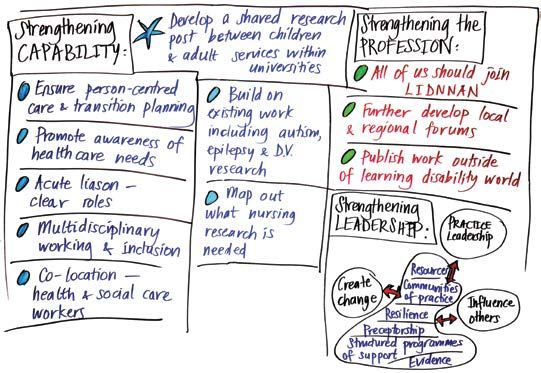
1 Our vision
   When Strengthening the Commitment was published in 2012 it set out a clear agenda to meet
   the challenge of making sure that people with learning disabilities across the United Kingdom
   had the high quality support from learning disability nurses that they deserved, needed and
   were entitled to in modern, 21st century health and social care services. Learning disability
  nurses had the opportunity to implement this agenda and to take their services forward to a
  new level: in the past three years they have seized that opportunity with both hands.

  The population of people with learning disabilities is increasing across the UK. There are
  approximately 1.5 million people in Britain living with learning disabilities (Learningdisabilities.
  org.uk). Demographic projections suggest that the numbers of people with learning disabilities
  will increase by 14% by 2021 as many more children born with a learning disability live longer,
  more fulfilled lives into adulthood, and the increasing adult population of people with learning
  disabilities grows into older age. Yet we continue to have evidence that people with learning
  disabilities experience significant health inequalities and are dying at a younger age than people
  without learning disabilities.

      People with learning disabilities
      n Have poorer health than the general population
      n Are more likely to need hospital services compared to the general
        population [26% compared to 14%] (Beacock et al., 2015)
      n 97% of people with a learning disability who die had one or more
        long-term or treatable health condition (Heslop et al., 2013)
      n Have difficulty accessing and using general health services
      n Are 58 times more likely to die aged under 50 than other people
      n Men with learning disabilities die, on average, 13 years sooner than men
        in the general population (Heslop et al., 2013)
      n Women with learning disabilities die, on average, 20 years sooner than
        women in the general population (Heslop et al., 2013)
      n 43% of deaths of people with learning disabilities were unexpected with
        repeated problems of delayed diagnosis, poor identification of needs and
        inappropriate care (Heslop et al., 2013)

 10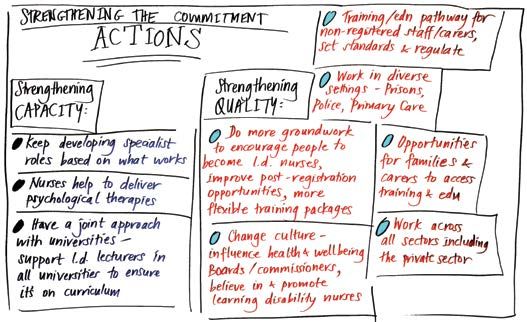
Strengthening the Commitment recognised that the role and profile of learning disability
nursing had changed significantly over the previous three decades and that the workforce had
become widely distributed across the health and social care sector.

The values and principles that are important to people with learning disabilities, their families
and carers and which were spelt out in Strengthening the Commitment continue to underpin
learning disability nursing. The challenges set out remain as true today as three years ago and
there are now new and emerging challenges that need a renewed, fresh focus to make sure
we are responsive to the needs of people with a learning disability, and their families and carers
while continuing to strengthen the learning disability profession.

Four clear challenges were identified to support the development of learning disability nursing:

n Strengthening capacity

n Strengthening capability

n Strengthening quality

n Strengthening the profession.

We knew that the actions required of the profession were considerable, that they would be
taking place in a time of recession, uncertainty and increasing diversity across the four UK
healthcare systems. As this report will demonstrate, UK government health departments,
employers, educators, people with learning disabilities, their families and carers, learning
disability nurses, students and wider health and social care staff have all risen to the challenges
and are now delivering a significantly improved, person-centred and imaginative service for
people with learning disabilities.

For example, the health and social care organisations in England are delivering a major
programme to transform the care of people with learning disabilities. This includes a
commitment to redesign care models and services which reduce the need for patient beds
and support people in a place they call home. As part of this work new staffing models will be
developed and the role of the registered learning disability nurse will be vital to ensure safe,
compassionate and competent care in whatever setting.

This report celebrates the achievements made in the past three years and the positive impact
that learning disability nurses have on health outcomes. The examples of positive practice
in this report have been chosen to be representative of the wide range of innovative work
that is taking place in all four countries. There are numerous examples of innovations and
developments across the whole UK and the Fact File provides brief information of many of
these. We hope that you will find these examples inspiring and useful as you work to improve
learning disability services for some of the most vulnerable people in our society.

                                                                                                      11
12
How we have approached the challenges                                                                     2
Unity and collaboration
A key feature of the implementation of the Strengthening the Commitment initiative has been
the way the four countries have worked together to address the challenges and opportunities to
create a modern learning disability nursing service fit for the 21st century. Partnership working
across all four countries has been central to our work and every country has contributed to a
shared understanding of the agenda and of how to approach it.

Inevitably each of the countries has worked at a different pace as each approached the
challenges from a different starting point. The Chief Nursing Officers of each country have
been actively and visibly committed to strengthening the role of learning disability nurses and
recognise the benefits of having specifically prepared nurses to support people with learning
disabilities. All recognise the crucial role that learning disability nurses play in the care of people
with learning disabilities whether in specialist hospital services or within community services, in
championing health improvement and working to tackle the health inequalities experienced by
people with learning disabilities.

A commitment to implementation
Across all four countries there has been a commitment to implementing the recommendations
in Strengthening the Commitment and to set up systems to monitor progress. A clear
programme of work has meant that the strategy has been driven forward nationally and locally
and regular reporting processes have ensured all countries kept the strategy firmly in view.
There has been progress on all seventeen recommendations and regular reviews of action plans
to strengthen services for people with learning disabilities.

High level leadership
A UK-wide Strengthening the Commitment Steering Group has provided strategic leadership
and a clear work plan with deliverables. The Steering Group has coordinated activities
and initiatives across the four countries and has been the focus for great achievement and
celebration. Membership of the Steering Group, see Appendix 1, has included the leads from
each of the four countries, student representatives, academics, the independent and voluntary
sectors, the Royal College of Nursing, and practising learning disability nurses.

Visible, high profile leadership within and across all four countries has been a key factor in
ensuring that the challenges set out by Strengthening the Commitment have been kept
clearly in view. Members of the Steering Group have acted as role models and a focus for
the aspirations of many learning disability nurses by being visible, approachable and actively
expanding the horizons of learning disability nursing.

Recently, the UK Strengthening the Commitment Steering Group has been joined by the
Deputy Chief Nurse, representing the Chief Nurse, from the Republic of Ireland seeking support
and partnership working to modernise learning disability nursing provision in her own country.

                                                                                                          13
The UK Strengthening the Commitment Steering Group has established positive working
relationships with key national organisations such as the Royal College of Nursing, MENCAP,
the Royal Society of Medicine, the Council of Deans of Health and many others. Such
partnerships have ensured that learning disability nursing is regularly considered and reviewed
by key stakeholders.
Throughout all four countries there have been examples of initiatives being spearheaded by
senior leaders to demonstrate the importance placed on developments such as the Health
Equalities Framework (HEF).
Nurturing future leaders
Leaders at all levels of the profession must be supported. A UK-wide initiative by the UK
Strengthening the Commitment Steering Group focused on nurturing future leaders within the
profession. A leadership programme for 3rd year students attended by 42 people from across
the UK included a two-day leadership workshop which explored the development of practice,
research and writing for publication with the opportunity to discuss issues in small groups
with leadership coaches. The evaluation of the workshop
highlighted the value participants found in developing their ‘It’s made me brave … I can go
personal leadership abilities and their confidence to use into situations and ask questions.’
these abilities to bring about change in practice.
Amy Hodkin,
student
Engagement with frontline practitioners and networking
Implementing the strategy has been grounded in working with frontline practitioners to engage
them with the aspirations and practical planning resulting from the initiative. There has been
bottom-up engagement with action plans throughout the NHS, the independent and voluntary
sectors. Clinicians at all points of their careers have engaged with the process and networking
has flourished.
There has been an explosion in the use of social media and communities of practice have
developed as a result with practitioners sharing good practice and experiences across the UK.
Previously learning disability nurses and students tended to be fragmented and could feel
isolated but use of Facebook and Twitter alongside numerous more conventional meetings and
events, has enabled practitioners to become connected with Strengthening the Commitment as
an anchor for the development of new ideas. As practitioners move out of their more traditional
roles, it is the more important that they are able to stay connected with their colleagues and to
exchange ideas and practice and to drive the profession forward.
14#ldnursechat
A voluntary, social media based discussion and networking forum set up by learning
disability nurses which has developed an international following. #ldnursechat is in talks
with universities to promote the profession and to share networking skills.
@WeLDnurses
Connects learning disability nurses, talking and sharing with everyone
with a passion for learning disability care. Has 3,982 followers (at June
2015).
https://twitter.com/WeLDnurses
Academic networking and the evidence base for learning
disability nursing
It was clear that the academic underpinning, research and the evidence base for learning
disability nursing needed to be strengthened. The UK Learning and Intellectual Disabilities
Nursing Academic Network (LIDNAN) was created to tackle this challenge and has proved
highly successful. The aims of LIDNAN are to:
n Represent and promote learning disability nursing education, research and practice
development
n Influence and respond to UK learning disability nursing agenda through well-informed
debate, discussion and dissemination of material
n Act as a source of consultation and advice to learning disability nurses and others on learning
disability nursing education and research
n Share good practice and innovations in the development and conduct of learning disability
nursing education and research.
The network has achieved a great deal in the past three years and has established a model for
collaborative working which strengthens the profession and ensures a robust academic and
research base for the future. Its work plan consists of nine areas of activity including post-
registration development. In Scotland the Career and Development Framework for Learning
Disability Nursing in Scotland (NES, 2013) outlines the developmental needs of the registered
nursing disability workforce, reflecting the key priorities for workforce development in
Strengthening the Commitment.
15Positive practice (UK wide)
Developing research capacity and capability in learning disability nursing
The following case study illustrates the work that UK LIDNAN has achieved to develop research
capacity and capability among learning disability nurses.
The challenge
Two reviews of learning disability nursing research
The journey
(Northway et al, 2006; Griffiths et al, 2007) highlighted Initial activities focused on
key limitations of learning disability nursing research developing wide engagement with
relating to both quality and quantity. Strengthening the research by raising awareness and
Commitment included two recommendations (16 and stimulating discussion and interest.
17) relating to the need for practice to be evidence-based A research session was included in
and calling for an extension of learning disability nursing the leadership workshop held in July
research. To progress work in these areas a work stream 2013 for 3rd year student nurses.
concerning research was established under the auspices A Facebook group, twitter feed and
of the Learning and Intellectual Disabilities Nursing blog were established in March 2014
Academic Network (LIDNAN). and by May 2015 the Facebook
The aim was to increase research capacity and capability group had grown to 1,254 members.
within learning disability nursing to promote better At the Positive Choices conference
quality of service provision and enhance development of in 2014 a survey was undertaken
the profession thus linking to all of the key principles of of delegates (310 responses) to
Strengthening the Commitment. determine factors affecting the use
of research in practice, sources of
information used and priorities for
future learning disability nursing
research. The findings of this survey
suggest that whilst practitioners
use a variety of sources to access
evidence there are barriers to using
such evidence to develop practice.
16Key priorities for future research
were identified as being access to
healthcare and health promotion,
service user perspectives, and the
outcomes of nursing interventions.
A paper detailing findings from
this study relating to the teaching
of research has been published
(Northway et al, 2015). In December
2014 the University of South
The results
Wales hosted a research event This work stream is still in its relatively
attended by over 50 delegates from early stages. Nonetheless there has been
many parts of the UK including a great deal of activity and many more
students, clinically based staff and learning disability nurses are now engaged
academics. All delegates engaged in in discussions regarding research. This
undertaking a strengths, weaknesses, engagement has been at all levels of the
opportunities, threats (SWOT) profession including students, clinicians and
analysis that has been used to inform academics and from across the UK.
development of a position paper
regarding learning disability nursing It has been encouraging that many nurses
research. want to be actively involved in research – the
challenge now is to develop frameworks that
enable this to happen. The position paper
has been presented to the UK Strengthening
the Commitment Steering Group and to the
Academic Network: discussions are currently
taking place as to how its recommendations
will be taken forward.
Contacts
Ruth Northway
Unit for Development in Intellectual Disabilities
School of Care Sciences
Faculty of Life Science and Education
University of South Wales, Pontypridd, Wales, CF37 1DL
Telephone: 01443 483177
Email: ruth.northway@southwales.ac.uk
Members of the working group were: Helen Atherton (University of
Leeds), David Charnock (University of Nottingham), Nicky Genders
(University of South Wales), Joann Kiernan (Edge Hill University) and
Sue Read (University of Keele)
17UK Learning Disability Consultant Nurse Network The UK Learning Disability Consultant Nurse Network (UK LDCNN) has provided a vital focus for innovation and development across all four countries. The open sharing of ideas and initiatives has meant that ideas have spread quickly and readily. A major piece of work undertaken by members of the UK LDCNN was to develop an outcome measure for learning disability nursing practice: the Health Equalities Framework (HEF). The HEF provides a clear example of nurse leaders stepping up to meet the challenges to the profession laid out in Strengthening the Commitment. Its UK wide dissemination demonstrates the value of a collaborative four-country approach and the UK Strengthening the Commitment Steering Group was an invaluable reference group at all stages of its development. Strengthening the Commitment (recommendation 9) called on nurse leaders to develop outcomes focused frameworks to evidence the value of the learning disability nursing contribution. The Health Equalities Framework The Health Equalities Framework (HEF) is a systematically developed, evidence based outcomes framework which was developed by four members of the UK LDCNN (Dave Atkinson, Phil Boulter, Crispin Hebron and Gwen Moulster). It measures the extent to which services are delivered to reduce the impact of service users’ exposure to determinants of health inequalities. Exposure to these determinants is known to be associated with premature, avoidable deaths and grossly impoverished quality of life. All four countries are supporting its rollout and pilot work is ongoing in Northern Ireland and Scotland and has recently been concluded in Wales. In England, where the framework was initially developed, increasing numbers of services are making routine use of the HEF as key outcome measure. Subjective feedback from practitioners suggests the HEF guides nursing practice, validates nurses’ decision making and informs caseload management. The HEF not only measures the difference that services make to individual service users but also allows comparison of differing models of service delivery and informs commissioning decisions by aggregating anonymised data. Outcomes data is set against the context of profiles of population needs so that regional differences can be recognised and explored. The tool can therefore also inform public health strategy for people with learning disabilities. The HEF, along with supporting materials, have been made freely available to services, practitioners and families alike. It is increasingly being recognised as having value across multidisciplinary teams and has been presented, and well received, internationally. A number of further HEF related initiatives are ongoing including: development of a free HEF app, development of a new HEF for children and young people with learning disabilities and a project which links the HEF to best practice care pathways. Independent and voluntary sectors The independent and voluntary sectors have a critical role to play in providing a range of services for people with learning disabilities. Many learning disability nurses are employed in the independent and voluntary sectors. However, the actual numbers of those employed are not known as employment figures for the independent and voluntary sectors are not collected nationally. The four UK health departments together with key partners and representatives from 18
the independent and voluntary sectors have formed an Independent Sector Collaborative and
have held three engagement conferences. The aim has been to establish better understanding of,
and planning for, a high quality and sustainable registered learning disability workforce across all
sectors. As major employers, it has been important to ensure that the independent and voluntary
sector providers are engaged in workforce planning with student nurse education commissioners.
Commissioning arrangements vary across the four countries. The independent and voluntary
sectors also offer a varied range of clinical placements and experience for student nurses.
Exposure to the independent and voluntary sectors at an early stage in nurses’ careers increases
understanding and improves flexibility and transferability between sectors and employers. It
also increases career options, for example, there has been an increase in the number of learning
disabilities nurse consultants employed in the independent sector.

Promoting learning disability competence in other fields of nursing
There are concerns about the numbers of learning disability nurses as demand for learning
disability nursing is likely to grow. There are also concerns that many staff working in general
health and social care settings are seeking to expand their knowledge of how to improve how
they communicate with and respond to the needs of people with learning disabilities and have
little access to training. Strengthening the Commitment called for those who develop or deliver
education to ‘ensure that nurses in other fields of practice develop the core knowledge and skills
necessary to work … with people with learning disabilities who are using general health services’.
LIDNAN together with the UK Council of Deans of Health (CoDH) published a report (Beacock
et al., 2014) that addressed the question of how to best promote learning disability competence
in other fields of pre-registration nursing education. The report’s recommendations highlight a
number of areas in which higher education provision and the framework that govern it could be
developed. The recommendations include:
n a standard competency framework should be developed to support consistent delivery of
  learning disability competence, based on the priority areas identified in the literature
n people with learning disabilities, their families and carers should be involved in all aspects of
  curriculum design and delivery
n the role of learning disability nurses and how they support people across a range of settings
  should feature as part of education delivery
n that HEIs consider a range of activities and models as a means of delivering learning disability
   education.

In Scotland a series of ‘Thinking Space’ events facilitated by NHS Education for Scotland
brought key stakeholders together to develop plans to ensure student nurses in other
fields of practice are prepared to support people with learning disabilities. A number of
recommendations were made including:
n supporting students to evidence achievement of Nursing and Midwifery Council (NMC)
  outcomes through an e-portfolio and placements with people with learning disabilities
n clarifying the roles and responsibilities of the learning disability lead (LDL), recommending an
  LDL for each institution offering nursing programmes and measuring their impact
n networking among the universities currently offering learning disabilities courses and those
  who do not.
                                                                                                       19
20
What have we achieved?                                                                                        3
Focus on capacity
Accurate information about where learning disability nurses work is important for workforce
planning. The challenge set by Strengthening the Commitment was to scope the learning
disability workforce, including those working in the independent and voluntary sector and in
social care so that strategic workforce development plans could be developed.

Learning disability nurses have a history of working in a wide variety of settings in health and
social care. Consequently it can be challenging to obtain accurate figures of where and how
many learning disability nurses are working and in what roles. This is particularly so across the
independent sector where there are many individual employers and no centrally collected data
for numbers employed. Where we have available data we will continue to monitor trends in
workforce numbers and settings. It is clear that there continues to be a need to strengthen
the numbers of learning disability nurses, particularly as the numbers of people with learning
disabilities increases.

The holistic, person-centred skills of learning disability nurses are valued in the prison service,
secure services, forensic services, children’s services, general practice, social care (where they
may not be employed as registered nurses), the police, voluntary sector, the community, and
with families, as well as in the acute sector, accident and emergency and neurosciences. Without
good information about the location and activities of learning disability nurses it is difficult to
move forward.

The four UK health departments, together with key partners, have held three engagement
conferences with the independent and voluntary sector. The aim was to establish better
understanding of, and planning for, a high quality
and sustainable registered learning disability nursing           ‘The issue is not the lack of services but
workforce across all sectors. An Independent Sector             rather the lack of specialist professionals
Collaborative is taking this work forward.                     and expertise working within primary and
                                                                           secondary healthcare.’

                                                          Carer, mother of adults with
                                                              learning disabilities

                                                                                                              21
Positive practice (Northern Ireland)
Strengthening capacity: responding to clients with complex needs
A core skill of learning disability nurses is to work with people who have complex needs and
who may present with challenging behaviour. When a breakdown happens for such clients,
skilled learning disability nurses can work as part of a crisis outreach team to stabilise the
client’s care and condition so that the individual does not have to be admitted to an acute
hospital setting. The following case study illustrates how this vital service has been developed in
Northern Ireland.
The
challenge The journey
Clients with complex The Southern Health and Social Care Trust (SHSCT) developed a
learning disability needs Learning Disability Crisis Response Service to effectively support clients
who present with mental with complex learning disability needs to remain in the community. The
ill health or behaviour that purpose of the service is to provide short-term assessment, support and
challenges need specialist treatment for adults with a learning disability and their carers in an effort
care. The challenge was to to effectively support clients to remain in their own home and avoid
provide effective support unnecessary admission to hospital where possible.
for individuals to enable
them to stay in their The crisis response service was developed by two learning disabilities
own homes and avoid nurses to provide expert assessment, treatment, care planning and
unnecessary admission to evaluation for adults with a learning disability who present with mental
ill health or behaviour that is perceived as challenging. This is a tertiary
hospital where possible.
service, delivered by a small team of professional staff as a part of
community based specialist services for adult learning disability.
The service is delivered in the ‘home’ environment as a viable alternative
to hospital admission. The direct intervention in the home allows the
adult with a learning disability to use the support of family and social
networks during times of distress to aid the process of recovery. It
also allows for the identification of precipitating environmental factors
that may lead to an episode of mental ill health or behaviours that are
perceived as challenging in the environment where they occur. This
provides the opportunity for nursing staff to work collaboratively to
deliver an intervention aimed at ameliorating or minimising these factors.
Acute inpatient services for adults with a learning disability now consist
of one ward of 10 beds for short-term assessment and treatment, located
alongside acute mental health beds on the Bluestone site at Craigavon
Area Hospital.
The development of this team demonstrates the commitment of SHSCT
to the implementation of regional policy recommendations as set out in
Transforming your Care (2011) and The Bamford Action Plan (2012-
2015). It also effectively demonstrates how the SHSCT has strengthened
the capacity of the learning disabilities nurses to meet the needs of clients
whilst delivering on the recommendations within Strengthening the
Commitment.
22Strengthening capacity is evidenced in the following ways.
n This team delivers a specialist service to adults with a learning disability
outside of traditional roles and places of work.
n Organisational and decision-making skills of team members are harnessed
to deliver interventions that encourage empowerment, participation,
shared decision-making and minimise risk.
n Team members have acquired greater skills and knowledge particularly in
liaising with other health professionals and stakeholders.
n Enhanced ability of team members to engage in high levels of autonomous
decision making, discretion and clinical with support available if required
from consultant psychiatrist on-call.
n The team act in an advisory role to adults with learning disability and their
families/carers and a diverse range of health professionals and stakeholders
during periods of periods of mental ill health or behaviours that challenge.
n Training carers/independent healthcare providers to build capacity in
managing emergency or crisis situations.
The results Contacts
Outcomes for service users
Gavin Crilly
Outcomes for people with learning disabilities are Crisis Response Practitioner
evidenced through the reduction in the number of Dorsy Unit, Bluestone,
admission to acute learning disability hospital beds Craigavon Area Hospital
in the host trust. There has been a 60% reduction in 68 Lurgan Road, Portadown, BT63 5QQ
the number of admission in the 21 months since the Email: gavin.crilly@southerntrust.hscni.net
team was formed.
Innovation/continued professional development Bryce McMurray
Assistant Director Mental Health Services
As part of this team’s development there will be Southern Health & Social Care Trust
ongoing review of skills requirements and associated Bannvale House
competencies. As the service grows and develops 10 Moyallen Road
it is anticipated that further continuing professional Gilford, Co Down, BT63 5JX
development opportunities will be identified
Telephone: 02838833240
including those at a postgraduate level to enhance
Email: Bryce.mcmurray@southerntrust.
the existing skill set of the team in providing holistic
hscni.net
care to meet the bio-psycho-social needs of clients.
23Positive practice (England)
The role of the learning disability nurse across healthcare services: The perspecti
The aim of acute liaison nurses is to improve standards in hospitals and to ensure that reasonable
adjustments are made for people with learning disabilities so that they are able to access health
services. Learning disability nurses in the role of acute liaison nurses work with general nurses
to give them the confidence to work with people with learning disabilities. The following case
study presents the views of an acute liaison nurse and the mother of two men both of whom
have learning disabilities and highlights the vital role played by the acute liaison nurse.
The challenge
This case involved a mother and her two The journey
sons both of whom have profound learning The practitioner’s view
disabilities and complex care needs. Learning
‘The mother has provided exceptional care to her
disability nursing input had been stopped
sons, the family’s resilience has enabled them to
because the community learning disability
meet the challenges thrown at them. The primary
nursing team resource was redirected, leaving
liaison LDN identified the sons’ health needs
the mother struggling day to day and with an
through their annual health checks and followed
unclear direction for service implementation.
up on identified health needs from their health
The family’s GP had over 1,000 patients and
action plans, as well as implementing identified
did not have the expertise to support the family.
reasonable adjustments at their GP practice.
The mother’s view ‘Both sons had hospital admissions during the
‘The challenge primarily was transition to adult past year. This time was stressful, but was eased
services for my younger son. I had already been by the assistance of the acute learning disability
through the transition process for my older son, liaison nurse who ensured the hospital acute
11 years before. My honest feeling was that if staff were meeting the needs of both sons by
he had an acute admission to an adult ward he implementing reasonable adjustments and
would die. arranging for their mother to stay at the hospital.
‘Both sons had lots of services involved ‘The LDN also helped the mother in a care
however these were disjointed and we still coordinator role. Service provision in the
relied heavily on outreach and short breaks community for her sons had been problematic
from the children’s hospice. We are thankful due to the complexity of their needs and the
this had been continued until my son was 21. LDN’s role was to ensure the sons’ health needs
This time was challenging because of the lack were being met in a person-centred way, to
of services for people who can meet the needs advocate for the family, and work strategically to
of people with profound learning disabilities ensure the community services were competent
in healthcare services. The issue is not the and meeting their needs.’
lack of services but rather the lack of specialist
professionals and expertise working within
primary and secondary healthcare. For example
there are no specialist acute consultants which
is what is provided in paediatric services.’
The practitioner’s view
‘The mother had to fill in the gaps left by
services including invasive treatment that
she was told could not be provided in the
community. The learning disability nurse (LDN)
identified the need for assistance to support the
family and ensured their individual needs were
met. The lack of engaged service provision was
impacting on both sons’ health and wellbeing.’
24ves of the mother and practitioner
The mother’s view
‘This journey has not been easy, especially due for people with learning disabilities and often
to the unpredictability of my sons’ health. It been told I am unlucky due to my older son
means there have been emergency situations being ahead of the increasing population
that have meant advocating for both my son’s of people coming through transition with
more regularly then any parent should have to. profound and complex disabilities. However
I have found services create barriers, which has he has been in adult services for more than
meant I have had to fill the void. 10 years and I have not seen the amount of
‘I have had vast experience of adult services improvement I would have hoped for.’
The results
The mother’s view The practitioner’s view
‘This isn’t a situation that can be resolved ‘The LDN’s impact across the health services
over night, however the involvement of has ensured steps towards a seamless
LDNs across the health services has definitely transition across primary and secondary care
improved access and treatment for my sons. as outlined in Valuing People (2001). Being
Having a named person to offer support and proactive in primary healthcare is looking to
bridge the gap between services cannot be reduce premature death among people with
undervalued. The answer would be more learning disabilities whilst the role of acute
resources but I am aware this is cannot always liaison nurses is to meet deficits in service
be relied upon, but it is often professionals delivery in secondary care. LDNs have a duty
skills which are lacking, this could be resolved to advocate for improvement to health service
by standardised training. delivery to ensure the needs of individuals are
‘Health services need to understand that being met independently.’
people with profound and complex learning
disabilities often have multiple health needs
so won’t fit into generic health structures
where one need is addressed at a time, issues Contacts
need to be tackled collectively. Looking Daniel Turner
holistically is a key skill of a LDN.’ Community Nurse
Clinical Health Team for People with
Learning Disabilities
2nd Floor Civic Offices, St Nicholas Way,
Sutton, Surrey, SM1 1EA
Telephone: 0208 770 6433
Mobile: 07816 079828
25Graphics created at Strengthening the Commitment event held at the University of Wolverhampton, 2014. Reproduced with thanks to Staffordshire and South Shropshire Foundation Trust and Pen Mendonca www.penmendonca.com 26
Focus on capability
The challenge set by Strengthening the Commitment was that the skills, knowledge and
competencies of learning disability nurses needed to change and extend to reflect the changing
needs of people with learning disabilities. Learning disability nurses have an important role
to play in supporting timely access to services as well as contributing to preventative and
anticipatory care. The following case study relates to strengthening both capacity and capability.
It focuses on developing leadership and also enabling experienced learning disability nurses to
facilitate learning in practice.

                     Positive choices: Together we are better
    Positive Choices is the only national conference designed to give student nurses the
    freedom to celebrate the contribution they make to the lives of people with a learning
    disability. Established before the publication of Strengthening the Commitment,
    the core Positive Choices team have worked closely with the UK Strengthening the
    Commitment Steering Group to support implementation and to facilitate the leadership
    event for 3rd year students. It relies on the goodwill of five universities, speakers who
    give their time and talents freely, and organisations including the Department of Health,
    learningdisabiltynursing.com, RCN Learning Disability Practice, who sponsor the event
    each year.
                                                                     ‘Invigorating’

                                                                                     ‘Supports and
                                                                                        inspires’

                                                                                                     27
Positive practice (Scotland)
Developing leadership and facilitating learning in practice
The challenge
The right support is key to enabling
people to live meaningful and fulfilled
lives. The skills, attitudes, knowledge
and confidence in supporting people
are central to getting the support right.
Service commissioners and providers
The journey
face a major issue in providing effective, NHS Education for Scotland recognised the role of
efficient and equitable services for people support workers in supporting people with learning
with a learning disability who present disabilities and wanted to roll out their educational
with challenging behaviours. There may resource: Improving Practice: Supporting people with
be serious consequences for people learning disabilities whose behaviour is perceived
with a learning disability and behaviours as challenging. An educational resource for support
perceived as challenging, including risk workers.
of placement breakdown, neglect, abuse
The leadership role of learning disability nurses was
and social deprivation, and staff play an
recognised and NES recruited experienced learning
invaluable role in supporting them.
disabilities nurses from all over Scotland to act as
trainers. Trainers attended a series of five workshops to
work through a trainer’s toolkit that accompanied the
resource. Each of the workshops concentrated on a unit
from Improving Practice:
n Day 1 Value based care and getting orientated
n Day 2 Positive behavioural support and
communication
n Day 3 Active support plans and skills development
n Day 4 Reactive and restrictive practice
n Day 5 Future facilitation and evaluation
These workshop enabled trainers to become familiar
with the resource, Improving Practice, and explore how
to make best use of the trainer’s toolkit. Trainers then
worked through the units with their support workers.
The fifth workshop concentrated on future facilitation
and evaluation.
28The results
Trainers gained tremendously from the ‘Doing this course has opened my eyes
group work and the networking. One to how much the individual was capable
trainer observed the impact that the of doing for himself. Skills have been lost
Improving Practice resource had for the over time as staff were doing for him and
support workers that she facilitated. not with him. The activity plan now in
place enhances his life and builds on his
‘Whilst working through Improving
skills. He is a much happier person.’
Practice with my two support workers I
became aware of a change in their values, Marie White, support worker
their motivation and their interactions
with the tenants they were working ‘From the start of the course my values
with. They learnt the skills necessary have changed and the way I work has
for planning person-centred care and changed. I look at the individual now,
gained the confidence to implement it, putting them at the centre of everything
sometimes without the support of the that I do and try to encourage them to
entire staff team. The tenants are being take part in their own lives more.’
enabled to participate in more active lives Lesley Robinson, support worker
and, for one of them, a simple thing like a
cup of coffee and a chat with staff before Improving Practice: Supporting people
bed has become an integral part of ending with learning disabilities whose
the day in a positive way.’ behaviour is perceived as challenging. An
Yvonne Maclean, educational resource for support workers.
community learning disability nurse Published by NHS Education for Scotland
in 2004. This resource is freely available to
Support workers also identified the major staff throughout Scotland.
changes to their attitudes and practice as a
result of participating in the programme.
Contacts
Elaine Kwiatek
Education Project Manager Learning
Disabilities
Nursing, Midwifery and Allied Health
Professionals
2nd Floor, 102 West Port, Edinburgh
EH3 9DN
Telephone: 0131 656 4268
Email: Elaine.Kwiatek@nes.scot.nhs.uk
29Positive practice (England)
Strengthening capability, quality and care: empowering people with learning
The health and social care organisations in England are delivering a major programme to
transform the care of people with learning disabilities. This includes a commitment to redesign
care models and services which reduce the need for in-patient beds and support people in
a place they call home. As part of this work, new staffing models will be developed and the
role of the registered learning disability nurse will be vital to ensure safe, compassionate and
competent care in whatever setting.
People with learning disabilities suffer a higher incidence of ill health than the general
population. In the following case study a team approach succeeded in reducing the numbers of
individuals reaching crisis point.
The challenge
There is a higher prevalence of ill health
among people with learning disabilities
The journey
partly because people with learning The team identified the need to link care planning
disabilities and their carers often do with care pathways incorporating the Health Equalities
not recognise a deterioration in health Framework together with the resources related to the
until the situation has become serious. determinants of health inequality. Following a series of
The intensive health outreach team in workshops, nutrition and hydration were identified as
Cheltenham recognised that referrals factors in the majority of the referrals. The team also
often reached crisis level because of recognised that information was not always stored in an
unmet basic health needs such as organised way to enable practitioners to access it quickly
malnutrition and dehydration. The team and effectively.
also recognised that practitioners needed Claire James, administration manager, created a flow
to have appropriate resource readily to chart for nurses and health care assistants which linked
hand in an accessible form to respond to resources for care staff and service users. As the flow
referrals. chart developed, additional resources were created for
use by practitioners.
For example, carers often did not understand how to
judge the amount of fluids an individual was having
during the day. The team created a fluid chart in the
form of an image of a jug which carers could mark to
show daily intake as the jug ‘filled up’. In addition a
nutritionist worked with the team to identify foods that
were nutritious and hydrating.
The flow charts, linked to the electronic pathway,
enabled practitioners to locate relevant resources in a
timely way when called out to referrals in residential
settings, supported living environments and even over
the weekend.
30disabilities
The outcomes
n Electronic care pathways support timely access n Service users experience greater consistency of
to services i.e. right person, right place, right care and advice from learning disabilities and
time as well as contributing to preventative care providers. Students are able to follow the
and anticipated care. pathways which reinforced their knowledge of
using validated procedures, and enable them to
n The care pathways improve safety and
provide guidance in a structured systematic approach.
increase the productivity of the learning
disability nurse through preparation and the n Health literacy among people with learning
ability to access the resources needed for disabilities and their carers improved alongside
reasonable adjustments and partnership care their ability to recognise a deterioration in
planning in a timely and responsive manner. health before a crisis occurs.
n They enable non-registered nurses to have n The approach offers staff clarity and validity
access to reliable, evidence-based resources and allows them to work to minimise health
in the absence of senior staff thus enabling inequality by using their unique skills while
registered nurses to use their skills to the utmost also transferring skills and information to
while spreading their knowledge to all sectors. other care sectors.
n The resource includes easy-read and health n The culture has moved from reactive and
information to aid proactive and preventative crisis-led to a more preventative strategy that
literature that increases health literacy is also responsive and measurable.
and prevents unnecessary admissions and n The resources linked to the electronic
improves safety for service users and allows pathway provide easy-read and template
the nurses to respond in a timely fashion care plans and visual aids that can be saved
so aiding the productivity of the team as a and personalised for the individual. These
whole. bespoke examples of care planning empower
n The journey to implement solutions has the individual and carers thereby assisting and
helped staff look at the relationship between promoting a move from a culture of exclusion
health inequalities and the care provided to one of inclusion.
and to recognise that basic healthcare and
preventing ill health needed to be embedded
in the social care environment before a crisis
occurs.
Contacts
Intensive Health Outreach Team
n Staff are more productive in relation to Room CR 027
releasing time to care, the independent Charlton Lane Centre, Charlton Lane, Cheltenham
care providers receive valuable resources to Gloucestershire, GL53 9DZ
increase health literacy and are better able to
Telephone: 01242 634 175
offer preventative solutions themselves.
Email: Consultant nurse:
Crispin.Hebron@glos.nhs.uk
Email: Administration manager:
Claire.James@glos.nhs.uk
Email: Clinical nurse specialist:
Marc.Pratt@glos.nhs.uk
31Positive practice (Wales)
Strengthening capability in forensic care in the independent sector
Many learning disability nurses work in the independent sector. This case study is an example
of partnership working between statutory services and an independent sector provider (Public
Health Wales, 2013) who up until that time had had no previous experience of working with
high-risk offenders. It demonstrates the added value brought to the service by a learning
disability nurse.
The challenge
A small independent provider specialising
in supporting individuals with learning
disabilities and serious challenging
behavior, including high risk offenders,
values the skills of learning disability
The journey
nurses in working with these individuals A detailed risk assessment using a forensic Structured
to deliver evidence based treatment Assessment of Violence Risk in Youth (SAVRY) risk
programmes. assessment (Webster, Douglas et al, 1997) enables the
multidisciplinary team to work with individuals with high
risk behavior including sexual offences to reduce the
possibility of a recurrence (Lindsay et al, 2004). A review
of the relevant literature (Lindsay and Taylor, 2005)
demonstrates the potential benefits of this approach for
individuals and the protection of public safety.
The learning disability nurse, who is also the forensic
lead, leads and develops the organisation to become
knowledgeable and skilled in working with this cohort of
complex individuals. Interventions involve a treatment-
based approach using adapted material from validated
and recognised pathways (Craig et al, 2010) and which
may include weekly sessions at the person’s place of
residence in conjunction with the clinical psychologist
from the local learning disability team. The Good Lives
Model (Ward, 2011) is promoted to ensure a rich,
fulfilling and meaningful lifestyle.
32You can also read


