Surprise pandemic lessons for pharma - IQVIA
←
→
Page content transcription
If your browser does not render page correctly, please read the page content below

Surprise pandemic
                                             lessons for pharma

                                             Ask people in most western nations to
                                             think back to 2019 and consider what they
                                             would have said then about the potential
                                             impact of a pandemic on their everyday
                                             lives and my guess is that the vast majority
                                             of us would have had little insight into what
                                             would happen.

                                                       Residents of Southeast Asia who had
                                                       experienced the SARS outbreak in 2002-
                                                       04 would likely have had a much better
                                                       understanding, but even they could not
                                                       have imagined just how disorganised the
                                                       response would be in many other parts
                                                       the world. The unpredictability of the
                                                       progress of the pandemic continues to
                                                       affect our business and personal lives in
                                                       many different ways. It also continues to
                                                       surprise us.

                                                       Over the last year I have written regularly
                                                       about what our team at IQVIA sees in
                                                       the developing picture of commercial
                                                       activities in the life sciences industry
                                                       across the world. Throughout this journey
                                                       there have been a number of surprising
                                                       developments that I think have important
                                                       implications and opportunities for our
                                                       industry in the years ahead.

1 | pharmaphorum.com/deep-dive | June 2021
The vaccines’
                success
                I recall conversations with colleagues
                last March, in the early days of the
                pandemic, about our expectations
                of when effective vaccines might be
                available. Past experience led most
                of us to place an optimistic scenario
                at 12 months, but more realistically
                18 months. How wrong we were.

                It is testament to the talented people in our industry and the partners and
                governments they work alongside that we have a host of effective vaccines
                already providing millions with a high degree of protection against the virus.
                Few would have thought it possible to reduce what can be a decade long process
                of development down to as little as nine months, nor would many of us have
                predicted the level of positive collaboration between industry and governments
                to get these vaccines to patients quickly.

                Across all our activities, this now presents a once in a generation opportunity for
                industry to re-position itself in the minds of patients, government, regulators and
                healthcare providers (HCP). We have shown ourselves to be partners in the solution
                to the biggest challenges in human health, something we have a duty to emphasise
                and amplify across everything we do. And we should be confident in representing
                our value to these same stakeholders.

2 | June 2021
So, does absence
                                make the heart
                                grow fonder?

                                For many of our HCP customers this value would appear to
                                be something they have developed a better understanding
                                of when it has been disrupted. The chart below comes from
                                our ChannelDynamics survey for Europe, illustrating the
                                change in attitudes of HCPs towards the different channels of
                                communication used by companies for promotional activities
                                over the period from January 2020 to January 2021. This shows
                                a positive shift in perceptions of all channels irrespective of
                                whether the total activity via the channel has risen during the
                                pandemic (as for telephone and remote e-detailing) or reduced
                                (face-to-face). At the same time every country in the survey saw
                                an overall reduction in total promotional volumes during this
                                period. This suggests HCPs developed a better understanding of
                                the value of promotional activity as it reduced and where there
                                was an increase in experience of any one channel, particularly
                                remote engagement, they found this beneficial.

3 | pharmaphorum.com/deep-dive | June 2021
Indeed, results from a research survey we conducted with HCPs across four
                European countries supported this more positive view, with one UK Specialty
                Physician telling us: “I’ve got a lot more out of my interactions with the industry
                in the past six months than I’ve had before. Virtual interaction has been much
                more beneficial.”

                It may come as a surprise to many, but others focused more on how they missed
                the personal interactions that come with face to face meetings. As a German
                Physician told us: “I would very much like personal contact to be maintained…
                it’s simply at a different level for me. It establishes a trusting relationship.”

                The ongoing value of
                face to face interaction
                Much has been written in the last year about how the shift to remote
                and on-line engagement throughout the pandemic is going to replace
                a lot of face-to-face engagement in the future. However, qualitative
                and quantitative data confirms that HCPs still highly value face-to-face
                interactions. In Italy, for example, face-to-face engagement continues
                to rise and return towards pre-pandemic levels compared to other
                channels. This suggests it will continue to be the most important
                channel post pandemic. Contrast this with the UK, where face-to-face
                volumes have not recovered even as lockdown restrictions have begun
                to ease. Even here, both the net promoter scores and feedback from
                our survey suggest that HCPs still view face-to-face activity positively
                and value the interaction with industry. Companies operating in the
                UK will need to think carefully about where face to face interactions
                can return and add most value and concentrate efforts on a true
                multi-channel engagement strategy.

4 | June 2021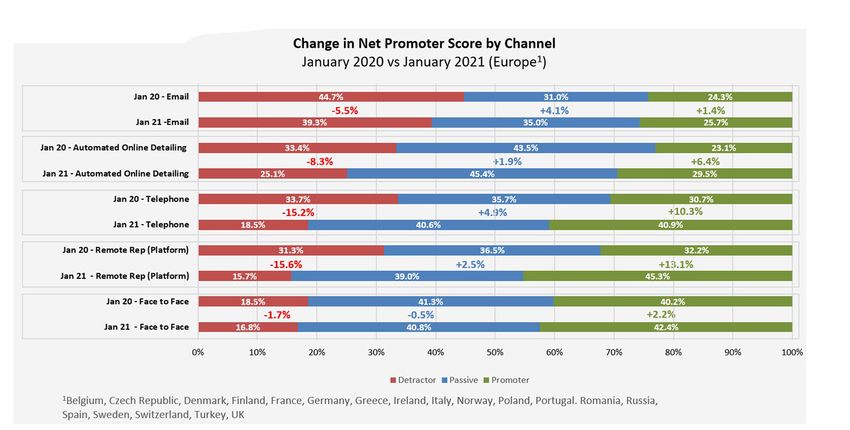
Is the ‘new normal’
                                             the ‘old normal’?

                                             The UK is indeed a good example of where
                                             the future promotional channel mix is likely
                                             to look very different post pandemic. Italy on
                                             the other hand is likely to have a situation that
                                             looks quite similar to what came before, but
                                             with virtual and remote interactions playing a
                                             more significant part in a more mixed model.
                                             However, it might come as a surprise to many
                                             who made bold predictions about changing
                                             engagement models that in some countries the
                                             future may look very similar to the past. Let’s
                                             take Korea for example, where data suggests
                                             talk of a ‘new normal’ may well be redundant.

5 | pharmaphorum.com/deep-dive | June 2021
Data suggests Korea is somewhat of an outlier and most countries will likely end up in a place
           where face-to-face volumes are not what they were and other remote channels in particular
           become more prevalent to fill the gap. The fact that HCPs globally have had to adopt these
           channels more significantly as part of their everyday clinical practice (the speed and degree
           of acceptance of which has been a surprise in itself) will be a key factor in maintaining
           increased volumes. When it comes to decisions about where to spend promotional resources
           the main question for companies is going to be ‘when will the channel mix stabilise and what
           will it look like?’ Here we can draw on the experience from two large markets.

           China is somewhat further on in its journey through the pandemic and whilst it has a very
           different system and pre-pandemic experience to countries like the US it may provide
           a useful benchmark to the speed and stabilisation of channel activity. In the US we have seen
           a gradual return of face to face activity over the last six months or so and this continues.
           At the same time remote engagements are falling as a percentage of the total but maintaining
           a level well above where they were pre-pandemic. So where will these levels stabilise?

6 | June 2021
In China face-to-face has been the predominant channel in the past and had recovered
           around 70% of its pre-pandemic level before the end of 2020. Latest data shows activity
           levels coming into June 2021 almost identical to where they were in November ’20,
           suggesting this may indeed be the ‘new normal’. If the US were to follow a similar pattern
           then we might expect face to face to stabilise at around 40% of total promotional volume
           sometime in the next three to four months.

           Big changes to
           field forces?
           Life Sciences companies across the globe will have already invested
           much time and effort considering the implications of the pandemic
           for their future business and how to respond. Our Consulting teams
           at IQVIA have experienced this first-hand, working with customers
           on challenges that span the product lifecycle. Surprisingly we have
           yet to see this translate into companies making very significant or
           large-scale changes to their sales forces. Here, our insight is more
           anecdotal than quantitative, but if we look at the feedback from our
           contract sales teams across the globe a pattern does seem to emerge
           of a cautious approach from our customers.

7 | pharmaphorum.com/deep-dive | June 2021
Speaking with a top ten pharma leadership team recently we had the same
                feedback, with their focus more on making small changes now whilst still debating
                if and when they should introduce fundamental changes to their commercial
                model. When I first wrote about the impact of the pandemic almost a year ago I
                indicated that we had observed customers taking a ‘wait and see’ approach and
                a reluctance to make major changes to sales team sizes in light of the ongoing
                uncertainty. My sense is that this continues, albeit with companies having a lot
                more data, insight and experience on which to draw for their decision-making
                process when they eventually get to it.

                More surprises to come?
                Looking ahead, the experience of the last 18 months may also
                provide an insight into a few additional surprises that might
                come along:
                •	Field force sizes may not decline as predicted, partly driven by HCP interaction
                   preferences, partly due to an improved understanding of the value they add and a
                   reluctance from companies to reduce investment for fear of the competitive impact.

                  Total promotional volumes could well increase as HCPs take up more remote
                •
                  interactions as well as maintaining some face to face contact.

                •	Alongside this, average call durations may increase, linked to the increased use of
                   remote engagements. Conducting these at more convenient times for HCPs helps extend
                   time spent on promotional and non-promotional contacts.

                •	We see real innovation in HCP engagement being driven by emerging BioPharma and
                   companies with little or no prior commercialisation experience who are not tied to pre-
                   pandemic models of commercial engagement.

                •	Collaborations with healthcare organisations and governments may flourish across
                 the globe as they seek additional help from life sciences companies as trusted partners,
                 creating a more favourable commercial environment.

8 | June 2021
Uncertainty linked to the pandemic will be with us for some time and making
bold decisions against this backdrop will not be easy. However, thinking will
eventually have to turn to positive action and those maintaining a ‘wait and see’
approach will eventually find it counter-productive. Indeed, companies can take
positive action despite this uncertainty – as leadership theorist Peter Drucker is
credited with saying “You cannot predict the future, but you can create it”.
About the author
John Procter is VP offering development, IQVIA’s Contract Sales & Medical
Solutions Global Business Unit (CSMS GBU). John leads global strategy and service
development for IQVIA’s CSMS, covering patient services, medical affairs and
contract sales.His expert knowledge in health solutions comes from 30 years in
the healthcare industry. He joined Quintiles in October 2010 to run the Patient
Services, Medical Affairs and Market Access business in the UK and then moved
on to work in global service development and then head of Europe for these
businesses. He took up his new role in the GBU global team in January 2018.Prior
to joining Quintiles John spent eleven years at Pfizer.
About IQVIA
IQVIA is a leading global provider of advanced analytics, technology solutions and
clinical research services to the life sciences industry. Powered by the IQVIA CORE™,
IQVIA delivers unique and actionable insights at the intersection of large-scale analytics,
transformative technology and extensive domain expertise, as well as execution
capabilities. Formed through the merger of IMS Health and Quintiles, IQVIA has
approximately 68,000 employees worldwide.
Learn more at www.iqvia.com.
9 | pharmaphorum.com/deep-dive | June 2021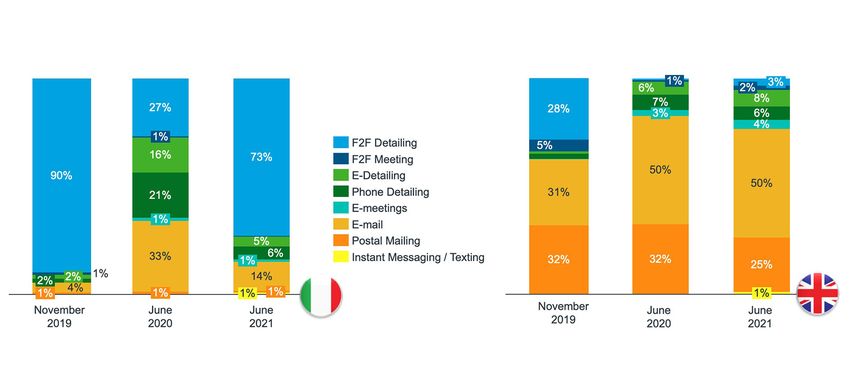
You can also read


