FMCG leaders need to think BIG and SMALL in 2021 - BTS
←
→
Page content transcription
If your browser does not render page correctly, please read the page content below

FMCG leaders need to think BIG and SMALL in 2021 | BTS

FMCG leaders need to think
BIG and SMALL in 2021
                                      In 2019, the future of FMCG companies looked more uncertain
                                      than ever. Management changes at firms like Procter and
Kraft Heinz Starts to                 Gamble and Campbell’s Soup—where leaders promised a
Pick Up the Pieces                    shift away from short-term cost cutting toward innovation
Wall Street Journal, Oct. 31, 2019    and quality—brought signs of a turnaround. Still, the industry
                                      continued to face the headwinds that had been battering
                                      it for years: changing consumer preferences, competition
Campbell’s U.S. Soup                  from private label goods, and e-commerce’s disruption of the
Sales Dip                             market.
Wall Street Journal, Dec. 4, 2019
                                      Then came 2020. Consumers stockpiled staples and turned
                                      to the comfort of familiar foods, as they prepared to hunker
Pantry Loading Boosts                 down at home until it was safe to return to schools, offices,
Sales at Kraft Heinz,                 and restaurants. Suddenly, FMCG firms confronted an
Kellogg                               altogether different challenge—keeping up with demand for
Wall Street Journal, April 30,        their products.
2020
                                      Now, with the world poised to emerge from the crisis,
Mondelez’s Sales Climb                companies will once again need to navigate through
as People Stockpile Food              uncertainty. Based on experience partnering with leading
Amid Lockdowns                        FMCG firms during and long before the pandemic, BTS
Wall Street Journal, April 28, 2020   has identified the mindsets around six critical areas that
                                      organizations need to master to be successful in 2021 and
                                      beyond. They reflect the distinct strengths of big firms and of
                                      their smaller counterparts.

                                      Thinking Big
                                      Large firms have myriad advantages: greater leverage
                                      negotiating with suppliers, more flexible supply chains, more
                                      capital to pursue innovation, and the resources to quickly scale
                                      a well-performing product. FMCG firms of any size can benefit
                                      from thinking big.

                                                                                    www.bts.com • Copyright © 2021 BTS | 1
BTS I FMCG leaders need to think BIG and SMALL in 2021

       Acquisitions
       Act like a venture capitalist

       Leading FMCG companies have a merger and acquisition strategy that combines the risk
       tolerance of a venture capital firm with the business acumen and change-ready leadership
       needed to get the most benefit from a deal.

       Instead of waiting for a sure thing, they make many smaller bets, investing into emerging
       trends and themes that don’t have a large market—yet. These firms know they have the scale
       to withstand some “misses,” and that the payoff from success in spotting a trend early or in
       M&A is more than worth the risk.

       To stress test potential deals, smart firms employ “future back thinking,” a series of
       techniques (e.g., “pre-mortem,” “risk storming,” “back casting”) that can help them make
       better decisions today by imagining tomorrow more clearly.

       Post-acquisition comes the crucial and too-often neglected work of cultural integration.
       Building a cohesive culture starts with diagnosing and acknowledging the differences between
       how the formerly separate companies have functioned, and then setting a vision for how
       everyone will work together in the future. Turning that vision into reality requires leaders who
       can inspire their teams to embrace the new culture.

                                                                                 www.bts.com • Copyright © 2021 BTS | 2
FMCG leaders need to think BIG and SMALL in 2021 | BTS

Supply Chain
Treat supply chain as a strategic capability—not as a cost center

During the crisis, FMCG firms faced trying to meet surging demand amid factory shutdowns,
border closings, and labor shortages. Many were not ready. Years of overemphasizing cost-
efficiency had resulted in supply chains that were lean but inflexible. Companies scrambled,
and sometimes failed, to keep up.

But for firms that had built resilient supply chains—planning for contingencies by investing in
multiple suppliers and production and delivery options—the crisis became an opportunity to
watch sales soar.

                                                                               www.bts.com • Copyright © 2021 BTS | 3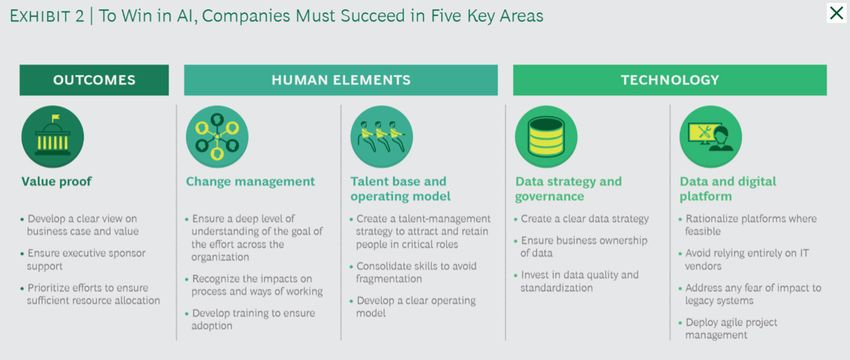
BTS I FMCG leaders need to think BIG and SMALL in 2021

       No one can predict when or what the next            right.” They also understand the corporation’s
       crisis will be: trade wars, civil unrest, natural   technical capabilities and how a product fits
       disasters, and another pandemic all loom            into overall corporate strategy. FMCGs will
       as possibilities. To prepare, FMCG firms            benefit from cultivating, and valuing,
       must treat supply chain not as a cost center        generalist product managers.
       but as a strategic capability. That means
       giving supply chain leaders a voice in overall
       company strategy and bringing in cross-
       functional teams to explore the crucial trade-
       offs between efficiency and resilience.

       Thinking Small
       Small companies tend to be more nimble,
       innovative, and adept at cross-functional
       collaboration than their larger counterparts.
       FMCG firms of any size can benefit from
       thinking small.

       Product Management
       Focus on developing generalist product              Smart Experimentation
       managers
       In his bestselling book Range, David Epstein        Design experiments to test ideas fast and
       argues that generalists are more creative,          cheap
       agile, and able to make connections than            Smaller FMCG firms don’t have the
       specialists. That’s a counterintuitive idea         resources of their bigger competitors. And
       for many large FMCG firms, which value              they use that constraint to their advantage.
       product managers who excel in their narrow          Their leaders are closer to the consumer; they
       functional areas. However, modern product           know the consumer’s pain points without
       development and management calls for                having to read a report. Instead of investing
       leaders who can own multiple disciplines.           in endless research—the tendency at bigger
                                                           firms—they get their product in front of the
       Compared to other fields, the FMCG industry         consumer quickly to see if there is a market
       requires faster responses to consumer trends        for it.
       and a greater degree of localization (e.g., an
       SaaS firm can often push an update to all           Large firms should learn to test ideas “fast
       global users at once). As the number of             and cheap,” instead of investing heavily in a
       stakeholders involved increases, generalist         small number of product launches. That way
       PMs can keep a project from going off track.        they can avoid the trap of only catering to
       An effective PM combines the insights of a          sizable existing markets, and instead focus
       data scientist, the facilitation skills of an       on delighting a thin slice of the population,
       Agile scrum master, and the customer-               recognizing the segment’s potential to grow.
       centricity of a design lead. They know how to
       “design the right thing, then design the thing

                                                                                   www.bts.com • Copyright © 2021 BTS | 4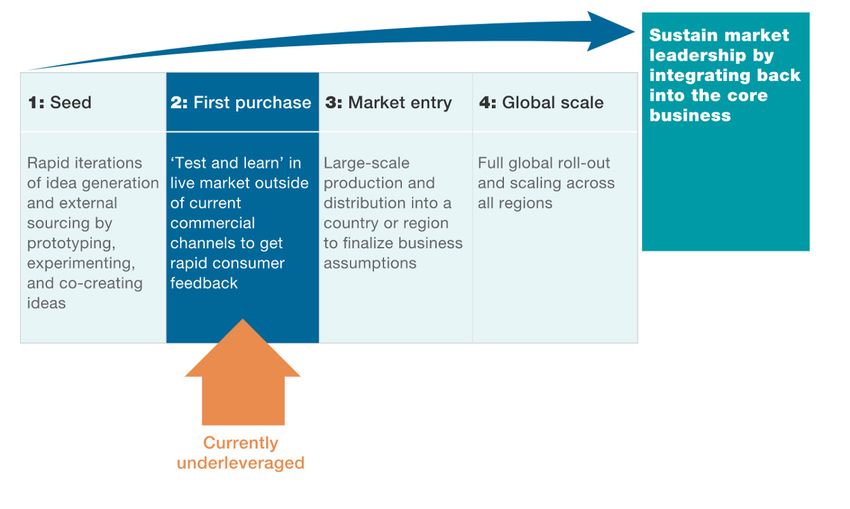
FMCG leaders need to think BIG and SMALL in 2021 | BTS

One method is through disciplined experimentation (DE), a set of principles, processes,
and tools that eliminate “this will never work” thinking that prevents ideas from getting a
chance—and protect against sunk-cost bias that keeps firms pouring resources into an idea
after experimentation has proved it won’t work. The DE process isn’t difficult. The challenge is
having leaders with the mindset to use it.

                                                                              www.bts.com • Copyright © 2021 BTS | 5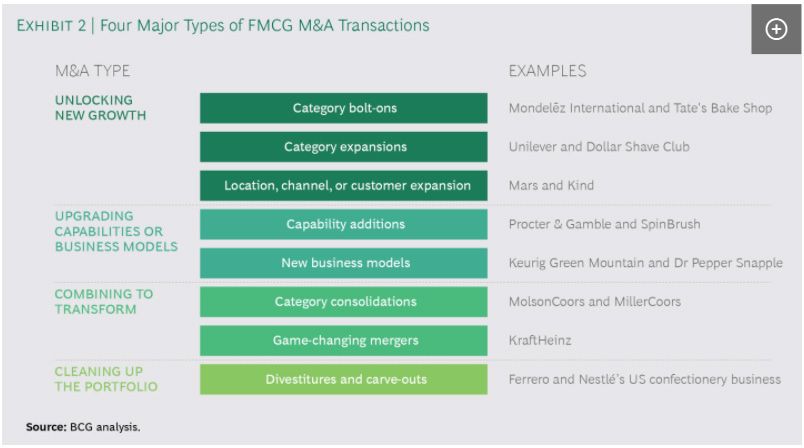
BTS I FMCG leaders need to think BIG and SMALL in 2021

       Thinking Big & Small
       While large FMCG companies may be better          Beyond COVID-19 – customers are redefining
       connected with their retail customers, small      the rules of engagement
       firms excel at staying in touch with and
       understanding their end consumer. Large
       FMCG companies are often data rich, but
       insight poor, whereas small firms may lack
       the data to validate their great insights.
       FMCG firms of all sizes can benefit from
       thinking big and small.

       Consumer experience
       Go beyond consumer-centricity to consumer
       integration
       FMCG firms often involve consumers in
       the initial research phase, then quickly shift
       into execution mode, forgetting about the
       consumer (40% of firms don’t talk to the
       consumer during product development). In
       today’s environment, firms must integrate
       their customers (retailers) and their end
       consumers into the development process.

       Companies should use first principles
       thinking to test assumptions and go deeper
       into the mind of the consumer, discovering
       what consumers want even before they
       know they want it. This extends beyond the
       products themselves to the shopping and
       buying experience. The FMCG firms that
       succeed in the future will be those that keep
       the consumer front and center at every
       stage of the development process to uncover
       and meet consumer needs for products, and
       to provide an engaging shopping experience
       that leads to a seamless buying experience.

                                                                               www.bts.com • Copyright © 2021 BTS | 6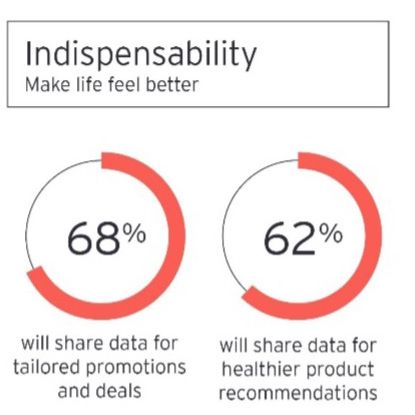
FMCG leaders need to think BIG and SMALL in 2021 | BTS

Data & Digital Literacy
Find. Understand. Use. Value.
Big firms collect a massive amount of data, but don’t take full advantage of it to drive
decisions; almost 80% of data collected is not even mined. Small firms don’t have as much
data, but make the most of what they do have to create insights.

To succeed, firms of all sizes need to build deep data literacy and digital literacy throughout
the organization. It is not about algorithms. It is about cross-functional sharing of data. And
it’s about people who can construct machine-learning models and input the right data to find
relevant patterns in huge amounts of information—revealing and predicting consumer habits
and preferences—and leaders who can translate what they discover into winning strategy.

                                                                              www.bts.com • Copyright © 2021 BTS | 7
BTS I FMCG leaders need to think BIG and SMALL in 2021

       A Culture of New Mindsets
       The pandemic made clear what had long been true: FMCG firms need to adapt their culture,
       strategy, and leadership to a changing business landscape. Companies that embrace the
       mindsets of thinking big and small will be ready to meet any challenge.

                                                                            www.bts.com • Copyright © 2021 BTS | 8
You can also read


