Low Resolution Refinement - Paul Adams Phenix Workshop University of Vienna, May 2018
←
→
Page content transcription
If your browser does not render page correctly, please read the page content below
Low Resolution Refinement

            Phenix Workshop
     University of Vienna, May 2018

              Paul Adams
     Lawrence Berkeley Laboratory and
  Department of Bioengineering UC Berkeley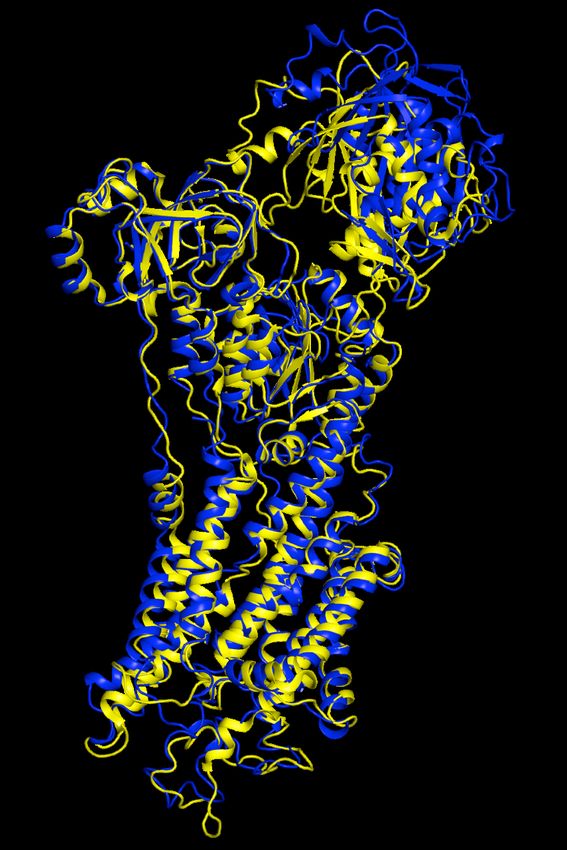
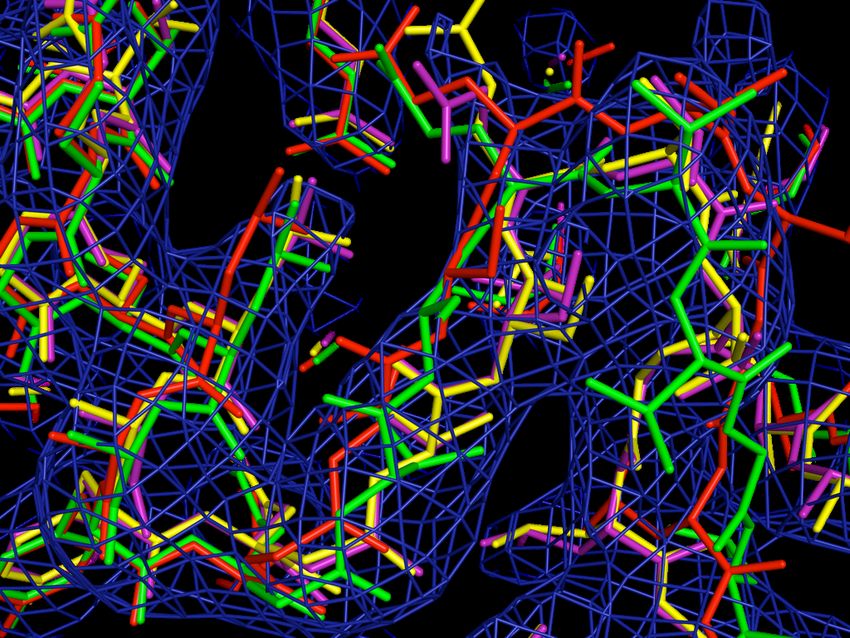
Macromolecular Crystallography
  PDBID: 2gkg                               PDB ID: 3k7a
Resolution: 1.00Å                         Resolution: 3.80Å

•    Many challenges, but low resolution data is increasingly an issue:
 •   How to interpret “featureless” maps (pattern matching, chemical
     constraints)
 •   How to optimize models with sparse data (prior information)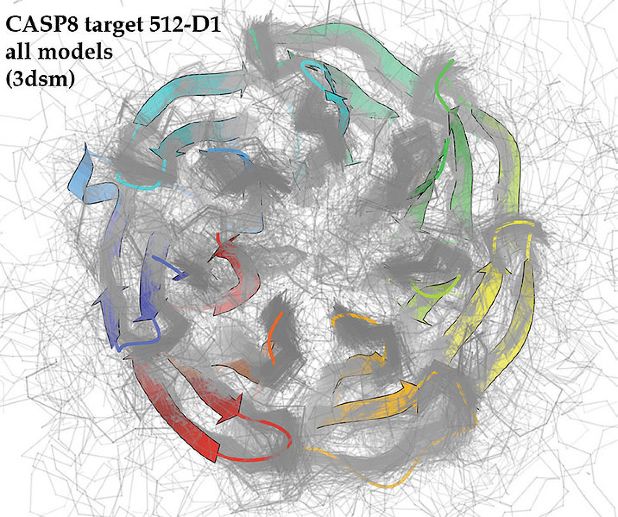
The Challenge of Too Few Data

• With only low resolution data we typically
  have too many parameters to optimize
   • Atomic coordinates, displacement
     parameters

• Underdetermined optimization problems
  lead to overfitting of the data

• To help address overfitting we can:
   • Add prior information to reduce the
     number of effective parameters

   • Remove parameters
• Current refinement methods do not
  define a reasonable chemical result in the
  absence of data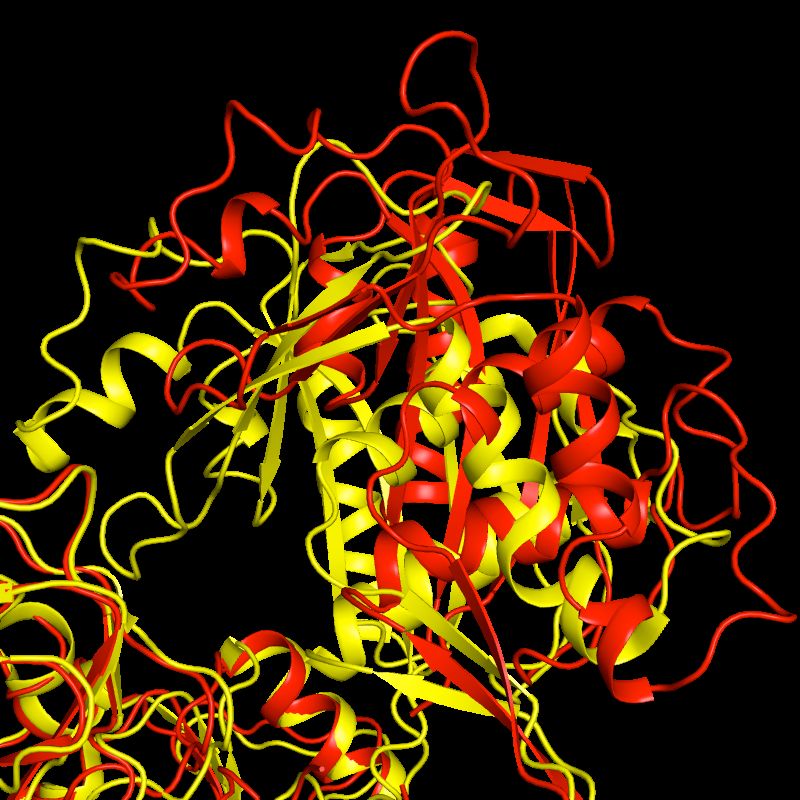
Improving the Observation to Parameter Ratio

•   To make refinement practical the observation to
    parameter ratio is increased using restraints and
    constraints:
•   Restraint
    •   Model property ~ ideal value
    •   Adds prior observed information (reduces the number of
        parameters refined)
    •   Inclusion of chemical information in the objective function
•   Constraint
    •   Model property = ideal value
    •   Removes one or more parameters from the model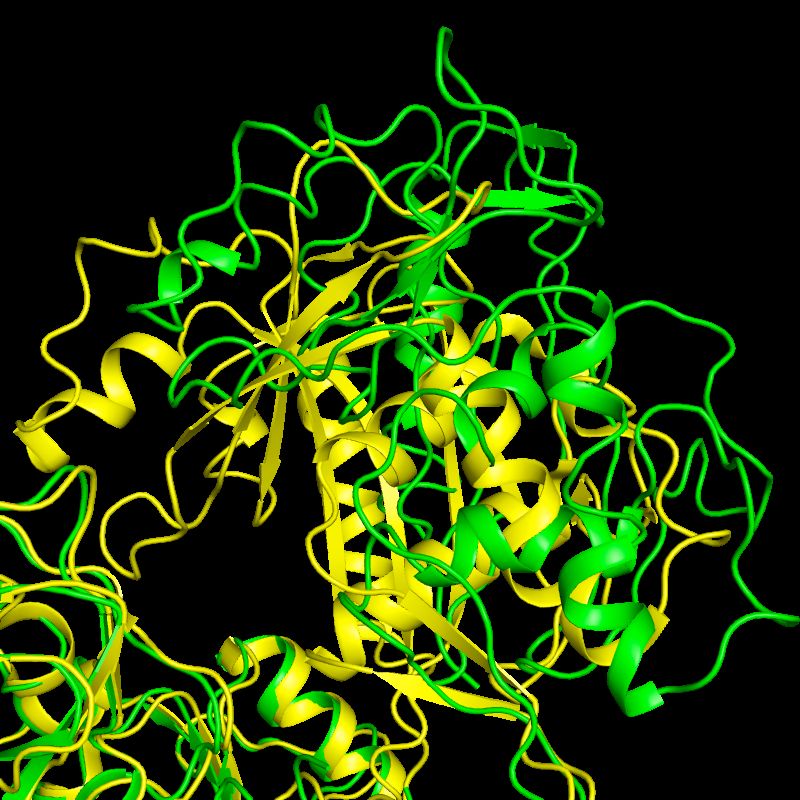
Methods in Phenix for Improving Models

•   Using prior structural knowledge as additional
    restraints:
    •   Secondary structure
    •   Protein mainchain conformations (Ramachandran)
    •   Related high resolution structures as restraints
    •   Multiple copies of the same molecule as restraints (c.f.
        local NCS restraints in SHELX)
•   Automated correction of models during
    refinement using prior knowledge of
    stereochemistry:
    •   Fixing of rotamers
    •   Flipping of side chains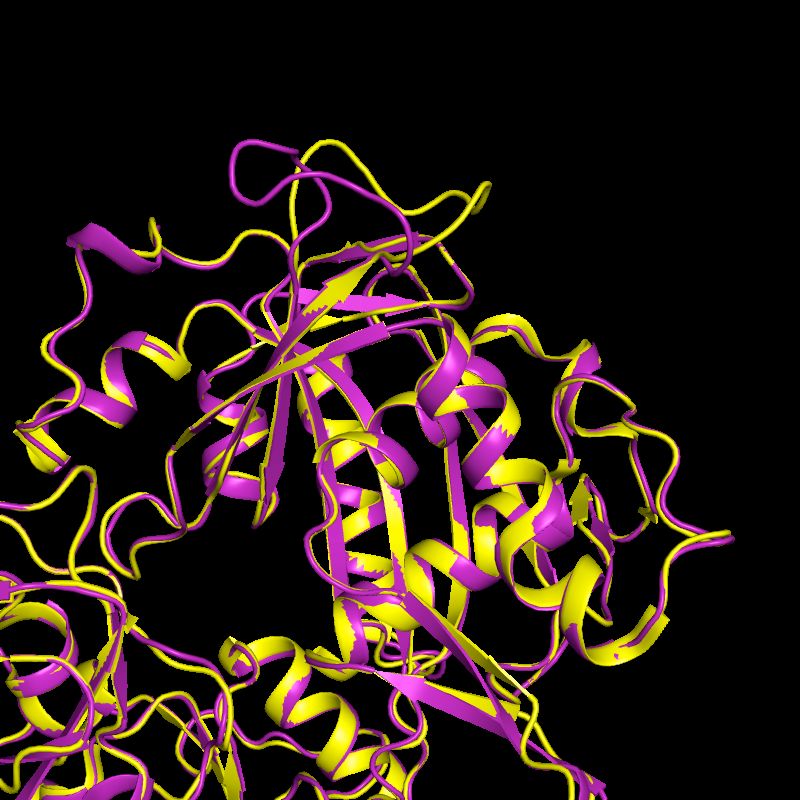
Reference model restraints
        (Jeff Headd)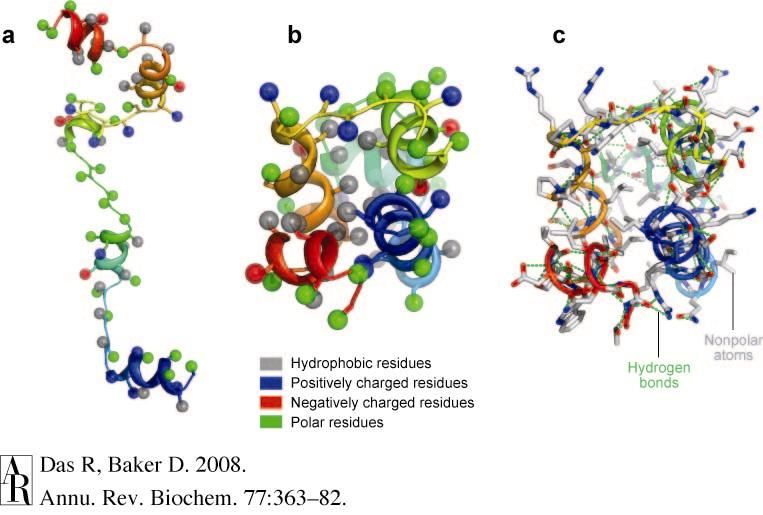
1GTX and 1OHV

1GTX: 3.0 Å
1OHV: 2.3 Å

         4-aminobutyrate-aminotransferase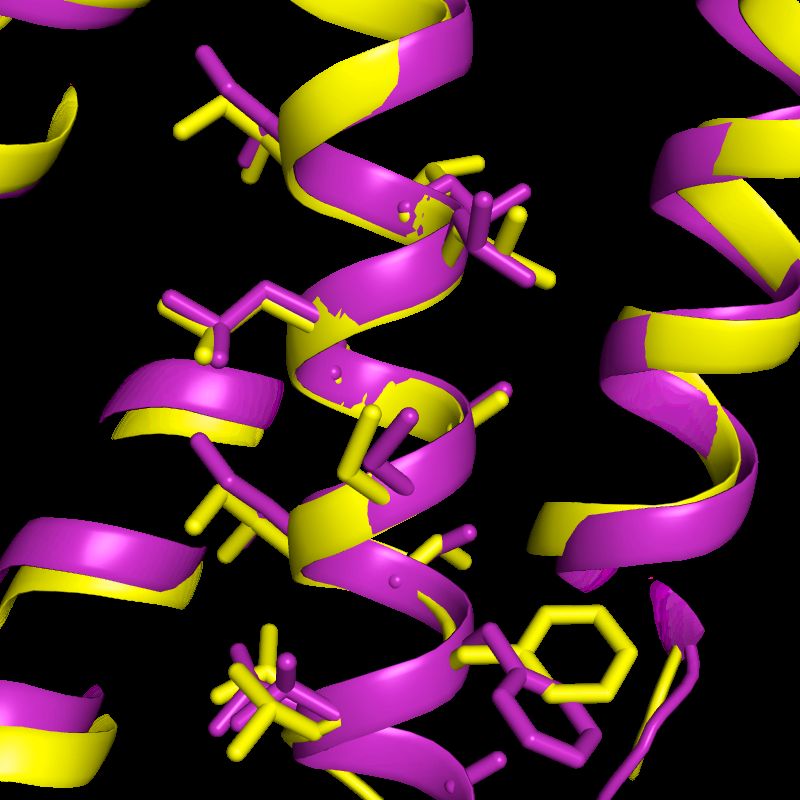
1GTX and 1OHV
                4-aminobutyrate-
                aminotransferase

1OHV: 2.3 Å                        1GTX: 3.0 Å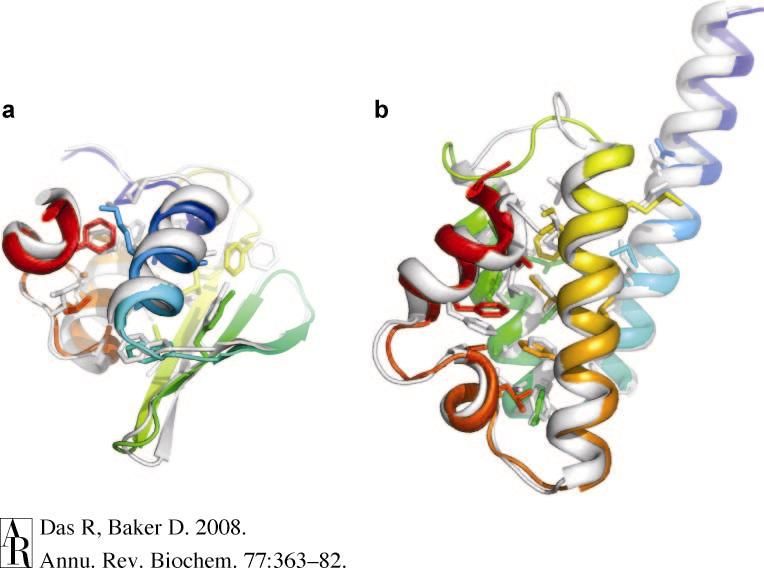
Reference Model Restraints

Combines two concepts:
• Pre-correct rotamer outliers
 •   Set rotamer outliers in the model to match the torsion angles of the
     reference model if the reference model has an acceptable rotamer at
     that position and there is no significant clash or density mismatch

• Generate reference torsion restraints
 •   Restrain each torsion angle in the working model to the
     corresponding torsion angle in the reference model
     • Chains are aligned using SSM alignment to allow for sequence differences
 •   Restraints take the form of a modified harmonic ‘top-out’ potential
     that allows for structural differences

                                    Headd JJ et al., 2012, Acta Cryst. D68:381-390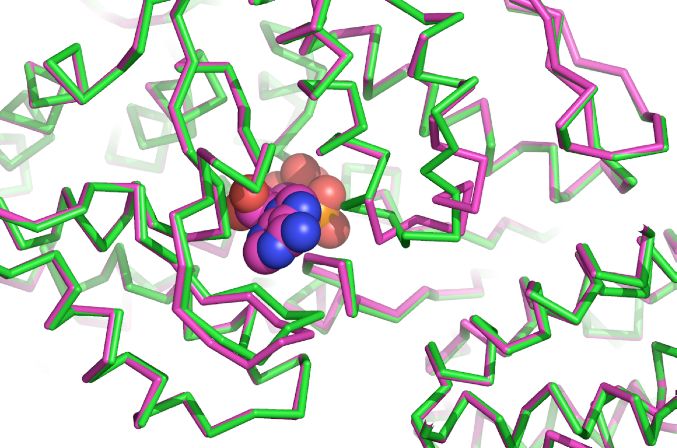
Reference model restraints
                                                                                                         "top-out" function

                                !
                                n

                                                                                    250
                                                                                    225
                 Etotal =              Ei

                                                                                    200
                                                                                    175
                                 i=1

                                                                                    150
                                                                         residual

                                                                                    125
                                                           2
Simple harmonic potential:                     Ei =      w∆i

                                                                                    100
                                                                                    75
                                                             −∆2

                                                                                    50
                                                                 i
‘Top-out’ potential:              Ei = τ (1.0 − e             l2     )

                                                                                    25
                                                                                    0
                                                                                            -30    -15           0            15   30
                                                         2
                                             τ = wl                                                             delta

                                                                                          Similar potentials are used in
                                                1                                         REFMAC5 and BUSTER -
                                             w= 2                                         Geman-McClure robust
                                               σ                                          estimator function

where σ is the ESD, Δ is the difference between the model dihedral and reference dihedral, and l is a ‘limit’
parameter that limits how far the model dihedral may vary from the reference dihedral before being shut off.

              developed by Ralf Grosse-Kunstleve                                          default: limit = 15.0°
The ‘limit’ parameter
default: limit = 15.0°
>> limit,
no restraint
< limit,
restrain all dihedrals
to referenceWhy torsion angles?
Tyr B 7
3ftl
Asn B 5
chi 2
chi 2
chi 1
chi 1
phi
psi
chi 1
chi 1
Thr B 6
Ser B 41GTX/1OHV reference example
outlier correction restrained refinement
Leu A 34 Glu A 41
tp rotamer
mt-10
rotamer
tp
rotamer
outlier
1GTX (3.0Å) 1OHV (2.3Å) 1GTX w/ 1OHV reference
5 macrocycles of phenix.refine
w/ reference restraints Rfree: 0.2379 ! 0.2186
ΔR: 0.833 ! 0.60
MolProbity: 64th ! 96thPractical Example
Cyclic GMP-dependent protein kinases (PKG’s)
cAMP bound: 2.49Å
cGMP bound: 3.20Å
APO form: 2.69Å
JJ Kim et al. (2011) Crystal structures of PKG
Iβ (92-227) with cGMP and cAMP reveal the
molecular details of cyclic nucleotide binding.
PLoS ONE.Cyclic GMP-dependent protein kinase cGMP bound
56.57
cGMP bound
24.56
15th 87th
18.58% 4.00%
cAMP bound: 2.49Å 0.40%
2.02%
cGMP bound: 3.20Å 85.48% 96.00%
23 0
APO form: 2.69Å 3.84 2.61
12th 96th
Validation Criteria cAMP bound 2.38% 0.00%
Clashscore, all atoms: 16.53 5.95% 1.18%
All-Atom Contacts 0.2102 0.1980
Clashscore percentile 81st
0.2582 0.2397
Poor rotamers: 2.61%
Rama outliers: 0.00% APO APO
Rama favored: 98.80% 28.52 19.5
Cβ dev. > 0.25Å: 0 46th 15th
Protein
Geometry 10.53% 3.66%
MolProbity score: 2.04
3.19% 0.60%
MP score percentile 95th 89.02% 96.61%
Res w/ bad bonds: 0.00% 3 0
Res w/ bad angles: 0.00% 3.29 2.43
R-work 0.1960 12th 89th
Residual
R-free 0.2264 0.79% 0.00%
0.98% 0.20%
0.2205 0.2166
0.2612 0.2525Sources of Prior Information
Sidechain
distributions
Mainchain
distributions
Covalent
geometry
Images from PumMa web
site (http://www.pumma.nl)
Related Internal Secondary
structures symmetry structureTorsion space NCS restraints
(Jeff Headd)1b04: 2.8 Å rotamer outlier correction
DNA ligase
2. correct to
corresponding
rotamer in
1. Identify
NCS-related
rotamer outlier
Leu B 180 chain by Leu B 180
outlier matching χ tp rotamer
angles
3. ‘backrub’ 4. verify
search, then rotamer is
limited χ angle still correct
torsion search Leu B 180 match Leu B 180
tp rotamer
“backrub”molecular replacement refinement
3hd0: 2.70 Å
2w35
endonuclease MR w/ Phaser 2.15 Å
Rwork = 0.3844
• Rebuild in place
• NCS on for rebuilding
AutoBuild • NCS off for refinement
• No water picking
Rwork = 0.1895
Rgap = 0.085
Rfree = 0.2745
• 10 macrocycles
• optimize weights
phenix.refine • No NCS, Cartesian NCS,
torsion NCS w/ and w/o
rotamer correction3hd0 refinement
no NCS Cartesian NCS torsion NCS torsion NCS w/ rotamer correction
0.34%
0.33%
0.32%
0.31%
0.3%
Rfree
0.29%
0.28%
0.27%
0.26%
0.25%
1% 1
2% 2
3% 3
4% 4
5% 6%5 6
7% 78% 8
9% 9
10% 10
11%
macrocycle
Rwork = 0.2040 R
torsion NCS w/ rotamer correction gap = 0.056
Rfree = 0.2606Sources of Prior Information
Sidechain
distributions
Mainchain
distributions
Covalent
geometry
Images from PumMa web
site (http://www.pumma.nl)
Related Internal Secondary
structures symmetry structureMore Prior Information
• As the number of observations decreases we need to increase
the amount of prior information we include (or the number of
constraints we apply)
• At the extreme - what if we had no data?
• Other fields have been trying to address this problem:
• Structure prediction
• Homology modelling
• Protein folding
From: Kryshtafovych & Fidelis, Drug
Discovery Today, 2009, 14:386–393
http://www.predictioncenter.orgPhysically Realistic Potentials (Rosetta)
(Nat Echols & Frank DiMaio)Rosetta
• ab initio model generation and
model optimization
• Requires extensive
computational sampling
Black - Rosetta ab initio models, Red -
Crystal structure after Relax protocolWhy Rosetta
• Designed to recognize near-native structures among
many possible models; combines empirical and physical
potentials
• All-atom force field, incorporates solvation effects, attractive
forces, hydrogen bonds, knowledge-based dihedral restraints
• Can yield chemically realistic ab initio models without
experimental data to guide assembly
• Occasionally good enough for molecular replacement
• Shown to be useful for NMR structure determination
with sparse data (CS-Rosetta), MR solution
improvement (MR-Rosetta), RNA structure refinement
(ERRASER)
Kuhlman et al. (2003) Science 302:1364-8
Rohl et al. (2004) Methods Enzymol. 383:66-93
Keedy et al. (2009) Proteins 77:29-49 https://www.rosettacommons.orgComplementary Algorithms
Phenix Rosetta
• Reciprocal space X-ray
target functions (ML, MLHL,
• Physically realistic potentials
LS-twin) • Repacking to remove steric
clashes and building rotameric
• Bulk solvent correction sidechains
• B-factor refinement
(including TLS)
• Torsion-angle minimization
• Real-space target (refinement
• Map calculation against electron density)
• Density modification (using
RESOLVE)
• Fragment-based rebuilding
(optional, not currently used)
Python/C++ architecture facilitates combinationLow Resolution Protocol
• Sidechain repacking • Sidechain repacking • Sidechain repacking
(using density) (using density) (using density)
• Coordinate • Coordinate • Coordinate
refinement refinement (real refinement
(reciprocal space space and (reciprocal space
torsion angle reciprocal space minimization with
minimization and
torsion angle restrained bonds
reduced nonbonded
minimization) and angles)
penalty)
• B-factor refinement • B-factor refinement • B-factor refinement
3 Cycles 5 Cycles 2 Cycles
Protocol run 5 times in parallel and the
best model selected based on R-freeTest Cases
Solved by molecular replacement with same protein
from another deposition at higher resolution
2j5f (3.0Å) 1bke (3.15Å) 3mtt (3.3Å) 1kct (3.46Å) 3snh (3.7Å) 2vaf (3.8Å) 3rzf (4.0Å)
Membrane Solved using
Proteins homologous proteins
3fps (3.2Å) 3k07 (3.52Å) 2x79 (3.8Å) 1isr (4.0Å) 3pwy (3.5Å) 3idq (3.7Å) 3a8n (4.5Å)Calcium ATPase - phenix.refine
R R-free mp score RMSD
start 0.47 0.51 3.21 6.1
phenix 0.43 0.48 2.66 6.2Calcium ATPase - DEN
R R-free mp score RMSD
start 0.47 0.51 3.21 6.1
DEN 0.38 0.44 3.79 6.1Calcium ATPase - Phenix-Rosetta
R R-free mp score RMSD
start 0.47 0.51 3.21 6.1
Rosetta 0.24 0.28 1.55 1.7Calcium ATPase - Detail
• Phenix-Rosetta model is very close to the deposited
structure (even at the level of side chains) with better fit to
densityImproved Models
16"
Start" Phenix"
DEN" Rose8a"
12"
16"
frequency"
Start" Phenix"
DEN" Rose8a"
8"
12"
frequency"
4"8"
0"4"
0.0" molprobity" 6.0" 0.0" RMSd" 6.0" 0.20" Rfree" 0.55"
0"
0.0" molprobity" 6.0" 0.0" RMSd" 6.0" 0.20" Rfree" 0.55"
• Phenix-Rosetta typically has improved fit to the
crystallographic data and models are closer to the known
structure
• Phenix-Rosetta always has improved model quality, as judged by
Molprobity
• Generally similar to DEN results but with much improved
geometry, and generally faster
DiMiao et al., 2013, Nature Methods 10:1102-1104Acknowledgments
• Lawrence Berkeley Laboratory • Oak Ridge National Laboratory
• •
•
Pavel Afonine,Youval Dar, Nat Echols, Jeff Headd, Marat Mustyakimov, Paul Langan
CCI
Richard Gildea, Ralf Grosse-Kunstleve, Dorothee
Liebschner, Nigel Moriarty, Nader Morshed, Billy
Poon, Ian Rees, Nicholas Sauter, Oleg Sobolev, • Others
Peter Zwart • Alexandre Urzhumtsev & Vladimir Lunin
• Los Alamos National Laboratory • Garib Murshudov & Alexi Vagin
• Tom Terwilliger, Li-Wei Hung • Kevin Cowtan, Paul Emsley, Bernhard Lohkamp
• David Abrahams
• Cambridge University • PHENIX Testers & Users: James Fraser, Herb
• Randy Read, Airlie McCoy, Laurent Storoni, Klei, Warren Delano, William Scott, Joel Bard,
Bob Nolte, Frank von Delft, Scott Classen, Ben
Gabor Bunkoczi, Robert Oeffner
Eisenbraun, Phil Evans, Felix Frolow, Christine
• Duke University Gee, Miguel Ortiz-Lombardia, Blaine Mooers,
Daniil Prigozhin, Miles Pufall, Edward Snell,
• Jane Richardson & David Richardson, Ian Davis, Eugene Valkov, Erik Vogan, Andre White, and many
Vincent Chen, Jeff Headd, Christopher Williams, more
Bryan Arendall, Laura Murray, Gary Kapral, Dan
Keedy, Swati Jain, Bradley Hintze, Lindsay Deis, • Funding:
Lizbeth Videau
• NIH/NIGMS:
• University of Washington • P01GM063210, P50GM062412,
P01GM064692, R01GM071939
• Frank DiMaio, David Baker
• Lawrence Berkeley Laboratory
• PHENIX Industrial ConsortiumYou can also read


