Returning to School Planning Ahead for September 2020 - Committee of the Whole August 18, 2020 - James Li
←
→
Page content transcription
If your browser does not render page correctly, please read the page content below
Returning to School
Planning Ahead for September 2020

        Committee of the Whole
           August 18, 2020

                                    1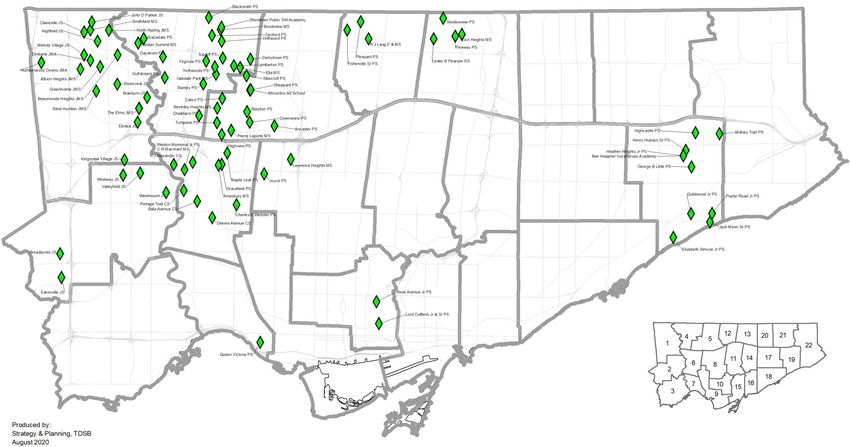
Guiding Principles

                     2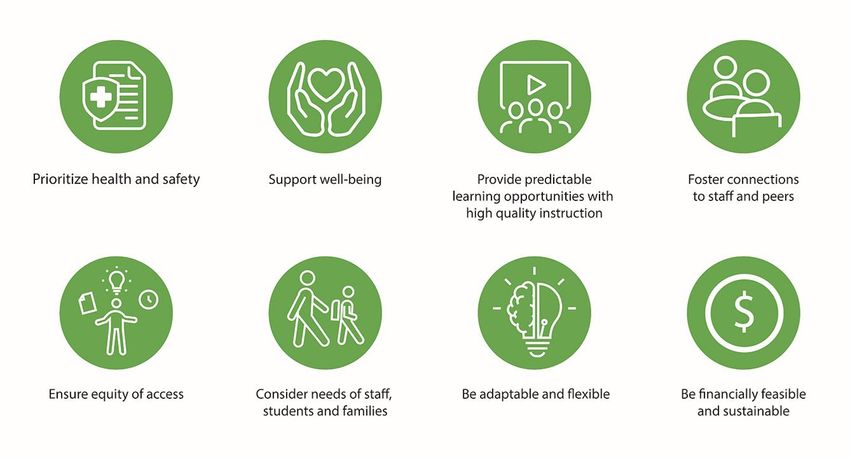
Toronto Public Health Recommendations
•   2m spacing between desks
•   Masks/face coverings where physical distancing is not
    possible
•   Open space whenever possible
•   Regular hand washing and sanitizing
•   Incorporate outdoor activities whenever possible for
    distancing and relief from mask/face coverings
•   Active screening of symptoms prior to entry
•   Delay start of school year or have staggered starts to
    allow time for public health measures to be
    incorporated
                                                             3
Pre-Registration Surveys
• School Messenger was used to conduct an
automated telephone survey to find out how
many students are intending to participate in
learning in school or remote learning.
• The survey was broadcasted to parents/
guardians of elementary and secondary students
as well as Adult Day and Edvance students
between Tuesday August 11 to Friday August 14.
4Pre-Registration, Overall Response Rates
The average response rate was 67%, a total of 169,312
responses. There were 82,286 non-respondents.
Total Responses Response Rate
JK to Grade 3 59,907 71%
Grades 4-6 37,342 72%
Grades 7-8 23,831 70%
Grades 9-12 45,466 60%
Adult Day and Edvance 2,766 49%
Total 169,312 67%
5Pre-Registration Response Rates by LOI and
TPH Priority Neighbourhoods
● Across LOI rankings:
○ Response rates at the elementary level show a slight difference
between the most challenged and least challenged schools, but
overall high response rates across neighborhoods.
○ Response rates at the secondary level shows more variability
across LOI school rankings when compared to elementary
● Toronto Public Health ranked schools by neighbourhood based on
COVID-19 risk score
○ Survey response rates for TPH neighbourhoods ranked most at
risk align with our overall response rate (range: 48% to 74%)
6Pre-Registration Results
Elementary Student Findings
Will your child be returning to school in September if there is:
• A regular school day model with normal class sizes (this means a full day of learning in school
every day)
Yes, my child will return to a regular school day 85,677 (71%)
No, my child will not return and will participate in 35,389 (29%)
remote learning instead
• A school day model with smaller class sizes of 15-20 students (this means learning in school
every day and may mean a shorter school day)
Yes, my child will return with smaller class sizes 91,549 (77%)
No, my child will not return to the smaller class size 26,776 (23%)
model and will participate in remote learning instead
• Across LOI school rankings, there is strong intention to return to school with regular and smaller
class sizes.
7Pre-Registration Results
Secondary Student Findings
Will your child be returning to school in September for:
An Adapted In-School Day Model with Smaller Class Size Cohorts (this means students
attend school in person every other day, in smaller class sizes of approximately 15
students, with learning continuing at home the other half of the day including both
independent work time and live synchronous teaching):
Yes, my child will attend 37,843 (83%)
No, my child will not attend and will participate 7,622 (17%)
in fully remote learning instead
● Across LOI school rankings, there is strong intention to return to school with an adapted day model.
8Pre-Registration Results
Adult and EdVance Student Findings
In September, Adult and EdVance high school students will have the choice of taking their
courses at school or online.
I want to take my courses at the school in 1,127 (41%)
September
I want to take my courses online in 1,125 (44%)
September
I will not be coming to an Adult or EdVance 424 (15%)
High School in September
International Students
Parents/guardians of International Students were sent an online survey on August 14.
This surveys closes on August 18.
9Staff Survey Results
• A survey was sent to all permanent staff on August 15, 2020 after
consultation with all TDSB Bargaining Units
• The survey will give us data on staff ability to return to work and potential
needs to support a full time and safe return to work. This data will be by
employee classification, location, etc.
• The survey also provided details on contact information for requesting
medical accommodation due to a disability and contact names for requesting
non-medical accommodation (i.e. childcare/elder care) accommodation. Staff
in Employee Services will work with employees, Union representatives and
Principals/Managers to respond to these requests on a case-by-case basis.
• A survey for casual/daily workers (e.g. Occasional Teachers, replacement
support staff) is being finalized.
10Secondary Adapted In-School/Synchronous(live) Learning Day Model
Secondary Quadmester Calendar
Quad 1: Sept 8 - Nov. 9 + Exams Nov. 10 and Nov. 11
Quad 2: Nov. 12 - Jan. 28 + Exams Jan. 29 and Feb. 1
Quad 3: Feb. 3 - April 19 + Exams April 20-21 *April 8, 2021: OSSLT Day
Quad 4: April 22 - June 23 + Exams June 24, 25, 28
PA Days: September 1-3, November 20, February 2, February 12, June 29
Sept Oct Nov Dec Jan Feb Mar Apr May June
Full Year 8 courses all year
Semester 4 courses 4 courses
Quadmester 2 courses 2 courses 2 courses 2 coursesFour Day Timetable
*Schedule Repeats itself on the fifth day August
16/2020
Cohort A Cohort B
Time
Day 1 Day 2 Day 3 Day 4 Day 1 Day 2 Day 3 Day 4
Course1 Course1 Course2 Course2 Course1 Course1 Course2 Course2
In Person Independent In Person Independent Independent In Person Independent In Person
8:45 a.m.– @ School Learning @ @ School Learning @ Learning @ @ School Learning @ @ School
12:30p.m. Home Home Home Home
Student Dismissal (return home / lunch)
12:30 p.m. – Provide extra help to students
2:00 p.m. Contact Parents
Professionally Managed Activities for Teachers
Course2 Course1 Course2 Course1
Live Virtual Learning Live VirtualLearning Live Virtual Learning Live Virtual Learning
2:00 p.m.–
3:15 p.m.
Live Virtual Independent In Person Learning
Learning LearningFully Remote Learning - Secondary
Fully Remote Learning - Secondary
Some students may opt to not return to school and continue their learning at home. We may also need to be
prepared to pivot from face to face instruction if public health guidance requires a change in operation. The
guidelines below outline Remote Learning in the TDSB for secondary students.
Students will have a daily schedule as outlined below. A minimum of 90 minutes/course/day must be
synchronous through BrightSpace or Google Classroom.
• Course 1: 9 to 11:30 a.m.
• Course 2: 12:30 to 3 p.m.
13Virtual School for K-12 Remote Learning
• Through the Ministry of Education, TDSB is
requesting a BSID (Board School Identification)
number to create a central “virtual school” for all
students choosing fully remote learning for the
2020-21 school year
• The school will be staffed with Superintendent,
principals, vice-principals, teachers, guidance
counsellors
14Focus of Elementary Program
• TPH letter to TDSB states that: “We recommend that the priority
for allocation of resources should be schools within high
incidence areas.”
• Identify available spaces within school (gym, cafetorium, library)
to support increased distances between students
• Work with external partners to identify, secure and set up
alternative space for student learning (i.e. City of Toronto)
• On August 18, we received an updated list from TPH re: schools
in high incidence areas and continue to work with TPH to
develop more precise modelling of school configurations in the
coming days
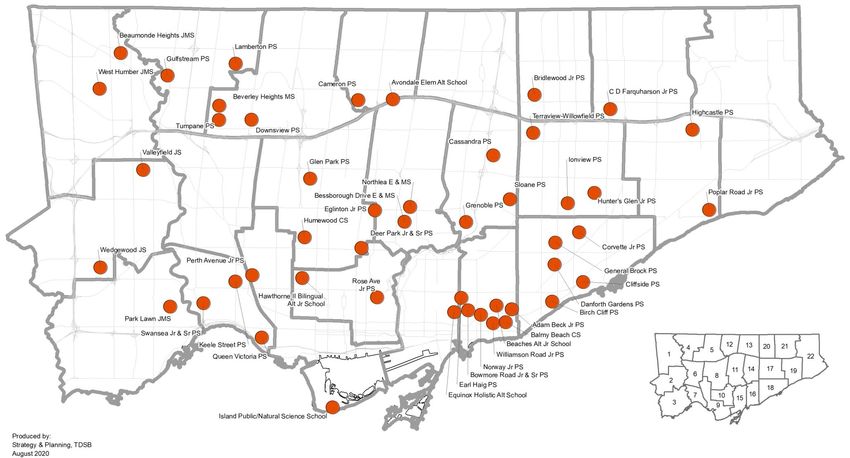
15List of Elementary Schools in Highest Risk Areas
Currently Identified by Toronto Public Health
(*as of August 18)Elementary Class Size Limitations
In Person:
• The TDSB does not have sufficient funds available to support
class sizes which would allow for 2m distancing between
students in every class.
Remote Learning:
• Delivered through a central virtual school model as there are not
sufficient resources to provide for an individual school based
model.
17Status of Reserve Funds
*As of August 31, 2019
Status of Reserve Funds
Reserve Type
Health and Dental Reserve
Amount
$4.5M
Details
These funds will be used to complete the
*as of August 31,of2019
transition employee to benefit trusts
Group Life Insurance $12.9 The surplus in this benefit plan of $10M was used
to balance the Board’s original forecasted deficit
Long Term Disability Reserve $88.2 These funds offset the actuarial liability of LTDI
claims which were calculated to be $59.9M as of
18-19 yearend.
School Budget Carryovers $17.7M This reserve offsets the use of school budget
carryovers in future years
Contractual Professional $0.9M This reserve offsets the use of contractual PD of
Development Carryovers Superintendents and Principals carryover in
future yearsStatus of Reserve Funds
*As of August 31, 2019
IT Projects
Status of Reserve Funds
Reserve Type Amount
$1.3M
Details
Information technology projects not completed in
*as of August
18-19.31, 2019
This reserve will be spent during 19-20.
Various Department $1.7M Projects in 18-19 that were not completed until
Carryovers 19-20. This reserve will be spent during 19-20.
Environmental Legacy Fund $2.9M Funds received through carbon credits to support
environmental related projects
Artificial Turf Fund $0.7M Permit Revenue from artificial turf fields used for
future replacements
Total Reserves $130.8MElementary Class Size Model
• All three proposed models would require the
redeployment of some central, itinerant and
school-based teachers
• This redeployment would result in
approximately 400 teachers to support smaller
class sizes
20Elementary Model: Option 1
Funding
• Uses additional teacher funding from the Ministry of
Education of approximately $6.3M, plus repurposed
$2.9M of TDSB budget
• The total TDSB deficit would remain at 1% under this option
Staffing
• These funds provide 86 teachers in addition to the 400
redeployed teachers
• Total: 486 teachers to support smaller class sizes
21Elementary Model: Option 1
Considerations and Risks
• Insufficient space to accommodate students
• Student supervision
• Transportation
22Elementary Model: Option 2
Funding
• In addition to Option 1, additional use of reserves to
increase the deficit by 1% ($29.5M)
• The total TDSB deficit would be 2% under this option
• The following reserves would be utilized to provide this
additional funding:
– School Budget Carryovers ($17.7M)
– Contractual Professional Development Carryovers ($0.9M)
– Environmental Legacy Fund ($2.3M)
– Artificial Turf Fund ($0.2M)
– Long Term Disability Reserve ($8.4M)
23Elementary Model: Option 2
Staffing
• The use of these reserves would result in an additional
280 teachers
• Total: 766 teachers to support smaller class sizes
24Elementary Model: Option 2
Considerations and Risks
• Insufficient space to accommodate students
• Student supervision
• Transportation
• Use of reserves could impact financial position of TDSB
in current or future years
• Potential second year of COVID-19 would require use
of additional reserves
25Elementary Model: Option 3
Funding
• In addition to Option 1 and Option 2, additional use of
reserves to increase the deficit by 2% ($59.0M)
• The total TDSB deficit would be 3% under this option
• The following reserves would be utilized to provide this
additional funding:
– School Budget Carryovers ($17.7M)
– Contractual Professional Development Carryovers ($0.9M)
– Environmental Legacy Fund ($2.3M)
– Artificial Turf Fund ($0.2M)
– Long Term Disability Reserve ($37.9M)
26Elementary Model: Option 3
Staffing
• The use of these reserves would result in an additional
280 teachers
• Total: 1,046 teachers to support smaller class sizes
27Elementary Model: Option 3
Considerations and Risks
• Insufficient space to accommodate students
• Approximately 48 elementary schools could have a shortfall of classrooms
after using the gyms, libraries, lunchrooms and cafeterias as classrooms,
resulting in an 96 additional classrooms required
• Student supervision
• Transportation
• Use of reserves could significantly impact financial
position of TDSB in current or future years
• Potential second year of COVID-19 would require use
of additional reserves
28Elementary Schools Anticipated to have a
Shortfall of ClassroomsSummary of Financial Options Description Option 1 Option 2 Option 3 TDSB additional budget allocation $2.9M $2.9M $2.9M Ministry Funding for Additional Teachers $6.3M $6.3M $6.3M Use of Reserves up to 2% Deficit $29.5M $29.5M Use of Reserves up to 3% Deficit $29.5M Total $9.2M $38.7M $68.2M Number of additional Teachers Available 86.0 366.0 646.0
Summary of Available Teachers by Option
Full Time Equivalent Teachers

 Source of Teacher                                  Option 1     Option 2    Option 3

 Available Funded Teachers

         TDSB additional budget allocation               $27.0       $27.0        $27.0

         Ministry Funding for Additional Teachers        $59.0       $59.0        $59.0

         Use of Reserves up to a 2% Deficit                         $280.0       $280.0

         Use of Reserves up to a 3% Deficit                                      $280.0

 Redeployed Teachers

         Central, Itinerant and School-based             400.0       400.0        400.0

 Total Teachers                                          486.0       766.0       1046.0
Optional Attendance
For Regular Schools, Specialized Programs, Alternative
Schools and French Programs, Staff is finalizing the
process and messaging for Principals and
Superintendents on:
• Parents’ requests to have their children attend their
designated school by address instead of their Optional
Attendance school.
• Parents’ requests for re-admission/re-entry to FSL
programs.
32Technology Devices
Principals and Superintendents will receive details on:
• Devices that were distributed to the system in the
spring
• Devices that will be returned to them
• How they can purchase additional devices for staff and
students
• How parents will be able to ask for devices in
September
33Transportation
• Toronto Student Transportation Group (TSTG)
approved a staggered start to transportation
• All students with Special Education needs (excluding
gifted program) will be transported in the first week of
school
• Barring any significant issues, bussing would begin for
all other students, including French and gifted, in week
2
• Transportation to remote sites would be subject to
availability of transportation and where available
would not be in place for start of school year.
34Delayed Start and Staggered Entry
• As part of a recent update from the Ministry of Education, the
concept of delaying the start of school has been suggested and
staff are currently looking at this option given the ongoing
evolution of plans that are happening.
• Further, staff is considering how a staggered start within each
school might occur. For example, to build experience with new
routines, a few grades will start for a couple of days and
additional grades would begin school on a staggered basis.
35Next Steps
Pre-registration: All elementary and secondary families will be surveyed again once all
school model information has been finalized.
Returning to School: A Guide to Safely Reopening TDSB Schools:
Update this guide for staff, students, parents, education partners and the community.
Create additional documents and resources for staff to provide the necessary information
for implementation.
Protocols for Principals:
• Two ‘Return to School Working Groups’ of Principals, Senior Managers, Staff and
Superintendents at the elementary and secondary levels have been working to create
elementary and secondary guidelines for school operations as well as teaching and
learning for both in-person as well as the fully remote settings
• Superintendents will engage Learning Network Principals and Vice-Principals in almost
daily conversations to monitor and support safe reopening and school experiences
with close attention paid to addressing local contexts across the TDSB
• Principals will continue to engage parents and School Councils in a variety of ways so
that student and parent voice inform climate and decision-making at the local level
3637
You can also read


