TABLE OF CONTENT - Sciencesconf.org
←
→
Page content transcription
If your browser does not render page correctly, please read the page content below

TABLE OF CONTENT

OVER VIEW
        P.3
    PLENARIES
        P.8
    SESSIONS
       P.11
      TOPICS
       P.17
    SESSIONS
4 FEBRUARY 2020
       P.25
    SESSIONS
5 FEBRUARY 2020
       P.35
    SESSIONS
6 FEBRUARY 2020
       P.45
   SIDE EVENTS
       P.55

                  P.2
OVER VIEW

4 February 2020

                  P.4
                    P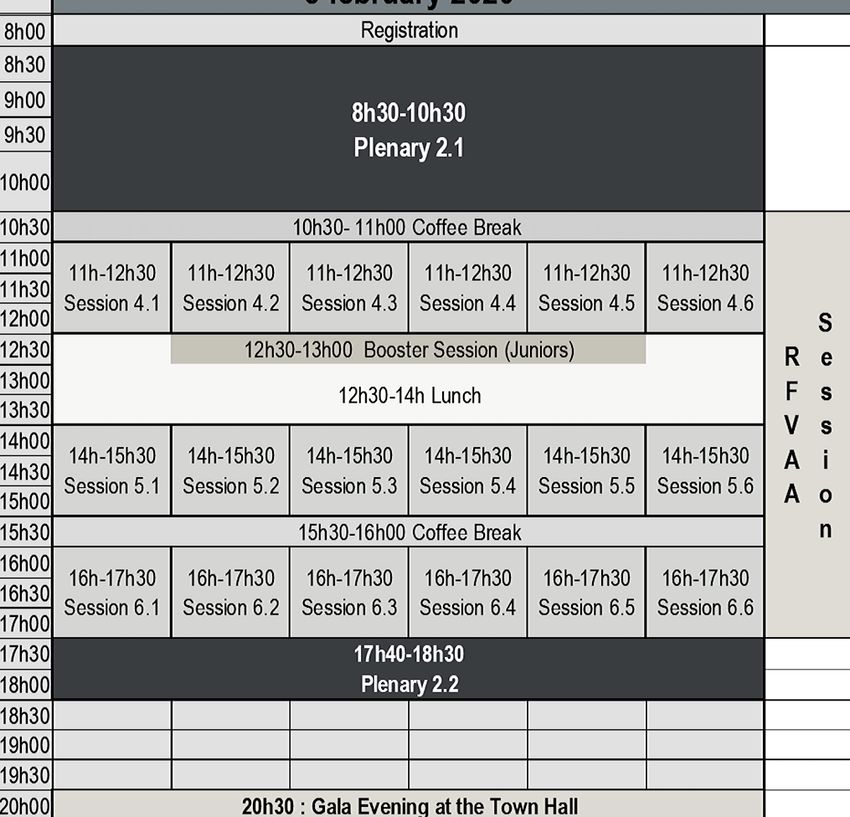
5 February 2020

                  P.5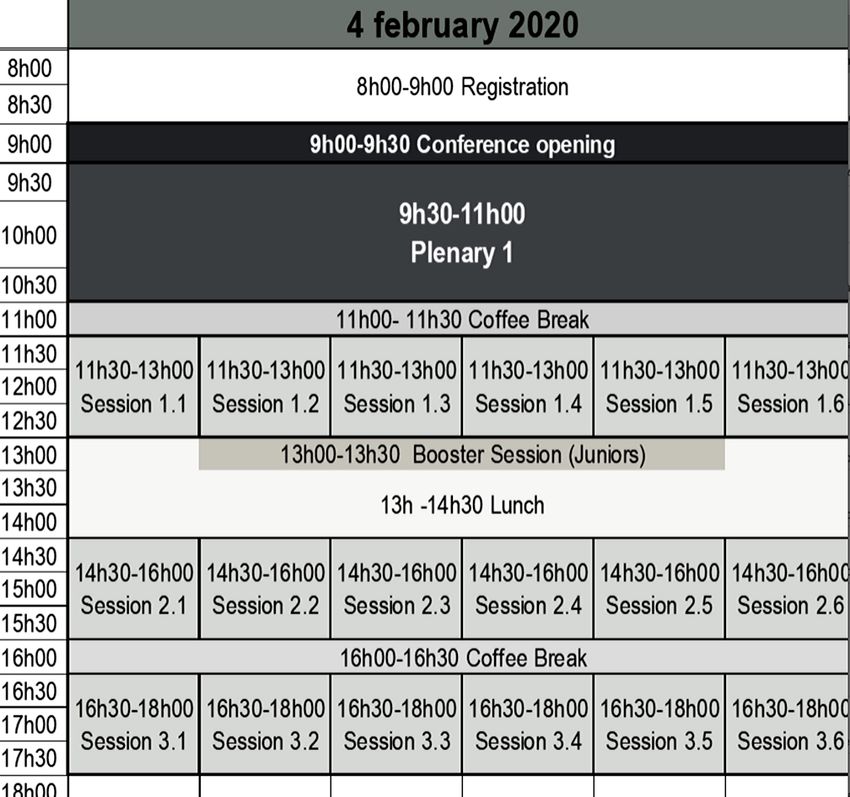
6 February 2020

                  P.6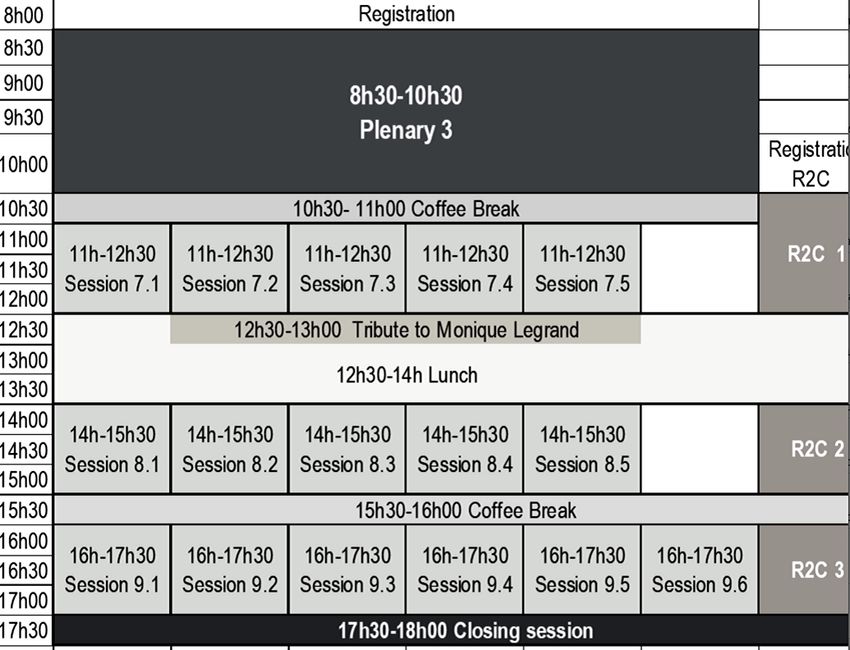
SIDE
                  EVENTS

58H30
   FEBRUARY      2020
      AM - 5H30 PM
MEETING
SPEAKINGWITH  THE
         NETWORK  FRENCH
                   OF AGE
FRIENDLY CITIES
610H30
   FEBRUARY      2020
       AM - 05 H30 PM
MEETING : RESEARCHERS-CITIZENS

410H30
   ET 6AMFÉVRIER
          - 5H30 PM2020
REIACTIS JUNIORS WORKSHOPS

                                 P.7
PLENARIES
4OFFICIAL
FEBRUARY 2020
OPENING
9H30 - 11H00
Plenary Session 1
Inclusion / Exclusion: different perspectives
Auditorium
4 FEBRUARY 2020 - 9.30 AM – 11 AM
President: Emmanuelle Cambois, ILVV
Moderation : Thibauld Moulaert & Jean-Philippe Viriot Durandal
Inclusive society and social connections. Returning to the origins of human
solidarity.
Serge Paugam, School for Advanced Studies in the Social Sciences (École
des Hautes Études en Sciences Sociales, EHESS), France
A critical review and development of a conceptual model of exclusion from
social relations for older people: lessons learned for ROSENET and beyond.
Marja Aartsen, Oslo Metropolitan University, NOVA Ageing Research and
Housing Studies, Norway
P.8PLENARIES
Plenary Session 2
Inclusive society and universal rights. Divergences
and convergences between ageing and disability
Auditorium
5 FEBRUARY 2020 8.30 AM – 10.30 AM
8.30 am – 9.30 am - Part One: : Universal rights as a lever for a more inclusive society
for the elderly and the disabled?
President: Dominique Argoud, President of the Scientific Committee
Moderation: Alain Rochon, APF-France Handicap
Intervenantes : Maria Soledad Cisternas: The UN Secretary General’s Special Envoy
on Disability and Adaptation, Rosita Kornfeld: UN Independent Expert on the
enjoyment of all human rights by older persons, United Nations Human Rights Council
9.30 am – 10.30 am - Part Two: : Convergences and divergences between ageing and
disability: contributions from research.
President: Dominique Argoud, President of the Scientific Committee of CNSA
(National solidarity fund for autonomy)
Moderation: Jean Michel Hote , Age Platform Europe
Speakers:
Patrick Fougeyrollas: Professor at the University of Laval, Quebec,
Canada, International Network on Disability Creation Process.
Alan Walker: Professor, University of Sheffield, Great Britain
Plenary Session 2.2:
Volet 3 : Nouveaux défis, perspectives d’action
5 FEBRUARY 2020 5.40 PM - 6.30 PM
Président : Alan Walker
Modération : Patrick Fougeyrollas
Christian Meistermann, APF France handicap
Jean Michel Hôte , Age Platform Europe
P.9PLENARIES
Plenary Session 3
An inclusive and ageing society:
the challenges ahead
Auditorium
6 FEBRUARY 2020 8.30 AM – 10.30 AM
President: Emmanuel Jovelin
Moderator: Jean-Philippe Viriot Durandal
An inclusive and ageing society through the prism of future societal changes.
Sarah Harper, “Director of the Oxford’s Institute of Population Ageing,
Oxford University
PERSPECTIVES:
Africa: George Rouamba, Joseph Ki Zerbo University, Ouagadougou (UJKZ),
Burkina FasoNorthern
America : Marie Beaulieu, Sherbrooke University, Canada
South America : Rosita Kornfeld, UN Independent
ExpertAsie : Justine Rochot, Center for Research on Contemporary
China (EHESS), France & Sophie Buhnik, French Institute of Research on
Japan, CNRS, France
Europe : Anne-Marie Guillemard, EHESS, France
6 FEBRUARY 2020
5H30 PM 6H00 PM
CLOSING SESSION
P.10SESSIONS
P.12
P.13
P.14
P.15
P.16
TOPICS
P.18
P.19
P.20
P.21
P.22
P.23
P.24
SESSIONS
 4 FEBRUARY 2020
SESSIONS
                  4 FEBRUARY 2020
11.30 AM – 1 PM : SESSIONS 1
                    Housing and social life [WG1] Auditorium
                                   Presidente: Agathe Gestin
                                     Moderation: Anne Labit
                                           Auditorium
  ✓ Inclusion and life experience in old age: involvement in activities and services and
  changing relationship structures amongst independent pensioners living in shared
  accommodation.
  Melaine Cervera, University of Lorraine, 2L2S, France
  ✓ Co-residency with grandchildren and active ageing amongst the elderly in Chile.
  Maria Soledad Herrera, Raul Elgueta, the Pontifical Catholic University of Chile,
  Institute of Sociology, Chile
  ✓ L'habitat inclusif l'est-il pour ses habitants ? L'exemple des habitants de Résidences
  Services.
  Antoine Gerard, Université de Tours, UMR Citeres, France
  ✓ Just how inclusive is inclusive housing? The example of the residents of Résidences
  Services
  Antoine Gerard, University of Tours, UMR Citeres, France
  ✓ “Living together at all ages, even in fragile situations”; the initial results of
  collaborative action research.
  Julien Aimé, Interdisciplinary Research Laboratory on the Transformation of
  Educational and Social Practices (Laboratoire Interdisciplinaire de Recherche sur les
  Transformations des pratiques Éducatives et des pratiques Sociales, LIRTES); Cécile
  Rosenfelder, School for Advanced Studies in Public Health (École des Hautes Études en
  Santé Publique, EHESP); Marion Villez, Paris-Est-Créteil Val-de-Marne University,
  LIRTES, France
         1.2 VADA as a response to older people’s citizenship issues
                              [WG2] Room 1
                              President: Pierre-Olivier Lefebvre
                                   Moderation: Mario Paris
                                           Room 1
  ✓ When senior citizens reflect and take action on the conditions governing the
  involvement and representation of senior citizens within their regions – the case of the
  “Age-Friendly Community” (“Communauté amie des aînés”, CADA) in the Pays-de-Mormal
  (Nord Region, France).
  Damien Vanneste, the Catholic University of Lille, HADéPaS, France
  ✓ Mons, Belgium: Wallonia’s 1st Age-Friendly City (Ville amie des Aînés, VADA), think
  tank on older citizens’ involvement in municipal policy.
  Geneviève Houioux, Hainaut Health Observatory (Observatoire de la Santé du Hainaut,
  OSH), Belgium
  ✓ Citizenship revisited through the prism of VADA approaches: issues and
  consequences.
  Catherine Gucher, University of Grenoble-Alpes, Pacte, SFR Santé société, France
  ✓ Regions, social and spatial mobility and ageing. Different regions, different
  generations.
  Olivier Masson, Myriam Leleu, Robert Grabczan, the Catholic University of Louvain,
  Belgium                                                                                    P.26
SESSIONS
4 FEBRUARY 2020
11.30 AM – 1 PM : SESSION 1
1.3 Dying at a great age in a western context today.
1/ Living out one’s final days: what are the platforms for dialogue and choice?
[WG3]
President: Patrick Durivage
Moderation: Pierre Moulin
Room 3+5
✓ Escaping from suffering via a social bond: the concept of assisted dying.
Marc-Antoine Berthod, University of Applied Sciences of Western Switzerland (Haute
École Spécialisée de Suisse Occidentale, HES-SO), Switzerland
✓ From anomie to fatalism: assisted suicide at the limits of inclusion.
Alexandre Pillonel, University of Applied Sciences of Western Switzerland (Haute École
Spécialisée de Suisse Occidentale, HES-SO), Switzerland
✓ Living out one’s final days in a residential home. The role of attachment in relation to
the death of elderly residents.
Aurélie Chopard-Dit-Jean, University of Lausanne, PRN LIVES, Faculty of Social and
Political Sciences, Switzerland / Bourgogne- Franche-Comté University, Psychology
Laboratory, MSHE Ledoux, France; Magalie Bonnet, University of Bourgogne- Franche-
Comté, EA 3188 Psychology Laboratory; Dario Spini, University of Lausanne LIVES
National Research Centre (Pôle de Recherche National), Switzerland; André Mariage,
University of Bourgogne-Franche-Comté, EA 3188 Psychology Laboratory, France
1.4 Questions regarding the employment of senior citizens [WG8]
President : Anne-Marie Guillemard
Moderation : Elena Mascova et Blandine Destremau
Room Verlaine
✓ Employment patterns of Russian middle-aged and older individuals: active ageing or
exclusion from labour market.
Anna Cherviakova, Elizaveta Gorvat , Oksana Sinyavskaya, National Research
University, Higher School of Economics (HSE), Russie
✓ Social Dialogue and Active Ageing : Lessons from Conversations with UK and European
Employer and Trade Union Representatives.
Christopher Ball, Newcastle University, Royaume-Uni
✓ Maintaining employment, activity and social integration. Ethnographic elements in
experiences of ageing in Bogotá, Colombia.
Guillaume Matuzesky, University of Lyon, UMR 5600 EVS, IC EUL, LabEx IMU / National
University of Colombia, CES, France/Colombia
P.27SESSIONS
4 FEBRUARY 2020
11.30 AM – 1 PM : SESSION 1
1.5 Vulnerability, health and advancing age within an African context
[WG11]
President: George Rouamba
Moderation: Fatoumata Hane
Room 11+12
✓ Improving the medico-social inclusion of the elderly in Burkina Faso’s urban
environment: the Network for the Protection and Promotion of the Elderly (Réseau de
protection et de promotion des personnes âgées) experiment.
Blahima Konaté, Institute of Social Sciences/National Centre for Scientific and
Technological Research (Institut des Sciences des Sociétés/Centre national de
recherche scientifique et technologique, INSS/CNRST), Centre MURAZ; Abdramane
Berthe, Achille Soulama, Lalla Berthe/Sanou, Maïmouna Sanou, Cécile
Ouattara, Issiaka Bamba, Fatoumata Tou, Centre MURAZ, Burkina Faso
✓ Ageing within an institution in the Maghreb: exclusion that reflects lifelong
vulnerability?
Muriel Sajoux, University of Tours, CITERES, France; Mohammed Amar, Meknes
National School of Agriculture, Morocco; Karima Bouaziz, University of Algiers 2,
Faculty of Social Sciences, Algeria; Lassaad Labidi, University of Carthage (INTES),
TunisiaGrand Témoin : Fatoumata Hane, UASZiguinchor (Université Assane Seck), Diabir
BP 523, Sénégal
1.6 ROUND TABLE Human rights, advancing age, and obstacles to the
exercise of rights and social inclusion
President: Jean-Pierre Aquino
Moderation: François Blanchard
Room 9+10
✓ Natural and artificial obstacles.
François Blanchard, French-speaking Association for Human Rights for the Elderly
(Association francophone des Droits de l’Homme Âgé), France
✓ The relativity of the concept of age.
Robert Moulias, Age, Rights and Freedom Commission (Commission Âge, Droits,
Liberté, SFGG); Scientific Council, Federation Against Abuse (Conseil Scientifique,
Fédération contre les maltraitances), France
✓ Universal rights or specific rights
Valérian Boudjemadi, University of Strasbourg, Cognitive Psychology Laboratory,
France
P.28SESSIONS
4 FEBRUARY 2020
2.30 PM – 4 PM : SESSIONS 2
2.1 Living differently: what are the tensions? [WG1]
President: Anne-Bérénice Simzac
Moderation: Cloé Pillot
Room 9+10
✓ Under what conditions could sheltered accommodation constitute a model for
sustainable and inclusive housing?
Marion Droz Mendelzweig, Maria Grazia Bedin, La Source Institute and University of
Health (Institut et Haute École de la Santé La Source) (HES-SO), Switzerland
✓ The inclusive society, advancing age and living alone. Reflections on the experience of
“ageing alone”.
Michèle Charpentier, UQAM Research Chair in Ageing and Citizen Diversity; Maryse
Soulières, Laurie Kirouac, University of Quebec, Montreal, Canada
✓ Some practical limits within the principle of inclusion. The example of an inclusive
support system for the dependent elderly.
Noémie Rapegno, Cécile Rosenfelder, School for Advanced Studies in Public Health
(École des Hautes Études en Santé Publique, EHESP) France
✓ Housing for older people: challenges and opportunities for age-friendly municipalities
in Quebec.
Samuèle Rémillard-Boilard, Suzanne Garon, Christyne Lavoie, François Racicot-
Lanoue, University of Sherbrooke, Centre for Research on Ageing, CIUSSS de l'Estrie –
CHUS; Mario Paris, University of Moncton, Canada
2.2 Regions for ageing?[WG2]
President : Sébastien Lord
Moderation : Catherine Pilon (CGET)
Audirorium
✓ A study on the social inclusion of the elderly within the Franco-Catalan cross-border region.
Ousmane Ndiaye, University of Perpignan Via Domitia (UPVD), ProspectSaso, France
✓ Taking and maintaining one’s place in a changing neighbourhood. Contrasting experiences of
older peoples’ homes within metropolitan areas and medium-sized cities.
Sébastien Lord, University of Montreal (UdeM), Observatory on Sustainable Mobility (OMD),
Ivanhoé Cambridge Observatory on Urban and Real Estate Development (OIC), Canada
✓ An inclusive approach within départements’ initiatives for the elderly. A comparison
between two local areas within the Aquitaine Region.
Marie-Laure Pouchadon, CNRS-Bordeaux Montaigne-ENSAPBx-UPPA, PASSAGES; Philippe
Martin, University of Bordeaux, COMPTRASEC, France
✓ Retirement Migration: A way to evade social exclusion?
Toni Calasanti, Virginia Polytechnic Institute and State University (Virginia Tech),
USA; Marion Repetti, Institute of Social Work, University of Applied Sciences of Western
Switzerland (Institut de travail social, Haute École Spécialisée de Suisse Occidentale), HES-SO
Valais-Wallis, Switzerland; Sadie Giles, Virginia Tech, USA P.29SESSIONS
4 FEBRUARY 2020
2.30 PM – 4 PM : SESSIONS 2
2.3 Dying at a great age in a western context today
2/ Questions regarding support [WG3]
Président : Marc-Antoine Berthod
Modération : Marion Villez
Room 3+5
✓ The various voluntary initiatives within the field of palliative care.
Andrée Sévigny, Institute on Ageing and the Social Participation of the Elderly (Institut
sur le vieillissement et la participation sociale des aînés), University of Laval, Canada
✓ Collaborative Action Research (RAC) within the field of palliative care: what are the
conditions for granting elderly patients expert user status?
Murielle Pott, University of Applied Sciences of Western Switzerland (Haute École
Spécialisée de Suisse Occidentale) (HESAV, HES-SO), Switzerland
✓ Being able to die in the comfort of one’s own home: the ultimate form of social
inclusion.
Andrée Sévigny, Institute on Ageing and the Social Participation of the Elderly (Institut
sur le vieillissement et la participation sociale des aînés), University of Laval,
Canada; Tanguy Châtel, French Society for Palliative Care and Support (Société
française d'accompagnement et de soins palliatifs, SFAP), France
✓ Do the issues encountered by home carers in Quebec have an impact on elderly
people’s access to palliative and end-of-life care?
Patrick Durivage, CREGES; Isabelle Van Pevenage, University of Montreal -
UdeM; Margaux Blamoutier,CREGES; Freitas Zelda, CREGES, Canada
2.4 Symposium Inclusion or political and economic exclusion that increases
with age in Africa [WG11]
President : Mohammed Amar
Moderation : Muriel Sajoux
Room Verlaine
✓ Public policy on the vulnerability of the elderly in Senegal
Muriel Sajoux, University of Tours, CITERES ; Ousseynou Ka, UFR Health and Sustainable
Development, Alioune-Diop University, Bambey, Dakar Centre of Gerontology and Geriatrics, the
Ministry of Health and Social Action in Senegal; ; Enguerran Macia, UMI 3189 Environment, Health
and Society (CNRS / Cheikh-Anta-Diop University / Gaston Berger University / University of Bamako
/ CNRST)
✓ Rebalancing the relationships between generations through PAYG micro-retirement schemes.
François-Xavier Albouy, President of the EIDLL “International Longevity Economics” Network and
Research Director of the "Demographic Transitions, Economic Transitions” (“Transitions
démographiques, Transitions économiques") Chair (TDTE, Louis Bachelier Institute); Mathieu
Noguès, EIDLL Network and TDTE Chair (Louis Bachelier Institute)
✓ Ageing in rural Morocco: the central role played by family solidarity in the face of limited public
social protection schemes.
Mohammed Amar, Meknes National School of Agriculture, Morocco
P.30SESSIONS
4 FEBRUARY 2020
2.30 PM – 4 PM : SESSIONS 2
2.5 CONCEPTUAL CURIOSITY WORKSHOP
Three approaches to inclusion
Presidente : Antigone Mouchtouris
Moderation : Hervé Jory
Room 3+5
✓ Inclusion: a new way of speaking, new ways of thinking and doing.
Marcel Jaeger, CNAM, LISE Laboratory, France
✓ The paradigm of inclusion.
Yves Pillant, IMF Marseille, France
✓ Considering inclusion through attachment.
Magalie Bonnet, University of Franche-Comté, EA3188 Psychology Laboratory,
France; Aurélie Chopard-Dit-Jean, University of Lausanne, PRN LIVES, Faculty of Social
and Political Sciences, Switzerland/ Bourgogne-Franche-Comté University, Psychology
Laboratory, MSHE Ledoux, France
2.6 ROUND TABLE Life experience under the scrutiny
of OHS organisations
President : Hervé Levilain
Moderation : Hans Mazetier
Room 1
✓ Jean-Pierre Mercier, , President, OHS Lorraine, President of the FEHAP National
Commission for the Elderly (commission nationale Personnes âgées)
✓ Renaud Michel, Director General, OHS Lorraine
✓Dominique Somme, Head of Anaesthesia, SAMU, Emergencies, Resuscitation, Internal
Medicine and Geriatrics, Head of Geriatrics, UFR Médecine, University of Rennes 1
✓ Christian Anastasy, Consultant, former IGAS, former Director and founder of ANAP
✓ Muriel Vidalenc, GDA ARS Grand Est
✓Valérie Romilly, Vice-President Health and Autonomy, County council of Moselle
P.31SESSIONS
4 FEBRUARY 2020
4.30 PM – 6 PM : SESSIONS 3
3.1 ROUND TABLE Living differently: what are the prospects? [WG1]
With the support of the Association for severely disabled people. Association Lorraine d’aide
aux personnes gravement handicapées (ALAGH)
President : Pascal Dreyer
Moderation : Cécile Rosenfelder
Room 9+10
✓ The Abbeyfield Project and its extension: an opportunity for independent people...
François Verhulst, Member of the Coordination of Associations of Seniors (Coordination des
Associations de Seniors, CAS), Resident at an Abbeyfield house, Belgium
✓ Shared and socially cohesive housing : A solution for the future ?
Agathe Gestin, Fondation de France, France
✓ PAPH, a varied and inclusive residential option.
José Salas, Director of the Lorraine Region’s Association for Aid for the Severely Disabled
(Association lorraine d'aide aux personnes gravement handicapées, ALAGH)
✓ Familles Solidaires, an initiative that aims to create inclusive housing for elderly people suffering
from Alzheimer’s disease.
Bernadette Paul-Cornu, Familles Solidaires, France
3.2 SYMPOSIUM The epistemology and methodology
of participatory research involving the elderly
The VADA international laboratory [WG2]
President : Myriam Leleu
Moderation : Mario Paris
Auditorium
✓ The impact of a participatory approach to the development of collective awareness: Age-Friendly
Wallonia (Wallonie Amie des Aînés), a Walloon Region pilot scheme.
Myriam Leleu, Olivier Masson, Robert Grabczan, the Catholic University of Louvain, Faculty of
Architecture, Architectural Engineering and Town Planning, Belgium
✓ The strenWGhs and weaknesses of participatory diagnostic approaches in the light of support
for projects involving the elderly within municipalities in the Hainaut region and involvement in Age-
Friendly Wallonia (Wallonie Amie des Aînés, WADA).
Geneviève Houioux, Annick Vanlierde, Hainaut Health Observatory, Belgium
✓ The MADA model’s concept of involvement and its anchorage points during the various phases of its
implementation.
Suzanne Garon, Centre for Research on Ageing, University of Sherbrooke, Canada
✓ Participatory research in a minority-language context: a means to develop and establish French-
speaking community housing in New Brunswick.
Mario Paris, School of Social Work, University of Moncton, Canada
✓ Participatory approaches: method, justification or front for social intervention? Feedback from
countries with Age-Friendly Cities (Villes amies des aînés).
Thibauld Moulaert, Grenoble-Alpes University, CNRS, Grenoble Institute of Political Studies (Science
Po Grenoble), PACTE, France
P.32SESSIONS
4 FEBRUARY 2020
4.30 PM – 6 PM : SESSIONS 3
3.3 ROUND TABLE Living out one’s final days in an inclusive society [WG3]
With support from the Burgundy and Franche-Comté Space for Ethical Reflection (Espace de
réflexion éthique Bourgogne et Franche-Comté) and the Grand Est Space for Ethical Reflection
(Espace de réflexion éthique Grand Est)
President : Marie-Christine Pfrimmer
Moderation : Aurélie Chopard-dit-Jean
Room 3+5
✓ The National Ethics Advisory Committee’s point of view.
Régis Aubry, Member of the National Ethics Advisory Committee (Comité consultatif national
d'éthique, CCNE, France), Head of the Geriatrics Department at Besançon University Teaching
Hospital (CHU) and Head of Besançon CHU’s Autonomy Department, France
✓ Advance directives for EHPADs (nursing homes): a new right? A new constraint?
Patrick Karcher, Hospital practitioner, Strasbourg University Teaching Hospitals’ Geriatrics
Department, Associate Researcher, Henri-Poincaré Archives, UMR 7117 CNRS, France
✓ Some thoughts on the initial end-of-life status report from the Quebec End-of-Life Care
Commission (Commission des soins de fin de vie).
Patrick Durivage, Msc, social worker, coordinator of expertise in the area of palliative care at the
Centre for Research and Expertise in Social Gerontology (Centre de recherche et d’expertise en
gérontologie sociale, CREGES), in collaboration with the Quebec End-of-Life Care Commission
(Commission des soins de fin de vie), Canada
✓ Roland Grunder, Co-president of the Swiss Council for Older People (Conseil Suisse des aînés),
Switzerland
3.4 Social participation through the prism of intervention [WG5]
President : Jean-Philippe Nau
Moderation : Tabitha Oubda
Room 1
✓ Participe-Présent: a programme for the inclusion and community-level involvement of
older people living with psychosocial issues.
Ginette Aubin, University of Quebec at Trois-Rivières (UQTR), CREGÉS; Manon Parisien,
Montreal University Institute for Physical Rehabilitation (Institut universitaire sur la
réadaptation en déficience physique de Montréal) at the CIUSSS, Centre-Sud-de- l'Île-de-
Montréal (IURDPM); Martine Hilaire, Time for a Break (Le temps d'une pause), Montreal,
Quebec; Bernadette Dallaire, Institute on Ageing and the Social Participation of the Elderly
(Institut sur le vieillissement et la participation sociale des aînés), University of
Laval; Véronique Billette, VIES Partnership Research Team, Canada
✓ The trajectories of elderly people and the co-production of inclusive leisure: the case of
the “joëlettes group”.
Jean-Philippe Nau, University of Lorraine, IAE Nancy School of Management,
CEREFIGE; Renaud Garcia-Bardidia, IUT Evreux, University of Rouen; Coralie Lallemand,
University of Rouen, EA NIMEC; Judit Vari, University of Rouen, CIRNEF, Franc
✓ Individuals with dementia. Inclusion and friendship issues: a theological perspective.
Talitha Cooreman-Guittin, the Catholic University of Louvain, Belgium
✓ The Leisure and Fulfilment Retirement Programme (Programme Retraite épanouie et loisir)
to help the recently-retired adjust to their new lives: a pilot study.
Hélène Carbonneau, University of Quebec at Trois-Rivières, CREGÉS, RQRV, LIREIL; Teresa
Freire, University of Minho; Lyson Marcoux, University of Quebec at Trois-Rivières,
RQRV; Sébastien Grenier, University of Montreal - UdeM, RQRV; Julie Fortier, University of
Quebec at Trois Rivières, RQRV; Véronique Provencher, University of Sherbrooke,
RQRV; Camille Joanisse, University of Quebec at Trois Rivières, CREGÉS, RQRV, LIREIL,
Canada P.33SESSIONS
4 FEBRUARY 2020
4.30 PM – 6 PM : SESSIONS 3
3.5 Pluralistic approaches to forms of exclusion as regards the elderly
President : Agnès Gramain
Moderation : Valérie Wolff
Room 11+12
✓ Healthcare for elderly people living on the streets: from emergency treatment to inclusion?
Valérie Wolff, European Higher School of Social Intervention (École Européenne de
l’Intervention Sociale), ESEIS, University of Strasbourg, DynamE, Fran
✓ A better understanding of the debt trajectories of elderly people in debt, in order to facilitate
social intervention.
Olivier Moreau, University of Sherbrooke; Yves Couturier, University of
Sherbrooke; Louise Belzile, University of Sherbrooke; Anne-Marie Millaire, University of
Quebec, Montreal; Nathalie Dame, University of Sherbrooke, Canada
✓ Diversity in ageing in Barcelona.
Mercè Pérez Salanova, Universitat autonoma de Barcelona, Espagne
3.6 Physical and social environments for addressing ageing [WG2]
President : Grégory Hamez
Moderation : Hervé Marchal
Room Verlaine
✓ Ageing, Climate Change and the Age-Friendly City.
Kim Sawchuk, Constance Lafontaine, Concordia University, Canad
✓ Ageing in suburban housing: the neighbourhood as a stage for collective initiatives and a
space for social interaction.
Hervé Marchal, University of Bourgogne-Franche-Comt
✓ Ageing and local revitalisation policies within the urban fringes of contemporary Japan: the
challenge of residential continuity.
Sophie Buhnik, French Institute for Research on Japan (Institut français de recherche sur le
Japon), CNRS, France
P.34SESSIONS 5 FEBRUARY 2020
SESSIONS
 5 FEBRUARY 2020
11 AM – 12.30 PM : SESSIONS 4
4.1 When mobility becomes an issue of inclusion [WG2]
President : Jean-Marc Macé
Moderation : Joël Meissonnier
Room 2
✓ The needs of the elderly in terms of mobility within the community: what has been written.
Sylvie Miaux, Ginette Aubin, Hélène Carbonneau, University of Quebec at Trois-Rivières,
Canada
✓ Recognising the needs of the elderly and the disabled regarding their independent use of
public transport.
Caroline Pigeon, Aline Alauzet, Laurence Paire-Ficout, LESCOT IFSTTAR, France
✓ The urban environment: support for inclusion and the reinvention of mobility for older people.
Carlyne Berthot, Grenoble-Alpes University, Grenoble Institute of Political Studies (Sciences
Po Grenoble), Pacte, France
✓ When the time comes to stop driving: access to the car as a new risk of exclusion?
Joël Meissonnier, Maria Tébar, Fabrice Hasiak, CEREMA (Centre for Studies and Expertise on
Risks, the Environment, Mobility and Planning, Centre d’Études et d’Expertise sur les Risques,
l’Environnement, la Mobilité et l'Aménagement), ESPRIM Research Team, France
4.2 Inclusion/exclusion from political life with advancing age [WG4]
President : Antoine Bosquet
Moderation : Barbara Lucas
Auditorium
✓ Decision to take political action amongst older indigenous populations in Ecuador.
Jonathan Guillemot, Institute of Gerontology, King's College London, Escuela de
Medicina, Universidad San Francisco de Quito USFQ, Ecuador
✓ Older vulnerable people's citizenship: an issue of social justice.
Lea Sgier, Institute for Citizenship Studies (Institut d'études de la citoyenneté), University of
Geneva (Incite, Unige); Barbara Lucas, Maëlle Meigniez, University of Social Work (Haute
école de travail social), Geneva HES-SO (Hets), Switzerland
“Grand temoin” : Citoyennage project in nursing homes
Romain Gizolme, Director of AD-PA“Grand Temoin” : Programs against older persons’ exclusion
in a Citizenship perspective. Alain Villez, President of Les petits frères des pauvres
P.36SESSIONS
5 FEBRUARY 2020
11 AM – 12.30 PM : SESSIONS 4
4.3 MUTAC ROUND TABLE Active solidarity between generations and
voluntary involvement. From research to action [WG5]
President : Nicole Bigas, Présidente de la Fondation MUTAC
Moderation : Frédéric Balard
Room 11 + 12
✓ Introduction.
Philippe Bergogne, Managing Director of the MUTAC Foundation
✓ The challenges of pensioners’ social and voluntary involvement.
Tabitha Oubda, University of Lorraine, 2L2S, France
✓ Social involvement and advancing age. Analysis and results of the “Ageing and Being Useful”
(“Vieillir et Être Utile”) survey.
Frédéric Balard, Alice Miron, University of Lorraine, 2L2S, France
✓ Barriers and levers to social and voluntary involvement. What can we learn from the work
undertaken in Quebec?
Andrée Sévigny, Institute on Ageing and the Social Participation of the Elderly (Institut sur le
vieillissement et la participation sociale des aînés), University of Laval, Canada
✓ Feedback from Offices involved in building a strategy for activating the social involvement of
pensioners.
Guy Vançon, President of the Nancy Office for the Elderly (Office Nancéen des Personnes
Âgées) (subject to alteration) and Manuella Sciuto-Zinck, Director of the Belfort Office for
the Elderly (Office Belfortain des Personnes âgées), France
Presentation of the MUTAC Foundation awards
4.4 Lifelong learning, challenges and issues for inclusion [WG7]
President : Dominique Kern
Moderation : Aline Chamahian
Room Verlaine
✓ Universities for the elderly in urban China: institutions for inclusion, assignment or social
control?
Justine Rochot, Centre for Studies of Modern and Contemporary China (Centre d’Études sur la
Chine et Contemporaine, EHESS) and the Sorbonne Institute for Development Studies (Institut
d’Études du Développement de La Sorbonne), Panthéon-Sorbonne University, France
✓ Between gerontagogy and lifelong learning. The model of “personal blossoming pedagogy”.
Boniface Bahi, Alberta University, Edmonton, Canada; Mihaela-Viorica Rusitoru, IUTAM
Montreal, Canada
✓ Training: a precondition for access to end-of-life rights and involvement in public policy-
making.
Annie Mollier, Grenoble-Alpes University, SFR Santé Société, France
P.37SESSIONS
5 FEBRUARY 2020
11 AM – 12.30 PM : SESSIONS 4
Abuse, legal protection and support [WG9]
President : Alice Casagrande
Moderation : Dominique Terrasson
Room 9+10
✓ Legal protection: the only answer to the vulnerability of the elderly.
Isabel Perriot-Comte, Legal Representative for the Protection of Adults, Member of
the Capdroits Collective; Pierre Bouttier, Tutor-researcher in social sciences and the legal
protection of adults, Member of the ACSEDROITS programme, ANR, France
✓ Support for the elderly within CHRSs (Accommodation and Social Reintegration Centres):
tensions between autonomy and protection.
Arnaud Beal, School of Practicing Psychologists (École des Psychologues Praticiens), the
Catholic Institute of Paris (ICP); Benoît Eyraud, Lumière - Lyon II University, Max Weber Centre
(CMW), France
✓ Meeting the challenges of raising awareness to combat the abuse and intimidation of older
people (Quebec): development and content of the DAMIA Guide to Practice.
Marie Beaulieu, University of Sherbrooke (UdeS), Research Chair on the abuse of older people,
Centre for Research on Ageing, Integrated University Health and Social Services
Centre; Caroline Pelletier, University of Sherbrooke (UdeS), Research Chair on the abuse of
older people, Centre for Research on Ageing, Integrated University Health and Social Services
Centre; Marie-Philippe Dubuc, Research Chair on the abuse of older people, DIRA-Estrie,
Canada
Speaker: Nicolas Berg, La Citadelle Hospital, Liège. The Walloon Agency for Combating Abuse
(Agence wallonne de lutte contre la maltraitance), Respect Senior, Belgium
4.6 ROUND TABLE Inclusive transition:
a revolution in the effectiveness of rights within a disability-producing society
President: Christian Meistermann, Grand Est Regional Representative of APF France handicap
Moderation: Raùl Morales La Mura
Room 1
✓ Fundamental human rights, quality of life an inclusive society.
Maryvonne Lyazid, President of the Ages Foundation (subject to alteration)
✓Transition inclusive et handicap, Inclusive transition and handicap.
The experience of APF- Pierre-Yves Lenen, Director of APF France handicap Service Provision
(subject to alteration)
✓ Capacity changes, self-determination in life projects and resilient environments to prevent social
exclusion.
Jean-Pierre Robin, President of the RIPPH, Québec, Canada; Patrick Fougeyrollas, Anthropologist,
University Laval, Québec, Canada RIPPH
✓ Inclusion in the field of autonomy.
Dominique Argoud, Paris-Est-Créteil University, President of the CNSA Scientific Council P.38SESSIONS
5 FEBRUARY 2020
2 PM – 3.30 PM : SESSIONS 5
LUE SYMPOSIUM Ageing and territory:
participation beyond and across borders
Président : Peter Dörrenbächer
Modération : Marine Le Calvez & Sabrina De Pindray D'ambelle
Room Verlaine
✓ Introduction.
Peter Dörrenbächer, Interreg UniGR-Centre for Border Studies, University of Saarland,
Germany
✓ Forms and regional dynamics of ageing.
Christian Pihet, University of Angers, ESO, France
✓ Ageing, the development of communities and experienced territory.
Suzanne Garon, Centre for Research on Ageing, University of Sherbrooke, Canada
✓ Ageing in caring communes and locally responsible communities.
Cornelia Kricheldorff, Institut for Applied Research and Development (IAF), Catholic
University of Applied Sciences Freiburg, Germany
5.2 Power(s) within the city and advancing age [WG4]
President : Romain Gizolme
Moderation : Axel Gosseries
Room 11 + 12
✓ Opportunity: the issue of grey power.
Jean-Philippe Viriot Durandal, University of Lorraine, 2L2S, France
✓ The political inclusion of senior citizens within France. From fulfilment to civic withdrawal.
Bernard Denni, Grenoble-Alpes University, Grenoble Institute of Political Studies (Sciences Po
Grenoble), CNRS, Pacte, France
✓"We still represent part of the population!” ("On fait encore partie du monde"!)
An ethnography of citizenship within medico-social institutions.
Maëlle Meigniez, Barbara Lucas, Geneva University of Social Work (Haute école de travail
social), HES-SO (Hets); Lea Sgier, Institute for Citizenship Studies (Institut d'études de la
citoyenneté), University of Geneva (Incite, Unige), Switzerland
✓ Speaker: riding the wave of the yellow vests.
Luc Gwiazdzinski, University of Grenoble-Alpes, Pacte, France
P.39SESSIONS
5 FEBRUARY 2020
2 PM – 3.30 PM : SESSIONS 5
5.3 Active ageing, involvement and social integration [WG5]
Presidente : Emmanuel Jovelin
Moderation : Guillaume Jehannin
Auditorium
✓ Active ageing – Participation in Society.
Per H. Jensen, Center for Comparative Welfare Studies (CCWS), Aalborg University,
Danemark
✓ Community based intervention for older adults: can technology play a role?
Adele De Stefani, Oscar Zanutto, Istituto per Servizi di Ricovero e Assistenza agli Anziani -
Treviso, Italie
✓ Promoting social participation in the middle and older age to increase the quality of later life.
Darya Kareva, Anna Cherviakova, Oksana Sinyavskaya, National Research University, Higher
School of Economics (HSE), Russie
✓ Seniors bien portants en Suisse : activités, bénévolat et vie associative garants de
citoyenneté.
Kaj Noschis, Laboratoire de sociologie urbaine (LASUR), Lausanne, Suisse
5.4 Round table Inclusion through training within the context of ageing:
a new idea? [WG7]
President: Jean-Michel Verdier
Moderation: Aline Chamahian et Anne Marcilhac
Room 2
✓ Introduction: Lifelong learning and an inclusive society: for whom? Why? By whom?
Aline Chamahian, Sociologist, University of Lille
✓ Training for carers: proposal or injunction? Inclusive or exclusive? The reasons for non- involvement
Florence Leduc, President of the French Association of Caregivers (Association française des
aidants); Judith Mollard, Clinical Psychologist, France Alzheimer
✓ How can the elderly be involved in their own care? Is this possible within the context of neuro-
progressive diseases? ETP training for nursing staff.
Pascaline Cassagnaud, Geriatrician, CMRR Lille
✓ Access to training: which courses for which professions? How can careers in caring for the elderly
be promoted? What improvements can be made?
Anne Marcilhac, Neurobiologist, Director of the ITEV; Annie de Vivie, Gerontologist, Founder of
AgeVillage
✓ ITEV Testimonials
P.40SESSIONS
5 FEBRUARY 2020
2 PM – 3.30 PM : SESSIONS 5
5.5 Abuse, gender and social environments [WG9]
President and moderator: Daniel Réguer
Room 9+10
✓ The meaning given to requests for help from women who have experienced abuse in old age:
the results of a doctoral thesis from Quebec.
Caroline Pelletier, Marie Beaulieu, University of Sherbrooke (UdeS), Chair of Research on the
abuse of the elderly, Centre for Research on Ageing, Integrated University Health and Social
Services Centre; Françoise Le Borgne-Uguen, University of Brest, LABERS (EA 3149), France
✓ Societal violence and women’s rights. Social inclusion policies for women accused of
witchcraft in Burkina Faso.
George Rouamba, Joseph-Ki-Zerbo University, Ouagadougou (UJKZ), Burkina Faso
✓ Collective living for the elderly: the organisational factors that contribute both to abuse
between residents, and to “living well together”.
Marie Beaulieu, Roxane Leboeuf, Centre for Research on Ageing, Integrated University Health
and Social Services Centre, Chair of Research on the abuse of the elderly, University of
Sherbrooke (UdeS),Canada
✓ Speaker: Bridget Penhale, University of East Anglia, England
5.6 Disability and ageing
President: Geneviève Houioux
Moderation : Thierry Desbonnets
Room 1
✓ Ageing in individuals with disabilities: a new reality in the provincial institutions of Belgian Hainaut
Annick Vanlierde, Hainaut Health Observatory; Christian Massot, Emmanuelle Plaquet, Sarah
Morlet, Geneviève Houioux, Belgium
✓ The experience of inclusion amongst older people living with mental health problems
Ginette Aubin, Centre for Research and Expertise in Social Gerontology (Centre de recherche et
d’expertise en gérontologie sociale, Montreal, Quebec (CREGÉS), University of Quebec at Trois-
Rivières (UQTR); Karol-Ann Girard, the La-Mauricie-and-Centre-of-Quebec Integrated Health and
Social Services Centre, (CIUSSS-MCQ); Hélène Carbonneau, Centre for Research and Expertise in
Social Gerontology (Centre de recherche et d’expertise en gérontologie sociale, Montreal, Quebec
(CREGÉS), University of Quebec at Trois-Rivières (UQTR); Sylvie Miaux, University of Quebec at
Trois-Rivières (UQTR), Canada
✓ Advancing age in people with Down’s Syndrome: siblings as caregivers as an environmental
resource?
Lise Lemoine, University of Rennes 2, LP3C Laboratory; Benoît Schneider, University of Lorraine,
2LPN, France
✓ Issues of cultural citizenship within deaf ageing cultures. Exploratory analysis of the musical
experiences of elderly deaf sign language users in Montreal.
Line Grenier, University of Montreal - UdeM; Véro Leduc, University of Quebec, Montreal (UQAM),
Canada P.41SESSIONS
5 FEBRUARY 2020
4 PM – 5.30 PM SESSIONS 6
6.1 ROUND TABLE Interreg UniGR-Centre for Border Studies: participation
beyond and across borders: the case of the Greater Region [WG2]
President : Peter Dörrenbächer
Moderation : Sabrina De Pindray D'ambelle & Marine Le Calvez
Room Verlaine
✓ Introduction.
Peter Dörenbächer, Interreg UniGR-Centre for Border Studies, University of Saarland, Germany
✓ Senior Activ' : a cross-border cooperation to Age Well in the Greater Region.
Anne-Laure Maclot, Christophe Muller, Coordinators of the Senior activ
project, Département of the Moselle, France
✓ Local and cross-border involvement for and by older adults.
Marianne Granz, President of Europ'Age, German
✓ The Coordination of Senior Citizens Associations : building a collective voice of Senior
Citizens Associations.
François Verhulst, Member of Coordination of Senior Citizens Associations, Belgium
6.2 ROUND TABLE Questions regarding the exercise of the political rights of
the elderly [WG4]
President : Athanase Benetos
Moderation : Isabel Perriot-Comte
Room 11+12
✓ Assessing voting capacity.
Antoine Bosquet, APHP, France
✓ Restoring the citizenship of individuals under guardianship: principles and actions proposed
by Handéo.
Cyril Desjeux, Scientific Director of Handéo
✓ Promoting, ignoring and confiscating. Medico-social institutions and the political rights of
their residents.
Barbara Lucas, Maëlle Meigniez, Geneva University of Social Work (Haute école de travail
social), HES-SO (Hets); Lea Sgier, Institute for Citizenship Studies (Institut d'études de la
citoyenneté), University of Geneva (Incite, Unige)
✓ Speakers : Pascal Champvert & Bernard Ennuyer
P.42SESSIONS
5 FEBRUARY 2020
4 PM – 5.30 PM SESSIONS 6
6.3 SYMPOSIUM Personalised Citizen Support for Community Integration
(Accompagnement-citoyen personalisé d’intégration communautaire, APIC):
promoting inclusion at an advanced age through social and leisure activities
[WG5]
President and moderation: Mélanie Levasseur
Room 2
✓ Adapting Personalised Citizen Support for Community Integration (Accompagnement-
citoyen personalise d’intégration communautaire, APIC) to visual impairment and within the
clinical contexts of rehabilitation centres.
Caroline Pigeon, Lescot-TS2-IFSTTAR; Judith Renaud, School of Optometry, University
of Montreal; Mélanie Levasseur, Faculty of Medicine and Health Sciences, University
of Sherbrooke, Centre for Research on Ageing, CIUSSS de l’Estrie-CHUS, Canada
✓ The impact of APIC on the lives of older people with disabilities: the different perspectives of
older people receiving support and volunteers providing support.
Janie Gobeil, Marie-France Dubois, Faculty of Medicine and Health Sciences, University of
Sherbrooke, Centre for Research on Ageing, CIUSSS de l’Estrie-CHUS; Catherine
Maisonneuve, Centre for Research on Ageing, CIUSSS de l’Estrie-CHUS; Mélanie Levasseur,
Faculty of Medicine and Health Sciences, University of Sherbrooke, Centre for Research on
Ageing, CIUSSS de l’Estrie-CHUS, Canad
✓ Further research using multicentric and pragmatic Randomised Controlled Trials (ECRs):
examples of the strenWGhs and challenges of Personalised Support (APIC).
Mélanie Levasseur, Faculty of Medicine and Health Sciences, University of Sherbrooke,
Centre for Research on Ageing, CIUSSS de l’Estrie-CHUS; Catherine Maisonneuve, Centre for
Research on Ageing, CIUSSS de l’Estrie-CHUS; Janie Gobeil, Marie-France Dubois - Faculty of
Medicine and Health Sciences, University of Sherbrooke, Centre for Research on Ageing,
CIUSSS de l’Estrie-CHUS; Johanne Filiatrault, University Institute of Geriatrics Research
Centre, Montreal, School of Rehabilitation, University of Montreal; Helen-Maria Vasiliadis,
Faculty of Medicine and Health Sciences, University of Sherbrooke, Charles-Le Moyne–
Saguenay –Lac-Saint-Jean Centre for Research on Health Innovations, Canada
6.4 Round table The structuring and conditions of power in defence of the
rights of the elderly and the disabled.
Président : Raul Morales La Mura
Modération : Marion Scheider-Yılmaz
Room 1
✓ Marion Scheider-Yılmaz, 2L2S, Lorraine University
✓ Michèle Charpentier, Research Chair on ageing and diversity and citizenship, Québec
University in Montréal (UQAM)
✓ Patrick Fougeyrollas, Professor at the University of Laval, Quebec, Canada, International
Network on Disability Creation Process
P.43SESSIONS
5 FEBRUARY 2020
4 PM – 5.30 PM SESSIONS 6
6.5 SYMPOSIUM Involving elderly people and their families in decisions
regarding home care services
President and moderation: Françoise Le Borgne-Uguen
Room 9+10
✓ Should elderly people play a decision-making role in the APA à domicile (Personal Autonomy
at Home Allowance) award process?
Annie Dussuet, Clémence Ledoux, CENS UMR 6025 et DCS UMR 6297, University of Nantes,
France
✓ Changes in the legal framework for family carers: between securing the status of carers and
derogations from labour law?
Pascal Caillaud, “Law and Social Change” Laboratory, (UMR CNRS 6297), University of Nantes,
France
✓ The direct employment of home carers by recipients of the APA: between trust and
dependence.
Olivier Crasset, Cens UMR 6025, University of Nantes, France
✓ Being employed by a relative, or working as a home carer and providing a relative with support
within the framework of the APA? Proximities and differences between approaches regarding
the involvement of the elderly.
Françoise Le Borgne-Uguen, Simone Pennec, University of Brest, LABERS (EA 3149), France
6.6 Questions regarding integration, discrimination and intergeneration
Presidente : Mercè Pérez Salanova
Moderation : Anita Meidani
Auditorium
✓ Intergenerational cohabitation as a means of inclusion for the various generations: using
feedback from a research project to consider communication principles and social
representation issues.
Thomas Watkin, University of Nîmes, Projekt EA7447, France
✓ The multiplicity and complexity of age discrimination in healthcare: the case of osteoporosis
management.
Jonathan Guillemot, Institute of Gerontology, King's College London, Escuela de Medicina,
Universidad San Francisco de Quito USFQ, Great Britain/Ecuador
✓Cities, Gender and Ageing: between senior citizens’ right to citizenship and gerontophobia
Anita Meidani, Jean-Jaurès University, Toulouse, LISST, France
✓ Ageism: findings and proposals for an inclusive society vis-à-vis the elderly.
Agnieszka Bozanic, University of Barcelona, Spain
P.44SESSIONS 6 FEBRUARY 2020
SESSIONS
 6 FEBRUARY 2020
11 AM – 12.30 PM : SESSIONS 7
7.1 Social involvement, life experience and community relations [WG5]
President : Jean-Yves Trépos
Moderation : Andrée Sévigny
Room 9+10
✓ Social participation: Definitions and perspectives.
Andrée Sévigny, Institute on Ageing and the Social Participation of the, University of Laval,
Canada
✓ Perspectives on Social participation and political participation.
Jean-Philippe Viriot Durandal, Lorraine University, 2L2S, France
✓ Social involvement put to the test of life experience: when ill health leads to new
positionings.
Catherine Gucher, Grenoble-Alpes University, Pacte, France
7.2 Digital inclusion through the prism of its users [WG6]
Presidente : Marie-Line Rubini
Moderation : Christophe Humbert
Room 1
✓ Staying connected: the challenges of the poorest districts of Montevideo.
Soledad Caballero De Luis, University of the Republic (UdelaR - FIC), Uruguay / the Open
University of Catalonia (UOC), Spain
✓ Family Conflicts and Internet Use: The Voices of Grandmothers.
Loredana Ivan, National University of Political Studies and Public Administration,
Bucharest, Romania; Galit Nimrod, Ben Gurion, University of the Negev, Israel
“Grand Témoin” : Gait initiation and onboard sensors: assessment of the risk of falling at home
in elderly Laure Coudrat, 2LPN, Lorraine University; Joseph Bascou, INI-CERAH; Jean-Luc Kop,
2LPN, Lorraine University; Christel Jacob; Thérèse Jonveaux, CMRR – CHRU-Nancy; Marion
Tousselard, IRBA – Unité NPS; Jérôme Dinet, 2LPN, Lorraine University, France
P.46SESSIONS
6 FEBRUARY 2020
11 AM – 12.30 PM : SESSIONS 7
7.3 Associations and families in the inclusion of elderly migrants [WG10]
President : Piero Galloro
Moderation : Emmanuel Jovelin
Room Verlaine
✓ The role of cultural and religious associations in the social inclusion of North African and
Turkish immigrants, and ageing Muslims.
Mohamed Hicham Joudat, University of Lorraine, 2L2S, France
✓ Potential of Regional Elderly Care Labour Markets by the Integration of Migrants. The
example of Saarland.
Julia Lenz, Universität des Saarlandes, Germany
✓ The Chibanias: invisible heroines? The lives of female immigrants growing old in Marseille.
Julie Leblanc, Lumière - Lyon II University, Laboratory of the Anthropology of Contemporary
Issues (Laboratoire d'anthropologie des enjeux contemporains, LADEC), France
✓ The return and non-return of elderly immigrants from sub-Saharan Africa.
Emmanuel Jovelin, University of Lorraine, 2L2S, France
7.4 ROUND TABLE Taking, giving, hearing and criticizing the “word of the
old”: different perspectives on the inclusive society
Moderation : Thibauld Moulaert
Room 3+5
✓ The place of older people within society (inclusive).
Jean Giard, Honorary President, Alerte 38, France
✓ Why give old people a say if they’ve never had it before?
Bernard Ennuyer, EA 4569: Ethics, Politics and Health (Éthique, Politique et Santé), Paris
Descartes, France
✓ Anticipating dialogue so as to respect choices: using the “The Issue & Me! Stories of
choices” (“Question & Moi ! Des histories de choix”) tool as good practice in allowing for the
inclusion of older people’s choices within decision-making processes.
Dominique Langhendries, Mélanie Oudewater, Pascale Broché, Claire Bachelet, Respect
seniors, Belgium
✓ From policy-making to political decision: how do we listen to the “word of the old” and get
their voices heard?
Sandrine Chaix, Regional Elected Representative (Auvergne-Rhône-Alpes Region) and founder
of a care and home services unit (disability and ageing), France
P.47SESSIONS
6 FEBRUARY 2020
11 AM – 12.30 PM : SESSIONS 7
7.5 Inclusion and exclusion in the face of
age-related neurodegenerative diseases
President : Christine Perret-Guillaume
Moderation : Anne-Bérénice Simzac
Room 11+12
✓ When living with Alzheimer’s disease becomes a factor in inclusion: an example of a joint
initiative by two Foundations.
Anne-Bérénice Simzac, Arènes Laboratory, France
✓ The Libault report: inclusion or exclusion?
Daniel Réguer, Le Havre University, Normandy (ULH), IDEES, France
✓ Those excluded from activities. Is the provision of activities within Gerontology an effective
inclusion mechanism?
Antoine Gerard, University of Tours, Citeres, France
✓ Interim housing and ‘extramural’ EHPADs; the issue of home support.
Corinne Grenier, Roland Rizoulières, Olivier Blin, Aix-en-Provence Institute of Political
Studies (Sciences Po Aix), KEDGE Business School, and the Institute of Systems
Neurosciences (Institut de Neurosciences des Systèmes, INS), France
2 PM – 3.30 PM : SESSIONS 8
1 SYMPOSIUM Materiality, Mobility and Critical Theory: from Physical
Objects and Embodied Experiences to Political Narratives of Ageing in Public
Space [WG2]
President : Anna Wanka
Moderation : Thibauld Moulaert
Room Verlaine
✓ The interrelationship between place and critical life transitions in later life. Social exclusion: a
scoping review.
Anna Urbaniak, Irish Centre for Social Gerontology, Institute for Life Course and Society, NUI,
Galway, Ireland
✓ Ageing lifestyles in contrasted urban environments: A mixed-method look at the daily
mobility of older adults in Montreal.
Michel Després, Faculty of Environmental Design, Montreal University, Canada
✓ Mapping Age: The Socio-Material Arrangements of Ageing in Public Space.
Anna Wanka, Goethe University Frankfurt am Main, Research Training School Doing
Transitions, Germany
✓ Benches as Mediations of Age in Public Space: Contested Representations from Materiality
to Public Policy.
Thibauld Moulaert, Grenoble-Alpes University, CNRS, Grenoble Institute of Political Studies
(Science Po Grenoble), Pacte, France P.48SESSIONS
6 FEBRUARY 2020
2 PM – 3.30 PM : SESSIONS 8
8.2 SYMPOSIUM Tackling loneliness from inclusive societies: studies and
examples of action in Spain. [WG5]
Moderation : Sara Marsillas
Room 1
✓ Loneliness(s) and aloneness in older adults.
Sara Marsillas, Elena del Barrio and Mayte Sancho, Matia Instituto, Spain
✓ Loneliness and the importance of meaningful roles.
Daniel Prieto Sancho, Complutense University of Madrid (UCM), Spain
✓ Grandes Vecinos: Enhancing friendly relationships between older adults and their neighbours
Mercedes Villegas, Grandes Amigos, Spain.
✓ Age-Friendly Basque Country Project: A tool for citizenship and social inclusion.
Elena del Barrio; Sara Marsillas; A. Tomasena, N. Almazán, Mayte Sancho, Matia Institute,
Amilibia, L., Department of Employment and Social Policies, Basque Country, Spain
8.3 Digital inclusion: new political, economic and social challenges [WG6]
President : Raymond Magro
Moderation : Hervé Levilain
Room 11+12
✓ The digitisation of public services: an elective advance?
Rémi Gallou, Sabrina Aouici, French National Old Age Insurance Fund (Caisse nationale
d'assurance vieillesse, CNAV), France
✓ Gerontological coordination via an information system: impacts on the autonomy and
inclusion of the elderly.
Christophe Humbert, University of Strasbourg, France ✓ “ Grand Témoin”: Marie-Line Rubini,
Development officer in Digital use for Health , Pulsy
P.49SESSIONS
6 FEBRUARY 2020
2 PM – 3.30 PM : SESSIONS 8
8.4 ROUND TABLE Abuse of the elderly and social exclusion [WG9]
Proposed by the Federation 39 77’s Scientific Council Against Abuse
(Conseil Scientifique de la Fédération 39 77 contre les maltraitances)
President : Robert Moulias
Moderation : Pierre Czernichow
Room 9+10
✓ Abuse and skewed social relations.
Robert Moulias, Federation 39 77’s Scientific Council Against Abuse (Conseil Scientifique de
la Fédération 39 77 contre les maltraitances), Age, Rights and Freedom
Commission (Commission Âge Droits Liberté, SFGG), France
✓ Types of abuse.
André Wang, ALMA Moselle, France
✓ Warnings and society.
Pierre Czernichow, President of the Federation 39 77 Against Abuse (Fédération 39 77
contre les maltraitances), ALMA 76, France
8.5 International perspectives on carers
President : Magalie Bonnnet
Moderation : Annaïg Pedrant
Room 3+5
✓ The services provided by the programme for improving the quality of life of carers and family
members suffering from cognitive impairment within a leisure-based community setting: a pilot
establishment.
Hélène Carbonneau, University of Quebec at Trois-Rivières, Leisure and Community Life
Laboratory, LIREIL, RQRV, CREGÉS; Ginette Aubin, University of Quebec at Trois-Rivières,
LIREIL, RQRV, CREGÉS; Camille Joanisse, University of Quebec at Trois-Rivières, LIREIL, RQRV,
CREGÉS; Lyson Marcoux, University of Quebec at Trois-Rivières, RQRV, Canada
✓ The role of attachment amongst professional carers in the inclusion of the elderly
Magalie Bonnet, University of Franche-Comté, EA3188 Psychology Laboratory; Rose-
Angélique Belot, University of Franche-Comté, EA3188 Psychology Laboratory; Julie Gobert,
University of Franche-Comté, EA3188 Psychology Laboratory; Aurélie Chopard-Dit-Jean,
University of Lausanne, PRN LIVES, Faculty of Social and Political Sciences, Switzerland /
Bourgogne-Franche-Comté University, Psychology Laboratory, MSHE Ledoux, France
✓ Not just caregivers: recognising their various social roles.
Isabelle Moesch, Bourgogne-Franche-Comté Centre for Gerontology and Innovation (Pôle de
gérontologie et d’innovation), University of Franche-Comté, LASA-UBFC, France
✓ Managing Law 2 on palliative and end-of-life care in Quebec: the challenges for English-
speaking carers with low health literacy.
Patrick Durivage, CREGES; Isabelle Van Pevenage, CREGES; Bilkis Vissandjee, University of
Montreal - UdeM; Freitas Zelda, CREGES, Canada P.50You can also read


