Follow-up of Report No. 2 of 2014-15 Review of universities' implementation of recommendations - oic.qld.gov.au
←
→
Page content transcription
If your browser does not render page correctly, please read the page content below

Follow-up of Report No. 2 of 2014-15

Review of universities’ implementation of
recommendations

Compliance with Right to Information and Information Privacy

Griffith University, Queensland University of Technology, University of
Queensland and University of Southern Queensland

Report No. 3 to the Queensland Legislative Assembly for 2016-17
The Office of the Information Commissioner (OIC) thanks the universities for their
cooperation throughout the review process and for the courtesy displayed towards the
officers undertaking the assessment. In undertaking this follow-up review, OIC recognises
the commitment of the business units and their desire for continuous improvement in right
to information and information privacy.

This report to the Queensland Legislative Assembly by the Office of the Information Commissioner
is licensed under a Creative Commons – Attribution License. People reading or using this report
may do so in accordance with the following conditions: Attribution (BY), requiring attribution to the
original author.

© The State of Queensland (Office of the Information Commissioner) 2016

Copies of this report are available on our website at www.oic.qld.gov.au and further copies are
available on request to:

Office of the Information Commissioner
Level 8, 160 Mary Street, Brisbane, Qld 4000
PO Box 10143, Adelaide Street, Brisbane, Qld 4000

Phone 07 3234 7373 or Freecall 1800 OIC QLD (1800 642 753)
Fax     07 3405 1122
Email administration@oic.qld.gov.au
Web     www.oic.qld.gov.au

ISBN: 978-0-9953725-1-1
November 2016

Mr Mark Furner MP
Chair
Legal Affairs and Community Safety Committee
Parliament House
George Street
Brisbane QLD 4000

Dear Mr Furner

I am pleased to present Follow-up of Report No. 2 of 2014-15: Review of universities’
implementation of recommendations — Compliance with Right to Information and
Information Privacy: Griffith University; Queensland University of Technology; University of
Queensland and University of Southern Queensland. This report is prepared under
section 131 of the Right to Information Act 2009 (Qld) and section 135 of the Information
Privacy Act 2009 (Qld).

It follows up on the progress of the universities in implementing the recommendations
made in the original compliance review.

In accordance with subsection 184(5) of the Right to Information Act 2009 (Qld), I request
that you arrange for the report to be tabled in the Legislative Assembly on the next sitting
day.

Yours sincerely

JS Mead
A/Information Commissioner
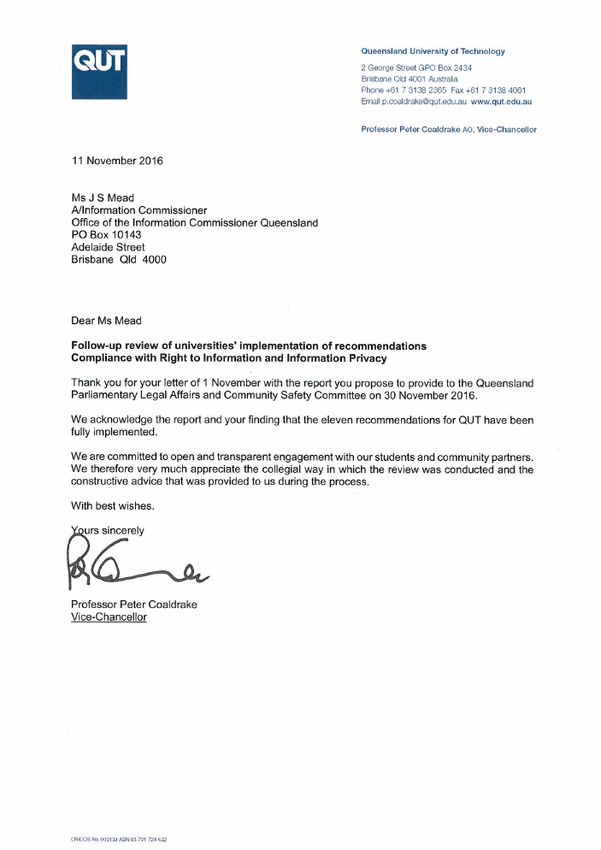
Table of contents

1    Executive summary ........................................................................................ 1
2    Context ............................................................................................................ 3
3    Implementation status of recommendations ............................................... 5
4    Culture of openness ....................................................................................... 9
5    Leadership .................................................................................................... 13
6    Accountability............................................................................................... 18
7    Maximum disclosure .................................................................................... 22
8    Compliance ................................................................................................... 28
Appendix – Comments received........................................................................ 33

1 Executive summary

In November 2014, we (the Office of the Information Commissioner) tabled
‘Compliance Review – Queensland Universities: Griffith University; Queensland
University of Technology; University of Queensland and University of Southern
Queensland. Review of universities’ compliance with the Right to Information Act 2009
(Qld) and Information Privacy Act 2009 (Qld).’

The report assessed the extent to which the four universities were complying with the
requirements of the Right to Information Act 2009 (Qld) (RTI Act) and Information
Privacy Act 2009 (Qld) (IP Act).

Our original review focused on the:

      •   universities’ culture of openness and engagement with the community
      •   leadership within each university to promote proactive release of information
          and good information governance
      •   accountability and performance measurement
      •   strategies adopted to maximise disclosure of information
      •   compliance with specific legislative requirements.

We found that overall, while performance was strong and the universities were
progressing well in meeting their legislative obligations under the RTI Act and IP Act,
there were opportunities for improvement.

We made 13 recommendations in the report to assist the four universities in taking up
these opportunities. Of these recommendations, 10 applied to all four universities, and
three applied to a specific university, making a combined total of 43 recommendations.
This review follows up the progress of the universities in implementing these
recommendations.

1.1       Conclusions
We are pleased to report that the four universities have fully implemented 40 of the 43
recommendations we made in the original review. Their greater maturity in right to
information (RTI) and information privacy (IP) practices strengthens their accountability
and transparency.

    “An open and accessible [information release] regime promotes more open government and
    better community interaction. The more valuable information that the public can access and
    reuse to build knowledge and empower the community, the healthier the Queensland society,
                     economy and environment will become.” (Solomon Report 1).

1The Right to Information – Reviewing Queensland’s Freedom of Information Act, June 2008, accessible
at www.rti.qld.gov.au/__data/assets/pdf_file/0019/107632/solomon-report.pdf.

Office of the Information Commissioner - Report No. 3 to the Queensland Legislative Assembly for 2016-17   Page 1
Figure 1A shows the implementation status of recommendations by university.
                                                   Figure 1A
          Our assessment of the implementation status of recommendations

University                          Total                                    Status

                                                    Fully             Implementation              Partially
                                                implemented             in progress             implemented
Griffith University                   11                9                      0                           2
Queensland University of
                                      11               11                      0                           0
Technology
University of Queensland              10               10                      0                           0
University of Southern
                                      11               10                      1                           0
Queensland
TOTAL                                 43               40                      1                           2
Source: Office of the Information Commissioner

As a result of implementing our recommendations, the universities are able to meet
their RTI and IP obligations more efficiently and effectively.

Their increased ability to manage information as a strategic asset means the
universities can exploit the information they hold to its fullest extent.

We noted that the universities better used strategies for informal release of information,
such as publication schemes and administrative access schemes. They are putting
information into the community faster and are positioning legislative access as the ‘last
resort’ in seeking government information. The universities’ information asset registers
will assist the community to discover the information universities hold. They will also
enable the universities to readily identify data that they could publish.

The four universities have also improved the quality of their RTI and IP awareness
training and broadened its application. This will help staff and decision-makers to
manage, share and use information appropriately.

They have explicitly recognised the value of two-way community engagement to better
understand the information needs of their stakeholders.

Together, these improvements demonstrate the universities’ commitment to a culture
of openness and transparency.

1.2      Reference to agency comments
We provided each university with a copy of this report and a request for comments. We
have considered the universities’ views in reaching our follow-up review conclusions
and have represented them to the extent relevant and warranted in preparing this
report. The comments received are in the appendix of this report.

Office of the Information Commissioner - Report No. 3 to the Queensland Legislative Assembly for 2016-17       Page 2
2 Context 2.1 Background Queensland public universities are agencies for the purposes of the RTI and IP Acts. 2 We commenced a compliance review of Griffith University (Griffith), Queensland University of Technology (QUT), the University of Queensland (UQ) and the University of Southern Queensland (USQ) in late 2013. The resulting Compliance Review – Queensland Universities: Griffith University; Queensland University of Technology; University of Queensland and University of Southern Queensland. Review of universities’ compliance with the Right to Information Act 2009 (Qld) and Information Privacy Act 2009 (Qld). 3 was tabled in Parliament on 27 November 2014. Our original review reported that overall, the universities’ performance was strong and that each university presented particular strengths in different areas. While the review did not find any significant instances of non-compliance with specific legislative requirements, we identified several opportunities for improvement. The report made 13 recommendations. The universities accepted all recommendations, except one recommendation that QUT did not accept. The universities agreed to implement all accepted recommendations by March 2016. 2.2 Follow-up process In June 2016, we asked the four universities to provide a progress report on the implementation status of each recommendation and the actions they took to address the recommendations. We also requested that the universities provide evidence supporting their response. We assessed the progress reports and supporting evidence, and where necessary, performed risk-based checks to gain assurance on the universities’ actions and implementation of the recommendations. Figure 2A shows the ratings we used to assess the implementation status of the recommendations. 2 See section 14(1)(c) of the RTI Act and sections 17 and 18(1)(d) of the IP Act. 3 Accessible at https://www.oic.qld.gov.au/about/our-organisation/key-functions/compliance-and-audit- reports/. Office of the Information Commissioner - Report No. 3 to the Queensland Legislative Assembly for 2016-17 Page 3
Figure 2A
                                    Implementation status ratings

              Rating                                                 Description
Fully implemented                       The agency has adopted                       the     recommendation
                                        substantially or in its entirety.
Implementation in progress              The agency has taken some action to implement the
                                        recommendation and efforts to complete implementation
                                        are ongoing. Included in this rating are those
                                        recommendations about which the agency did not provide
                                        sufficient support evidence to verify the stated actions.
Partially implemented                   The agency has implemented part of the recommendation,
                                        but the intent of the recommendation has not been fully
                                        satisfied.
No action taken                         The agency has not implemented any part of the
                                        recommendation and there is no valid reason for why
                                        action was not taken.
Source: Office of the Information Commissioner

This report presents the implementation progress by university (chapter 3) and by the
broad performance areas (chapters 4 to 8) that we monitor across all agencies in order
to report on agency compliance with the RTI and IP Acts. 4

4For more information about each performance area, please refer to our publication RTI and IP –
Performance Standards and Measures for Agencies, accessible at
https://www.oic.qld.gov.au/__data/assets/excel_doc/0009/7758/policy-performance-standards-and-
measures.xls.

Office of the Information Commissioner - Report No. 3 to the Queensland Legislative Assembly for 2016-17   Page 4
3 Implementation status of recommendations
3.1 Griffith University
Culture of Leadership & Maximum
disclosure Compliance
openness accountability
Develop and Drive proactive Promote Update publication
publish a release of administrative scheme
statement of information access
(Rec 10 –
commitment to through bodies arrangements
Implemented)
community governing
(Rec 7 –
engagement information
Implemented)
about their management
information needs
(Rec 3 –
(Rec 1 – Implemented)
Implemented)
Clarify status of For good practice, Where relevant
right to information adopt an documents have
policy and administrative not been published
procedures access to the disclosure
arrangement for log, ensure
(Rec 4 – Partially
reference checking reasons for non-
implemented)
on promotion to publication are
maximise recorded
disclosure and
(Rec 11 –
streamline
Implemented)
processes
(Rec 8 –
Implemented)
Expand scope and Develop and For good practice,
coverage of publish an contact applicants
general awareness Information Asset if information is to
training about right Register be provided in an
to information and access type other
(Rec 9 –
information privacy than as requested
Implemented)
to all staff
(Rec 12 –
(Rec 5 – Partially Implemented)
implemented)
Improve
performance
measurement
(Rec 6 –
Implemented)
Source: Office of the Information Commissioner
Office of the Information Commissioner - Report No. 3 to the Queensland Legislative Assembly for 2016-17 Page 53.2 Queensland University of Technology
Culture of Leadership & Maximum
openness accountability disclosure Compliance
Develop and Drive proactive Promote Update
publish a statement release of administrative publication
of commitment to information through access scheme
community bodies governing arrangements (Rec 10 –
engagement about information (Rec 7 – Implemented)
their information management Implemented)
needs (Rec 3 –
(Rec 1 – Implemented)
Implemented)
Develop and Include information For good practice, Where relevant
publish a statement management adopt an documents have
of commitment to activities in plans administrative not been
right to information and work programs access published to the
(Rec 2 – (Rec 3 – arrangement for disclosure log,
Implemented) Implemented) reference checking ensure reasons
on promotion to for non-
maximise publication are
disclosure and recorded
streamline (Rec 11 –
processes Implemented)
(Rec 8 –
Implemented)
Promote the use of Update training Develop and For good
administrative modules on right to publish an practice, contact
access information and Information Asset applicants if
arrangements to privacy Register information is to
staff through (Rec 5 – (Rec 9 – be provided in an
training and Implemented) Implemented) access type other
communication than as requested
(Rec 2 – (Rec 12 –
Implemented) Implemented)
Implement plan to
deliver updated
privacy module to
all staff
(Rec 5 –
Implemented)
Improve
performance
measurement
(Rec 6 –
Implemented)
Source: Office of the Information Commissioner
Office of the Information Commissioner - Report No. 3 to the Queensland Legislative Assembly for 2016-17 Page 63.3 University of Queensland
Culture of Leadership & Maximum
accountability Compliance
openness disclosure
Develop and Drive proactive Promote Update publication
publish a release of administrative scheme
statement of information access (Rec 10 –
commitment to through bodies arrangements Implemented)
community governing (Rec 7 –
engagement about information Implemented)
their information management
needs (Rec 3 –
(Rec 1 – Implemented)
Implemented)
Review general For good practice, Where relevant
awareness training adopt an documents have
and incorporate administrative not been published
greater right to access to the disclosure
information content arrangement for log, ensure
(Rec 5 – reference checking reasons for non-
Implemented) on promotion to publication are
maximise recorded
disclosure and (Rec 11 –
streamline Implemented)
processes
(Rec 8 –
Implemented)
Improve Develop and For good practice,
performance publish an contact applicants
measurement Information Asset if information is to
(Rec 6 – Register be provided in an
Implemented) (Rec 9 – access type other
Implemented) than as requested
(Rec 12 –
Implemented)
Source: Office of the Information Commissioner
Office of the Information Commissioner - Report No. 3 to the Queensland Legislative Assembly for 2016-17 Page 73.4 University of Southern Queensland
Culture of Leadership & Maximum Compliance
openness accountability disclosure
Develop and Drive proactive Promote Update publication
publish a release of administrative scheme
statement of information access
(Rec 10 –
commitment to through bodies arrangements
Implemented)
community governing
(Rec 7 –
engagement about information
Implemented)
their information management
needs
(Rec 3 –
(Rec 1 – Implemented)
Implemented)
Include For good practice, Where relevant
information adopt an documents have
management administrative not been published
activities in plans access to the disclosure
and work arrangement for log, ensure
programs reference checking reasons for non-
on promotion to publication are
(Rec 3 –
maximise recorded
Implemented)
disclosure and
(Rec 11 –
streamline
Implemented)
processes
(Rec 8 –
Implemented)
Include right to Develop and For good practice,
information and publish an contact applicants
privacy in Information Asset if information is to
induction Register be provided in an
access type other
(Rec 5 – (Rec 9 –
than as requested
Implemented) Implemented)
(Rec 12 –
Implemented)
Update training For good practice,
modules reduce time to
process
(Rec 5 –
applications
Implemented)
(Rec 13 –
Implemented)
Improve
performance
measurement
(Rec 6 – In
progress)
Source: Office of the Information Commissioner
Office of the Information Commissioner - Report No. 3 to the Queensland Legislative Assembly for 2016-17 Page 84 Culture of openness
Key findings
• Each university has published a policy statement promoting two-way
community engagement about access to university-held information.
• QUT has undertaken multiple activities to raise staff awareness of
administrative access arrangements and the RTI and IP application process.
4.1 Introduction
In our original review, we examined whether the culture of the universities embraced
openness and transparency. This included looking for evidence that each university
explicitly recognised community engagement about releasing information.
When agencies recognise the value of asking the community what information it needs,
they can perform their right to information obligations more effectively. For example,
such engagement can assist an agency to identify information for proactive release, or
opportunities to improve access to information.
The four universities had each addressed community engagement to differing degrees
and in different ways; however, none had a community engagement strategy,
framework, or policy statement about information release. We sought evidence that the
universities had a public statement of commitment to engaging in two-way dialog with
the community about access to university-held information.
Our original review also identified varying levels of awareness and support across
business units at QUT for administrative access arrangements and the RTI and IP
application process. We recommended that QUT take steps to continue to build a
pro-disclosure culture.
Figure 4A shows the implementation status of the recommendations about culture of
openness.
Office of the Information Commissioner - Report No. 3 to the Queensland Legislative Assembly for 2016-17 Page 9Figure 4A
Culture of openness
Recommendation Status
1 All universities develop a broad strategic policy statement
Recommendation
promoting community engagement about access to
fully implemented
university-held information, and publish the policy statement
(all universities)
within 12 months.
2 QUT issue agency wide communications to all business units
within the next three months to reinforce QUT’s commitment to
the right to information, and through training and
Recommendation
communication activities by management, ensure QUT staff
fully implemented
are aware of and operate in accordance with QUT’s
(QUT)
procedures for administrative access and respond
appropriately to requests for information by Governance and
Legal Services, within the next 12 months.
Source: Office of the Information Commissioner
4.2 Conclusions
All four universities are better positioned to understand the information needs of their
stakeholders now that they have explicitly recognised the importance of two-way
community engagement in a published statement of commitment. This will assist the
universities to perform their right to information obligations, including promoting access
to the information they hold.
The training and awareness activities QUT undertook will strengthen a pro-disclosure
culture across the university and support its RTI and IP decision-makers in handling
applications made under the RTI and IP Acts. This in turn will enable quicker
processing times and provide the community with faster access to information.
4.3 Results
The four universities have published a statement of commitment to community
engagement about access to university-held information. For example, figure 4B shows
the statement that UQ added to its Right to Information – Policy. 5
5 Accessible at https://ppl.app.uq.edu.au/content/1.60.01-right-information.
Office of the Information Commissioner - Report No. 3 to the Queensland Legislative Assembly for 2016-17 Page 10Figure 4B
UQ Right to Information - Policy (extract)
The Right to Information Act 2009 reflects government policy that documents should be
made generally available administratively without the need for a formal application. The
University’s continued success as a knowledge leader relies on the forging of strategic
partnerships with key partners and stakeholders. In achieving this, the University will
engage those partners and stakeholders about appropriate access to University-held
information. For that purpose, the University is committed to understand the information
needs of its stakeholders.
Source: University of Queensland
Figure 4C shows the statement that USQ added to its website. 6
Figure 4C
USQ - Our Community Engagement Statement webpage
Source: University of Southern Queensland
6 Accessible at https://www.usq.edu.au/about-usq/engage/community-engagement-statement.
Office of the Information Commissioner - Report No. 3 to the Queensland Legislative Assembly for 2016-17 Page 11QUT undertook a number of training and communications activities to build a
pro-disclosure culture across all business units. For example, a broadcast email from
the QUT Registrar to all staff included a statement about QUT’s commitment to
providing access to information unless there is a public interest reason to refuse.
Governance and Legal Services within QUT implemented a standard search
record/documents retrieval request, modelled on the template provided in our
guideline: Searching for documents, 7 to assist staff in their handling of applications for
information made under the RTI and IP Acts.
QUT also revised its information privacy awareness online training module. The
updated module explained how QUT gives individuals access to information through
formal access applications and administrative access arrangements.
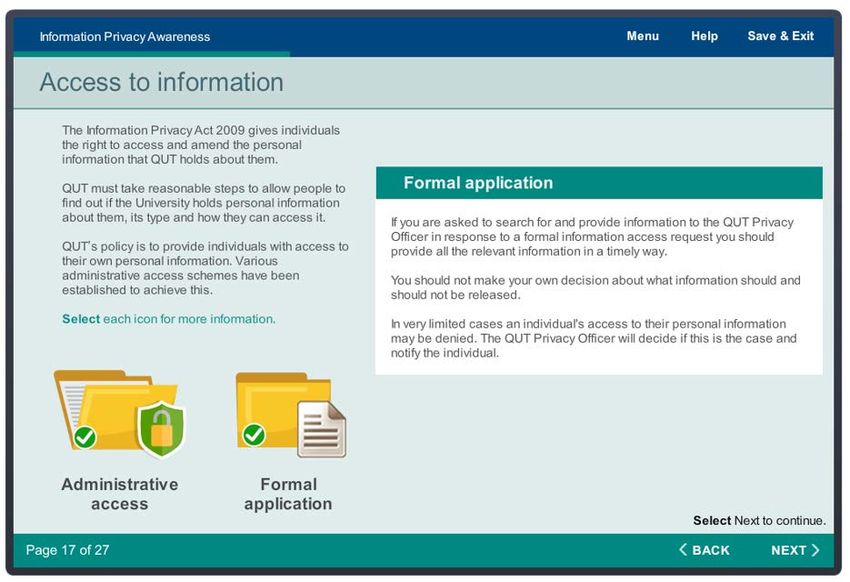
For example, figure 4D shows a page about what action QUT staff should take if asked
to search for and provide information in response to an access application under the
RTI Act or IP Act.
Figure 4D
QUT – Information Privacy Awareness online training module (extract)
Source: Queensland University of Technology
7Accessible at https://www.oic.qld.gov.au/guidelines/for-government/access-and-amendment/processing-
applications/searching-for-documents-process-and-requirements.
Office of the Information Commissioner - Report No. 3 to the Queensland Legislative Assembly for 2016-17 Page 125 Leadership
Key findings
• Each university has implemented strategies to actively monitor and oversee the
proactive release of information.
• Griffith has clarified the status of policy information provided on its privacy
webpage, but has not clarified the status of policy information provided on its
RTI webpage.
• QUT, UQ and USQ updated their RTI and IP training materials to address
feedback from OIC during the original review.
• Griffith updated its IP training module. There was no evidence of amendments
to its RTI training module.
• QUT and USQ added RTI and IP general awareness training into their
mandatory induction program.
5.1 Introduction
In our original review, we examined the universities’ leadership and governance
frameworks, including strategies for good governance, active management of
information, organisational structure, resourcing and training.
Each of the four universities had a committee that was broadly responsible for strategic
information management or information and communications technology (ICT). We
looked at how these committees managed information as a strategic asset. We found
that the universities could adopt strategies for active monitoring and oversight of the
proactive release of information to inform their committees better about progress in
addressing the requirements of the RTI Act.
We also examined whether the universities’ plans or work programs identified or
contained right to information and information privacy initiatives. Griffith and UQ’s
strategic plans and work programs contained information management projects and
activities, whereas QUT and USQ focused on ICT projects. Consequently, we
recommended that QUT and USQ include information management activities in their
plans and work programs.
We assessed the universities’ RTI and IP training materials and recommended the
universities broaden the scope of this material and increase staff participation in
general awareness training.
Office of the Information Commissioner - Report No. 3 to the Queensland Legislative Assembly for 2016-17 Page 13All four universities maintained a publicly available library or manual of their policies
and procedures. The libraries/manuals for UQ, QUT and USQ contained right to
information and information privacy policies and procedures, whereas Griffith’s policy
library contained its privacy plan. Because Griffith had no formal right to information
policy, we recommended that it clarify the status of any existing policy or procedural
information on its RTI webpage, to ensure that people using the website had
confidence that the information provided represents the official policy of the university.
Figure 5A shows the implementation status of the recommendations about leadership.
Figure 5A
Leadership
Recommendation Status
All universities ensure that the responsible bodies governing
Recommendation
information management implement ongoing active monitoring
fully implemented
and oversight of the proactive release of information in
(all universities)
3 accordance with the RTI and IP Acts, within the next 12 months.
QUT and USQ include information management activities in Recommendation
future strategic information management plans and operational fully implemented
work programs, within the next 12 months. (QUT and USQ)
Griffith clarifies the status of policy information provided on its Partially
4 website about right to information policy and procedures, within implemented
12 months. (Griffith)
Griffith expands the scope and coverage of general awareness
Partially
training about right to information and information privacy and
implemented
delivers the updated training to all university staff within 12
(Griffith)
months.
QUT updates its training modules regarding right to information Recommendation
and information privacy and in particular administrative release fully implemented
within 12 months. (QUT)
QUT implements a plan to deliver its updated training module Recommendation
on information privacy to all existing university staff within 12 fully implemented
5 months. (QUT)
UQ reviews its general awareness training programs and Recommendation
incorporates greater content relating to right to information fully implemented
within 12 months. (UQ)
Recommendation
USQ updates training modules regarding right to information
fully implemented
and information privacy within 12 months.
(USQ)
USQ includes information about right to information and Recommendation
information privacy in its induction process for new staff within fully implemented
12 months. (USQ)
Source: Office of the Information Commissioner
Office of the Information Commissioner - Report No. 3 to the Queensland Legislative Assembly for 2016-17 Page 145.2 Conclusions The four universities have improved their management of information as a strategic asset. Their plans and work programs included information management activities to help them monitor the proactive release of information. They have also extended general awareness training in right to information and information privacy and improved the quality of this training. Together, these activities will help to ensure that the four universities exploit the information they hold to its fullest extent, and that staff are supported to manage, share and use information appropriately. 5.3 Results The universities have undertaken a range of activities to ensure the governing bodies responsible for information management actively monitor and oversee the proactive release of information. QUT developed a corporate information asset policy 8 to clarify the roles and responsibilities for information identified as being of value to QUT’s business functions. For example, it allocated responsibility for ‘sharing of the information asset to the maximum extent possible in accordance with data standards and data security’ to the data custodian. UQ expanded the scope of the terms of reference for its information management governance committee by adding the responsibility to ‘Where appropriate, consider data sets that may be suitable for proactive release and make recommendations to the Chief Operating Officer on the University's obligations under the Open Data Strategy for Queensland Universities’. USQ’s ICT Strategy Board endorsed the establishment of a working group that will consider requests to release datasets. The working group will also look at how the university already releases information - for example, under legislative and administrative access schemes - to guide them in their considerations. The ICT Strategy Board has oversight of the working group’s considerations through half-yearly reporting. USQ and QUT addressed information management activities in their strategic plans and work programs. 8 Accessible at http://www.mopp.qut.edu.au/F/F_01_09.jsp. Office of the Information Commissioner - Report No. 3 to the Queensland Legislative Assembly for 2016-17 Page 15
For example, USQ’s Enterprise ICT Plan 2016 – 2020 includes activities specifically
aimed at increasing the availability and accessibility of information, such as:

    •    identify and eliminate barriers to information access and promote openness of
         data internally

    •    enhance capacity for data collection to inform training and digital fluency needs
         identification over time.

QUT’s Governance and Legal Services Operational Plan 2016 identified key
operational priorities for 2016, including the progressive rollout of committee portals as
an efficient means of promulgating committee information and supporting committee
business.

We assessed Griffith’s implementation of recommendation four as partially
implemented. While Griffith updated its privacy webpage to state that it had
promulgated its privacy plan as university policy, there was no equivalent statement
about existing policy or procedural information on its right to information webpage.
Updating the right to information landing page with the status of policy or procedural
information provided on that page would implement this recommendation in full.
Alternatively, Griffith could fully implement this recommendation by including a right to
information policy in its policy library.

QUT, UQ and USQ updated their training material to address the feedback provided in
our original review. QUT and USQ also addressed specific recommendations to
expand the extent to which they provide training by including RTI and IP training in
mandatory induction training.

We assessed that Griffith had partially implemented this recommendation. While it has
expanded the scope of its general awareness training on information privacy, it did not
provide evidence showing similar improvements to its general awareness training on
right to information.

QUT, as part of a broader training review, implemented a framework to deliver
improved online training. Improvements included better design and graphics, the ability
to define a target audience and frequency, and automated reporting on completion
rates.

Figure 5B provides an example of the design and graphics used on the menu screen of
QUT’s Information Privacy Awareness online training module.

Office of the Information Commissioner - Report No. 3 to the Queensland Legislative Assembly for 2016-17   Page 16
Figure 5B
QUT – Information Privacy Awareness online training module
Source: Queensland University of Technology
QUT staff are required to complete the Information Privacy Awareness online training
module if their length of employment is two months or more, and the number of hours
worked per week is 10 hours or more.
Refresher training will occur every two years. Ongoing and fixed-term staff receive
automated emails with one month’s notice of required training they are due to
complete. Staff and their supervisor receive a reminder email if the staff member has
not completed the training within one month of its scheduled completion date.
Office of the Information Commissioner - Report No. 3 to the Queensland Legislative Assembly for 2016-17 Page 176 Accountability
Key findings
• Griffith, QUT and UQ have developed performance measures to monitor their
RTI and IP functions at the operational and strategic level.
• USQ is collecting data that it can use to inform the development of operational
performance measures.
6.1 Introduction
Our original review examined the universities’ systems for monitoring the effectiveness
and efficiency of its RTI and IP operations. We found evidence of performance
measurement at the operational level across all four universities, and project based
performance measures at the strategic level at Griffith and UQ.
We recommended that the universities develop a holistic suite of performance
measures to ensure ongoing monitoring of right to information and information privacy.
This will assist the universities to identify improvements they could make to increase
the proactive release of information and protection of personal information.
Figure 6A shows the implementation status of the recommendations about
accountability.
Figure 6A
Accountability
Recommendation Status
Recommendation
fully implemented
All universities, within 15 months, develop and incorporate
performance measures and targets at the strategic and (Griffith, QUT and
6 operational level to measure effectiveness and efficiency in UQ)
implementing right to information and information privacy Implementation in
processes. progress
(USQ)
Source: Office of the Information Commissioner
Office of the Information Commissioner - Report No. 3 to the Queensland Legislative Assembly for 2016-17 Page 186.2 Conclusions
Since our original review, Griffith, QUT and UQ have established a review program, or
included performance measures in strategic and operational plans, to monitor and
report on the performance of their RTI and IP functions. USQ is collecting data that will
provide a solid foundation from which to undertake further work in identifying suitable
performance measures and targets.
These activities have placed the universities in a better position to sustain a culture of
accountability for performance and continuous improvement in their RTI and IP
functions.
The universities’ analysis of the performance information means they can identify and
implement improvements about proactive and administrative release of information and
protection of personal information. This will benefit the community, create value, and
influence trust and confidence in the universities’ products, services and policies.
6.3 Results
Griffith, QUT and UQ have established a review program or included performance
measures at a strategic or operational level to monitor and improve their compliance
with the RTI and IP Acts. USQ’s implementation of this recommendation is in progress.
Integrating suitable performance measures and targets into its annual planning
process, together with ongoing status reports on RTI and IP projects to the governance
committee, would implement this recommendation in full.
QUT incorporated performance measures and targets into its annual operational plan
for Governance and Legal Services, the unit responsible for RTI and IP functions.
There was a strong focus on maximum disclosure of information to the community and
compliance with the legislative requirements of the RTI and IP Acts. The plan included
operational priorities for 2016, as well as medium term three-year goals.
Examples of performance indicators included:
• completion of the online RTI and IP induction training module
• review of RTI and IP policies, procedures, resources and manuals
• review of student collection notice
• review of communications to staff promoting greater awareness of RTI
processes.
Office of the Information Commissioner - Report No. 3 to the Queensland Legislative Assembly for 2016-17 Page 19UQ developed a ‘RTI and IP Performance Measures Compliance Program’ based on
the performance areas described in our guideline: How to review and measure your
agency’s progress in implementing RTI and IP. 9 Griffith also incorporated our guideline
into its annual assessment of how well the university is meeting its legislative
obligations.
It is encouraging to note the value that Griffith places on compliance with its legislative
obligations in its Griffith University Compliance Framework 10, as shown in figure 6B.
Figure 6B
Griffith University Compliance Framework (extract)
2. COMPLIANCE PROGRAM
The University's compliance program is an important element of the University's
corporate governance framework.
The compliance program aims to prevent, and where necessary, identify and
respond to, noncompliance with the University's obligations under laws,
regulations, codes and its own organisational standards. An important priority
for the compliance program is to encourage a culture of valuing compliance
with obligations, consistent with the profile of a good corporate citizen.
The compliance program's general aims are pursued through the following key
elements:
identification and management of the University's legal obligations in the
Register of Compliance Obligations;
allocation of responsibility to the relevant operational areas for ensuring
compliance with obligations;
the assessment of how well the University meets its obligations, and where
and how it could improve, including identification of any non-compliance
and remedial action taken;
promotion and training to staff and management on the importance of
compliance with specific obligations, as well as commitment to compliance
as an organisational value in line with the University's Code of Conduct.
Source: Griffith University
We assessed USQ’s implementation of the recommendation as in progress. It
broadened the operational reporting to its Audit and Risk Committee to include
activities such as administrative access requests, privacy impact assessments,
enquiries and outsourcing arrangements. Figure 6C shows the information privacy
activities that USQ reports to its Audit and Risk Committee11.
9 Accessible at https://www.oic.qld.gov.au/guidelines/for-government/access-and-amendment/proactive-
disclosure/measuring-progress-on-rti-implementation.
10 Accessible at http://policies.griffith.edu.au/pdf/Compliance%20Framework.pdf.
11 Noting USQ’s advice that it is planning to refine this reporting process, which may result in changes.
Office of the Information Commissioner - Report No. 3 to the Queensland Legislative Assembly for 2016-17 Page 20Figure 6C
USQ Information Privacy Report to the Audit and Risk Committee (extract)
Source: University of Southern Queensland
The Audit and Risk Committee also received strategic performance information in
these reports, such as status updates on USQ’s implementation of the
recommendations from our original review.
USQ could use this information, together with the half-yearly reports provided to the
ICT Strategy Board about requests to release USQ datasets, to inform the selection of
suitable performance measures and targets for inclusion in its annual plans and work
programs. Reporting on these measures, and continuing to provide its governance
committee with status updates of RTI and IP projects, such as those listed in USQ’s
Enterprise ICT Plan 2016 – 2020, would implement this recommendation in full.
Office of the Information Commissioner - Report No. 3 to the Queensland Legislative Assembly for 2016-17 Page 217 Maximum disclosure
Key findings
• Each university’s website provided easily accessible information about
administrative access arrangements.
• All four universities have considered developing formal administrative access
arrangements for making referee reports available to applicants for promotion.
• Each university has published an Information Asset Register on its website, and
developed procedures for maintaining the register.
7.1 Introduction
Our original review examined two strategies for routine and proactive disclosure of
information to the public: fast tracking the provision of information through
administrative access, and leveraging online information delivery.
Documented processes for the administrative release of certain information not only
allow the community to understand how administrative access works in the agency, but
also increase the confidence of agency staff to release information.
In our original review, we found that the visibility of available administrative access
arrangements online was an issue. We also identified that requests to access referee
reports arising out of the academic promotion process was a common application type
and recommended that the universities adopt procedures to streamline processing
requests of this type.
We reported that the universities did not maintain publicly available Information Asset
Registers online. This meant that the community might find it difficult to discover what
information the university holds.
Figure 7A shows the implementation status of the recommendations about maximum
disclosure.
Office of the Information Commissioner - Report No. 3 to the Queensland Legislative Assembly for 2016-17 Page 22Figure 7A
Maximum disclosure
Recommendation Status
All universities ensure that administrative access Recommendation
7 arrangements are made more prominent on the universities’ fully implemented
websites within 12 months. (all universities)
All universities, as a matter of good practice, consider
developing an administrative access arrangement for
Recommendation
making referee reports available to applicants for promotion,
8 fully implemented
and adopt procedures that maximise disclosure and
(all universities)
streamline handling of any requests by applicants to obtain
referee reports, within 12 months.
All universities develop an Information Asset Register within
12 months, along with procedures to ensure the Information
Recommendation
Asset Register is maintained.
9 fully implemented
All universities publish their Information Asset Register on
(all universities)
the website to create greater transparency as to the
information resources available, within 12 months.
Source: Office of the Information Commissioner
7.2 Conclusions
The four universities have made their administrative access arrangements more visible
online. This will help raise internal and external awareness of the options available for
obtaining information held by the universities.
The publication of an online information asset register by each university will
encourage access to, and reuse of, information. It will also assist the universities to
avoid any unnecessary duplication of information.
Together, these improvements will support the universities to make the maximum
amount of information available to the community efficiently and economically.
7.3 Results
The four universities have increased the visibility of their administrative access
arrangements on their websites. QUT, UQ and USQ websites provided information
about the types of information available for release under formal administrative access
arrangements, such as academic transcripts. This information was accessible from the
RTI webpage and from the relevant policies and procedures. It is encouraging to note
that we were able to locate this information more easily than in our original review.
Office of the Information Commissioner - Report No. 3 to the Queensland Legislative Assembly for 2016-17 Page 23Griffith’s website clearly promoted administrative release as the simplest means by
which an individual might access information. Its website stated the timeframe in which
Griffith would generally decide whether to release the requested documents
administratively.
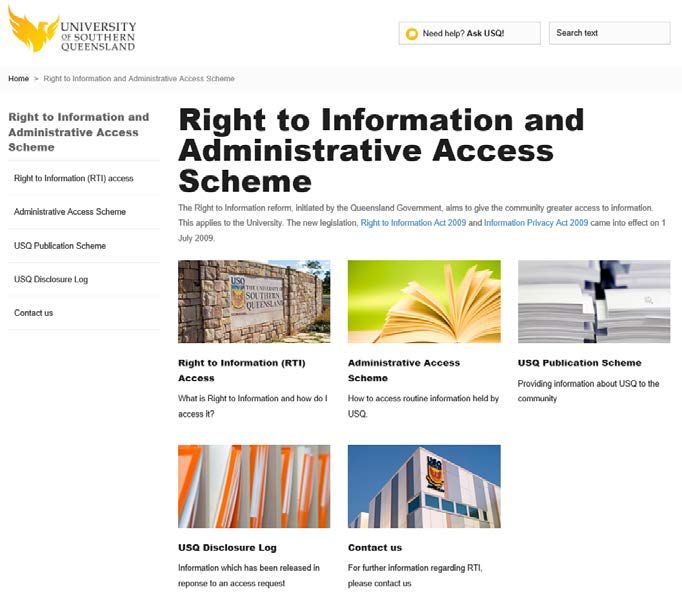
USQ’s administrative access arrangements were particularly prominent. As shown in
figure 7B, the availability of administrative access was visible in the webpage title,
navigation pane and in the images used as links in the body of the webpage.
Figure 7B
USQ – Right to Information and Administrative Access Scheme webpage 12
Source: University of Southern Queensland
All four universities considered developing a formal access arrangement for referee
reports arising out of the academic promotion process. Key factors they considered
included the volume of RTI applications received for this type of referee report, and the
efficiency of existing practices in handling requests of this nature.
UQ and USQ developed a formal access arrangement to provide applicants for
academic promotion with access to referee reports. Their websites contained details of
the arrangements.
Figure 7C shows UQ’s administrative access arrangement, as set out in its Right to
Information – Procedures 13.
12 Accessible at http://www.usq.edu.au/right-to-information.
Office of the Information Commissioner - Report No. 3 to the Queensland Legislative Assembly for 2016-17 Page 24Figure 7C
UQ – Right to Information – Procedures (extract)
5.2 Access to referee reports for continuing appointment and
promotion of academic staff levels A-D
Academic staff who have applied for confirmation of continuing appointment
or promotion (excluding professorial confirmation and promotion) are
permitted access to referee reports, only where the referee has agreed to
the release of the report to the staff member. To access the referee reports,
the staff member must:
• lodge a written request to the Right to Information and Privacy Office via
email to rtip@uq.edu.au
• specify the reports requested
• include a copy of the applicant's staff card.
The application will normally be processed within 15 business days and
access to the reports will be provided electronically to the nominated email
address or by collection on CD from the Right to Information and Privacy
Office.
Applications seeking access to a) referee reports where the referee has not
consented to the disclosure of the report to the staff member or b) other
documents relating to an application for confirmation of continuing
appointment or promotion must be made under the Information Privacy Act
2009.
Source: University of Queensland
In its response to the original review, QUT did not agree to developing a formal access
arrangement for referee reports because it had received no requests for records of this
nature in 10 years. However, we assessed that QUT has fully implemented this
recommendation. It has embedded the proactive release of the report containing an
evaluation of the applicant’s suitability for promotion to the respective applicant in its
policy B/5.3 Promotion for academic staff.
All four universities have published an Information Asset Register (IAR) on their
websites, and documented formal processes for its maintenance. The registers
contained on average 46 datasets, and were easy to locate using the website search
function.
Each university has taken steps to increase the visibility of its IAR. All four universities
added a link to the ‘Our Lists’ class in the publication scheme; and one university
added a link to its RTI webpage.
13 Accessible at http://ppl.app.uq.edu.au/content/1.60.01-right-information.
Office of the Information Commissioner - Report No. 3 to the Queensland Legislative Assembly for 2016-17 Page 25The level of detail about the datasets varied between universities 14. At a minimum,
each university described its datasets, most typically grouped into key functions.
Griffith detailed the dataset’s owner, custodian, security classification, access rights,
keywords and creation date. Similarly, USQ published additional details about the
system owner, business process supported by the dataset and the dataset’s source
system.
The usability of the IARs varied. The universities presented the information differently:
by means of an online tool, expand/collapse headings, a table, or Adobe Portable
Document Format (PDF) 15. Figure 7D shows Griffith’s register. 16 It had multiple search
options, such as the ability to select from an alphabetical list, apply filters or conduct a
full text search.
Figure 7D
Griffith - Information Asset Register
Source: Griffith University
Each university provided contact details for enquiries about its IAR. A good practice
noted in two registers was an explicit statement of how the community could request
access to the listed datasets.
14 Please see the Queensland Government Enterprise Architecture Information asset register guideline,
accessible at https://www.qgcio.qld.gov.au/images/documents/QGEA_documents/Information-asset-
register-v200-publish.docx, for advice on content typically captured in an information asset register.
15 PDF is a file format developed by Adobe for sharing electronic documents. PDF files preserve and
protect the content and layout of a document, regardless of the software, hardware or operating system
used to view or print the document. However, it can be challenging to reuse information within a PDF
document, as the content cannot be easily manipulated.
16 Accessible at https://www.griffith.edu.au/about-griffith/governance/right-to-information/information-asset-
register.
Office of the Information Commissioner - Report No. 3 to the Queensland Legislative Assembly for 2016-17 Page 26Griffith, QUT 17 and USQ 18 developed a policy, procedure or guideline setting out roles
and responsibilities for managing their IARs, including an annual review for currency
and accuracy. UQ incorporated maintenance of its register into its ‘RTI and IP
Performance Measures and Compliance Program’. This program included a review of
the IAR every two years as a measure of its proactive release of information.
A good practice noted at Griffith was to embed processes into its standard project
initiation templates and solution architecture reviews 19 for updating the register when a
business process or system creates or uses a new dataset.
The universities have devoted considerable time and resources to developing their
IARs. It is encouraging to see their commitment to regular reviews and growth of their
registers. Examples of activities include:
• engaging a consultant to assist in the development of an Information Asset
Management Framework
• appointing a project manager to implement the IAR and system to appropriately
manage the use of corporate information within the university
• initiating a project to identify corporate information asset held at faculty level,
assign roles for these information assets and further populate the IAR
• procuring specialist taxonomy software 20 to assist in the ongoing management
of the IAR
• delivering face-to-face training and workshops for data custodians and system
administrators
• developing a project plan for the continued population of the IAR.
17 QUT F/6.3 Access to information policy, accessible at http://www.mopp.qut.edu.au/F/F_06_03.jsp.
18 USQ Information Asset and Security Classification Procedures, accessible at
http://policy.usq.edu.au/documents/13931PL.
19 A solution architecture review ensures that solutions in development or being delivered to solve a
business problem comply with the current and future structure and behaviour for an organisation's
processes, information, applications, technology and human resources.
20 Taxonomy software is a tool that is used to create and maintain a classification scheme structure, and
then assign each piece of content a place in that structure.
Office of the Information Commissioner - Report No. 3 to the Queensland Legislative Assembly for 2016-17 Page 278 Compliance
Key findings
• The four universities have addressed all feedback that we provided on their
publication schemes during our original review.
• Each university has amended its processes so that it records decisions not to
publish information released under the RTI Act to the disclosure log.
• Each university has amended its processes to include contacting applicants
where it is not possible to provide access in the format requested and negotiate
an alternate access type.
• USQ reduced the average time to process an access application from 46.4
business days to 17 business days.
8.1 Introduction
Our original review looked at whether the universities were complying with legislative
requirements for publication schemes and disclosure logs. We also looked at the
universities’ application processing and personal information handling practices.
We found that the universities could include more information in their publication
schemes and the terms on which this information is available. In addition, the
universities were not routinely recording their decisions about not publishing
information to the disclosure log.
The original review noted instances at three universities where they did not provide
access in the type requested by the applicant, and there was no evidence on file of a
discussion with the applicant as to whether or not the alternative access type was
suitable. We also recommended that USQ take action to reduce the length of time it
takes to process applications.
Figure 8A shows the implementation status of the recommendations about compliance.
Office of the Information Commissioner - Report No. 3 to the Queensland Legislative Assembly for 2016-17 Page 28Figure 8A
Compliance
Recommendation Status
Recommendation
All universities review and update their publication schemes
10 fully implemented
to meet compliance requirements within 12 months.
(all universities)
All universities document any decision not to publish
information released under the RTI Act to the agency’s Recommendation
11 disclosure log, and retain the reasons for the decisions in fully implemented
internal records in accordance with the Ministerial (all universities)
Guidelines, commencing immediately.
All universities, as a matter of good practice, ensure that if it
is necessary to provide information in an alternative access
Recommendation
type (for example, provide information by compact disc
12 fully implemented
rather than a hard copy) the applicant is first contacted to
(all universities)
negotiate how access will be provided, commencing
immediately.
Recommendation
USQ, as a matter of good practice, takes action to reduce
13 fully implemented
the time taken to process applications within 12 months.
(USQ)
Source: Office of the Information Commissioner
8.2 Conclusions
The four universities are making better use of push model strategies, such as
publication schemes, to make information available to the community. These actions
support the community’s access to information and show the universities’ commitment
to transparency and accountability.
The universities’ improvements to application handling practices means applicants will
have faster and easier access to information.
8.3 Results
In our original review, we issued a detailed list of findings to each university about
improving the administration of their publication schemes. Common opportunities for
improvement included populating the publication scheme with as much significant,
appropriate and accurate information as possible, and giving further advice about the
terms on which the university will make information available.
Office of the Information Commissioner - Report No. 3 to the Queensland Legislative Assembly for 2016-17 Page 29You can also read


