TAKING CONTROL? RUSSIA - Reporter ohne Grenzen
←
→
Page content transcription
If your browser does not render page correctly, please read the page content below
TAKING
CONTROL?
INTERNET CENSORSHIP
AND SURVEILLANCE IN

RUSSIA
A digital version of this report with links and references can be found online:
                        www.reporter-ohne-grenzen.de/russiareport

A REPORT BY REPORTERS WITHOUT BORDERS/ NOVEMBER 2019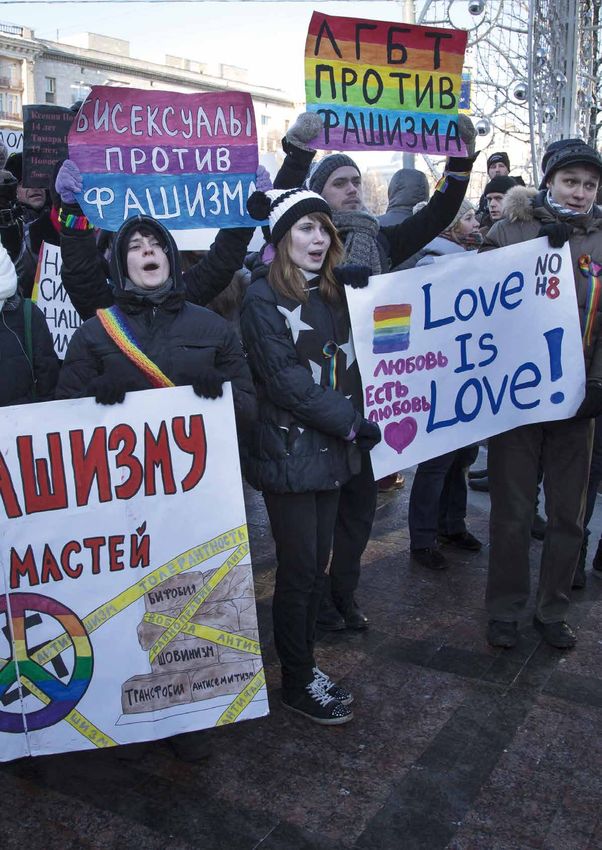
© pixabay

             TABLE OF CONTENTS

            Preface                                                       5

                                                                              3
            1 Overview                                                    6

            2 Laws restricting press freedom and freedom of expression   10
              Chronology from 2012 to 2019

            3 Changes of ownership and dismissals                        23
              Editorial departments under pressure

            4 Courageous and committed                                   32
              The diversity of Russian online media

            5 Arbitrary and severe penalties                             45
              Every user risks prosecution

            6 The intelligence service is reading right along            56
              The fight against anonymous communication

            7 Pressure on internet companies                             66
              The crucial role of international platforms

            8 Recommendations                                            74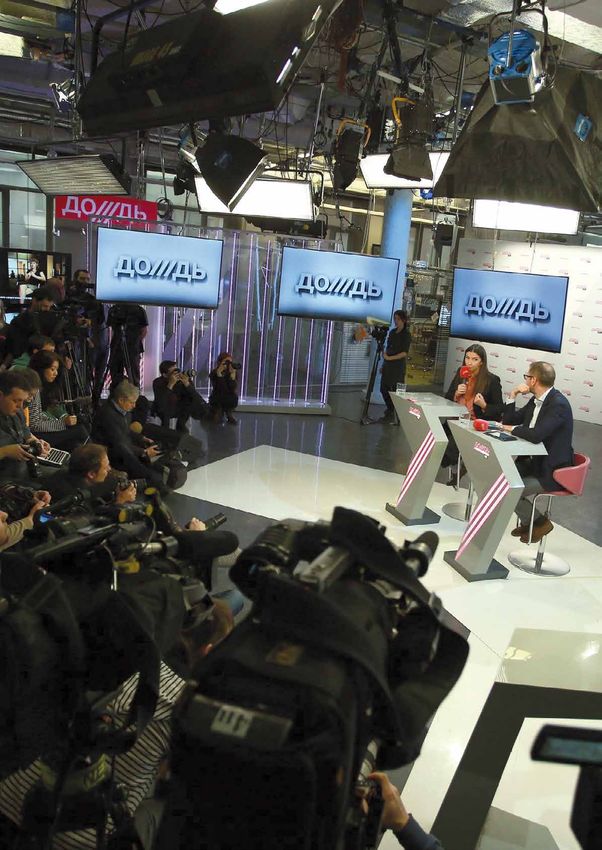
PREFACE
Today the internet is thought to be a strategically crucial sector in Russian politics
although for a long time those in power in the Kremlin did not recognise its
importance. Ten years ago, the virtual space in Russia was still a place where lively
debates about problems in society and politics unfolded. In the future, it is 5
planned to be censored and surveilled centrally, according to Russia’s new “sovereign
internet law”.
The present report traces the development from the first bans on content in 2012
to the present day. It shows how critical editorial teams are put under pressure
and how the authorities attempt to silence individual journalists and bloggers. It
provides information about new online media that report on societal ills against all
odds, and it raises the question about the relevance of international platforms
for the freedom of expression in Russia.
This report is based on about 30 interviews with journalists and activists, lawyers
and human rights defenders conducted by Reporters Without Borders (RSF)
Germany press officer Ulrike Gruska and RSF Germany board member Gemma
Pörzgen in Moscow and Berlin. We would like to thank the interviewees for their
openness and patience when explaining the political and technical backgrounds of
the internet censorship in Russia to us. It was only with their help that we have been
able to comprehensively portray the situation in Russia, which is ranked 149th of
180 countries in RSF’s 2019 World Press Freedom Index.
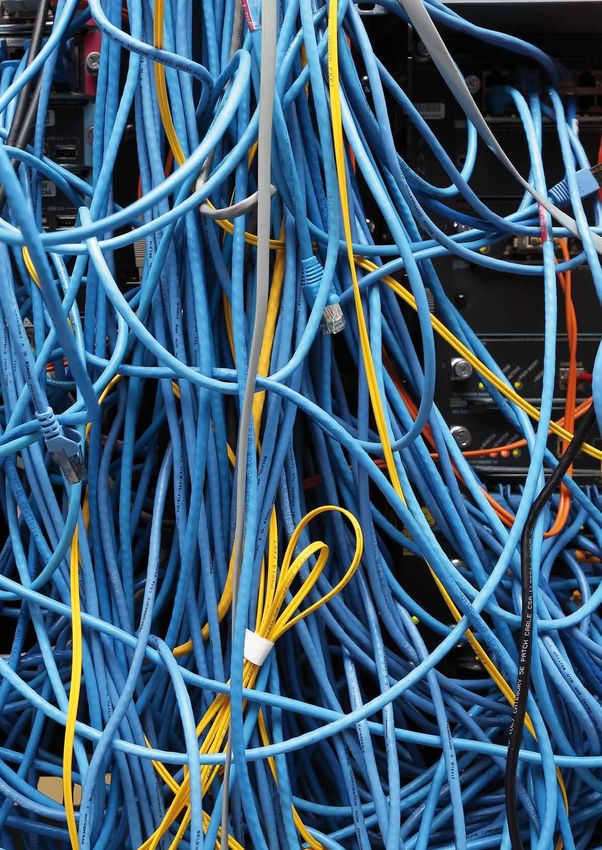
Nothing remains hidden
from the Kremlin: the
human rights organisation
Roskomsvoboda used
this image to illustrate
the news of a law
banning anonymous
communications via
messaging services.
© Roskomsvoboda / image
section / CC BY 4.0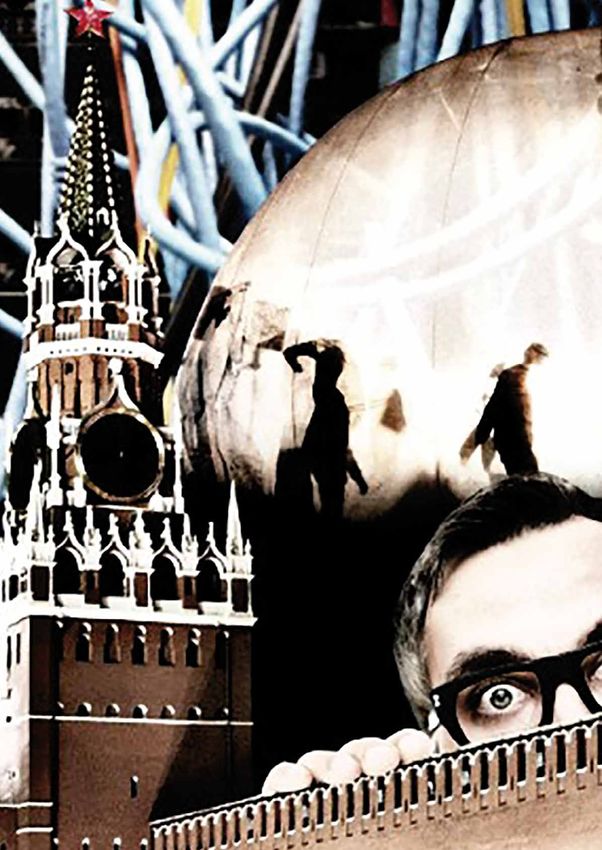
OVERVIEW

                           Regulation of the Russian internet began in 2012, initially mostly in reaction to
                           domestic events. Up until then, the government had taken little notice of political
                           debates in the virtual space–after all, its power had been supported reliably by the
                       $   state-controlled television channels for decades. They were the main sources of
  Internet censorship in
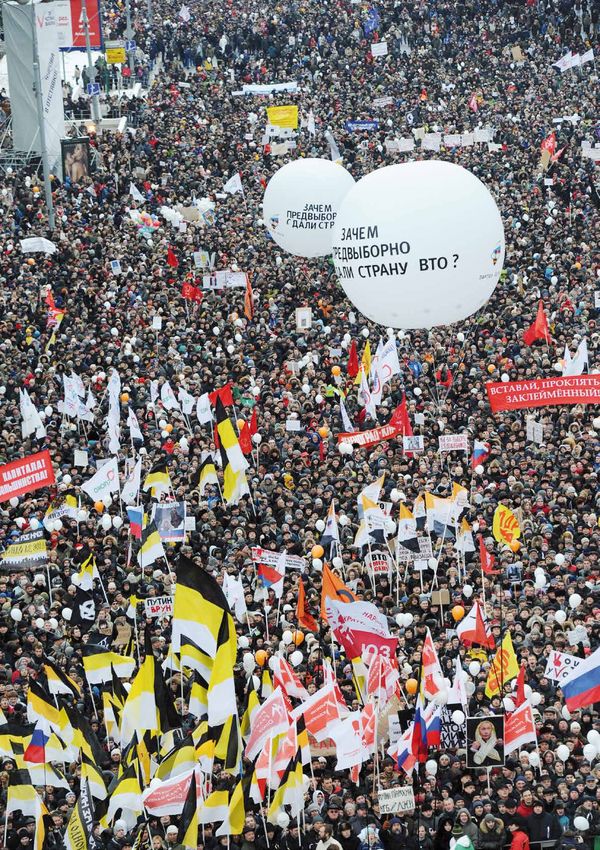
Russia began during the    information for the majority of the population. But the discontented members of the
     2011/12 protests.     public who in the winter of 2011/12 gathered for the biggest demonstrations since
          © RSF Germany    the end of the Soviet Union no longer believed what they saw on television.
ONLINE MEDIA INSTEAD OF TV NEWS
Television is losing influence in Russia as more and more people get their information
on the internet. This is documented by a study published by the Levada Centre, an
independent polling agency, in August 2019: ten years ago, 94 percent of Russians
obtained their information about domestic and international politics mostly from
television, but that number has dropped to only 72 percent. People under 35 in
particular tend to learn about current events through social networks and online
media. According to the study, television has lost much of its credibility: over half the
population think that TV reporting in particular on business and economics does not
correspond to reality. The share of those who regularly watch the state-controlled
Pervyy Kanal (English: Channel One) has decreased from 72 percent (March 2018)
to 47 percent (March 2019) within a year, while one third of the population regularly       7
follow video blogs (even as many as two thirds among 18 to 25-year-olds). Trust in
online media and social networks is growing; 56 percent of the population (85 percent
of 18- to 25-year-olds) use social media daily or multiple times per week. The number
of those using messaging services for text messages or phone calls has doubled
in the past three years, according to the study: from 31 percent of the population
(2016) to 62 percent. The trend towards greater use of online services and media
is also reflected in the development of the Russian advertising market: 2018 was
the first year in which businesses invested more money in advertising on the internet
(approx. Rb 203 billion, €2.8 billion) than on television (approx. Rb 187 billion, €2.57
billion). The internet is also the fastest growing advertising sector (22 percent growth
compared to 2017), while growth in TV advertising is slowing.

Across the country, tens of thousands protested against election fraud and against
Vladimir Putin, who was becoming president for the third time. They organised their
protests online, using Facebook and its Russian equivalent VKontakte to arrange
rallies. They documented irregularities during the parliamentary election on December
4th 2011 and published live videos from polling stations on the website of the
Russian human rights organisation Golos. They used social media to raise money for
protests and exchanged information about individuals who had been arrested. The
demonstrations were the top news story in critical online media for months.

The state leadership was completely unprepared for the enormous impact of this
decentralised protest movement organised online–and it reacted promptly: just one
month after Putin had begun his third term, the Russian parliament discussed a law,
in its first reading, introducing a blacklist of websites that were to be blocked. It was
used to ban various content in the following years: articles presenting homosexuality
as normal, blog posts that allegedly offend religious sentiments or call for extremism
and posts using swearwords. The state’s media regulator Roskomnadzor was
granted the right to block websites without a court order.
At the same time, the editorial departments of media critical of the Kremlin were
A live broadcast of Putin’s targeted and put under pressure. Besides popular news websites, this had a
annual press conference
particular impact on the liberal business media, whose investigative research on
© dpa
politically explosive topics had found a broad online readership. The authorities
also cracked down on individual users who did not take the officially desired view:
from 2015 to 2018, several hundred people per year were subjected to criminal
prosecution because of their online activities and dozens were sentenced to prison.
The victims of prosecution are not only media professionals or politically active
bloggers. Even people who simply forward images or texts or click on “like” in the
wrong place may end up in prison.
The foreign policy developments surrounding Euromaidan in Kiev, the war in eastern
Ukraine and the annexation of Crimea in 2014 were an important turning point.
It exacerbated the confrontation with the EU and the United States and, from
the perspective of the Russian government, it also increasingly made the internet
a battleground. Time and again, the media reported about a “troll factory” in St.
Petersburg that allegedly coordinated targeted disinformation campaigns in Ukraine
and beyond. Pro-Kremlin comments flooded discussion forums and news pages
in various countries. In return, NATO declared cyber-attacks to be an integral part
of military conflicts. The United States toughened its cyber strategy in the autumn
of 2018, calling Russia one of its main strategic adversaries. Russia’s “sovereign
internet law” was introduced to parliament in late 2018 as a direct reaction to the
new American cyber strategy, yet its origins can be traced back to the beginning of
the Ukraine crisis.
Since 2018, the Russian authorities have increasingly been focusing their attention
on international platforms such as Google, Facebook and Twitter. They are required
by law to remove content banned in Russia and to store Russian citizens’ personal
data exclusively on servers in Russia. For a long time, the authorities merely issued
verbal threats if these laws were not obeyed. Now, however, fines are imposed and
laws made more stringent to allow penalties running into millions. While Google is
partly cooperating with the authorities, Twitter and Facebook have refused to do so.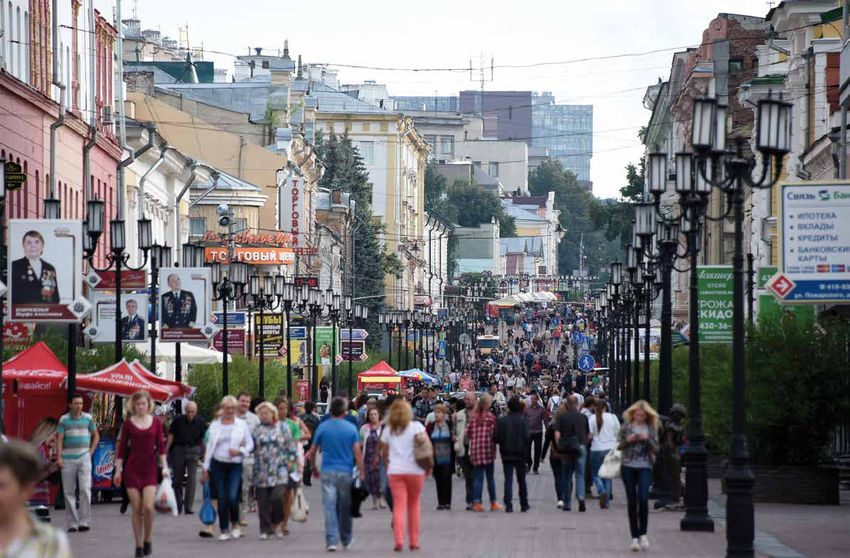
In 2019, many of the developments described in this report reached an all-time high.
Russia’s “sovereign internet law”, adopted in May, takes internet censorship in Russia
to a new level: the government is attempting to gain control over the infrastructure
of the web. It is seeking to block content, and surveil communication more effectively
and, if necessary, be able to cut the Russian internet off from the worldwide web. In
the spring, thousands of people protested against this law and for the freedom of the
internet. In the summer, tens of thousands took to the streets for a greater voice in
politics. Hundreds of demonstrators were arrested and quite a few were sentenced
to prison. At the same time, independent online media and civil society organisations’
information portals that resist the Kremlin’s dictates experienced an unimagined
wave of support.

                                                                                          9

 THE DIGITAL ECONOMY IS BOOMING
Using apps to pay for parking, make a doctor’s appointment or settle the bill in a
restaurant is commonplace for people in major Russian cities. Free Wi-Fi is available
in most public places, certainly in hotels and restaurants and even dozens of metres
below ground on the Moscow Metro. Network infrastructure is well developed,
broadband internet is the norm in big cities. At least for mobile internet, prices
are among the lowest worldwide since a large number of Russian mobile network
operators are competing for customers seeking fast and cheap mobile internet
service for their smartphones or tablets. More than three quarters of the population in
Russia are online regularly, the Russian Association for Electronic Communications
(RAEC) estimates the number of active internet users to be roughly 93 million.
In 2018, the digital economy accounted for roughly 4 percent of Russia’s gross
domestic product (Rb 3.9 trillion, approx. €54 billion)–an increase of 11 percent
compared to the previous year, and the upward trend is continuing. The digital
sector, particularly online retailing, is growing many times faster than other sectors
of the economy; Russian companies have great hopes for exports in particular. “The
digital economy is one of the most successful sectors of the Russian economy”,
Dmitry Kononenko of the German-Russian Chamber of Foreign Trade told RSF.
“E-commerce grew by 60 percent last year and Russian software is on its way to
becoming the sixth largest export product.” Hence the state’s efforts to increasingly
control and restrict its citizens’ internet traffic, are endangering precisely that
segment of the economy in which Russian companies are competitive internationally.
LAWS RESTRICTING
PRESS FREEDOM AND
FREEDOM OF EXPRESSION
CHRONOLOGY FROM 2012 TO 2019
Introduced in 1991, shortly after the collapse of the Soviet Union, Russia’s
Law on Mass Media was widely regarded as one of the most progressive
in Europe at the time. It bans all forms of censorship and guarantees the
freedom to establish private mass media. But since the widespread protests
of 2011/12, the Russian parliament has passed a number of laws that restrict
journalists’ work and internet users’ freedom of expression. These laws
prohibit certain types of content, step up surveillance and state control over
internet infrastructure, and limit the influence of foreign media companies.
Many of them were hastily drafted and are legally flawed, or they apply to
circumstances that are already dealt with elsewhere. In many cases, the
regulations are vaguely worded and open to interpretation. As a result, they
can be used to suppress unwanted reporting or discussion on social media
and to impose penalties arbitrarily.

Blacklist of websites subject to blocking
Federal Law No. 139-FZ of July 28th 2012,1 which entered into force on November
1st 2012, introduced a blacklist of websites and URLs subject to blocking. The list,
which is also known as the Unified Register of Prohibited Sites or single register,
is managed by Roskomnadzor, the Russian state’s media regulator, and is not
accessible to the public. Once a website appears in the register, Roskomnadzor
instructs the site’s hosting provider or the owner of the social network or website
to remove the relevant material. If the material is not removed, all internet providers
in the country are required to block access to the site. According to the Russian
human rights organisation Roskomsvoboda, at the beginning of November 2019 the
register contained more than 290,000 entries.

_____

1
  Unless otherwise stated, the dates in this chapter refer to the day the legislation in question was signed into law by
President Vladimir Putin–the final stage in the legislative process before publication of the law.
11

An LGBT demonstration
in Moscow in 2014
© picture alliance / AP Photo
ROSKOMNADZOR: THE STATE’S MEDIA REGULATOR
Roskomnadzor, the Federal Service for Supervision of Communications, Information
Technology and Mass Media, is the Russian supervisory authority responsible for
mass media, telecommunications and data protection. It was established in 2008
and has been headed by Alexander Zharov since May 2012–which was when
Vladimir Putin’s third term as Russian president began. Under Zharov, Roskomnadzor
has evolved from a small authority with a few dozen employees into an influential
state body with more than 2,700 employees and local branches across the country.
Roskomnadzor is responsible for radio licensing and the registration of mass media.
In April 2019, the authority refused to issue registration certificates to several media
outlets that are critical of the government. It oversees compliance with the media
laws and is empowered to issue warnings to editorial offices that are allegedly
failing to comply. Media outlets that receive two warnings within twelve months face
immediate closure. In addition, Roskomnadzor manages various official registers,
including the list of websites subject to blocking and the register of “organisers of
dissemination of information”. One of the first web pages to be banned by media
regulator was a public safety video by a metro train company in Melbourne, Australia,
warning people to be careful on train platforms. Roskomnadzor considered the prize-
winning video and viral hit in which animated characters die in various ways to be
propaganda for suicide. In 2019, the case of Park Gagarina, a news website based
in the city of Samara in southwestern Russia, drew derision when it was fined for not
updating its page on a weekend claiming there were no news to report. The website
responded by launching a section in which it reports on absurd decisions by the
media regulator.

Defamation recriminalised
In July 2012, two months after Putin’s third inauguration as president, Russia’s
lower house of parliament, the State Duma, passed Federal Law No. 141-FZ,
which reincorporated a controversial section on defamation into the country’s
Criminal Code. Defamation had been decriminalised and the corresponding section
transferred to administrative law only a few months earlier in December 2011.
Every year hundreds of people are charged with defamation in Russia, most of them
journalists and bloggers based outside Moscow. The plaintiffs in many cases are
public officials.

Definition of treason and espionage expanded
In November 2012, the State Duma passed Federal Law No. 190-FZ, which
sharpened the regulations on treason and espionage and broadened the definition
of these crimes. Since then, all activities allegedly endangering the security of
the Russian state in general are defined as treason. Previously this was limited to
activities endangering the “external security” of the Russian state. Under the new
provision, individuals can be charged with espionage even if they were not working
for a foreign intelligence agency. The penalties for violations were increased to fines
of up to Rb 500,000 (approx. €7,200) or eight years’ imprisonment.
Ban on swearwords
In April 2013, Federal Law No. 34-FZ, banned the use of swearwords in the media.
The ban applies to journalists, their interview partners and readers’ comments. The
law stipulates penalties of up to Rb 200,000 (approx. €2,900) for broadcasters and
publishers. There is no official list of prohibited language. The Russian state media
monitoring agency Roskomnadzor decides which words violate the law on a case-by-
case basis.

Ban on insulting religious feelings
Federal Law Nr. 136-FZ, an amendment to Article 148 of the Russian Criminal Code
adopted in June 2013, criminalises actions that insult religious beliefs. Offenders
face fines of up to Rb 200,000 (approx. €2,900) or one year in prison. The regulation           13
does not clearly define what constitutes an action that “expresses clear disrespect
for society” and aims to “insult the religious feelings of believers”. It was initiated after
the feminist punk rock band Pussy Riot performed its “punk prayer” in the Cathedral
of Christ the Saviour in Moscow in February 2012.

Ban on “homosexual propaganda”
Federal Law No. 135-FZ of June 2013 bans information promoting “non-traditional
sexual relations” in the presence of minors. It therefore also applies to journalistic
reporting on LGBT issues, and even prohibits statements that portray “non-traditional
sexual relations” as normal. Broadcasters and publishers found to be in breach of
the law face fines of up to Rb 1 million (approx. €14,300). Access to the articles in
question can be blocked and media outlets closed down for up to 90 days.

Blocking of websites without a court order
Passed in December 2013, Federal Law No. 398-FZ (also known as the Lugovoy
law) empowers the authorities to block–within 24 hours and without a court
order–online content that calls for “mass riots, extremist activities, or participation
in unsanctioned public events that disturb public order”. If the Prosecutor General’s
Office instructs media regulator Roskomnadzor to block such content, internet
providers must react within 24 hours and block access to the relevant sites. Before
this law was passed, only very few types of content could be blocked
without a court order, for example, child pornography or content that
breached copyright.

                                                              "
                                       Andrei Lugovoy, a former
                                            Russian intelligence
                                       officer, now a member of
                                                 the State Duma
                                         © duma.gov.ru / CC BY 4.0
Harsher penalties for separatist appeals
Although “calls for separatism” are already forbidden as a form of extremism under
Article 280 of the Russian Criminal Code, the State Duma amended the law to
include a new section in December 2013. Article 280.1 makes “public calls to
action aimed at violating the territorial integrity of the Russian Federation” a criminal
offence, and it was amended shortly afterwards to apply not only to mass media but
explicitly to the internet as a whole. In the following years, more than a dozen people
were charged under this article–in most cases for questioning the claim that Crimea
belongs to Russia.
Law on bloggers and “organisers of dissemination of information”
Federal Law No. 97-FZ of May 2014 introduces the term “organisers of
$ dissemination of information” on the internet. The term is broadly defined to apply
The personal data of to any person or entity that enables users to communicate including providers of
Russian citizens may now
only be stored on servers social networking services and messaging apps. The law requires media monitoring
in Russia. agency Roskomnadzor to set up a national database in which all “organisers of
© RSF Germany dissemination of information” must be registered.All services registered in the database are obliged to store certain user data and
make these available to law enforcement agencies, as well as assist them in
monitoring users’ communications. The regulation applies to the Russian social
networking sites VKontakte and Odnoklassniki and e-mail service Mail.ru, among
others. The first foreign service to be added to the register was the Swiss messaging
app Threema in March 2017, followed by messaging app Telegram in June 2017
and dating website Tinder in May 2019. More than 180 “organisers of dissemination
of information” are currently registered with Roskomnadzor (as of November 1st,
2019).
The law also required Russian bloggers with more than 3,000 unique visitors per
day to register as news media with Roskomnadzor. As such, they were subject to
the same legal obligations as mass media, but without the constitutional protection
and privileges enjoyed by the latter. More than three years later, in July 2017, this
regulation was repealed by Federal Law No. 276-FZ (see below).
15
Storage of personal data in Russia
The vague wording of Federal Law No. 242-FZ of July 2014 (which entered into
force on September 1st 2015) stipulates that the personal data of Russian citizens
may no longer be stored on servers located outside Russia but only on servers
inside the country. The law applies to providers of e-mail services, social networks,
search engines and other online services, including foreign services such as Google,
Facebook and Twitter. Access to the US business and employment networking
service LinkedIn was blocked in Russia in November 2016 after the network refused
to comply with this requirement.
Restrictions on the activities of foreign publishers
Federal Law Nr. 305-FZ of October 2014 (which went into effect on January 1st
2016) restricts foreign ownership in Russian media organisations to 20 percent.
This was justified with national security concerns. Previously, there were no limits on
foreign stakes in Russian print and online media, and foreigners could own a stake
of up to 50 percent in radio and television broadcasters. Many foreign companies
consider a 20 percent stake to be financially unviable. The legislation prompted the
German Axel Springer group to give up its activities in Russia at the end of 2015,
after more than ten years in the country, and the licence for business magazine
Forbes Russia, known for its critical reporting, was transferred to Russian ownership.
The Finnish media group Sanoma and Swiss publisher Edipresse were also
compelled to sell their stakes in Russian media.
Further amendments to the Law on Mass Media (Federal Law No. 464-FZ of
December 2015) require media companies to inform media regulator Roskomnadzor
about any funding they receive from “international sources”–a term that is broadly
defined in the law.News aggregators accountable for content
Under Federal Law No. 208-FZ, which was passed in June 2016 and entered into
force in January 2017, the owners of news aggregator sites with over one million
users per day are accountable for the content of all information disseminated via the
sites-except when such content is a verbatim reproduction of content published by
registered mass media outlets. The law applies to all news aggregators (including
search engines and social networks) that disseminate content in Russian or other
languages of the Russian Federation. Ownership of these news aggregators is
restricted to Russian companies or nationals.
Large-scale data retention
Federal Law No. 374-FZ (passed in July 2016 in a package of counter-
terrorism legislation known as the Yarovaya laws) stipulates extensive
data retention measures: providers of telecommunications
services and internet services are required to store
communications metadata, for example information about
who made calls or exchanged messages with whom and
the times of such communications, for three years. In
addition, the specific content of users’ communications,
including phone calls, messages, images and videos,
is to be stored for six months. These data must be
made available to authorities on request and without a
court order. To ensure the implementation of this mass
surveillance, operators are required to invest millions
in equipment and the construction of new data storage
facilities. Although the law entered into force in July
2018, a year later many telecommunications companies
and internet service providers had yet to install the necessary
technology.
Irina Yarovaya initiated the
Intelligence service wants access to encrypted messages
tightening of the
anti-terrorism laws. The same law requires companies that provide e-mail and messaging services to
© dpa assist the Russian security agency, the Federal Security Service (FSB), with the
surveillance of encrypted messages and, if necessary, provide it with decryption keys.
Failure to comply can lead to heavy fines and even to the blocking of services. It
remains unclear how this regulation is to be implemented in the case of services that
provide end-to-end encryption, such as the messaging app Telegram: messages sent
using end-to-end encryption can be accessed only by the sender and the recipient.
The service provider does not have access to the encryption key.17
VPNs and anonymizers banned from showing blocked content
The FSB wants access to
the content of encrypted
Federal Law No. 276-FZ of 29th July 2017 (which came into force on November communications sent via
1st 2017) prohibits all references to content or websites that have been banned by messaging services.
the media regulator Roskomnadzor. This also applies to search engine result lists. © pixabay
VPN providers and internet anonymizer services are banned from providing access
to banned content or websites, meaning that these services may not be used to
circumvent internet censorship. The law also empowers Roskomnadzor to block all
other sites that provide instructions on how to bypass internet censorship. Providers
are required to block, within 24 hours, the internet access of services that continue
to display forbidden content or provide links to this type of content despite being
warned not to.
No more anonymous communication via messaging apps
Federal Law No. 241-FZ of July 29th 2017 prohibits anonymous communication
via messaging applications. All services that are defined by law as “organisers of
dissemination of information” (see above, Federal Law No. 97-FZ of May 2014)
are required to verify the identity of their users by their mobile phone numbers and
are banned from providing their services to persons who have not provided clear
proof of identity. After several delays, this regulation entered into force in May 2019.
Messaging applications that fail to implement the new regulations can be completely
blocked in Russia. In addition, they are required to block user accounts that are used
to spread “illegal content”.Media as “foreign agents”
Under Federal Law No. 327-FZ of November 25th 2017, media outlets that are
registered abroad or receive foreign funding must register with Russia’s Ministry of
Justice as “foreign agents”. The law was passed after US authorities forced Russian
international broadcaster Russia Today (RT) to register as a “foreign agent” in the
United States under the Foreign Agents Registration Act. Media outlets subject
to the law must mark all their publications or broadcasts with the disclosure that
they are a “foreign agent”, and they are also required to disclose their finances in
detail. The first media outlets to fall within the scope of the regulation were the US
international broadcaster Voice of America and Radio Free Europe/Radio Liberty
(RFE/RL) and several RFE/RFL regional services, including those in Crimea
(annexed by Russia in 2014), Siberia and the North Caucasus region.
Immediate deletion of defamatory information
Federal Law No. 102-FZ of April 23rd 2018 deals with information that may
discredit the honour and dignity of a person or the business reputation of a person
or company. In court proceedings, judicial officers are empowered to have websites
containing this information blocked if the defendant fails to delete it within the
specified period of time. Before this law came into effect, they could merely levy a
fine in such cases.
Harsh penalties for search engine operators
Federal Law No. 155-FZ of June 27th 2018 is an amendment to Federal Law No.
276-FZ from 2017 (see above) and stipulates harsh penalties for search engine
operators that link to prohibited content or display this content in their search results.
Companies face fines of between Rb 500,000 and Rb 700,000 (approx. €6,800 to
€9,600). The same penalties apply for search engine operators that have failed to
connect to the state “Register of prohibited websites” (see Federal Law No. 139-FZ
$
of July 2012). The law also prescribes penalties for providers that fail to pass on
Soldiers are no longer
allowed to take selfies information to the media regulator Roskomnadzor about an individual or company
while on duty. that offers VPNs and anonymizer services through its servers within the specified
© picture alliance / AA period of time.Prison sentences for not deleting prohibited content
Two laws enacted on October 2nd 2018 tighten the penalties for providers that fail
to remove online content that has been prohibited by court order. In extreme cases,
offenders face up to two years’ imprisonment. Federal Law No. 347-FZ stipulates
fines of up to Rb 20,000 (approx. €270) for private individuals who fail to delete
prohibited content within the specified time limit. For repeat offenders, up to ten days
of administrative arrest may be imposed. Federal Law No. 348-FZ introduces the
criminal offence of “malicious disregard” of a court decision.2 For this offence, private
individuals face fines of up to Rb 50,000 (approx. €700) or a year’s imprisonment;
state employees or employees of companies and organisations can be punished with
fines of up to Rb 200,000 (approx. €2,700) or two years’ imprisonment.
Soldiers banned from using smartphones 19
Federal Law No. 19-FZ of March 6th 2019 bans soldiers from using smartphones
while on duty and also from posting photographs or information on social media that
show them or their comrades on duty or that show weapons or allow conclusions
to be drawn about their deployment location. The law was a response to public
discussion of military operations which the Russian government would have preferred
to keep secret at the time. For example, in 2015, photographs from Syria showing
preparations for a Russian military intervention circulated on social networks–several
weeks before the Russian parliament voted on the operation. In 2014, Russian
soldiers posted images from eastern Ukraine at the same time as the Russian
government was denying any involvement in the fighting there. Russian media
reported that dozens of soldiers were sentenced to between five and fifteen days’
arrest in the first four months after the law came into force.
Ban on “fake news” and “disrespect” towards the state
A package of four laws passed on March 18th 2019 targets the dissemination of
content considered to be “fake news” and “disrespectful” statements about the
state and its organs. Federal Law No. 31-FZ prohibits the dissemination of “socially
relevant information” that has the appearance of a factual report but is deemed by
the Prosecutor General’s Office to be false, and therefore constitutes a “threat to
people, property or public safety and order”. The media regulator Roskomnadzor is
empowered to delete such information with immediate effect. Federal Law No. 27-FZ
stipulates fines of up to Rb 400,000 (approx. €5,500) for individuals and up to Rb 1.5
million (approx. €20,500) for companies that disseminate this information.
Federal Law No. 30-FZ prohibits the dissemination of information that shows
“blatant disrespect for society, the government, official symbols of government, the
constitution or government bodies”. For violations of this regulation, Federal Law
No. 28-FZ stipulates fines of up to Rb 100,000 (approx. €1,400). Offenders who
repeatedly “disrespect” state power or disseminate “disrespectful” statements can be
fined up to Rb 300,000 (approx. €4,100) or sentenced to up to 15 days in prison. By
the end of August 2019, fines for “disrespect” had been levied in at least 36 cases,
most of them concerning remarks about President Vladimir Putin on social network
VKontakte.
_____
2
Russian: “‘злостное нарушениe’ решения суда”. This law amends Article 315 of the Russian Criminal Code.Russia’s “sovereign internet law”
The Domain Name Federal Law No. 90-FZ of May 2019 stipulates that in future a larger proportion
System (DNS) is the internet of Russian internet traffic will be routed through servers located inside Russia. The
equivalent of an address book.
It translates domain names that stated purpose is to create a more independent Russian internet and ensure that
humans find easy to remember it is able to continue functioning in the event of disruptions or cyberattacks from
(for example, www.rsf.org) into outside the country. Some of the law’s provisions came into effect at the beginning of
numerical Internet Protocol
(IP) addresses that can be November 2019, while others will enter into force on January 1st 2021.
processed by computers. It
is stored on thousands of The law provides for the following measures. First, Russian telecommunications
servers across the globe. In
an uncensored system, any companies and internet service providers are to route internet traffic exclusively
website can be called up by through domestic internet exchange points (IXPs) that are registered with the
the DNS’s many servers. A media regulator Roskomnadzor. Second, all internet service providers are to install
national Russian DNS that
internet providers were obliged new technology3 that enables Roskomnadzor to centrally block websites and
to use would allow the Russian reroute internet traffic. This would mean that it would no longer have to rely on the
authorities to block specific assistance of providers that have not always followed the government’s instructions
user requests and exclude
the possibility of attempts to in the past. Third, a national Domain Name System is to be set up, which providers
circumvent this. At present, the will be required to use from January 1st 2021. Fourth, a new control centre is to
use of alternative DNS servers be established that would be subordinate to Roskomnadzor and able to centrally
that the Kremlin cannot control
because they are operated monitor and censor the flow of information in Russian cyberspace if necessary.
from outside the country is still
possible from within Russia.
_____
3 The law does not specify what technology is to be installed. It seems likely that, among others, the Russian state
has Deep Packet Inspection in mind–a technology that makes it possible to examine unencrypted content in electronic
communications as they are being sent (see Chapter 6).21
The Kremlin controls most
of the television channels,
RUSHED AND VAGUELY WORDED but it has not been able
to do the same on the
internet yet.
Many of the laws that have come into force since 2012 were rushed through the © dpa - Fotoreport
Russian parliament, in some cases with just a few weeks between the first reading
in the State Duma and their signing into law by the president. An extreme case was
the law on the deletion of defamatory information, which went through all three
parliamentary readings within a few days in April 2018 and was approved with equal
speed by the Federation Council, the upper house of the Federal Assembly (the
Russian parliament). When defamation was recriminalised in July 2012, the whole
procedure was completed within just three weeks–in the middle of the summer
break.
“In many cases, it is only years later that the consequences of these laws become
apparent,” Artem Kozlyuk of human rights organisation Roskomsvoboda said in
an interview with RSF. He added that those who draw up the laws often lack the
necessary digital expertise. Damir Gainutdinov, a lawyer for human rights organisation
Agora, explained that many of the regulations are vaguely worded and open to
interpretation, and consequently they can be used to stifle unwanted reporting and
discussion on social networks. He stated that “their arbitrary application creates
a climate of uncertainty and fear”. “We are manoeuvring in a grey area filled with
unclear legislation,” said Anastasia Lotareva, editor-in-chief of online magazine Takie
dela.3 CHANGES OF OWNERSHIP
AND DISMISSALS:
EDITORIAL DEPARTMENTS 23
UNDER PRESSURE
The websites Gazeta.ru and Lenta.ru, both founded in 1999 by Russian
internet pioneer Anton Nosik, and the TV channel Dozhd were among the Tens of thousands of
people took to Moscow’s
first widely consumed independent online media. Their audience grew streets in December 2011
enormously during the mass protests of 2011/12–and they were the first to to protest against election
experience the state’s crackdown on freedom of expression on the internet. fraud and Vladimir Putin.
Shortly afterwards, traditional business media, whose investigative reporting © dpa
and politically explosive stories online and offline attracted attention, were
targeted, too. Recalcitrant editors-in-chief were either fired or chose to leave.
Foreign investors were pushed out of the country, and publishing houses
were taken over by entrepreneurs with close ties to the Kremlin. The state’s
media regulator Roskomnadzor put pressure on critical editorial teams by
issuing warnings and blocking entire websites.
Businessman
The mass protests in 2011/12 were a turning point for the internet portals Alexander Mamut
Gazeta.ru and Lenta.ru. They were enormously popular during the demonstrations © picture alliance / Stanislav
because of their well-founded critical reports on the events, but their reporting Krasilnikov / TASS / dpa
changed considerably in the following years. As early as November
2011, Gazeta.ru lost its deputy editor-in-chief Roman Badanin,1
who resigned following a conflict with management: he had
refused to put advertising banners of the Kremlin party,
United Russia, on the website two weeks before the
parliamentary election. Instead, he promoted for a project
of the human rights organisation Golos that called on
people to document irregularities at polling sites. After
the controversial election on December 4th 2011,
banker Alexander Mamut, who has close ties to the
Kremlin, bought Gazeta.ru. Editor-in-chief Mikhail Kotov
left in March 2013. A few months later, almost the entire
politics desk was replaced, and Gazeta.ru became a
news portal whose reporting was mostly meaningless.
_____
1
Badanin later worked as editor-in-chief of Forbes Russia, the news agency RBC and TV Dozhd
and founded the not-for-profit investigative portal Proekt in 2018 (see Chapter 4).Shortly afterwards, the politics desk of the online
newspaper Lenta.ru was also replaced. Lenta.ru was
one of the most often quoted media on the Russian
internet following the protests of 2011 and 2012. It
was known for its extensive coverage of anti-Putin
activists such as the punk band Pussy Riot or opposition
politician Alexei Navalny. On March 10th 2014, Lenta.ru
published an interview with a leader of the Right Sector
in Ukraine–the right-wing extremists that Russian state
media called the leaders of the “fascist coup” on Kiev’s Maidan.
Roskomnadzor, the Russian state’s media regulator, then issued a
warning to Lenta.ru for “distributing extremist material” and the owner
of the website, businessman Alexander Mamut, ordered editor-in-chief Galina
Meduza founder
Galina Timchenko Timchenko to leave her position “within a matter of seconds”. But the respected
© picture alliance / AP Photo journalist, who had headed Lenta.ru for ten years, had her colleagues on her side:
in an open letter to their readers, the editorial team complained almost unanimously
about “censorship” and about the new editor-in-chief who, they claimed, had come
“directly from the offices of the Kremlin”. Timchenko was followed by 39 staff
members who left Lenta.ru, among them the entire politics desk.2
Entire sites blocked for the first time
The day after Galina Timchenko was fired, the authorities for the first
time blocked not only individual articles, but entire websites: on
March 13th 2014, Roskomnadzor ordered the blocking of the
oppositional news sites grani.ru and ej.ru3. The website of
self-exiled opposition politician Garry Kasparov (kasparov.
ru) and Kremlin critic Alexei Navalny’s blog on the popular
platform Livejournal.com were also blocked. The Lugovoy
law of December 2013 served as the legal basis. It
empowers the authorities to block–without a court
order–websites that call for “mass riots” or “extremist
activities”. The day it was blocked, a piece on EJ had
criticised Russian state television’s euphoria about the
annexation of Crimea. Grani.ru had received a warning
from Roskomnadzor because of a report on an art project
entitled Pussy Riot Icon, among other things. However,
some providers did not follow the orders as desired: although
they did block access to the sites, they also provided links to
information about how to circumvent internet censorship.
Opposition politician
Alexei Navalny
© picture alliance / AP Photo
_____
2
Around six months later, in October 2014, Timchenko and roughly 20 former Lenta journalists launched their new
project, the online portal Meduza, in Riga, Latvia (see Chapter 4).
3
EJ, the Ezhednevny Zhurnal (Daily Journal), and grani.ru were the best-known platforms for prominent liberal
commentators.25
Supporters of the far-
right party Right Sector
On March 12th 2015, the World Day Against Cyber Censorship, RSF unblocked demonstrating in the
grani.ru and other banned websites from other countries: they were mirrored Ukrainian capital, Kiev.
(that is, copied) and uploaded to the clouds of major server providers such as An interview with one
Amazon, Google and Microsoft. The only way to block them there would be to block of its leaders cost
the entire cloud–which would entail significant economic damage. The editorial lenta.ru’s editor-in-chief
Galina Timchenko
department of grani.ru then mirrored the contents of its site again multiple times–yet her job.
Roskomnadzor blocked several hundred of these mirrored sites as well. In May 2016 © picture alliance /
editor-in-chief Yulia Berezovskaia, who by that time was living in exile in France, Pacific Press Agency
announced that graniru.org had moved to the domain graniru.org for this reason.
© Robin Grassi / RSFSince then, there have been several cases in Russia of online media being blocked
in their entirety. In May 2016, Roskomnadzor had the news site Krym Realii, which
was operated by Radio Free Europe/Radio Liberty, blocked after it had published
an interview with a representative of the Crimean Tatars. The Prosecutor’s Office
claimed that the website incited hate and extremism. The news site Russiangate,
which had published investigative articles about organised crime and corruption in
the state leadership, was shut down completely in 2018. On January 23rd 2018,
it published a report about real estate owned in secret by Alexander Bortnikov, the
head of the Federal Security Service (FSB), Russia’s domestic intelligence service.
Roskomnadzor subsequently blocked the site within a few hours without any
advance warning, allegedly because of extremist content. The next day editor-in-chief
Alexandrina Yelagina was fired, the investors withdrew their financial support for the
project, and the editorial department discontinued its work.
On July 14th 2019, the news site Fortanga in the North Caucasus Republic of
Ingushetia was also blocked on the instructions of Roskomnadzor. As is so often
the case, the reason given was that the site was disseminating “extremist material”.
Fortanga had been established in October 2018 following protests by the local
population against changes to the administrative border with the neighbouring
Republic of Chechnya. The site publishes critical reports about the work of the
Ingush authorities and documents persecution of activists. A number of former
members of Fortanga’s editorial team were arrested shortly before the site was
$ blocked. One of them stated that he had been tortured in prison. Akhmed Buzurtanov,
Protests in Ingushetia the founder of Fortanga, said that the impact on its readership of the site being
against the new border
with neighbouring blocked had been minimal since most people followed its reporting on social media
Chechnya and messaging services such as YouTube, VKontakte, Instagram and Telegram. A few
© Caucasian Knot days later, the site was accessible again in Russia, he added.BUSINESS MEDIA UNDER PRESSURE
Traditional media have also come under increasing
pressure because of the new laws. This has mostly
affected Russian business newspapers and magazines
whose investigative reporting and politically explosive
stories, online and offline, attracted attention. In October
2015, the Russian edition of Forbes Magazine, which
was highly regarded for its professional investigative
reporting, saw a change of ownership. This followed a law
limiting foreign interests in Russian media to at most 20
percent, which entered into force in January 2016. For this
reason, the German Axel Springer Group, which had originally
held the Russian licence for Forbes, left Russia entirely, after
more than ten years. The new owner of Forbes Russia, businessman
Alexander Fedotov, announced that the publication would avoid “the 27
political realm” in future. In the following years, multiple editors-in-chief left the
Regina von Flemming
magazine because of his major interference in the editorial work. The smouldering
was CEO of German
conflict between the owner and the editorial department escalated in the summer publishing group Axel
of 2018, and Fedotov sold the magazine to the North Caucasian businessman Springer’s Russian
Magomed Musaev, who promised to observe the independence of the editorial division.
work and brought a number of journalists back to Forbes Russia.4 The editorial © dpa
team celebrated the magazine changing hands again as a victory in the struggle
against political influence–yet it is an open question whether Musaev will succeed in
protecting the editorial department’s independence.
The law limiting the activities of foreign publishers affected not only Forbes Russia,
but also the business publication Vedomosti. It was established in 1999 as a joint
project of the British newspaper Financial Times, the US newspaper The Wall
Street Journal and the Finnish media corporation Sanoma. Because of the new law,
the three foreign investors sold Vedomosti to Israeli-Russian media entrepreneur
Demyan Kudryavtsev in 2015. In May 2017, he replaced renowned editor-in-chief
Tatyana Lysova with Ilya Bulavinov, who had previously been head of internet
broadcasting for the state-run TV station Pervyy Kanal (Channel One). In July 2017,
the Russian authorities unexpectedly stripped Kudryavtsev of his Russian citizenship.
In the spring of 2019, it became known that Vedomosti was again seeking a buyer.
The media holding company RBC (RosBiznesConsulting) lost its senior leadership
in mid-2016 because of its critical reporting; a year later, it was sold to a publisher
with close ties to the Kremlin. RBC’s holdings include a daily newspaper, a
news agency, an online magazine and a TV station; at the time, it was the largest
independent media company in Russia. RBC’s media had made a name for
themselves with their investigative research into corruption surrounding prestigious
construction projects and Russia’s military actions in Syria and eastern Ukraine.
In the course of the international publication of the Panama Papers, they revealed
offshore dealings of confidants of Putin’s in April 2016. Russian media reported that
the Kremlin was particularly dissatisfied that the daily newspaper RBC had illustrated
an article on the Panama Papers with a photo of President Putin.
_____
4
A newly established Board of Directors, which took up its work in December 2018, is to plan the strategic development
of Forbes Russia. Its members include Elizaveta Osetinskaya, editor-in-chief of Forbes Russia from 2011 to 2013 and
founder of the news platform The Bell, and Elmar Murtazayev, editor-in-chief of Forbes Russia from 2014 to 2016.The same month, the tax investigation authorities searched
the business offices of oligarch and opposition politician
Mikhail Prokhorov, whose corporation owned RBC. In
mid-May 2016, Maxim Solyus, editor-in-chief of the
daily newspaper RBC, was fired. Elizaveta Osetinskaya,
director of the media holding company, and Roman
Badanin, editor-in-chief of the news agency, then
resigned, too. They were followed by 20 more staff
members, most of them senior editors. Elisaveta Golikova
and Igor Trosnikov of the state news agency TASS took
over chief editorships. In the first editorial meeting, a recording
of which was leaked to the press, they declared that journalism
should observe certain rules and that a certain line was not to be
crossed. In May 2017, owner Prokhorov yielded to pressure and sold
his majority interest in RBC to publisher Grigory Berezkin, who has close ties to
After 22 years as
the Kremlin and owns Metro, a newspaper that is free of charge, and the tabloid
editor-in-chief of Novaya
Gazeta, Dmitry Muratov Komsomolskaya Pravda, among others.
gave up the post in
November 2017. Since The reputation of the liberal business paper Kommersant, the most important quality
then he has been the newspaper in Russia in the 1990s, also suffered considerably when it became part
chairman of the Kremlin-
of a media company owned by an oligarch with ties to the Kremlin. In May 2019,
critical newspaper’s board
of directors. the paper lost its entire domestic editorial team: journalists quit in protest at the
© dpa - Report firing of their colleagues Maxim Ivanov and Ivan Safronov, who had refused to reveal
their sources for a controversial article, claiming protection of whistle-blowers. More
than 200 staff members of the publishing house then complained in an open letter
that one of the country’s best media was being destroyed because its owner was
interfering in editorial work. In 2006, billionaire Alisher Usmanov had bought the
publishing house, whereupon the then editor-in-chief left the paper. A number of
editors-in-chief followed in rapid succession. Most recently, prominent Kommersant
editor-in-chief Sergei Yakovlev resigned after over 20 years with the publisher. In
March 2019, the newspaper also let its St Petersburg correspondent Maria Karpenko
Inside the editorial offices
of Novaya Gazeta go. The official reason was that she had “violated editorial policy” with her channel
in Moscow on Telegram. Karpenko had often criticised the policies of the Governor of St
© dpa - Report Petersburg, Alexander Beglov, in her writing.29
WARNINGS ISSUED TO TRADITIONAL CRITICS OF THE KREMLIN
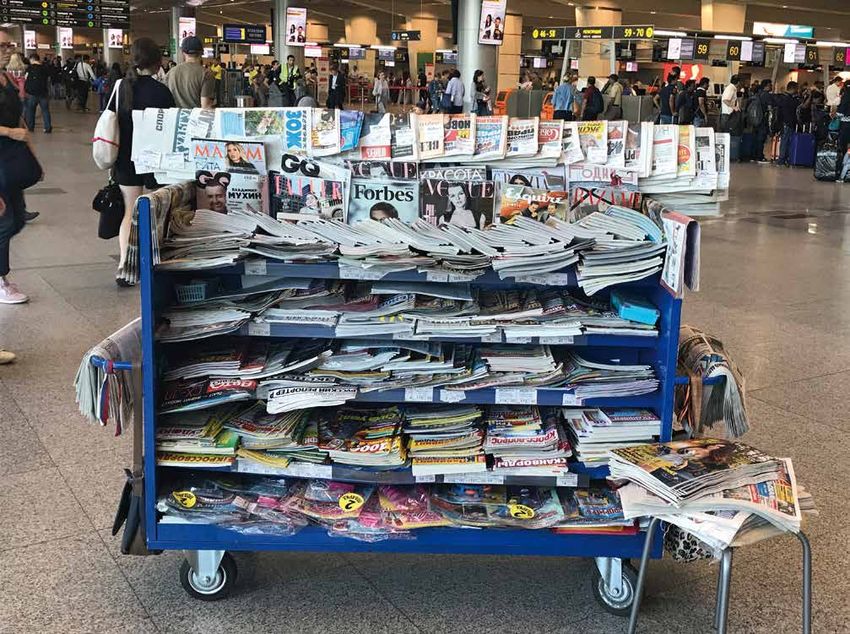
A newsstand at Moscow
Domodedovo Airport
The best-known media in Russia that are critical of the Kremlin, the newspaper © RSF
Novaya Gazeta and the radio station Echo Moskvy, are subject to particularly
close monitoring by Roskomnadzor. Novaya Gazeta received two warnings from
Roskomnadzor in 2014 and 2015 within a 12-month period, which meant that it
could have been closed down at any time–a situation the editorial team felt to be
highly threatening. One of the warnings referred to an expletive in the advance
publication of a literary work; yet the word itself had not even been printed but
instead replaced with an ellipsis. In April 2018, the radio station Echo Moskvy
became one of the first media that had to pay a fine because of a mere link to
content that Roskomnadzor considered objectionable. The agency issued a Rb
20,000 (approx. €260) fine for “obscene speech” in a YouTube video that popular
TV moderator and opposition activist Ksenia Sobchak had provided a link to in her
blog on the Echo Moskvy website. The legal basis was a 2013 law banning the
use of swearwords in the media. In this case, it was obviously no longer applied to
journalistic content only, the editorial department was also made responsible for
hyperlinks.NOW ONLY ONLINE: THE CHANNEL DOZHD “Give TV another chance!” This was the slogan of the private TV channel Dozhd when it first started broadcasting in April 2010. Founded by journalist Natalya Sindeyeva and her husband, entrepreneur Alexander Vinokurov, TV Dozhd (TV Rain) confronted the excessive power of submissive pro-Putin news on state television and offered a forum for critical media professionals and opposition politicians. Its first editor-in-chief, in this post up until 2015, was the renowned Russian journalist Mikhail Zygar. His goal was to make TV Dozhd an independent TV station, not a medium of the opposition. TV Dozhd quickly became popular due to its live coverage of the mass protests against Vladimir Putin in 2011/12. The station reported on the court case against the feminist punk band Pussy Riot as well as about opposition politician Alexei Navalny’s allegations of corruption against high-ranking government officials–topics not mentioned in the state-controlled media. TV Dozhd’s broadcasts of the protests on the Maidan in Kiev in 2013 reached an audience of 18 million people, while state television defamed the protests as provocations by paid fascists. In early 2014, a controversial online poll about the siege of Leningrad during World War II served as a pretence for taking massive action against TV Dozhd. “Should Leningrad have surrendered to save hundreds of thousands of people’s lives?” the editorial team asked the public 70 years after the siege was lifted. The poll was online for a few minutes only, and the editorial team apologised repeatedly after the first wave of outrage in social networks. Nonetheless, the country’s leading cable and satellite operators cancelled their contracts with the TV station. Since then, Dozhd online; the channel lost a large section of the audience as well as financially strong advertisers. In the autumn of 2014, the editorial department had to give up its office in central Moscow because the landlord did not extend the lease. It then reported from apartments for a time before finding new offices on the site of the former Flacon design factory in Moscow. Dozhd switched to a paid model and has been financing itself mostly from subscription fees since then. According to editor-in-chief Alexandra Perepelova, they accounted for approx. 65 percent of the budget in mid-2019; the number of subscriptions has stagnated at approx. 60,000. Although roughly six million people visit the station’s website per month, it is struggling to survive financially. On July 26th 2019, the day before the Moscow police brutally cracked down on demonstrating protesters and arrested more than 1,300 people, Dozhd temporarily removed the paywall and asked viewers for donations to sustain its editorial operations. That day, 45,000 people followed the live coverage from central Moscow on Dozhd ’s YouTube channel.
31

A news conference at
television channel Dozhd
in February 2014: founder
Natalya Sindeyeva fears
for the future of her
channel.
© picture alliance / Russian
Look
4   COURAGEOUS AND
    COMMITTED: THE DIVERSITY
    OF RUSSIAN ONLINE MEDIA
    In reaction to growing state control over the internet and pressure on
    traditional news media, many new websites and alternative media projects
    have sprung up on the Russian-language internet in recent years. They fill the
    void that censorship and self-censorship are leaving in the media and cover
    topics that are suppressed in state-controlled reporting. Individuals, too, are
    attracting large audiences on social media and, in some cases, their channels
    have more subscribers and followers than established media platforms. And
    in various regions of Russia, small online media are fearless and committed in
    their coverage of issues that are having a local impact.

    The Insider, The Bell and Proekt are three examples of these new websites–
    founded by professional journalists who left (leading) positions at established media
    outlets. With investigative reporting and exclusive information from the upper circles
    of politics they are now making a name for themselves in new publications. Their
    texts and topics are frequently taken up by media with large audiences both inside
    and outside Russia, thus evading the attempts of those in power to exert full control
    over news coverage. Many of the new online media outlets are registered outside
    the Russian Federation in order to escape Russian legislation and harassment by the
    authorities. Meduza, the most popular Russian-language news website, is not only
    registered outside Russia but also has its editorial offices in the Latvian capital, Riga.

    In addition, there are websites such as OVD-Info, Mediazona or Takie Dela launched
    by human rights activists who want to inform the (web) community about their causes
    and enlist support for their activities. Their reports, analyses and in-depth coverage
    of issues such as social problems and cases of arbitrary justice have made these
    websites an indispensable source of information about the situation in the country.
You can also read


