Technological University Dublin - School of Computing Information Pack - UPC-FIB
←
→
Page content transcription
If your browser does not render page correctly, please read the page content below
Technological University Dublin
     School of Computing

        Information Pack
Contents
Welcome                                                        3
      Student Campus Life Services                             4
      Counselling                                              4
      Student Health Centre                                    4
      Clubs & Societies                                        4
      Sport and Recreation Service                             5
      Students Union TU DUBLINSU                               5
      Career Development Centre                                5
      Disability Support Service (DSS)                         5
      English Language Support                                 6
      Mathematics Learning Support

Things to do
       GNIB (for non EU students)                              7
       Next of Kin                                             7
       Keep in touch                                           7

Accommodation                                                  8

Academic and Admin issues                                      9
      Modules available                                        10
      Academic Calendar                                        12

Applying for Exchange at TU DUBLIN Process and Closing Dates   14

Practical information outside TU DUBLIN                        15

                                                                    2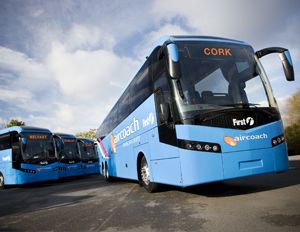
Welcome
Dear partner/international student

On behalf of the School of Computer Science I would like to welcome you to the School of Computer Science
in Technological University Dublin (TU Dublin).

TU Dublin is ranked in the top 3% of universities worldwide and one of the largest Higher Education
Institutions in Ireland with a history dating back to the nineteenth century. TU Dublin is located in Dublin
city center, Ireland’s capital city, which has earned a reputation as the ‘Silicon Valley of Europe’. Ireland has
the second highest concentration of top ICT multinationals in the world and has a thriving indigenous IT
sector.

The School of Computing has one of the strongest international profiles of any School in Ireland. We have
approximately one fifth of TU DUBLIN’s total undergraduate international students and we have welcomed
over 1000 international students from 53 countries to our programmes over the last five years. We have
established strong links with Korea, China, Tanzania and several key EU countries. With inward migration
representing a high percentage of recruitment in the ICT sector in Ireland (up to 50%), further development
of international activity is a priority for our School. The ICT sector is very multi-cultural in its composition
and it is important that our students are exposed to this diversity at an early stage in their careers.

Our vision for international activities is that the School will be a global hub for Connecting the highest caliber
international computer science graduates with the global ICT industry. To achieve this, we are:
    • Creating substantive collaboration with our closest counterpart in higher education in the top ten
        countries with the largest ICT sectors.
    • Fully internationalizing our teaching and research programmes to ensure we attract national and
        international students of the highest caliber and provide them with a quality international education
        and placement experience.
    • Engaging with multinational and indigenous companies operating in an international context to
        provide pathways to employment for our graduates

The following pack will provide further information on will outline the some of the important areas and
services on offer for your students coming to TU DUBLIN on study abroad exchange.

Regards,

William O’Mahony
International Officer
School of Computing
Technological University Dublin
Kevin Street,
Dublin 8, Ireland
+353 (0) 1 402 4954 | 453977@dit.ie

http://www.TU Dublin.ie/computing/

                                                                                                                3
Student Campus Life Services
The transition into a new cultural, social and academic environment will certainly be challenging at times for
your students but there are a range of excellent support services throughout TU DUBLIN which will provide
the support and advise your students may require during their time with us. Information on these services
is listed below.
Counselling
The Counselling Service provides support and help if your students have any mental or personal problems
that interfere with your studies or outside college.
If your students wish to visit a counsellor you must make an appointment with the service by filling out a
form on line. If your students cannot wait to your appointment, there is a short drop in service every day
at the following colleges:
Monday 11am TU DUBLIN Mountjoy Sq (Room M 324)
Tuesday 9.30am TU DUBLIN Aungier St (Room AU 2012)
Wednesday 3pm TU DUBLIN Bolton St (Linenhall – Room 3)
Thursday 9.30am TU DUBLIN Aungier St (Room AU 2043)
Your students must make sure that attend appointments and if they are not going to do so, they must cancel
in advance to allow other students to be seen.
For further information: http://www.TU Dublin.ie/counselling/
Student Health Centre
All registered full-time students are eligible to attend any of the two health centres during the academic
year.
South City TU DUBLIN Aungier St (room 2051 on the 2nd floor) T: 01 402 3051
TU DUBLIN Linenhall Lodge (opposite Bolton St
North city T: 01 402 3614
college)
Your students can ring or call into either of the two centres to arrange an appointment. The opening hours
are 9am to 1pm and 2pm to 5pm from Monday to Friday. They must present your student card when
attending. General consultations with the doctor or nurse are free at the TU DUBLIN Student Health Centre.
However, they may be some charges for specialist clinics, services or products.
It is important that your students contact the relevant centre to cancel an appointment with 24 hours’ notice
so that another student can avail of the appointment. If they fail to attend an appointment, there is a €10
charge. Please visit their webpage at http://www.TU Dublin.ie/campuslife/studenthealthservice/ .
Clubs & Societies
A good way of making friends and integrating is to join a society. There is a wide range of societies on offer
which range from volunteering, performing arts, religious, baking, mountaineering and so on. Societies give
students the opportunity to experience and organise many different cultural and social events and activities.
4Your students may visit their webpage at http://www.TU Dublin.ie/societies/ and if thye are interested all
they have to do is to sign up by filling out a membership form.
There is always a Clubs and Societies festival in the middle of September where students will have an
opportunity to meet committee members from the different clubs and societies and find out more about
them. These are always run by students of TU DUBLIN for the students of TU DUBLIN. There are over 120
Clubs and Societies and therefore there should be something for everyone.
Sport and Recreation Service
Whether your students sports is indoor or outdoor, team based or individual, competitive or fun, there is a
sports activity for them at TU DUBLIN. Joining a sports club can help your students settle into college life and
it is another way of making friends.
Some of the facilities include a gym, 18 metre swimming pool and multi-purpose sports hall at TU DUBLIN
Kevin St; a fully equipped gym and multi-purpose sports hall in TU DUBLIN Bolton St and home playing fields
in Grangegorman.
The main office is located in TU DUBLIN Aungier St and there are other offices in Kevin St and Bolton St.
There are also on-site sports facilities. http://www.TU Dublinsports.ie/
Students Union TU DUBLINSU
The TU DUBLIN Students’ Union (TU DUBLINSU) is the largest Students’ Union in in the country and is the
representative body for all students in the Institute. It is a democratic structure which aims to represent and
defend on behalf of all its members.
A Sabbatical Officer is a TU DUBLIN student who represents TU DUBLIN students full time, at the highest
levels within TU DUBLIN, for the course of the academic year. There are four sabbatical officers for the
academic year 2017/18:
• President: Boni Odoemene
• Vice President for Education: Pierre Yimbog
• Vice President for Welfare: Roisin O’Donovan
• Vice President for Events: Diarmuid Mc Cleary.
For more information, you may visit their webpage: https://www.TU Dublinsu.ie/
Career Development Centre
This department offers a wide range of quality information both online and take away materials in relation
to career planning, employers, applications, how to write CVs, interviewing skills, vacancies and so on.
There is also a wide range of career-related information at all site libraries.
For more information, visit their webpage: http://www.TU Dublin.ie/careers/
Disability Support Service (DSS)
If any of your students have a disability, they may register with this service. There is a Learning Support
Officer (LSO) for each campus and help is at hand. You can find valuable information for any student with
5a disability on their webpage http://www.TU Dublin.ie/campuslife/disability/ or you can email them at
disability@TU Dublin.ie.
English Language Support
The Academic Writing Centre (AWC) offers a free service available to all TU DUBLIN students to support
them, on a one to one basis, develop their academic writing competence in English.
The AWC is run by the Languages Department based in TU DUBLIN Kevin St and does not offer classes on a
weekly basis or teaches English as a foreign language.
For further information please email academicwritingcentre@TU Dublin.ie
Mathematics Learning Support
If your students need help with their maths, there is a Mathematics Learning Support Centre (MLSC).
All they have to do is to drop in to one of their centres with their notes and a tutor will be able to help
them on a one-to-one basis.
For location and opening hours please visit their webpage at http://www.TU Dublin.ie/mlsc/
6Things to do
GNIB (for non EU students)
For students from outside EU, it is imperative that they make an appointment with INIS (Irish Naturalisation
and Immigration Services) to get their registration card at your earliest convenience.
There is an online appointment system in place to get the student visa card. They can book an appointment
by clicking on the following link: https://burghquayregistrationoffice.inis.gov.ie/
On the day of the appointment, your students will need to bring two documents from TU DUBLIN with them:
• A letter to verifying the status of student and
• Medical insurance.
Both documents are organised by the International Office. In the first case you will have to request it from
us and on the second case, you will receive it from us via email around 7 days after registered in TU DUBLIN.
Please note that all Exchange students must provide their own medical insurance.
Other documentation your students will need to present is listed below as well as other important details:
• passport;
• scholarship funding (if applicable);
• evidence of financial support;
• €300* is the registration fee and payment is to be made by bank giro, creTU Dublin card or debit card
(not applicable for Exchange, Erasmus or Erasmus students).
• Length of visit: about one hour.
It is a legal requirement that you register as failure to do so could result in deportation.
*This fee is subject to change without notification.
Next of Kin
In the event of an emergency, it is very important that we have details of your students next of kin (name,
relation to you, phone number). This piece of information will be requested by us during the first day of the
induction week.
Keep in Touch
Your students may visit the following website http://www.TU Dublin.ie/international/ and face-book pages
https://www.facebook.com/internationalofficeTU Dublin/ regularly for any updates. Information on what
is going on is always available at this link: http://TU Dublin.ie/currentstudents/ .
Information is also sent via text and it is advisable that we have your students mobile phone numbers (Irish
mobile numbers preferably).
Your students should check their TU DUBLIN email messages frequently as this is the TU DUBLIN email
account we will use to circulate any information regarding TU DUBLIN.
7Accommodation
Although there is no student accommodation available at TU DUBLIN, there is an Accommodation
Department that can provide help and information to your students on accommodation options that are
available.
The earlier your students find accommodation, the better. The nearer to the city centre, the more expensive
the accommodation will be. While the further away they are from the city centre, the cheaper it is, your
students need to take into account the time and transport expenses. Beware of scams.
Your students should only pay deposits using an international bank transfer where they will have the exact
details of a bank account, a contact name, a postal address and land line telephone number (NOT mobile
phone number).
Your students should always read their tenancy contract (lease) very carefully. Sign it if they are happy with
all the terms and conditions. If your students have to pay a deposit, make sure that they understand the
terms and conditions about the return of their deposits and everything else.
Your students should be prepared to be flexible if you can’t find your ideal accommodation and make sure
that you do your research well before booking anything. You should watch out for extra costs like electricity,
heating and internet access. Are they included? In addition, you may have to pay for services like the use
of a washing machine.
Please visit their webpage on below link:
http://www.TU Dublin.ie/campuslife/studentsupport/accommodation/
Please find below a list of student accommodation providers where previous exchange students to TU
DUBLIN have stayed:
1. http://www.celtichalls.com/home.htm
2. https://unineststudents.ie/locations/dublin/new-mill/
3. https://unineststudents.ie/
4. https://www.student.com/en-gb/
5. http://www.chubbproperties.com/
Accommodation prices can vary in Dublin depending on accommodation type and location. Students can
be expected to pay anything from €250 per month for a shared room up to €600+ per month for individual
room.
8Academic and Admin issues
The International Office and / or the Student Service Centres can provide your students with admin support
and assistance with their studies. They can request letters from us for example to open a bank account, to
have a PPS (Personal Public Service) number, for the GNIB (for non- European Students only) or to verify
their student status. Your students can either email either of the two offices or present themselves to the
offices on the days and times mentioned below.
International Office Office hours Telephone Email
40-45 Mountjoy Sq Mon to Fri:
International@TU
Dublin 1 10am to 12noon & 2.30pm to 01-402 4253
Dublin.ie
4pm
Besides that, the International Student Experience Officer is based in the following TU DUBLINs to be
available to all international students:
• TU DUBLIN Kevin St beside the Boardroom on the first floor on Mondays;
• TU DUBLIN Bolton St in Room 255 near the coffee dock on Wednesdays and Fridays;
• TU DUBLIN Mountjoy Sq in the International Office on Tuesdays and Thursdays.
Please make an appointment to ensure her availability by emailing her at alicia.hughes@TU Dublin.ie.
TU DUBLIN Student Office hours Telephone Email
Service Centres
Aungier St Mon to Thu: 9am to 1pm
(ground floor & 2pm to 5pm 01-402
opposite to Grumpy Fri: 9am to 1pm & 2pm to 7000
Mule Café) 4pm
Mon to Thu: 9am to 1pm
Bolton St requestastudentservice@dit.ie
& 2pm to 5pm 01-402
(Room 319 on the 3rd
Fri: 9am to 1pm & 2pm to 3883
level)
4pm
Mon to Fri: 9.30am to
Grangegorman
1pm
Rathdown House
Fri: 2pm to 4.30pm
Within the School of Computing there is both an International Academic Coordinator and International
Officer available to help with anything to do with academic/School of Computing issues.
William O’Mahony International Officer, School of Computing +353-1- william.omahony@dit.ie
402-4954
Dr. Michael Collins International Coordinator / International +353 1 402 michael.collins@dit.ie
Academic Coordinator 2866
• William O’Mahony
William O’Mahony is responsible for managing and administering all inbound and outbound study mobility
programs within the School of Computing. This includes the overall coordination for study mobility programs
9such as: assessing eligibility, application process, enrolment, orientation and funding as well as providing
support to students before, during and after their time overseas.
• Dr. Michael Collins
Dr. Michael Collins is responsible for the academic review of the study mobility programmes and provides
instruction to the students on the assessment requirements of the study mobility programme.
TU DUBLIN offices are not open at the weekends or public holidays days.
Modules available
The following modules are available to your Undergraduate students to study whilst at DIT. These module
are delivered at year 3.
Winter Semester (September start date):
Web Development - 5 ECTS
Mobile Software Development - 5 ECTS
Cloud Computing - 5 ECTS
Software Engineering - 5 ECTS
Introduction to Artificial Intelligence - 5 ECTS
Databases - 5 ECTS
Global Classroom - 10 ECTS
EAP (English for Academic Purposes) - 5 ECTS
Irish Cultural Studies - 5 ECTS
Spring Semester (February start date):
Business and Enterprise - 5 ECTS
Systems Security - 5 ECTS
Mobile Robotics - 5 ECTS
Universal Design and Assistive Technology - 5 ECTS
Programming with Smart Objects - 5 ECTS
Global Classroom - 10 ECTS
EAP (English for Academic Purposes) - 5 ECTS
Irish Cultural Studies - 5 ECTS
Please note that the Global Classroom module is available in both semesters but can only be studied once.
Students must select modules which amount to 30 credits per/each semester. Information on the modules
can be found by clicking on the following link
(https://www.dit.ie/catalogue/Programmes/Details/DT228?tab=Programme%20Structure) and selecting
the 'DT228 Year 3' drop down option.
The following modules are available to your Postgraduate students to study whilst at TU DUBLIN:
10Winter Semester (September start date):
Working with Data (10 ECTS)
Advanced Databases (5 ECTS)
Pen. Testing & Vulnerab Analysis (5 ECTS)
Universal Design (5 ECTS)
Data Mining (5 ECTS)
Data Visualization (5 ECTS)
GIS (5 ECTS)
Web Applications Architectures (10 ECTS)
Machine Learning (5 ECTS)
Programming Paradigms (5 ECTS)
Software Design (5 ECTS)
Case Studies in Computing (5ECTS)
Prob. & Statistical Interface (5ECTS)
Research Design & Proposal Writing (5ECTS)
Scientific Research and Literature 5ECTS)
EAP - English for Academic Purposes (5 ECTS)
Strategic Management (School of Business Module) ( ECTS)
Spring Semester (February start date):
Secure Systems Development (5 ECTS)
Machine Learning (10 ECTS)
Systems Architectures (10 ECTS)
Social Network Analysis (5 ECTS)
Web Architectures (10 ECTS)
Data Visualisation (5 ECTS)
Data Management (5 ECTS)
Research Design & Proposal Writing (5 ECTS)
Prob. & Statistical Interface (5 ECTS)
Programming for Big Data (5 ECTS)
Data Mining (5 ECTS)
Advanced database (5 ECTS)
Mobile Device Forensics (5 ECTS)
Universal Design (5 ECTS)
Speech & Audio Processing (5 ECTS)
UX Design (5 ECTS)
Please be aware that the above modules can be subject to change.
The module catalogue is available at the link below which will give module descriptors for almost all of the
modules. Alternatively you can locate the catalogue on the left-hand side of the page on this link:
http://ditmsc.blogspot.ie
11Academic Calendar
DIT Academic Calendar 2018/2019
Semester 1
August 2018 Reassessment
20/08/18 (2017/18)
Reassessment
27/08/18 (2017/18)
September 2018 Academic Year commences
03/09/18 2018/19
10/09/18
17/09/18 1 Semester of 15 weeks that normally includes 12 weeks
teaching
24/09/18 2
October 2018 01/10/18 3
08/10/18 4
15/10/18 5
22/10/18 6
29/10/18 7* Review Week (unless otherwise approved and advised)*
Review week to be used either for revision, reading, field visits,
November 2018 05/11/18 8 lectures, interim tests, formative assessment feedback etc. To
be applied in week 7, except where otherwise arranged
12/11/18 9
19/11/18 10
26/11/18 11
December 2018 03/12/18 12
10/12/18 13
17/12/18 The week of 17 December 2018 to be used for projects,
assessment and engagement with students. In the event that
examinations are required, requests will require approval by
College Board, and will be noted at Academic Council. The
Office of Student Development must also be advised.
24/12/18 Christmas
31/12/18 Christmas
January 2019 07/01/19 14 Weeks 14 and 15 provide flexibility to allow exams or marking
during this time.
14/01/19 15
21/01/19 Exam Boards
12Semester 2
28/01/19 1 Semester of 15 weeks that normally includes 12
weeks teaching
February 2019 04/02/19 2
11/02/19 3
18/02/19 4
25/02/19 5
March 2019 04/03/19 6
11/03/19 7
18/03/19 8* Review Week (unless otherwise approved and
advised )*
Review week to be used either for revision, reading,
field visits, lectures, interim tests,
25/03/19 9 formative assessment feedback etc. To be applied in
week 8, except where otherwise arranged.
April 2019 01/04/19 10
08/04/19 11
15/04/19 Easter Break
22/04/19 Easter Break
29/04/19 12
May 2019 06/05/19 13
13/05/19 14 Weeks 14 and 15 provide flexibility to allow exams or
marking during this time.
20/05/19 15
27/05/19
June 2019 03/06/19
10/06/19 Student feedback and Appeals
17/06/19 Student feedback and Appeals
*Review Week
It has been agreed that there will be an Institute-wide Review Week (to be set by the Institute) in each Semester. There
is a right to seek derogation for an individual programme. The derogation case is to be presented by the relevant
Programme Committee to the Head of School responsible for the programme and the College Director, who together
will make the final decision. It is suggested that Programme Committees should endeavour to agree their approach to
the Review Week in a timely manner, to allow decisions to be communicated to both staff and students before the start
of the Semester in which a Review Week occurs.
13Applying for Exchange at TU DUBLIN Process and Closing Dates
In order to come to TU DUBLIN as an Exchange student, an MoU and/or a Student Exchange Agreement
must be in place with TU DUBLIN for the subject area your students are wishing to study while here.
TU DUBLIN does not accept Free Movers (i.e. students who wish to come to TU DUBLIN for one or two
semesters but whose home universities do not have a bilateral agreement with TU DUBLIN).
Assuming a partner agreement is in place, your students must then be nominated by you- your
International Office will send an email to erasmus@dit.ie to confirm that your students have been selected
to come to TU DUBLIN. Your students will then receive an email from the Exchange Section to explain how
to apply and what documents your students need. This information can also be found below:
Closing Date for receipt of the single signed softcopy (PDF file only) Applications for Semester 1 & Full Year
- 2018/2019: 20 April 2018
Closing Date for receipt of the single softcopy ( PDF file only) Applications for Semester 2 -2018/19: Friday
2 Nov 2018
14Practical information outside TU DUBLIN
Getting to Dublin from Dublin Airport
You can find information below on different bus services available to reach the city centre from the airport.
Aircoach. This bus service connects Dublin airport with the city centre 24 hours a day operating up to every
15 minutes. O’Connell St is the city centre.
A single ticket from the airport to the city costs €6.
For more information, you may visit their webpage at
http://www.aircoach.ie/
Airlink and Other Buses
All the airport tickets can be bought in the following locations:
Terminal 1: bus & travel information desk, arrivals hall, vending
machines located at the Airlink bus stop and the Spar shop.
Terminal 2: the Spar shop.
The Airlink Express service (747 and 757) connects Dublin Airport with many of Dublin city’s most popular
locations. Please see below link.
There are also other bus routes that go to and from the airport. These buses will set down at all stops
between Dublin Airport and the departure / destination point. You must pay the exact fare in coins if you
do not have a prepaid ticket.
http://www.dublinbus.ie/Your-Journey1/Timetables/Airport-Services/
By Taxi
The fee depends on the length of the journey but generally speaking a taxi from the airport to O’Connell St
would cost between €25 and €30.
Public Transport from the City Centre
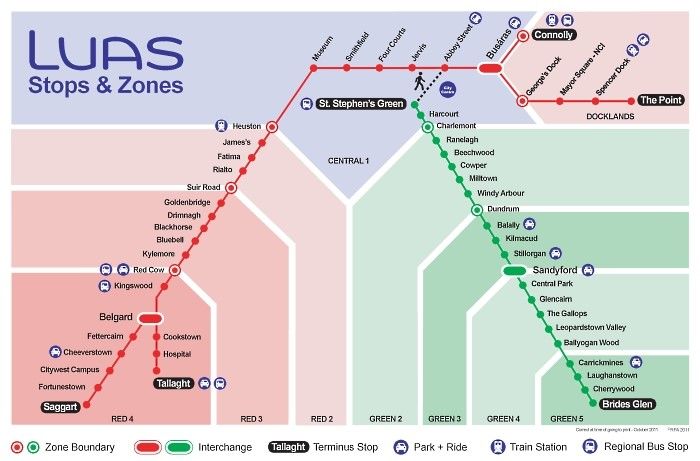
Luas
It is the light rail transit system in Dublin and has two tram lines:
• The red line is 20 kms in length and has 32 stops. It runs from Tallaght to The Point.
• The green line is 16.5km in length and has 22 stops. It runs from Brides Glen to St Sephen’s Green
through Sandyford.
https://www.luas.ie/
https://www.luas.ie/tickets-and-fares/
15Dublin Bus Services
The fare depends on the distance travelled. You have to pay the exact fare as change is not given. If you are
going to depend on the bus regularly, your best option is the multi-journey tickets or the Leap Card which is
a card that can be used to pay-as-you-go on Dublin Bus, Luas, Dart and commuter rail services around Dublin.
You pay less with a Leap Card.
https://www.dublinbus.ie/
There is an app that you can use with iphone and android to obtain real time information on the bus arrival
at your stop, fare and route planner. It is free to download. For more information, please visit:
http://www.dublinbus.ie/DublinBus-Mobile/
Dart (Dublin Area Rapid Transit)
It is the electric rail system and another way to get around Dublin. It runs along the coast of the Irish Sea
from Malahide or Howth in north county Dublin southwards as far as Greystones in County Wicklow. The
service operates every 15 minutes all day.
http://www.irishrail.ie/about-us/dart-commuter
Dublin Bikes
Dublinbikes is a public bicycle rental scheme in the city centre and there is one
station located outside each TU DUBLIN campus. For more information, please
visit their web page:
http://www.dublinbikes.ie
Places of Worship
Below is information on various religions links:
• Irish Jewish Community: www.jewishireland.org
16• The Russian Orthodox Church in Ireland : www.irishchurches.org
• Dublin Buddhist Centre: www.dublinbuddhistcentre.org
• Hindu Cultural Centre in Ireland: www.hindu.ie
• The Islamic Foundation of Ireland: www.islaminireland.com
• Church of Ireland (Anglican): www.ireland.anglican.org
• The Methodist Church in Ireland: www.irishmethodist.org
• The Presbyterian Church in Ireland: www.presbyterianireland.org
• The Catholic Church in Ireland: www.catholicireland.net
Mobile Phone Providers
The main mobile providers in Ireland are Vodafone, Meteor, 3 and Tesco. The 3 network also provides a
network specialised in 3G technology.
There is always good quality communication in all cities. If you want to get connected to one of the Irish
mobile networks, you can buy a SIM card or a SIM card and phone together. You will also have to choose
between Pay as You Go (prepaid system) or contract (one year contract at least).
You can buy a mobile phone from all operator stores or visit their online shops. The Carphone
Warehouse provides mobiles from all networks and comparison charts for everything you could possibly
want. In general, their magazine groups all necessary information and it is a good idea to read them. They
are especially useful if you wish to purchase an actual phone with your new line.
You can also use www.callcosts.ie to compare the price of mobile phones and roaming charges.
Banking
The main banks in Ireland are AIB (Allied Irish Bank), Bank of Ireland, Ulter Bank and Permanent TSB. The
bank opening hours are usually from 10am to 4pm and from10am to 5pm on Thursdays.
There are branches of AIB in TU DUBLIN Kevin St, TU DUBLIN Aungier St and TU DUBLIN Bolton St as well as
one ATM (cash point) located beside each of them. The TU DUBLIN AIB branches opening hours and phone
numbers are as follows:
Monday Tuesday Wednesday Thursday Friday Tel No
Aungier St 13:30 – 13:30 – 13:30 – 13:30 – 13:30 – 01 475
15:30 15:30 15:30 15:30 15:30 9654
Bolton St 10:00 – 10:00 – 10:30 – 10:00 – 10:00 – 01 874
16:00 13:00 16:00 16:00 13:00 0409
Kevin St 10:00 – 10:00 – 10:00 – 10:00 – 10:00 – 01 4159680
12:30 12:30 12:30 12:30 12:30
Food
There is a wide variety of foods from different countries in Dublin. The prices of food can vary greatly
depending on where you purchase your items. You may find Dublin a bit expensive when you arrive for the
first time but you can reduce the cost of food if you buy at some places.
17The cheapest option for you to buy food will be places like Aldi or Lidl. Dunnes Stores or Tesco will be
considered the next cheapest option and Supervalue the most expensive option. If you purchase your food
in small convenience stores like Spar or Centra you will find yourself paying extra money.
You can buy fruit and vegetables at good value for money in fresh food markets e.g. in Moore St (close to
Cathal Brugha St and Bolton St) or in Camden St (close to Kevin St and Aungier St). Information on farmer
markets can be seen in www.irishfarmermarkets.ie .
The Asian markets can be found in Drury St and Parnell St. Halal food can be purchased in Clanbrassil St and
Wexford St which are located near TU DUBLIN Kevin St and Aungier St.
Most of the shops in the city centre are open from 9am to 6pm Monday to Saturday and they close at 9pm
on Thursday and Fridays. A lot of shops are also open on Sundays from 12noon to 6pm. Some large
supermarkets like Tesco and Dunes may be open 24 hours a week.
Other Useful Contacts
Urgent Out-of-Hours DL - DOC 01 663 9869
GP/Doctor
Local Hospital /A&E St James Hospital 01 410 3000
Rapid Injury Clinic Smithfield 01 657 9000
Emergency Services Fire 999 or 112
Brigade/Ambulance/Gardaí
Bord Gáis Gas leak / 24 hour 1850 20 50 50
Tourism Ireland http://www.ireland.com/en-gb/ For visitors to Ireland
Dublin Airport https://www.dublinairport.com/
18You can also read


