The 2018 Pension Adequacy Report - of the Commission and the SPC Valdis ZAGORSKIS - MISSOC
←
→
Page content transcription
If your browser does not render page correctly, please read the page content below
The 2018 Pension Adequacy Report
   of the Commission and the SPC
                                    Valdis ZAGORSKIS

            Modernisation of Social Protection Systems
                      DG EMPL, European Commission

           31 May 2018, Sofia

                 Social Europe
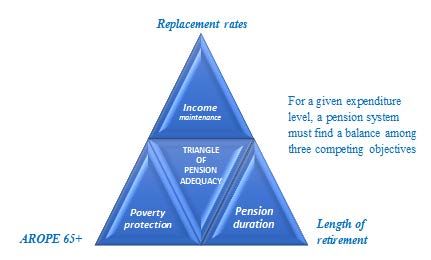
1       "Triangle of pension adequacy":
          multi-dimensional approach
                Replacement rates

                                          A pension system
                                         must find a balance
                                             among three
                                            dimensions of
                                              adequacy

                                                          New!
                                              Length of
    AROPE 65+                                retirement

                         Social Europe
- despite improvements, there is no
room for complacency -

                Social Europe
1
Old-age poverty: progress to Europe 2020 targets
Older people (65+) at risk-of-poverty or social exclusion in the EU Europe 2020 Strategy:
12,3 million (26.2%) 11 million (20.6%) Target – reducing poverty
by at least 20 million
6,9 million (19.4%)
6,3 million (15%)
2008 2016 2020
19,2 million 17,3 million
(23.3 %) (18.2%)
Social Europe1 Other the last decade, the replacement ratio of
pensions has seen an overall improvement
Aggregate replacement ratio, 2008-2016
58% (EU-28) in 2016
Source: Eurostat. * - 2010 data for HR. EU refers to EU-27 in 2008and EU-28 in 2016.
Social Europe1
Working lives get longer, but not as fast as life expectancy
Average time before working, working time and retirement
duration, 2015, years
Ratio between
average retirement
duration and working
life, EU
Social Europe- inequalities remain and some
groups require specific policy
attention -
Social Europe1 Women remain at a higher risk of poverty
One out of five older women (65+) is at risk of poverty or
social exclusion in the EU
AROPE rate of older people (65+), by gender, 2016
Gender gap
Source: Eurostat. Notes: Sorted by gender gap in at-risk-of-poverty or social exclusion rate.
Social EuropeRetired self-employed: SHARE evidence
Lower income and higher income poverty risk compared to
former employees
At-risk-of-poverty rate by former work type (SHARE wave 7, 2017)
Social Europe1Career breaks are partly compensated by credits
Social Europe- pension systems and labour
markets continue to evolve -
Social Europe1 Shifting reform trends in 2014 -2017
• New reforms to balance pension duration…
• Pensionable age (+ longevity link)
• Career length
• Reduced early retirement options and more incentives to defer
• Increasing focus on flexible retirement pathways
• BUT - some policy reversals
Adequacy back in focus - but will it do the trick?
• Protecting low-income pensioners
• Basic pensions
• Indexation
• Tax allowances
• Improving access and transferability for different categories
• Facilitating supplementary saving
Social Europe3 The role of pension systems
1 Minimum income provisions for older people
• Recently retired cohorts are overall less
dependent on minimum income benefits than
previous cohorts, possibly due to more robust
labour market performance, in particular for
women.
• However, women continue to be
overrepresented among the recipients of
minimum benefits.
Social Europe1 Factors in increased employment rates
Factors in increased employment rates of
older people
Overall increased Behaviour in late
employment careers
Overal
Younger increase Better
Women Extended Higher Better
cohorts Better in labour and safer
working working pensionab old-age
better health market working
more lifes le ages health
educated participati conditions
on
Social Europe- adequacy of future pensions will
require further improvements -
Social Europe1s life expectancy improves, pension income for a
A
similar career will be lower
Net TRR, base case (40 years up to the SPA), men, average
earner, p.p. change, 2016-2056
Social Europe1 Policy response: longer working lives Projected exit ages from the labour market, 2017 and 2056, years Source: The 2018 Ageing Report assumptions Social Europe
1Women's pensions 37%
lower, reflecting multiple
   labour market gaps
• Different careers

• The gender pay gap - 16.3%

• Women (33) work on
  average almost 5 years less
  than men (38)

• 31.6% of women (15-64)
  work in part-time
  employment compared to
  7% of men in the EU-28.
                            Social Europe
1 People in non-standard employment and self-
employment often face less favourable conditions
for accessing and accruing pension rights
The earnings gap
Gaps in access and benefit accrual
High risk for old-age income adequacy
Social Europe1
Maturing occupational pillars to contribute more to old-age
incomes in some countries…
…while supplementary pensions remain marginal in others
Coverage of retirees and working people (50+) by occupational pensions, 2017, %
Source: SHARE wave 7; countries with missing values not shown; survey does not include Ireland, the
Netherlands and the UK. Notes: "Retired" refers to share of retirees with an occupational benefit. "Working"
refers to share of working people with an occupational pension entitlement. All respondents are older than 50.
Social Europe2 Current living standards
1
Health care is generally affordable, but not for everyone
• Women tend to live longer with illnesses or disabilities than men.
• Long-term care provision can make a large impact and it varies widely
among countries.
Self-reported unmet needs for medical Public expenditure on long-term care, 2013, % of
examinations because they were too expensive GDP
(%), 2016
Source: Eurostat. Source: The 2015 Ageing Report.
Social Europe- joint efforts at the EU level need
to be pursued -
Social EuropePolicy response at EU level
European Pillar of Social Rights and related
initiatives
Directive on work-life balance
Recommendation on access to social protection
High-level group of experts on pensions
Holistic reflection on adequacy and sustainability
Pension Adequacy Report and the Ageing Report
Adequacy monitoring to continue
Next Pension Adequacy Report in 2021
Social Europe1
Social EuropeYou can also read


