The ADL-Hillel Campus Antisemitism Survey: 2021 - OCT 2021
←
→
Page content transcription
If your browser does not render page correctly, please read the page content below

The ADL-Hillel         OCT
                          2021

    Campus Antisemitism
    Survey: 2021

1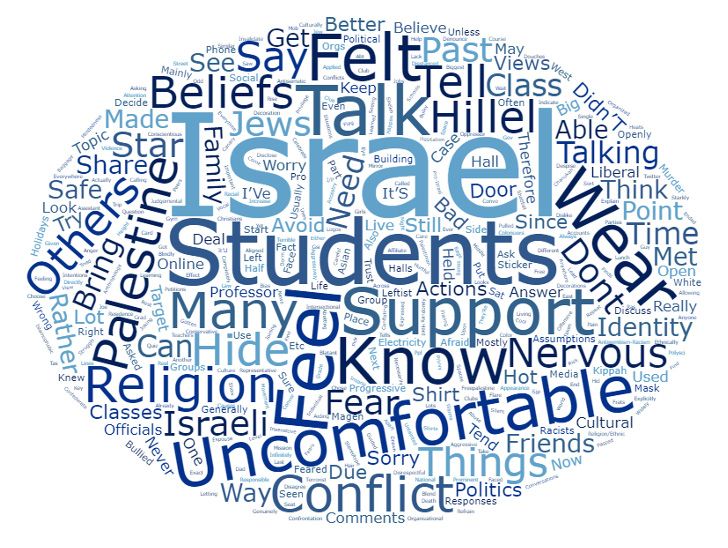
The ADL-Hillel Campus
Antisemitism Survey: 2021
    Survey
INTRODUCTION
Antisemitism has been a problem on college and university campuses for decades. But while the climate for
Jewish students had been improving for many years, we are seeing an alarming new uptick in the number of
reported antisemitic incidents across the country. Swastikas, Nazi symbols and other antisemitic graffiti have
been reported on numerous campuses, and antisemitic tropes hurled at Jewish students have made headlines.
Most notably, white supremacists marched through the campus of the University of Virginia in 2017 shouting
“Jews will not replace us.”

In the aftermath of increased conflict between Israel and Hamas in May 2021, students at college campuses
across the United States experienced an even sharper increase in antisemitic activity, including many incidents
not directly connected to Israel. Antisemitic incidents peaked during the 2020-2021 academic year, reaching
an all-time high of 244 incidents, even though many campuses were physically closed due to the COVID-19
pandemic. From past research and conversations with students, we know that antisemitic activity on campus
makes some Jewish students feel unwelcome or unsupported by their campus community. According to one
recent survey, Jewish students were the least likely among their peers to view their campus as welcoming to
religious diversity.

The Anti-Defamation League and Hillel International are dedicated to supporting Jewish students and
addressing all acts of antisemitism. We are working together to respond to antisemitic activity on campus, and
to proactively counter the underlying hatreds and biases that lead to it through education and engagement. To
do so, it is vital to ground ourselves in data to understand the nature of antisemitism on college and university
campuses today and the experiences of Jewish students. This study was conducted to better understand
these national trends by hearing from a nationally representative sample of Jewish students across the
United States. This report explores the extent to which Jewish college students face antisemitism and
exclusion on campus and seeks to understand how campus communities can most effectively support them.
Understanding these trends will help inform our efforts to partner with and educate campus administrators,
Hillel professionals, and students, to ensure Jewish students are secure, supported, and empowered.

2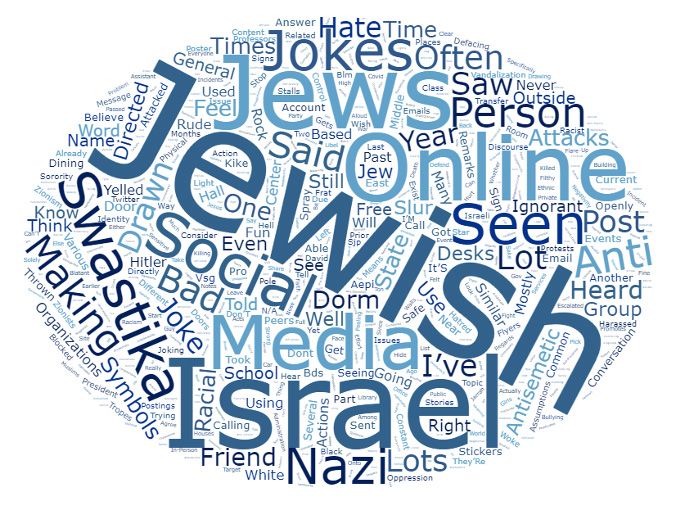
METHODOLOGY
This survey was conducted by College Pulse, an online survey and analytics company dedicated to
understanding college students, on behalf of ADL and Hillel International. The survey instrument was adapted
from Hillel International’s Campus Climate Initiative student survey. This survey was conducted online between
July 7th and August 21st, 2021 and included 756 self-identified Jewish undergraduate students who are
currently enrolled in 220 different four-year colleges and universities across the United States. This sample
was drawn from College Pulse’s Undergraduate Student Panel, which includes over 400,000 diverse students
from more than 1,000 colleges and universities across all 50 states. The survey results were adjusted based on
demographic distributions from the 2017 Current Population Survey to reduce the effects of non-response bias
and appropriately weight the sample based on age, race and ethnicity, and gender. The margin of error for this
survey is ± four percent.

These survey results can be used as a point of comparison for colleges and universities that want to engage
in surveys as one indicator of the climate for Jewish students and related to antisemitism on their own
campuses.

RESULTS
Experiences with Antisemitism

Jewish students in the United States report
that antisemitism continues to be a looming
and present threat on college campuses. Their
concern about antisemitism can impede their
ability to participate in classes, join clubs, and
display their Jewish identity proudly.

Within the last year, nearly one-third of Jewish
students personally experienced antisemitism
directed at them on campus or by a member
of the campus community. The most common
forms of antisemitism were offensive
comments or slurs online or in person. For
those who experienced offensive comments
or slurs directed at them in person, 79 percent
reported that it happened to them more than
once. One student described an incident at a
party where someone gave a Nazi salute after
finding out they were Jewish.

3
“I’ve had swastikas drawn on my notes, been called a ‘kike’ downtown … while I was wearing my hamsa. I’ve seen
an increase in people making judgements about me for being Jewish due to the current political climate with
Palestine. People keep tying Jews that have nothing to do with the conflict to the Israeli government. Anytime it
is mentioned that I am Jewish to someone who doesn’t know that already, the topic of Palestine is brought up,
which is intrinsically antisemitic.” –Student at a small northeastern university

Additionally, in the last year, 31 percent of Jewish students witnessed antisemitic activity on campus that
was not directed at them. The most common experience was witnessing antisemitism in symbols, logos, and
posters on campus, observed by 18 percent of respondents. Many of the respondents recalled swastikas
being drawn around campus and the vandalism of Jewish fraternities, sororities, and cultural buildings. One
student from a small liberal arts school in the northeast remembered a mezuzah being stolen off a Jewish
student’s dorm room door and a student from a public university in the southeast discussed instances of
swastikas being put up on Jewish students’ doors.

                                                                        “The anti-Israel sentiment is very strong...
                                                                        and it often (not always) manifests
                                                                        as antisemitism. In the 2019/2020
                                                                        school year (pre-covid) our Hillel was
                                                                        repeatedly vandalized and even though
                                                                        the administration knew about it we had
                                                                        to fight with them for months before they
                                                                        took action. I’ve also seen/ heard anti-
                                                                        Israel comments from my peers that were
                                                                        blatantly antisemitic both online and in-
                                                                        person (more so online since covid)”
                                                                        – Student at a small northeastern college

Taken together, 43 percent of Jewish college students experienced and/or witnessed antisemitic activity in
the last year. We asked them to describe those occurrences and created the following word cloud to highlight
their responses. Outside of Jews and Jewish, the most common words in the descriptions of antisemitic
experiences include “Israel,” “Nazi,” “swastikas,” and “jokes.” Additionally, the prominence of the words “online”
and “social media” reinforce the finding that many Jewish students experience antisemitism online. In the age
of increased virtual learning and constant social media engagement, this is particularly concerning.

4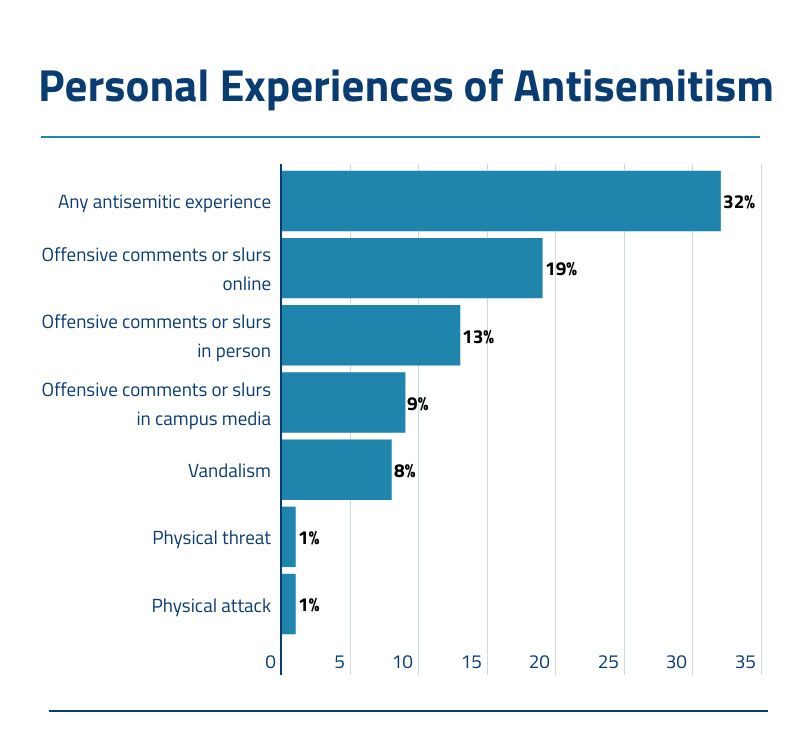
Only a small number of students were victims
                                                                      of antisemitic violence (one percent) or were
                                                                      threatened with violence (one percent). While
                                                                      it is reassuring that violent antisemitic activity
                                                                      is not more prevalent, it remains true that any
                                                                      act of antisemitic violence is alarming and
                                                                      should be viewed as one act too many.

                                                                      Experiences Reporting Antisemitism

                                                                          Consistent with other victims of hate crimes
                                                                          and bias-motivated incidents, most Jewish
                                                                          students who experience antisemitism do not
                                                                          report it. Three-quarters of respondents who
Word cloud depicting responses when participants were asked to describe
incidents of antisemitism that they experienced or witnessed on campus or personally experienced antisemitism did not
by a member of their campus community                                     report it to anyone. While reporting is higher
                                                                          for physical violence and threats of violence,
only 37 percent of students reported property damage, defacement, and vandalism. Additionally, only 24
percent reported antisemitic slurs and comments online and just 23 percent reported them when they occurred
in person. Only three percent of students who experienced antisemitism reported it to local or campus police.
While we may not expect students to report offensive comments and slurs to the police, we would hope that
students would feel comfortable and empowered to report these encounters to other professionals, such as
campus employees, Hillel staff, or the ADL.

For those who did report, campus employees and Hillel professionals were the most common avenues. Of
the 12 percent of students who reported incidents to campus employees, 40 percent felt they were not taken
seriously. Unfortunately, knowledge of how to report antisemitic incidents was also low, with 41 percent of all
student respondents saying that they did not know how to report an antisemitic incident when it occurs.

Campus Climate

The survey also examined Jewish students’ experience of campus climate more broadly. Seven out of 10
students reported feeling safe on campus as a Jew. Additionally, 67 percent agreed that their campus was
welcoming and supportive of Jewish students. For those students who had experienced antisemitism, only 51
percent agreed that they felt safe, and 50 percent agreed that their campus was welcoming and supportive.

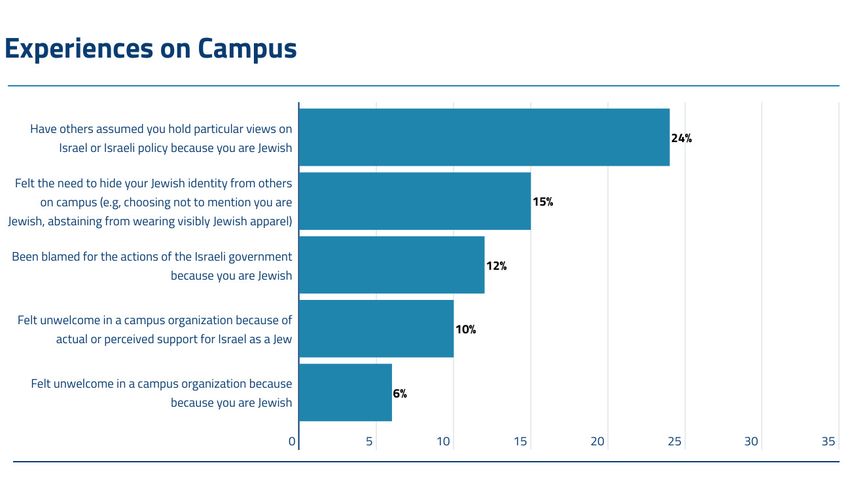
While the majority of Jewish students reported feeling welcome and safe on campus, many students also
noted challenges they experienced, as shown in the chart below.

5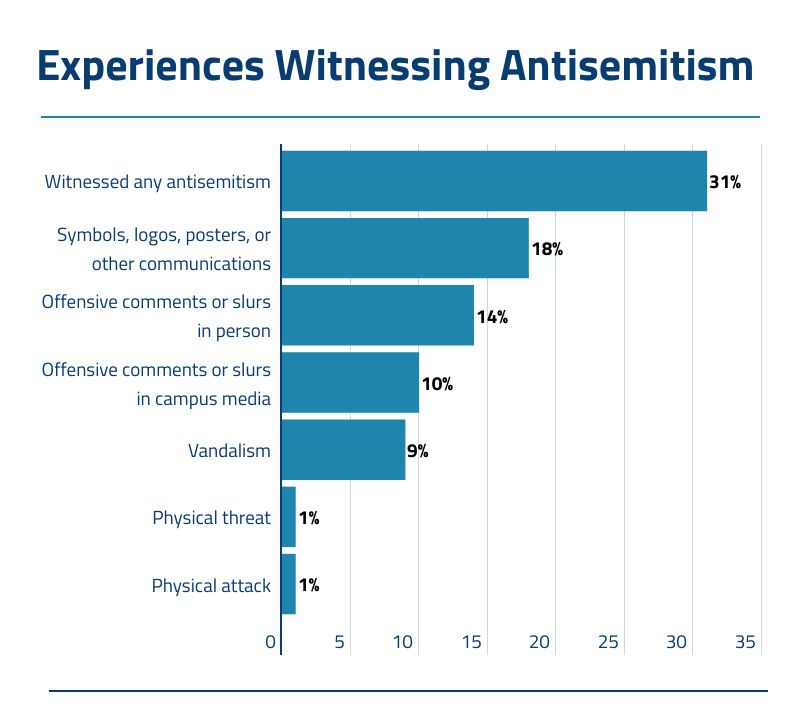
Fifteen percent of Jewish college students reported that they felt the need to hide their Jewish identity from
others on campus, including in class, in their dorms or living area, with other students outside of class, and
even with campus employees and officials. We asked respondents to describe these circumstances. As
seen in the word cloud below, Israel appeared as the most prominent aspect of these students’ experiences,
reflecting that students particularly felt the need to hide any connection to Israel from others on campus.
Students may feel the need to do this because 12 percent have been blamed by others for the actions of the
Israeli government, and 24 percent have had their views on Israel or Israeli policy assumed by others, simply for
being Jewish.

                         Word cloud depicting responses when participants were asked to describe
                         their experiences when they felt the need to hide their Jewish identity from
                         others on campus

6
The most common place where students felt they needed to hide their Jewish identity was in the classroom.
When one student was asked to describe this experience, they simply wrote “I’d rather be safe than sorry.”

“Sometimes when I say I’m Jewish in classes that becomes the center of whatever I have to say for the rest of the
semester and there is more to me than just being Jewish.” –Student at a small southern university.

“One time, I sat next to someone in my political science class and I put my phone on the table with an “I Celebrate
Chanukah’’ sticker on the case. The person next to me pulled out his laptop with a Confederate flag sticker, looked
at my phone case, and moved across the room. Ever since then, I try not to show my Judaism.” –Student at a large
southern university

Additionally, many students said they feel that they will be harassed about Israel in class if they are openly
Jewish.

“Expressing support for the Jewish community or Israel is immediately met with ostracizing and harassment to
the point of not being able to talk about it in class.” –Student at a large northeastern university

“Students conflating the actions of the Israeli government with the Jewish people’s. General misguided hatred
and anger in general from their comments. [There is a lot] of ‘leftist rage,’ which is a community I’m involved in so
it was weird and uncomfortable. Didn’t seem like people were open to any conversation & by the way they spoke,
it made me feel as though I was better off not being open about my Judaism - which is something I’m used to.
– Student at a large southern university

One student from a midwest liberal arts college tried to circumvent this stereotype by writing “Jews for a Free
Palestine” on the whiteboard outside of their dorm.

“I used to be more vocal about my Jewishness. I’m worried people will stereotype me and assume I support Israel’s
action because I’m Jewish. To prevent this I wrote on my dorm door whiteboard ‘Jews for a Free Palestine.’ I worry
that the legitimate and real racial trauma of Jewish families is ignored because they are now perceived as white and
therefore seen as complete recipients of American cultural hegemony with family lines of privilege that are untainted
by systematic disenfranchisement, murder and abuse.” –Student at a small midwestern liberal arts college

7

Approximately one in three of those who felt they needed to hide their Jewish identity reported doing so in
their residence halls or place of living. One student from a large public university in the south explained that
other Jewish students have had their property vandalized and stated, “I do not want to be a target.” This was a
sentiment shared by many of the respondents. Others described not wanting to hang up their mezuzah or wear
articles of clothing that would signify their Jewish identity for fear of being called out, harassed, or attacked.

Many respondents also reported hiding their Jewish identity in co-curricular activities. Ten percent felt they
were unwelcome because of their actual or perceived support for Israel as a Jew. Additionally, four percent of
students had been asked or told to leave a student organization either because they were Jewish or because of
their actual or perceived support for Israel as a Jew.

Reflecting on their experience being asked to leave a campus organization because they were Jewish, a
student from a large private university in the northeast recalled being called a “Kike Jewlord.” Another student
from a northeastern public university recalled being harassed and essentially banned from liberal clubs that
they had previously been welcome in after openly supporting Israel. A student from a large midwestern public
university, who identifies as queer, discussed how a queer student organization refused to support the school’s
Jewish queer student organization because of its affiliation with Hillel, a “Zionist organization.”

Concerns of Antisemitism Across the Political Spectrum

Contrary to politicized narratives that often highlight antisemitism as stemming only from one end of the
political spectrum or another, the Jewish students surveyed expressed concern about antisemitism from the
political left, center, and right, though to somewhat varying degrees. They reported being most concerned
about antisemitism from those who identify as conservative or with the right (69 percent), followed closely
by those who identify as progressive or with the left (62 percent). They are least concerned with antisemitism
from those who identify as centrists (54 percent), although more than half of them are still concerned.

Building Resilience

The results of this survey show a correlation between participation in Jewish life and feeling safe on campus.
Of those who participated in this survey, three-quarters participated in at least some Jewish activities in the
past year. Interestingly, 74 percent of students who participated in Jewish activities reported feeling safe on
campus as a Jew - compared to 65 percent of students who did not participate in Jewish activities. This is
despite the fact that students who participate in Jewish activities are more likely to experience antisemitic
incidents and behaviors.

This seems to confirm the fear that many participants expressed about being afraid to openly display their
Jewish identity because they will be targeted. However, it also suggests that participating in Jewish activities
and building a strong Jewish community may help build resilience and alleviate the anxiety that so many
Jewish students experience. This affirms the need for building thriving Jewish life on college campuses
to offer Jewish students a safe space free of antisemitism and to provide them the tools and resources to
address antisemitism if and when they experience it.

8
Desired Action

Nearly half of Jewish students want changes to be made in how antisemitism is addressed on their campus.
Overall, 32 percent want student governments to do more, 27 percent want campus employees to do more, and
25 percent want campus faculty to do more.

Jewish students want their fellow students and campus faculty, staff, and officials to understand antisemitism,
but unfortunately many universities fail to provide this education. Several students noted that Jews are not
included in the Diversity, Equity and Inclusion curricula that students, faculty and staff are frequently required to
take.

“It would be great to see diversity embraced instead of accepted. Since most of the school is Christian, there
isn’t a ton of understanding of other cultures and while there are some great existing programs to improve cultural
awareness I think there could be more.” –Student at a large southern university.

“The … staff was widely ill-equipped to deal with antisemitism, and many of them even made accidentally offensive
comments while working with us. I also learned that antisemitism is not covered in the diversity, equality and
inclusion training for employees, which explains a lot but is unacceptable.” –Student at a small northeastern college.

Many students also want more action to be taken in response to antisemitic activity on their campuses. In their
open-ended responses, many students felt that antisemitic incidents are not acknowledged by their universities
and in many cases are not even investigated. A student from an elite private university in the northeast noted
their school’s position of political neutrality, but felt it would be helpful if campus employees “made real
affirmative stances about the value of different ethnicities and religions.” A student from a private university in
the mid-Atlantic region stressed the importance of listening to student concerns of antisemitism; “they should
make sure that Jewish students are heard when they come forward with complaints rather than disregard
them.”

“The school needs to address the rise of ‘white nationalist’ ideals and their ties to elitism and fraternal
organizations. Organizations that are accused of discriminatory behavior and/or harassment need to be
thoroughly investigated and removed or placed on probation as appropriate. Educational requirements should
reflect a desire to educate all students on the history of discrimination and harassment in this country and
the institutional racism that persists today. Students that complain of discrimination and harassment must
be treated with respect and their complaints should be investigated thoroughly.” –Student at a large western
university

“They [campus officials] could talk to people who get reported for antisemitic comments, or at the very least put
out a statement in the wake of antisemitic comments that Jews (and Israelis) on campus are not responsible for
the actions of the Israeli government.” –Student at a large western university

9
CONCLUSIONS AND RECOMMENDATIONS
This survey establishes that antisemitism remains a consistent and serious concern for Jewish students on
college campuses across the United States. Jewish students – like all students – deserve to feel safe and
accepted in their college communities. College is a time where students have the opportunity to grow, explore
their identity, challenge their ideas about the world, and learn and engage with those who are different from
them. However, Jewish students cannot do this when they fear for their safety and feel the need to hide their
Jewish identity from others.

There have been an alarming number of reported antisemitic attacks and incidents on college campuses
in recent years, but this survey suggests the true extent is even more alarming, as most incidents and
microaggressions go unreported.

University officials have an obligation to keep their students safe and provide a learning environment where all
students can thrive, free from harassment. In order to address these issues, colleges and universities should
take the following steps:

Appropriate inclusion of antisemitism in orientations and training for students, faculty, staff, and the
administration. Universities should include antisemitism alongside other forms of bias in their Diversity, Equity,
and Inclusion programs for faculty and staff, as well as in student orientations and student leadership training.
Additionally, higher education graduate programs and professional associations should ensure that content on
the Jewish community and antisemitism is included in their programs.

Increase visibility of where and how to report acts of antisemitism on campus. The majority of those who
personally experienced antisemitism did not report the incident. Additionally, 41 percent of those surveyed
said that they did not know how to report an antisemitic incident if it were to occur. Colleges and universities
need to make it a priority to regularly highlight how and where to report antisemitic incidents. This should
happen within the campus’s broader bias and discrimination reporting processes, and students should also be
informed about how to specifically report antisemitism through their local Hillel.

Address acts of antisemitism and take concrete steps to investigate incidents. Many students feel their
universities do not prioritize investigating or responding to acts of antisemitism, or that university officials
even actively downplay its significance. They feel that their universities do not respond to antisemitism
with the same thoroughness and transparency as they respond to other hateful acts. This contributes to an
environment that emboldens others to perpetuate antisemitism without fear of repercussion and one that
silences its Jewish students. Policies and procedures for responding to antisemitic incidents should be
clear and include thorough, transparent response to the incident as well as support for victims. When acts
of antisemitism occur that target the whole Jewish campus community, campus officials should be quick to
release statements that clearly name the problem as antisemitism and show their support for Jewish students.

Listen to Jewish students. University leaders should take intentional steps to listen to and learn from
Jewish students. Through avenues such as listening sessions, focus groups, and surveys, administrators
can hear directly from their Jewish campus community, better understand their experiences, and learn if and

10
how antisemitism affects them personally. This national data provides important learnings that are widely
applicable, but each institution should examine its own climate, hear directly from its students and respond
appropriately.

Support Jewish life on campus. Students who participated in Jewish activities are more likely to report
feeling safe on campus as a Jew. Creating and supporting space for Jewish life on campus can help buttress
the impact that antisemitic activity may have by helping Jewish students create communities of support for
one another. Colleges and universities can take steps to help foster thriving Jewish life by sharing tools and
resources, participating in Jewish life programs, and incorporating Jewish students into broader campus
programs and structures alongside other racial, religious and ethnic minorities.

Most Jewish students report feeling safe and welcome on campus. Despite this, antisemitic activity remains
prevalent at many U.S. colleges and universities, resulting in some students hiding their Jewish identity in
exchange for feeling more secure. The ADL and Hillel International are committed to addressing the roots
of antisemitism and building a more inclusive campus environment. It is important that all members of the
campus community stand up against antisemitism and hate so that all students can thrive.

11
ABOUT HILLEL:                                              ABOUT THE CAMPUS CLIMATE
                                                           INITIATIVE:
Our Mission: Enriching the lives of Jewish students
so that they may enrich the Jewish people and the          Hillel International’s Campus Climate Initiative
world.                                                     (CCI) works collaboratively with higher education
                                                           administrators to ensure a positive campus climate in
Founded in 1923, Hillel has been enriching the lives of    which Jewish students feel comfortable expressing
Jewish students for more than 90 years. Today, Hillel      their identity and values, free of antisemitism,
International is a global organization that welcomes       harassment, or marginalization. The CCI model
students of all backgrounds and fosters an enduring        involves partnership between the college or university
commitment to Jewish life, learning and Israel. As the     administration, the local Hillel, and the CCI team.
largest Jewish student organization in the world, Hillel   It is based on the premise that key administrative
builds connections with emerging adults at more than       leaders play an essential role in effecting broad-
550 colleges and universities and inspires them to         based educational and policy change on campus,
direct their own path.                                     and that the university-Hillel partnership can lead
                                                           toward positive changes that will benefit both Jewish
Hillel International works to prevent, mitigate and        students and all students.
respond to antisemitism on college campuses
through a series of critical initiatives to create         The CCI team works with campuses to support them
safe and welcoming campus communities for                  in gathering data to better understand the current
Jewish students. These efforts include the recent          climate for Jewish students; training and empowering
#OwnYourStar social media campaign designed to             university administration and staff to understand the
encourage Jewish students and allies to express            needs of Jewish students, the diversity of the Jewish
their Jewish pride and spread the message that             community, and the current challenges of campus
antisemitism has no place on campus or online, and         antisemitism; and creating and adopting best practice
a new antisemitism curriculum, built in collaboration      policies, procedures and programs to address
with ADL, to educate students and Hillel professionals     antisemitism and foster a positive campus climate
about the history of antisemitism and how it               for Jewish students and all students. This work is
manifests on college campuses today.                       intentionally situated within institutions’ existing
                                                           commitments to diversity, equity and inclusion.

                                                           Learn more by visiting https://www.hillel.org/jewish/
                                                           campus-climate-initiative.

12
ABOUT ADL: ADL is a leading anti-hate organization that was founded in 1913 in response to an escalating climate of antisemitism and bigotry. Today, ADL is the first call when acts of antisemitism occur and continues to fight all forms of hate. A global leader in exposing extremism, delivering anti-bias education and fighting hate online, ADL’s ultimate goal is a world in which no group or individual suffers from bias, discrimination or hate. For more information visit adl.org. 13
You can also read


