The Blended & Virtual Learning Frontier Special Report
←
→
Page content transcription
If your browser does not render page correctly, please read the page content below

The Blended & Virtual
Learning Frontier
Special Report
A Research Report from the center
for digital education and Converge

                                               Jeb Bush,
                                        Former Florida
                                      gov.
                                         GOVERNOR
                                           and founder
                                                    and
                                     of the
                                        founder
                                            Foundation
                                                  of the
                                        for
                                        Foundation
                                            Excellence
                                                     for
                                          Excellence
                                           in Educationin
                                              Education
From the Publisher

                       “What distinguishes a technological world is that the terms of nature are
                       obscured; one need not live quite in the present or the local.”
                       — Rebecca Solnit, River of Shadows: Eadweard Muybridge and the Technological Wild West

                       These are interesting times in the education field, and a bit hectic for education leaders at all
                       levels. The digital revolution has hit full force and a whole new education frontier is emerging.
                           It is important to remember, however, that the revolution in banking took under a decade. The ATM
                       greatly improved convenience for users and significantly lowered costs for banks. I can’t even remember
                       the last time I went to a field branch. Similarly, the peak of evolution in education with blended and online
                       learning has been the fundamental restructuring of the delivery mechanism. It will continue to evolve into the
                       future, like in other fields. Banking, for instance, is now personalized online in so many ways and there is even
                       micro-banking and micro-lending.
                           The Center for Digital Education sees that schools everywhere are grappling with the rather vast new
                       frontier of blended and virtual learning. As such, we wanted to start defining the territory. This Special
                       Report describes the various terms in blended and virtual learning, and gives education leaders more
                       than a few ideas of what their peers are already doing in this new frontier.

                                                             Leilani Cauthen
                                                             Publisher, Converge Special Reports
                                                             Vice President, Center for Digital Education

                                                             In the last special report we looked at how educational
                                                              institutions were addressing the digital revolution. We talked about
                                                              how digital textbooks and other forms of digital content are changing
                                                              the way learning is conducted. In this Special Report we take a close
                                                              look at one aspect of this digital outgrowth — the movement to online
                                                              and blended learning.
                                                                  This investigation was enlightening for us. We learned not only
                                                              that there were multiple sources for online and blended learning
                                                              curriculum and content, but that there are multiple delivery systems for
                       that content. Because there are so many options for educational institutions to investigate, campuses must
                       perform proper due diligence to ensure they maximize opportunities and achieve the best results for their
                       students and staff. But this is not a one-time investigation. As the education industry continues to evolve
                       new tools, courseware and content, educators and administrators (including schools of education) must
                       adopt methodologies, delivery systems and best practices to keep pace for optimum student performance
                       and institutional efficiency.
                           Online and blended learning are yet two more ways we can achieve the goal of personalized learning.
                       When curriculum is online, when it can be delivered 24/7, when it can be easily customized, when student
                       achievement can be instantly measured, when we can blend face-to-face and online benefits, we enable
                       greater personalization. We know this will not come easily. Instruction must be altered, curriculum must
                       be adapted, administrators must adjust practices and students must become more responsible for their
                       learning. Everyone in the system must adjust. But the effort will be worthwhile when we see the results.

                       John Halpin
                       Vice President, Strategic Programs
                       Center for Digital Education

2   converge | special report
contents                         2012 | issue 3

introduction
4 New Frontier, Big Impact:
The Promise of Virtual and
Blended Learning

glossary
6 Bringing Clarity to the Confusion

8 Every Revolution
Meets Resistance:
A Look at the Drivers and Roadblocks

                                       14
14 The Support Ecosystem:
What’s Needed to Make it Work

20 The Enhanced, Evolving
Role of Educators

                                                                                                                                          digitalbookmobile.com
                                                            26 Effective Leadership         32 Best Practices
                                                            Goes a Long Way:                from the Field

                                 20
                                       flickr/macsd

                                                            Administrators Inspire Change
                                                            from the Top Down

                                                            28 Making Virtual and           34 What Will Become of
                                                            Blended Learning a Reality      Campuses in the Future?
                                       ConnectionsAcademy

                                                            conclusion
                                                            36 Moving Forward

                                 28                         Toward a New Frontier           © 2012 e.Republic. All Rights Reserved
                                                                                            100 Blue Ravine Road, Folsom, CA 95630
                                                                                            916.932.1300 phone | 916.932.1470 fax

                                                                                                              converge | special report      3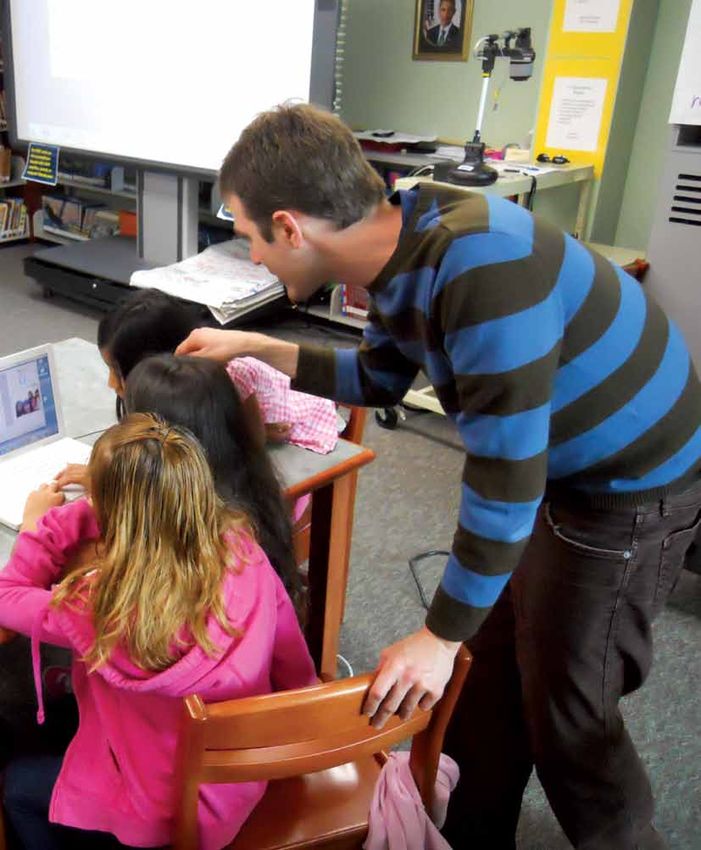
INTROduction

A fourth-grade
student works on an
estimation lesson
on MIND Research
Institute’s ST Math
Software with his
class at Overton
Elementary School
in Chicago, Ill.

           New Frontier, Big Impact                                                              graduates had participated in the
                                                                                                 new online curriculum; according
                                                                                                 to St. Mary’s County Public Schools
            The Promise of Virtual and Blended Learning                                          Superintendent Mike Martirano,
                                                                                                 some of these students would not have

           D
                     ental students at the University      At Evansville Vanderburgh School      graduated without the blended option. 3
                     of Maryland can skip class         Corporation (EVSC) Virtual Academy          Vignettes like these give a small
                     if they want, because the          in Indiana, a high school senior wants   picture of the big transformation
            professor’s lecture is recorded and         to boost her GPA, so she enrolls in an   occurring in education as a result of
            available online almost as soon as          online version of a course she already   blended and virtual learning, which
            she is finished, complete with the          took in class. She earns a higher        are becoming more common in U.S.
            slides she presented and notes she          grade, which her school allows her       schools at every level. These types of
            included. Students can rewind,              to replace. Not only does she improve    learning have created a new frontier,
            fast-forward and freeze-frame               her GPA, she hones her concentration     where the roles of instructors,
            her talk as well as zoom in on the          and study skills, leading to a higher    administrators, students and the entire
            slides. The convenience of having           SAT score and college acceptance.2       campus ecosystem are evolving. These
            the lectures captured and stored —             After just one year of blended        changes are leading to a rethinking
            along with a lecture library going          learning, the graduation rate            of the structure of educational
            back several years — has many               at Great Mills High School in            institutions, new funding models, new
            students listing this as a reason to        Maryland increased about 7 percent.      forms of curriculum and new, more
            pick UM’s program over others.1             Approximately 75 of the 2012             personalized approaches to pedagogy.

4   converge | special report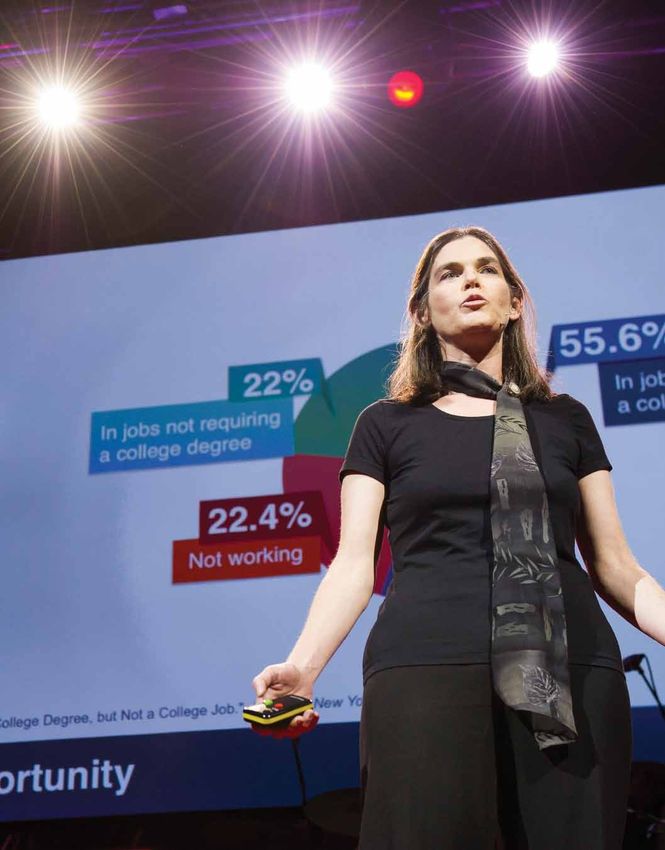
college students
                                                                                                   over

                                                                                                 6.1
                                                                                                            took an online
                                                                                                            course in fall 2010
                                                                                                            (up 560,000 from
                                                                                                            2009, representing
                                                                                                 million    a 10 percent
                                                                         The Growth                         growth rate).4

                                                                         of Blended and
                                                                         Virtual Learning

                                                                         At the
                                                                         K-12 level,

                                                                         1.8
                                                                         million
                                                                                                40
                                                                                                 states
                                                                         students were           have virtual
                                                                         enrolled in             schools or
                                                                         distance education      online learning
                                          getty images/Chicago Tribune

                                                                         courses in the          initiatives.5
                                                                         2009-2010 school
                                                                         year, while

   As more students choose
online or hybrid models of learning,
challenges are rising as well. Too many
                                                                                              12
                                                                                              percent
                                                                                                                        If
                                                                                                                    current
                                                                                                                     trends
instructors remain untrained in the                                                           of high
                                                                                                                   continue, by
use of online pedagogy. Administrators

                                                                                                              2018
                                                                                              school
similarly lack training in the unique                                                         students
complexities of managing online                                                               have taken
courses, programs and institutions.                                                           an online
Public policy sometimes works                                                                 class on               there
against successful online learning,                                                           their own,          will be more
such as government seat-time                                                                  outside           full-time online
restrictions that limit reimbursement                                                         of the            post-secondary
to the hours a student sits in a                                                              classroom,         students than
classroom rather than what a student                                                          to learn           students who
learns. Entrenched bureaucracies,                                                             about a            take all their
regulations and attitudes all stand                                                           topic that           classes in
in the way of needed reform.                                                                  interested           a physical
   This Special Report examines the                                                           them.6               location.7
new blended and virtual learning
frontier, taking an in-depth look at
its challenges and its promise. n

                                                                                                            converge | special report   5
glossary

        Bringing Clarity to the Confusion
         There remains much confusion in the field of blended and virtual learning over what these terms
         actually mean. School officials will sometimes say their campuses are incorporating blended learn-
         ing, but what they mean is their classrooms use technology to enrich learning. A student may use the
         Internet for research, but this alone does not constitute blended learning. The following definition of
         blended learning is widely accepted and was developed by the Innosight Institute in 2012 with input
         from more than 100 education experts and 80 organizations.

       “Blended learning is a formal education program in which
        a student learns at least in part through online delivery of content
        and instruction with some element of student control over time,
        place, path, and/or pace and at least in part at a supervised
        brick-and-mortar location away from home.” 8

         Innosight further breaks down blended learning        to study outside of class (a video recording of
         into four models:                                     the lecture, for example). The material normally
                                                               considered as homework — activities related
         1) Rotation:                                          to the content, plus discussion — is then done
         Students’ time is split between different             in class.
         modalities: sometimes in the classroom,
         sometimes in the lab. In class, students rotate       Hybrid learning is another term often used: Is
         on a scheduled basis between stations,                it different from blended? No, says Vicky Phillips,
         such as group projects, individual tutoring or        CEO of GetEducated, a consumer and research
         independent online learning.                          group focused on online learning.

         2) Flex:                                              Online learning, virtual learning and
         Students move on an individually customized,          distance learning are also terms that are
         fluid schedule among different learning modali-       often used interchangeably, yet they can carry
         ties, with teachers providing help as needed.         different meanings.
         Such models often employ differentiated staffing.
                                                               Distance learning is any type of learning
         3) Self-blend:                                        that takes place with the student and instructor
         Students attend traditional school but take one or    geographically distant from each other.
         more classes online.
                                                               Online learning is the most recent delivery
         4) Enriched virtual:                                  method used for distance learning instruction.
         Students learn at a physical school but teachers
         are brought in remotely, or divide time between       Virtual learning is any learning that occurs
         campus and home online learning; this model           where either the instructor or student are pres-
         began as full-time virtual schools developed          ent for an educational event in virtual rather
         blended programs to give students more face-to-       than physical form.9
         face time.
                                                               Mike Lawrence, executive director of
         Flipped classroom models are another form of          Computer-Using Educators, suggests “e-learn-
         blended learning where material that tradition-       ing strategies” as a more easily understood
         ally would have been covered in class, such as        and accepted term, covering both blended and
         an instructor’s lecture, is provided for students     online instruction. n

6   converge | special report
converge | special report
                            Getty Images/Diane Collins /Jordan Hollender

7
Drivers &
                  Roadblocks

Daphne Koller
is a co-founder
of Coursera, a
massive open
online course
(MOOC) that offers
free online courses
from a host of top
universities.

  8      converge | special report
Every
                        Revolution
                        Meets
                        Resistance
                        A Look at the Drivers and Roadblocks

                        S
                                 tudents in a Florida public school classroom work side by
                                 side at computers, but each child studies something different:
                                 Spanish, algebra, biology, English. A facilitator — not a certi-
                        fied teacher — manages the class, walking the room to maintain order
                        and make sure equipment functions properly.
                            Florida Virtual Learning Labs — offered to public schools as part
                        of Florida Virtual High School — are becoming popular because they
                        allow school districts to meet Florida’s strict class-size guidelines
                        without having to hire more teachers. They also help schools comply
                        with a state mandate that students attend an online course. In 2012,
                        273 online courses existed — a number set to double in 2013.
                            The School of One in New York is another ambitious blended
                        program. Middle-school walls were knocked down, creating a large
                        open space filled with centers that students move through in a
                        rotational model. At the end of each day, teachers run an algorithm
                        showing what each student has mastered, which determines the next
                        day’s assignment for that particular student.
                            At the University of Connecticut, a new graduate business class
FLICKR/TED Conference

                        is being held simultaneously at two campus locations, Hartford and
                        Stamford, using videoconferencing with an auto-tracking camera to
                        connect the instructor and students in one classroom with a teach-
                        ing assistant and students in another. The instructor uses a wireless
                        graphics tablet to make annotations on material displayed on the

                                                                                          converge | special report   9
interactive whiteboard and to control       well-known); nonprofit, online-only          courseware movement. Students can
          his PowerPoint presentation. The            public schools (such as the Western          take part in discussion sessions, answer
          interactive whiteboard is visible at both   Governors University, formed in 1997         quizzes, receive grades and earn a cer-
          locations, observed in real time as well    as the result of a cooperative effort        tificate of completion, all at no charge.
          as recorded for students to view later.     among the governors of 19 states);               Udemy is offering another new
              These outposts on the frontier          nonprofit, online private schools; and       option for students to learn by
          show some of the chief characteristics      both private and public brick-and-           empowering experts around the world
          of e-learning today: it is personalized,    mortar schools, which offer either           to teach and share what they know
          flexible and convenient. It is also a       online-only or blended programs.             online. It is a community platform
          key element in the educational change           The newest wrinkle: MOOCs, or            where it is easy for anyone with an
          that’s urgently needed to restore           massive open online courses. Examples        expertise to build an online course by
          America to economic health.                 include Coursera, a company co-found-        using video, PowerPoint, PDFs, audio,
              “Most jobs today — 60 percent —         ed by Stanford professors Andrew Ng          zip files and live classes.11
          require post-secondary education, yet       and Daphne Koller to offer free online           Even when college courses aren’t
          we are turning out a workforce with only    classes in more than three dozen             fully online, many are likely to have some
          about 40 percent holding a post-sec-        subjects from a host of top universities,    kind of an online element, such as virtual
          ondary degree,” says Bob Wise, former       including Stanford, Princeton, the           office hours, downloadable content or
          governor of West Virginia and head of       University of Pennsylvania and others.       videotaped lectures, says GetEducated’s
          the Alliance for Excellent Education.10     The company was started after Ng’s           Vicky Phillips. “There isn’t any ‘either/
              Wise calls for a host of changes to     first class drew more than 100,000           or’ — it’s flexing together.”
          spur greater educational attainment         students.                                        One reason: students today — raised
          at the K-12 level, including the use of         Other MOOCs include Google Vice          with online technology — demand it.
          blended learning.                           President Sebastian Thrun’s Udac-                “This generation of students is all
              Within higher education, there has      ity, which he started after his free         about convenience,” says Phillips.
          also been an increase in online and         online class in artificial intelligence at   “If they don’t want to go to a class,
          blended options at a range of differ-       Stanford attracted 160,000 students.         why should they? If they don’t want
          ent types of institutions: for-profit,          With MOOCs, students are given           to wait until 3 p.m. for office hours,
          online-only schools (the University         more than just the free lectures that        why can’t the instructor have virtual
          of Phoenix being perhaps the most           have long been part of the open              office hours? It’s the whole mentality

10   converge | special report
of anytime/anywhere — it’s very much • changes in pedagogy that value Despite these and other drivers, a
a part of our culture and especially this student-centered, flexible, data- variety of roadblocks and challenges
generation.” informed instruction, which pairs remain on the road to broad implemen-
Indeed, today’s mobile devices, well with personalized digital tation of blended and virtual learning.
digital content (including instruc- content available online; and
tional games), availability of video • Common Core implementation Educator, Administrator and
(conferencing, streaming, capture) and (and the ability to run online as- Community Acceptance
access to WiFi have helped fuel the sessments) must be accomplished Prevailing attitudes among some
movement to personalized, blended in the next two years for the 45 educators, administrators and communi-
and virtual learning. states that are adoptees (plus the ties that online and blended learning are
Other drivers include: District of Columbia); even states not as rigorous as traditional learning are
• the need to improve high school that aren’t Common Core adoptees slowing adoption. Less than one-third of
graduation rates, which has led to have upgraded standards, which chief academic officers say their faculty
the use of more credit-recovery pro- means a national imperative to accept the value and legitimacy of online
grams, many of which are online; change curriculum and upgrade education, a percentage that has changed
• demand by students for the freedom teacher skills. little over the last eight years.13
getty images/Blend Images/Ariel Skelley
to “self-blend” and take whichever
type of course best suits their needs;
getty images/MACIEJ NOSKOWSKI
• demand by state legislatures that
students take at least one online
course before they graduate (Florida
and Idaho have this mandate);
• budgetary pressures; as funding
drops, districts look for more
economical ways to provide services
(online learning can be less expen-
sive — Florida Virtual High School’s
per-student costs in 2010-11 were
$4,840, compared with $6,999
statewide and $10,000 nationally);12
• competition; at both higher educa-
tion and K-12 levels, there is student
demand for blended and/or online
services; in some districts, K-12
students have multiple choices for
online learning (including charter
and state schools), while colleges
find themselves competing for
enrollments with schools offering
more flexible learning options;
“We are incentivizing the
wrong things. We need to
put our money where our
priorities are. If our priority
is to keep kids in chairs while
their parents are away, I’m
pretty sure we don’t need to
have people paid $90,000 a
year to do that work.”
— David Haglund, Principal,
Riverside Virtual School, Calif.
converge | special report 11Zoe Renfro, principal of the new incentivizing the wrong things. We
Bradley County Virtual School in need to put our money where our
Cleveland, Tenn., says winning priorities are. If our priority is to keep
administrative, school board and kids in chairs while their parents are
community support for their grades away, I’m pretty sure we don’t need
3-12 school was a challenge. “They to have people paid $90,000 a year
went to brick and mortar schools,” to do that work. If we paid schools
and weren’t convinced students could based on their outcomes, maybe we
get a quality education online, says would see a shift in focus in the work
Renfro. “It’s taken some time to show and a subsequent improvement in
them there are curriculum providers learning. As my dad always warned
out there who are writing and provid- me, you get what you pay for.”
ing a good, rigorous curriculum.”14 Riverside has introduced
language in the California legis-
Seat-Time Funding lature that would reimburse the
Funding based on Carnegie district based on demonstration
seat-time reimburses school districts of competency in online courses.
for the amount of time students are “Don’t pay us until our kids dem-
physically present (typically 180 days onstrate proficiency,” he says.17
a year). Such rules were put in place in The 15-year-old Florida Virtual
the early 1900s as a reform measure School already follows this prin-
ensuring all American children had ciple; it is reimbursed only after
access to education. Today, though, students master their courses.
such rules are counterproductive.
“The seat-time policies didn’t Disparate Learning Systems;
foresee online courses and learn- Lack of Standardization
ing,” says Susan Patrick, CEO of Instructors using digital curriculum
the International Association for products from different vendors may
K-12 Online Learning (iNACOL). find themselves faced with learning
“They are clunky and limit what several different interfaces — not some-
a district can do in terms of on- thing busy instructors want to take the
line and blended learning.”15 time to do. Disparate learning systems
In recent years, states have started may also not offer interoperability
FLICKR/Fort Sill Cannoneer
moving away from seat-time policies. with learning management systems.
Students enjoy some
Thirty-six states have adopted policies Middleware that allows for easier,
technology time at the that allow for credit-for-performance more cost-effective integration of
School Age Center
computer lab in Fort rather than time spent physically in content and platforms is one solution.
Sill, Okla. class. In 2009, New Hampshire did Organizations such as the IMS
away with seat-time policies entirely, Group and the Association of
requiring high schools to comply Educational Publishers (AEP) are
with a competency-based model.16 working to develop and foster the
“Kids should be allowed to move on use of common standards for digital
when they’ve mastered the content,” materials. This would allow digital
says David Haglund, principal of Riv- content from publishers, third-party
erside Virtual School in California. “If providers and others to be more
we’re going to focus on learning, we’re easily integrated into a school or
going to have to let go of arbitrary college’s learning environment,
constrictions relating to time and making these products more likely
place. From my perspective, the only to be adopted by instructors. The
way to do that is to engage learning AEP, for example, supports the
24/7 and focus on competency.” Learning Resource Metadata
Haglund says it makes more sense Initiative, which would create a
for schools to be paid based on student standard framework for the online
outcomes, not seat time. “We are tagging of educational content.18
12 converge | special reportAnother issue with digital content Despite these challenges, research continues to show that blended
at both the K-12 and higher education and virtual learning are equal to or better than face-to-face learning.
levels has been a tendency for institu-
tions to adopt standardized software 3 Eighth-grade algebra students in a blended learning class outperformed
solutions that may not be adaptable or counterparts in a traditional classroom setting, according to a recent study
customizable for various disciplines by researchers from the American Institutes for Research and Education
— leading educators to reject using Development Center. The study compared 218 students who studied online
these products and instead build their at school with 222 students who received classroom instruction. The online
own. In recognition of this problem, students were proctored by a math teacher and also had an online math
future learning content models may instructor assigned to them. At the end of an academic year, the online
shift to a less structured, hierarchical students scored slightly higher than the control group and were twice as
approach in favor of more organic likely to take advanced math classes.21
dissemination and collaboration.
Additional challenges when 3 Nonprofit researcher Ithaka recently studied blended learning, comparing
moving to blended and virtual students at six public universities to test efficacy. The students were divided
environments include: into two groups, with one taking a course in hybrid fashion and the other
• A lack of formal training taking a traditional course. Result: The hybrid group got the same scores as
or certification in technol- traditional learners, but took less time to complete their courses.22
ogy integration in most teacher
preparatory programs. Many 3 In a 2009 meta-analysis of online and blended learning, the U.S. Department of
new teachers arrive in classrooms Education found these types of learning were just as effective as face-to-face
not knowing how to use online learning, with blended learning offering the best results.23
and blended learning technolo-
gies and must learn on the job.
• Intellectual property concerns.
Which material found online
(and how much of it) can be used
legally by instructors? While fair
use and TEACH Act provisions
provide guidance, there still
remains gray areas for instruc-
tors planning lessons, especially
those that include digital content
excerpts.19 Another issue: Do
instructors maintain any rights to
their lesson materials, videocasts
or audiocasts? University policies
can differ quite significantly. 20
• A potential confusing new
dynamic for administrators,
teachers and students. Shifting to
a blended learning environment
can be especially tricky because
the existing on-site structure
is still largely maintained, yet
with new roles for teachers,
flickr/August Jennewein/courtesy UMSL
administrators and students.
Proper training and understand-
ing of the new learning dynamic
is essential to the transition.
• Network access and security
concerns. These must be addressed
to support the shift to vastly
increased student access. n
converge | special report 13The Support
Ecosystem
All aspects of campuses
need to evolve to support
the transition to blended
and virtual learning. School
district libraries are now
hosting Digital Bookmo-
biles (an alternative to the
traditional bookmobile)
to engage students with
e-books, audiobooks,
music and video.
14 converge | special reportdigitalbookmobile.com
The Support
Ecosystem:
What’s Needed
to Make it Work
Moving into the blended
and virtual learning
frontier requires a strong
support system that
includes both human and
technology resources,
and updated policies and
strategies. This support
ecosystem expands
outside of the traditional
classroom and reaches
across all departments
and areas of a campus.
converge | special report 15For some additional resources about instructional design
degree and certificate programs, visit the following sites:
www.learningsolutionsmag.com/articles/670/
www.bls.gov/ooh/Education-Training-and-Library/Instructional-
coordinators.htm
www.instructionaldesigncentral.com
flickr/ConnectionsAcademy
can tap the teachers at supporting the technical educational
Teachers at the virtual remotely for a certain needs to facilitate these new learning
public school, Connections
Academy, interact with number of hours per opportunities. Also, a variety of degree
students on the phone, week (including different and certificate programs — many
over the Web, and at
in-person field trips and teachers from different online — have surfaced in the last
social activities.
schools, depending on decade in the field of instructional
language specialty), with design. Districts and colleges also may
The Learning Staff a facilitator or paraprofessional on use the services of online curriculum
To transition to blended and hand to supervise and prevent prob- developers, subject matter experts,
virtual learning, a host of support staff lems, thus allowing more students content writers and others.
is needed, both inside and outside to receive varied language instruc-
the classroom, covering everything tion while still containing costs. Collaborative Technologies
from aides and IT workers to special Librarians, too, have a changing Beyond personnel, another key to
education paraprofessionals and role: Today’s librarians, whether in making e-learning initiatives suc-
counselors to library specialists. Often, higher education or K-12, “have to be cessful is collaborative technology.
these roles are changing and evolving much more IT-sophisticated,” and Having a flexible, user-friendly LMS
with the move to online learning. have become digital curators and can help instructors and students
When students are studying online archivists, says Vicky Phillips, CEO of maintain the communication needed
coursework in classrooms or computer GetEducated. “Still there are very few for successful online learning.
labs, it may make sense for lesser- library science programs even online Another collaborative tool that is
trained (and paid) paraprofessionals, that have an emphasis on digital.”24 increasingly critical: video capture,
facilitators or others to be on hand The role of the IT professional in where educators record lectures,
for support, leaving certified educa- education is also shifting, as more lessons and other material for students
tors for higher-level interactions. maintenance and traditional IT duties to watch later, either as a download or
Proctors assigned to watch students are being outsourced to cloud-based streamed material.
taking tests may be able to do this services. For some, this may mean a Lecture capture is growing rapidly in
virtually, allowing students to take move to instructional development and higher education. More than two-thirds
tests from home rather than having design. Master teachers with tech skills of online courses at the community
to travel to an in-person, proctored also may move into these positions. college level use some type of online col-
test site. Services exist that let proc- “The trend I see is for technol- laboration tools, according to the Center
tors monitor students through their ogy departments to become less of for Digital Education’s 2011 Com-
computers’ webcams. The proctors a technical department and more of munity Colleges Survey.26 Additionally,
also monitor the students’ comput- an instructional department,” says in another recent university study,
ers to make sure no unauthorized Aaron Slutsky, director of technology recorded lectures and other content
programs are being accessed. Students for McDowell County Public Schools were found to increase student compre-
can’t take screenshots or look up in North Carolina. “I would like to hension and test prep, and helped some
answers if forbidden by examiners. grow our instructional side and have students score more highly on tests.27
In foreign language classes, a a group of facilitators who are in the At North Arkansas College, 90
district might employ a limited classroom helping teachers integrate courses are recording lectures and 84
number of teachers certified in specific the technology into the curriculum.”25 percent of students say they’d like to see
languages, being unable to afford to Although this trend is not more use of this technology in future
have this teaching repertoire in every widespread as of yet, districts are courses.28 Pace University in New York
school every day. But a language lab acknowledging the need to get better views lecture capture as a way to serve
16 converge | special reportStudents interact
with each other and
digital content at the
Colorado Springs
School District 11
Internet Cafe.
students located in other countries
Derek Swanson
(and time zones). “We know that
recorded lectures are an important part
of distance learning courses that can
attract students from around the world,
who will add to the rich cultural experi- In one such configuration, students of nursing students working with medi-
ence of the university,” says Shikha call into a bridge mechanism that cal simulation mannequins.
Bajracharya, director of user services.29 allows the professor to see their faces Some classrooms of the future
University of Maryland College of in a Hollywood Squares-like display, can cost $100,000-plus and be fully
Dentistry students report on end-of- with each student’s face in a small box tricked out with video and audio tools
year surveys that they find recorded on the screen. The instructor controls to capture the classroom experience. A
lectures to be extremely valuable, says what is displayed; students are usu- more typical classroom capture setting
James Craig, educational consultant for ally shown only during discussions with video costs $15,000 to $30,000,
the school. “Students will say if it wasn’t or question-and-answer periods. including projection technology, controls
for lecture capture, they wouldn’t These specialty rooms are outfit- for lights and audio, and fixed cameras.
have graduated,” says Craig. “Many ted with multiple cameras (including Some universities are tiering their video
students select us because of that.”30 ones that can sense and respond to capture classrooms, so that some rooms
Within K-12 schools, video cap- whomever is speaking) and special have higher-level capture tools than
ture is still a small segment, though sound and lighting equipment. If rooms others, with courses scheduled accord-
growing. The primary use in K-12 aren’t available, cart-based systems ingly. Universities may fully outfit 10
is professional training. Sometimes can be wheeled from classroom to percent of their rooms, and then work
rural schools will use it to offer AP classroom. Desktop capture is an- in coming years to add equipment to
courses they can’t provide on location, other alternative — using a classroom others as funds become available.
rather than having students travel. computer to do the recording. Some believe for-profit institutions
Videoconferencing is another Instructors now have the ability can afford to adopt these technologies
rising element. It is becoming more to annotate over presentations, such faster than public institutions, where
affordable, allowing teachers to as on interactive whiteboards; these budgets are tight. Yet this technology
connect students with other students, annotations can be captured as part of can be a cost-saver for institutions:
experts and outside-the-classroom the lecture so students don’t see just the rather than build or expand classroom
virtual field trips. Students can col- instructor’s face, but also the material facilities and large lecture halls,
laborate with another classroom being presented and annotated. The they can offer classes online (maybe
within their district, in another state or whiteboarded material can be saved with a smaller number of students
another country. They can use mobile as a PDF file or other format and made showing up for in-person lectures).
devices to join lecture discussions available online or via email after class.
that they can’t attend in person. Teachers can present other content, Digital Learning Content that is
Lecture capture and videocon- websites and so forth. Document camer- Interactive, Adaptive and Guided
ferencing work most smoothly when as can show 3D objects on these screens. Digital content today is not just
there are dedicated room systems, Medical simulation capture can in- a repurposed textbook, but rather
letting teachers focus on teaching volve three or four different angles cap- material that can include video and
rather than lights and cameras. Such tured simultaneously, as at a nursing lab audio elements, games, puzzles,
room systems might have touch- at Douglas College in British Columbia. quizzes and tests. Schools and colleges
panel control systems in the instructor’s The college was experiencing a shortage can pick from prepackaged courses,
podium to view students connecting of nurses and nursing instructors, so individual learning objects that are
on mobile devices or computers. recorded several angles simultaneously available a la carte and open source
converge | special report 17students. Students can join Alabama is also providing Common
Web-based social com- Core materials through its online
munities to interact with Alabama Learning Exchange (ALEX).34
other students, including
those who are natives Updated Procurement Policies
in the language they are Procurement policies for online
studying. Lessons could digital materials are often overly compli-
include activities such as cated and inflexible. “Up until 15 years
sending a text message ago, we focused on only one type of
in a foreign language or content delivery: textbooks,” says Wise.
performing a mock job “But buying a textbook with a lifespan
interview in another of four to six years versus buying digital
language (recorded for content that is updated daily is a far
the teacher to see). different situation. Those procure-
Online curriculum ment rules need to be revisited and in
FLICKR/jasonwoodhead23
The University of Alberta increasingly is mirroring many cases completely changed.”35
in Canada accommodated
the IP address needs of
what’s being taught in Using purchase orders to buy
38,000 students and 14,000 the brick-and-mortar content pieces, such as online text-
faculty and staff by using an
automated management classroom. “We’re shifting books, remains an area of difficulty
software solution.
away from a high level for campuses. Administrators might
of difference,” says Greg see deals on consumer sites, such as
(free) content, or they can create their Ottinger, director of online learning for Amazon.com, and want to simply buy
own content. Some learning courses the San Diego County Office of Educa- items in bulk this way, but districts
are customizable, allowing instruc- tion.32 The classroom and home learning work with purchase orders and can’t
tors to rearrange units, add their own experiences are becoming more similar buy downloads. In addition, state
projects or even film themselves on Web today, letting students move back and contract vehicles that would speed up
cameras to incorporate into lessons. forth between them (such as during an the purchasing process are not readily
With a few clicks, teachers can include illness). The remote student can partici- available in every state for all potential
video of themselves, including news pate and have the same opportunities at digital curriculum providers. It is also
on the fly in a daily lesson or activity. home with the same learning tools and more common for state departments
“Technology means teachers don’t resources as those in the classroom. of education to allow digital content
have to keep repeating the same lecture School districts in most states will add-ons to existing textbook contracts,
but can find content materials and want digital content to be Common rather than allowing the purchase of a
authorities across the globe that will Core compliant. As these standards are full digital curriculum replacement.
best move their students forward,” says being implemented, it is key for K-12 Colleges shifting from print to digital
former West Virginia Gov. Bob Wise.31 teachers to have material available textbooks can take months to negotiate
Instructional programs can be that has been aligned to the standards the change with publishers and prepare
used in or outside the classroom, with they need to teach. Or, for the handful for e-books that students can read on
students working on personalized of states that have not adopted CCSS, mobile devices. Even once purchased,
lessons, at their own pace. Continu- it is important for teachers to have publishers can impose restrictions —
ous formative assessment built into state standards-compliant material. such as limiting content access to one
content adjusts the material instantly States getting ready for Common device per student or restricting the
to a student’s performance. Core implementation and assessment number of pages a student can print.
With foreign language content, can look to Michigan and South One new initiative brings together
studio coaches can work online with Dakota for an example of how to use 28 schools in a joint effort to receive
students to practice conversations resources to help schools prepare. The deeply discounted e-textbooks, view-
with native speakers (students can see two states are paying teachers to locate able via Internet2’s NET+ cloud-based
them via video presence). Students can open access, Common Core-aligned collaborative purchasing system.
record video and/or audio of themselves resources, such as digital learning The effort should help students save
practicing lessons for a teacher to hear objects, and post them to Michigan’s money (the average student spends
and assess; they can also see a graphic open source digital resource portal, about $1,000 per year on books).36
display of their audio waves and match MORE (Michigan Online Resources Some states (including Florida,
this pattern to that produced by a native for Educators). Michigan is welcom- West Virginia, Utah and Idaho) are
speaker. Teachers can record replies to ing other states to join the effort.33 unbundling content, enabling schools
18 converge | special reportto obtain content from a variety of to more than a third of devices being Achieve K12 is a four-year-old, fully
sources. Content can be broken down mobile, says Patches Hill, technology online K-12 school in Colorado Springs,
into individual parts and purchased systems manager. The district recently Colo., serving about 200 students (and
a la carte, so that digital learning installed a mobile device management growing: the prior year’s enrollment
objects, chapters and other bits of solution to help push configurations was 60). Students take courses online
material can be purchased separately. and control settings while improving but can come to school for tutoring
security. “We will now be able to sessions with their teachers. Achieve
Tailored IT Security and Solutions make a change on devices without K12 also offers on-site art and physical
The virtual and blended learning students and teachers bringing them education programs.
frontier has a variety of security needs. into a central location,” says Hill.37 About 30 of the students in the most
Integrity of online assignments and Multiple devices coming onto net- recent year were elementary students
tests is one concern. Districts and works mean IP address management from grades 2 through 5, says Assistant
colleges need to prevent cheating is needed. The University of Alberta Superintendent Robert Curran. “We
and take steps to ensure, as much as in Edmonton, Canada, needed to see a lot of parents who would gener-
they are able, that the online student accommodate IP address needs ally home school their children, but
turning in the homework or taking the of more than 38,000 students and they decide on this because we provide
test is the student receiving credit. 14,000 faculty and staff. A software the curriculum. They have the ability
One strategy is requiring “two-factor solution allowed the university to to be home with the student.”
authentication” or “multi-factor iden- reduce the complexity of manag- Achieve K12 competes with “a ton
tification” — such as having university ing IP addresses across multiple of online providers within the state,”
credentials and a PIN to log in. Virtual platforms. Putting in automated says Curran, plus programs at neigh-
proctors are another solution, mak- management allowed the university boring school districts and a state
ing use of cameras in classrooms to to reduce administrative costs, while online program. “It’s gotten to be a
watch for cheating during tests. enhancing reliability, manage- very competitive environment.”40 n
FERPA (the Family Educational ability, scalability and security. 38
Rights and Privacy Act) is another
concern: to receive funding, administra- New Branding and Best Practices for Online
tors must ensure confidentiality and Marketing Strategies Pedagogy Services
integrity of information. Administrators Branding is important for recruitment, 3 Build a community (example: have
need to make sure the right person has especially in a crowded, competitive field. students embed photos and videos of
the right level of access and that Web How do campuses set themselves apart? themselves, their hobbies and interests)
servers are secure, so data is protected. More students are starting to look at 3 Use appropriate formative and summative
Managing back-end infrastructure return on investment for their education assessments
is also important. Many institutions dollars. Will an educational institution 3 Foster collaboration
are now using hosted applications provide them with the 21st-century 3 Instill the “4 Cs” of 21st-Century learning
but with access control to ensure skills they will need in the marketplace (creativity, critical thinking, collaboration,
confidential information isn’t leaked. (which could include video capture/ communication)
On the other hand, having to conferencing as well as a general envi- 3 Remember that tech tools are subordinate
re-authenticate repeatedly during the ronment of technological innovation)? to educational objectives: map out first
course of a school day is frustrating Ivy League schools are jumping what standards you want to achieve, then
for students, faculty and staff. An into the online world. Yale, Harvard, find the tool to help students get there
instructor might need to know multiple Stanford and Columbia all have begun
passwords and usernames in order to offering online courses for credit in
sign in for various classes, databases, recent years. The $25-million funded
vendor sites, student accounts and so Minerva Project aims to begin offering
on. Single sign-on is preferred, though an Ivy-League level education in a fully
not always possible. Still, programs and online mode, cutting costs to about
services exist to provide authentication $20,000 per year, starting in 2014. 39
and password management assistance. Marketing is relevant not only
Additionally, mobile devices can in higher education but also in K-12
represent a challenge for institutional education, where parents are being
networks. In the past two years, Indian asked to decide between public and
River School District in Delaware has private schools or between charter
gone from almost no mobile devices and traditional schools.
converge | special report 19ROle of educators
The
Enhanced,
Evolving Role
of Educators
E
ducators are key to successful
learning, whether online or not.
Yet it’s not always easy for them
to transition from one field to the next,
or to juggle the demands of a blended
classroom, especially since many are
not trained in online skillsets.
Former Gov. Bob Wise says the shift
Subhead
to a blended, technology-infused envi-
ronment is good for educators. “I think
it’s a positive shift and it enhances the
role of the educator; it doesn’t diminish
it,” he says. Beyond being a guide on
the side, today’s instructors are more
like educational designers, he says,
using technology tools that allow them
to work on an individual basis with
students, knowing their strengths and
weaknesses, and helping design their
most successful learning path.
Parents’ biggest concern about their
children using technology in school,
says Wise, is that it will depersonalize
the process. Yet, he argues, despite
constrained budgets, “layoffs for
laptops” and political rhetoric that
negatively portrays the profession,
“The educator is still the most critical
element in school. The educator has
a much greater ability to bring about
successful outcomes.”41
20 converge | special reportflickr/macsd converge | special report 21
Online learning systems can do         looking at a student and realizing ‘this                       encouragement and empowerment.
          much to help students learn, but they     student hasn’t had breakfast in three                          Even more importantly, technology
          can’t replace the human connection        consecutive days; this is a problem.’”42                       allows them to get to know their
          students make with instructors, nor          Teachers may worry that they are                            students on a much deeper level;
          the influence they have, especially in    going to be replaced by technology.                            they’re not trying to teach to a large
          a blended model where there remains       When they see such programs in action                          class, all learning the same subject at
          some element of face-to-face contact.     and discover their continuing role, such                       the same time.
             “I spent 10 years teaching in an       fears may ease. They also may appreci-                             Many learning programs provide
          inner-city school,” says Greg Ottinger,   ate the support technology can provide                         student data through a learning
          director of online learning for the San   them in helping plan individualized                            management system, such as forma-
          Diego County Office of Education.         lessons and track student analytics.                           tive assessments and other analytics.
          “There is a huge difference between          In a blended or virtual system,                             New frontier teachers need to be able
          a curriculum saying ‘click here and       teachers are still teaching; they                              to interpret this data in order to best
          here and do it again’ versus a teacher    are still providing support,                                   provide differentiated instruction.

          The Roles of Educators in Online and Blended Learning Environments
          The roles of educators are constantly evolving, especially when it comes to blended and virtual learning. These
          images represent four of the common roles found in blended and virtual learning environments. The ideal blended
          and virtual educator would most likely incorporate aspects from all four roles.
                                                                     flickr/flickingerbrad

          Supervising self-guided instruction                                                Lecturing with the support of technology
          In blended learning environments it is common                                      Although increasingly less common in blended and
          for students to self-guide themselves through the                                  online learning environments, educators are still required
          curriculum. In this case, lesser-trained (but still                                in certain situations to feed information to students —
          paid) paraprofessionals or facilitators can supervise                              similar to a lecture in a traditional classroom structure.
          certain classes to make sure students stay on task.                                Online and blended educators, however, have the
                                                                                             advantage of using technology to supplement lectures.

22   converge | special report
Differences Between Online Teaching students need reminders to log in and “The educator is
in K-12 and Higher Education to do assignments. “In college, the at-
As Metropolitan Nashville Public titude is that the students are in college
still the most critical
Schools began adding virtual and blended so they should know how to do this by element in school.
learning last year, administrators initially now. In K-12, that can’t be the case. You The educator has a
chose part-time online college instruc- really have to pull them along, encour- much greater ability
tors as teachers — but realized there are age them, and help them adapt to this to bring about
differences between how courses are environment.”43
taught online in college and in K-12. While online educators at colleges
successful outcomes.”
“What they are required to do at the and universities may expect indepen- — Bob Wise, Former Governor of West
K-12 level is significantly different from dence from their students, they still Virginia and Head of the Alliance
what they do at college,” says Kecia Ray, need to keep lines of communication for Excellent Education
executive director of learning technology. open and be responsive for online
Courses are paced differently, while learning to be effective.
FLICKR/Karen Blumberg
flickr/flickingerbrad
flickr/flickingerbrad
Making real-world connections teaching in a purely virtual environment
A highly trained online and blended learning In a purely virtual/online learning environment, students
educator achieves a proper balance of teaching drive their own learning and advancement through the
students and guiding students in their own curriculum, while educators are available via online chat
learning. They also make real-world connections or video presence to answer questions and intervene
with their lessons, with the aid of technology. when necessary.
converge | special report 23Key Instructor Traits for Blended and Virtual Teaching
Successful online teachers need to be able to:
• Use student-centered instructional strategies to encourage active
learning and interaction
• Identify tech tools and strategies to move project-based learning
into the online environment
• Collaborate with colleagues through the use of Web-based tools
• Use asynchronous discussion tools and social media tools
• Understand accessibility; know the relevant laws and regulations
related to Section 508 and the Americans with Disabilities Act (ADA)
• Know how to develop and deliver assessments, projects and
assignments that meet standards-based learning goals
• Understand the changing role of the online teacher to online coach
Courtesy of Greg Ottinger, Director of Online Learning, San Diego County Office of Education
GetEducated.com collected data development to help teachers become
from about 1,000 online college acclimated to the product and create
students to find leading causes for their own tasks or lessons within the
dissatisfaction with their schools. The framework of the software.
chief complaint, says GetEducated CEO Professional learning communi-
Vicky Phillips, is related to inadequate ties also exist online, supported by
instructor interaction. learning software providers, educa-
“The number one complaint by far tion associations and educational
is: ‘Where is my professor?’” she says. institutions. These allow teachers
“They’ll say, ‘I could have learned as to compare notes on online teaching
much by buying a book.’ They feel they practices and can be a source of ongo-
are not getting any mentoring, guidance ing coaching, mentoring and support.
or feedback.”44 A new national program offering
certification for e-learning teachers
Professional Development: is Leading Edge Certification, run
Training Needed in Online by a nonprofit alliance of educators,
Teaching Skills universities and educational agencies.
“Teachers are not often trained Leading Edge began certifying online
in online and/or blended instruction,” and blended learning teachers in 2011
says Susan Patrick, iNACOL CEO. and administrators in 2012.
“In the 21st-century, there’s a huge “The vast majority of the teaching
need for teachers to be coming out of force out there and administrators However, implementing lecture
teacher prep programs with a wider as well have limited experience in an capture is not without its difficul-
range of skills.”45 online and blended environment,” ties. When the system was first put
K-12 teachers are not the only ones says Mike Lawrence, Leading Edge into practice, some faculty members
lacking training in online teaching. founder. “I see a massive chasm in the were uncomfortable with the idea
Only about half of 183 two- and skillset of teaching online.”47 of attendance not being mandatory.
four-year colleges had formal training One aspect of online teaching that Faculty and students have been able
in place for faculty to teach online, ac- instructors need to prepare for is the to compromise on the issue, and some
cording to the 2010 Managing Online increased time-shifting by students classes at the school have mandatory
Education survey by WCET and the of their lectures. At the University attendance, while others do not.48
Campus Computing Project.46 of Maryland College of Dentistry, all
One way to gain training in online lectures are recorded; some classes Transitioning to Online
skills is from content providers, give students the option to attend Julie Young, CEO of Florida Virtual
which typically provide professional in-person, remotely or not at all. School (FLVS), says full-time teachers
24 converge | special reportshutterstock.com
should spend a day in a kindergarten traits in an online environment, it’s not “Full-time teachers
or first-grade classroom as part of an always easy.”49 should spend a day in a
orientation to blended learning, because Other teachers may struggle in a kindergarten or first-grade
they can get an appreciation for what it’s traditional environment, but find it classroom as part of an
like to have multiple students pursuing easier to teach and excel online because orientation to blended
multiple paths simultaneously. everything is not done in real time; learning, because they
“You could have a phenomenal teachers have time to plan for their can get an appreciation
classroom teacher who comes to next student interactions. for what it’s like to
Florida Virtual School and is miser- Mentors can be helpful for teachers have multiple students
able,” says Young. “They may be new to online and blended learning. At pursuing multiple paths
phenomenal because they are great FLVS, “star teachers” are paired with new simultaneously.”
entertainers and very engaging in teachers to “shepherd them through their
class, but when you come to any virtual first year,” says Young. Mentors are avail- — Julie Young, CEO,
school and see how to have these same able 7 a.m. to midnight for teacher calls. n Florida Virtual School
converge | special report 25You can also read


