The evolution of creationism
←
→
Page content transcription
If your browser does not render page correctly, please read the page content below
The evolution of creationism

                            David R. Montgomery, Quaternary Research Center and Dept. of            (354–413), Thomas Aquinas (1225–1274), and John Calvin (1509–
                            Earth and Space Sciences, Box 351310, University of Washington,         1564) all endorsed reason as the way to learn about the world.
                            Seattle, Washington 98195-1310, USA, dave@ess.washington.edu            Augustine was among the first to caution against advocating for
                                                                                                    biblical interpretations that conflicted with what one could
                              I do not feel obliged to believe that the same God who has endowed    observe for oneself. Centuries later, Aquinas praised the pursuit of
                            us with senses, reason, and intellect has intended us to forego their   knowledge and insight gained from experience reading God’s
                            use. —Galileo Galilei                                                   other book—nature.
                                                                                                       Writing at the time of the Reformation, Calvin, too, considered
                            ABSTRACT                                                                the revelations of both nature and the Bible as fundamental
                                                                                                    truths. In his Institutes of the Christian Religion (1559), Calvin
                               For centuries, natural philosophers, their scientific successors,    explicitly embraced the idea of respecting natural truths revealed
                            and theologians alike sought to explain the physical and natural        through the study of nature: “If we regard the Spirit of God as the
                            world. The now common cultural narrative of perpetual conflict          sole fountain of truth, we shall neither reject the truth itself, nor
                            between science and religion simplifies the arguments and               despise it wherever it shall appear, unless we wish to dishonor the
                            struggles of the past and overlooks cross-pollination between           Spirit of God” (McNeill, ed., 1960, p. 273–274).
                            those who embraced faith and reason as the keys to understanding           Calvin believed in keeping an open mind when it came to
                            earth history. When geologists unequivocally dismissed the idea         evaluating what we can learn about the natural world from
                            of a global flood and recognized Earth’s antiquity, many                observation and experience. In his view, closing one’s eyes to the
                            conservative theologians acknowledged that there was more to the        way the world works was to close one’s eyes to God.
                            past than literally spelled out in Genesis, the opening chapter of         Augustine, Aquinas, and Calvin all believed that Noah’s Flood
                            the Bible. But some Christians—those we now call creationists—          was a global flood. They interpreted fossil seashells found in rocks
                            rejected this perspective and chose to see geology as a threat to       as compelling proof—how else could the bones of marine
                            their faith. In so doing, they abandoned faith in reason and cast       creatures have ended up entombed in rocks high in the
                            off a long-standing theological tradition that rocks don’t lie.         mountains?
                                                                                                       Biblical interpretations accommodated new discoveries as
                            INTRODUCTION                                                            knowledge of the natural world grew, because theologians adhered
                               The story of historical views on Noah’s Flood shows how there        to the principle that God’s works in the natural world could not
                            is far more to the story of the relationship between science and        conflict with His Word in the Bible. Generation after generation
                            religion than the simple portrayal of a long-running feud               of natural philosophers slowly uncovered facts inconsistent with a
                            (Gillespie, 1951; Glacken, 1967; Davies, 1969; Rudwick, 2005;           global flood, making it increasingly implausible to understand
                            Montgomery, 2012). By the end of the nineteenth century,                earth history in ways consistent with traditional literal
                            conservative Christians generally accepted that there was no            interpretations of the Bible.
                            geological support for reading Noah’s Flood as a globe-wrecking
                            deluge and that natural revelations established by science should       FINDING TIME
                            guide biblical interpretation. Even the original fundamentalists           In 1669, when Steno, the venerated grandfather of geology, laid
                            accepted geologic evidence that contradicted the view of a six-day      down his principles for reading the rock record, he interpreted his
                            creation followed by Noah’s Flood as all there was to earth history     observations of the Tuscan landscape as recording six stages, one
                            (Numbers, 1993). But the forerunners of modern creationists             of which corresponded to Noah’s Flood (Fig. 1). Steno’s insights
                            chose to defend their preferred literal reading of scripture no         framed how to read earth history directly from the rocks. In
                            matter what the rocks revealed. Dismissing the findings of              arguing that the Flood laid down strata that subsequently
                            geologists, they rejected reason in the name of faith. In this sense,   collapsed to form today’s topography, Steno indirectly introduced
                            modern creationism evolved in response to geological discoveries.       the idea of tectonic controls on landforms, a foundational concept
                            The following brief review traces aspects of this story to illustrate   of modern geomorphology.
                            how geological debates evolved into theological schisms anchored           Steno’s little book, with its simple diagrams, formalized how to
GSA TODAY | NOVEMBER 2012

                            by creationist views with no scientific currency.                       read earth history using the basic principles of geometry. The key
                                                                                                    wasn’t the underlying mathematical symmetry astronomers found
                            FAITH IN NATURE                                                         in the heavens; it was simple rules based on what one could see for
                              For the first millennium of Christianity, major theologians           oneself. Before Steno, only a curious few read beyond the cover of
                            embraced knowledge of the natural world in order to defend              nature’s great book to ponder the relationship between rocks and
                            against pagan challenges to biblical authority. Saint Augustine         the lay of the land.

                            GSA Today, v. 22, no. 11, doi: 10.1130/GSATG158A.1.

         4
A century later, geologic history began to challenge theological
1 4 tradition after discoveries like James Hutton’s unconformity,
F G F G
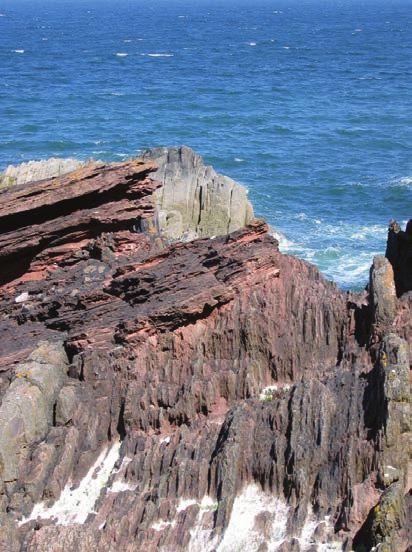
separating two distinct sandstones, at Siccar Point (Fig. 2)
B A C demonstrated that Earth’s history was too complicated to be
accounted for by a single flood, no matter how big. Mainstream
theologians willing to allow that there was more to the geological
story than laid out in the Bible, and that the days of creation may
have been allegorical, were less inclined to give up on the reality of
2 5 a global flood. Many believed that the biblical flood inaugurated
F G F G the most recent geological age. The lack of human remains in
B A C rocks thought to pre-date the flood was widely considered to
confirm this view.
Although it is commonly assumed that eighteenth-century
Christian theologians were opposed to science, some orthodox
churchmen openly accepted the idea that Earth was ancient. In
3 6 1785, the Reverend James Douglas presented A Dissertation on the
F G F G Antiquity of the Earth to the Royal Society. Douglas noted that
I B C sound geological observations supported the idea that the world
A
D was much older than the traditional 6000 years inferred from
biblical interpretation: “Many well-informed persons have
therefore been inclined to suppose that the earth was created in
six expanses of time instead of six days” (p. 40).
Figure 1. Steno’s six-stage model for the formation of the landscape around By 1800, the question under debate among natural philosophers
Florence, involving (1) precipitation of fossil-free sedimentary rocks into a was whether Earth was tens of thousands or millions of years old.
universal ocean; (2) excavation by fire or water of great subterranean caverns;
(3) collapse of undermined continents and the inundation of newly formed
Some, however, refused to consider geologic evidence and simply
valleys in a great flood (Noah’s Flood); (4) deposition of layered sedimentary rejected an old Earth outright. In his Genius of Christianity (1802),
rocks containing fossils as the floodwaters receded; (5) renewed undermining François-René de Chateaubriand (1768–1848) argued that God
of younger rocks in valleys; and (6) a final round of collapse to create modern “created the world with all the marks of antiquity and decay”
topography. Letters serve to identify the same locations or rock layers in (Roberts, 2007, p. 43). This new idea that God made the world to
successive panels. appear ancient—and therefore one could not investigate earth
history by studying Earth itself—broke with tradition and
garnered little support in the nineteenth century.
TESTIMONY OF THE ROCKS
In his influential Natural Theology (1802), Reverend William
Paley echoed Aquinas and argued that because the Bible and nature
shared the same author, scientific revelations that contradicted
biblical interpretations provided natural guidance for better
interpreting scripture. As realization grew that the world was
unimaginably old, those seeking to reconcile biblical interpretation
with geological findings employed two primary arguments. The
day-age theory held that each day in the biblical week of creation
corresponded to a geologic or cosmic age. The other theory, known
as the gap theory, held that God created the world long ago but
remodeled it for human use a few thousand years ago. The time in
between wasn’t recorded in the Bible, creating an indeterminate gap
between the first two verses of Genesis.
In 1807, London’s Geological Society was founded to promote
the elevation of facts and observations over imaginative theories.
GSA TODAY | NOVEMBER 2012
Central to the issue of whether a global flood shaped the world
was the question of what carved valleys. Did topography form
beneath the waters of a great flood, or did rivers slowly cut their
own paths? Studies of regional geology were seen as key to such
fundamental questions.
Figure 2. James Hutton’s unconformity at Siccar Point, Scotland—the contact In his inaugural address to the Princeton Theological Seminary in
between the gently inclined Devonian Old Red Sandstone and vertically
1812, Archibald Alexander (1772–1851) promoted the need for
dipping Silurian graywacke that established a compelling case for the vast
scope of geologic time. The expanse of time required to uplift and erode the scientific literacy among those preparing for the ministry. Alexander
two mountain ranges that were the source for the sand in these deposits was noted that natural history, and geology in particular, could help
unimaginable to Hutton. Photo by David R. Montgomery. resolve difficult or ambiguous Bible passages. He preached that
5Christians should respect truth in all its forms because failure to take generate a devastating flood in humanity’s ancestral homeland. In
heed of scientific knowledge would only breed contempt for believers 1863, the Dictionary of the Bible dismissed the notion of a
and hinder the spreading of the Gospel. universal flood and argued that a local flood in the lower valley of
At the same time, geologists moved the search for evidence of the Euphrates River provided a reasonable interpretation
Noah’s Flood out of the rocks and up into surficial deposits and compatible with scripture. Many nineteenth-century
the form of topography as they continued to see the biblical deluge Christians—geologists and archaeologists among them—
as a geologically significant event. In his Reliquiae Diluvianae concluded that the biblical flood story described a devastating
(Relics of the Flood, 1823) Oxford’s first geology professor, Mesopotamian flood.
Reverend William Buckland, gathered facts thought to Forerunners of modern creationists adopted a different
demonstrate the reality of a global flood. He described great approach. In 1857, Philip Henry Gosse, a leading British
accumulations of bones he believed were deposited by an naturalist, published Omphalos (“bellybutton” in Greek), in which
enormous flood “immediately antecedent to the formation of he argued that Earth’s apparent antiquity was an illusion. In his
those superficial and almost universal deposits of loam and gravel, view, all the world’s strata, fossils, and even fossil footprints were
which seems impossible to account for unless we ascribe them to a created at the same time, along with glacial furrows and polished
transient deluge, affecting universally, simultaneously, and at no rocks, evidence for the retreat of Niagara Falls, and mammoth
very distant period, the entire surface of our planet” (Buckland, bones gnawed by wolves. Confident he had the answer for the
1823, p. 146). geological problems of the age of the world and the effects of the
Buckland went on to admire the way in which originally Flood, like Chateaubriand, he too thought God simply made the
horizontal strata were inclined such that mineral deposits and world to look old. Geologic evidence of past epochs of earth
coal were accessible to miners, as well as how convenient it was history was created to appear as if “all the preceding eras of its
that fertile soils were found in flat valley bottoms. Like many of history had been real” (Gosse, 1857, p. 351).
his contemporaries, he thought geological evidence confirmed the Gosse argued that because all organic life exists in a cycle of
Genesis stories and showed how well the world was designed for birth, growth, decline, and death, everything must have started
human use. somewhere within this cycle back at the Creation. Adam was not
After several decades studying Europe’s rocks and surficial created as a fertilized embryo, for he had no mother. Gosse
deposits, Buckland eventually admitted to having let his professed that as surely as the first man had a bellybutton, trees
imagination run wild in his zeal to defend a global flood. He were created with rings and rocks with fossils. Victorian minds
formally reversed course when he was asked to prepare a volume ridiculed mercilessly his idea that God preloaded fossils into rocks
in a series of treatises illustrating “the power, wisdom, and back at the original Creation.
goodness of God, as manifested in the creation,” which was
commissioned by the will of the Earl of Bridgewater. In his 1836 THE ROOTS OF CREATIONISM
volume, Buckland acknowledged new geological discoveries that The roots of modern creationism run directly back to George
contradicted his earlier views. There was no geological evidence of McCready Price (1870–1963), an amateur geologist with no
a global flood after all. formal training. In a book designed to look like a geology
Shortly after Buckland’s recantation, Louis Agassiz invoked textbook, Price (1923) asserted that there was no order to the fossil
stray boulders in the Swiss Alps, grooved rock outcrops, and record. Rejecting the idea of fossil succession, he argued that the
scratches on the underside of a rock overhang near Edinburgh to succession of organisms that geologists read in the fossil record
convince geologists that most of the evidence traditionally was really just a mixed-up sampling of communities that lived in
interpreted as resulting from a global flood actually recorded a different parts of the antediluvian world. He considered the fossil
flood of ice. record too incomplete to confidently reconstruct the past, citing
Particularly compelling was Charles Lyell’s argument that the the occasional discovery of animals thought to be extinct and
cinder cones of southern France were too fragile to have survived known only from fossils.
a global flood. Deep valleys were incised into hard lava flows that Leading fundamentalists praised Price’s book, calling it a “great
could be traced back to their volcanic source in the cinder cones. and monumental” work of an “up-to-date scientist”—“a
Thus, the valleys must have been carved after the cinder cones masterpiece of real science” by one of “the world’s leading
formed. Lyell reasoned that Noah’s Flood could not have carved Geologists,” and “the sanest, clearest and most irrefutable
the valleys because any flood capable of carving valleys into solid presentation of the Science of Geology from the standpoint of
rock would have swept away the loose cinders that formed the Creation and the Deluge, ever to see the light of day” (Numbers,
volcanic cones. 1992, p. 98). But even some of Price’s most ardent supporters had
GSA TODAY | NOVEMBER 2012
In the third volume of his Principles of Geology (1833), Lyell questions about his new flood geology. In a 1924 review in the
concluded that Noah’s Flood must have been a local or regional evangelical journal Bibliotheca Sacra, the editor credited Price with
affair rather than a global deluge. Perhaps, he proposed, throwing “a wrench into the smooth running machinery of the
catastrophic flooding of a low-lying area like the Caspian Sea may evolutionary theory” but wondered why it was that when fossils were
have been recorded in the biblical flood story. found in the wrong order, they were always in exactly the reverse of
By the late nineteenth century, educated Christians widely that predicted by geologists (Numbers, 1992, p. 95). How could
endorsed the idea of a local flood in response to new geologic strata have gotten flipped upside down after Noah’s Flood laid them
evidence. Theologians across denominational bounds endorsed down if the Bible did not mention subsequent catastrophes? Despite
variants of Lyell’s Caspian Sea hypothesis as a reasonable way to such qualms, fundamentalist proponents of flood geology were
6inclined to assess Price’s credibility by the conclusions he reached thickness of the rocks of any geological age is only a fraction of its
rather than the strength of his arguments or evidence. maximum thickness and that only a fraction of Earth’s dynamic
Byron Nelson (1893–1972), one of Price’s flood geology history is preserved in any one region of the planet.
disciples, reviewed the history of thinking about flood geology in Whitcomb and Morris did not go so far as to suggest that
The Deluge Story in Stone (1931). In praising Buckland as an Christians reject geological facts, but maintained that the long
upstanding nineteenth-century catastrophist, and overlooking and complex history of the planet that geologists read in the rock
Buckland’s famous recantation of Noah’s Flood, Nelson glossed record was fiction. In their zeal to dismiss conventional geology as
over the reasons mainstream geologists abandoned flood geology a sham, they described it in terms that serve well to describe their
in the first place. He then blamed the demise of flood geology on own work: “Procrustean interpretations, pure speculation and
education having passed into the hands of men “more or less dogmatic authoritarianism—a system purporting to expound the
lacking in religious convictions” (Young, 1995, p. 252). entire evolutionary history of the earth and its inhabitants, yet all
Other fundamentalist theologians joined in steadfastly the while filled with innumerable gaps and contradictions”
defending Price’s global flood. Herbert Leupold (1892–1972) (Whitcomb and Morris, 1961, p. 212).
dismissed all criticism related to the distribution and migration of In their view, the plain meaning of God’s words trumped
animals to and from the ark as pointless. He thought that anything science could throw at it. “The instructed Christian
eruptions of vast amounts of subterranean water caused huge knows that the evidences for full divine inspiration of Scripture
waves that deposited the entire fossil record, drowning mammoth, are far weightier than the evidences for any fact of science”
dinosaur, and man alike. Illustrating just how wide the (Whitcomb and Morris, 1961, p. 118).
communication gulf had become between geologists and They read the Bible to determine geologic history and then
fundamentalists by the mid-twentieth century, Leupold wondered looked for scientific support for their views—and dismissed or
“when will geologists begin to notice these basic facts?” (Young, ignored contradictory evidence. They were surprisingly forthright
1995, p. 283). Such ignorance of how geologists had already about it: “We take this revealed framework of history as our basic
considered, tested, and refuted a global flood helped keep flood datum, and then try to see how all the pertinent data can be
geology alive in the twentieth century. understood in this context” (Whitcomb and Morris, 1961; preface
Despite the efforts of Price and his followers, during the first half to the 6th printing).
of the twentieth century, the majority of Christians—and Their view of earth history was based on a literal interpretation
evangelical fundamentalists—continued to endorse attempts to of Genesis. In the beginning, at the Creation, God made Earth’s
reconcile geology and Genesis. Even prominent anti-evolution core and some kind of crust. Rocks that display evidence of
crusader Harry Rimmer (1890–1952) acknowledged that Earth was internal deformation, like folds or minerals that form only at
quite ancient and thought the biblical flood was a local affair rather high pressures or temperatures, date from the First Day. Over
than a global catastrophe. Twentieth-century fundamentalist circles the next week, a tremendous amount of geological work was
split into young-Earth creationists, who defended a global flood, and accomplished, especially on the Third Day, when mountains were
old-Earth creationists, who acknowledged geological evidence that thrust up and ocean basins were carved out in a great rush of
we live on an ancient planet but maintained that God fashioned it for water as the planet was remodeled into a suitable dominion for
eventual human use. man (Fig. 3). All this erosion and deposition formed the non-
fossil–bearing sedimentary rocks and carved mountains into
THE BIRTH OF MODERN CREATIONISM them. Several thousand years later, the Flood ripped up the entire
Curiously, the founders of modern young-Earth creationism surface of the planet, killed everything not aboard the ark, and
grounded their unorthodox views in a surprisingly perceptive laid down fossil-bearing sedimentary rocks. Then the present
critique of pre-plate tectonics geology (Montgomery, 2012). John geological era began after a brief Ice Age caused by all the snow
Whitcomb and Henry Morris wrote The Genesis Flood (1961), the accumulating on freshly uplifted mountains. As far as the
book that spawned the creationist revival and resurrected appearance of great antiquity, it was just that. The world was
evangelical faith in a global flood. Whitcomb, an Old Testament created to seem old. Whitcomb and Morris simply dismissed fossil
teacher, and Morris, a hydraulic engineer, embraced literal biblical evidence for a long history of life “on the basis of overwhelming
interpretation to argue that the world was a few thousand years Biblical evidence” (1961, p. 457) and asserted that it was
old and that Noah’s Flood had laid down all the sedimentary impossible to learn the age of the world through studying the
rocks before carving the topography we know today. Their lack of operation of natural laws now in operation. The idea laughed out
geological training did not stop them from claiming that a global of Victorian England took root in Cold War America. Still, at the
flood provided a better explanation for the geologic record than time, Morris admitted he knew few evangelicals who bought into
GSA TODAY | NOVEMBER 2012
did the theories of geologists. their views (Numbers, 1992).
Following Price, Whitcomb and Morris argued that the One of many awkward facts facing advocates of a global flood is
stratigraphic column worked out by geologists was fiction that although most of the world’s sedimentary rocks are found on
because, they believed, it was based primarily on the illusion of continents, a global flood would have preferentially deposited
fossil succession. Pointing out that if one stacked up the greatest sediments in low spots, such as ocean basins. Many flood geology
thickness of sedimentary beds in every geological age, the pile proponents adopted the ecological zonation theory of Price’s
would reach more than 100 miles high, they held this ridiculous student Harold Clark, which held that geological strata with
height to invalidate the conventional geologic column. In coming distinct fossil assemblages represented antediluvian ecological
to this conclusion, they breezed by the facts that the average zones. While they argued that the sedimentary cover on the
7story of how naturalists wrestled over reconciling the biblical
flood with a growing body of contradictory geological evidence
shows that the twentieth-century revival of flood geology recycled
ideas previously abandoned in the face of compelling evidence. In
light of nineteenth-century scientific discoveries, it appeared
reasonable to read the biblical account of the Flood as either
allegorical or a story told from the perspective that the whole
world appeared flooded from the ark. Time and again, Christians
accommodated geologic findings by reinterpreting Genesis to
preserve the integrity of both natural and scriptural truths.
Of course, there were significant holes in conventional
geological theories when Whitcomb and Morris laid out their
biblically inspired views on earth history. Plate tectonics did not
yet provide an explanation for the origin and distribution of
mountains and other geological problems, such as the presence of
fossils of temperate and tropical creatures entombed in rocks at
high latitudes. But when the plate tectonics revolution swept
through the earth sciences and explained previously perplexing
observations, creationists ignored what they considered yet
another misguided geological theory.
While geological thought has evolved over the past several
centuries, Christianity has too—to the point where several
varieties of creationists now argue bitterly amongst themselves.
Young-Earth creationists believe the world is fewer than 10,000
years old and that Noah’s Flood remodeled it into the topography
we know today in one fell swoop a few thousand years ago. Old-
Earth creationists accept geological evidence and endorse ideas
such as the gap or day-age theories and progressive creationism
(also known as theistic evolution), through which God guided
evolution in creating the diversity of life. The latest step in the
Figure 3. The third day of Creation as depicted in plate VI to illustrate Genesis evolution of creationism is based on repackaging as intelligent
1:9–10 in Johann Scheuchzer’s Physica Sacra (Sacred Physics, 1731). design the inherently untestable assertion that God designed the
world with a particular purpose or goal in mind. Today, after
losing repeated court battles over efforts to teach creationist views
modern continents was eroded from the ocean basins, this begs in science classrooms, the creationist strategy appears to have
the question of how whole ecological communities of organisms shifted to promoting efforts to question evolution.
and coral reefs could be transported intact and without mixing Generally left out of the resulting “debates” is the simple fact
across great distances to be deposited preserving their original that creationists lack any independently supported geological
ecological zonation. evidence to support their views. The late Harvard paleontologist
Stephen J. Gould described a global flood as “the only specific and
CREATIONISM TODAY testable theory the creationists have offered,” noting that “the
When nineteenth-century geologists shelved the idea of a global claim that creationism is a science rests above all on the
flood as the central event in earth history, even the original plausibility of the biblical flood” (Gould, 1982, p. 12, 10). And yet,
fundamentalists accepted that the opening book of the Bible could the geological case for a global flood that creationists offer as an
not wholly explain the past. Later, in waging war on evolution, alternative to evolution was discredited before Darwin set foot
reactionary evangelicals resurrected discredited seventeenth- aboard The Beagle.
century ideas to explain topography, rock formations, and earth Geologists assess theories by how well they fit data, and
history—invoking a mysterious vapor canopy that they held fell creationists evaluate facts by how well they fit their theories.
from the sky to trigger Noah’s Flood. The displays at the Creation This simple distinction frames an unbridgeable intellectual
GSA TODAY | NOVEMBER 2012
Museum in Peterson, Kentucky, USA, explicitly reject reason, rift. Nowhere is this divide deeper than over how to interpret
branding it the enemy of faith and invoking a centuries-long, the story of Noah’s Flood, for the ideas invoked to explain such
ongoing conspiracy of scientists to mislead the faithful about the an event have been refuted time and again, and there is no
nature of the world. Despite centuries of geological research that geologic evidence of a global deluge. Following Whitcomb and
contradicts creationist claims, Gallup tracking polls from 1982 to Morris, today’s creationists continue to pick and choose
2012 have consistently found that more than 40% of Americans evidence to support beliefs their faith inspires. Given the
believe that God created people fewer than 10,000 years ago ongoing conflict over what to teach in science classrooms,
(Gallup, 2012). perhaps teaching the historical evolution of creationism offers
While struggles over the geological implications of biblical a fresh way for students to learn about the history of geology,
interpretations date back to the earliest days of the Church, the and thereby our knowledge of the world and how it works.
8How many creationists today know that modern creationism Montgomery, D.R., 2012, The Rocks Don’t Lie: A Geologist Investigates Noah’s
arose from abandoning faith that the study of nature would Flood: New York, W.W. Norton & Co., 302 p.
Nelson, B., 1931, The Deluge Story in Stone: Minneapolis, Augsburg Press, 190 p.
reveal God’s grand design for the world?
Numbers, R.L., 1992, The Creationists: The Evolution of Scientific Creationism:
New York, Alfred A. Knopf, 458 p.
REFERENCES CITED Paley, W., 1802, Natural Theology: Or Evidences of the Existence and Attributes of
Buckland, W., 1823, Reliquiae Diluvianae; or, Observations on the Organic the Deity, Collected from the Appearances of Nature: London, R. Faulder.
Remains Contained in Caves, Fissures, and Diluvial Gravel, and on Other Price, G.M., 1923, The New Geology: A Textbook for Colleges, Normal Schools,
Geological Phenomena, Attesting the Action of an Universal Deluge: and Training Schools; and For the General Reader: Mountain View,
London, John Murray. California, Pacific Press Publishing Association, 726 p.
Davies, G.L., 1969, The Earth in Decay: A History of British Geomorphology Roberts, M.B., 2007, Genesis Chapter 1 and geological time from Hugo Grotius
1578 to 1878: New York, Elsevier Publishing, 390 p. and Marin Mersenne to William Conybeare and Thomas Chalmers
Douglas, J., 1785, A Dissertation on the Antiquity of the Earth, Read at the Royal (1620–1825), in Piccardi, L., and Masse, W.B., eds., Myth and Geology:
Society, 12 May 1785: London, G. Nicol. London, Geological Society Special Publication 273, p. 39–49.
Gallup, 2012, In U.S., 46% hold creationist view of human origins: Gallup Inc., Rudwick, M.J.S., 2005, Bursting the Limits of Time: The Reconstruction of
http://www.gallup.com/poll/155003/hold-creationist-view-human- Geohistory in the Age of Revolution: Chicago, The University of Chicago
origins.aspx (last accessed 14 Sept. 2012). Press, 708 p.
Gillespie, C.C., 1951, Genesis and Geology: New York, Harper & Row, 315 p. Scheuchzer, J.J., 1731, Kupfer-Bibel in Welcher die Physica Sacra oder Geheiligte
Glacken, C., 1967, Traces on the Rhodian Shore: Nature and Culture in Western Natur-Wissenschaft (Sacred Physics): Augsburg and Ulm.
Thought from Ancient Times to the End of the Eighteenth Century: Whitcomb, J.C., and Morris, H.M., 1961, The Genesis Flood: The Biblical
Berkeley, University of California Press, 800 p. Record and Its Scientific Implications: Philadelphia, The Presbyterian &
Gosse, P.H., 1857, Omphalos: An Attempt to Untie the Geological Knot: Reformed Publishing Company, 518 p.
London, J. Van Voorst, 376 p. Young, D.A., 1995, The Biblical Flood: A Case Study of the Church’s Response to
Gould, S.J., 1982, Creationism: Genesis vs. geology: The Atlantic, v. 250, no. 3 Extrabiblical Evidence: Grand Rapids, Michigan, William B. Eerdmans
(Sept.), p. 10–17. Publishing Co., 341 p.
Lyell, C., 1833, Principles of Geology, Being an Attempt to Explain the Former
Changes of the Earth’s Surface by Reference to Causes Now in Operation,
v. III: London, John Murray, 398 p.
McNeill, J.T., editor, 1960, Calvin: Institutes of the Christian Religion, 1559
translated edition (Institutio Christianae religionis by J. Calvin; trans. by
F.L. Battles): Philadelphia, The Westminster John Knox Press, 1800 p. Manuscript received 24 May 2012; accepted 21 Aug. 2012.
ALONG COLORADO’S
FRONT RANGE
LON ABBOTT AND TERRI COOK
Travelling from Fort Collins to Trinidad you’ll learn
about the geologic features of the Front Range.
With its towering mountains, rocky ridges, fossil
beds, gold deposits and more, the Front Range is
a treasure trove of geologic history.
352 pages • 6 x 9 • full color throughout
glossary • suggested reading • index
GSA TODAY | NOVEMBER 2012
paper, $24.00 • Item No. 299
Mountain Press
P U B L I S H I N G CO M PA N Y
P.O. Box 2399 • Missoula, MT 59806 • 406-728-1900
800-234-5308 • info @mtnpress.com
www.mountain-press.com
9You can also read


