The future of fixed telephone services - Policy positioning statement - Publication Date: 22 February 2019 - Ofcom
←
→
Page content transcription
If your browser does not render page correctly, please read the page content below
The future of fixed telephone services
Policy positioning statement

Publication Date: 22 February 2019
Contents
Section
1. Overview                                    1
2. Consumer migration to VoIP                  5
3. Regulatory policy considerations            12
4. Stakeholder engagement                      15

Annex
A1. All IP Steering Group and Working Groups   19
The future of fixed telephone services

1. Overview
The UK’s telecoms networks will undergo substantial change in the coming years, as the companies
that run them upgrade their technology. Some phone companies are already gradually moving their
landline customers from the country’s traditional telephone network – the ‘public switched
telephone network’ (PSTN) – to newer digital technology known as ‘voice over internet protocol’
(VoIP), which carries calls over a broadband connection.
The change will offer potential benefits to consumers, such as clearer phone calls, and it will help
ensure the UK’s landline telephone services are fit for the future. The transition will be
straightforward for most customers. However, some who rely on services such as security alarms
and telecare devices, and those who have only a landline telephone service, may require additional
support to help them update their services.
Although this change is being led by the broadband and phone companies, a number of
organisations, including Ofcom, have a role to play in making sure customers experience minimal
disruption and are protected from harm. Ofcom’s rules mean that phone users must receive
equivalent protections, however their landline is delivered. However, the migration also presents an
opportunity for us to think about how we regulate telephone services to meet customers’ changing
expectations and needs.
In this document, we have explained what changes are taking place, the roles and responsibilities of
different organisations, and our expectations of telecoms providers as they make these changes. In
doing so, we aim to provide a clear understanding of Ofcom’s role, the breadth of related work we
are carrying out, and an overview of when we will be working with other organisations on particular
issues.
Ofcom’s strategy is to encourage investment and promote competition in fibre broadband networks,
which are replacing older copper wires. At the same time, we must ensure consumers are protected
from harm.
While switching to phone calls over broadband will be vital to the successful transition from the
copper network, these are two distinct activities. However, the expectations we set out may also
apply in part to the growth in fibre networks, particularly for customers who opt to take up fibre
services ahead of the withdrawal of the PSTN.

Background
1.1        Historically, most landline telephone services have been delivered over the PSTN. The PSTN
           has been in place for many decades and generally includes copper wires, and equipment
           dedicated to supporting call services. Over the last decade, however, telecoms companies
           have built modern internet protocol (IP) based networks which can support both
           broadband and landline telephone services. While some providers have maintained two
           separate networks – the PSTN for call services and a separate IP network for broadband –
           others have replaced the PSTN and carried phone calls over broadband. To date, these
                                                                                                       1
The future of fixed telephone services
changes have been largely invisible to customers, as providers have not upgraded all parts
of their networks or have chosen to emulate how traditional call services work in
customers’ homes.
1.2 Customers can already choose to use VoIP, which uses a broadband connection to make
calls. For example, services such as Skype and Vonage have been available for a number of
years, and many businesses already use VoIP services.
1.3 During the next few years these broadband-based call services will become more common,
as the PSTN is reaching the end of its life and becoming increasingly difficult and costly to
maintain. Major landline providers will offer VoIP products delivered over broadband to
their residential customers before the PSTN is retired completely.
1.4 This has been prompted by Openreach’s announcement that it will withdraw its Wholesale
Line Rental (WLR) products that rely on the BT PSTN by 2025. 1 As a result, over 16 million
telephone lines that use Openreach’s wholesale call products will be transferred to IP-
based networks which support broadband-based call services. Similarly, Virgin Media
intends to retire its PSTN over the next few years and currently anticipates completing its
switch to IP in line with Openreach’s timescales.
1.5 The nature of this change means it will take a number of years to complete. It is industry-
led, and decisions to retire the PSTN lie with the companies. This means that the switch to
phone calls over broadband will be undertaken by different companies, at different times,
and in different locations depending on their plans.
1.6 This change is not unique to the UK and a number of countries around the world have
completed, or are in the process of, a similar transition. 2
Market context
1.7 The way in which people in the UK make phone calls has changed substantially over the
last decade. While landline call services are still prevalent – around eight in ten UK
households (81%) have a landline service 3 – most consumers now own a mobile and use
this as their main method for making and receiving calls in the home. 4 Our research shows
that the volume of mobile calls in the UK has increased steadily in recent years, from 132.1
1 See https://www.openreach.co.uk/orpg/home/products/wlrwithdrawal/wlrwithdrawal.do.
2 The Broadband Stakeholder Group recently published a report entitled Preparing the UK for an All-IP future: experiences
from other countries which outlines the approach taken and experiences to date of four countries (France, Germany, New
Zealand and Switzerland) migrating their services (http://www.broadbanduk.org/wp-content/uploads/2018/12/Plum-BSG-
Preparing-the-UK-for-all-IP.pdf).
3 Ofcom Technology Tracker H1 2018. See Ofcom, 2018. Communications Market Report, p.11.
https://www.ofcom.org.uk/__data/assets/pdf_file/0022/117256/CMR-2018-narrative-report.pdf.
4 Ofcom survey data from 2017 suggests that 67% of those with a personal mobile and a landline see their mobile as the
main method for making and receiving calls in the home (Ofcom, 2017. Phone Use in the Home Survey.
https://www.ofcom.org.uk/__data/assets/pdf_file/0016/114217/phone-use-home-survey.pdf).
2The future of fixed telephone services
billion minutes in 2012 to 151.4 billion in 2017 5, while landline call volumes nearly halved
in the same period, falling from 103.1 billion minutes to 53.6 billion. 6
1.8 Despite this decline, many people still depend on their landline, such as those who do not
own a mobile phone. Our research suggests that 4% of UK adults live in a home with a
landline and no mobile phone. 7
1.9 Our research also indicates that while there has been a steady increase in the take-up of
fixed broadband in the UK 8, 3% of households have only a landline – without any
broadband. 9
Impact on customers
1.10 We understand that most providers intend to invite their customers to upgrade to new
VoIP-based services on a voluntary basis. This could offer benefits to customers, such as
clearer phone calls.
1.11 For most customers, switching to VoIP should be straightforward and they will continue to
receive what they recognise as a traditional phone service. While all landline customers
will eventually need a broadband connection to continue receiving a phone service, they
will still have the same phone number and use phone numbers to make and receive calls.
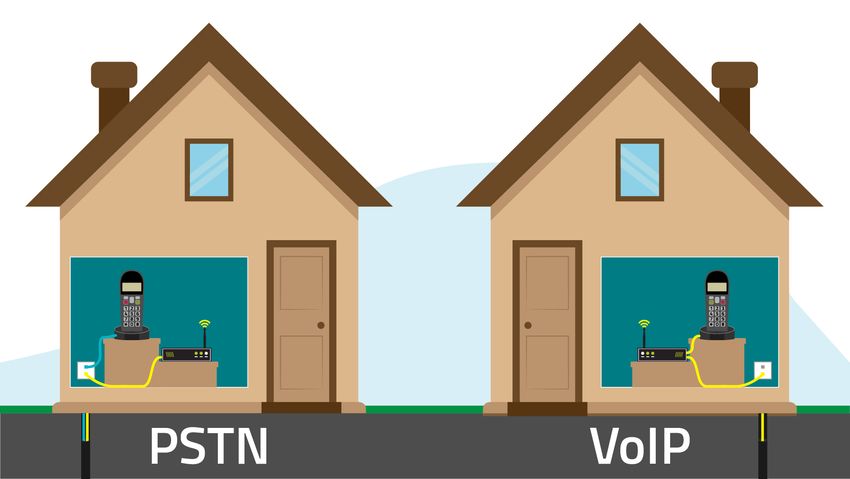
For many, the only change they will need to make will be to connect their existing handset
to a different socket.
5 Ofcom/Operators. Note: includes estimates where Ofcom does not receive data from operators. See Ofcom, 2019.
Telecommunications Market Data Update Q3 2018, https://www.ofcom.org.uk/__data/assets/file/0021/135192/Q3-2018-
Telecoms-Data-Update.csv.
6 Ofcom/Operators. See Telecommunications Market Data Update Q3 2018.
7 Ofcom Technology Tracker H1 2018.
8 See Ofcom, 2018. Communications Market Report, p.11.
9 Ofcom Technology Tracker H1 2018.
3The future of fixed telephone services
1.12 Some final migrations may need to be compulsory, with sufficient warning, to ensure all
customers are moved from the relevant networks prior to the final switch-off deadline.
Regardless of whether they are voluntarily or compulsorily migrated, some customers,
particularly those who are elderly, need a new broadband connection or have accessibility
or disability requirements, may need additional support during the change.
1.13 The migration will also impact services – such as security and fire alarms, telecare devices,
retail payment terminals and equipment for monitoring and controlling networks – which
rely on some attributes of the PSTN that may not be fully replicated in VoIP-based
platforms. This could have implications for both domestic and business customers, as well
as public sector users, including some organisations delivering critical national
infrastructure. A carefully managed transition will be vital to ensure people experience as
little disruption as possible and are protected from harm.
Regulatory policy considerations
1.14 Migration to VoIP is part of a wider change in technology and the market. This change
creates challenges for providers and telephone services, but also opportunities: for
example, to help identify and prevent nuisance calls and to improve the quality of voice
services.
1.15 Regulation also has a role to play. Our aims are to promote competition between
providers, maintain confidence in call services and protect customers from harm. We are
reviewing regulation on the use and management of phone numbers and of the
interconnection arrangements between networks.
Scope of this document
1.16 While the decision to switch off the PSTN is led by broadband and phone companies, and
they are responsible for ensuring a smooth transition for both their retail and wholesale
customers, switching to calls over broadband is a wide-ranging change that will affect a
number of organisations. Many of these have a role to play in making sure this change is
successful and minimising the risk of harm.
1.17 Section 2 describes the roles of different organisations, and Ofcom, in relation to the
migration. In particular, it sets out our expectations of the measures providers should take
to ensure customers are not harmed. Section 3 discusses the policy opportunities the
migration presents, and the areas where Ofcom is considering regulatory changes to create
the conditions required to ensure minimum disruption. Finally, Section 4 includes more
information about how telecoms companies and other interested parties can engage with
Ofcom, and each other, in relation to different aspects of the programme of work set out
in this document.
4The future of fixed telephone services
2. Consumer migration to VoIP
2.1 In this section, we discuss the different organisations that we consider have a role to play
to ensure that the migration is successful and the work that some of them have carried out
to date to support it. We also set out in more detail the issues that communications
providers need to take into account when migrating their customers, including our
expectations of the measures they should put in place to ensure they protect their
customers from undue disruption.
Ofcom
2.2 We recognise that the migration to VoIP is necessary to ensure the continued provision of
reliable landline telephone services given that the PSTN can no longer be sustained in the
long term.
2.3 Ofcom is supportive of a well-managed migration and the opportunities it presents to
deliver future-proofed services that better meet the needs of customers. The change will
offer potential benefits to consumers, such as clearer phone calls and the choice to have
broadband provided separately from the telephone service. However, it is important that
disruption to landline voice customers, both business and residential, is minimised.
Wherever possible, our preference is for voluntary-led migration, where customers actively
choose to adopt a new VoIP service, as opposed to being compelled to move as a migration
deadline approaches.
2.4 While the decision to migrate telephone services to IP has been led by industry, Ofcom has
a role to play throughout the migration process to help ensure that customers are not
subject to undue disruption, including by facilitating co-ordination between providers, and
to ensure that competition continues to deliver efficiency and innovation.
2.5 We have been working closely with providers to consider the issues that will be raised by
the migration, monitor their migration plans and provide clarity regarding our expectations
of how they communicate with, and support, customers and downstream service providers
during the migration process.
2.6 We are also working with communications providers, government departments and other
regulators to ensure that downstream service providers, equipment manufacturers and
key business users that rely on the PSTN are aware of the changes so that the services can
be upgraded or replaced if necessary and continue to work post migration. As part of this,
Ofcom has convened two All IP Working Groups; the first – the Technical All IP Working
Group – relates to technical issues and enables members to share information about the
migration and discuss any emerging issues, and the second – the Communications All IP
Working Group – enables members to share information and best practice about consumer
communications relating to the migration. These groups aim to share information and
facilitate collaboration between communications providers, downstream service providers
and other stakeholders including Government. (Further details about these groups and
plans for their evolution are set out in Section 4).
5The future of fixed telephone services
2.7 As communications providers’ migration plans progress, we will continue to work with
them and with downstream service providers and consumer groups to understand the
needs of vulnerable consumers in particular and to ensure that critical services continue to
work following migration.
Downstream service providers and users
2.8 Several other bodies will have a role to play in ensuring the migration is completed
successfully. Most notably, these include downstream service providers that offer services
such as telecare and burglar alarms, payment terminals and monitoring systems, that rely
on some of the technical characteristics of the PSTN. These service providers will need to
test their equipment to see if it will continue to function over IP and then replace, upgrade
or reconfigure it as appropriate. They also need to make sure that their customers (which
range from residential users to large commercial and public sector entities) are aware of
the issue and take any necessary steps to maintain their service(s).
2.9 Government is also working to ensure that the sectors that utilise downstream services,
including health, energy, transport and business, are aware of the change and prepare
accordingly. The Department for Digital, Culture, Media and Sport (DCMS), with support
from Ofcom, is working on cross-departmental engagement in order to ensure government
departments are aware of, and prepared for, the change and its effects on industry and
public service sectors they sponsor.
2.10 Finally, downstream service users will need to act on the information provided by their
downstream service and communications providers to ensure their services continue to
work once they can no longer utilise the PSTN. As the migration progresses and more
customers are transitioned to VoIP services, we anticipate that consumer bodies will have
a role to play in helping to disseminate information about the change and provide advice
to consumers regarding the steps they need to take and support they will be offered if they
are migrated.
Communications providers
2.11 As noted above, we expect communications providers to ensure that the transition runs
smoothly for their customers. In this section, we describe some key issues that providers
need to take into account when migrating their customers to All IP networks. We also state
our expectations around how they will communicate with, and provide support to, their
customers to ensure that migration delivers good outcomes for them, and that there are
adequate protections in place for those that are at greater risk of harm. These include our
expectations in relation to:
• working with downstream service providers;
• supporting migrating customers;
• Ofcom’s guidance on access to emergency services; and
• the continued availability of landline telephone services.
6The future of fixed telephone services
2.12 We welcome the fact that a number of providers are already considering these issues and
how best to communicate with, and protect, their customers. We are aware that some
have taken steps to identify services and sectors that are likely to be impacted by the
migration and alert them to the change. BT has a dedicated ‘Special Services engagement
team’ to raise awareness of the BT All IP programme and has opened testing facilities for
downstream service providers to see if their equipment will continue to work effectively
over VoIP. 10 As part of their engagement work, representatives from BT and Virgin Media
have presented at trade events and conferences to raise awareness within affected
sectors. In addition, processes are being developed to ensure a customer’s PSTN
connection can be restored if they are migrated and critical services that rely on the PSTN
no longer function correctly.
Our expectations of communications providers
2.13 In Ofcom’s Connected Nations reports 2016 and 2017, we set out a series of ‘consumer
protection principles 11’ that we would apply during migration to mitigate the risk of bad
outcomes for consumers and businesses. The expectations of industry that we have set out
below in relation to downstream service providers and supporting migrating customers
build on these principles.
2.14 In the majority of cases, a communications provider will not be aware of the specific
downstream services that are being run over their network and so will not have a record,
or full understanding, of all the services that may be impacted by the switch-off or how
extensive the impact will be. However, given the critical nature of some of the services that
rely on the PSTN, we consider that communications providers should engage with key
downstream service providers to help them understand and prepare for the change to
ensure the transition is as smooth as possible and to mitigate the risk of any consumer
harm.
2.15 As explained above, for most consumers the migration from the PSTN to VoIP services
should be straightforward and simply entail connecting their telephone to their broadband
router instead of the wall socket. The move to VoIP may, however, be more complex for
consumers that have downstream services such as telecare devices and security alarms
that rely on the PSTN. In addition, some customers, such as landline-only customers, or
those with a visual impairment or mobility issue, may require support from their provider
when installing or using new equipment.
2.16 Ofcom has met with a range of stakeholders, including communications providers,
consumer bodies and representatives from downstream service providers, to establish a
common understanding of the challenges likely to be faced by customers and downstream
10See: https://btplc.com/DigitalServicesLab/index.htm.
11See Ofcom, 2016. Connected Nations, p.69. https://www.ofcom.org.uk/__data/assets/pdf_file/0035/95876/CN-Report-
2016.pdf, and Ofcom, 2017. Connected Nations: Data Analysis, p.71-72.
https://www.ofcom.org.uk/__data/assets/pdf_file/0016/108511/connected-nations-2017.pdf.
7The future of fixed telephone services
service providers, and to develop some good practice principles for communications
providers to follow during the migration.
2.17 Our expectations developed from these stakeholder discussions are set out below. These
are separated into two groups; those setting out our expectations of how communications
providers should work with downstream service providers, and our expectations of the
support that they should provide to customers during the migration process.
2.18 These are intended to apply to providers who are migrating customers both voluntarily and
compulsorily, and both residential and business customers. These expectations are likely to
evolve as providers learn from their experiences of rolling out VoIP services and we will
continue to engage with stakeholders to develop more detailed examples of good practice
around them.
2.19 At a minimum, we consider that communications providers, either directly, or, where
relevant, via their trade association, should:
Downstream services
• Share knowledge of the key downstream services impacted by the migration and examples of
good practice/successful communication strategies, for example, by participating in Ofcom’s and
industry’s All IP Working Groups;
• Develop a strategy to identify and engage with downstream service providers that utilise their
landline services, in a timely fashion, to ensure they are aware of the change and the potential
implications;
• Where relevant, make downstream service providers aware of any available testing facilities or
facilitate access to the facilities offered by access network providers, so they can determine
whether their services will work effectively over an IP network;
• Identify customers who use critical downstream services (such as a telecare device), develop
appropriate communications plans and put in extra protection measures. For example, this could
include delaying a customer’s migration until satisfied that their downstream service is
compatible with VoIP;
• Develop effective processes to support customers who inform them that their downstream
services do not function as planned after migration. This could include returning them to a PSTN
service if it remains available where the failure creates a risk of significant harm.
8The future of fixed telephone services
Supporting migrating customers
• Give adequate notice of service changes, noting that both residential and business customers
may need time to acquire and configure new equipment;
• Ensure that all communications regarding the migration are clear and timely, in a format that
reflects the needs of the customer, and include information about the potential impact on
equipment that uses the PSTN;
• Assess customers’ needs and offer help with migration (for example, a home visit to install a
router) if necessary;
• Offer advice and assistance for all migrating customers, including those who use downstream
services, and co-operate with providers of these services, to minimise disruption;
• Put ongoing protections in place to respond appropriately to later changes in end-users’
circumstances, for example, customers that migrate to a VoIP service and then purchase a
security alarm or telecare device.
Guidance on access to emergency services
2.20 An important function of the telephone network is to allow people to contact the
emergency services. For this reason, Ofcom requires communications providers to take all
necessary measures to ensure uninterrupted access to emergency organisations for their
customers. 12
2.21 Traditional voice calls over the PSTN are delivered to premises via copper wire connections
and, as these lines are powered from the local telephone exchange, emergency calls can be
made in the event of a power cut at the premise. In contrast, calls made over broadband
using VoIP-based technology will not function in a power cut unless additional measures
are in place, as the broadband equipment at the premise requires mains power to work.
2.22 In October 2018, following consultation, we published guidance on how providers can
continue to meet their obligation to ensure uninterrupted access to emergency
organisations during a power outage for those customers using VoIP technology. 13 The
guidance sets out four principles that we consider, if followed, are likely to mean that a
provider is meeting their obligation.
2.23 In summary, the principles state that:
• Providers should have at least one solution available that enables access to emergency
services for a minimum of one hour in the event of a power outage in the premises;
12 General Condition A3.2(b) places a regulatory obligation on providers of a Publicly Available Telephone Service (PATS),
and/or a Public Electronic Communications Network (PECN) over which a PATS is provided, to take all necessary measures
to ensure uninterrupted access to emergency organisations as part of any PATS offered. See the revised General
Conditions of Entitlement: https://www.ofcom.org.uk/__data/assets/pdf_file/0021/112692/Consolidated-General-
Conditions.pdf.
13 See Ofcom, 2018. Protecting access to emergency organisations when there is a power cut at the customer’s premises:
Guidance on General Condition A3.2(b). https://www.ofcom.org.uk/__data/assets/pdf_file/0016/123118/guidance-
emergency-access-power-cut.pdf.
9The future of fixed telephone services
• The solution should be suitable for customers’ needs and should be offered free of
charge to those who are at risk as they are dependent on their landline;
• Providers should i) take steps to identify at risk customers and ii) engage in effective
communications to ensure all customers understand the risk and eligibility criteria and
can request the protection solution; and
• Providers should have a process to ensure that customers who move to a new house or
whose circumstances change are aware of the risk and protection solution available.
2.24 The full guidance which sets out Ofcom’s expectations in relation to each principle in turn
can be found on the Ofcom website at https://www.ofcom.org.uk/consultations-and-
statements/category-2/access-emergency-organisations-power-cut.
2.25 Given the guidance relates to a General Condition that was already in place, it applied
immediately upon publication.
Availability of telephone services
2.26 Current landline telephone customers that utilise services that rely on the PSTN will
require a broadband connection if they still wish to receive a landline telephone service on
migration to VoIP. We note that some landline-only customers currently live in areas
without reliable broadband coverage. However, in March 2018 the Government
introduced legislation for a broadband universal service obligation (USO), which will give
eligible homes and businesses the right to request a decent broadband connection by
2020. Ofcom is now responsible for the implementation of the USO. 14 In addition, currently
both BT and KCOM are designated as universal service providers for landline telephone
services which means they need to supply a voice connection upon reasonable request and
ensure that uniform pricing is adopted for all USO customers.
2.27 We will be working with the USO providers to understand how they plan to continue to
meet their obligations.
Next steps
2.28 We will continue to work with providers to monitor their migration plans. As part of that
monitoring we want to understand:
• how they have taken the above expectations into account when formalising their plans
and any learnings from their engagement with customers;
• their interaction with downstream service providers, including the sectors they have
engaged with and an overview of any testing results; and
• the measures they have put in place in response to our guidance on ensuring access to
the emergency services.
2.29 Where relevant, we also expect voice USO providers to be able to explain the plans they
have in place to ensure they will continue to meet their obligations.
14 See https://www.ofcom.org.uk/phones-telecoms-and-internet/advice-for-consumers/broadband-uso-need-to-know.
10The future of fixed telephone services
2.30 To help us monitor how the migration is progressing, we will ask communications providers
to supply data to us as they begin to launch their commercial VoIP products. The data of
interest to us is likely to evolve as voluntary migration progresses to compulsory migration,
and the volume of customers using VoIP services increases. At a minimum, however, we
expect providers to share information regarding the take-up of VoIP services, how many
complaints they have received relating to migration and an analysis of the key themes
raised, and quality of service metrics for their VoIP products.
2.31 We will also continue to monitor any complaints Ofcom receives about customers’
migration experiences, including their interaction with providers, the support they are
offered, and the protection solutions they are offered to ensure they have uninterrupted
access to the emergency services. We will address any significant concerns identified
through Ofcom’s complaints data, or the data supplied by communications providers, with
providers directly and through formal enforcement action where appropriate.
2.32 The above sets out our current approach when engaging with industry and other
stakeholders, and our expectations of the actions that providers should take. We will keep
this under review as the migration proceeds to see if further measures need to be taken to
improve customer awareness and outcomes, and co-ordination between stakeholders.
11The future of fixed telephone services
3. Regulatory policy considerations
3.1 Migration to VoIP is part of a wider change in technology and the market. This change has
led to challenges for providers and telephony services, but it also creates opportunities: for
example, to help identify and prevent nuisance calls and to improve the quality of voice
services.
3.2 Regulation also has a role to play. This section sets out how we are reviewing regulation on
the use and management of phone numbers and of the interconnection arrangements
between networks. The aims of this review include:
• Promoting competition between providers of telephony services, recognising the
changing market environment, where over-the-top (OTT), social media and messaging
platforms offer alternatives to telephony and increasingly, through services such as
'Skype to Phone’, provide access to telephony in competition to traditional telephony
providers.
• Promoting consumer confidence in telephony by tackling nuisance and scam calls and
addressing pricing practises that lead to unexpected or excessive bills.
• Protecting consumers from harm by making sure they continue to have access to
important services.
3.3 We plan to publish a suite of documents in the Spring, seeking stakeholder views on the
shape of regulation of voice in the future.
Telephone number management
3.4 Telephone numbers will remain a key means by which consumers will identify called and
calling parties. However, nuisance and scam calls have become a widespread problem.
Trust and confidence in using voice services may be diminished if customers become more
vulnerable to fraud and nuisance calls.
3.5 New rules about the use of private information have sought to address this, but those rules
do not prevent unscrupulous companies from hiding their identity by spoofing the
telephone number presented to the called party and network (‘Caller ID’). As rules and
technology evolve to put in new barriers to these abuses, those making nuisance and scam
calls seek out new ways to get around them.
3.6 A key challenge to be addressed is the absence of a solution to verify the authenticity of
the Caller ID and, hence, the actual origin of a VoIP call and rights to use that number.
3.7 The move to an All IP environment also provides an opportunity to update the UK’s legacy
systems and processes for allowing consumers to keep their telephone numbers when
switching providers (‘number portability’). Number portability makes it easier for
customers to change their provider which, in turn, sustains effective competition.
12The future of fixed telephone services
3.8 The move to IP also provides the opportunity for us to consider more generally how we
manage telephone numbers, what consumers and businesses understand and need from
telephone numbers and how they should be used in the future.
Future use of numbers
3.9 Telephone numbers will continue to have an important role in electronic communications
for many years to come, however their function will evolve. We need to look at what
customers understand, want and need from telephone numbers going forward.
3.10 Our national telephone numbering plan, like those around the world, has been shaped by
the development of the PSTN. 15 But, in the future, the evolution of telephony services may
make the distinction between telephone numbers used for landlines and those for calling
mobiles blur and have less meaning to customers.
3.11 Call prices have also become much simpler. The cost of a landline call used to depend on
distance; calls to and from a mobile were typically much more expensive. Now most calls,
both from landlines and from post-paid mobile, are included in call allowances. However,
when calls are charged for, this can lead to unexpected or excessive bills. As the UK’s
numbering plan is designed to inform on service and/or call cost, we need to consider how
it, and associated regulation, might need to evolve to continue to provide this information
accurately to customers and ensure compliance.
3.12 More specifically, we are considering whether location significance should be preserved in
geographic numbers. Currently the UK is divided into 610 area codes, which is a
consequence of the PSTN. 16 Migration to IP makes this redundant from a technical
perspective. However, location significance may continue to have value for consumers and
businesses, so we need to consider whether it would be appropriate to retain area codes.
3.13 Also, we recognise that the dynamics of service provision have changed significantly since
the introduction of non-geographic number ranges such as 084 and 087, where the
concept of sharing the cost of provision between the caller and service provider was
established. The price of phone calls has reduced considerably with most calls now made
from call allowances without additional call charges. There are also now many alternatives
to telephony for micropayments. We therefore need to look at the future role of non-
geographic numbers as a form of micropayment for provision of telephony services.
3.14 Furthermore, we need to consider if any new services might benefit from being identifiable
in the numbering plan.
15 For example, geographic telephone numbers (which today begin with 01 or 02) where the first few digits relate to a UK
area, were originally devised to allow a subscriber to automatically ‘trunk dial’ without needing a human operator to
connect their national call. So, from the 1950s, a subscriber could dial a geographic telephone number to automatically
instruct their local telephone exchange (say in Bristol) to switch them to a subscriber connected to a different telephone
exchange (say in Glasgow).
16 See footnote 15.
13The future of fixed telephone services
Interconnection and termination
3.15 Interconnection arrangements between providers underpin the commercial and technical
practicalities of connecting telephone networks. Migration to VoIP could result in far
simpler interconnection between fixed networks and make it more likely that providers will
compete to offer transit services to, or from, smaller providers.
3.16 In the future, as landline and mobile voice services converge both in terms of how they are
delivered and how customers use the services, the justification for different pricing of
wholesale fixed and mobile call termination may erode. Equally, an aspect that we might
need to consider in reviewing our approach to wholesale pricing is the effect of
competition from other platforms not subject to the same open access and
interconnection rules.
Next steps
3.17 We plan to publish separate ‘call for input’ documents in Spring 2019 to cover:
• Number management. We will discuss some of the available options for implementing
a strategic numbering solution, including some new proof of concept work we have
been doing with industry using blockchain technology. 17 We will seek views about these
options and invite other suggestions from stakeholders.
• Future use of numbers. We will seek views on potential changes to the use of and
obligations associated with different number ranges.
• Interconnection and call termination. We will discuss and seek views about options for
regulation of interconnection and call termination during the period of migration to
VoIP on fixed networks and in the longer term, and on the rules that apply in relation
to end-to-end connectivity. We envisage any proposed changes in regulation to be
considered in future market reviews and implemented from 2021.
17See Ofcom’s media release at: https://www.ofcom.org.uk/about-ofcom/latest/features-and-news/blockchain-
technology-uk-telephone-numbers.
14The future of fixed telephone services
4. Stakeholder engagement
4.1 There are a number of industry groups, some convened by Ofcom, that providers may wish
to engage with in relation to the migration of telephony services to IP. This section
provides more information about these bodies, their respective remits and how they relate
to and interact with Ofcom.
Ofcom All IP Working Groups
4.2 Since 2017 Ofcom has convened two All IP Working Groups – a Technical Working Group
and a Communications Working Group – to consider issues being raised by the migration
to VoIP. In addition to the wide range of industry stakeholders at these meetings, DCMS
also attends regularly to keep up-to-date with developments.
Technical Working Group
4.3 The Technical Group meets quarterly and aims to facilitate collaboration between
communications providers, providers of downstream services that use the PSTN and other
interested organisations. Members share information about technical issues around the
migration and highlight resulting issues. Topics discussed include:
• providers’ migration plans and timetables;
• work by the NICC to develop new, and update existing, standards to support new All IP
voice networks (see paragraphs 4.10 – 4.12); and
• the implications for downstream services.
Communications Working Group
4.4 The objective of the Communications Group is to enable members to share information
and best practice about consumer communications relating to the migration to IP. Topics
discussed include the scope for developing common terminology and challenges faced by
providers migrating consumers to VoIP services to date. 18
Other Ofcom Working Groups
4.5 As the work described in Section 3 evolves, further Ofcom-led working groups may be set
up as appropriate.
Office of the Telecommunications Adjudicator (OTA2)
4.6 The OTA2 19 is an independent body that seeks to implement processes that enable
competitors to access Openreach products on an equivalent basis to that enjoyed by BT. It
18 The Broadband Stakeholder Group (see: http://www.broadbanduk.org) is also considering initiatives in this area.
19 See: http://www.offta.org.uk/index.htm.
15The future of fixed telephone services
also ensures that these processes are fit for purpose and deliver an acceptable quality
of consumer experience.
4.7 The OTA2 has developed a variety of working groups covering Openreach’s product lines.
These comprise of representatives from interested parties across industry whose aim is to
review product changes and performance and address any issues. It seeks to do this by
mediating between Openreach and its customers and avoiding unnecessary disputes being
raised with Ofcom.
4.8 In relation to the migration to VoIP the OTA2:
• Is developing a new industry programme aimed at pre-validating the migration
processes which gaining providers will be using to support the increased demand from
end users migrating from PSTN to VoIP;
• Has developed a new Code of Practice for restoring end users’ ‘special services’ if they
have ceased to work post migration to VoIP;
• Is supporting Openreach to deliver its WLR withdrawal plans; the OTA2 co-own all the
WLR work programmes listed below.
4.9 The OTA2 also convenes the Number Port Executive Steering Group 20 and is a member of
the Ofcom Technical All IP Working Group and regularly provides updates regarding its
work in relation to the migration.
NICC
4.10 NICC 21 is a technical forum for the UK communications sector that develops
interoperability standards for the public electronic communications networks and services
in the UK. It is an independent organisation owned and run by its members, of which there
are three membership classes – Full (open to all telecommunications providers and
organisations with an operating presence or other interest in the UK and the equipment
supplier community), Associate (similar to Full membership but unable to attend board
meetings and do not have voting rights on NICC standards) and Observer (currently Ofcom
and DCMS – can attend board meetings in a non-voting capacity).
4.11 NICC currently has a number of working groups involved in issues related to the migration
to VoIP including developing new and updating existing standards to support the new All IP
network and access environment.
4.12 NICC member organisations are members of the Ofcom Technical All IP Working Group and
regularly provide updates regarding the All IP Task Group’s work.
20 Comprising representatives from the landline number porting stakeholder community who oversee business rules and
processes for porting geographic and non-geographic numbers excluding mobile.
21 See http://www.niccstandards.org.uk/.
16The future of fixed telephone services
Openreach WLR withdrawal working groups
4.13 With the support of the OTA2, Openreach has set up a number of working group sessions
on key themes around the withdrawal of WLR and the development of the Single Order
Transitional Access Product (SOTAP). These are open to all providers and industry groups 22
and include:
• White Label Communications
• Resellers
• SOTAP Product Development
• Stop Sell: WLR, Shared Metallic Path Facility (SMPF), Sub Loop Unbundling SMPF
• WLR Withdrawal Trials
• Special Services Testing and Critical National Infrastructure (CNI)
• Migrations Management
• Management Information System (MIS) Reporting
• Managing Orphaned End Customers
4.14 We regularly meet with Openreach on a bi-lateral basis. It is also a member of our All IP
Working Groups and provides regular updates regarding its WLR withdrawal plans. We will
continue to monitor the progress of the above working group sessions as Openreach’s
withdrawal plans progress to ensure that the interests of both Openreach’s retail
customers and end users are protected.
All IP programme overview: new Steering Group
4.15 To help communications providers stay informed of this extensive programme of policy
and implementation work underway to support the migration to VoIP, Ofcom is
establishing an All IP Steering Group to meet on a quarterly basis, alongside technical and
communications working groups. This will act as an umbrella body (with members
including communications providers, OTA2, NICC and DCMS) to provide updates on the
overall programme of work and will help providers direct issues raised to the relevant
Ofcom, OTA2 and Openreach groups. As the Steering Group is expected to cover some of
the issues that the Technical Working Group has considered to date, we propose that the
Technical Working Group evolve to focus primarily on downstream services.
4.16 A diagram showing the evolving structure is set out in Annex 1.
Engagement with Government and public bodies
4.17 Given the potential implications for downstream services using the PSTN, Government has
a key role to play in helping to ensure that the sectors that use such services, including
health, energy, transport and business, are aware of the change and prepare accordingly.
Information about the working groups and content generally around WLR withdrawal can be found on the Openreach
22
web page: https://www.openreach.co.uk/orpg/home/products/wlrwithdrawal/wlrwithdrawal.do.
17The future of fixed telephone services
Ofcom will continue to support DCMS and governments in the nations with cross-
departmental engagement. Updates on this engagement will be provided to the All IP
Steering Group.
4.18 In addition, telecoms companies that provide services to Government and other public
bodies will be contacting them to communicate details of any changes to those services.
Communicating with Ofcom
4.19 If stakeholders have any comments or queries relating to any aspects of this document or
are interested in joining the Ofcom All IP Steering Group, then they should contact us at
futureofvoice@ofcom.org.uk.
18The future of fixed telephone services
A1. All IP Steering Group and Working Groups
A1.1 The chart below illustrates the envisaged structure of working groups run by Ofcom, OTA2
and Openreach – as described in Section 4.
19You can also read


