The GLOBE Climate Legislation Study - Cetesb
←
→
Page content transcription
If your browser does not render page correctly, please read the page content below
The GLOBE Climate Legislation Study
                          FOURTH EDITION
        A Review of Climate Change Legislation in 66 Countries
                  INTRODUCTION AND SUMMARY

Michal Nachmany, Sam Fankhauser, Terry Townshend, Murray Collins, Tucker
   Landesman, Adam Matthews, Carolina Pavese, Katharina Rietig, Philip
                       Schleifer and Joana Setzer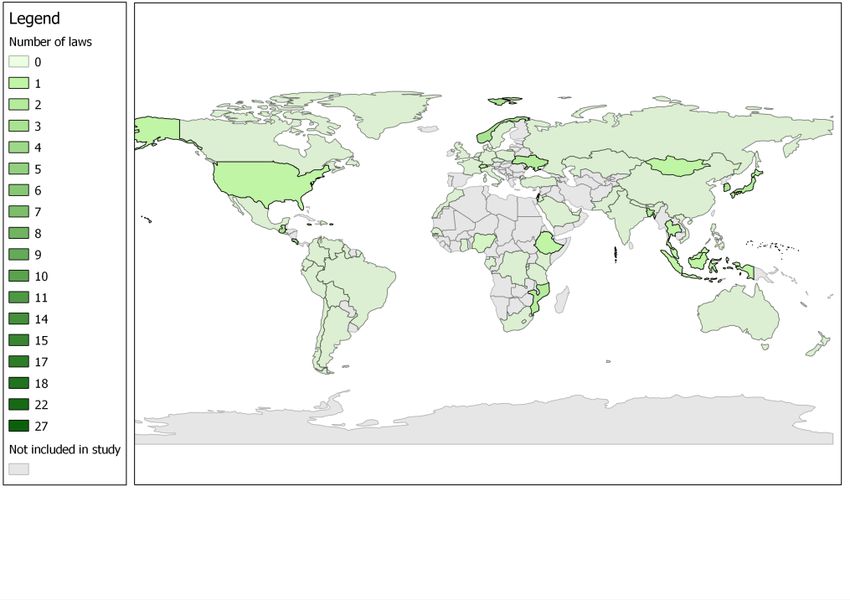
Contents                                    Climate Change Legislation                                                  i

Contents
Terms and abbreviations ............................................................................ iii
Acknowledgments ....................................................................................... iv
Foreword by the President of GLOBE International .................................. vii
Foreword by the Executive Secretary of the UN Framework Convention on
       Climate Change (UNFCCC) ................................................................... ix
1..... Introduction .......................................................................................... 1
2..... Progress in 2013 .................................................................................... 3
      2.1     Overview .................................................................................................3
      2.2     Summary of Progress by Region .............................................................4
      2.3     Flagship Legislation and Assessment of Progress in 2013 ......................8
      3.1     The Stock of Climate Change Laws .......................................................23
      3.2     The Dynamics of Climate Change Legislation .......................................25
      3.3     The Sectors Covered in Climate Legislation ..........................................29
iii           Climate Change Legislation                 Terms and abbreviations

Terms and abbreviations
ADAPTATION - Adjustment in natural or human systems in response to actual or
expected climatic stimuli or their effects
ANNEX 1 COUNTRIES – Group of OECD countries and Economies in transition listed
in Annex I to the UN Framework Convention on Climate Change
NON-ANNEX 1 COUNTRIES - Countries that have ratified or acceded to the United
Nations Framework Convention on Climate Change that are not included in
Annex I of the Convention, mostly developing countries
ANNEX 2 COUNTRIES – Countries of Annex I that have special obligation to provide
financial resources and facilitate technology transfer to developing countries.
This group includes 24 OECD countries and the European Union
CDM- Clean Development Mechanism of the Kyoto Protocol
COP – Conference of the parties to the UN Framework Convention on Climate
Change
ETS – Emissions Trading System
EU ETS – European Union Emissions Trading Scheme
GEF - Global Environment Facility
LULUCF - Land Use, Land-Use Change, and Forestry
MOP – Meeting of the Parties to the Kyoto Protocol
MRV - Measurement, Reporting and Verification
PES - Payments for Ecosystem Services
MITIGATION - Initiatives to reduce emissions of greenhouse gases
NAMAS - Nationally Appropriate Mitigation Actions
REDD+ - Mitigation measures related to “Reducing Emissions from Deforestation
and Forest Degradation (REDD)” that also includes conservation, sustainable
management of forests and enhancement of forest carbon stocks, thus REDD+
UNDP - United Nations Development Programme
UNEP - United Nations Environment Programme
UNFCCC - United Nations Framework Convention on Climate Change
UN-REDD - United Nations collaborative initiative on Reducing Emissions from
Deforestation and forest Degradation (REDD) in developing countries
Acknowledgements                         Climate Change Legislation              iv

Acknowledgments
This report would not have been possible without the contributions, advice and
assistance from colleagues across the GLOBE and LSE networks. In particular the
authors would like to thank the legislators who gave feedback and comments on
the previous editions of GLOBE Climate Legislation Study and who commented
on drafts of the national chapters in this 4th study. Legislative staffers were also
immensely helpful in facilitating comments from legislators and in providing
comments themselves.

Gauri Kiik, Fulvio Menghini, Marlene Grundstrom, Danny Stevens, Andres Avila-
Akerberg and Rafael Aybar in the GLOBE International Secretariat provided
much appreciated support and advice in the production of this and previous
studies. Staff at the UK Foreign and Commonwealth Office, particularly David
Concar, Daniel Parkes and Marie-Louise Childs, provided important support and
advice. Colleagues at the Grantham Research Institute have also provided
valuable insights. The authors appreciate the dedicated work of Mike Scott from
Carbon Copy Communications who edited and typeset this study, of Analiz
Vergara, who assisted with data compilation and of Maria Carvalho and Udi
Nachmany who assisted with design.

GLOBE International would like to thank the UK Foreign and Commonwealth
Office for supporting the production of this study and the work of GLOBE.

The Grantham Research Institute is supported by the Grantham Foundation for
the Protection of the Environment and the UK Economic and Social Research
Council (ESRC), through its support of the Centre for Climate Change Economics
and Policy (CCCEP).

A large number of people have assisted with reviewing of the country chapters
this year. We wish to thank them all – legislators, executive officials, academics,
NGO representatives and independent observers – for their significant
contributions to the accuracy and comprehensiveness of the study, while we
retain all responsibility for errors:

 Argentina            Patricia Cazenave

 Australia            Eleanor Ashton, Heike Phillips

 Bangladesh           Muhammad Jahedul Huq Shovon, Saleemul Huq, Monir
                      Shaikh Moniruzzaman
 Bolivia              Patricia Cazenave

 Brazil               Barbara Oliveira

 Canada               Jenny Hooper, David McGuinty MP

 Chile                Fernando Farías Ellies, Andrea Rudnik
Acknowledgements Climate Change Legislation v
China Ding Ding, Li Ting
Colombia Senador Mauricio Ospina, Francisco Quiroga, Mauricio
Umaña Camacho
Costa Rica Roberto Guzmán Gutiérrez, Deputy Alfonso Pérez Gómez,
Luis Rivera
Czech Republic Michal Danhelka, Pavel Zamyslicky
Denmark Steen Gade, MP, Pernille Sørensen, Rikke Thoning
Dominican Pedro García , Omar Ramírez Tejada
Republic
DRC Fumu Munanga, Crispin Mutumbe Mbuya
Ecuador Angel Valverde, Patricia Velasco , Analiz Vergara
Ethiopia Russell Bishop
EU Samuela Bassi , Jürgen Lefevere, Terhi Letonen, Alexandre
Paquot, Damyana Stoynova
France Marguerite Culot
FSM Lam Dang, Congressman Isaac V. Figir
Germany Philipp Behrens, Michael Kauch MdB, Volker Krah
Ghana Joseph Kofi Teye
Guyana Lili Ilieva , Tim Laing
India Elizabeth Colebourn, Pranav Sinha
Indonesia Rian Pradipta, Satya Yudha
Israel Ofira Ayalon, Dana Tabachnik, Arye Wanger
Italy Caterina Gennaioli
Jamaica Heather Cooke
Japan Jinichi Ueda
Jordan Amal Dababseh
Kazakhstan Kassymkhan Kapparov, Karlygash Kuralbayeva
Kenya Helen Baker
Malaysia Tan Ching Sin , Yap Kok Seng,
Mexico Andres Avila-Akerberg, Carolina
Hernández Campos, Jatziri Pando MedinaAcknowledgements Climate Change Legislation vi
Mongolia Sambuu Demberel, Bata Ochir
Morocco Yassir Benabdallaoui, Moh Rejdali
Mozambique Paula Panguene
Nepal Ram Chandra Khanal, Lucky Sherpa,
Netherlands Bart Pierik
New Zealand Kate Hodgkinson , Judy Lawrence
Nigeria Appollonia Okhimamhe, Innocent Onah, Abubakar S.
Sambo
Norway Freya Nowell
Pakistan Kashif Majeed Salik
Peru Pablo Larco, Eduardo Durand López Hurtado, Isabela
Souza, Patrick Wieland
Philippines Chris Estallo
Poland Elzbieta Lenart, Jacek Mizak
Russia Elena Chistyakova, Karlygash Kuralbayeva
Saudi Arabia Abdulaziz Ahmed, Ali Althuwaini
South Africa Cedric Frolick MP, Scotney Watts
South Korea Jeemin Lee , Ohkeum Lee
Sweden Marlene Grundström, Marie Karlberg, Erica Petterson,
Anna Wallentin
Switzerland Reto Burkard, Laurence Mortier, Marjorie Perroud
Thailand Buntoon Srethasirote , Sopitsuda Tongsopit
Turkey Bali Emrah Biçer, Nicholas Pope
UAE Dennis Kumetat, Dane McQueen
Ukraine Natalie Kushko, Irina Stavchuk
United Kingdom Officials at the Department for Energy and Climate Change
USA Ana Unruh Cohen
Venezuela Patricia Cazenave
Vietnam Le Kim ThaiForeword Climate Change Legislation vii
Foreword by the President of GLOBE International
Welcome to the 4th edition of the GLOBE Climate Legislation
Study, a collaboration between Globe International and the
London School of Economics. Since the first edition was
published in 2010, covering 16 countries, the Study has
established itself as the world’s most authoritative and
comprehensive audit of climate change-related legislation.
At the launch of the 3rd edition in London in January 2013
Christiana Figueres, Executive Secretary of the United Nations
Framework Convention on Climate Change (UNFCCC), challenged us to “double
the coverage” of countries reviewed. I am delighted to say that we have met
this challenge. The 4th edition has been expanded from 33 to 66 countries
(including the European Union as a single entity), which are together responsible
for approximately 88% of global emissions of greenhouse gases.
With its broader coverage and deeper analysis, the 4 th edition shows more
clearly than ever before the extent and breadth of the legislative activity on
climate change. It’s happening across the globe: in Africa, the Americas, Asia
and Europe and in both large and small economies from China to Micronesia.
The study shows that 61 out of 66 countries have passed laws to promote
domestic, clean sources of energy and 54 have legislated to increase energy
efficiency. The former reduces reliance on imported fossil fuels, thereby
mitigating exposure to volatile fossil fuel prices and increasing energy security.
The latter reduces costs and increases competitiveness. All of these actions,
whilst being driven by national interest, have a positive benefit for the world’s
climate. And it’s no surprise, either, that 52 of the 66 countries covered by the
study have developed legislation or policies to improve their resilience to the
impacts of climate change, many of which we are already experiencing.
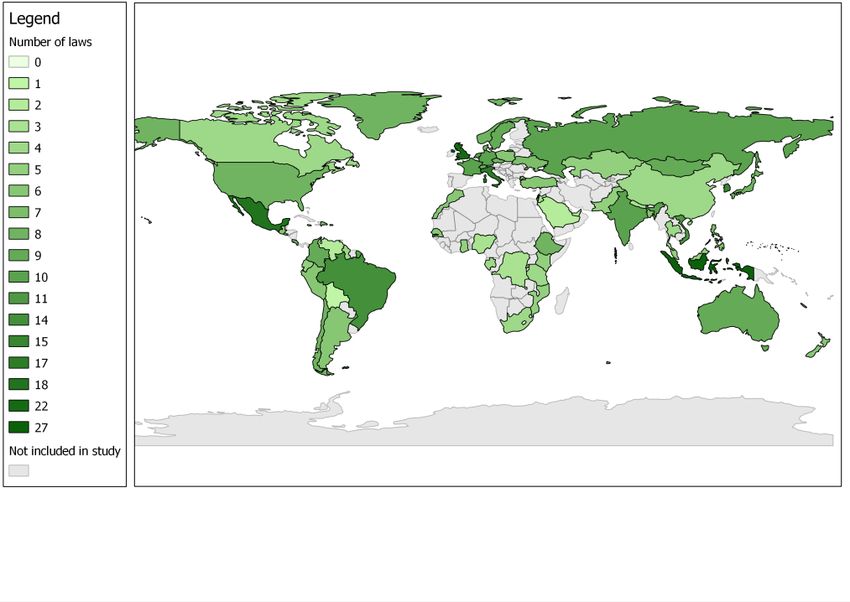
As illustrated by the comparative graphics, legislation is progressing at a rapid
rate, reflecting the fact that addressing climate change is being seen as firmly in
the national interest. National achievements are often also supported and, in
some cases surpassed, by the legislation produced by States and Provinces.
Canada and the US are cases in point. At the same time we must recognise that
progress can sometimes be undone. The new attitude of Australia in
particular could lead to a reversal of the important legislative steps taken to
enable it to play its part in the global battle against climate change.
We should be clear that the legislative response thus far is not yet sufficient to
limit emissions at a level that would cause only a 2 degree Celsius rise in global
average temperature, the agreed goal of the international community.
However, it is also clear that the cumulative effect of the advances in national
legislation outlined by the study is the creation of a strong foundation on which
a post-2020 global deal can be built. Domestic legislation is establishing the
institutional frameworks and policies to measure, report, verify, and manage
emissions. The ambition of these policies and laws can be increased as countries
experience the co-benefits of tackling climate change and discover that the costs
are manageable. This legislation is a fundamental pre-requisite to an effective
international deal.Foreword Climate Change Legislation viii As the formal UN negotiations move towards Paris in 2015, the scheduled conclusion of negotiations on a post-2020 framework, it is increasingly clear that an effective and ambitious deal is dependent on the national legislation passed in advance. That is why the GLOBE Climate Legislation Initiative (GCLI) is so important. Launched in January 2013, the GCLI is bringing together legislators in over 60 countries to share experience, discuss common challenges and develop legislation. Building on the success of GLOBE Mexico in developing and securing the political support for the General Law on Climate Change in 2012, GLOBE members in 2013 have been instrumental in the passage of climate change legislation in Micronesia, an influential member of the Alliance of Small Island States, a comprehensive climate change law has been tabled by GLOBE Costa Rica, which is expected to pass in early 2014, and GLOBE members are developing legislation in China, Colombia, Nigeria and Peru, amongst others. Of course, the role of legislators does not end when legislation is passed. Equally if not more important than legislators’ role in developing and passing legislation is oversight of governments, not least in approving national budgets. It is one thing to pass legislation and another to implement it. That is why the GCLI includes a major strand of work on oversight, identifying and promoting good practice and equipping legislators to be as effective as possible in holding their governments to account. GLOBE International will be working continuously with its network of legislators across the world to advance the legislative response to climate change. Success in Paris in 2015 depends on it. The Rt Hon. John Gummer, Lord Deben President, The Global Legislators’ Organisation (GLOBE International)
Foreword              Climate Change Legislation                               ix

Foreword by the Executive Secretary of the UN
Framework Convention on Climate Change (UNFCCC)
                     Climate change is the greatest challenge of our time.
                     Evidence clearly shows that human actions have a direct
                     and dramatic effect on the climate system. Recent reports
                     from the Intergovernmental Panel on Climate Change, UN
                     Environment Programme, International Energy Agency and
                     World Economic Forum constitute a clarion call to curb
                     greenhouse gas emissions and adapt to climate change.

These reports also point to one emerging truth. We can act to avoid the worst
effects of climate change, but time is running out. Capturing our opportunity to
stabilise the climate system, achieve the internationally agreed goal of limiting
warming to less than 2 degrees Celsius and safeguard development for future
generations requires immediate action by leaders in every country and every
sector. Given the complexity of climate science and vastly different geopolitics
around the world, no one suite of climate policies is right for everyone.
Therefore, instruments that promote sharing experiences, discussing challenges
and developing appropriate legislation are exceedingly valuable. GLOBE
International provides just such an instrument.

In 2014, Parties to the UNFCCC are conducting the domestic conversations
necessary to determine their contributions to the new, universal climate
agreement slated for 2015. The GLOBE Climate Legislation Study gives
policymakers clear options by showcasing national climate policies, regional
progress and the effects of legislation. Last year, I challenged GLOBE to double
the number of countries in the study and they rose to the challenge. This year, I
challenge legislators to take advantage of the information in this study, create
strong national policy that moves us to a low-carbon world and bring strong
contributions to the international process. In doing so, legislators can rise to
meet our greatest challenge, climate change.

Christiana Figueres, Executive Secretary, United Nations Framework
Convention on Climate Change
Introduction Climate Change Legislation 1 1 Introduction The GLOBE Climate Legislation Study seeks to provide an authoritative and comprehensive annual audit of climate change-related laws in the 66 country chapters. The origin of the study was the 2009 agreement on a set of Legislative Principles on Climate Change, co-authored by Chinese Congressman Wang Guangtao and then US Congressman Ed Markey and endorsed by 120 legislators from 16 countries. These principles were designed to guide legislators as they advanced climate change legislation, on the understanding that moving together in a nationally-appropriate and consistent fashion would help to maximise the benefits of moving towards a low carbon economy and minimise the competitive distortions. To facilitate the implementation of the Legislative Principles on Climate Change, it was important to develop an understanding of existing climate change-related legislation to learn lessons and benefit from the experience of others in drafting, building support for, passing and implementing these laws. In 2010 GLOBE and the Grantham Research Institute at the London School of Economics partnered to produce the 1st edition of The GLOBE Climate Legislation Study (Townshend et al 2010), examining climate-related legislation in 16 of the major economies. The 2nd edition of The GLOBE Climate Legislation Study, published in December 2011, was expanded to include Australia, and covered progress in 2011. Subsequently, in response to a challenge “to double the coverage” by Christiana Figueres, Executive Secretary of the UNFCCC, the coverage was increased to 33 countries in the 3rd edition, launched in January 2013, and further expanded to 66 countries in this 4th edition. This latest edition includes 18 of the top 20 emitters of greenhouse gases (GHGs) and 39 of the top 50, representing approximately 88% of (anthropogenic) global emissions. Recognising the growing importance of adapting to climate change, GLOBE co- hosted a conference in July 2013 entitled “Adapting to Climate Change: Policy, Practice and Legislation”, bringing together legislators, policy makers and experts from more than 10 countries. The output was a set of “Adaptation Principles” designed to inform the development of adaptation-related legislation. These Adaptation Principles have already informed legislation in Micronesia and the adaptation elements of Costa Rica’s draft law while the Chinese government received the principles as an input to the drafting of their national climate change law. The aims of the GLOBE Climate Legislation Studies are threefold. First, to support legislators advancing climate-related legislation by providing a detailed summary of existing legislation to identify best practice and help peer-to-peer learning. Second, to document the broad progress on climate change legislation at the domestic level in both industrialised and developing countries to provide
Progress in 2013       Climate Change Legislation                                2

positive momentum to the international negotiations. And third, to highlight the
fundamental role of legislators in any effective strategy to tackle climate change.

Parliaments considering climate-related legislation can benefit from the
experience of others. For example, South Korea’s emissions trading legislation
and China’s sub-national schemes draw on the experience, and lessons learned,
from the EU’s emissions trading system. Mexico’s General Law on Climate
Change draws on the experience of the UK’s Climate Change Act, while Costa
Rica’s draft law builds on Mexico’s legislation. Brazilian, Indonesian, Mexican and
Congolese legislators have been sharing knowledge of forest-related legislation
via the GLOBE Legislators’ Forest Initiative to ensure maximum consistency and
share experience. And in January 2012 the team drafting China’s climate change
law made a study visit to London and Brussels, hosted by GLOBE International,
to learn from the experience of the UK and the EU to inform the development of
their national law. GLOBE’s engagement with China is ongoing as it develops its
law, expected to pass in 2015.

The 4th edition is a major output of The GLOBE Climate Legislation Initiative
(GCLI), a policy process to support the advance of climate change legislation in
more than 40 countries. The GCLI is running alongside the international
negotiations under the Durban Platform with the aim of helping to build the
foundations and political conditions that enable an international agreement to
be reached.

Legislative action at the national level is fundamental to achieving the ultimate
goal of the UN Framework Convention on Climate Change – the stabilisation of
GHG concentrations in the atmosphere at a level that would prevent dangerous
anthropogenic interference with the climate system.
Progress in 2013       Climate Change Legislation                                3

2       Progress in 2013
This section summarises the major changes to the legislative picture in 2013, or
more specifically between the cut-off date of the third study (October 2012) and
the end of 2013. It includes laws, regulations, policies or decrees as per the
definition of legislation used in this study (see Section 4). In addition we review
major legislative or regulatory proposals that have a reasonable chance of
entering into law or being approved by governments.

2.1 Overview
2013 was a period of transition in global climate diplomacy. The international
negotiations are slowly gearing up towards the crucial 2015 Conference of the
Parties/Meeting of the Parties in Paris. Among developed countries, US
President Barack Obama raised the bar when he promised to “respond to the
threat of climate change” in his inaugural State of the Union address after his re-
election, and subsequently published a Climate Action Plan. With the worst of
the economic crisis over, the European Union began to focus again on climate
policy and its climate objectives beyond 2020. However, compared to a few
years ago the political environment for carbon legislation in industrialised
countries has become more difficult, nowhere more so than in Australia, where
a new administration has vowed to repeal the key aspects of Australia’s flagship
legislation – the Clean Energy Act. Japan also announced a downward revision of
its climate targets to accommodate a much-reduced reliance on low-carbon
nuclear energy after the tsunami that devastated the nuclear plant at
Fukushima.

These developments accentuate a longer-term trend that has seen the
momentum in climate change legislation shifting from industrialised countries to
developing countries and emerging markets. This has gone hand in hand with a
rise in legislation covering adaptation. The stock of climate laws in developing
countries is still lower than in industrialised nations, but many have started to
close the gap by passing sophisticated new legislation.

We identify significant positive changes in two regions in particular. In Sub-
Saharan Africa national strategies and plans are being formed in almost all the
study countries, as the basis for future legislation. In Latin America, plans are
beginning to transform into concrete legislation, notably Bolivia’s Framework
Law on Mother Earth and Integral Development to Live Well and Costa Rica’s
anticipated Framework Law on Climate Change, building on the substantial
progress in Mexico we reported in the 3rd edition.
Progress in 2013       Climate Change Legislation                                4

Overall, we report substantive legislative progress in 8 of the 66 countries, which
passed flagship legislation, and some positive advances in a further 19 countries.
Detailed chapters on each country’s climate change-related legislation can be
found in Section 4 – Climate Legislation Country by Country.

2.2 Summary of Progress by Region

2.2.1 Summary of Progress in Africa and the Middle East
Sub Saharan Africa saw major developments in 2013, with progress made in
almost all of the study countries, notably the approval of national plans and
strategies on climate change. In Ethiopia, the Environmental Protection Agency
was upgraded to the status of a ministry with the formation of the Ministry of
Environment and Forest, and is better equipped to take the technical
responsibility of building a climate-resilient green economy. Gabon passed
Resolution No. 20/2013 on Sustainable Development in the Republic of Gabon.

Kenya adopted the 2013-2017 Climate Change Action Plan, with the objective of
providing a platform for the implementation of the 2010 National Climate
Change Response Strategy (NCCRS). In November 2012, Mozambique adopted
the 2013-2025 National Strategy for Climate Change, with the aim of reducing
vulnerability to climate change and improving living conditions. The strategy
proposes climate change adaptation and disaster risk reduction measures and
also addresses mitigation by targeting low carbon development.

Tanzania passed its National Strategy on REDD+ in March 2013. In late 2012,
Nigeria’s Legislative Council approved the adoption of a National Climate Change
Policy and Response Strategy (NCCP-RS). NCCP-RS aims to provide Nigeria with a
framework for responding to climate change-related challenges such as
increased flooding and sea level rise. Rwanda approved its Second Economic
Development and Poverty Reduction Strategy (2013-2018), which highlights
pursuing a green economy approach to development, and integrating climate
change and the environment as a ‘cross-cutting issue’.

Limited progress has been observed in the Middle East and North Africa.
Exceptions include Jordan, which passed its National Climate Change Policy in
May. Saudi Arabia is preparing for climate legislation, having issued a white
paper which contains a roadmap and description of policy tools for launching a
large renewable energy programme. The UAE launched a mandatory Energy
Efficiency Standardisation and Labelling Scheme.

2.2.2 Summary of Progress in the Americas and Caribbean
In the USA, dedicated climate change legislation remains politically challenging.
However, the President announced a Climate Action Plan, including a series of
Progress in 2013      Climate Change Legislation                                5

executive actions designed to accomplish the United States’ GHG emission
reduction targets and prepare for the impacts of climate change. The Plan sets a
timetable for the Environmental Protection Agency to complete work on
regulations governing existing and future fossil fuel power plants. Additionally,
an executive order was issued by the President, entitled Preparing the United
States for the Impacts of Climate Change, which promotes information-sharing
and climate risk-informed decision-making at all levels of government. In late
2013, the Senate began floor consideration of bipartisan energy efficiency
legislation, the Energy Savings and Industrial Competitiveness Act, which will see
further debate in 2014.

Mexico, following up on its 2012 General Law on Climate Change, announced
the creation of the Climate Change National System and the Inter-secretarial
Committee on Climate Change. It also adopted the National Climate Change
Strategy. This strategy sets out the main focal areas regarding cross-sectoral
climate policy, adaptation to climate change and reduction of GHG emissions,
and reinforces Mexico’s GHG mitigation targets. El Salvador adopted the
National Climate Change Strategy, aiming to enhance the financial and
institutional resources to reduce economic and social impact of climate change.
The Strategy focuses on three core areas: adaptation, mitigation and
international co-operation.

In Costa Rica, a Framework Law on Climate Change was formally introduced to
Congress in September 2013, and is expected to pass in 2014. The proposal
includes the creation of the Climate Change National Committee and the Climate
Change National Council, together responsible for the implementation of the
National Adaptation and Mitigation Plans. The draft bill also calls for the
adoption of a National Climate Change Plan and the further development of
climate policies oriented towards research, crisis management, GHG reporting
and monitoring as well as mitigation and adaptation. Further developments
include a Ministerial Decree adopted in September 2013, which creates a
voluntary carbon market.

In Ecuador, Decree 1815 established the Intersectoral National Strategy for
Climate Change, part of a package of measures to encourage sustainable
development in Ecuador. The National Plan for Good Living promotes adaptation
to climate change, which sits alongside the National Environmental Policy. Other
decrees passed in 2013 include the Ministerial Accord 33 on REDD+, the
Ministerial Accord 095 (adoption of The National Climate Change Strategy), and
Ministerial Accord 089, which establishes the National Authority for
Implementation of the NAMA. In October 2012 Bolivia passed The Mother Earth
Law and Integral Development to Live Well, Law No 300 of 2012. The law is a
sweeping overhaul of the national management of natural resources, climate,
and ecosystem.
Progress in 2013      Climate Change Legislation                                6

2.2.3 Summary of Progress in Europe
The EU reform of the Common Agricultural Policy, approved in 2013, has led to
the integration of climate change mitigation and adaptation measures by
introducing two rural development policy priorities for restoring, preserving and
enhancing ecosystems, for resource efficiency and to address climate change. In
June, the Council of the European Union adopted an EU strategy on adaptation
to climate change. Finally, the Directive on Energy Efficiency has been revised to
include the legal obligation to establish energy efficiency schemes or policy
measures in all Member States.

Within the European Union, Sweden passed an act creating tax incentives for
biofuels, while the United Kingdom passed the Energy Act, which implements a
white paper on electricity market reform, and supports low-carbon electricity
generation through contracts for differences.

In July 2013 France concluded its National Debate on Energy Transition, resulting
in a series of policy recommendations. One recommendation reiterates the
President’s commitment to reduce the proportion of nuclear energy in the
overall energy mix from the current 75% to 50% in 2025. Another
recommendation demands a reduction in total energy consumption of 50% by
2050. The recommendations from the Energy Transition Debate have been
submitted to the government and draft legislation is expected in 2014.

The Czech Republic passed an Act on Promoted Energy Sources, imposing a levy
on renewables development while still meeting EU targets, with increased
support for nuclear energy. Poland adopted the Polish National Strategy for
Adaptation to climate Change (SPA 2020), the first strategic document directly
focused on adaptation to climate change. Poland also adopted a Strategy for
Economic Innovation and Effectiveness, which aims to make the country highly
innovative by 2020. It is also in the process of adopting a Strategy for Energy
Security and Environment, which sets targets to increase energy efficiency and
the share of renewables.

Outside the EU, Switzerland revised its CO2 Act. The revision sets an emission
reduction target of 20% below 1990 levels by 2020, and sets interim goals and
various measures for buildings, transportation and industry.

The State Environmental Agency of the Ukraine is currently working on a new
draft law on a national ETS. In September 2013, the Russian President signed a
decree adopting a target for GHG emissions, stating that by 2020 they must not
exceed 75% of the total emissions of 1990.

2.2.4 Summary of Progress in Asia Pacific
China continues to work on its national climate change law, a draft of which is
expected to be completed and consulted on in 2014. The National Development
Progress in 2013       Climate Change Legislation                                  7

and Reform Commission has also developed and published a National Plan for
Addressing Climate Change (2013-2020) that outlines the framework for tackling
climate change in China, including targets, tasks and safeguarding measures.
Progress has also continued with sub-national legislation and pilot carbon
trading systems in key Provinces and Municipalities.

In January 2013 Mongolia signed a bilateral document on a Joint Crediting
Mechanism (JMC) agreement with the government of Japan to help offset its
GHG emissions. The Forest Law amended in July 2013 now foresees the use of
forests for GHG sequestration. The UN-REDD Programme is working with the
government to integrate REDD+ into national strategies and legislation.

Following a change of government, Japan announced in late 2013 that instead of
aiming for a 25% reduction in greenhouse gas emissions by 2020, it would
increase its emissions by 3%, following the shutdown of many nuclear reactors
after the tsunami that led to the shutdown of the Fukushima nuclear power
plant. It is yet to be seen how this might be reflected in Japan’s legislation.

Although Kazakhstan did not pass any new legislation in the past year, it began
trading carbon in January 2013 for a pilot period of one year. Should the trading
system be deemed successful, a second trading period will be enacted for the
period to 2020.

The Federated States of Micronesia made significant progress on tackling
climate change this year, passing two major pieces of legislation in late 2013.
The first, the Nationwide Integrated Disaster Risk Management and Climate
Change Policy, sets out in its guiding principles a ‘multi-hazard’ risk management
approach that integrates disaster risk management, climate change adaptation
and GHG emissions reduction. The second, The Climate Change Act, instructs
government offices and departments to prepare plans and policies consistent
with the Climate Change Policy and includes an obligation on the President to
report to Congress on the progress of implementation.

Indonesia has been active on REDD+, with a decree establishing a Managing
Agency for REDD+, which amongst other things will develop a national REDD+
strategy. A Presidential Instruction extends the forest moratorium, which is a
core aspect of REDD+ implementation. In Thailand, the Office of Natural
Resources and Environmental Policy Planning is working on the National Master
Plan on Climate Change 2013-2050, outlining strategies and policy
recommendations for climate change adaptation, mitigation, and capacity
building for climate change.

Australia’s climate change policy took a turn following the September 2013
general election. The new government announced it would repeal the carbon tax
effective from 1 July 2014, and it introduced carbon tax repeal bills into
parliament as its first item of legislative business. Full repeal of the Clean Energy
Progress in 2013       Climate Change Legislation                                 8

legislative package would also see the abolition of the Climate Change Authority
and the Clean Energy Finance Corporation. The repeal of these laws, if supported
in parliament, is expected to take place in 2014. In place of the Clean Energy Act,
the new government plans to introduce a Direct Action Plan in July 2014, under
which the government has committed to reduce GHG emissions by 5% from
2000 levels by 2020. In August 2013, the government of New Zealand
announced an unconditional emissions reduction target of 5% to be achieved by
2020.

2.3 Flagship Legislation and Assessment of Progress
in 2013
For 62 of the 66 country studies we have been able to identify a flagship law – a
piece of legislation or regulation with equivalent status that serves as a
comprehensive, unifying basis for climate change policy. Changes in flagship
legislation are therefore particularly significant. They constitute a step change in
a country’s approach to climate change.

In 2013 eight countries passed new flagship legislation. They are Bolivia, El
Salvador, Guatemala, Kenya, Micronesia, Mozambique, Nigeria and Switzerland.
In addition, we have changed the flagship law of El Salvador, from The National
Environment Policy (2012) to The National Climate Change Strategy (2013),
which is specifically focused on climate change.

Table 1 below provides a summary of “flagship legislation” in all 66 countries.
The final column displays an assessment of legislative progress in 2013. The
assessment takes into account laws passed since the cut-off date for the third
edition of the study (October 2012). It also – through the use of coloured
exclamation marks – includes an indication of major legislative proposals that,
although not yet passed, have been formally introduced to the legislature for
consideration.
Progress in 2013               Climate Change Legislation                                                         9

         Table 1: Flagship Legislation and Legislative Progress in 2013
        Country      Name of Law              Main Purpose            Date Passed       Progress in 20131
     Argentina      Presidential      Includes far-reaching and          2007
                    Decree            ambitious goals to reduce
                    140/2007          energy consumption and
                    declaring         promote the use of
                    “rational and     renewable energy in the
                    efficient” energy public sector (including
                    use a national    public transport and
                    priority          lighting), private industry
                                      and private residencies.
     Australia      Clean Energy      The purpose of the Clean           2011
                    Act 2011          Energy Act is to put
                                      Australia on a path to                                          !
                                      reduce its GHG emissions
                                                                                      New government has
                                      by 80% by 2050. The
                                                                                    published draft legislation
                                      central element of the bill is
                                                                                     to repeal aspects of the
                                      pricing carbon, initially via a
                                                                                         Clean Energy Act
                                      carbon tax and,
                                      subsequently, via an
                                      emissions trading scheme.
     Bangladesh     The Climate       Focused on funding                 2009
                    Change Trust      adaptation-related
                    Fund Act          activities over the period
                                      2009–2011.
     Bolivia        Framework Law The vision of the Law is to            2012
                    on Mother Earth “establish the vision and
                    Law and           fundamentals of integral
                    Integral          development in harmony
                    Development to and balance with Mother                          The Mother Earth Law and
                    Live Well, Law    Earth to Live Well,                            Integral Development to
                    No 300 of 2012 guaranteeing the continued                                Live Well
                                      capacity of Mother Earth to
                                      regenerate natural systems,
                                      recuperating and
                                      strengthening local and
                                      ancestral practices, within
                                      the framework of rights,
                                      obligations and
                                      responsibilities”.
     Brazil         National Policy The NPCC is based on                 2009
                    on Climate        Brazil’s international
                    Change (NPCC) commitment within the
                                      UNFCCC and incorporates
                                      all previous related                               Law No. 12805
                                      government instruments                        Establishing the National
                                      (i.e. the National Plan on                       Policy on Farming-
                                      Climate Change, the                               Livestock-Forest
                                      National Fund on Climate                             Integration
                                      Change and others).

1
    Taking into account laws passed between the close of the third edition of the study, in October
2012 and the end of 2013.
Progress in 2013 Climate Change Legislation 10
Country Name of Law Main Purpose Date Passed Progress in 20131
Canada No flagship
legislation
Heavy-duty Vehicle and
Engine Greenhouse Gas
Emission Regulations P.C.
2013-160
Chile National Creates an Inter-ministerial 2008
Climate Change Committee on Climate
Action Plan Change and two dialogue
2008–2012 platforms, one for public–
private partnerships and
one for civil society. The
Plan establishes a set of
public policy guidelines for
five years, after which it
will be followed by long-
term national and sectoral
plans for adaptation and
mitigation.
China 12th Five-Year The 12th Five-Year Plan 2011
Plan includes targets to
decrease the carbon
intensity of GDP by 17% by National Adaptation Plan
2015; to decrease the published
energy intensity of GDP by
16%; to increase the share
of non-fossil fuel primary
energy consumption to
11.4%; and to increase
forest coverage by 21.6%.
Colombia Law No. 1450 of National Development Plan 2011
2011 2010–2014 addresses
sustainability and risk
reduction and foresees the
implementation of a
National Climate Change
Policy.
Costa Rica 2008 National The primary objective of 2008
Climate Change the NCCS is to convert the
Strategy country into a “climate !
neutral” economy by 2021. 2013 Biofuels Law;
Other objectives are to Ministerial Decree DAJ-62-
reduce the socio-economic 2012-MINAE creating the
and environmental impacts Voluntary Carbon Market;
of climate change, and New Framework Law on
promote sustainable Climate Change in debate
development and and expected to pass in
environmental protection 2014
through actions of
mitigation and adaptation.
The NCSS is divided into a
national and an
international agenda,
detailing specific areas and
actions to be taken within
each domain.Progress in 2013 Climate Change Legislation 11
Country Name of Law Main Purpose Date Passed Progress in 20131
Czech National The National Programme to 2004
Republic Programme to Abate Climate Change
Abate Climate Impacts in the Czech
Change Impacts Republic is the key
in the Czech document through which
Republic the ministries co-ordinate
cross-cutting and sectoral
policies at the national level
that are necessary to
comply with the European
Climate Change Programme
and other EU climate
legislation. It thus forms
the basis for further,
sector-specific climate
legislation.
Denmark Energy Comprehensive 2012
Agreement governmental agreement
2012-2020 passed by the parliament
(Folketing) that aims to
reduce emissions via
energy efficiency and
increase the share of
renewable energies as part
of a green socio-economic
transition. The overall
objective is to make
Denmark’s energy supply
100% renewable by 2050.
Dominican Law 1-12: The strategy aims to 2012
Republic National integrate climate change
Development learning in key sectors to
Strategy promote human and
institutional capacity to
cope with climate change.
The Law establishes a
binding commitment to
achieve a reduction in GHG
emissions of 25% in the DR
compared to 2010 levels.
Democratic Law No. 11/009 The Law covers many areas 2011
Republic of on the from the management of
Congo Protection of air and water through to
the Environment the introduction of
genetically modified
organisms. It sets out the
fundamental principles
concerning environmental
protection. The law
establishes the institutional
framework and outlines the
procedural and financial
mechanisms of
environmental protection
for DRC. The Law sets out
the rules for natural
resources management and
conservation.Progress in 2013 Climate Change Legislation 12
Country Name of Law Main Purpose Date Passed Progress in 20131
Ecuador Executive The Decree defines 2009
Decree 1815 No. adaptation and mitigation
636, catalysing as government policy,
under the oversight of the Ministerial Accord 095
the National
Ministry of the Official Register No9
Strategy on
passed, adopting the
Climate Change Environment, Secretary of
Climate Change. The National Climate Change
decree led the formulation Strategy; Ministerial
of the National Strategy on Accord 33 on REDD+
Climate Change. passed
El Salvador The National The Strategy aims to 2013
Climate Change enhance financial and
Strategy institutional resources to
reduce the economic and
social impact of climate The National Climate
change by addressing three Change Strategy
core issues: tackling losses
generated by climate
change, adaptation
measures and development
of a mitigation programme
associated with the
national agenda for social
and economic
development, including the
development of a low-
carbon economy.
Ethiopia Climate- The CRGE’s vision is 2011
Resilient Green achieving middle-income
Economy status by 2025 in a climate-
Initiative resilient green economy,
outlining four pillars: Proclamation creating the
Adoption of agricultural Ministry of Environment
and land use efficiency and Forestry
measures; increased GHG
sequestration in forestry;
deployment of renewable
and clean power
generation; and use of
advanced technologies in
industry, transportation,
and buildings.
European Climate and The core of the package 2008
Union Energy Package comprises four pieces of
complementary legislation:
Revision and strengthening An EU strategy on
of the EU Emissions Trading adaptation to climate
Scheme (ETS) change.
Reducing GHG emissions Council of the European
fairly, taking into account Union conclusions
the relative wealth of EU 11151/13; Decision No
Member States 529/2013/EU of the
A framework for the European Parliament on
production and promotion accounting rules on GHG
emissions and removals
of renewable energy
resulting from activities
A legal framework for the
relating to land use, land-
environmentally safe
use change and forestry
geological storage of CO2
and on information
concerning actions relating
to those activitiesProgress in 2013 Climate Change Legislation 13
Country Name of Law Main Purpose Date Passed Progress in 20131
France Grenelle I and II Grenelle laws include 2009 and
comprehensive policies on 2010
emissions targets,
renewable energy, energy
efficiency and research and
development.
Gabon National The plan is designed to 2012
Climate Change enable Gabon to be able to
Action Plan- control its GHG emissions
and reduce climate risks Resolution No. 20/2013 on
‘Plan Climat’
across the country; and to Sustainable Development
enable the reconciliation of in the Republic of Gabon
environmental protection
and sustainable economic
development, in
accordance with the Gabon
Emergent strategy.
Germany Integrated This programme aims to cut 2007
Climate and GHG emissions by 40% (updated
Energy from 1990 levels by 2020. 2008)
Programme The package focuses
strongly on the building Implementation of the
sector. The government Government Programme
approved a new climate for Electric Mobility from
package of measures in 23 November 2012, No.
June 2008 that focuses on 634/12
the transportation and
construction sectors.
Ghana Renewable The Act’s objective is to 2011
Energy Act, provide for the
2011 Act 832 development, management
and use of renewable
energy sources for the
production of heat and
power in an efficient and
environmentally
sustainable manner.
Guatemala Framework law The main aim of the law is 2013
for the to provide an immediate
regulation of and co-ordinated response
vulnerability to climate change. The bill
reduction, stresses the need to Framework law to regulate
mandatory develop a national vulnerability reduction and
adaptation to adaptation and mitigation obligatory adaptation to
the effects of plan. the effects of climate
climate change change and the mitigation
and mitigation of GHG effects
of GHGsProgress in 2013 Climate Change Legislation 14
Country Name of Law Main Purpose Date Passed Progress in 20131
Guyana Low Carbon The Low Carbon 2009
Development Development strategy
Strategy seeks to transform
Guyana's economy from
one on a high energy
intensity 'business as usual'
path towards one focused
on low carbon growth and
reduced exploitation of
forests with concomitant
benefits for climate change
mitigation.
India National Action India’s NAPCC outlines 2008
Plan on Climate existing and future policies
Change (NAPCC) and programmes directed
at climate change
mitigation and adaptation.
The Plan sets out eight
“national missions” running
up to 2017.
Indonesia Presidential RAN-GRK is a national 2011
Decree (PerPres) guideline for emission
No. 61 2011, reduction covering 70
National Action programmes, to be Decree 62 of 2013 to
Plan to reduce conducted together by the establish a Managing
GHG emissions Central Government, Local Agency for REDD+;
(RAN-GRK) Governments, private Presidential Instruction
sectors/business actors and Inpres 6/2013 extending
civil society. It sets out the the forest moratorium,
different sectors in which which is a core aspect of
Indonesia will make REDD+ implementation
emissions reductions,
namely Forestry and Peat
land, Agriculture, Energy
and Transportation,
Industry and Waste
Management.
Israel The National The plan's main strategies 2010
Greenhouse Gas relate to energy efficiency,
Emissions green building, and
Mitigation Plan transportation. A key
element was a
government-sponsored
programme of subsidies
administered jointly by the
Ministry of Environmental
Protection and the
Investment Centre in the
Ministry of
Economy, aimed at
encouraging investments in
energy efficiency and GHG
reduction projects and at
advancing new Israeli
technologies.
Italy Climate Change Italy’s CCAP is a 2007
Action Plan comprehensive action plan
(CCAP) to help Italy comply with
GHG reduction targets
under the Kyoto Protocol.Progress in 2013 Climate Change Legislation 15
Country Name of Law Main Purpose Date Passed Progress in 20131
Jamaica Vision 2030 Seeks to achieve developed 2007
Jamaica country status for Jamaica
by 2030. The Vision has
four goals, 15 National
Outcomes and 82 National
Strategies, with sector
strategies and actions.
National outcome 14 under
this goal is “Hazard Risk
Reduction and adaptation
to climate change”.
Japan Law Concerning This Law establishes the 1998
the Promotion Council of Ministers for (amended
of Measures to Global Environmental 2005)
Cope with Conservation; develops the
Global Warming Kyoto Achievement Plan;
and stipulates the
establishment and
implementation of
countermeasures by local
governments.
Jordan Renewable The renewable energy and 2010
Energy & Energy energy efficiency law
Efficiency Law, provides the legislative
framework to encourage National Climate Change
No. 3 of 2010
exploitation of enable Policy 2013-2020
energy sources, further
supply-side energy
efficiency and streamline
private sector investment
through incentives.
Kazakhstan The Concept of The Concept for 2006
Transition of the Sustainable Development
Republic of (Concept) is a
Kazakhstan to comprehensive guide to
Sustainable planning national
Development development over a period
for the Period of nearly two decades. The
2007-2024, Concept was developed
Presidential within the framework of
Decree No 753 the World Summit on
of 2006 Sustainable Development
(Johannesburg, 2002) by
the Ministry of
Environment with support
from UNDP, UNEP-EU, as
well as scientists and
experts.
Kenya The 2013-2017 Provides a platform for the 2013
Climate Change implementation of the
Action Plan 2010 National Climate
Change Response Strategy, Climate Change Action
defining clear measures on Plan
adaptation and mitigation.Progress in 2013 Climate Change Legislation 16
Country Name of Law Main Purpose Date Passed Progress in 20131
Malaysia Renewable The Renewable Energy Act 2011
Energy Act 2011 2011 establishes a system
of feed-in tariffs for
renewables. The system
sets fixed tariff rates for
electricity generated from
solar, biomass, biogas, and
hydro energy. Depending
on the type of resource
used, these tariffs are
guaranteed for a period of
16 to 21 years.
Maldives National The Plan is divided into five 2006
Adaptation policy components: (i)
Programme of climate change-related
Action of 2006 hazards; (ii) adaption of
systems vulnerable to
climate change
(ecosystems, biodiversity,
non-renewable resources,
land use, human social
relations); (iii) sustainable
development outcomes of
adaption strategies; (iv)
processes to compensate
for lost, damaged or
negatively altered systems
(as listed above) as a result
of climate change; and (v)
barriers to implementation.
Mexico General Law on Establishes the basis for the 2012
Climate Change creation of institutions,
legal frameworks and
financing to move towards National Climate Change
a low carbon economy. Strategy
Puts into law the country’s
emissions reduction target
of 30% below Business As
Usual by 2020, subject to
the availability of financial
resources and technology
transfer.
Micronesia Federated The Act implements the 2013
States of recently adopted
Micronesia Nationwide Integrated
Climate Change Policy and
Climate Change Disaster Risk Management
and Climate Change Policy. Climate Change Act
Act
It instructs government
offices and departments to
prepare plans and policies
consistent with the Climate
Change Policy and includes
an obligation on the
President to report to
Congress on the progress of
implementation of the
Climate Change Act.Progress in 2013 Climate Change Legislation 17
Country Name of Law Main Purpose Date Passed Progress in 20131
Mongolia National Action The NAPCC aims to create a 2011
Programme on sustainable environment
Climate Change for development by
(NAPCC) promoting capacities and
measures on adaptation to
climate change, halting
imbalances in the country’s
ecosystems and protecting
them. The implementation
strategies in this NAPCC
include institutional,
legislative, financial,
human, education and
public awareness, and
research programmes, as
well as co-ordination with
other national and sectoral
development plans.
Morocco National Plan The National Plan presents 2009
Against Global the mitigation and
Warming adaptation actions taken by
the government to combat
climate change. It
consolidates within the
Department for the
Environment a number of
initiatives related to climate
change established by
other ministries.
Mozambique 2013-2025 The objective is to reduce 2012
Climate Change vulnerability to climate
Strategy change and improve the
living conditions of the Adoption of the 2013-
Mozambican people. It 2025 National Strategy for
proposes climate change Climate Change
adaptation and disaster risk
reduction measures and
also focuses on mitigation
by targeting low carbon
development.
Nepal Climate Change Sets out a vision to address 2011
Policy, 2011 the adverse impacts of
climate change and take
opportunities to improve
livelihoods and encourage
climate-friendly change.
Netherlands New Energy for The Programme has three 2007
Climate Policy: main objectives: setting
The Clean and and implementing firm
Efficient targets for reducing GHG
Programme emissions, increasing the
share of renewable
energies and improving
energy efficiency.Progress in 2013 Climate Change Legislation 18
Country Name of Law Main Purpose Date Passed Progress in 20131
New Zealand Climate Change The Act established an 2002
Response Act institutional and legal
2002 framework for New
Zealand to ratify and meet
its obligations and the
Kyoto Protocol and the
United Nations Framework
Convention on Climate
Change.
Nigeria National Policy The objectives of the Plan 2013
on Climate are to foster low-carbon,
Change high growth economic
development path and National Policy on climate
build a climate-resilient change
society through the
attainment of set targets.
Norway Climate The Settlement reinforces 2012
Settlement the targets set out in the
2008 agreement on climate
policy on transportation;
construction; agriculture
and carbon uptake by
forests; and mainland
industry and petroleum
activities.
Pakistan National Identifies vulnerabilities to 2012
Climate Change climate change, and spells
Policy out appropriate response
measures, including
disaster risk management.
Peru National The National Strategy for 2003
Strategy on Climate Change has the
Climate Change general objective of
reducing the adverse
impacts of climate change
by conducting research that
identifies vulnerability and
developing strategic action
plans to mitigate climate
change as well as
adaptation techniques.
Philippines Climate Change The Act establishes the 2009
Act of 2009 Climate Change
(Republic Act Commission as the sole
No. 9729) (and policy-making body within
Implementing government, and requires
Rules and the Commission to draft a
Regulations National Climate Change
[IRR] of the Framework, a detailed
“Climate National Climate Change
Change Act of Action Plan and guidelines
2009” for local Climate Change
Action Plans.Progress in 2013 Climate Change Legislation 19
Country Name of Law Main Purpose Date Passed Progress in 20131
Poland Strategies for Outlines the actions to be 2003
Greenhouse Gas taken in each sector of the
Emission economy to comply with
Reduction in international obligations
Poland until including energy, industry,
2020 transportation, agriculture,
forestry, waste, public
utilities, services and
households.
Russia Climate The doctrine sets strategic 2009
Doctrine of the guidelines for the
Russian development and
implementation of future Presidential decree from
Federation
climate policy, covering 30 September 2013
issues related to climate adopting a target for GHG
change and its impacts. emissions: by 2020 they
cannot exceed 75% of the
total emissions of 1990
Rwanda Green Growth Includes a collection of 9 2011
and Climate working papers covering all
Resilience – major sectors relating to
mitigation and adaptation. The Second Economic
National
Development and Poverty
Strategy on
Reduction Strategy (2013-
Climate Change
2018)
and Low Carbon
Development
Saudi Arabia No flagship
legislation
Senegal Ministerial The Decree formalises the 2003
Decree 1220 creation of the National
establishing theClimate Change Committee
National (NCCC) with jurisdiction
Climate Change over all domains related to
Committee the activities related to the
UNFCCC and its legal
instruments.
South Africa National The Policy is a 2011
Climate Change comprehensive plan to
Response Policy address both mitigation
White Paper and adaptation in the short,
(NCCRP) medium and long term (up
to 2050). Strategies are
specified for: Water;
Agriculture and Commercial
Forestry; Health;
Biodiversity and
Ecosystems; Human
Settlements; and Disaster
Risk Reduction and
Management.You can also read


