THE RCCI ENGINE Breakthrough Fuel Efficiency, Low NOx & Soot Emissions - Investing in research, making a difference.
←
→
Page content transcription
If your browser does not render page correctly, please read the page content below
THE RCCI ENGINE
Breakthrough Fuel Efficiency, Low NOx & Soot Emissions

      Investing in research, makingInvesting
                                      a difference.
                                             in research, making a difference.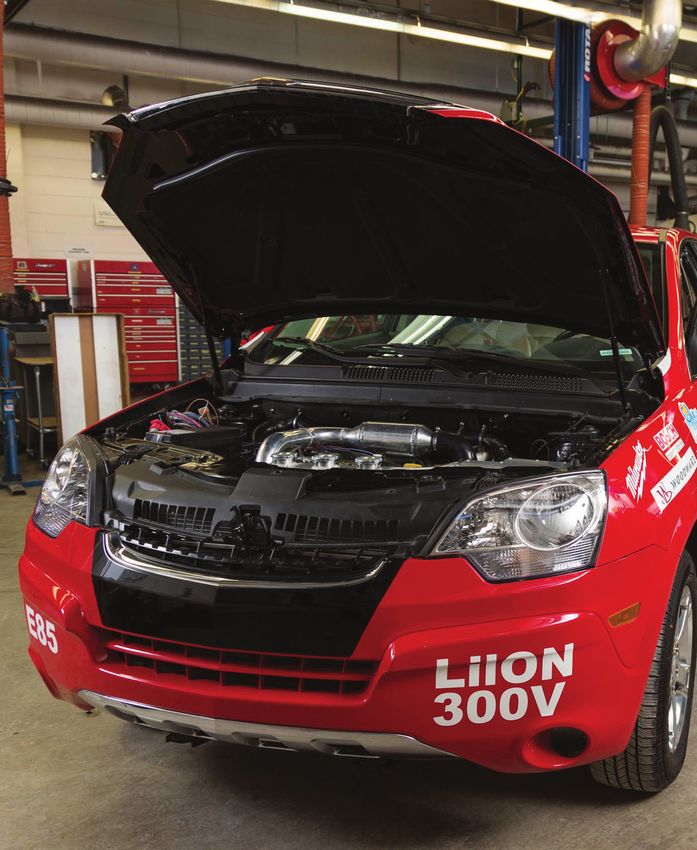
To Compete in the world’s
fastest growing markets, engine manufac-
turers and fleet operators need to meet
increasingly stringent emissions require-
ments while also improving fuel efficiency.
Fleet-wide efficiency goals and the need to reduce
fuel consumption to meet current and future emission
and efficiency mandates also reinforce the demand
for a new generation of engine technologies.
                                                                          Figure 1: Modified diesel intake manifold
A portfolio of recently patented engine technolo-                                  with port fuel injectors.
gies developed by a team from the University of
Wisconsin–Madison Engine Research Center led by                 Laboratory demonstrate that engines utilizing these
Director Rolf Reitz solves a host of environmental              technologies attain exceptional fuel efficiency. The
and efficiency challenges by offering dramatic re-              test engine has achieved an unprecedented 60
ductions in nitrogen oxide and soot emissions while             percent gross indicated efficiency1 in the laboratory
boosting fuel economy. The technologies are now                 (corresponding to a diesel fuel energy equivalent
available for licensing through the Wisconsin Alum-             gross indicated specific fuel consumption of 141
ni Research Foundation, which patents and licenses              g/kW-hr) with nitrogen oxide and soot emissions
discoveries arising from UW–Madison research.                   significantly below current limits in the U.S., EU and
                                                                Japan. (Fig. 2)
Called reactivity controlled compression igni-
tion, or RCCI, the base technology uses multiple                Additional research published by the International
injections of differing fuel types to optimize                  Journal of Engine Research points to a 100-fold
combustion phasing, duration and magnitude.                     reduction in nitrogen oxide and a 10-fold reduction
Laboratory experiments performed at the Engine                  in soot when compared with a conventional diesel
Research Center and at Oak Ridge National                       combustion engine.2 (Fig. 3)

         Figure 2: Comparison of light-duty RCCI                          Figure 3: Comparison of heavy-duty RCCI
              and conventional combustion.                                      and conventional combustion.

 1. S
     plitter, D.A., Wissink, M., DelVescovo, D., and Reitz, R.D., “RCCI Engine Operation Towards 60% Thermal Efficien-
    cy,” SAE Paper 2013-01-0279, 2013.

 2. K
     okjohn, S.L., Hanson, R.M., Splitter, D.A., and Reitz, R.D., “Fuel Reactivity Controlled Compression Ignition (RCCI):
    A Pathway to Controlled High-Efficiency Clean Combustion,” International Journal of Engine Research, Special Is-
    sue on Fuel Efficiency, Vol. 12, pp. 209-226, doi:10.1177/1468087411401548, 2011.

                                                                               Investing in research, making a difference.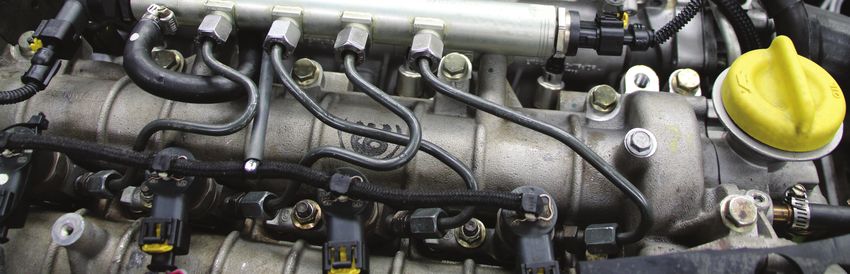
Figure 4

     The RCCI technology portfolio (warf.org/RCCI) comprises nine related patents and patent pending
     technologies that enable the unique in-cylinder fuel blending, stratification and compression combustion
     process. WARF seeks partners to license and develop the RCCI technologies.

      •	P100054US01 – Reactivity Controlled Compression Ignition Engine;
      •	P100054US02 – Fuel Reactivity Method Cuts Diesel Engine Emissions;
      •	P110092US01 –	Engine Combustion Control at Low Loads with
                        Reactivity Controlled Compression Ignition Combustion;
      •	P110320US01 –	Improved Compression Ignition Combustion in Rotary Engines for Higher Efficiency and Lower
                        Pollutant Emissions;
      •	P07342US    – Adaptive Fuel Injection Method Cuts Diesel Engine Emissions;
      •	P06042US    – Valve Method Cuts Engine Emissions, Boosts Combustion;
      •	P03152US    –	Variable Valve Actuation Method to Enhance Combustion and Reduce Engine Emissions;
      •	P01320US    – Reducing Emissions and Controlling Combustion Phasing in HCCI Engines; and
      •	P01108US    –	Use of Multiple Injections of Increasing Pressure to Reduce Diesel Engine Emissions.

           “Reactivity Controlled Compression Ignition is a new and superior way to burn fuel in internal combustion
           engines. It improves fuel use efficiency and reduces carbon dioxide emission. Compared with a conven-
           tional diesel it reduces nitric oxides emission 100-fold and soot 10-fold.

           Two fuels with differing reactivity are used. The lower reactivity fuel, e.g., gasoline, is injected early and
           is too dilute (lean) to self-ignite even at the high compression needed for high efficiency. The higher
           reactivity fuel, e.g., diesel, is injected later but early enough that mixing has time to prevent soot
           formation in locally rich cool regions and NOx formation in locally stoichiometric hot regions. The ratio of
           the two fuels provides an important control parameter to enable the engine to work optimally over ranges
           of speed, load and ambient temperature.

           The level of understanding that made this RCCI discovery possible is the direct result of decades
           of thoughtful interaction between evolving theory and experiment by Professor Rolf Reitz, faculty and
           students at the Engine Research Center at the University of Wisconsin–Madison.

           Future engines, especially those required for long haul of freight by road, river, rail or ocean, will compete
           to provide lowest cost of ownership while meeting minimum greenhouse gas and other emissions. RCCI
           provides an opportunity for a substantial advance in the way engines work their magic for the benefit of
           the world community.”

           – John Clarke, B.Sc., CEng, MIMechE, Fellow SAE, Associate ASME
              Caterpillar Research (Retired)

                                                                                 Investing in research, making a difference.
RCCI Technologies offer end-to-end benefits for engine
manufacturers, fleet owners and other engine applications
With the ability to meet the world’s most restrictive
regulatory standards while providing dramatic cost
savings in fuel and after-treatment systems, the RCCI
engine and its associated technologies promise a
broad range of benefits for engine manufacturers; fleet
owners; and producers of transportation, utility and
auxiliary power equipment.
• Benefits for engine manufacturers:
Implementation of the RCCI technology portfolio
enables compliance with U.S., EU and Japanese
regulatory frameworks through 2016 while
providing a basis for continued reductions.
The technologies offer substantial savings in
overall engine cost and weight due to significantly
reduced requirements for injection pressure
and engine heat rejection while lowering the
reliance on NOx and soot after-treatment systems Figure 5: Step load transient emissions of
and maintaining standard frame and engine RCCI vs. conventional diesel combustion (CDC).
compartment metrics.
• Benefits for fleet owners: • Benefits across multiple engine markets:
The RCCI engine technologies support increased
The technologies apply to automobiles; light-,
fleet efficiency through added fuel flexibility medium- and heavy-duty trucks and buses;
(e.g., RCCI allows the use of natural gas at high off-road vehicles (agricultural, construction,
substitution rates), improved fuel economy and industrial); locomotives; generator sets and
lowered reliance on costly after-treatment systems. marine vessels including large oceangoing ships
t
RCCI
operaHon
is
possible
for
a
large
fracHon
The technologies also reduce operator input and
fleet maintenance and lower the cost of ownership racHon
oof
f
eeac
ac
(propulsion and auxiliary power).
by reducing or eliminating the use of diesel exhaust
fluid (DEF).
Fuel
Fuel Drive
Drive Total
Total Dies
Die
economy
economy Drive
Drive cycle
cycle cycle
cycle by
by diesel
diesel duri
dur
RCCI
RCCI benefit
benefit by distance
by distance time
time fuel
fuel RC
RC
ngine
ngine
Drive Cycle
results (relative (%)
results (relative %)
%) (%) (%)
(%) (%)
(%) (%
(%
conomy
conomy
ghway
UDDSCity
UDDS +14
+14 72
72 55
55 56
56 41
4
ghway
HwyHWFET
< 60MPH +15 88 86 44 37
HWFET +15 88 86 44 3
US06 US06
Aggressive +8
+8 66
66 56
56 66
66 31
3
NYCC
Low Speed Stop-and-Go
NYCC +13
+13 69
69 36
36 65
65 43
4
Figure 6: Estimated RCCI-enabled engine increases in fuel economy over city and highway drive cycles
(Curran et al. SAE 2014-01-1324).
Investing in research, making a difference.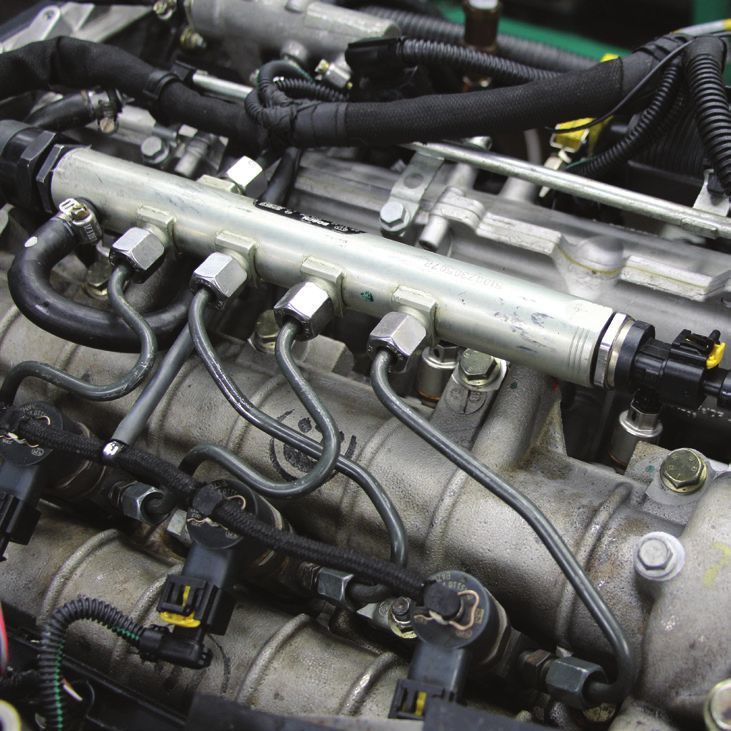
RCCI Technologies advance state of the art in engine design
The RCCI engine and associated technologies over-          •	Reduced engine costs:
come current diesel limitations by reducing both NOx
                                                            The expensive high pressure diesel injector
and soot while also improving fuel economy. This is         can be replaced by a relatively inexpensive
accomplished within the cylinder at lower injection         low pressure injector. Additionally, the RCCI
pressure and temperature, thereby reducing the need         engine technologies achieve soot and NOx
for expensive NOx and soot exhaust after-treatment          control within the combustion chamber with the
systems and high pressure injection systems.                addition of an inexpensive port fuel injector
                                                            for a diesel engine or by replacing the spark
The Advantages are Dramatic                                 plug with an injector for a spark ignition engine.

 •	Fuel savings of up to 20 percent:                      •	Reduced reliance on costly after-treat-

  The unique fuel injection system and highly effi-          ment systems and fluids:
  cient combustion process improves performance
                                                            Test results confirm that RCCI enables compliance
  for all engine uses, with fuel savings of up to 20        with today’s most stringent EPA emissions
  percent as compared to conventional diesel en-            regulations, in-cylinder, with reduced need
  gines. The multifuel system uses a combination            for NOx or soot after-treatment systems and
  of two or more fuels with varying reactivities,           chemicals. In addition, the system is compatible
  e.g., diesel with gasoline, natural gas or ethanol.       with existing exhaust gas recirculation and
                                                            after-treatment methods that would provide for
 •	NOx reductions without after-treatment:                 further emission reductions.
		The RCCI technologies reduce emissions of
   nitrogen oxides through lower and more                  •	End-to-end benefits:
   uniform combustion temperatures. The result
                                                            From lower engine costs to reduced fuel
   is an overall reduction in NOx emissions with            consumption to savings from fuel flexibility and
   reduced need for expensive after-treatment               reduced need for DEF and other operator inputs,
   systems that use nitrogen oxide catalysts                the RCCI technologies offer dramatic, measurable
		 and diesel exhaust fluid. (Fig. 3)                       advantages. At the same time, the documented
                                                            emission reductions ensure regulatory compli-
 • Soot reductions without after-treatment:                 ance while signaling a commitment to superior

  Rather than injecting a single fuel charge late           environmental performance for manufacturers
  in the cycle, the engine employs multiple charges         and fleet owners alike.
  injected very early in the cycle to generate low
  soot emissions during the combustion process.
  (Fig. 3)

  “Diesel engines have long been recognized for their fuel efficiency. However, while substantial progress
  has been made in reducing their emission of NOx and particulate matter, the remaining emissions of these
  criteria pollutants continue to be a source of environmental concern and are facing ever tighter emission
  regulations. The RCCI engine uses advanced, low temperature combustion techniques combined with
  multiple injections of a high and a low reactivity fuel at varying pressures to further reduce emissions and
  achieve even greater fuel efficiency. RCCI represents an important path forward in the effort to optimize
  the performance of diesel combustion systems.”

  –	Dennis Siebers, Engine Combustion Research Program Manager
     Sandia National Laboratories Combustion Research Facility

                                                                       Investing in research, making a difference.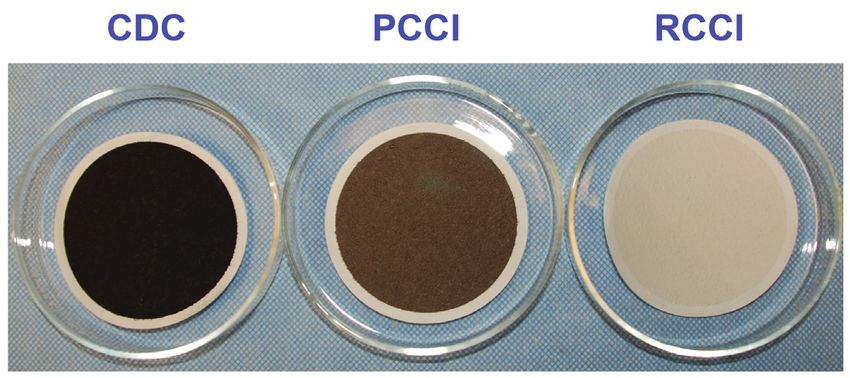
Figure 7

           Investing in research, making a difference.
Cell 2, 6-7,
                                                          Engine       6-9, 6-10,
                                                                  Condition:  2300GM engine
                                                                                   rpm, 4.2 bar BMEP*
                                                RCCI post-DOC emissions 0.014 +- 0.001 g/hp-hr
                                                                                                                           Engine-out PCCI and
                                    0.14                                                                                     Diesel
Particle Mass Emissions (g/hp-hr)
                                                                                                                           RCCI mass were similar
                                                                      Reduction by DOC                                     inOxidation
                                                                                                                              magnitude but
                                    0.12                              Conventional Diesel: 30 ± 6%
                                                                                                                                 The DOC reduced PM
                                                                             Diesel PCCI: 9 ± 18%                           Catalysts
                                                                                                                              mass by 50% with
                                    0.10                                 Dual-Fuel RCCI: 47 ± 9%                               RCCI vs. 30% with
                                                                                                                            (DOC)
                                                                                                                               CDC further
                                                                                                                                    and 10%reduce
                                                                                                                                            with
                                    0.08                                                                                       PCCI
                                                                                                                            particulates.
                                                                                                                           DOC was effective for
                                    0.06                                                                                   RCCI despite PCCI
                                                                                                                            Engine-out  lower and
                                                                                                                           exhaust temperature
                                    0.04                                                                                    RCCI mass were similar
                                                                                                                            in magnitude. However,
                                    0.02                                                                                    the DOC further reduced
                                    0.00                                                                                    PM mass by 47% with
                                                 Engine              Engine     Post        Engine
                                            0       1
                                                  Out
                                                            Post
                                                              2
                                                            DOC
                                                                       3
                                                                      Out
                                                                                 4
                                                                                DOC
                                                                                             5
                                                                                             Out
                                                                                                         Post
                                                                                                         6
                                                                                                         DOC
                                                                                                                   7        RCCI vs. only 30% with
                                                 Conventional Diesel   Diesel PCCI           Dual-Fuel RCCI                 CDC and 9% with PCCI.
                                           RCCI post-DOC emissions 0.014 ± 0.001 g/hp-hr
                                                                                                                            DOC was effective for
                                                     iB4.4),8"C')0"/)R^;JcQgRI
The RCCI Engine and
                                                                                PFI                   DI
                                                                      Intake                                Exhaust

associated technologies provide a broad
range of engine power and torque char-
acteristics suitable for automobiles; light-,
medium- and heavy-duty trucks and buses;
off-road vehicles (agricultural, construction,
industrial); locomotives; generator sets and
marine vessels including large oceangoing                    Port injection
                                                                  of low
                                                                                                                   Direct
                                                                                                            injection of high
ships (propulsion and auxiliary power).                      reactivity fuel,
                                                             i.e., gasoline/
                                                                                                              reactivity fuel,
                                                                                                             i.e., diesel/B20
                                                              E85 (orange)                                         (blue)
Engine-size scaling relationships are used to scale
fuel injection parameters across engine platforms.              Figure 10: Schematic of cylinder injection and fuel
Differences in compression ratio, engine speed                    distribution (Curran et al. SAE 2014-01-1324).
and operating conditions are accommodated with
adjustments to the fuel blend. The technologies also
are applicable to rotary engines.                           • Variable valve actuation:

                                                             In a traditional four-stroke engine, intake and ex-
                                                             haust valves open to allow air into the combustion
Control of fuel reactivity and stratification                chamber and again to release exhaust gases fol-
combine for a high-performance system                        lowing combustion. A fixed geometry and phasing
The RCCI engine portfolio integrates important               mechanical camshaft opens and closes the valves.
advances in combustion phasing and duration
control to achieve its impressive performance profile.        Newer technology called variable valve actuation
Key innovations include the use of fuels with differing       (VVA) uses independently controlled camshaft
reactivities delivered through multiple injections to         profile and phasing to open and close valves
achieve optimum fuel reactivity stratification. This          at optimal times during the combustion cycle.
enhanced combustion process improves performance,
even at low loads or while idling.
                                                               Gasoline               PFI Fuel Rail
                                                                Fuel
 • Multiple injections at varying pressures:                   System                                      Port Fuel

  The engine cycle starts with a pulse of lower                                                            Injectors
  reactivity fuel (e.g., gasoline, natural gas or               Diesel
  ethanol) during the early phase of the compression             Fuel
  stroke. This fuel pulse is timed to mix with intake           System                DI Fuel Rail
  air so that it is too “lean” to produce appreciable            Diesel
  soot or nitrogen oxides upon combustion, but                 Injectors
                                                                                                             Cooler
                                                                                                              ERG

  not so lean that it creates significant amounts of
  unburned hydrocarbons and carbon monoxide.

   Smaller pulses of higher reactivity fuel (e.g.,
   diesel, biodiesel or additive) then provide a locally
   richer fuel mixture for effective autoignition. The                                       Turbo
   timing and volume of these pulses are optimized to
   control the combustion event to maximize efficiency.                                                    CAC
                                                             Exhaust
   The use of varying injection pressures also aids
   ignition and cuts emissions by introducing further                                           Intake Air
   control over the combustion process. The first
                                                                 Figure 11: Schematic of engine injection and fuel
   injection arrives at a lower pressure followed by
                                                                   distribution (Curran et al. SAE 2013-01-0289).
   subsequent injections at higher pressures.

                                                                                Investing in research, making a difference.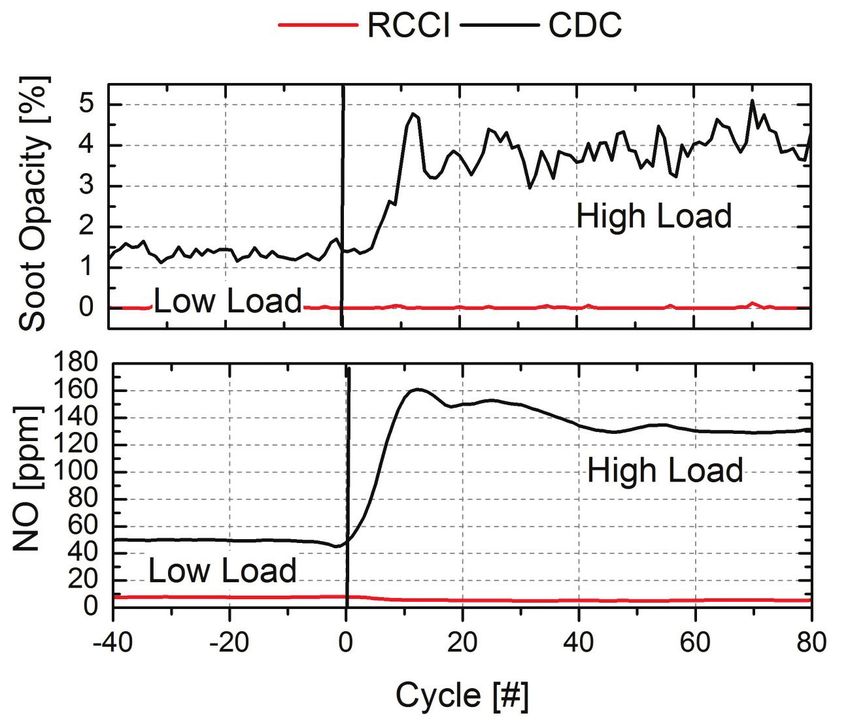
Low = Prevents Autoignition                                            Fuel Reactivity                         High = Promotes Autoignition

                               Figure 12: Combustion mode spectrum (Curran 2013 U.S. DOE Annual Merit Review).

           The RCCI engine can exploit VVA to introduce air                                     • Enhanced performance at low loads:
           into the combustion chamber at optimal times
                                                                                                Many advanced engines provide high output
           during the compression and power strokes to                                          and efficient fuel use, but performance declines
           control the combustion process.                                                      markedly at low loads or while idling. The RCCI
                                                                                                engine overcomes this obstacle through stratified
 • Improved compression ignition:                                                               fuel reactivity and a throttle upstream from the

  An initial injection of a lower reactivity fuel is fol-                                       intake port to maintain the optimal fuel/air mixture.
  lowed by injection of a higher reactivity fuel. This
  fuel reactivity stratification allows combustion in                                         The technology ensures low emissions and enhanced
  the chamber without use of a spark source.                                                  fuel economy across a wide range of engine loads. It
                                                                                              can be combined with exhaust gas recirculation and
                                                                                              exhaust after-treatment strategies.

  Single Fuel Operation with Additive
 RCCI can operate using a single fuel plus a small tank of cetane improving additive. As depicted in figure
 13, RCCI is able to use port fuel injection of gasoline and direct injection of the same gasoline doped
 with a small quantity of additive, e.g., ethylhexyl nitrate (EHN). Results show that while there is a slight
 increase in NOx emissions using the additive, they
 are still lower than regulated levels. Additionally,
                                                                          Additive
 soot emissions are lower and thermal efficiency is
                                                                           Tank              Fuel Tank
 increased by using the additive as compared to
 operation with diesel fuel. (Fig. 14)

 uch an operating strategy would only require
 S
 refilling the additive at typical oil change intervals.
 Based on a 50 mpg estimate, a 3 gallon tank
 of additive would require refilling every 10,000
 miles, which is less than DEF refilling intervals
 and amounts.
                                                                                                    Figure 13: Single fuel plus additive RCCI setup.

                                      E10 + E10/EHN
                 0.3                  E10 + Diesel Fuel                   0.006                                                52
                                                                                                                               50
  NOx (g/kW-h)

                                                          Soot (g/kW-h)

                 0.2                                                      0.004                                                48
                                                                                                                     GIE (%)

                                                                                                                               46
                 0.1                                                      0.002                                                44
                                                                                                                               42
                 0.0                                                      0.000                                                40
                       5.5 bar IMEP      9 bar IMEP                                  5.5 bar IMEP    9 bar IMEP                     5.5 bar IMEP   9 bar IMEP

                                   Figure 14: Emissions and performance comparison of single fuel plus additive
                          RCCI (E10 + E10/EHN) and dual-fuel RCCI (E10 + Diesel Fuel) (Kaddatz et al. SAE 2012-01-1110).

                                                                                                              Investing in research, making a difference.
The Wisconsin Alumni Research Foundation is actively seeking industry partners to
develop and incorporate the RCCI engine technologies into commercial products.
Please contact Chris Thomas (608.890.2524, cthomas@warf.org) to discuss licensing opportunities.
         To learn more about the RCCI engine technology portfolio, visit warf.org/RCCI.

Figure 6:	Curran, S., Gao, Z., and Wagner, R. “Reactivity Controlled Compression Ignition Drive Cycle Emissions and Fuel
           Economy Estimations Using Vehicle Systems Simulations with E30 and ULSD,” SAE Technical Paper 2014-01-1324, 2014.

Figure 8:	Daw, S., “Modeling Emissions Controls for RCCI Engines,” Presentation given at the University of Wisconsin–Madison
           Engine Research Center Symposium, “Engine Fuel Efficiency and Advanced Combustion,” 2013.

Figure 10:	Curran et al. SAE 2014-01-1324.

Figure 11:	Curran, S., Hanson, R., Wagner, R., and Reitz, R., “Efficiency and Emissions Mapping of RCCI in a Light-Duty Diesel
            Engine,” SAE Technical Paper 2013-01-0289, 2013.

Figure 12:	Curran, S., “High Efficiency Clean Combustion in Multi-Cylinder Light-Duty Engines,” 2013 US DOE Annual Merit Review.
            www4.eere.energy.gov/vehiclesandfuels/resources/merit-review/sites/default/files/ace016_curran_2013_o.pdf

Figure 14:
           Kaddatz, J., Andrie, M.J., Reitz, R.D., and Kokjohn, S.L., “Light-duty Reactivity Controlled Compression Ignition
           Combustion using a Cetane Improver,” SAE Paper 2012-01-1110, 2012.

                                                                                  Investing in research, making a difference.
About Rolf Reitz
Rolf Reitz is a Wisconsin Distinguished Professor in With major support from the U.S. Department of
UW–Madison’s College of Engineering where he Energy’s Sandia laboratories, Caterpillar, GM and
serves as director of the Engine Research Center Ford, the Reitz research group currently includes two
and director of the Direct-Injection Engine Research staff members, three postdoctoral students and about
Consortium. The consortium currently counts 30 17 students pursuing master’s and doctoral degrees.
industrial members and three national laboratories Reitz also supervises international visiting scientists.
among its participants.
Reitz and his group have won numerous industry
His research interests include development of and academic awards through the years includ-
advanced computer models for predicting engine ing multiple presentations of the SAE International
performance. With annual sponsored research funding Harry L. Horning Memorial Award, the DOE Vehicle
totaling some $1 million per year, Reitz operates Technologies R&D Program Award in 2012 and the
a heavy-duty diesel engine laboratory featuring a ASME Internal Combustion Engine Award in 2011.
Caterpillar 3401E single-cylinder test engine For more information, visit reitz.me.wisc.edu.
equipped with prototype fuel injection systems.
He was the first to demonstrate that use of multiple
injections can produce significant emissions
reductions in these engines. About WARF
Reitz also runs a high-speed engine laboratory WARF helps steward the cycle of research, discovery,
featuring an automotive-size diesel engine with commercialization and investment for the University
advanced electronically controlled fuel injection of Wisconsin. Founded in 1925 as an independent,
systems capable of multiple injections. His experi- nonprofit foundation, WARF manages commercial
mental spray research focuses on fuel drop breakup opportunities on more than 1,500 technologies as it
and atomization phenomena and his research has funds university research, obtains patents for discov-
pioneered the use of computational fluid dynamics to eries from campus labs and licenses the inventions to
understand the basic physical processes involved. industry. For more information, visit www.warf.org.
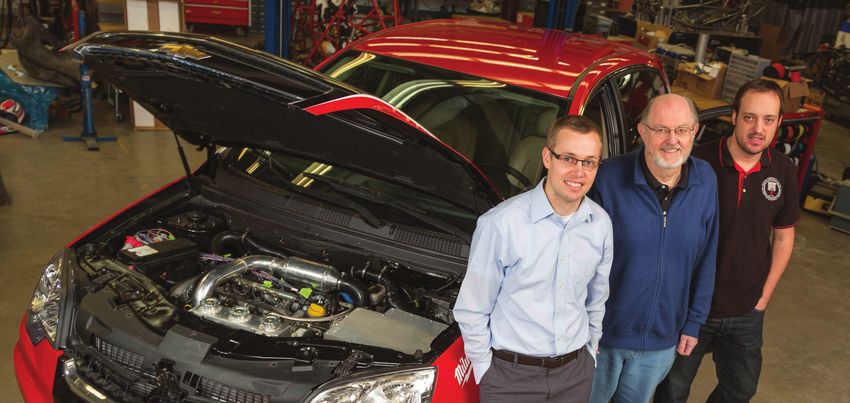
Figure 15: UW–Madison Inventors Asst. Prof. Sage Kokjohn, Prof. Rolf Reitz, Reed Hanson, Ph.D. (not pictured: Derek Splitter, Ph.D.)
Investing in research, making a difference.To find out more about WARF’s
Reactivity Controlled Compression Ignition Technology Portfolio
visit warf.org/RCCI
UW–Madison Campus | 614 Walnut Street, 13th floor | Madison, WI 53726 | 608.263.2500 | www.warf.org
Investing in research, making a difference.
03.14You can also read


