Surgical Oncology in Romania: An Analysis of Research and Impact Based on Literature Search in PubMed and Web of Science - Hindawi.com
←
→
Page content transcription
If your browser does not render page correctly, please read the page content below
Hindawi
BioMed Research International
Volume 2021, Article ID 5528582, 7 pages
https://doi.org/10.1155/2021/5528582

Research Article
Surgical Oncology in Romania: An Analysis of Research and
Impact Based on Literature Search in PubMed and Web of Science

          Sînziana Ionescu,1,2 Octavia-Luciana Madge ,1,3 Ioana Robu,4 Eugen Brătucu,1,2
          and Claudiu Daha1,2
          1
            Oncology Institute Bucharest, First Clinic of General Surgery and Surgical Oncology, 252 Fundeni Road, 2nd District,
            022328 Bucharest, Romania
          2
            “Carol Davila” University of Medicine and Pharmacy Bucharest, 37 Dionisie Lupu Street, 1st District, Bucharest, Romania
          3
            University of Bucharest, 5-7 Edgar Quinet Street, 1st District, 010017, Bucharest, Romania
          4
            The Library of the Cluj Medicine and Pharmacy University, 8 Victor Babes Street, 400012 Cluj-Napoca, Romania

          Correspondence should be addressed to Octavia-Luciana Madge; octavialucianamadge@yahoo.com

          Received 5 January 2021; Revised 10 February 2021; Accepted 19 February 2021; Published 8 March 2021

          Academic Editor: Ajoy Prasad Shetty

          Copyright © 2021 Sînziana Ionescu et al. This is an open access article distributed under the Creative Commons Attribution
          License, which permits unrestricted use, distribution, and reproduction in any medium, provided the original work is
          properly cited.

          Background. With a long tradition and outstanding contributions over time, medical scientific research in Romania has experienced
          major changes in the last two decades, marked by an increase in scientific publications, originating especially from university
          centers and fostered by national regulations on publication standards required for professional promotion. This study is aimed
          at assessing the literature on surgical oncology in Romania, published by Romanian authors in journals indexed in international
          databases. Materials and Methods. A literature search was performed, focused on surgical oncology performed in Romania. Two
          databases, PubMed and Web of Science (WoS), were finally selected and included in the study, which included bibliometric
          parameters and subject analysis. Results. The PubMed search retrieved 464,295 articles being published in only 3 Romanian
          journals, Chirurgia, The Medical-Surgical Journal (Iasi), and Romanian Journal of Morphology and Embryology. The search of
          the Web of Science retrieved 494 records on the subject of surgical oncology in Romania, 449 of which were published after
          1989. The 494 articles received 2,102 citations, 4.26 per year, and an overall Hirsch index of 21. Most articles were published in
          the same 3 Romanian journals as in PubMed. Neoplasms of the digestive system prevailed, followed by articles on general
          surgical oncology issues, cancer research, and therapy. Bucharest has the highest number of authors, followed by Cluj-Napoca
          and Iasi. Conclusion. Research originating from Romania in the field of surgical oncology is present and visible at an
          international level mainly through Romanian journals. Sustained effort is required from surgical oncology authors to be
          published in international journals on this subject, as it is the only way to increase global visibility and impact.

1. Introduction                                                         the second leading cause of morbidity and death, with over
                                                                        4.5 million new cases and over 2 million deaths in 2018 [2].
According to the World Health Organization, “Cancer is the                  In Romania, according to the 2019 Romanian Statistical
second leading cause of death globally, being responsible for           Yearbook, the number of patients classified according to
an estimated 9.6 million deaths in 2018; approximately 70%              diagnosis at the moment of hospital discharge as cancer
of deaths from cancer occur in low- and middle-income                   was 402,000 in 2018, and the number of new cancer
countries” [1]. Lung, colorectal, gastric, and breast cancers           cases declared by family physicians in the same year
are the most common causes of cancer death worldwide.                   was 111,000 [3].
    Almost a quarter (23.4%) of cancer cases in the world                   Mortality by cancer was the second cause of death in
are in Europe, where this disease represents, worldwide,                Romania in 2018, with 51,652 deaths, after diseases of the
2 BioMed Research International
cardiovascular system followed by respiratory system dis- the core component of PubMed), we retained PubMed for
eases, digestive system diseases, and accidents. Crude death the study analysis. In the same way, between WoS and
rate by neoplasms per 100,000 inhabitants increased from Scopus, the results from WoS (All Databases and Core
181 in 2000 to 232.9 in 2018. According to the official data, Collection) were used, mainly because the search results did
the most frequent causes of deaths by neoplasms in 2018 not show much difference.
were the neoplasms of the bronchi and lungs (45.3 per Worthy of mention is that Romanian journals not
100,000 inhabitants), neoplasm of the colon (18.2 per included in these databases were also initially considered
100,000 inhabitants), neoplasm of the breast (16 per for the study, but because of the large proportion (75%) of
100,000 inhabitants), neoplasm of the liver and intrahepatic articles written in Romanian and the almost complete lack
bile ducts (14.3 per 100,000 inhabitants), and neoplasm of of international visibility, the final decision was to exclude
the stomach (14 per 100,000 inhabitants) [4]. them.
The number of cancer cases in the records of the oncol-
ogy specialists was 490,655 in 2018 and the number of newly 3.1. PubMed Search. The following search syntax was used:
diagnosed cancer cases detected in Romania was 61,780, with ((((((“Neoplasms/surgery”[Majr]) OR (“Neoplasms by site/
a territorially uneven distribution and a much higher inci- surgery”[Majr]) OR (oncological surgery) OR (surgical
dence for the male gender and for the urban environment, oncology))) OR (cancer AND surgical treatment)) OR
and the forecast by 2025 indicates a trend of continuous (tumors AND surgical treatment))) AND ((“Romania”
growth of new cases [5]. [Mesh]) OR (Romania∗[tiab])).
The statistics on the total number of surgeries performed It combines index terms (MeSH: Medical Subject Head-
in Romania in 2018 for the diagnosis of cancer are not easily ings) and free text. The initial separate searches of various
available, but there is certainly an increasing number, year by neoplasms by site, e.g. “colon cancer,” “lung cancer,” and
year. breast cancer,” proved to be impractical because of the diffi-
Dissemination of the results of medical research is done culties in filtering. Moreover, the search of “Romania” in
firstly by publishing articles in journals and by presenting the field of author affiliation retrieved a large number of arti-
the results at scientific events. “The results of scientific cles of surgical oncology in general, but not in Romania,
research are communicated primarily through publications authored and mainly coauthored by Romanians, which were
in journals” [6]. considered irrelevant for the study.
However, what is published does not necessarily reflect All results were saved to Mendeley, the Elsevier free refer-
the interests or needs of patients or professionals in the field, ence manager, for easy processing and data extraction.
as Lawler et al. noted, referring to the results regarding rarer
types of cancer which are not “disseminated as effectively as 3.2. Web of Science Search. The search was performed with
those for more common cancers” [7]. the “All Databases” option, which, besides the Core Collec-
tion journals (with Impact Factor, indexed in Journal
2. Aim Citation Reports), included MEDLINE, BIOSIS, Current
Contents, SciELO, Russian SCI, and Derwent Innovation.
This study is aimed at providing the objective assessment of The advanced search option was used according to the
the literature on surgical oncology in Romania, published field syntax, e.g., TS = oncological surgery (search by topic).
by Romanian authors in journals indexed in international Boolean combination of terms was performed in the search
databases. The specific goals are to extract information on history option for more accuracy. “Romania” was searched
the evolution of the scientific output in time, the number of in titles and abstracts and author affiliations.
authors and their distribution across the large Romanian The retrieved records were submitted to the citation anal-
medical and surgical centers, the impact of published ysis option and saved to an Excel file. Because the “All DB”
research, the fields of interest within surgical oncology, a option did not allow saving of author affiliations, the Core
basic comparison with neighboring countries, and trends Collection records were extracted from the set for further
and possible ways to improve global publication and analysis.
visibility. No time limits were defined in the searches, as these
could be easily found in the retrieved sets.
3. Materials and Methods
4. Results
The databases (DB) comprised the following: PubMed,
Embase, Web of Science (WoS), and Scopus. Google Scholar 4.1. PubMed. At the time of manuscript drafting, the total
was also searched, but because of the large record yield, it is number of retrieved records was 464. The number of articles
very difficult to manage in a structured way and, therefore, per year, as displayed by the PubMed graph, is represented in
was not included in the analysis. Of the four DBs mentioned, Figure 1.
two are bibliographic—PubMed and Embase—focusing on The increase in numbers is clearly evidenced starting
subject search, while the other two—Web of Science and with the year 2005, reaching a peak in 2015, when 47 articles
Scopus—are bibliometric, focusing on citation and research were indexed.
impact analysis. Given the fact that PubMed and Embase The journals in which these articles were published are
retrieved very similar results (Embase includes MEDLINE, dominated by the Romanian journals indexed in PubMed,BioMed Research International 3
Number of PubMed articles by year Number of articles by publishing journals
50
45
40 Romanian Journal
35 of Morphology
30 and Embryology
25 n = 50 (11%)
20
15 Other Romanian
Chirurgia
10 Journals
(Bucharest)
5 n = 59 (13%)
0 n = 160 (34%)
1963
1967
1970
1974
1977
1979
1982
1985
1987
1989
1991
1993
1995
1997
2000
2002
2004
2006
2008
2010
2012
2014
2016
2018
2020
Figure 1: PubMed articles on surgical oncology in Romania by The Medical-Surgical
publication year. Journal (Iasi)
n = 85 (18%)
Non-Romanian
mainly Chirurgia, The Medical-Surgical Journal (Iasi), and Journals
Romanian Journal of Morphology and Embryology. The n = 110 (24%)
number of articles by journal is shown in Figure 2.
Data evidence shows that 295 articles out of 464 were
published in only 3 journals, and only less than a quarter of
the number of articles was published in non-Romanian
journals (110 of 464). Figure 2: Number of Romanian surgical oncology articles by
According to the PubMed type of articles, the majority journal.
are classified as “journal articles,” which we may assume are
original research, followed by case reports and reviews, in a
significantly smaller number, as shown in Figure 3.
As the PubMed search string allowed a quick comparison there were 170 articles (34.4%) written in Romanian of a total
of the number of articles in Romania with those in the neigh- of 494.
boring countries, a search was performed with the same syn- Other bibliometric parameters would have been of great
tax in which the country name was replaced. Romania is value in our evaluation, as argued by Roldan-Valadez et al.
surpassed by Poland with 1,485 articles in surgical oncology [8]. However, metrics such as the Eigenfactor score and Arti-
and by Hungary with 667. Bulgaria (n = 328), Czech Republic cle Influence Score proved to be of little relevance for our
(n = 271), Croatia (n = 152), and Slovakia (n = 87) have fewer study, given that they could be retrieved only for 2 journals
articles indexed in PubMed on the subject. out of the three significant ones, namely, Chirurgia (available
for the years 2011-2012!) and Rom J Morph Embryology
(available for 2010-2019)—the Eigenfactor score of the last
4.2. Web of Science. The search of WoS All Databases available 5 years is shown in Figure 6.
retrieved a total number of 494 records about surgical oncol- Both the above mentioned journals are in the Q4 (4th
ogy in Romania, 449 of which were published after 1989. The quartile) journal rank category, which is also of low signifi-
citation analysis feature of the database evidenced the- cance because they are not in the specific field of surgical
following information: the total number of 494 received oncology.
2,102 citations, which on average means 4.26 per year. Based Because the WoS All Databases retrieved set included the
on these data, the Hirsch index was calculated to be 21. largest number of articles, we performed a keyword search on
Figures 4 and 5 are extracted as such from the database cita- the 494 titles found, the terms used being organs or cancer
tion analysis report. sites, and correlated them with the “Analyze results” feature
In WoS, a similar search was performed for Poland, of the database. The results are shown in Figure 7.
retrieving 1,605 records, with an overall Hirsch index of 69, By far, the majority of articles refer to the digestive
and Hungary, 862 records, with H‐index = 45. system—the gastrointestinal tract, liver, and pancreas,
Of the 494 articles, 293 (59.3%) received at least one cita- followed by articles on general surgical oncology issues,
tion. The highest number of citations received was 54, for an cancer research, and therapy.
article published in 2009. All cited articles, except 2, were Because one of the objectives of this study was to evaluate
published after 1990. the distribution of authors by the most important oncological
The journals in which these articles were published main- centers in Romania, the articles indexed in the Core Collec-
tained the same pattern as in PubMed: 275 articles (55.6%) tion set of the Web of Science were saved separately to an
were published in 3 Romanian journals: Chirurgia, The Excel file, because only this database allows saving of author
Medical-Surgical Journal (Iasi), and Romanian Journal of affiliations. The total number of articles found was 259, pub-
Morphology and Embryology. Unlike in PubMed, in the lished between 1977 and 2020, of which 185 were cited at
WoS retrieved set, it was readily possible to see the language least once.
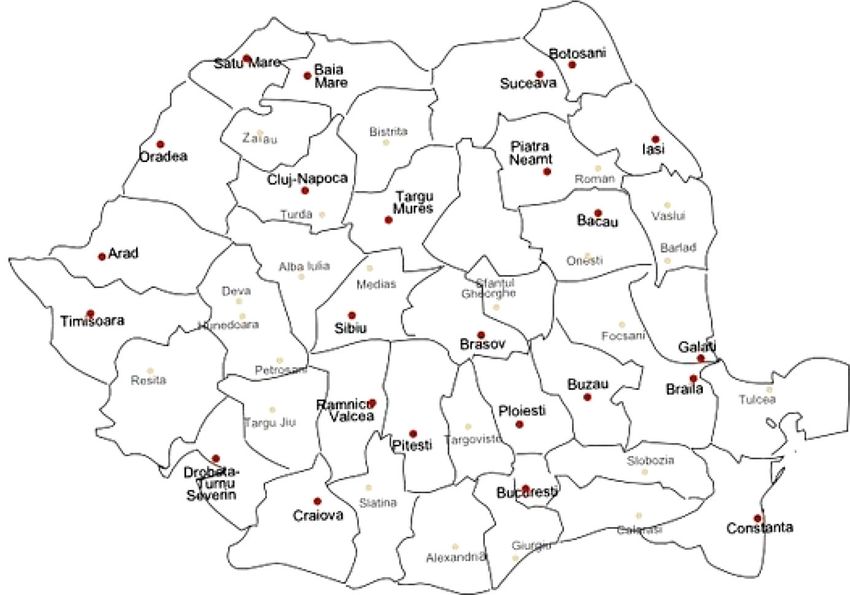
in which the articles were written. Surprisingly, until as late as The geographical distribution of the authors is shown in
2008, 99% of the articles were written in Romanian. Overall, Figure 8.4 BioMed Research International
Number
Systematic reviews 1
Clinical trials 7
Reviews 32
Case reports 50
Journal articles 374
0 50 100 150 200 250 300 350 400
Figure 3: Number of articles by publication type.
38 No. of articles
36 Gastrointestinal tract 123
34 General cancer research/therapy 104
32 Other sites / organs 76
30
28 Liver and pancreas 60
26 Breast 42
24 Lung 35
22
20 ENT 30
18 Thyroid 24
16
14 0 20 40 60 80 100 120 140
12
10
8 Figure 7: Number of articles by cancer sites and subject focus.
6
2001
2002
2003
2004
2005
2006
2007
2008
2009
2010
2011
2012
2013
2014
2015
2016
2017
2018
2019
2020
2021
As expected, Bucharest has the highest number of
Figure 4: Total number of articles in WoS by year of publication. authors, followed by Cluj-Napoca and Iasi, the 3 centers
being the largest and most renowned in the medical and
surgical field.
300
280
260
240 5. Discussion
220
200
180 PubMed is the most comprehensive bibliographic medical
160 database in the world, while Web of Science, as a bibliometric
140
120 database, is considered the most prestigious when analyzing
100 the quality and impact of research. Our study focused on
80
60 the analysis of the results from searches on surgical oncology
40
20 publications from Romania in these two major sources of
medical records worldwide.
2002
2003
2004
2005
2006
2007
2008
2009
2010
2011
2012
2013
2014
2015
2016
2017
2018
2019
2020
2021
2022
After 1990, the academic and scientific communities in
Romania experienced many changes and new practices,
Figure 5: Sum of citations received by year. rules, and criteria in all fields of specialization with an open-
ing to new opportunities and research available at the inter-
national level.
Eigenfactor score The last two decades have seen an increase of surgical
0.0025 0.00230 0.00233 research originating from Romania, published in journals
Eigenfactor score
0.0020 0.00199
0.00184 0.00182
visible and accessible internationally.
0.0015
The searches in the two databases returned very close
numbers of articles, 464 and 494, and showed an increase
0.0010
in the number of publications starting with 2005-2006.
0.0005
The first reason for these results is the fact that most arti-
0.0000 cles retrieved are published in three Romanian journals
2015 2016 2017 2018 2019
JCR years
indexed in the databases. The increase in numbers after
2005 can be explained by the fact that the rules and criteria
Figure 6: Eigenfactor score of the Romanian Journal of Morphology for promotion in higher education in Romania changed
and Embryology for the period 2015-2019. along the years. At the same time, journals started to raise
the standards and publish research in English to be indexedBioMed Research International 5
Cluj-Napoca = 62
Iasi = 34
Timisoara = 21
Tg.Mures =16
Brasov = 13
Craiova = 23 Bucharest = 88
Figure 8: Romania map: geographical distribution of authors.
in international databases, a requirement also taken into another sign that efforts and improvements are required
consideration in the national rankings. to raise the visibility and consequently the impact of
The fact that only a small number of articles were research in Romania.
published in journals from abroad showed that for certain One of the problems it seems is the fact that only a few
specialties, it is still very difficult for Romanian authors/ Romanian journals succeeded in being indexed in WoS.
specialists to get published in the mainstream scientific Again, in comparison with Poland and Hungary evidence,
literature. although these countries have a high number of articles pub-
The fact that most articles are in the category of journal lished in their respective national journals, they still have a
articles, which we assume to be original research, can be much better parity with international journals than Romania
explained by the fact that this type of article is taken into con- does.
sideration for promotion or as a prerequisite for the PhD The analysis of results by subject research areas did not
thesis. provide any surprise: besides the largest number of digestive
Compared to the publishing activity in the neighboring cancers prevalent in surgical oncology, the articles focused on
East European countries, Romania can be placed on the third general cancer research and therapy, a field yielding the best
place, somewhere in the middle, regarding the number of results for scientific reporting.
articles, after Poland, a much larger country, and with more Furthermore, another area of analysis might be a com-
financial resources, and Hungary. parison between the number of PubMed articles and the
The fact that until very late, only starting with 2008, 99% ascending trend of cancer diagnosis and treatment. For
of the articles were written in Romanian indicated a lower instance, if we are to compare Figures 1 and 9, it can be
speed of adaptation to international standards. Criteria such observed that the year 2015 registered as a peak not only
as international visibility, which is achieved by publishing in regarding the number of articles on surgical oncology but
English, were not adopted until imposed at the national level also due to a noticeable increase in cancer cases [9].
by authorities for promotion in the academic career. However, in this study, we did not aim to assess the qual-
The impact of researching on surgical oncology originat- ity of the papers published, unlike in a much similar report
ing from Romania is illustrated by the number of citations. from Australia [10].
This increased starting with 2012. A reason for the low
number of citations until that moment is the fact that many
articles were published in Romanian, which restricted the 6. Limitations
access of researchers from abroad, doubled by the fact that
the three Romanian journals were not very well known The limitations of this study are given by the initial pre-
abroad or visible at the international level. In addition, liminary findings, which did not allow the application of
the number of articles in the Core Collection was only more elaborate bibliometrics, because of the scarcity of
259 with only 185 being cited. The Hirsch index value of the results, which did not lend themselves to comparative
21, considerably lower than for Poland or Hungary, is processing.6 BioMed Research International
Number of cancer cases from 2009 to 2020 publish as an essential part of their promotional pathway in
3500
their academic career.
3000 Future studies could analyze and compare the visibility
and impact of research from Romania with those from other
2500 countries and analyze the evolution of Romanian research in
the general field of surgery.
2000
1500
Data Availability
1000
We used in our analysis data retrieved from the following
databases: PubMed and Web of Science. The results of our
500 searches in these databases were saved to Mendeley, the
Elsevier free reference manager, for easy processing and data
0 extraction. The data are available on request from the
2008 2010 2012 2014 2016 2018 2020 2022
authors.
Figure 9: Number of cancer cases diagnosed and treated in general
surgery units; the numbers for the year 2020 are those available until Ethical Approval
the 31th of August.
This article does not contain any studies with human partic-
7. Future Direction ipants or animals performed by any of the authors.
A new education law came into force in 2011 which made it Consent
no longer possible to circumvent the imposed criteria. This
meant that promotion in the academic career requires more For this type of formal study, consent is not required.
articles published in WoS-indexed journals with an impact
factor; this is the most important criterion, overriding publi- Conflicts of Interest
cations in other databases. It may further lead to an increase
of articles in JCR journals. However, authors should be The authors declare that they have no conflict of interest.
encouraged to publish in journals of their specialty, which
would validate comparative evaluations. As it is now, authors Authors’ Contributions
seek publication channels outside their specialty, such as the
Rom J Morph Embryol, defeating efforts of more precise bib- SI was responsible for writing the original draft; OLM was
liometric measurements and predictability. responsible for conceptualization, formal analysis, investiga-
The new criteria adopted by medical universities after the tion, writing the original draft, and visualization; IR was
new law came into force also stipulate the position in the list responsible for the methodology, investigation, resources,
of authors of an article, meaning that one must have, for writing the original draft, and visualization; EB was responsi-
example, at least 6 articles as first author. The starting point ble for the supervision; and CD was responsible for the
of a future study might be represented by the Romanian supervision.
authors, similar to the study by LaRocca et al. [11].
References
8. Conclusions
[1] World Health Organization, “Cancer,” 2020, https://www.who
Advanced and high-quality research which matters and .int/news-room/fact-sheets/detail/cancer.
brings innovation is published in journals which comply [2] The National Institute of Public Health, National Center for
with the highest standards, most often English language Health Assessment and Promotion, and Timișoara Regional
journals, indexed in the most important international sci- Public Health Center, “European Cancer Week 25-31 May
entific databases. 2019. Situation Analysis,” apud OMS Europa. World Health
Organization Regional Office for Europe. European (HFA-
Research originating from Romania in the field of surgi-
DB), 2020, https://insp.gov.ro/sites/cnepss/, http://data.euro
cal oncology is present and visible internationally but still at .who.int/hfadb.
a low level. For an increase of the impact and visibility of sur-
[3] The National Institute of Statistics, “Romanian Statistical
gical research, potential authors/researchers should consider Yearbook,” 2020, https://insse.ro/cms/ro/tags/anuarul-
publishing more in the English language and in international statistic-al-romaniei.
journals which are indexed in prestigious databases. Roma- [4] Ministry of Health, The National Institute of Public Health, and
nian journals should also increase efforts to raise standards National Center for Statistics and Informatics in Public Health,
so that journals can be included and indexed in important “General Mortality,” p.5, 6, 10, 2018, https://cnsisp.insp.gov.ro/
databases. wp-content/uploads/2020/10/MORTALITATEA-
In general, Romanian authors of published research are GENERALA-2018-1.pdf.
from higher education institutions and have double affilia- [5] Ministry of Health, The National Institute of Public Health,
tions—their surgery clinic and a medical school, and they and National Center for Health Assessment and Promotion,BioMed Research International 7
“National Report of Population Health 2018,” 2019, https://
insp.gov.ro/sites/cnepss/.
[6] I. Robu, D. Marineanu, I. Aciu, and S. Wood-Lamont,
“Improving standards in the scientific biomedical community
in Romania by using journal ranking to improve journal qual-
ity,” Health Information and Libraries Journal, vol. 18, no. 2,
pp. 91–98, 2001.
[7] M. Lawler, G. Prue, I. Banks et al., “Mapping the cancer patient
information landscape: a comparative analysis of patient
groups across Europe and North America,” European Journal
of Cancer, vol. 92, pp. 88–95, 2018.
[8] E. Roldan-Valadez, S. Yoselin Salazar-Ruiz, R. Ibarra-
Contreras, and C. Rios, “Current concepts on bibliometrics:
a brief review about impact factor, Eigenfactor score, Cite-
Score, SCImago journal rank, source-normalised impact per
paper, H-index, and alternative metrics,” Irish Journal of Med-
ical Science, vol. 188, no. 3, pp. 939–951, 2019.
[9] SNSPMPDSB, Centrul de Cercetare și Evaluare a serviciilor de
sănătate, “Research and Evaluation Center of Health Services,”
2020, http://www.drg.ro.
[10] T. C. Chua, P. J. Crowe, and D. L. Morris, “Trends in surgical
oncology research in Australia during the period 1998–
2009—a bibliometric review,” Journal of Surgical Oncology,
vol. 104, no. 2, pp. 216–219, 2011.
[11] C. J. LaRocca, P. Wong, O. S. Eng, M. Raoof, S. G. Warner, and
L. G. Melstrom, “Academic productivity in surgical oncology:
where is the bar set for those training the next generation?,”
Journal of Surgical Oncology, vol. 118, no. 3, pp. 397–402, 2018.You can also read


