The status of eHealth in Finland - research examples from Åbo Akademi University and University of Oulu
←
→
Page content transcription
If your browser does not render page correctly, please read the page content below

The status of eHealth in Finland
& research examples from Åbo Akademi University and
                 University of Oulu

              Heidi Enwald, Information Studies
         University of Oulu & Åbo Akademi University
Themes                      Finnish health care system in a nutshell

                                Situation of eHealth

                                Examples of research
                                -   HIBA from Åbo Akademi
                                -   University of Oulu

                                Couple words about the eHealth-related
                                education

2   21.11.2019   Heidi Enwald                                              University of Oulu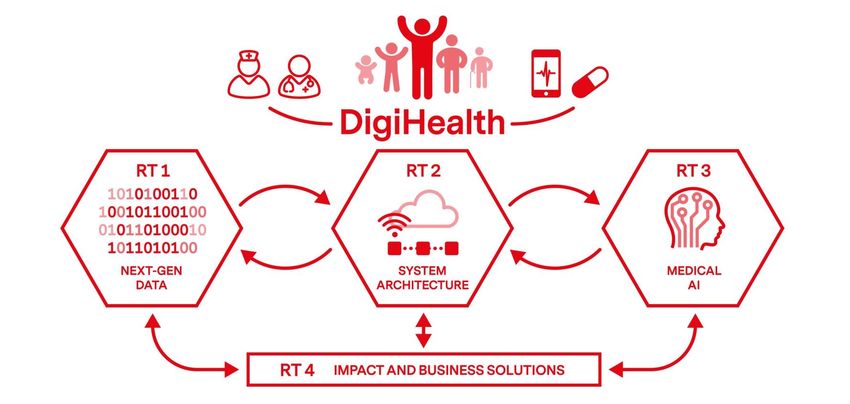
Finland                     Finland is a relatively sparsely populated
                                country (5.5 million inhabitants, with an
                                average population density of 18
                                persons/km2) with a highly advanced
                                technological infrastructure.

                                In the eastern and northern parts of the
                                country the population density is especially
                                low and distances are long.

3   21.11.2019   Heidi Enwald                                            University of Oulu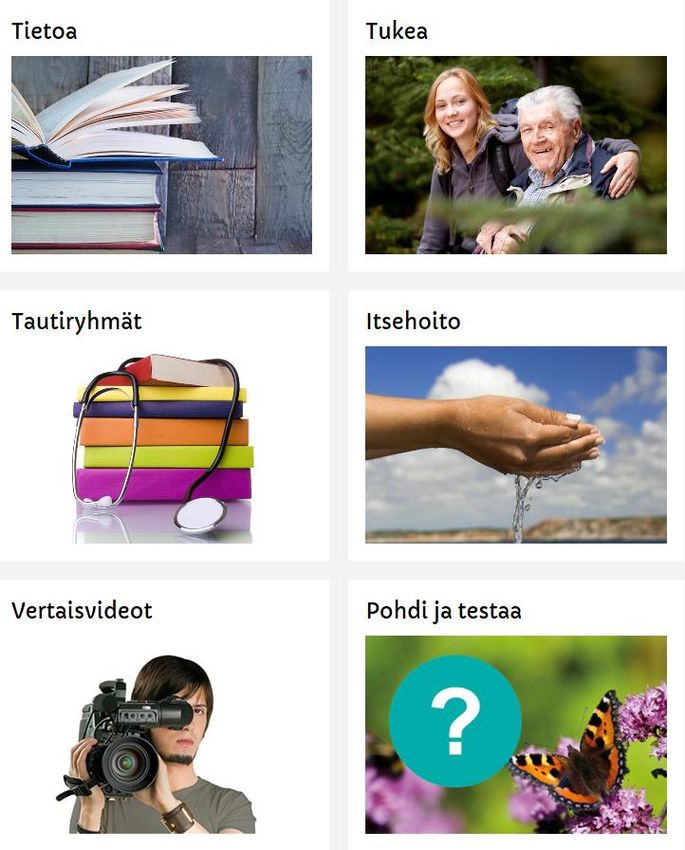
Finnish healthcare          The healthcare system in Finland is mainly
                                based on public health care providers.
    system in a nutshell        Municipalities, through taxes, finance most
                                of the health care and the government is
                                providing additional support.

                                There are additional private services based
                                on insurances and service fees.
                                Occupational healthcare.

                                Public primary healthcare services are either
                                produced by the municipalities themselves
                                or provided in cooperation with other
                                municipalities or purchased from private or
                                public providers.

4   21.11.2019   Heidi Enwald                                           University of Oulu
Challenges                  Finland’s population is aging faster than that
                                of many other countries.
                                Demographic and regional diversification is
                                increasing e.g., due to urbanization.

                                The municipal and service structure is in a
                                state of transition since the current structure
                                cannot bear the challenges of the ongoing
                                demographic changes.

                                A health and social care reform has been on
                                the agenda of several appointed
                                governments. A suggested reform by prime
                                minister Sipilä’s government was not
                                approved by parliament in 2019.

5   21.11.2019   Heidi Enwald                                             University of Oulu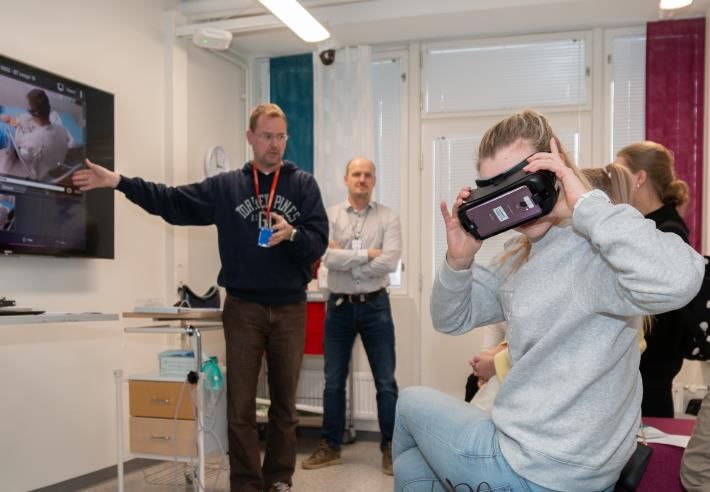
6   21.11.2019   Heidi Enwald                                                        University of Oulu
                                https://ec.europa.eu/digital-single-market/en/desi
eHealth
eHealth situation           Today in Finnish healthcare, the
                                documentation of patient data is carried out
                                by electronic means at all levels of care.

                                All the primary healthcare centers,
                                secondary and tertiary hospitals as well as
                                private service providers obey the same
                                general healthcare and medical treatment
                                guidelines and patient documentation
                                policies, which has contributed positively to
                                the opportunities offered by Telemedicine
                                and eHealth.

                                National Supervisory Authority for Welfare
                                and Health (Valvira) guides and follows
                                https://www.valvira.fi/web/en/healthcare/telemed
                                icine-services

8   21.11.2019   Heidi Enwald                                              University of Oulu
eHealth and eSocial                           Ministry of Social affairs and Health (2015)

              Strategy 2020
                                                            The objective of the strategy is to support
                                                            the renewal of the social welfare and health
                                                            care sector and the active role of citizens in
                                                            maintaining their own well-being by
                                                            improving information management and
                                                            increasing the provision of online services.

                                                            ”Socially Sustainable Finland 2020”

    http://julkaisut.valtioneuvosto.fi/handle/10024/74459

9             21.11.2019   Heidi Enwald                                                               University of Oulu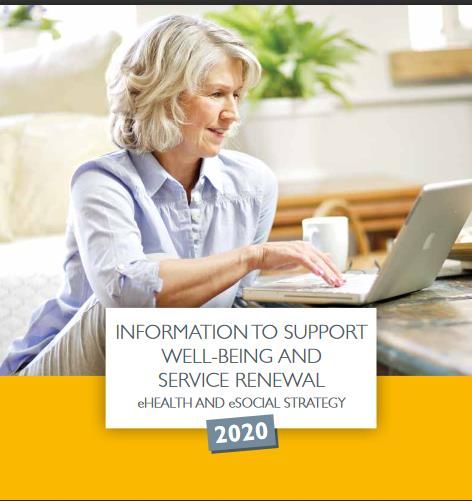
Monitoring of                            By National Institute for Health and Welfare
                                                                           (THL)
           eHealth situation in                     - Ministry of Social affairs and Health has
                                                       since 2003 regularly commissioned THL to
           Finland                                     assess status and trends of e-services on a
                                                       national level in Finland
                                                    -   The THL-led studies have been conducted
                                                        in close collaboration with universities:
                                                    -   E.g., University of Oulu – responsible for
                                                        eHealth availability surveys
                                                    -   The survey instruments have been kept as
                                                        similar as possible to enable comparison
                                                        to previous data collections, but updated
                                                        each round with questions related to new
                                                        eHealth functionalities.

                                                         - Next data collection round in 2020 –
                                                           introducing a further user experience
https://www.julkari.fi/bitstream/handle/10024/138244/RAP   study focusing on social workers
2019_7_e-health_and_e-welfare_web_4.pdf
10         21.11.2019   Heidi Enwald                                                               University of Oulu
‒ The Finnish ICT infrastructure for health
and social care is based on legislation
from 2007 and all its later ammendments
Finnish national (Act 159/2007).
storage for health ‒ It currently includes KANTA services
hosted by Social Insurance Institution
data (KELA):
- My Kanta pages
- Prescription service
- Pharmaceutical database
- Patient Data Repository
- Archiving of old patient data
11 11/23/2019 Replace footertext if needed University of Oulu- My Kanta pages give citizens access to
their electronic patient records,
laboratory tests and e-Prescriptions.
My Kanta: Patient - Patients can access log data on the
accessible national usage of their data.
electronic health
- Manage their consents – e.g. Giving or
record (PAEHR) refusing medical staff access to the data
- Organ donation testament
More info on My Kanta: https://www.kanta.fi/en/my-kanta-pages
12 11/23/2019 Replace footertext if needed University of Oulu‒ 63% of adults had
accessed the
PAEHR
Patient accessible (cumulatively from
2010) by the end of
national electronic 2018.
health record
(PAEHR)
https://www.kanta.fi/en/citizens
13 11/23/2019 Replace footertext if needed University of OulueHealth at home: Virtual hospital 2.0,
all university hospitals involved
‒ Specialiced care services available in net.
‒ Terveyskylä.fi (Health village) –web pages provide
professional services in various speciality domains,
”virtual houses”.
‒ By the end of 2018, more than 30 different advisory
virtual houses in operation, from mental health
services to pain management, from rehabilitation to
emercengy guidance.
‒ Open services and general guidance without
registration.
‒ Digital care pathways (more than 80 in 2018),
prescribed out-patient clinic services.
‒ Terveyskylä PRO, tools for research and quality
guidance for health professionals
https://www.terveyskyla.fi/
http://kunnat.net
Twitter: @reponenjarmo Oulun yliopistoResearch
University of OuluTaking Health Information Behaviour into Account
implications of a neglected element for successful implementation
#healthinformationbehaviour of consumer health technologies on older adults
#healthinformationliteracy
#consumerhealthtechnologies
#ehealth
#olderadults
Åbo Akademi University collaboration with Oulu University
and Uppsala University
Financed by the Academy of Finland 2015-2020
Lead by professor Isto HuvilaResearch questions 1. How do older adults (born 1946–1960) experience the usefulness, effectiveness, trustworthiness and privacy of e-health services? 2. Do existing e-health services have an impact on issues related to older adults health information behaviour? 3. How can e-health services be tailored to effectively fit older adults everyday health information behaviour? What are characteristic features of such tailored services? Data collected e.g., by: • Focus group interviews with older adults having used patient-accessible electronic health records (May-June 2018) • National postal survey of a random sample of 1,500 Finns aged 55-70 years (July 2019-Oct 2019)
Some preliminary results
• Focus group studies:
   • EHRs are perceived to still be under construction when taken into use and hence lack
     information and features that users require, which might increase frustration and
     hinder use.
• National postal survey:
   • >2/3 had accessed the My Kanta Pages
   • >2/3 of users of digital health services were positive and thought they are useful,
     increase awareness of own health, help to manage own information, increase
     knowledge and help to seek more information.
   • More than 80% of all respondents claimed that most important features of digital
     health services are credible, actual and consistent contents, ease of use, that they
     contain needed information, and contain information that is easy to understand and
     can be readily used.
EHR –professionals´user experience (UX) studies,
2010, 2014, 2017, ca. 4000 phycisians and 3600 nurses
© Research consortium: THL, Medical Association, University of Oulu , Aalto University, University of Eastern Finland, Nurses´ Association, TEHY
Next data collection will be in 2020
University of Oulu
Twitter: @reponenjarmoFeasibility studies in the real world digital environment of the
Oulu University Hospital, facilitated by the OYS Testlab
21 23.11.2019 Oulun yliopisto
Twitter: @reponenjarmoHealth Technology Assessment (HTA) for digital solutions,
a new Digi-HTA toolkit developed in Oulu
Haverinen, J., Keränen, N., Falkenbach, P., Maijala, A., Kolehmainen, T., & Reponen, J.
(2019). Digi-HTA: Health technology assessment framework for digital healthcare services .
Finnish Journal of EHealth and EWelfare, 11(4), 326–341. https://doi.org/10.23996/fjhw.82538
22
Twitter: @reponenjarmo University of OuluDigitalized Solutions for Future Healthcare (DigiHealth)
Finnish Academy: University profiling
University of Oulu received 6.6 M€ for 2018-2022 and
was ranked #3 among Finnish universities. DigiHealth
was one of three main areas.
R1: Next-generation data for digital healthcare
R2: System level architectures for future
digital healthcare
C R3: Medical AI to support clinical decisions
o
l R4: Impact and business solutions
l
a
b
o https://www.oulu.fi/digihealth/ University of Oulu
rArtificial Intelligence research in Oulu:
CARDS: Decision Support for radiologists1,2
‒ A helping tool, which is not making
the diagnosis, but helps the
radiologist by seeking similar cases
from the existing hospital databases.
‒ Combines references from RIS text
and PACS images.
‒ “Augmented Intelligence”.
2. BMC Medical Imaging (2017) 17:59 DOI 10.1186/s12880-017-0229-1
1. Martynov P, Mitropolskii N, Kukkola K, Mutanen L, Reponen J,
Mäkynen A (2016) CARDS: the decision support tool for
radiologists examining head CT images. ECR 2016 / B-0233. DOI:
10.1594/ecr2016/B-0233.
Image source: http://seemik.com/
Oulun yliopisto
© Jarmo Reponen Twitter:@reponenjarmoEducation
Finland as a forerunner: Special ”eHealth”
                competence for medical doctors
‒ Finnish Medical Association has in 2012 established a               Special
                                                                      competence in
  “Special competence of healthcare information                       eHealth
  technology” for physicians. Finnish Dentists Association            2 years
  joined in 2015 and Finnish Veterinarians Association 2019.
‒ Finnish Society of Telemedicine and eHealth is in charge of         Medical specialist
                                                                      (surgeon,
  its further development.                                            radiologist, etc.
‒ Basicly it is a full two year study program after medical           5 to 6 years
  specialist exam.                                                    Must include
                                                                      administration
‒ The program is targeted to medical/dental specialists, with
  already gained experience in medical/dental work.
                                                                      Medical doctor,
‒ 125 doctors and dentists have enrolled to the programme,            licenced physician
  of which 72 doctors and 13 dentists have qualified (status          in Finland
  12/2018)
                                                                      Minimum 6 years
‒ Resposible teacher: Prof. Jarmo Reponen, Univ. of Oulu              of basic and practical
                                                                      studies

                                                                 26                            University of Oulu
                                        Twitter: @reponenjarmo
Capacity building: Digital
skills for medical workforce:
*4,3 M€
*3 years
*5 medical
schools
*300
teachers
• University of Oulu coordinates the Finnish
national MEDigi project that aims for
• The University of Oulu started medical students´ harmonising and renewing medical and dental
education on eHealth and mHealth together with education in Finland by utilising digitalization.
health companies since 2016, fifth edition in 2020.
• The objectives include:
1) To specify core competencies in the medical fields
• In 2019, the 4th edition of the eHealth Seminar gathered about 2) To create an online service for the basic education,
300 medical and nursing students and more than 30 digital health 3) To produce electronic study material,
companies for a day full of practical testing of innovations that can 4) To develop electronic exam and evaluation methods,
improve future healthcare services. 5) To familiarize the students to eHealth and mHealth,
• Hands-on sessions in small groups provided students with an 6) To increase the digital pedagogy skills of teachers.
opportunity to find out how they could use them in their own work
with patients. https://www.medigi.fi/en/home-page.html
27 University of Oulu
http://ouluhealth.fi/medical-students-hands-on-experience-of-digital-solutions-the-ehealth-seminar-in-oulu/ Twitter: @reponenjarmohttp://ouluhealth.fi/future-hospital/
https://oys2030.fi/english.php
University of OuluHeidi Enwald heidi.enwald@oulu.fi In collaboration with: Professor of practice & MEDigi project leader Jarmo Reponen Jarmo.reponen@oulu.fi Twitter: @reponenjarmo DigiHealth: Professor Simo Saarakkala & Coordinator Tuire Salonurmi simo.saarakkala@oulu.fi tuire.salonurmi@oulu.fi HIBA research group, Åbo Akademi: https://blogs2.abo.fi/hiba/ University of Oulu
You can also read


