Towards a One Planet Olympics - Achieving the first sustainable Olympic Games and Paralympic Games
←
→
Page content transcription
If your browser does not render page correctly, please read the page content below
Towards a One Planet Olympics
 Achieving the first sustainable Olympic Games and Paralympic Games

                                a joint initiative:
What is a One Planet Olympics?

The One Planet Living Challenge
Studies into mankind’s levels of consumption and pollution                     As probably the largest peacetime events in the world, the
in WWF’s Living Planet Report reveal that as a global society                  Olympic Games and Paralympic Games are the culmination
we are living beyond the regenerative capacity of our planet.                  of more than seven years of preparation and development.
Our unsustainable lifestyles have meant that for the last                      This total Games phase will offer unparalleled opportunities
30 years we have been ‘eating into the Earth’s capital’ rather                 to plan for minimising the potential impact of the event itself,
than ‘living off its interest’. Although globally patterns of                  to increase public awareness of the positive links between sport,
consumption vary significantly between territories, if everyone                environment and healthy living, and to create sustainable
lived as we do in the UK we would need three planets. This                     legacy communities.
is especially marked in the case of cities. Living unsustainably               Sustainability has been at the heart of the London 2012 Bid
is resulting in the degradation of our environment and human                   and Masterplan, which in turn have drawn upon the Mayor
wellbeing, and may ultimately leave future generations with                    of London’s strategic vision to make London an Exemplar
a planet that is unable to sustain life as we know it.                         World Sustainable City.
                                                                               A One Planet Olympics in London would provide the mechanism
                                                                               for delivering a sustainable Olympic Games and Paralympic
                                                                               Games through the application of a framework of the 10
                                                                               One Planet Living Principles (shown in the table overleaf).
                                                                               London 2012, WWF and BioRegional have jointly signed a
Olympism and Sustainability                                                    Memorandum of Understanding to express their commitment
The promotion of sustainable development has become                            to continue working together towards a One Planet Olympics.
one of the fundamental objectives of the Olympic Movement.
Through its Agenda 21– Sport for Sustainable Development –
the Olympic Movement acknowledges the diversity and
fragility of our planet. It recognises the inherent synergies
between the Olympic and Global Sustainability agendas,
and the powerful role sport can play in contributing towards
the harmonious development of man to ensure the wellbeing
of people and the planet.
Towards a One Planet Olympics
London 2012, WWF and BioRegional have developed
the concept of a One Planet Olympics. The partners believe
that the One Planet Olympics approach provides a critical
‘implementation’ link between the aspirations of Agenda 21
and the analysis and benchmarking facilitated by the Olympic                   One Planet Living® is a joint initiative between WWF
Games Global Impact (OGGI) project. Staging a One Planet                       and BioRegional which aims to deliver communities,
Olympics in London would help the International Olympic                        products and services which will help us all to live
Committee to achieve the first sustainable Games.                              equitably within our fair share of the Earth’s resources.

How a One Planet Olympics would complement the Olympic Movement’s Agenda 21 and OGGI project

                          Aspiration                                   Implementation                             Review

                                                                       One Planet
                       Agenda 21                                                                                  OGGI
                                                                       Olympics

                                           Interface will align with                     Will set standards and
                                          Triple Bottom Line ethos                      monitoring mechanisms

                 Feedback Process to support Continual                                   Feedback Process to support Continual
                            Improvement                                                             Improvement
We only have one planet; London 2012 will respect its ecological limits, its cultural diversity and create a legacy for sport, the environment and the local and global community.
One Planet Living Principle Strategy Games Legacy
Zero Carbon Reducing carbon dioxide emissions by minimising building • Design and construction of Olympic facilities based on maximising • Athletes’ Village capable of being energy self-sufficient
energy demand and supplying from zero/low carbon and energy efficiency and use of low carbon and local renewable • Distributed network of heating, cooling and power serving
energy sources local communities
renewable resources • Basis for long-term sustainable energy infrastructure • Energy efficient sports venues
and management to be established
Zero Waste Developing closed resource loops. Reducing the amounts • No Games waste direct to landfill – all treated as a resource • Zero waste policies extend across East London based on high
of waste produced, then reclaiming, recycling and recovering • Zero waste target a pivotal procurement driver recycling rates and residual waste converted to compost
• Closed-loop waste management at all venues and renewable energy
• Public information campaign to promote high quality front-of-house • Increased market for recycled products
waste separation • Closed-loop waste management to be standard practice
for major sports events
Sustainable Transport Reducing the need to travel and providing sustainable • All spectators travelling by public transport, walking or cycling • Increased connectivity across and between legacy developments
alternatives to private car use to venues and neighbouring communities
• Low/no emission Olympic vehicle fleet • Reduced car dependency
• Olympic Park Low Emission Zone • Car free events policy adopted for other major events
• Carbon offset programme for international travel • Greater market for zero carbon transport
• Individualised travel plans as part of integrated ticketing process
Local and Sustainable Materials Materials chosen to give high performance in use with • Reclaimed, recycled and local construction materials used • Reclaimed, recycled and local construction materials
minimised impact in manufacture and delivery. Using local • Temporary buildings made for reuse elsewhere used during transformation into legacy mode
• Healthy materials used for construction and merchandise • Training and job opportunities locally in (re)manufacturing
materials can have further benefits to local economies • Materials with low environmental impact used for merchandising • Local and sustainable materials supply chains maintained
and in supporting traditional solutions • Robust Procurement and Management Systems implemented
Local and Sustainable Food Supporting consumption of local, seasonal and organic • Promotion of local, seasonal, healthy and organic produce • Increased markets for farmers in the region
produce, with reduced amount of animal protein and packaging • Promotion of links between healthy eating, sport and wellbeing • Markets, catering and retail outlets supplying local
• Partnerships established with key caterers, suppliers and sponsors and seasonal food
• Composting of food waste as part of Zero Waste plan • Composting facilities integrated into closed-loop food strategy
Sustainable Water Reducing water demand with sustainable management of rain • Olympic Park incorporating water recycling, rainwater • Long-term sustainable water supply and management
and waste water harvesting and water conserving appliances • Water efficient homes and infrastructure
• Dual water quality supplies to new buildings • Lower Lea Valley self-sufficient in water
• Recycled water used for irrigation or vehicle washing • Ongoing management of waterways to provide amenity
• Sewage and grey water fed into energy production and wildlife habitat
Natural Habitats and Wildlife Existing biodiversity conserved with opportunities taken • Remediation of land and creation of large new urban park • Net gain of ecologically valuable green space
to increase ecological value and access to nature • Waterways rejuvenated to provide amenity and wildlife habitats • Biodiversity an integral component of urban and park environment
• Olympic Biodiversity Action Plan implemented • People have greater local access to nature
• Buildings and infrastructure designed to minimise ecological impact • Lea Valley ‘green corridor’ connected to River Thames
• Landscaping, planting and building design to increase biodiversity
Culture and Heritage Cultural heritage acknowledged and interpreted. Sense of place • Development of Olympic Park to reflect local heritage • Creation of a vibrant and diverse legacy community
and identity engendered to contribute towards future heritage and contemporary culture • Local and traditional industries revived to create employment
• Facilities to acknowledge, reflect and support diversity of local and sense of identity
audience and global visitors • Ongoing development and management of legacy community
to include public and stakeholder consultation
Equity and Fair Trade Create a sense of community. Provide accessible, inclusive • Fully-accessible facilities for all • High proportion of affordable housing
and affordable facilities and services • Equity and Fair Trade an integral element of Procurement • Mixed-use development to create sense of community
and Management Systems • Opportunities for local employment and education
• Affordable ticketing and accommodation • ‘Green’ business hub
• Commitment to ethical business transactions • Fairtrade community status achieved
Health and Happiness Promote health and wellbeing. Establish long-term • Extensive public and stakeholder consultation • Healthy internal environments in homes and other facilities
management and support strategies • Programme to promote the health benefits of sport and exercise • Improved air quality, visual amenity and soundscape
• Healthy internal and external environments in the Olympic Park • Community facilities to provide healthcare, vocational training
• Safe and secure facilities and environments provided and other support structures
• Facilities for worship and spiritual development • Legacy community management and support structures to facilitate
long-term sustainable livingDelivering a One Planet Olympics
The process of developing a delivery framework is already
underway. To complement this summary document,
10 Briefing Plans have been produced to target initiatives
under each of the One Planet Living Principles outlined
in the preceding table. These briefings will feed into the
Sustainable Development Strategy for the Olympic and
Legacy Masterplans, and provide a basis for Action Plans
of the future London Organising Committee.
To draw these individual themes together London 2012
will initiate a Sustainability Management System, in which
sustainability criteria represent the core values of the
Organising Committee and underpin policies, implementation,
monitoring and reporting. This embedded approach to
sustainable development leads on to the delivery strategy
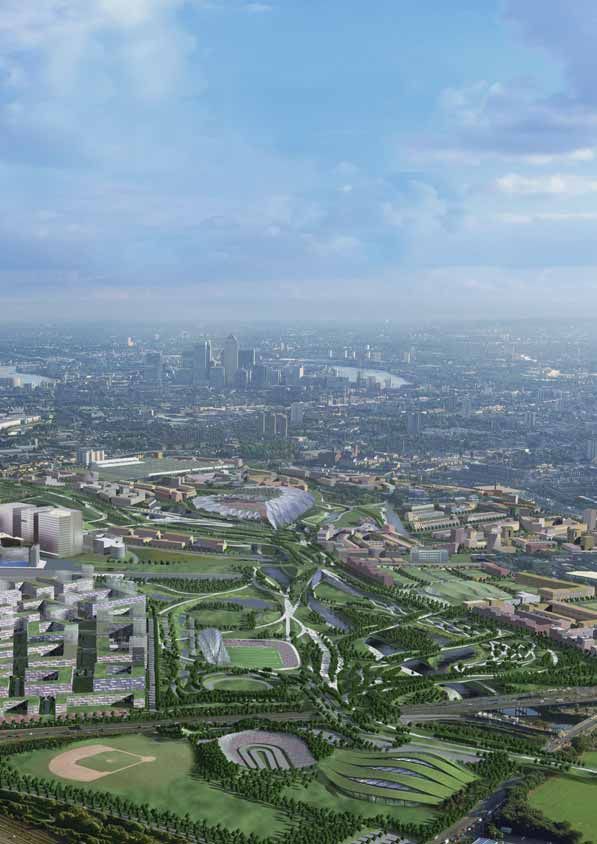
shown below. The Olympic Park, a lasting sporting and environmental legacy.
Taking Responsibility
Placing ‘sustainability at heart’ requires firm leadership
commitment, locating the Environment and Sustainable
Development Programme centrally within the organisation
and early actions. These obligations are already incorporated Communication and Raising Awareness
into the remit defined for the London 2012 Organising London 2012 proposes a Sustainable Sport Programme
Committee, and are reflected in plans for continuing working with partners to introduce environmental
environmental studies during the transition phase from improvement and awareness projects at sports facilities
Bid to Organising Committee. and events across the UK. Clean up campaigns, practical
Setting Targets conservation projects and trial closed-loop waste
Sustainability targets under each theme need to be both management at events will be among the visible applications
stretching and deliverable. This requires flexibility within the of this programme. The experience gained will reinforce
Management System to accommodate new technologies capability to deliver a One Planet Olympics in 2012.
and evolving best practices during the lifetime of the project. Measuring Performance and Reporting
Partnerships The IOC’s OGGI project now provides a consistent format
Public consultation and active stakeholder engagement for sustainability reporting by host cities. London 2012 will use
have been strong elements of the London 2012 Bid. OGGI additionally as a platform for internal monitoring within
The Organising Committee will build on these partnerships the Organising Committee. There is also a firm commitment
and establish appropriate forums for working with public to public reporting of results and independent scrutiny via
environmental authorities, NGOs, academic institutions the London Sustainable Development Commission.
and the business sector. Developing Legacies
Procurement The first sustainable One Planet Olympic Games will also
Sustainable procurement is central to delivery: all goods, help deliver:
materials and services will be assessed first on the basis of • A thriving sustainable community in East London
need and then evaluated according to environmental, social as a benchmark and inspiration for future development
and ethical criteria as well as conventional value parameters. internationally
The same principles will be used in selecting sponsors. • Increased public and political awareness of the
Education and Training interdependence between environmental quality, sport
The provision of appropriate and timely training and information and healthy living and the links between the wellbeing
will be critical in ensuring that the sustainable policies and of individuals and that of the planet
services are implemented. This will relate both to internal • Mechanisms for delivering future One Planet Olympics
Organising Committee staff and volunteers, and to key external as a practical implementation of the Olympic Movement’s
players including suppliers, contractors and venue managers. Agenda 21
Design by
Printed on Greencoat Velvet 150gsm. The Greencoat range contains 80% recycled
fibre and the remaining 20% virgin pulp is TCF (Totally Chlorine Free)Imagine: what a One Planet Olympics could mean for people…
“I was at school on the other side of the world when London was named
as the Host City for the 2012 Games, and I have worked hard for the last
seven years to stretch my performance and improve my efficiency – it is clear
that London has been doing the same.
As an athlete, I need to watch what I consume, how I get my energy and water,
and how efficiently I perform. It is inspiring that the London Games have been
developed with the same ethos to help protect the planet for the future.
My home in the Athletes’ Village is designed to the highest standards to be
comfortable and light with minimal energy and water needs. Everything I need
is nearby and easily accessible.
Travelling around the Olympic Park is easy. The Park itself is wonderful and
I enjoy spending time by the river. I am not famous so people don’t bother me
for my autograph, although yesterday I did meet some spectators who were
Competitor at the Games originally from my neighbouring village, but are now living in London – a home
audience for me half way around the world!”
“We travelled into London by train from mainland Europe. The train took
us into Stratford, which is adjacent to the Olympic Park and close to our hotel.
London is a great city with a rich cultural heritage and there are many things
to see in addition to Games.
We are keen to see as much as possible whilst we are here and it is great
that most of the facilities are so local. We have found it easy to get around
the Olympic Park on foot or using the Olympic bikes. I think that we might
take the free tube to Greenwich tomorrow to watch the Modern Pentathlon
and then the carnival afterwards. Including free travel with the ticket price
is a great idea, particularly for families.
This morning we all went to the main stadium to watch the heats for the relays,
before getting some lunch and sitting down by the river to watch the events
on the big screen. The volunteer we asked was very helpful in directing us
Visitor at the Games to a nice place to eat and explained what to do with our waste afterwards
to make sure it was recycled.”
“I have lived in East London with my family for all of my life and I have seen
many changes and improvements in that time.
I remember being involved in the public consultation for London 2012
in 2005, and it was clear then that something special was going to happen
in the Lower Lea Valley.
My brother and daughter were both keen to take advantage of the local
opportunities; he managed to get on a construction training course which lead to
a job building the main stadium; she is working as a volunteer during the Games.
In 2014, my family is due to move into one of the converted homes in the Athletes’
Village. Our home will be warm in the winter and cool in the summer, and thanks
to the clever local efficient power supply, our energy bills will be lower than they
used to be.
Legacy Community Resident It is going to be a great place to live with a real sense a community. Every day
I will make the short commute into work in the City, whilst my partner, who
runs a recycling consultancy, works mainly from home. We will have
everything we need locally including the Olympic Park and community
sporting facilities. My grandchildren already love going swimming at the
Aquatics Centre and are adamant they will become Olympians in the future.”With thanks to our Premier Partners www.london2012.com www.bioregional.com www.wwf.org.uk
You can also read


