TRAINING GUIDE FOR CORAL REEF RESTORATION
←
→
Page content transcription
If your browser does not render page correctly, please read the page content below

TRAINING GUIDE FOR
CORAL REEF RESTORATION

                         Photo: MAR Fund - Carlos Gereda

MESOAMERICAN REEF SYSTEM
                          (MAR Fund) REEF RESCUE INITIATIVE

This Guide is a practical, complementary tool for coral reef restoration training.

Individuals wishing to start a restoration project must contact local authorities to learn about the legal
implications and obtain the corresponding permits, as well as join working groups with restoration
experience to receive proper training.

For more information visit our websites:

www.coralmar.org
www.marfund.org

                                                                                                             Photo: MAR Fund - Carlos Gereda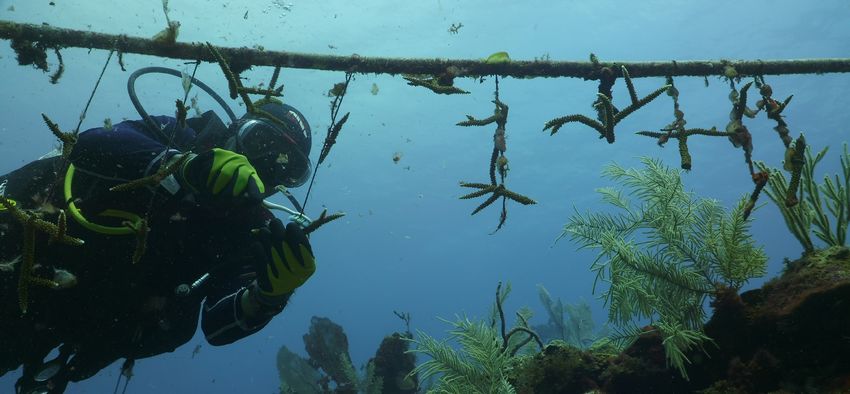
SCRIPT
Baruch Figueroa Zavala
Centro Ecológico Akumal

EDITOR
María José González
Executive Director, MAR Fund

Claudia Ruiz
Reef Rescue Initiative Coordinator, MAR
Fund

María del Carmen García Rivas             DESING
National Commission of Protected          Priscila Pocasangre
Natural Areas (CONANP)                    Perspectiva Arte&Diseño
Carlos Gereda
Espacio Visual                            COLLABORATORS

Enrique Castañeda                         Claudia Padilla
Espacio Visual                            Instituto Nacional de Pesca y Acuacultura
                                          (INAPESCA)
Gabriela Segovia
Atlantic Films                            Calina Zepeda
                                          The Nature Conservancy
Mónica Paiz
Atlantic Films                            Anastazia T. Banaszak
                                          Institute of Marine Sciences and Limnology
Fotografía                                (ICMYL) - Academic Unit of Reef Systems of
                                          Puerto Morelos, of the National Autonomous
Carlos Gereda                             University of Mexico (UNAM)
Espacio Visual
                                          Héctor Antonio Lizárraga
Claudia Ruiz                              Centro Ecológico Akumal
MAR Fund
                                          Lisa Carne
David Mejía Suansin
                                          Fragments of Hope
Fabián Grageda
                                          Tripp Funderburk
Mesoamerican Reef Restoration
                                          Roatan Marine Park Coral Restoration
Network
                                          Ángela Mujica
Marcio Aronne
                                          Restoration Projects
Conservation and Sustainable
Development in the Monumento
                                          Ana Giró
Natural Marino Cayos Cochinos
                                          Healthy Reefs for Healthy People
Roatan Divers
Photo: MAR Fund - Carlos Gereda
Emma Doyle                                      Mesoamerican Reef Fund
Gulf and Caribbean Fisheries Institute (GCFI)   (MAR Fund)
                                                Mesoamerican Reef Rescue Initiative
Miguel García Salgado
Oceanus, A.C.                                   This document was prepared by Mesoamerican
                                                Reef Fund (MAR Fund), Mesoamerican Reef
Gabriela Nava                                   Rescue Initiative (RRI) with the support of the
Oceanus, A.C.                                   International Coral Reef Initiative (ICRI) and
                                                the Small Grants Program for United Nations
Adriel Castañeda                                Environmental Programme (UN/UNEP).
Ecosystem-based Management Unit
Coordinator, Belize Fisheries Department

Ian Drysdale
Healthy Reefs for Healthy People

Someira Zambrano
Dominican Reef Network (RAD)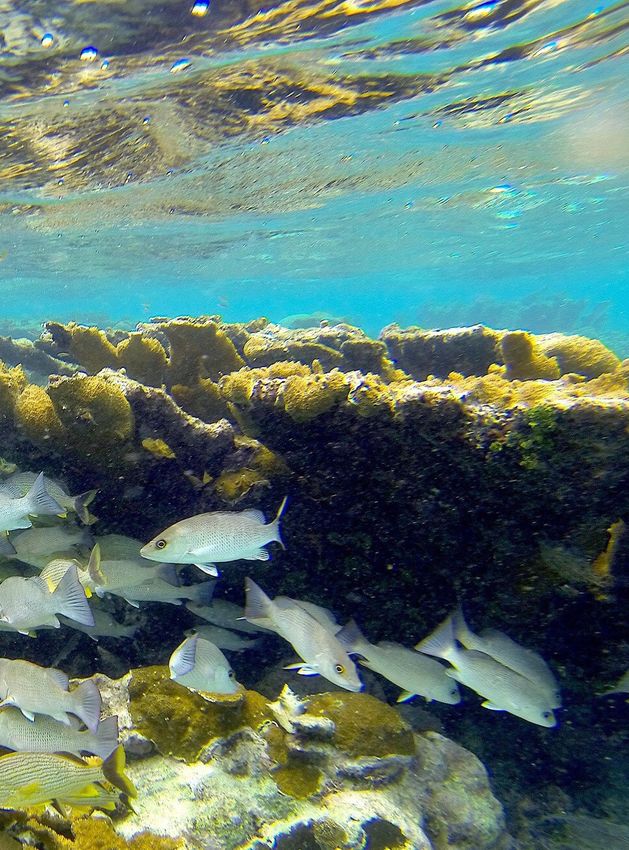
ÍNDICE
         CHAPTER 1
         THE MESOAMERICAN REEF SYSTEM .............................................		                                        9

         1.1 The Mesoamerican Reef System (MAR)                           ..............................................		   10
         1.2 Benefits of the MAR ..............................................................................		            10
         1.3 Threats to the MAR ...............................................................................		            11
         1.4 About this guide ...................................................................................		          11

         CHAPTER 2
         INTRODUCTION TO CORAL REEF RESTORATION.......................		                                                     13

         2.1 The benefits of restoration and considerations
             prior to its implementation.....................................................................		              14
         2.2 Planning................................................................................................		      15
         2.3 Initial scopes.........................................................................................		       15
         2.4 Objectives and actions...........................................................................		             16
         2.5 Feasibility study......................................................................................		       17
         2.6 Political and legal basis..........................................................................		           18

         CHAPTER 3
         RESTORATION OF CORAL REEFS
         Asexual rearing techniques of coral.........................................		                                      19

         3.1     Asexual reproduction...........................................................................		           20
         3.2     Sexual reproduction process through coral fragmentation....................		                               20
         3.3     Coral gardening (rearing in nurseries)..................................................		                  20
         3.4     Land-based nurseries (ex situ)..............................................................		              21
         3.5     Ocean-based nurseries (in situ).............................................................		              22
         3.6     Construction of in situ nurseries...........................................................		              23
         3.7     Floating structures................................................................................		       23
         3.8     Fixed structures....................................................................................		      24
         3.9     Steps to asexual restoration through fragmentation...............................		                         25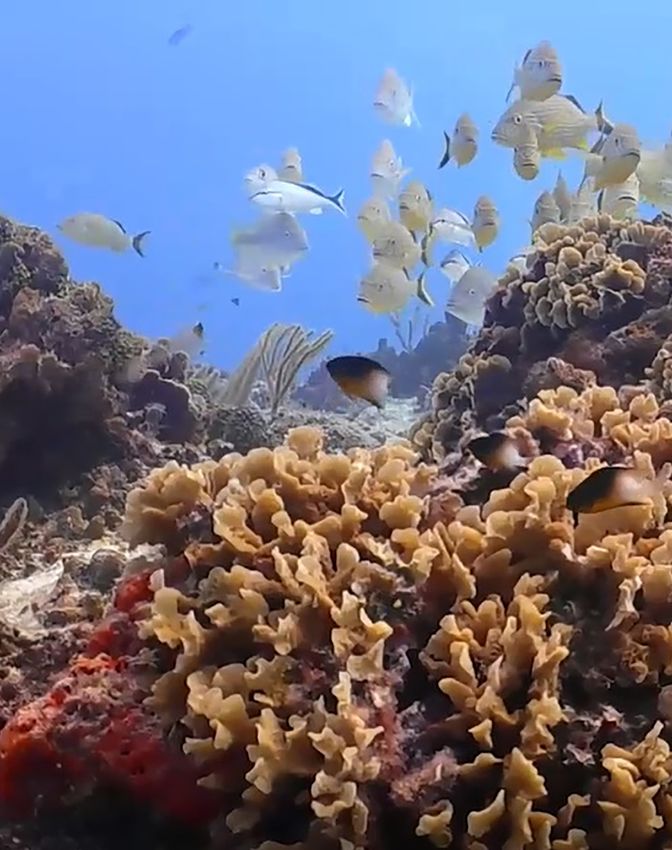
3.9.1 Site selection.......................................................................................		                    25
3.9.2 Collection...........................................................................................		                    28
3.9.3 Transportation to the nursery or outplanting site..................................		                                      29
3.9.4 Attaching fragments for stabilization in nurseries.................................		                                      30
3.9.5 Nursery maintenance..........................................................................		                            31
3.9.6 Monitoring of coral nurseries..............................................................		                              31
3.9.7 Outplanting onto the reef....................................................................		                            32
3.9.8 Maintenance and monitoring of the reef..............................................		                                     34

CHAPTER 4
RESTORATION OF CORAL REEFS .................................................................		                                   35

4.1 Sexual reproduction.............................................................................		                           36
4.2 Requirements for sexual reproduction of coral.....................................		                                         38
4.3 Spawning of coral................................................................................		                          38
4.4 Collection of gametes...........................................................................		                           39
4.5 Collection from the surface in spawning slicks.....................................		                                        39
4.6 Collecting from colonies in situ............................................................		                               39
4.7 Fertilization..........................................................................................		                    40
4.8 Embryo development in an incubator...................................................		                                      41
4.9 Settlement of larvae .............................................................................		                         42
4.10 Destination of coral recruits: introduction to the
     reef or rearing nursery...........................................................................		                        44

CHAPTER 5
EXPERIENCES AND ADVICE .............................................................................		                           45

5.1 Experts in reef restoration of the region share
                                                                                                                                      ÍNDICE
    their experiences....................................................................................		                      46
5.2 Challenges.............................................................................................		                    46
5.3 Achievements and recommendations.....................................................		                                      47

BIBLIOGRAPHY................................................................................................................		   49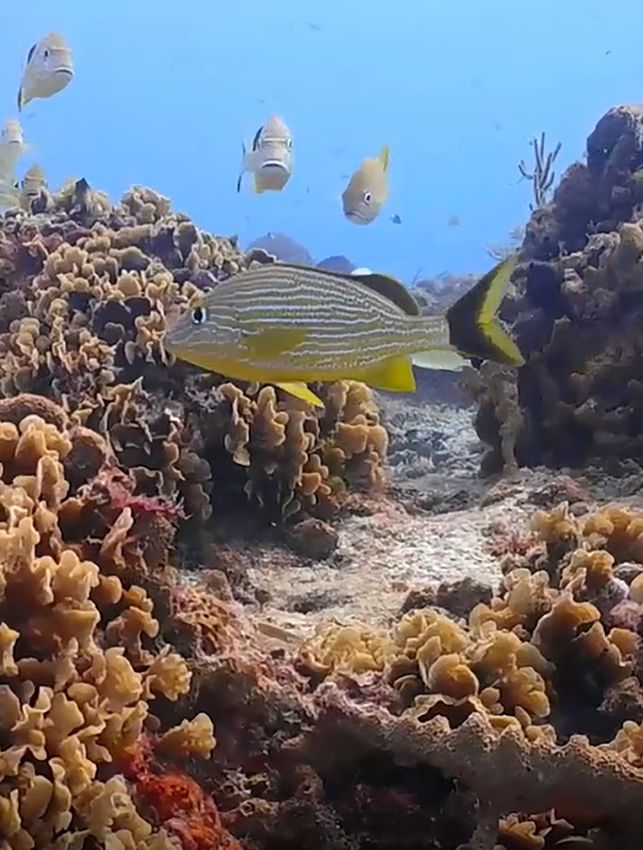
TRAINING GUIDE FOR CORAL REEF RESTORATION

cHAPTER 1
THE MESOAMERICAN
   REEF SYSTEM

                                              Photo: MAR Fund - Carlos Gereda

                                                        9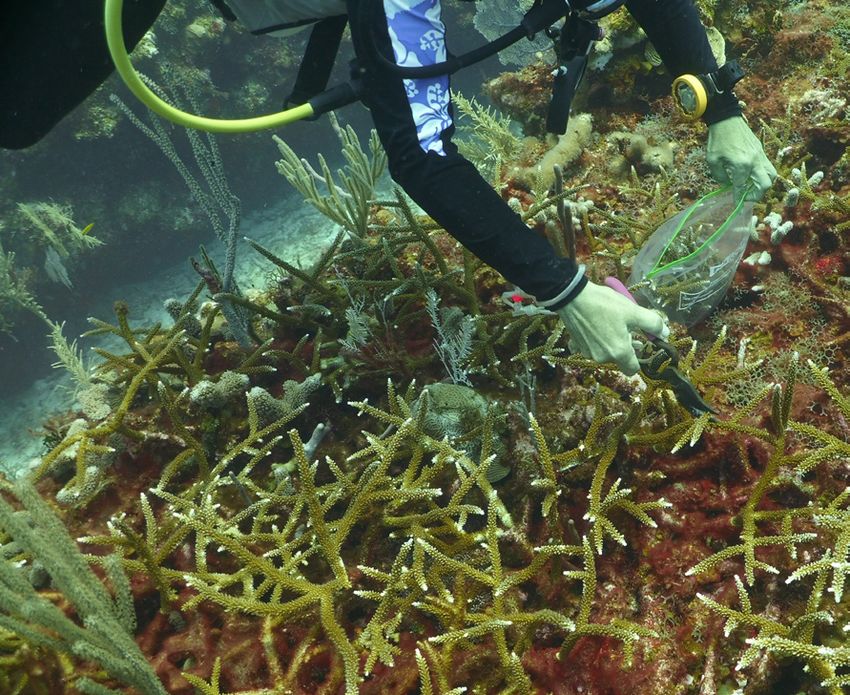
THE MESOAMERICAN REEF SYSTEM

                                     1.1   The Mesoamerican Reef                         1.2    Benefits of the MAR
                                           System (MAR)
                                                                                         The Mesoamerican Reef System supports over two
                                     The Mesoamerican Reef System stretches over         million people who directly or indirectly depend
                                     one thousand kilometers, from Isla Contoy in        on the resources it provides.
                                     the Yucatan Peninsula, Mexico, down to the
                                     Bay Islands in Honduras, including the coasts       Millions of tourists visit the MAR region every year
                                     of Belize and Guatemala.                            for the coastal and marine attractions. Tourism
                                                                                         and recreational activities like diving generate a
                                     It is the largest coral reef in the Western         substantial source of employment to the residents
                                     Hemisphere and the second largest in the            of the coasts in the four countries that make up
                                     world after the Australian Great Barrier Reef.      the MAR.
                                     It is home to more than 65 species of hard
                                     corals and has valuable concentrations of
                                     mangroves, as well as seagrass. It is the habitat
                                     for over 500 species of fish, more than 350
CAPÍTULO 1

                                     species of mollusks, and also to protected or
                                     endangered species, such as the manatee, the
                                     marine turtle, the whale shark, and acroporid
                                     corals, commonly known as elkhorn and
                                     staghorn corals.

                                     That is why the MAR constitutes a vital place
                                     for the protection of biodiversity and the
                                     preservation of ecosystemic services that are       Photo: David Mejia Suansin
                                     essential to humankind.
                                                                                         Fisheries provide food to all the populations of
                                                                                         these countries and are the primary source of
                                                                                         employment for local fishermen. The fisheries in the
                                                                                         MAR, such as lobster, halibut, conch, and snapper,
                                                                                         among others, are important at local, regional and
                                                                                         international levels.

                                                                                         Additionally, the reef structure is the first barrier
                                                                                         protection for the coast, because it absorbs up to
                                                                                         99 percent of the wave energy from surges, storms,
                                                                                         and hurricanes.

                                10
TRAINING GUIDE FOR CORAL REEF RESTORATION
1.3 Threats to the MAR
The spectacular beauty of the MAR landscape 5. Manufacturing and textile processing plants
makes it a tourism destination of high importance, depend on the water from the nearby rivers,
while the availability of its natural resources attracts which produces industrial runoff that spreads
the presence of industrial and agricultural activities. from the Atlantic coast of Guatemala and
Also, the abundance of aquatic species supplies the Honduras to the reef.
commercial fisheries of the region. Although many
of these activities stimulate the local economy, they
also compromise the integrity and health of coastal 1.4 About this guide
marine ecosystems of the MAR region.
The most relevant threats to the MAR include the This guide is a practical tool for specialists, students,
following: technicians, trainers, and the general audience,
who are interested in implementing activities in
1. The most important fishery resources in the the MAR or any other place where it is necessary
region have rapidly been depleted, given to apply the appropriate techniques for coral reef
the excessive amount of traditional and restoration.
commercial fishing vessels that compete in
a poorly regulated environment with free This guide combines knowledge and experiences of
access. coral reef restoration and rehabilitation specialists.
They have implemented restoration projects and
2. The high rate of coastal development strategies across the barrier reef in the four countries
has exceeded the capacity of the local of the MAR region.
infrastructure, which causes the spill of urban
and industrial waste into coastal waters and
the reef.
3. The exponential increase of cruises and
development of hotel compounds, from the
Yucatan Peninsula down to Belize and north
of Honduras, is scaling up activities such as
deep diving, snorkeling, and other aquatic
sports, more than the system is able to support
in the long term. This puts greater stress on
the reef.
4. Large-scale agroindustry applies pesticides
across thousands of hectares, and runoff
drains into the Caribbean. Small farmers, on
the other hand, do not have other options than Photo: Claudia Ruiz
to keep practicing slash-and-burn farming.
11TRAINING GUIDE FOR CORAL REEF RESTORATION
cHAPTER 2
INTRODUCTION TO CORAL
REEF RESTORATION
Photo: Ana Giró
13INTRODUCTION TO CORAL REEF RESTORATION
2.1 The benefits of restoration and
considerations prior to its implementation
Global degradation of coral reefs has reached Coral reef restoration techniques are a tool
a critical point. Local conservation strategies in the attempt to respond to human impact
and natural recovery processes alone can be on reef areas. If these techniques are used
less effective in preserving and restoring reef together with other interventions of local
biodiversity and integrity over the long term. That management, such as development and
is why researchers and managers are addressing implementation of regulations and public
reef restoration as a strategy focused on mitigating policies, creation of natural protected
degradation patterns and increasing the recovery areas, pollution management, good tourism
potential of damaged and depleted coral practices, good fishing practices, good
populations. navigation practices, the maintenance and
strengthening of technical capacities, among
Coral restoration consists of the processes of others, the resilience of the ecosystem could
recovering reefs that have been damaged or be improved. Thus, coral reefs could have
disturbed in their physical, biological, or functional at least a chance to survive as productive
integrity by implementing actions to revert it, as and functional systems in the face of global
much as possible, to its original state. impacts, including the effects of climate
change.
CAPÍTULO 2
Restoration actions may be passive. They involve
management actions to control the activities Due to the importance of reefs, any effort
that affect the reef indirectly (as when land- that may contribute to its resilience and
based contamination is mitigated). They can also ecosystemic services supplied to communities
be active actions when human intervention is is reflected in the reasonable use of resources.
involved in accelerating the recovery process (as It is important to have in mind that active
outplanting coral onto the reef). restoration is not an alternative to effective
coastal management. That is, there is no point
Photo: MAR Fund - Carlos Gereda
14TRAINING GUIDE FOR CORAL REEF RESTORATION
in implementing resources and work in places 2.2 Planning
where there are no regulations for human-induced
pressure and no adequate management plans. After understanding that the active reef restoration
program is to be defined only as an option within
In fact, restoration projects should be seen as a more comprehensive coastal management plan,
one component of a comprehensive coastal we can move on to the planning phase.
management plan, agreed upon with all decision-
makers of the area, and not just an isolated action. 2.3 Initial scopes
Ideally, a comprehensive management plan should
be developed to address or solve aspects related The early phase includes reviewing the initial
to the quality of local environmental conditions scopes of the restoration project. To that end, the
(nutrient runoff, sedimentation, overfishing, following questions should be answered in order to
tourism, etc.) that occur as a result of human include key factors that make the active restoration
activity, prior to the implementation of any active a feasible option in ecological, social, economic,
restoration project. and political-legal terms.
When an effective strategy has already been set What kind of coral community did the site support
up, all restoration efforts effectively contribute to before it was disturbed?
recovering the reef. This ideal situation can be
difficult to achieve. Finding the right moment where What kind of coral community can survive today
functional and sound management conditions in this place?
coalesce with the requirements for restoration
actions to be significant over a medium and What caused the deterioration of this place? Have
long term can be complicated. Hence, the need the causes of degradation already been stopped?
to design a scheme for strategic planning that is Does the substrate require stabilization?
conscientious and suitable for the target site in
order to reduce the risk of failing or increasing the
cost-effectiveness of interventions.
Photo: MAR Fund - Carlos Gereda
15To answer these questions, it is essential to have or generate knowledge about the ecological condition
of the reef, as well as the environmental conditions, in order to be able to identify the sources of damage.
Once they have been identified, it is important to work on the necessary management context to keep
them under control so that they don’t compromise the corals outplanted on the degraded site.
Pay attention to the effects related to water quality, the condition of populations of herbivore fish, the
components of the substrate cover focusing on macroalgae, and coral recruitment.
If the substrate of these zones which have suffered destruction, physical damage, or considerable loss
of the structure has not consolidated well, it is probably necessary to stabilize it before beginning the
active restoration. Stabilization processes are generally costly and complicated and depend on the level
of exposure to currents and waves. However, once these measures are necessary, and there is proper
funding, this is the initial action for an effective restoration process.
2.4 Objectives and actions
Clear objectives allow evaluating the project’s success and learn from the obtained lessons. The design of
a detailed restoration plan and timeline allows identifying the participation of decision-makers on more
specific objectives and when they will be achieved. These objectives need to be realistic and verifiable
using indicators that help detect the scope of objectives, one by one, in the agreed time, and need to be
monitored with adequate methods for each one of them.
For example:
Objective Increase the live coral cover by 10 percent at the end of year 1.
Actions to 1. Implement campaigns to outplant fragments from donor
execute colonies.
2. Monitor the survival and growth of fragments, including
their maintenance.
Performance Outplanting 10,000 fragments from the pruning of donor
indicators colonies.
Survival of 70 percent of colonies and increase the coral
Verification cover by 20 percent on the reef habitat.
means
16TRAINING GUIDE FOR CORAL REEF RESTORATION
INTRODUCTION TO CORAL REEF RESTORATION
2.5 Feasibility study
Additionally, it is essential to conduct a feasibility define which species work best for these
study of restoration projects, for which several actions; however, this has a cost and time to
factors should be taken into consideration, such determine their survival potential.
as the geographic location, the site ecology, the
available human resources, and financial resources. The cost of the intervention strongly depends
The first task is to quantify the scale to which the on the area to be restored, which must be taken
project is working in order to start the restoration, into consideration from the beginning because,
as well as the feasibility under such ecological again, it hinges on the scale, objectives, and
conditions. This consists of making field visits to available resources.
collect and systematize information of the site
and neighboring reefs, in order to determine if The selection of species to be used for
it is possible or worth it to carry out intervention restoration is subject, as mentioned above, to
actions. This process allows linking restoration the presence of reference colonies surviving
objectives with available resources and adjust on the site. These reference colonies do not
them as appropriate (raise more funds or readjust reproduce yet; they are only used as a guide.
objectives). The use of branching corals of rapid growth
(acroporids) helps to quickly generate a
The next step is to identify which areas within the structural complexity, which provides shelter
CAPÍTULO 2
degraded site are likely to be restored, depending to small fish and invertebrates. Massive species
on the approach to address the damage, objectives, such as Orbicella, Siderastrea, or Porites grow
and available funding. slower, yet they can be more resistant to
diseases or predators. The idea is to outplant a
Once the sites for restoration have been selected, diversity of species with those already present
it is important to define the type of reef community in the area to minimize risk and increase
to be restored. The presence of former and current outplanting efficiency.
colonies, their condition, and the diversity indicate
what was there before. However, knowing the
current ecological conditions determines how
much these same coral communities are able to
survive when they are outplanted onto the site.
If it is possible to find a “site of reference,” that is,
where live coral colonies are still found showing
the type of community that used to live on this
site, it can work as a guide to establishing which
species to outplant, at what density, and the kind
of combination, in order to achieve an optimum
restoration of the area. Sometimes, when there
are no points of reference, pilot experiments help
Photo: MAR Fund - Carlos Gereda
17INTRODUCTION TO CORAL REEF RESTORATION
Strategies that include mapping of the existing coral colonies, which can be used as donors, and show
genetic variability, help accelerate the natural recovery processes of the reefs. Make observations to
detect coral slicks nearby restoration sites and nursery facilities, in order to ensure that corals can
recover by themselves among resilient sites.
Experience suggests that the sites that contain donor colonies should be between 30 and 60 minutes
away from restoration sites to be able to transport them in healthy condition. These colonies can
be obtained from “fragments of opportunity” or fragments removed from intact colonies on sites of
reference or similar reefs. To that end, the amount of material to be extracted without causing significant
damage to donor areas must be estimated. It is often viable to remove 10 percent of fragments from
the donor colony in the case of branching colonies.
2.6 Political and legal basis
This section may be very important when conducting the project’s feasibility study. Many times,
restoration projects would be using endangered coral species or under management restrictions due
to their critical conservation status.
That is why it is essential to thoroughly review the status of coral species in the region where the
CAPÍTULO 2
project is to be implemented, to have in mind all the necessary processes for the application of special
permits issued by government agencies in charge to enforce environmental legislation, especially, for
managing restoration activities.
Occasionally, these permits can take too long to issue, depending on the requirements that each
government has on each region or country. This delay can strongly influence the feasibility of the
projects when they are being designed or implemented.
When taking into consideration all the points mentioned above, it is clear how feasible a project
can be. If the project is affordable, then a detailed restoration plan can be developed, including the
design of activities and requirements essential for its implementation. Human resources and available
funding must be taken into account as well.
Photo: MAR Fund - Carlos Gereda
18cHAPTER 3
RESTORATION OF CORAL REEFS
ASEXUAL REARING TECHNIQUES OF CORAL
Photo: MAR Fund - Carlos Gereda
19RESTORATION OF CORAL REEFS
3.1 Asexual reproduction
Asexual reproduction of corals can be either through budding
(a process in which the coral polyp is divided into two identical
polyps) or through fragmentation (in which a colony is broken off,
and fragments grow as individual colonies genetically identical).
3.2 Asexual reproduction process
through coral fragmentation
The implementation of coral restoration projects through asexual
reproduction is becoming increasingly common. This method
involves outplanting corals through fragmentation as a way to
imitate and accelerate reef recovery processes.
This technique is appropriate when the goal is to help a
CAPÍTULO 3
population that has lost coral cover and is not able to recover
naturally. The implementation of this technique allows corals
to “avoid” critical recruit settlement stages, particularly onto
substrates less favorable to coral larvae or their survival after
they have been attached.
Coral fragments have an advantage over recently settled larvae
due to its considerable size, allowing them to have more survival
and growth skills, better capability to compete for space, and
greater stability on a less consolidated substrate, among others.
They also provide habitat faster for other organisms like small
fish and invertebrates.
When a portion of coral is broken off, it is called “fragment of
opportunity.” It can be taken into a nursery to have it stabilized
and generate new coral colonies, which later can be placed
back onto the reef in order to promote live coral cover on the
substrate.
3.3 Coral gardening
(rearing in nurseries)
Coral nurseries are important because they provide a place
for coral fragments to survive, propagate, and grow in great
quantities. This technique allows to “grow coral seed” from smaller
pieces that can be locally reintroduced or provide material for
degraded areas in neighboring zones. It is important to mention
that asexual fragmentation does not increase genetic diversity.
Photo: MAR Fund - Carlos Gereda
20TRAINING GUIDE FOR CORAL REEF RESTORATION
Therefore, it is necessary to understand the
associated risks and reduce them during the
gardening process.
There is a wide range of nursery structures
successfully being used today, which vary in
shape, size, and purpose. In order to select
a suitable nursery, it is necessary to consider
several factors, such as the following:
a. The site where the nursery will be
established.
b. Environmental conditions of the site.
c. The available financial resources to
build it.
d. Maintenance requirements.
The major differences of these nurseries are
found in those that are far away from the site
(ex situ), or in the site (in situ). Additionally,
nurseries can be land-based or ocean-based.
3.4 Land-based nurseries
(ex situ)
Land-based nurseries are located on the
coast, in proper facilities (tanks), out in the
open, or contained in laboratories. Some
of the advantages of installing land-based
nurseries are that coral fragments can be
frequently monitored, are less exposed to
diseases given the control of environmental
conditions, and achieve optimum growth at
any time of the year.
Some of the disadvantages include their high
cost and requirement of skilled personnel.
Photo: MAR Fund - Carlos Gereda
21Recently, a technique applied in land-based Ideally, these nurseries should be installed in
nurseries of some research centers, called places where they require low maintenance and
microfragmentation, has allowed determining the provide a better survival conditions for fragments.
minimum fragmentation sizes of coral colonies. This means to ensure they are not subject to get
The advantage is that it allows them to grow at pollution influx, and their water is clear enough to
a faster rate than in their natural environment. get sunlight and low sedimentation, as well as the
Micofragmentation is useful to reproduce massive conditions without significant changes throughout
coral species that grow slower and can be reared the seasons (salinity, solar radiation, temperature)
in land-based nurseries. This is an innovative in order to avoid additional stress. Although a good
technique because of a more efficient production exchange of water is beneficial to nurseries, it is
of coral recruits to outplant them back onto the important to avoid areas subject to strong tidal
reef. currents that could damage the structures.
Technical advice for the installation of One of the advantages identified for ocean-based
ex-situ nurseries: nurseries is their low-cost construction, which
allows a greater number of people to take part in
1. For a successful distribution of the water coral restoration, and thus reduce financial stress.
system in the tanks, pumps, valves, pipes, However, the easy access to ocean-based nurseries
tanks, and a drainage system must be installed. is key to quantify visits to the site for maintenance
and monitoring. These activities require a significant
2. Land-based facilities should be equipped with
deployment of logistics (travel to the site, human
elements such as a shade using screens that
resources, equipment, etc.). Again, that is why the
can control light and temperature when the
selection of the implementation site is essential.
nursery is installed outdoors.
Then, it is invaluable that local people know
3. The water in the tanks must remain at optimal the reef site, mainly fishermen, when identifying
levels for coral growth. potential sites to install nurseries.
Both corals and their environmental conditions
must be monitored regularly by technical
personnel, specialized in nursery management
and maintenance.
3.5 Ocean-based nurseries
(in situ)
When selecting the optimum site to install an in-
situ nursery, it is essential to address the following
aspects: water quality, shelter, accessibility, and
tide potential. The idea is to place fragments in
these nurseries, which must have the appropriate
and similar conditions (depth, water temperature,
salinity, sedimentation, etc.) in order to survive at
the outplanting sites. Photo: MAR Fund - Carlos Gereda
22TRAINING GUIDE FOR CORAL REEF RESTORATION
3.6 Construction of
RESTORATION OF CORAL REEFS
iin-situ nurseries
There is a wide array of nurseries installed in This way, floating structures can be attached
the ocean that have proven to be effective in to marine soil with anchors or be placed
many coral restoration projects in recent years. onto old reef structures, or suspended at mid
Usually, floating or fixed structures may be used water using floats or on the surface. These
to implement them, but it is important to stress structures should be in places where they do
that each type of nursery responds to particular not represent a risk to boats, and at the depth
objectives and scope of each restoration project, where stabilized fragments are intended to
in terms of how easy the installation of nursery be outplanted.
structures (and its cost) can be, the type of coral to
be stabilized in the nursery, the number of fragments The following are examples of these structures:
it can contain, the necessary level of maintenance,
and how fast fragments can be outplanted a. Horizontal line nurseries
onto the reef to improve cost-effectiveness. b. Floating frame nurseries
CAPÍTULO 3
c. Coral tree nurseries
Technical advice:
1. PVC pipes, anchors, and floats may be
used to build a coral tree. Anchors can
be 25-kg concrete slabs or foundations,
anchoring lines between 1.5 and 5
meters long. Buoys are made of 5 to 10
liter (L) plastic containers, with synthetic
lines to connect buoys submerged at
2 to 3 m from the surface. The weight
of the nursery can be estimated taking
the weight of the colony and multiply
Photo: MAR Fund - Carlos Gereda it by the total weight of the nursery, or
by adding buoys to the system until the
nursery remains in a positive buoyancy
3.7 Floating structures and the structure maintains the tension.
Fragments may be secured to the
Floating nurseries can be useful when materials are structure with tarred twine or plastic
limited, placing fragments at different depths for their ties (although it is best to avoid less
photoacclimation. This depends on the outplanting environment-friendly materials).
area, when hundreds of corals are being considered
for outplanting or if anchoring conditions are the
best (coral massifs divided by sand furrows that
allow the installation of several adjacent lines).
232. In line nurseries, rope is used, coated with
plastic (to clean the line easily), as well as PVC These are some of the structures:
to join the anchoring line. Or it is simply tied
to concrete foundations in the reef, between a. Block nurseries
the massif systems and furrows. Tension is b. Dome nurseries
adjusted, and buoyant structures are applied
to keep it horizontal. c. Table nurseries
3. In nurseries with floating frames, a grid is Technical advice:
used to support the coral fragments, fixed to
the center with a plastic line, and buoyant 1. Fixed structures are built from a metal grid,
elements are added at the edges, on lines PVC structures, blocks, etc. The idea is that
approximately 1 to 2 m long, anchored the structure is placed horizontally over a
down with stainless steel rings to concrete stable substrate, such as sand or limestone,
foundations of 20 to 40 kg, depending on the and that the attaching surface (either with
support requirement. The number of anchors concrete or metal angle bars) is able to
and floatation devices to maintain a positive withstand the impact of waves and surges.
buoyancy depends on the number of grid PVC is commonly used to build tables or
frames. trays, as well as chimneys on which corals are
attached at the top, embedded on a concrete
3.8 Fixed structures “cookie,” or attached onto limestone, in pipe
systems over concrete slabs. Any species can
Fixed structures are anchored to marine soil and are be reproduced on these types of nurseries.
the best option for shallow-water settings. There is a
wide range of these type of nurseries, which consist 2. Other structures combine ropes with
of modular structures with the capacity to hold suspended lines like the line nursery, which
hundreds and even tens of thousands of fragments. are suspended in a structure such as a metal
table, 10 m long by 1.15 m wide by 2 m tall.
Photo: MAR Fund - Carlos Gereda
24TRAINING GUIDE FOR CORAL REEF RESTORATION
RESTORATION OF CORAL REEFS
Corals are placed onto the lines, separated 10 to 15 cm between them, either in the line twists or
with tarred twine or plastic ties. Not all species can be placed in this type of nursery (for example,
massive or slow-growth species), but branching species seem to do well. These nurseries can be more
expensive than the previous ones. They also allow a faster transplant of corals because lines can be
placed over the reef, as they are, with colonies growing on the rope.
3.9 Steps to asexual restoration
through fragmentation
Below is a specific list describing the steps to locating areas that can increase the chance
implement a restoration plan through fragmentation, of success of outplanted corals, and, finally,
taken from a research of some projects executed to determine the feasibility of the project.
in the MAR, mainly with branching corals such as
CAPÍTULO 3
elkhorn (Acropora palmata), staghorn (Acropora Three main factors that help determine which
cervicornis), and some massive corals (Orbicella areas should be restored:
faveolata, Montastraea cavernosa, Porites astreoides,
and Siderastrea siderea). a. The ecological history of the site
b. Biological and physical characteristics
3.9.1 Site selection
of the site
The site selection process can help determine if c. Restoration feasibility
active restoration is an appropriate management
strategy and which methods are the most suitable
for the project. Also, it helps quantify the scale
required for the coral outplanting, as well as
Photo: MAR Fund - Carlos Gereda
25RESTORATION OF CORAL REEFS
Site history
Sites should be selected where there are coral species to be restored. When it is not clear
what kind of natural communities existed before on the degraded site, it is important
to look for reference sites or communities in the surroundings. These communities may
help to determine how conditions of the site have changed as to no longer allow coral
species to grow. If there are no reference sites, then poor environmental conditions could
be an indicator preventing a successful restoration, besides being a strong factor for
the feasibility of the project due to the potential difficulties of finding donor colonies.
Site conditions
If the main reason for restoration is to strengthen the population of a particular species,
CAPÍTULO 3
then it is essential to find indicators that suggest a suitable environment for this species.
On the other hand, if the goal of the restoration is to improve ecosystemic services, such
as fisheries or coastal protection, other indicators should be taken into consideration
to select the sites. For outplanting activities, managers should select areas that provide
optimum conditions for the health of coral communities, with the goal to make them more
resilient to stressors, such as the rise in water temperature. With this purpose, a fact-finding
mission is advised to compare potential sites and their environmental or ecological quality.
Photo: MAR Fund - Carlos Gereda
26TRAINING GUIDE FOR CORAL REEF RESTORATION
The following indicators are frequently used to evaluate the resilience of sites:
a. Existence of wild coral populations and their condition
b. Origin of parent or donor colonies
c. Depth of the site (similar to the restoration area)
d. Type of soil (substrate)
e. Water quality (light, sedimentation, and nutrients)
f. Biological stressors (predators and competitors)
g. Accessibility of the site (for easier intervention logistics)
h. Protected status (optimum in protected areas)
i. Resilience and overall health (conduct prior evaluations)
Site feasibility
In order to determine if the site is feasible, several factors should be considered, such as the size of the
restoration area to establish operation costs (technical and scale), and which coral species are most suitable
for outplanting. It should be taken into account that a mixed outplanting of branching and massive species
allows minimizing risk and increasing the success of the restoration strategy, as well as to determine the
local source of coral fragments for nurseries and outplanting. Proximity to intervention sites is important.
Photo: MAR Fund - Carlos Gereda
273.9.2 Collection
Either to stock natural material for stabilization at in-situ
or ex-situ nurseries or outplant directly through assisted
dissemination, active restoration actions must obtain material
from parent or donor colonies. It is fundamental to ensure that
the collection of fragments causes as little collateral damage
as possible to healthy reefs.
Harnessing corals of opportunity
These are fragments found at the bottom, in separate colonies
or recruits on unstable substrates, unlikely to survive naturally.
However, they could survive if they are stabilized in the
nursery. Commonly, they belong to branching species, but
an abundance of fragments of opportunity of massive species
can be found after damaging events such as boat grounding
or storms.
Fragments of opportunity are easy to collect and can be
transported to land- or ocean-based nurseries to be stabilized.
Small fragments can be trimmed to remove dead, moribund,
or diseased tissue. Larger pieces may need to be further
fragmented by cutting with pliers to obtain the desired size.
An approximate size of 5 cm is recommended.
Fragmentation of donor colonies
In branching colonies, branches should be carefully cut in 5-cm
pieces approximately, and better yet if it has new branching
at the tip. Also, cutting pliers must be used. As a cautionary
measure, cutting more than 10 percent of the donor colony is
not advised. This reduces the probability of the colony getting
a negative impact. Wear cotton or surgical gloves, and be sure
to hold part of the colony during the cutting, since a strong
force might lead to breakage of other parts of the colony as
well. Try to choose parts of the colony that already show signs
of harm (tips of branches with the base covered by algae or
colonies close to other neighboring colonies).
Photo: MAR Fund - Carlos Gereda
28TRAINING GUIDE FOR CORAL REEF RESTORATION
RESTORATION OF CORAL REEFS
In order to collect fragments of massive, encrusting, or foliose species, it is advisable
to use a hammer and chisel. Preferably, fragments must be taken from the edge of the
colonies to minimize impact and facilitate healing. Cuts must be performed diagonally
or vertically to the surface of the colony to minimize the amount of skeleton removed
and the amount of surface exposed to the attack of encrusting or boring organisms. For
example, in elkhorn corals (A. palmata), cuts must be made in wedges, similar to a slice of
pizza. And as for O. faveolata, cuts must be made at the lower skirts of the coral structure.
Technical advice:
1. Before starting any kind of collection, make sure to have all the locally current
permits for the collection sites.
CAPÍTULO 3
2. Collect, if possible, only from healthy coral colonies.
3. Collect less than 10 percent of the colony to minimize the damage.
4. Remove dead tissue before transportation and reduce the thickness of the skeleton
as much as possible in massive species.
5. After cutting, remove tissue and skeleton debris by shaking them in fresh seawater.
6. Use plastic containers (resealable storage bags) but resistant, suitable for fragment
collection and transportation.
7. Place each genotype in separate containers to avoid harmful interactions.
8. When coral is brought to the surface, be careful not to keep it more than 60 minutes
on the deck of the boat, keep on the shade, and moisten it with clear seawater to
avoid stress.
3.9.3 Transportation to the nursery or outplanting site
Coral fragments should always be transported in plastic containers to move them easily
and safely to the nursery. Using large coolers with opaque lids is the most convenient
way to carry them.
If corals need to be transported a long distance from the collection site or origin to the
nursery or outplanting site, the containers must have the right size to fit the volume of
fragments collected. Moreover, seawater in these containers should differ only one or
two degrees from the temperature of the site where they were extracted.
29RESTORATION OF CORAL REEFS
If colony fragments are to be transported during a spawning event, it is important to bear
in mind that keeping them in darkness may lead them to spawn prematurely. Therefore, it
is recommended to expose them to the light of day by opening the lids of containers every
15 minutes approximately, and minimizing the time of transportation as much as possible.
If the transportation takes too long, colonies must be aerated using a battery-operated
aeration device, or, if possible, apply seawater exchanges for that purpose.
3.9.4 Attaching fragments for stabilization in nurseries
When fragments are transported from their original site (either collected from donor
colonies or brought from other nurseries), they should be attached to nurseries to start the
stabilization phase under the site’s conditions.
How they are attached to a temporary substrate to maintain them for an adequate amount
of time corresponds to the type of nursery used, so that they can adapt and grow. The
CAPÍTULO 3
selection should be based on the project’s objectives and the target species. It is important
to bear in mind that, depending on the time they are expected to spend in the stabilization
phase, fragments require some space to spread out, according to their growth rate. This is
to avoid contact between colonies, which can lead to physical stress by abrasion and cause
bleaching situations, tissue loss, or unwanted fragmentation, derived from the collision
between colonies due to currents or the effects of storm surges.
Reviewed experiences show that it is better to attach fragments in a modulated configuration,
securing them with tarred twine or plastic ties, to keep different levels between fragments
depending on their structure and size, in order to optimize the space between them and
the potential number of colonies that are reared in the nursery.
Massive colonies can be attached to nursery substrates (PVC connectors, metal or plastic
grids), using epoxy glues, acrylate adhesives, concrete, plastic ties, or nails.
It is fundamental to carefully classify fragments by origin and monitor their response in
terms of survival success. This allows identifying and choosing the most resilient genomes
and use them for outplanting in order to increase the efficiency of restoration efforts.
3.9.5 Nursery maintenance
The most common activities for regular maintenance in nurseries include the removal
(cleaning) of overgrowth of competing organisms on structures or fragments, such as
filamentous algae, macroalgae, cyanobacteria, hydroids, or mollusks, among others. It
also covers the re-configuration of coral fragments and repair of structures that have been
damaged by the effects of surges, currents, or storms.
30TRAINING GUIDE FOR CORAL REEF RESTORATION
Moreover, part of the maintenance work in nurseries is re-
fragmenting colonies that, due to their rapid growth, it is
necessary to trim them and reorganize them on the structure.
The purpose is to follow a systematic identification plan of
origin, and later determine and select the colonies with the
best response to the site’s environmental conditions for future
outplanting onto the reef.
Technical advice:
1. Remove encrusting organisms that may damage or
compete with corals, such as algae, sponges, fire corals,
hydroids, tunicates, mussels, and barnacles.
2. Remove, as much as possible, corallivore predators or
coral antagonists such as conches and fireworms. And, if
necessary, isolate corals from damselfish, butterflyfishes,
and triggerfish, etc., on the first days.
3. Stabilize or change damaged nursery structures, such
as ropes, anchors, or grids, and adjust the buoyancy of
structures in floating nurseries.
4. Re-attachment of fragments detached by physical
alterations (surge, currents, fish, etc.).
3.9.6 Monitoring of coral nurseries
It is necessary to continuously monitor coral fragments to assess
the project’s progress and check the health and condition of
reared corals. A regular visual check is usually enough to
identify problems in nurseries (overgrowth, mortality rate,
or diseases) that require adaptive management. However,
systematic evaluations are also required (less frequently) to
check the project’s progress regarding the objectives of coral
production in nurseries as outplanting material.
These actions also help define how frequently to implement
nursery maintenance and analyze the feasibility of the project
over time. Considering that the site’s conditions favor the
overgrowth of algae, the cost of the project would be too
high because frequent cleaning is necessary more than the
expected.
Photo: Marcio Aronne
31Technical advice: For an effective method, a good outplanting
survival and minimization of the likelihood of
The following aspects must be monitored and colonies becoming detached from the substrate and
evaluated: going adrift must be ensured. However, it depends
on the characteristics of the site and substrate. It
1. The growth rate of colonies. is common to lose 50 percent of transplants in
2. The coral health, in terms of the presence exposed sites, such as the case of the reef crest.
and percentage of bleaching incidence,
disease, tissue loss, and increasing and Most of the corals require a hard and solid substrate
transitional mortality. to survive, although other species may thrive on
sand or small debris. All efforts should be aimed at
3. The overgrowth of competing and predatory allowing corals to grow on the substrate (natural or
organisms. artificial). The attachment of corals by any artificial
4. The approximate size of colonies to method must be seen as a temporary measure
determine when re-fragmentation or allowing corals to attach themselves to the substrate
outplanting should occur in the reef. through tissue growth. Therefore, attachment
mechanisms must be as sound and durable as
5. Environmental variables such as
possible, isolating them from movement, because
temperature and, if possible, nutrients
if they oscillate with the waves, they are not be able
present on the surface, water column, and
to get attached by themselves.
sediment.
The surface of the substrate where fragments
are placed must be as clean as possible from
3.9.7 Outplanting onto the reef the overgrowth of algae, sponges, encrusting
organisms, etc. Therefore, it is recommended to
When fragments in nurseries are stabilized and meet clean the surfaces with wire-bristle brushes. Only
the required conditions (size and condition), they live tissue grows on the substrate, and that is why
can be outplanted back to the reef. This depends care should be taken when cutting the base of
on the project’s objectives. The outplanting process colonies and remove dead patches or areas of
can be carried out directly without going through exposed skeleton. In general, if corals have few
the nursery phase of fragments taken from donor points of contact with the substrate, that should be
colonies (such as the case of actions of assisted enough to get attached and grow.
dissemination focused on A. palmata).
It is very important to take the necessary measures
of reducing the stress on colonies as much as
possible during transport and handling for their
outplanting.
Outplanting methods
The most appropriate technique is determined
based on 1) the species of coral to be outplanted,
2) the nature of the substrate of the outplanting site,
and 3) the environment of the site.
Photos: Roatan Divers
32TRAINING GUIDE FOR CORAL REEF RESTORATION
Technical advice:
RESTORATION OF CORAL REEFS
Based on the type of substrate and available
materials, fragments could be attached to the
substrate with a series of techniques, such as by
tying them to the structures of old coral or artificial 1. Aim to reduce stress on colonies by
substrates with nails or wooden pegs. They can also carefully manipulating and transporting
be placed in holes on the reef boulder in sites with during outplanting.
protective conditions or using artificial adhesives 2. All the encrusting organisms and
(epoxy) or support bases (metal or concrete) in sediments must be removed from the
zones with high tidal energy. substrate using wire brushes and scrapers
before outplanting corals.
The most common outplanting method used in coral
restoration projects is probably the use of cement 3. It is advisable to outplant branching
and adhesives. This technique is labor-intensive corals of 5-15 cm in diameter, and
because it involves a hand-made process to provide massive corals of 4-5 cm in diameter.
and mold the concrete base where fragments are 4. Do not plant corals if they present
to be placed. It is necessary to organize them in a
CAPÍTULO 3
abnormal conditions, such as tissue loss,
configuration that promotes the fusion of fragments discoloration, bleaching, or parasites.
generating a colony with a structural complexity as
soon as possible. 5. Avoid outplanting corals right after a
storm or during the months with the
Cement, as an adhesive material, is much cheaper highest water temperatures, in order
than epoxy glue, and it is usually the best choice to prevent increasing the probability
to attach massive corals after grounding events of bleaching and the prevalence of
or hurricanes, as well as in large outplanting diseases.
operations of small colonies. It is advisable to 6. Nails and cable ties often work properly
clean the attachment area with a wire-bristle brush with branching corals in zones protected
previously. from wave energy, while cement is a
good option in exposed zones to attach
both small colonies and massive corals.
7. It is important that corals attached to the
reef substrate are securely fixed and in
contact with a solid surface, to allow
them to attach themselves through basal
growth tissue.
8. Set concrete structures where
microfragments of massive species will
be attached, to provide them with a
preconfigured support and help the reef
recover the structural complexity as fast
as possible.
Photos: Marcio Aronne
333.9.8 Maintenance and monitoring
of the reef
As in the nurseries mentioned before, intervention
zones require maintenance and monitoring visits.
They can be costly, given the high costs of coral
outplanting. Visits prevent losing many outplanted
colonies to predation or algae overgrowth.
It is advisable to tag the outplanted corals to record
and identify them (different genotypes or origins)
for future maintenance and monitoring activities.
Technical advice:
1. Observe coral growth and record its condition.
2. Clean planted colonies using toothbrushes,
because it allows removing algae outbreaks
in grooves and crevices between colonies.
3. Monitor the overall condition of the reef
site and assess changes in coral cover,
the abundance of fish, and the new coral
recruitment.
4. Detect and record environmental changes that
may compromise the outplanted colonies.
Establish a systematic maintenance and
monitoring scheme based on observations
and recorded data.
The proper use of coral restoration techniques,
concurrently with other local management
interventions (regulation of fisheries, creation of
protected areas, pollution control, etc.), could
reduce human-induced impact, improve the
ecosystem resilience, and eventually allow reefs
to continue being productive and functional.
34cHAPTER 4
RESTORATION OF CORAL REEFS
CORAL ASSISTED REPRODUCTION TECHNIQUE
Photo: MAR Fund - Carlos Gereda
354.1
RESTORATION OF CORAL REEFS
Sexual reproduction
Sexual reproduction is the most important process
in the life cycle of corals because it provides
genetic variation in order to survive environmental
changes.
Sexual reproduction requires the combination of
two gametes (sperm and eggs) to produce embryos
that will develop into free-floating planula larvae,
adapted to disseminate and settle, either in their
original reef, in neighboring reefs, or in reefs that
are a hundred kilometers away from their origin.
Most coral species reproduce mainly by night,
during events of massive spawning, although
CAPÍTULO 4
some reproduce before sunset. Spawning occurs
during the warm months of August, September,
and October, with a two or three-day frequency,
after a full moon.
Species like elkhorn and staghorn are suitable for
sexual restoration because they are hermaphrodites.
These corals release eggs and sperm from each
polyp. Gametes drift in packages to the water
surface, where they are easily collected.
Coral restoration through assisted reproduction
In hermaphrodite species, a pink bundle appears is achieved by the collection of gametes
at the mouth of the polyp, which is a sign that the from many colonies, fertilization, embryo
colony is preparing to spawn. development, larval phase, and settlement.
The use of corals from sexual reproduction has
For elkhorn coral, Acropora palmata, (one of the three key advantages over techniques used in
most studied species for assisted reproduction), corals obtained through fragmentation. In the
spawning occurs between two and eight nights first place, there is no need for fragment donor
after a full moon, during summer (mainly in August colonies, which reduces collateral damage to
and occasionally in July or September). Spawning reefs. In the second place, corals produced
occurs two hours following sunset, and it has been sexually are not clones, which increases the
seen that, if there are two full moons in the same genetic diversity of corals to be outplanted,
month (blue moon), it is possible that the spawning leading to a successful result in the long run
occurs in the same place during consecutive moon
cycles.
36TRAINING GUIDE FOR CORAL REEF RESTORATION
in terms of conservation of donor populations.
In the third place, it is possible to get high levels
of fertilization and settlement (millions of larvae
obtained from a few colonies).
Before implementing a coral restoration plan with
this technique, it is essential to obtain the necessary
collecting permits, issued by the authorities,
because the law often protects target species to
their conservation status. Moreover, it is strongly
advisable to previously consult with experts to
know the details and implications of the processes
thoroughly.
The method of coral sexual reproduction has
particular technical requirements. And, although
this method is well known, and it can become a
very simple and routinely process, it still needs
considerable systematic attention and intensive
work. The general processes are described below.
However, it is advisable to consult more technical
documents with a detailed explanation about each
phase of operation for these actions. Although
significant progress has been made in the last years,
Photo: MAR Fund - Carlos Gereda
the process of generating corals through sexual
reproduction for restoration is still experimental.
Therefore, the application scope and the diversity
of species to be used is yet limited.
Photo: MAR Fund - Carlos Gereda
37You can also read


