Training Manual: Personal Hygiene - Basic Level Requirements - FOOD SAFETY KNOWLEDGE NETWORK TRAINING MANUAL
←
→
Page content transcription
If your browser does not render page correctly, please read the page content below
FOOD SAFETY KNOWLEDGE NETWORK TRAINING MANUAL

Basic Level Requirements
  for Food Manufacture
Training Manual: Personal Hygiene
This manual is brought to by the Food Safety Knowledge Network
                      in partnership with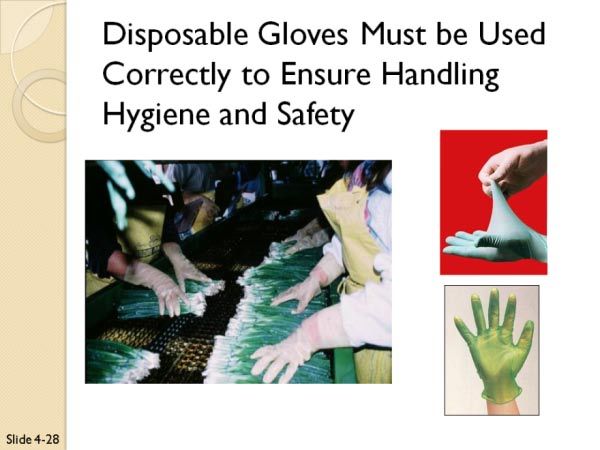
Contents
Personal Hygiene .................................................................................................................................................................... 1
   Description .......................................................................................................................................................................... 1
   Competencies ..................................................................................................................................................................... 1
   Presentation slides .............................................................................................................................................................. 2
   Sample assessment questions .......................................................................................................................................... 19
   Answer key for sample assessment questions ................................................................................................................. 20
FOOD SAFETY KNOWLEDGE NETWORK TRAINING MANUAL

Personal Hygiene
Description
The organisation shall have processes and procedures in place to ensure the implementation of employee and visitor
personal hygiene practices. Such practices shall result in the sanitary handling and delivery of safe and quality products
to customer. The Codex Alimentarius Commission's recommendation on personal hygiene shall be followed.

Competencies
The individual will:

    •   describe the principles and reasons for effective personal hygiene (i.e. hand washing, personal cleanliness,
        illness, injury, personal behavior, and visitor control).
    •   explain how to access regulations and customer requirements governing effective personal hygiene (i.e.. hand
        washing, personal cleanliness, illness, injury, personal behavior, and visitor control).
    •   explain when to apply proper hand washing techniques.
    •   identify employees with symptoms of illness (i.e.. fever, vomiting, diarrhea, sore throat) so they can ensure that
        ill individuals who might pose a risk to food safety are not allowed to work with food.
    •   design a system for employees and visitors to notify the organization of any symptoms of illness and injury that
        may preclude them from working in direct contact with food.
    •   operate a system for employees and visitors to notify the organization of any symptoms of illness and injury that
        may preclude them from working in direct contact with food.
    •   design a system to enforce procedures in relation to illness and injury, personal cleanliness, personal behaviour
        which could result in the contamination of food and food safety provision for visitors.
    •   operate a system to enforce procedures in relation to illness and injury, personal cleanliness, personal behaviour
        which could result in the contamination of food and food safety provision for visitors.

Personal Hygiene                                                                                                             1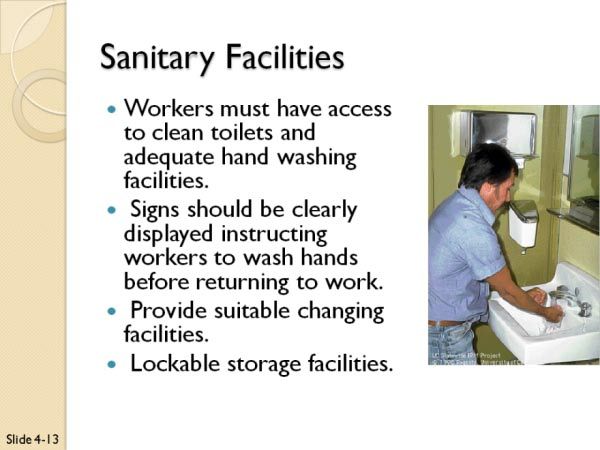
TRAINING MANUAL   FOOD SAFETY KNOWLEDGE NETWORK

Presentation slides
                                                      One might wonder what's personal hygiene got to do with
                                                      safety of food, but I think you're sitting in a room of
                                                      experts who know fully well on an individual as well as a
                                                      professional level how important personal or individual
                                                      hygiene can be impacted or will impact on your integrity
                                                      of your product.

                                                      Going back to some basic information that we should
                                                      know, what does [inaudible] say or dictate about before
         Basic Level Requirement                      level one aspect of personal hygiene? The organization
                                                      shall have processes and procedures in place to ensure
                                                      the implementation of employee and visitor personal
                                                      hygiene products. And these practices will or shall result
                                                      in sanitary handling and delivery of safe and quality
                                                      products to customers. You will also follow the
                                                      recommended Codex Alimentarius Commission on
                                                      personal hygiene. So this the tenet with which our next
                                                      presentation is going to talk about.

2                                                                                             Personal Hygiene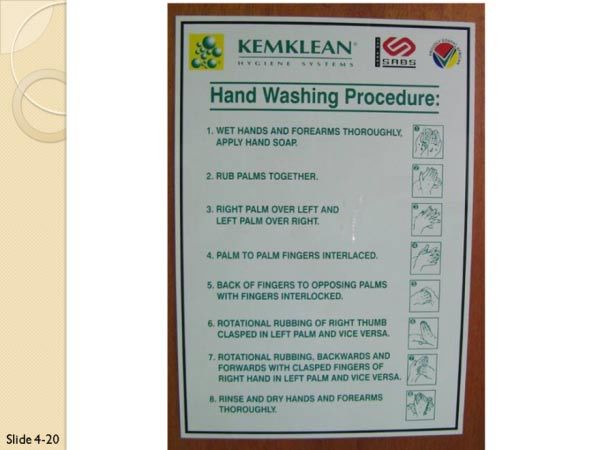
FOOD SAFETY KNOWLEDGE NETWORK TRAINING MANUAL

                          So we'll briefly touch upon the reasons of the worker
                          hygiene. What are the Codex general hygiene principles
                          on health status? Illness and injuries, personal cleanliness,
                          personal behavior, and the visitor control.

                          All right. Why is personal hygiene important? What is it so
                          important for an employee? It's now a well-established
                          and well-known fact that many of the recent food-borne
                          illnesses that we've seen are caused by infected food
                          handlers. Many as you can recall a very similar instance,
                          not just in India but elsewhere globally, where workers
                          have been implicated in large outbreaks. Even as close to
                          home in Lansing, Michigan, where I come from, a very
                          popular Italian restaurant had one of the largest
                          outbreaks we have seen I think in our history of Michigan
                          state where an infected worked infected with Norovirus
                          threw up in a wash basin and subsequently lettuce was
                          washed in the same basin. And about 300-400 people who
                          dined that week were infected. That's how critical it is,
                          and this restaurant had all the necessary certifications and
                          knew exactly what they needed to do.
                          Therefore, one has to keep in mind as you're setting up
                          processing plants in emerging markets to take into
                          consideration that your employees are well-trained in the
                          basic fundamental tenets of personal hygiene. Some of
                          the common examples of the microbial pathogens that
                          are transmitted by infected food workers are Norovirus,
                          [inaudible], e. coli [inaudible]. And one again can ask, so
                          what if my employee is infected? You know, I can send
                          them home. I can keep them for three days. I don't want
                          to stall what I am doing. No sir. You cannot.
                          Contaminations spread very, very, very easily. All it
                          requires is a microgram of fecal material lodged under
                          your fingernail. I wish I had a slide that showed about the
                          pyramid amplification effect of that small of material. It is
                          humongous which is why we emphasize on this aspect of
                          personal hygiene. Now yet again, you know, we found
                          coming from emerging markets as we do we proudly say
                          we are somewhat made of lead and iron. You know,
                          nothing can affect us. Sure. You, me, and these people
                          here can survive an outbreak or a contamination of this
Personal Hygiene                                                                      3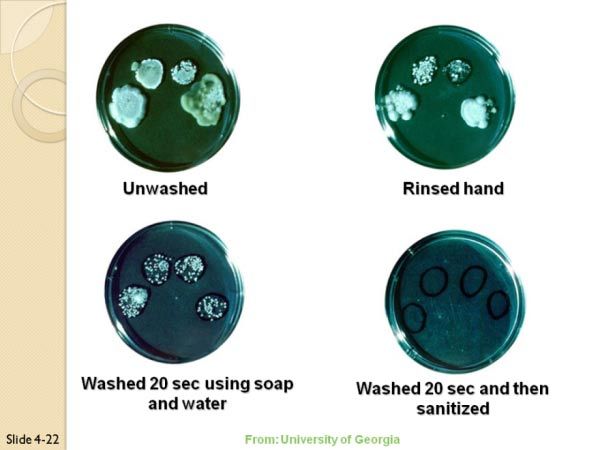
TRAINING MANUAL   FOOD SAFETY KNOWLEDGE NETWORK

                                                      type. But not the population workers, infants, small
                                                      children, elderly people, populations compromised with
                                                      the immune deficiencies disorders, pregnant women. We
                                                      cannot take that risk. Therefore, one has to be aware in
                                                      your designing of the systems and operations to take into
                                                      consideration procedures in place to prevent your
                                                      employees from spreading contamination.
                                                      It's not an easy task. There are several implementation
                                                      sheets, and you have to go back to the drawing board. The
                                                      fundamental thing that one has to remember is to build
                                                      awareness constantly. There's a huge turnover of
                                                      employees that go through our markets and our plants
                                                      here. Building awareness is critical. Along with it goes very
                                                      accurate and good training. Once you take care of both
                                                      aspects, then one has to make sure your facilities that
                                                      you're providing for your employees are appealing,
                                                      they're comfortable, they're dignified. Again, we come
                                                      from cultures where separation between genders comes
                                                      into play in terms of toilet facilities. Even a field or even in
                                                      a processing plant. So that's where the cultural sensitivity
                                                      comes into play. Thirdly, you have to have accurate
                                                      documentation procedures in place in order to have an
                                                      effective personal hygiene system. Lastly, you have to
                                                      incentivize your employees. Why is this important? And if
                                                      you do follow these rules and regulations and procedures,
                                                      give them some kind of prize system. Tell them what the
                                                      benefits are for following through this. Again, going back
                                                      to the roots of what we do and where we come from in
                                                      our betas, in our, in our tenets of villages. The cleanliness
                                                      have been emphasized by our forefathers and, and our
                                                      ancestors. Personal hygiene is not a new concept for us
                                                      here. What we practice at home, do we practice at our
                                                      manufacturing plants? Do we practice it at public places?
                                                      No.
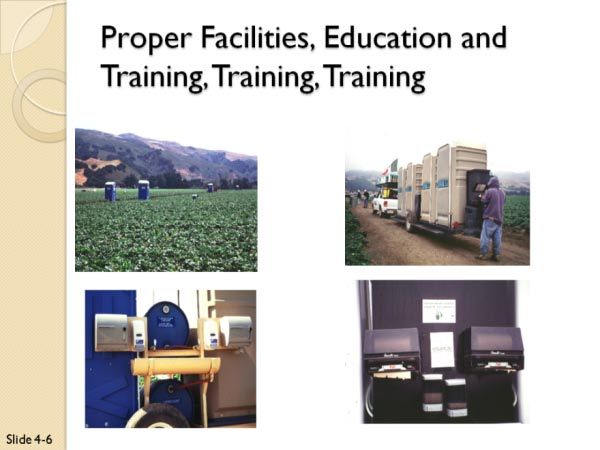
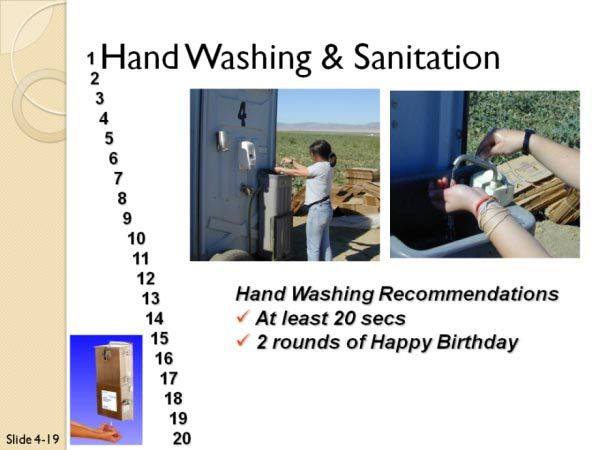
                                                      All right. Moving on to what, what type of facilities you
                                                      provide. What type of education you provide. And how
                                                      important training is as you go forward in implementing
                                                      your personal hygiene procedures. This slide shows some
                                                      of the more fancy sophisticated facilities that are available
                                                      in the U.S. and European marketplaces. You find these
                                                      little quarter toilets that are placed in what I think is a
                                                      spinach field I believe. And then you have the mobile
                                                      toilets parked on the side of the fields. That picture down
                                                      below shows a very, very sophisticated hand washing
                                                      system. And I believe the next slide show is a good
                                                      sanitation facility, a hand washing system with proper
                                                      signage and so on and so forth.
                                                      All right. What does Codex food hygiene principles say
                                                      about health status? People who are known or suspected
                                                      to be suffering from, or they are carrying of a disease
                                                      [inaudible] that is likely to be transmitted through food
                                                      should not be allowed to enter any food handling area if
                                                      there's a high likelihood of them contaminating

4                                                                                                Personal Hygiene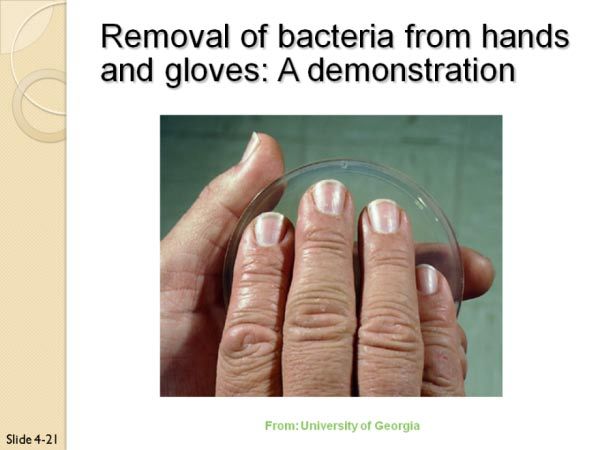
FOOD SAFETY KNOWLEDGE NETWORK TRAINING MANUAL

                          [inaudible] food products. Any person so affected should
                          immediately report illness or symptoms of illness to their
                          management. If necessary, but is warranted, medical
                          examination of a food handler should be carried out
                          immediately, and suitable actions should be taken. Should
                          be taken.
                          All right. What does Codex food hygiene principles say
                          about health status? People who are known or suspected
                          to be suffering from, or they are carrying of a disease
                          [inaudible] that is likely to be transmitted through food
                          should not be allowed to enter any food handling area if
                          there's a high likelihood of them contaminating
                          [inaudible] food products. Any person so affected should
                          immediately report illness or symptoms of illness to their
                          management. If necessary, but is warranted, medical
                          examination of a food handler should be carried out
                          immediately, and suitable actions should be taken. Should
                          be taken.

                          Some of the common conditions and symptoms that one
                          might experience in the countries we live are jaundice,
                          diarrhea, vomiting, fever, sore throats. And visibly
                          infected conditions are things that ooze out of pus, so on
                          and so forth, should be your first indication that
                          something is going wrong with your employees. So as a
                          good food safety manager you should be adept in
                          detecting these symptoms and take suitable actions when
                          you're confronted with an employee exhibiting these
                          symptoms.

Personal Hygiene                                                                   5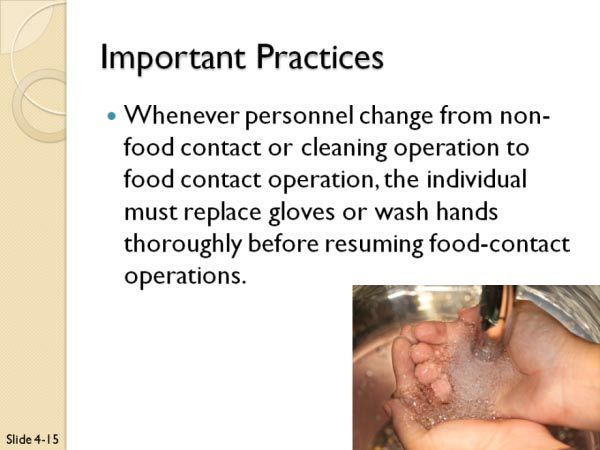
TRAINING MANUAL   FOOD SAFETY KNOWLEDGE NETWORK

                                                      Again to reiterate. This is a simple one-on-one for
                                                      personal hygiene. A person who has diarrhea or is a
                                                      carrier of a communicable disease that is transmitted
                                                      through food has to be prevented from working with
                                                      food. And that person should be removed from all food
                                                      handling areas including the receiving, inspection,
                                                      washing, or any other processing area. By the way, the
                                                      logo that we have on this particular slide is actually an
                                                      accepted international logo. Just like we have traffic signs
                                                      on roads, stop signs go, this is now an accepted food
                                                      safety sign. This was devised by the International
                                                      Association of Food Protection.

                                                      All right. To take you back to some basic microbiology
                                                      classes we had to look at what are the common food-
                                                      borne illnesses that we see. And again, many of these are
                                                      your ABC's for food safety management [inaudible]. E.
                                                      coli. Escherichia coli. What are the symptoms? Diarrhea,
                                                      vomiting, fever. Salmonella enteritidis. Abdominal cramps,
                                                      headache, fever. [Inaudible] fever, nausea, diarrhea. We
                                                      see diarrhea features a lot. So it's very simple. If your
                                                      employee comes and tells you I have a stomach, upset
                                                      stomach, let him go home. Let him take that one week off,
                                                      treat him with the right medication, advise him to seek
                                                      medical help. Let him go. It's not worth keeping that
                                                      employee in your factory for a week risking contamination
                                                      to the food, and then eventually you're in violation. Some
                                                      of the other common FBI's that we see are [inaudible],
                                                      [inaudible], and Norovirus. The one that I referenced to at
                                                      this place in Michigan was the Norovirus.

                                                      And this is another common sense practice that you have
                                                      to follow. Any type of abrasion or open skin abrasions can
                                                      be a source of pathogens, unless you treat it
                                                      appropriately. You have to wash the infected area, apply a
                                                      bandage. And then you put a barrier such as a glove or a
                                                      plastic sheet that prevents direct contamination of the
                                                      person with the food and vice versa.

6                                                                                              Personal Hygiene
FOOD SAFETY KNOWLEDGE NETWORK TRAINING MANUAL
Now coming to the next important Codex hygiene
principle is personal cleanliness. Employees, especially
food handlers, should maintain a very high degree of
personal cleanliness. And wear appropriate. Wear suitable
protective clothing, head covering, and footwear. Very
frequently you see in manufacturing plants employees
walk around with lab coats that look like jackets, and
perhaps a bouffant to cover your hair. And sometimes you
have to wear your hairnet across your, your head as well.
And appropriate footwear should be in place that can be
removed when the employee exits the building after the
day shift is over. Cuts and wounds where personnel are
permitted to continue working should be covered by
suitable waterproof dressings. I have a funny anecdote
about this. Recently in New York, and I forget which food
company manufactured this. But a customer who went
and bought a burger somewhere found a blue Bandaid in
their burger. Now, taking all of this into account you have
to remember any of these dressings that you put on the
employee could eventually become a physical hazard and
end up in your food supply. So it's a delicate balance to
maintain. But keep those things in mind as you go through
designing and operating a good personal hygiene system.
Sanitary facilities. And it's already been reiterated by
Kevin here. The workers must have access to clean toilets
and adequate hand washing facilities. He had a very good
discussion as to what the ratio of the hand washing
facilities per person should be. And the same goes for the
toilet. I think these should probably use simple subtropic
methodology if you will to see. If you have 50 employees
or 100 employees, look at their breaks times and then
decide on the number of stations you should put
depending on the type of processes you're often handling
in the plant. But clearly they should not be an adequate
number of toilets or hand washing stations. Otherwise
you might have a fantastic, perfect system in place, but
you will not be able to enforce it if you don't provide
adequate facilities. That plan should also provide suitable
changing facilities as well as a suitable lockable storage
facilities for the individual to feel comfortable to leave
their personal belongings when they don on your factory
mandated clothes.
Personal Hygiene 7TRAINING MANUAL FOOD SAFETY KNOWLEDGE NETWORK
More on to personal cleanliness. Personnel should always
wash their hands when personal cleanliness may affect
food safety. Again, personal cleanliness 101. And this is
something we know right from the start as a child till to
our old age that you wash your hands before you handle
food. You apply it at home. You apply it at your factory.
You apply it at other places at the start of food handling
activities. Immediately after using the toilet, and any time
you use, you handle raw food or any contaminated
material which could result in contamination of other
food items, those employees should also avoid handling
ready-to-eat food where appropriate.
So what's an important practice in order to ensure those
good. Particularly good hygiene practices are followed?
Whenever personnel change from a non-food contact or
cleaning operation to a food contact operation, the
individual must replace gloves or wash hands thoroughly
before reaching the food contact operation. Wearing
gloves does not make you impervious to contamination.
One of the common things that we face when we do our
training in the U.S. or elsewhere, in India or China, our
participants usually ask, why are you spending so much
time on hand washing? We know hand washing is
important and we'll take care of it. But seriously, if hand
washing is implemented in the way it should, it would
solve a lot of problems. I've only highlighted a few things
that, that are important when you wash your hands. But
the list actually runs about 30-35. Before you start work.
Any time you take a break. Any time you take a smoke
break. After you blow your nose or touch your hair, or
after you've used the restroom. After you handle dirty or
raw materials. You dropped your pen. You bend down to
pick up your pen, you're touching the floor. Immediately
you have to wash your hands. And after you perform
maintenance work on your equipment. Now if you, if you
take even these six or seven that I've listed, I think the
gentlemen here now can calculate the number of hand
washing stations one might actually have. Want to have.
8 Personal HygieneFOOD SAFETY KNOWLEDGE NETWORK TRAINING MANUAL
The permutation combination is tremendous.
All right. What's proper hand washing? Simple, right? Just
stick your hand under the water, use soap, you should be
done. No. You have a protocol for that as well.
Wet your hands with clean running water and apply soap.
Use warm water if it's available, going back to what Kevin
actually said. There are places where it requires ambient
temperature, specific temperature which your water
should be for washing your hands. Rub your hands to
make a strong lather. Scrub all surfaces. Get into the
crevices between your fingers, your fingernails. Scrub very
thoroughly. Rinse very well under running water. Dry your
hands. There's a lot of debate about drying methods in
the U.S. as well. The most recent mandate is you dry your
hands using single-use paper towels. You don't use the
same towel hanging by the side of the hand washing
station. It defeats the purpose of installing it in a hand
washing station if you re-use cotton towels. But even use
of an air dryer is now debated, as you all know, and can be
a potential source of contamination. So wherever possible
please provide paper towels, disposable paper towels at
the hand washing stations. And use the paper towel to
turn off your faucet. Otherwise, you'll be recontaminating
your hands.
Personal Hygiene 9TRAINING MANUAL FOOD SAFETY KNOWLEDGE NETWORK
This is another example of a field hand washing sanitation.
This is also what we recommend. If you noticed there are
seconds ticking here as I'm talking. When the second mark
reaches 20 that it how long it takes for you to lather and
wash your hands. Normally when we train people we'll say
sing two rounds of the Happy Birthday song or your ABC's.
And when we train here sometimes they hum the
National Anthem in your head, and that's how long you
should actually spend. There you go. You washed your
hands perfect.
Many times after you've done your training with your
employees, things are not reinforced or reiterated. You
cannot take it for granted that your employees are going
to follow these procedures effectively. And proper signage
and proper postings are also very important. Bear in mind
you have to put the signage also in the local languages
where you have got your hand washing facilities. This is a
good example of a hand washing facility we found in a, in
a manufacturing plant that leaves very little room for
doubt. Because you have a [inaudible] and clear, succinct,
statements of how long you should spend hand washing
and how you should.
Another thing that we do in our training programs is we
do a representation for our participants to show how
much hand washing is important. Unfortunately we can't
do it today, but we put this on slides to show in reality
what actually happens. Now, this particular picture
demonstrates a person imprinting their fingers on an Agar
plate and allowing the Agar plate to be upgraded
overnight for X number of days.
10 Personal HygieneFOOD SAFETY KNOWLEDGE NETWORK TRAINING MANUAL
All right. On the top left-hand corner that person who did
not wash their hands, when they imprinted their fingers
on the Agar plate that's the bacterial growth. This is real,
huh? We did this and we took those pictures. On the top
right-hand corner is the bacterial growth of someone who
rinsed their hands under running water. Not much of a
difference, right? On the bottom left-hand corner this is
the individual who washed his hands for 20 seconds using
soap and water. Did it clear your microorganisms? Lastly,
that individual washed in soap for 20 seconds and he used
[inaudible]. That appears to be your correct procedure.
It's very dramatic when you see this up front how much
bacteria that grows out of your hands if given the right
opportunity.
So for your pleasure of hand washing there are several
choices available in the market. You have soap,
antiseptics, hand sanitizers, skin protectant, and lastly
gloves also can be used as another barrier.
This standard soap actually uses detergent action. Again,
this is something we learned from our physics class and
chemistry class. Just a detergent action that helps remove
some physical [inaudible] such as the microorganisms
from the skin. Sometimes soap formulations can be
coupled with a chemical antiseptic to increase the
effectiveness. So it's up to you. Up to your company
choice. But use something that is recommended or
required by the client that you're working with normally.
Personal Hygiene 11TRAINING MANUAL FOOD SAFETY KNOWLEDGE NETWORK
Antiseptics have roughly about 62-70% alcohol in
concentration. Some of the common formulation used by
[inaudible] in market inspectors, and I'm not sure about
that. But that's something that's very commonly seen in
the antiseptics that we work with. You can also use the
iodine [inaudible] four based or Clorox. And they're all
based on formulations for your antiseptics if you will. But
fundamentally all of these formulations work at the same
capacity.
Thirdly, hand sanitizers are available these days. Hand
sanitizers are primarily dipped in an alcohol distilled
microorganisms. Again, it's extremely drying and I think
it's available even in the Indian market. I've seen a lot of
people buy small portable hand sanitizers by the bottle,
but it's extremely drying. It's constantly a moisturizing
component to counteracting drying effect. But hand
sanitizers are effective only to be used in a couple ways.
You know, washing your hands in soap and water. This
doesn't mean you can't avoid hand washing. It's not a
substitute for proper hand washing.
As I mentioned there are also skin protectants. They're
primarily skin moisturizing creams or lotions to give you a
protective barrier. We all know that we shed skin normally
during the course of our life, and that could be another
source of microorganisms. And if you wash, rinse your
hands with soap and water and use an antiseptic after
that, and a hand sanitizer. And finally putting a skin
protectant would be your ultimate hand protection that
you can offer.
12 Personal HygieneFOOD SAFETY KNOWLEDGE NETWORK TRAINING MANUAL
All right. Some glove technology to spend our time on.
Again, one might think what is the big deal about wearing
a pair of gloves? Gloves are gloves. It's not to be so.
Gloves can be another source of contamination if you
don't have the proper size given to your employees, and if
you don't use it properly. The gloves also carry a small
coating powder normally. And those powder particles can
fall into your food product. And [inaudible] processing can
be another source of contamination. So a good pair of
gloves should fit very tight and snugly, like a second skin.
And that picture demonstrates the elasticity or stretching
nature of the glove. And that's how tight your gloves
should be in order to be effective when you can handle it
in your food processing plants.
Once again, gloves cannot be used in place of proper hand
washing. Just because you've got a pair of gloves doesn't
mean you're introduced to other contamination. You
might forget that you've got gloves on if you touch your
hair or may contaminate yourself very many times, just as
you would do with a pair of hands. So wash your hands
thoroughly before you don the gloves and after you take
the gloves off. And remember, gloves can be only that
much protection and it can protect your food only that
much. It is your personal behavior that contributes and
controls the extent with which your personal hygiene can
be effectively implemented.
Moving on to personal behavior. People engage in food
handling activities should refrain from behavior that could
result in contamination of food such as coffee, spitting,
tobacco chewing, smoking, so on and so forth. Again,
these are very basic information that we all know. But
believe me this does happen as all of you can attest to in
your personal experiences. So you have to make this a
part of your training to gently coax your employees to
refrain from these habits as they work with food and food
products.
Personal Hygiene 13TRAINING MANUAL FOOD SAFETY KNOWLEDGE NETWORK
Tobacco in any form must not be used in the use of food
or food ingredients of [inaudible], handles, [inaudible].
This is another logo that has been standardized by the IFB.
One of the other common contaminations that we've
seen, I think Kevin alluded to, physical, chemical,
microbiological contaminations that can take place in a
processing plant, when employees come in wearing
personal affects such as jewelry or pins or bangles or, or
any sort of accessory that they have on their person, that
could become a potential physical hazard. Therefore,
these items should not be worn in any area where you
handle food. The common rule of thumb in food
processing establishments is no metal above the waist. In
keeping some cultural things in context, in the Western
world a wedding ring is allowed. People don't remove
that. And again, here, especially for women workers
coming from certain religious sects, they have a different
marital symbol, so you have to make that allowance to
allow them to wear that particular piece of jewelry. But
other than that make it very strict and mandatory that no
other jewelry is allowed.
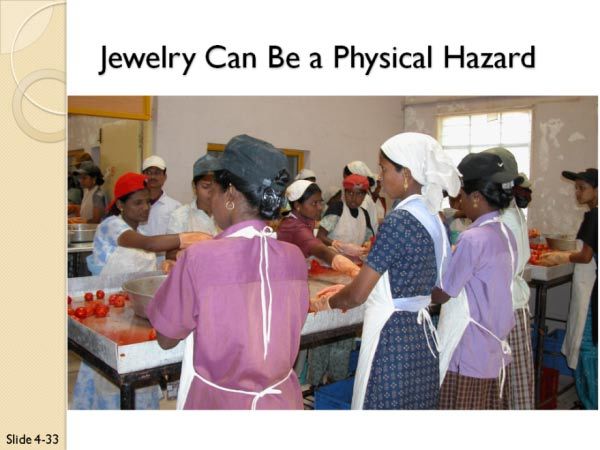
This is a a picture that we took, I want to say four years
ago when did a site visit in Maharasha in a tomato
processing plant. They did everything very well. They had
proper head coverings. They were wearing gloves. They
were disposing them in a timely frequent basis. They had
a good washing facility. But all of them wore jewelry in a
crop processing plant. That's a big no-no.
14 Personal HygieneFOOD SAFETY KNOWLEDGE NETWORK TRAINING MANUAL
Okay. Moving on to fingernails. Food employees should
keep their fingernails trimmed, filed, maintained, and
periodically checked for debris or dirt that collect under
those nails. Even your food particles as you work in your
plant. Just because you wear gloves doesn't mean your
fingernails should not be trimmed. And at the same time if
your women employees, or sometimes men, of who might
have a leaning towards fingernail polish, you should make
a mandatory thing to stipulate that they cannot wear
fingernail polish unless they're wearing gloves.
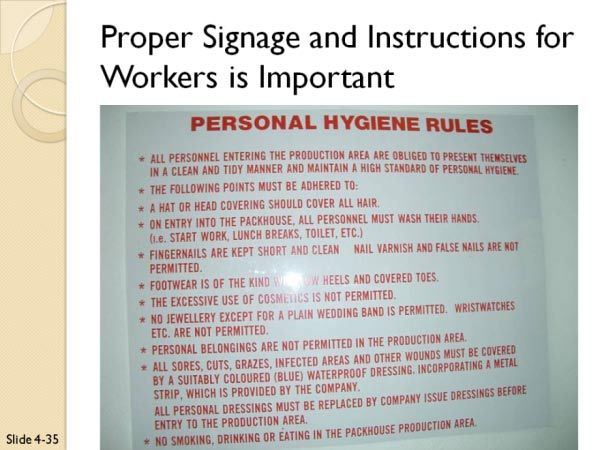
This is another good demonstration of what set of
personal hygiene rules you have to display in your plant
when you're designing a proper system in place. And this
particular set of rules actually applies even for your visitor,
controlled in some ways where when they present
[inaudible] into a plant you have to make. You have to
make sure even the visitor is using the highest code of
personal hygiene just as your employees would.
That takes us to the last point in our presentation. Visitors
are not exempt from, from these very same rules that you
subject your employees to. More often than not, there's a
given great deal of latitude and forget that they would
bring a whole source of contamination to the processing
plant. So you have to make that mandatory. Keep
sufficient and adequate and appropriate [inaudible] in
place. Disposable hairnets. Lab coats that they can wear
and gloves as needed. Safety goggles, again if it is
required. This particular picture was taken just last month.
I made this in a dairy processing plant and a water
processing plant in Rwanda. So we put this up to show
that this is universal. We teach this everywhere we go.
And even as experts that [inaudible] we were subjected to
the same protective wear that one has, one subjects your
employees to.
Personal Hygiene 15TRAINING MANUAL FOOD SAFETY KNOWLEDGE NETWORK
>> Can you go back to that last slide?
Is that one [inaudible] handed them off. [Inaudible]? And
is [inaudible] mainly a source of contamination?
>> Absolutely.
>> And managers and visitors are the main culprits.
>> Oh, yes.
>> Absolutely. You're absolutely right.
>> Not put something like that, but leaving it on our site?
But [inaudible] a customer and call? And he's run, run.
Walking, touching. What will we do about this?
>> I'm glad you said that. In our [inaudible] this picture
was taken when I was [inaudible]. She was calling for our
van to come, so I took this as an opportunity.
>> But she's standing around, all around.
>> You're absolutely right. They do not confiscate your
cellphones. They do take your cameras for obviously
reasons. But you're right. That. That's a constant battle we
do. And a lot of times we find managers and supervisors
violating the Continental Post in all these five or six, you
know, aspects that we've been talking about. You know,
discipline starts from your parents. We say, you know,
practice stops from top down. So unless you all as
managers set an example it's difficult to enforce.
>> No. My question is different. Even most of the workers
are getting cellphones. And as employees is it practical or
possible to confiscate the cellphones in the work areas for
four hours [inaudible]?
>> Yes.
>> Yes.
>> Is it a very difficult aspect?
>> Yes.
>> Yes.
>> And why didn't we discuss in [inaudible]?
>> Yeah.
>> [Inaudible]. As you were talking about it comes two
times.
>> Yes.
>> Once we are allowed it can be simple.
>> Indeed.
>> And at the same time it's almost impossible to
confiscate cellphones.
>> Maybe I can answer that one. We've been talking
about. If you look at those diagrams we're looking at
16 Personal HygieneFOOD SAFETY KNOWLEDGE NETWORK TRAINING MANUAL
moving towards fully sophisticated [inaudible]. Yeah? All
of the tables are recognized standards. Inspections on
personal hygiene. Very strong on personal hygiene. And I
think all of them have got the fact that there are adequate
facilities for staff to store their personal effects
completely away from the production area. And the point
of view sufficient storage space to allow to store their.
>> Lockable facilities.
>> Lockable facilities, yeah. So.
>> Lockable locker facilities.
>> Yeah. So they should be able. They should be able to
bring their phones in, but they should leave them in their
lockers completely away from the production area. Thus
the fact that I also can give you some experiences. Many
years ago the worst person to take a visitor around is the
factory owner.
>> Yes.
>> Because they think they're exempt from personal
hygiene. And if you've got that problem as a food safety
manager you have a real problem. Because when you go
around and you meet, the owners are coming into your
factories in the future. If your company owner is there and
they walk into the factory with a watch or earrings, you'll
have a problem. They've got. He's got to. Got to come
from this [inaudible]. Come from this [inaudible].
>> And the schedule. Many people alone can be used in a
[inaudible].
Okay. I said there are many people alone can be used a
[inaudible] on occasion. And other methods are hard to
use. Maybe that's in fact [inaudible]. Well my, my
[inaudible].
>> That's really take into concentration the cultural
facilities.
>> But what is [inaudible]?
>> Because. I mean those are the risks one has to take.
And if one can make that mandatory, one will. But this is a
tried and tested system where employees would refuse to
advocate something that is very closely related to their
sentiments.
>> [Inaudible] have their own for some [inaudible].
>> Which is why I said take into your constant context and
allow that one piece that most employees feel very close
to get attached to. And make that a concession. More
power to you if you can actually convince your employees
to advocate for better personal effects. But we have seen
more often than not in any culture we work with you have
to make those concessions. And I'm sure you'll see that in,
in terms of pathogen contamination from hair. And there
Personal Hygiene 17TRAINING MANUAL FOOD SAFETY KNOWLEDGE NETWORK
are certain aspects of people that we work with. You
cannot make that mandatory to have, you know, no facial
hair. So you have to put some permissions in place and as
well as make allowances in place. After all this is a
balancing act. If all of us were able to follow this 100% I
don't think we would have any of the [inaudible].
>> One more.
>> One would think that you would want to have bottled
water available for such facilities. But it may not be
practical every time. But your microbiological testing labs
should make a good baseline test to see if the water
source for your factory for hand washing is at least
microscopically, and to some extent microscopically clean
[inaudible]. To my best knowledge I don't know of any
particular attributes for limits on the specs of your water
for cleansing stations.
>> Yes. Yes, that's right. [Inaudible]. But even this one
problem [inaudible].
>> Indeed.
>> Yeah.
>> It's counter-effective then, and counter-productive in
that case. Absolutely. I agree with you. One would think
that in a manufacturing plant the provision of water
would. The potable water would meet those
specifications. And for hand washing stations, absolutely.
Your water should be of that level that allows you to
cleanse yourself before you go back to your food handling
areas.
>> Okay. We'll actually talk about that after Catherine
Bergen.
>> [Inaudible].
18 Personal HygieneFOOD SAFETY KNOWLEDGE NETWORK TRAINING MANUAL Sample assessment questions 1. Good personal hygiene will a) instill a good work ethic. b) produce high quality products. c) produce safe products. d) reduce the risk of unsafe products. 2. What critical aspects are required for an effective personal hygiene system in a manufacturing facility? a) Hair restraints, medical records, and control of illness, injury, personal health histories, and visitors. b) Hand hygiene, personal health history, visitor health records, visitor illness, and visitor injury. c) Hand washing, personal cleanliness, and control of illness, injury, personal behavior, and visitors. d) Hand washing, personal health records, facility cleanliness, employee injury and illness, and visitor health history. 3. Food workers must wash their hands after all of the activities described below except a) going to the bathroom. b) handling ready-to-eat foods. c) smoking, eating and handling trash and refuse. d) starting work. 4. An employee who is diagnosed with an illness from Salmonella Typhi shall be excluded from working with foods a) for one month after diagnosis. b) for one week after use of antibiotics. c) until a physician has provided proof that the person is clear of the disease. d) until all symptoms and signs of the disease are gone. 5. Protective clothing is used to protect the a) food handler from injury. b) food handlers’ personal clothing. c) hearing of the food handler. d) product from contamination. Answer key on next page. Personal Hygiene 19
TRAINING MANUAL     FOOD SAFETY KNOWLEDGE NETWORK

Answer key for sample assessment questions
1. Good personal hygiene will
   a) instill a good work ethic.
   b) produce high quality products.
   c) produce safe products.
   d) reduce the risk of unsafe products.*

2. What critical aspects are required for an effective personal hygiene system in a manufacturing facility?
   a) Hair restraints, medical records, and control of illness, injury, personal health histories, and visitors.
   b) Hand hygiene, personal health history, visitor health records, visitor illness, and visitor injury.
   c) Hand washing, personal cleanliness, and control of illness, injury, personal behavior, and visitors.*
   d) Hand washing, personal health records, facility cleanliness, employee injury and illness, and visitor health history.

3. Food workers must wash their hands after all of the activities described below except
   a) going to the bathroom.
   b) handling ready-to-eat foods.*
   c) smoking, eating and handling trash and refuse.
   d) starting work.

4. An employee who is diagnosed with an illness from Salmonella Typhi shall be excluded from working with foods
   a) for one month after diagnosis.
   b) for one week after use of antibiotics.
   c) until a physician has provided proof that the person is clear of the disease.*
   d) until all symptoms and signs of the disease are gone.

5. Protective clothing is used to protect the
   a) food handler from injury.
   b) food handlers’ personal clothing.
   c) hearing of the food handler.
   d) product from contamination.*

20                                                                                                      Personal Hygiene
You can also read


