Tuna Compliance Network - a partnership for sustainability - Food and Agriculture Organization of the ...
←
→
Page content transcription
If your browser does not render page correctly, please read the page content below
ABNJ

Tuna Compliance Network
           a partnership for sustainability
The Tuna Compliance Network
Supporting and strengthening the implementation of and compliance with tuna
fishery conservation and management measures

                                         the effectiveness of active CMMs. This
The key to sustainable                   is in general a vast task considering the
fisheries                                 number of Members in each RFMO,
The sustainability of fisheries can       the large number of reporting require-
only be achieved through the             ments, and that the information is
adoption and effective implementa-        often processed manually.
tion of Conservation and Manage-
ment Measures (CMMs). This is, in        Joining forces
particular, the case for straddling            In March
                                         In March   2017,2017,      the Tuna
                                                             the Tuna             Compliance
                                                                          Compliance
stocks and highly migratory species,           Network     (TCN)   was    set
                                         Network (TCN) was set up to facilitateup  to facilitate
where Members are required to                  communication         and
                                         communication and cooperation      cooperation
implement internationally agreed               between
                                         between    officers officers     responsible
                                                               responsible      for for
CMMs adopted in the framework of               compliance
                                         compliance            and experts
                                                       and experts               in Monitoring,
                                                                         in Monitoring,
Regional Fishery Management                    Control
                                         Control          and Surveillance
                                                  and Surveillance        (MCS).(MCS).
                                                                                    Its Its
Organizations (RFMOs).                   main main    objective
                                               objective           is to share
                                                            is to share            best practice
                                                                           best practice
                                               compliance
                                         compliance            processes
                                                       processes              associated
                                                                      associated
Tuna RFMO Members are suppor-                  mainly   with   tuna   RFMOs
                                         mainly with tuna RFMOs and, therefore   and, therefore
ted by a Secretariat, and especially           contribute     to combating
                                         contribute to combating IUU fishing      IUU fishing
                                                                                         in    in
by its officers responsible for                  tuna fisheries.
                                         tuna fisheries.             All RFMOs
                                                            All RFMOs              and their
                                                                           and their
compliance, in the implementation              Members
                                         Members             face similar
                                                     face similar            challenges
                                                                     challenges      in thein the
of adopted CMMs, and the monito-               implementation
                                         implementation       of CMMsof CMMs
                                                                           and the and the
ring of compliance with these                  assessment
                                         assessment     of theirof compliance,
                                                                   their compliance, and and
measures. Strict observance of all             can benefit
                                         can benefit            from other’s
                                                       from each      each other’s      knowled-
                                                                                 knowled-
binding measures is essential for fair         ge  and   experience.
                                         ge and experience. As an informalAs  an  informal
and effective management of these               network,
                                         network,   the TCNtheprovides
                                                                 TCN provides       a unique
                                                                             a unique
fisheries resources, and helps to               opportunity
                                         opportunity            for these
                                                        for these            exchanges
                                                                     exchanges       to     to
reduce Illegal, Unreported and                 take place
                                         take place   among   among     tuna RFMOs,
                                                                tuna RFMOs,
Unregulated (IUU) fishing.                      something
                                         something    that hasthatnot
                                                                    hashappened
                                                                           not happened
                                         beforebefore
                                                 in theincontext
                                                            the context      of compliance.
                                                                     of compliance.
Among many other activities,
officers responsible for compliance        WhileWhile   focused
                                                focused  on tunaon fisheries,
                                                                   tuna fisheries,
in tuna RFMOs collate and analyze              particularly through
                                         particularly through the five thetuna
                                                                           five tuna
data provided by Members to              RFMORFMOs,     thealso
                                               s, the TCN    Network   also promotes
                                                                 promotes
prepare reports and supporting                 the involvement
                                         the involvement          of other
                                                            of other expertsexperts
                                                                              in     in
material for the organization’s                fisheries
                                         fisheries        compliance
                                                   compliance          and MCS,
                                                                 and MCS,   inclu- inclu-
decision-making processes, and                 ding other
                                         ding other  RFMOs RFMOs    and relevant
                                                              and relevant
assess compliance by Members and               international
                                         international bodies.bodies.
The initiative                              Core Group and other
The TCN was established in coope-
                                            members
ration with the International Monito-       The TCN is organized around a Core
ring, Control and Surveillance              Group composed of officers
Network (IMCSN) and with support            responsible for compliance in the five
from the Common Oceans ABNJ                 tuna RFMOs:
Tuna Project, which is funded by the
Global Environment Facility (GEF)           • Commission for the Conservation of
and implemented by the Food and             Southern Bluefin Tuna (CCSBT)
Agriculture Organization of the             • Inter-American Tropical Tuna
United Nations (FAO). The TCN will          Commission (IATTC)
be supported by the Common                  • International Commission for the
Oceans ABNJ Tuna Project until June         Conservation of Atlantic Tunas
2019, after which time other                (ICCAT)
sources of funding will need to be          • Indian Ocean Tuna Commission
identified to ensure its continuation.       (IOTC)
                                            • Western and Central Pacific
A first workshop was held in Spain in        Fisheries Commission (WCPFC)
March 2017, where officers respon-
sible for compliance in each of the         In addition, the TCN includes an
five tuna RFMOs, and other experts           Extended Group of experts in
met and launched the TCN.                   compliance and MCS, who participa-
                                            te in the exchange of information for
                                            specific projects.

             Participants at the second TCN workshop in Honiara, Solomon Islands.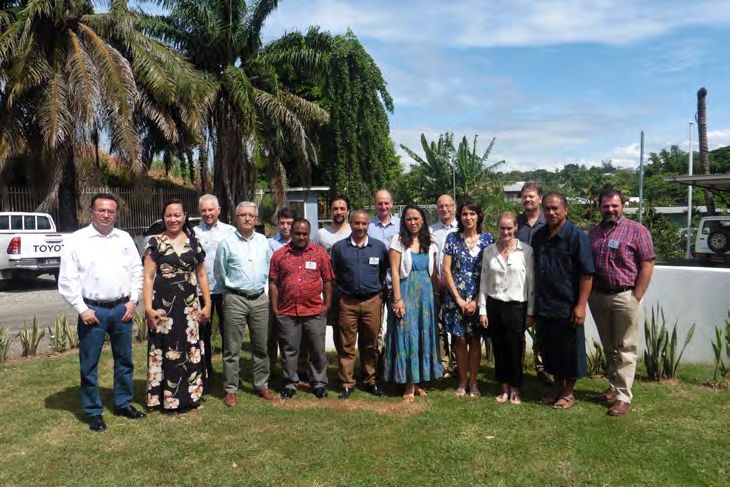
© Julien Million

Goals and priorities                       Current and future
                                           activities
The main goals of the TCN involve:

• Facilitating communication and           The TCN is providing inputs for other
information exchange;                      activities under the Common Oceans
• Fostering joint efforts, including the   ABNJ Tuna Project, i.e. the development
development of common tools and            of MCS Best Practices in tuna fisheries
procedures and best practice               and a study on transshipment called for
compliance methodologies;                  by the FAO Committee on Fisheries in
• Enhancing opportunities for sharing      2016.
technology and technology transfer;
• Improving awareness of new and           In February 2018 the TCN held its
existing measures, procedures and          second Workshop in Honiara, Solomon
technologies within RFMOs;                 Islands, at the FFA headquarters,
• Identifying and coordinating             focusing on data management and
capacity building and training oppor-      reporting for compliance. Participating
tunities.                                  experts explored the scope for
                                           cooperation and potential strategies to
During its first workshop, the             improve the effectiveness of current
TCN identified, as a priority,             systems. Conclusions are available in the
sharing best practice compliance           Workshop Report.
processes regarding:
                                           The Workplan for 2018-2019 includes, in
• Data management and reporting for        addition to continued information
effective implementation and control       exchange on compliance and MCS
of RFMO measures;                          matters, exploring opportunities for
• RFMOs' Compliance assessment and         greater collaboration in the review and
review procedures;                         development of compliance procedures.
• Authorized vessel lists;                 The TCN will convene a meeting with the
• IUU Vessel lists;                        Chairs of the Compliance Committees of
• Electronic monitoring and electronic     the tuna RFMOs, and address this topic
reporting systems;                         at the 3rd Workshop of the TCN, which
• Transshipment at sea, and                will take place back-to-back with the 6th
• Port State Measures.                     Global Fisheries Enforcement Training
                                           Workshop organized by the
                                           International MCS Network in Bangkok,
                                           Thailand, in February 2019.
The Tuna Compliance Network (TCN) is supported by the International
MCS Network, the Common Oceans ABNJ Tuna Project that is
funded by the Global Environment Facility (GEF) and implemented
by the Food and Agriculture Organization of the United Nations
(FAO), Regional Fisheries Management Organizations (RFMOs), and
other partners.
For more information
Adriana Fabra, TCN Coordinator:
afabra@imcsnet.org
Alejandro Anganuzzi, Global Coordinator,
Common Oceans ABNJ Tuna Project:
Alejandro.anganuzzi@fao.org© FAO, 2017 I8146EN/1/11.17
You can also read


