UNCAC IMPLEMENTATION REVIEW MECHANISM - CELEBRATING 10 YEARS OF THE - United Nations ...
←
→
Page content transcription
If your browser does not render page correctly, please read the page content below
CELEBRATING   10 YEARS OF THE
UNCAC IMPLEMENTATION
REVIEW MECHANISM
3

FOREWORD   Twenty-five years ago,
           there were no international agree-
                                                              provides a technical, objective and
                                                              non-adversarial
                                                              discussions     with
                                                                                      entry
                                                                                        and
                                                                                               point
                                                                                                between
                                                                                                        for
                                                                                                               Civil society is organized and active in this
                                                                                                               area.    Frameworks
                                                                                                               addressing     corruption
                                                                                                                                           and
                                                                                                                                             are
                                                                                                                                                    ideas   for
                                                                                                                                                    continually
           ments on corruption. Corruption was
                                                              governments      on     programming        for   developing. With all this, we have safely
           not regularly discussed in international
                                                              anti-corruption      reforms      and     can    moved beyond the beginning stage of
           settings,      and     bribes        were    tax
                                                              ultimately form the basis for strong             successfully     addressing          corruption
                                                                                                                                                                                                                                            IN MEMORIAM
           deductible in some countries.
                                                              comprehensive           framew orks        to    globally, but so much more needs to be                                                                                       DIMITRI VLASSIS
                                                              prevent and combat corruption.                   done.
           The    environment         has       changed                                                                                                                                                                                       1959—2019
           drastically since then.         There is now
                                                              The need to address corruption as an             We are at a next stage, where we need to
           unchallenged unity in acknowledging
                                                              impediment to development is now                 find more ways to allow governments to
           that corruption is unwanted. There are
                                                              cemented        in     the      Sustainable      effectively find help and help each other.
           186    States    parties        to    the    UN
                                                              Development Goals, particularly Goal             We      need    more      transparency       and
           Convention against Corruption, the
                                                              16,   and    fifteen    years     after   the    implementation of measures that will help
           only   truly    global     anti-corruption
                                                              adoption of the UNCAC, Member                    make     the    fight     against     corruption
           instrument      and     the     most        com-
                                                              States have unanimously adopted a                irreversible. We need to find ways to feed
           prehensive international agreement,
                                                              resolution calling for a Special Session         the hunger of all stakeholders – whether
           with its innovative chapters targeting
                                                              of the General Assembly dedicated                governments,      civil   society,    individual
           corruption      from     the     angles       of
                                                              to corruption in 2021.                           citizens or private sector.
           prevention, criminalization and law
           enforcement,         international     coope-      As the awareness for corruption as a             If we want to reach SDG 16 by 2030, we
           ration, asset recovery, and technical              root cause of many of a multitude of             must continue to make full use of the
           assistance.                                        problems has deepened in recent                  Mechanism, and I look forward to seeing
                                                              years, the political will to combat              what impact the next ten years will bring.
           Governments are more attuned to
                                                              corruption     has     grown     across   the
           their commitments and ready to learn
                                                              globe and countries are working
           and     share        experiences.            The
                                                              individually    and       collectively     to
           Implementation Review Mechanism                                                                                                   John Brandolino
                                                              effectively address it.
                                                                                                                         Director, Division for Treaty Affairs

                                                                                                                                                                  Will we ever win the battle against corruption? „We are paving the way for future generations.“
INTRODUCTION
Sixteen years after the adoption of the United Nations Convention against Corruption
in 2003 and nearly ten years after the launch of its Implementation Review Mechanism
in 2010, it is time to take stock of the impact of the Review Mechanism in the global
fight against corruption.
With 196 finalized executive summaries and 237 country visits or joint meetings under
both review cycles combined, the picture the Implementation Review Mechanism
paints is global. The country reviews have produced a worldwide, comprehensive and
detailed analysis of what challenges countries and regions face and what solutions
STATE PARTY PARTICIPATION
97%
of States parties participated in
one or more IRM country visit or joint meeting
Total Country Visits and Joint Meetings
17
Over
1,000 & 7,000
good practices
identified
11
MEASURES TAKEN
8
recommendations
20
made
by reviewers in the course of the 196 completed
1st and 2nd cycle reviews
almost
25
Identifying Gaps and Shortcomings
71% 58
of States said that the peer review helped
identify gaps in their frameworks and had
TECHNICAL ASSISTANCE
an overall positive impact
LEGISLATIVE REFORM
%
“ The Mechanism guarantees the principles that it
endorses in terms of respecting the diversity of the
States Parties, it is neither intrusive nor invasive […],
it is conducted at a high technical and inter-
governmental level, meaning in practice a real
and effective assistance without discrimination.
This exercise has strengthened, by its very nature,
objectives and methods of implementation, grea-
ter inter-institutional coordination and the develop-
ment of multidisciplinary teams that interact with
the different actors in society. It has also been cha-
racterized by the responsibility, professionalism and
quality of the work contributed by reviewers and
reviewed from the process of self-assessment and
87%
Under 1st and 2nd cycle
they found to address them. In the course of the reviews, almost 7,000 challenges,
over 1,000 good practices, and over 3,500 technical assistance needs have been
237
of States report
taking measures 3,866 the exchange of good practices and identificati-
90
”
on of legislative deficiencies, risks and problems to
identified across all regions. Through the review process, strong working relationships related to the 1st review cycle
%
SECONDCYLCLE
technical assistance needs be solved and in this sense it is the promoter par
have been established with and between the responsible authorities in the States
FIRST CYLCLE
have been identified
58
excellence of preventive work. We consider it an
parties, such as the relevant ministries, anti-corruption authorities, audit institutions or
% of States report through the IRM across
108
taking measures example, which must be disseminated for its work
financial intelligence units. 1 21 32 29 28 37 12 25 25 27
countries
related to the 2nd review cycle and experiences.
of States report legislative María del Carmen Romero Pérez
Through follow-up reporting after a review or during the meetings of the amendments
2010 2011 2012 2013 2014 2015 2016 2017 2018 2019 Head of the Legal Department, Office of the
Implementation Review Group, 147 States parties have shared information on good Comptroller-General, Cuba
practices, experiences and measures taken after the completion of their first cycle
reviews or in preparation for the second cycle, with measures ranging from the Executive Summaries CAPACITY BUILDING PREVENTIVE MEASURES FURTHER EFFORTS
INTERNATIONAL COOPERATION
creation of new and independent anti-corruption authorities, the active engagement
of the private sector in the fight against corruption, the opening of a dialogue with
Capacity building
37% of States strengthened their
50%
are being
civil society, the introduction of new criminal offences or the signing of new mutual
legal assistance treaties to the sharing of technical support with neighbouring
91 %
represents
40 %
international cooperation
capacities
50%
discussed or
underway in
50% of States
countries.
of technical assistance of States report the
The solutions countries are finding and implementing are creative, diverse, and
of first cycle reviews completed with needs for the 2nd cycle adoption of new
effective. This publication serves to highlight approaches countries across the globe executive summary adopted preventive measures
are taking to combat corruption, both individually and together, to showcase the
impact of the Review Mechanism since its launch ten years ago.
7
                                                                                Languages used

DIRECT DIALOGUE
                                                                              in country reviews...

                                                                                                                                                                                                                                                          Country pairings (years one and
                                                                                                                                                                                                                                                            two of the second cycle)

To date, 237 country visits and joint meetings involving 180 State Parties
have taken place. In keeping with the requirements of the IRM for each
visit, the State party under review has been reviewed by a State from the
same region as itself, and by another State. This feature has enabled a
global exchange of ideas, providing knowledge sharing opportunities for
diverse State parties from around the world.

Country visits have taken place between neighbors, such as Poland and
Belarus, or Peru, Bolivia and Ecuador, and between States who may
rarely have an opportunity to work together, such as Kiribati and Yemen,
or Zimbabwe and Finland. The Mechanism was created by States parties
as an opportunity to share good practices and challenges, and it
provides a learning opportunity not only for the State party under review,
but also for the reviewers. As a most recent example, during the country     … two-language reviews….
visit to Ghana in October 2019, the experts from South Sudan shared their                                CHINESE

experience with confiscation, providing important food for thought on
                                                                                                             4        5
how to proceed with the development of a confiscation and asset

                                                                                                                                                                               “
management regime in Ghana. After the country visit to Palau, reviewer                            23
Malaysia shared a law with Palau that would help them address one of                                                      2
the recommendations. In addition, Malaysia returned to Palau to provide
in-country assistance in preparing for the second review cycle.                              75                                            12
                                                                                  ENGLISH                                                                                      Where would we be without the Review Mechanism? It has provided a
                                                                                                                                                … and three language reviews
Reviews have been conducted in all six of the official United Nations                                                                                                           place to meet and discuss our ideas and exchange on our successes
                                                                                                                                      44        (under both cycles combined)
languages, making the results both transparent and accessible. Including                                                      1                                                    and failures. We have learned from each other and inspired each
executive summaries, country reports and self-assessment checklists, 309
                                                                                                                                                    ENG     FR     ESP    9     other to go further and look beyond our national context to find new
documents resulting from the country reviews are publicly available on
                                                                                                                                  6             4   ENG     FR     AR              solutions to old problems. Indeed, it has solidified a bond between
the UNODC website. 89% of States under the first cycle and 96% of States                                                                            ENG    AR     RUS     5                      small and big states in the anti-corruption community.
                                                                                                        45
                                                                                                                                                                                                       Charles Ayamdoo, Director, Anti-Corruption, Commission
under the second cycle chose to include other stakeholders in the                                                                               2   ENG     AR     ESP
                                                                                                                                                                                                           on Human Rights and Administrative Justice, Ghana
country visits, such as civil society, the private sector or academia.                                           11
9
SUMMARY OF GOOD PRACTICES AND RECOMMENDATIONS
Distribution of good practices in percent Distribution of good practices in percent
This chart displays the percentual distribution of recommendations and good practices per review cy- The highest number of indi- Under the second cycle, many good practices are being identified with At the same time, over 50% of States have received recommendations for
cle. In total, reviewers have identified nearly 6,000 recommendations and 1,000 good practices for the vidual States had good regard to preventive measures. Over 60% of States have been commend- each of the articles under chapter II, with over 85% of States having gaps
first cycle, and roughly 800 recommendations and 150 good practices under the second cycle. Under 20% practices under article 46 ed on their efforts regarding anti-corruption strategies, nearly half of all 20% identified under articles 5, 7, 8, 9 and 12. Under chapter V, 96% of States re-
some articles, the majority of States received recommendations, such as 61% of States for article 15, (57% of States). States for procurement or management of public finances, and 25-35% of ceived recommendations under article 52, and 70% under articles 55 and 57,
70% for article 16, 92% for article 44, and even 95% of States for article 46. States on codes of conduct, or anti-corruption bodies. respectively.
10% 10%
38. Cooperation between
30. Prosecution adjudi-
6. Preventative anti-
58. Financial intelligence
59. Bilateral and multi-
5. Preventative anti-
15. Bribery of national
26. Liability of legal per-
31. Freezing, seizure
32. Protection: witnesses
33. Protection of
39. Cooperation with the
42. Jurisdiction
50. Special investigative
8. Codes of conduct for
9. Public Procurement
7. Public sector
10. Public Reporting
11. Measures relating to
12. Private Sector
13. Participation of
54. Recovery of property
16. Bribery of foreign
23. Laundering pro-
14. Measures to prevent
46. Transfer of criminal
49. Joint investigation
56. Special cooperation
57. Return and disposal of
44. Extradition
47. Transfer of
51. General provision
52. Prevention/ detection
48. Law enforcement
53. Measures for direct
55. Int’l cooperation
national authorities
corruption bodies
unit
lateral agreements
corruption policies
cation, sanctions
reporting persons
private sector
techniques
public officials
the judiciary
society
by int’l cooperation
money-laundering
public officials
sons
and confiscation
experts & victims
proceedings
assets
sentenced persons
proceeds of crime
public officials
ceeds of crime
cooperation
for confiscation
recovery of property
10%
10%
20%
Distribution of recommendations in percent 20% Distribution of recommendations in percent
FIRST CYCLE SECOND CYCLE
11
PREVENTIVE PREVENTIVE ANTI‐CORRUPTION BODIES
Preventive anti‐corruption bodies with sufficient operational and institutional
PRIVATE SECTOR ENGAGEMENT THE VOICE OF CIVIL SOCIETY
Neither governments nor companies can fight corruption More and more States are including civil society not only in non-governmental organizations have produced their own
MEASURES independence, capacity and resources to carry out their functions are
essential corruption prevention tools. Under the second review cycle, 22 of
27 States received recommendations that specifically related to the creation
alone and the private and public sectors must work
together in this effort. The Convention considers the private
sector’s engagement as essential to the fight against
their review process, but more broadly consult the public in civil society review reports, evaluating the transparency and
many aspects of fighting corruption. To support the inclusiveness of the country review process and country
ratification, implementation and monitoring of the compliance with UNCAC standards,” says Mathias Huter,
or strengthening of these anti‐corruption bodies. corruption and encourages States to promote corporate Convention, the UNCAC Coalition, a global network of over Vienna Hub Coordinator of the UNCAC Coalition. “To further
compliance, to provide incentives for the private sector to 350 civil society organizations from over 100 countries, improve the IRM, States parties should also discuss the
Corruption can be prosecuted after the fact, but first and foremost,
34
cooperate with law enforcement in corruption cases, and mobilizes civil society action for UNCAC at international, creation of a mandatory follow-up mechanism on previous
States report having The UNODC Anti‐Corruption Tool
efforts must be undertaken to effectively prevent it, as public trust, -Kit has had over to strengthen auditing and accounting standards in regional and national levels. The Coalition’s Transparency reviews and the adoption of a continued review process. The
made changes to their
2600
the effectiveness of institutions, economic development and the anti-corruption bodies’
companies to increase transparency and accountability. Pledge, signed to date by 18 States parties, is a voluntary release of the self-assessment checklist and the full country
⚫⚫⚫⚫⚫⚫⚫⚫⚫
security of the State are at stake. The entire second chapter of the Panama has established online portals and websites for the commitment to make the review process more inclusive report as well as updated public information on the review
⚫⚫⚫⚫⚫⚫⚫⚫⚫ work. 5 more States
Convention is dedicated to prevention, with measures directed at private sector, especially for new businesses. The United through enhancing transparency and civil society schedule, country visits and the focal point are crucial to
⚫⚫⚫⚫⚫⚫⚫⚫⚫ are in the planning
downloads from the UNODC Kingdom relies on broad participation of CSOs and the participation in the reviews. “For the IRM to have a greater facilitate the involvement of civil society organizations in the
both the public and the private sectors. Preventing corruption also ⚫⚫⚫⚫⚫⚫⚫⚫⚫ stage
website private sector in the planning, development and impact in ensuring that UNCAC provisions are successfully review process. The end of the review process should be a
requires an effort from all members of society and the Convention ⚫⚫⚫
implementation of national anti-corruption policies and implemented, we believe it is crucial for States Parties to starting point for reforms, with governments and civil society
calls on countries to actively promote the involvement of civil
practices. In Kenya, licenses for performing public duties involve civil society organizations in all stages of the review discussing how to follow up on recommendations stemming
society, and to raise public awareness of corruption and what can MANAGING CONFLICTS OF INTEREST are tied to the duty to proactively disclose information on process. In numerous countries, civil society representatives from the IRM.” More information, and multi-lingual guidance
be done about it. The Convention encourages a broad range of corruption cases to authorities. have been invited to meet with country reviewers and have material for civil society organizations, is available at
“
A vital tool in the prevention of corruption is the prevention, detection and
preventive measures, ranging from anti-corruption strategies and contributed to the review process. In more than 30 countries, uncaccoalition.org.
management of conflicts of interests. States parties have found different
bodies to enhanced transparency in the financing of election UNCAC ratification from 2003 to 2019.
means to address these, including targeted trainings, codes of conduct or
campaigns and political parties. Those who use public services Opened for signature in December 2003 in Mérida, Mexico, with 186 States parties the ‚Mérida‘ Convention has
financial disclosure requirements. Kuwait, Liberia and Malaysia report on the
expect a high standard of conduct from their public servants. States reached almost universal adherance. The newest States parties are Samoa, Equatorial Guinea and Chad (2018).
development of new codes of conduct to promote integrity and safeguard
must endeavour to ensure that their public services are subject to the interest of the State. In Armenia, the registries of interests and assets are
The regulatory and institutional
safeguards that promote efficiency, transparency and recruitment available on a public ethics website. Through a new law from 2018, the reforms, complemented by the
based on merit. Once recruited, public servants should be subject to scope of officials obliged to declare assets was expanded and failure to
rise of civil society, measures ai-
codes of conduct, requirements for disclosure of conflicts of interests, declare carries administrative and criminal liability. In Italy, the code of
and appropriate disciplinary measures. Transparency and accounta-
conduct for house representatives was enhanced to include additional asset med at awareness-raising and
bility in matters of public finance must also be promoted, and
declaration requirements and to allow an advisory committee to monitor welfare amelioration appear to
violations of the code. Several new Codes of Conduct were introduced in
specific requirements are established for the prevention of corruption
Egypt, including for employees of the state, public prosecutors, diplomats, have changed ‘the rules of the
in the particularly critical areas of the public sector, such as the and employees of the Central Bank of Egypt. A compulsory course was game‘ beyond the point of no
judiciary and public procurement. Through the country reviews and added to all Egyptian universities that focuses on human rights and anti-
working groups, States parties have shared a wide array of measures corruption.
return, landing us at the new re-
taken to prevent corruption, a full overview of which is available on ality of greater accountability
the website of the Working Group on Prevention.
18 States report progress toward
improving public service codes of
conduct
1/4 of States have created a
national anti-corruption
strategy
and transparency.
Elnur Musayev, Senior Prosecutor, Anti-Corruption Direc-
torate, Prosecutor’s Office of Azerbaijan
13
PROCUREMENT & MANAGING PUBLIC FINANCES RAISING PUBLIC AWARENESS
With large amounts of money involved and Central Procurement Board, a Bid Evaluation Across the regions, recognition is growing that d’Ivoire, awareness-raising has included cartoons as awareness in the area of corruption and fraud
close cooperation between public officials and Committee and an Independent Review corruption must be tackled through a variety of well as a televised animated series showing real life prevention. The seminars were organized for various
private companies, public procurement is one panel. Procurement policies were also adopted means and with the participation of society as a situations of corruption and their occurrence in the groups including youth, legal professionals and local
of the areas most vulnerable to corruption in in Afghanistan, and Trinidad and Tobago. whole. Many States parties have organized daily lives of the family members in school or at work. governments. Information regarding the harmfulness
any country. As public procurement is a workshops, campaigns, and online and in-person of corruption was added to the school curriculum in
Timor Leste is gradually applying the In Hungary, a public awareness campaign took place
necessity, sectors such as extractive industries, educational materials to raise public awareness of 2014. In addition, comprehensive information was
technology to develop a national system on e- from 2012 to 2015 in national and local media,
telecommunication or infrastructure are often corruption and how to fight it. Côte d’Ivoire and provided to the public through a dedicated web
budgeting, e-procurement, and e-Planning. complemented by in-person contact with target
particularly at risk. Examples of new measures Ghana promote the active participation of a page.
Portugal also relies on an e-procurement groups at different events and festivals. The results of
identified through the reviews include: plethora of groups outside the public sector. In both
platform: Since the creation of the Portal BASE, a survey measuring the awareness and attitudes of In the context of the “Images against Corruption”
countries, these groups are now - as a rule - included
In Namibia, a new law on Public procurement public procurement is exclusively done on an the public towards corruption showed that lack of project, Portugal has been encouraging primary and
in activities ranging from drafting new laws to
established a Procurement Policy Unit, a electronic platform to increase transparency. information was a primary driver of distrust. In total, secondary school students, their families and teachers
supporting the reporting of corruption cases. In
almost 2000 police and public administration to reflect on the topic of ethics and the prevention of
Ghana alone, over 3000 public awareness activities
professionals helped to share information on corruption since 2012. Guided by manuals and
COORDINATED ANTI-CORRUPTION STRATEGIES are carried out annually by the Commission on
corruption at different campaign events. In Slovakia, teaching materials, art pieces such as plastic or video
Human Rights and Administrative Justice, the
According to article 5 of the Convention, each stakeholders in the drafting or monitoring, or two series of seminars were held to increase legal artworks on the topics are created.
country’s main anti-corruption institution. In Côte
State party shall have effective, coordinated through awareness-raising and implementation
anti-corruption policies that promote the measures.
participation of society and reflect the INTERNATIONAL ANTI-CORRUPTION DAY
States across the globe, from Ethiopia and
principles of the rule of law, proper Since its inception in 2003, the effects of the Against Corruption Network and Scripture Union Fiji
Mauritania to Austria and Jordan to Indonesia
management of public affairs and public International Anti-Corruption Day have been felt all organized a week-long anti-corruption programme. It
and Solomon Islands have reported back on
property, integrity, transparency and around the world every year on 9 December. The centred around an ‘artivism’ competition, themed
new or improved anti-corruption strategies (see
accountability. When based on a needs joint UNDP-UNODC United Against Corruption “Live Out Loud”, which was part of an annual,
red dots on the map).
assessment and tailored to a State’s specific campaign focuses on how corruption affects national secondary school camp. In the Solomon
requirements, with ambitious but achievable Oman, for example, developed a draft education, health, justice, democracy, prosperity and Islands, the Government used the day to join with civil
goals, effective and targeted implementation national strategy for the promotion of integrity development, making it one of the biggest society, youth and the UN to enact its Anti-Corruption
and accompanying monitoring processes, anti- and fight against corruption 2016 – 2020 in impediments to achieving the Sustainable Bill and Whistleblower Bill.
corruption policies, strategies or action plans advance of the second review cycle, Development Goals (SDGs). In 2018, International The International Anti-Corruption Excellence Award
can be an effective tool in the fight against containing an action plan that sets out Anti-Corruption Day was celebrated around the seeks to raise awareness, support, and solidarity to
corruption. Not only do they manifest measurable achievements, expected results Pacific. In Pohnpei, of the Federated States of combat corruption and encourage new initiatives in
underlying political commitment, but they can and reporting deadlines. The strategy also Micronesia, a talent show was organized that allowed pursuit of corruption-free societies. The 2019 ACE
create partnerships between a State and its includes performance indicators for the art to be used to speak out against corruption and Award summit will be co-hosted by Rwanda and
civil society, be it through the participation of evaluation of progress. raise awareness. This included songs, music jams, Qatar in Kigali on 9 December.
dances, drama, poems and
presentations. The Pacific Youth
15
ANTI-CORRUPTION TRAINING IN 2018 ALONE
Over the last 10 years, 177 countries have been trained present their national initiatives by running sessions and
23 Countries trained in Western Eu-
22 Countries Trained in Eastern
53 Countries Trained in
1600
CAPACITY
BUILDING
Asia-Pacific Group stakeholders trai-
on the Convention and the review mechanism. The showcasing the systems that have been established to ropean and Others Group European Group
ned in prevening,
objectives of these trainings are to inform States on the support the fight against corruption in their country. On detecting and
methodology for country reviews, to build their a number of occasions, such presentations have led to investigating/prosecuting/adjudica-
ting corruption cases
capacity to work with the private sector, to enable requests for cooperation and assistance, such as
them to reproduce the training at the local, national
and regional level, and to initiate dialogue with
through study tours.
In addition, through twelve multi-stakeholder trainings 600 stakeholders trained on
the Review Mechanism
50
government focal points. Trainings provide opportunities since 2012, representatives of nearly 400 civil society
for States to contribute by sharing their professional organizations have been trained on the Convention laws and policies on which
experiences freely. States are frequently asked to and on the Review Mechanism. UNODC gave support
30 institutions strengthened
177 44
through UNODC support
COUNTRIES LDCs
140
States received assis-
TRAINED trained
29
tance from UNODC in
Countries trained
WORLDWIDE areas such as: legisla-
in Latin American tive drafting, financial crime prosecu-
and Caribbean Group tion, setting up anti-corruption agen-
cies, asset declaration systems or de-
Training sessions held in veloping ethics trainings for police of-
ficers
32
different
countries African Group
TRAINING LANGUAGES
• Austria • Guatemala • Qatar
Asia-Pacific Group
• Botswana • Guinea • Russian
TRAINING
•
•
Cambodia
Central
African
•
•
•
Indonesia
Kazakhstan
Kuwait
Federation
• Samoa
• Saudi Arabia
SESSIONS BY Eastern European Group 50 Countries trained
in African Group
•
Republic
China
•
•
Lao PDR
Malaysia
• Senegal
• South Africa
REGION Latin America and
• Dominican • Morocco • Serbia Caribbean Group Training was offered
in all six UN official
Republic • Nigeria • Sudan Western European and PERCEIVED RELEVANCE OVERALL SATISFACTION languages: Arabic,
• Ecuador • Palau • Thailand Others Group
• Egypt • Panama • Timor-Leste of countries ranked the level of of countries ranked their level of Chinese, English,
relevance of the training they French, Russian, and
• Ethiopia • Paraguay • Viet Nam 81% received as 4/5 or higher.
98% satisfaction with the training as 4/5
or higher.
Spanish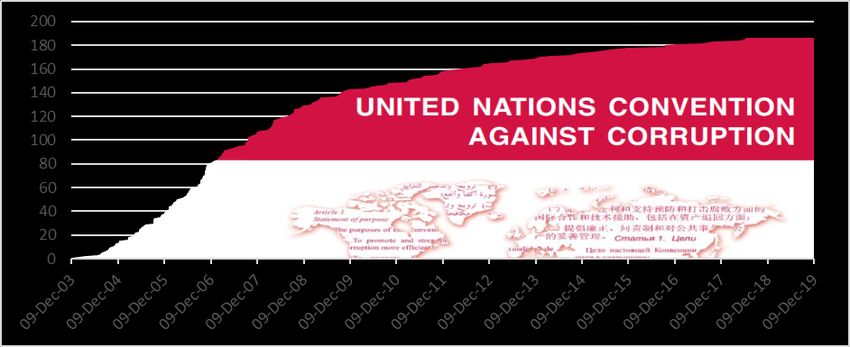
CRIMINALIZATION
France strengthened the independence of
the prosecution from the Ministry of Justice 17
and extended the time limit of ineligibility of
As part of the efforts to regularly update its anti- public officials from public office after During its first cycle review, India As part of the „Anti-Corruption
corruption legislation and its MLA and extradition committing corruption offences. criminalized the active bribery of
AND LAW
Package“ adopted after its first cycle
treaties, Cuba lowered the mens rea requirements foreign public officials. review, Armenia inter alia criminalized
for money-laundering. illicit enrichment, amended the
definition of public officials and The Philippines created a presidential
strengthened witness protection. UNCAC Inter-agency committee in 2014. Its
ENFORCEMENT
Liechtenstein, Portugal and
Armenia enacted laws on main function is to oversee the review and
trading of influence. implementation of the UNCAC. Inter-agency
consultation meetings have been organized
by the office of the president and attended
by representatives from the public and
The Convention requires countries to establish crimi- private sectors.
nal and other offences to cover a wide range of
acts of corruption in the public and private sectors
Colombia organized national
and to take measures to effectively enforce these inter-agency meetings to
offences. Besides the classic bribery offences, rela- share with national entities
the conclusions of IRM.
ted offences such as obstruction of justice or money
-laundering must be criminalized. Since the estab-
D o m i n i c a n R e pu b l i c p a s s e d a Madagascar To address a recommendation under the
lishment of the Review Mechanism, countries have
constitutional amendment to explicitly and Italy first cycle review, Indonesia introduced
shared measures taken to strengthen criminalization prohibit corruption for the first time, extended the protection measures and a reward
limitation system for whistleblowers whose reports
and enforcement, ranging from the initial establish- establishing penal procedures for the
periods to help law enforcement agencies uncover
prosecution of corruption offences.
ment of a criminal offence to the use of modern strengthen and prosecute corruption. Rewards are
enforcement taken directly from assets recovered by
technology to improve the efficiency of law en- of corruption
Afghanistan brought several law enforcement.
H ai t i i n t r o d u ce d n ew s p e ci al
forcement. offences. provisions of its Criminal Code
investigative techniques for money-
and Criminal Procedure Code in
laundering and corruption offences in
Mali crimina- line with UNCAC and passed
2013 and 2014.
llized illicit new AML, Proceeds of Crime
enrichment. and Extradition codes.
States parties that report recent legislative In addition to enhancing
sanctions for natural and legal To bring its Criminal Code and
amendments on persons, Chile introduced new Criminal Procedure Code in line
sanctions for corruption offences with UNCAC, in 2017, Niger In 2019, Seychelles strengthened the rights,
BRIBERY such as debarment from public
introduced legislative amend amend- powers, authority, privileges and immunity of
procurement. the Anti-Corruption Commissioner to prevent,
ments regarding consequences of
Vanuatu established a
WHISTLEBLOWER PROTECTION and sanctions for corruption, detect, investigate and prosecute corruption
National Anti-Corruption
including for legal persons. offences.
Committee which oversees
MONEY-LAUNDERING Following a recommendation, Brazil enacted a the implementation of the
recommendations and the
decree on the liability of legal persons and issued an Following recommendations under the first Following effective cooperation with law
In Myanmar, in connection with the follow-up to Vanuatu’s
ordinance setting the procedural rules for the
LIABILITY OF LEGAL PERSONS administrative adjudication process. A normative
cycle, Côte d’Ivoire put in place an action enforcement authorities in another State party, development of a new whistleblower review report.
plan to monitor corrective measures. As part an Israeli court convicted a corporation for protection law, a Complaint Handling
ruling was made that regulates the Registry for of this action plan, a Coordination foreign bribery for the first time since the Mechanism Workshop was organized
Ineligible and Suspended Companies and the Committee was established in 2016 for incorporation of the offence into Israeli law. with the cooperation of New Zealand.
National Registry of Punished Companies. actions related to the follow
follow-up.
“
ANTI-CORRUPTION 19
AND THE SDGs SPOTLIGHT ON: PROTECTION OF REPORTING PERSONS
Article 18 Thanks to the United
Nations Convention
”
against Corruption Under the first cycle, approximately 70% of States The catalytic role of UNCAC and UNODC’s work
nearly every country parties received recommendations to adopt or contributes to the continuously rising interest in the
Trading in
influence
Within SDG 16, Target 16.5 calls on States to substantially reduce in the world now has strengthen measures to protect whistleblowers and topic and the increased global recognition of the
corruption and bribery in all their forms. The inclusion of corruption in the half of these States also raised technical assistance need for effective whistleblower protection. Other
laws in place making
Agenda 2030 for Sustainable Development marks a milestone in the needs. The gaps and challenges that the review international fora started to refer to UNCAC and the
corruption a crime. mechanism highlighted led to UNODC publishing the findings of the review mechanism, including
fight against corruption as it symbolizes commitment by States not just
Yury Fedotov “Resource Guide on Good Practices in the Protection ECOSOC, which encourages governments at all levels
to criminalize, prevent or investigate this offence, but also to recognize
Executive Director of Reporting Persons” in 2015. The Guide aims to to adopt and enforce comprehensive legislation on
the cross-cutting nature of corruption across all SDGs and to measure its
UNODC highlight key principles and learning points on how to whistle-blower protection, building on the findings of
magnitude by producing data on the achievement of SDG 16.5. Over develop effective legal and institutional mechanisms the Implementation Review Mechanism (resolution E/
Article 20
Article 21
the course of ten years, the Review Mechanism has contributed to the Bribery in the private for assisting and protecting reporting persons and RES/2018/12 of 20 July 2018). The G20 High Level
Illicit Enrichment
depoliticization of the issue of corruption by reviewing all States parties sector provides illustrative examples. It also deepens the Principles for the Effective Protection of
using the same methodology and holding them to the same standards understanding of the differences between Whistleblowers, adopted under the co-chairmanship
set by the Convention, while not producing any ranking of a qualitative whistleblowers (article 33) and witnesses (article 32), of Japan and Mexico in June 2019, build on existing
or quantitative nature. In 2015, at its forty-sixth session, the United which was not always clear, as identified during standards and good practices from the United
Article 15
reviews. Nations, in particular article 33 of UNCAC. The various
Nations Statistical Commission created an Inter-agency and Expert
Foreign Bribery
In the last decade, States Responding to technical assistance requests and the national and regional new laws and initiatives,
Group on Sustainable Development Goal Indicators, composed of
have enhanced criminali- identification of enhanced whistleblower protection including the new EU Directive on the protection of
Member States and including regional and international agencies as
zation and strengthened has become a priority measure in different regions. persons who report breaches of Union law, adopted
observers. Six main areas were identified through which the UNODC has conducted multiple regional on 7 October 2019, further accelerate progress in the
enforcement through legis-
implementation of the SDGs would be reviewed. Among them, the lation, training and other workshops reaching participants from 65 States. protection of reporting persons and enrich peer
development of the area of Justice would be addressed by achieving capacity building initiatives. Subsequently UNODC provided assistance to 15 States learning at a global level.
the practical targets of SDG 16: “Promote peaceful and inclusive This graph illustrates the parties in various forms, ranging from awareness-
societies for sustainable development, provide access to justice for all Article 16 number of States that have raising workshops to comments on draft legislation or
and build effective, accountable and inclusive institutions at all levels”. reported different measures support for establishing whistleblowing procedures.
⅓
of States report
with respect to Whistleblowing protection has been identified as a
Measurement and monitoring of this pillar is paramount for the taking action to
criminalization and law priority area of work in all the regional platforms
achievement of the rest of the Agenda, for it recognizes that “there strengthen whistle-
enforcement. created to fast-track UNCAC implementation (see
can be no sustainable development without peace and no peace blower protection
page 32).
without sustainable development”.21
In Poland, the Central Anti-Corruption Bureau cooperates with 54 countries and 13 international
Austria strengthened its mechanisms of
INTERNATIONAL
organizations. A number of bilateral agreements on information exchange and cooperation in
In response to its first cycle review, to expand its treaty fighting and preventing corruption were also signed with foreign law enforcement agencies, control to overcome unnecessary delays in
network, Switzerland signed a bilateral agreement on including from Lithuania, Ukraine, Lebanon and Bulgaria. providing MLA.
MLA in criminal matters with Indonesia and MOUs with
COOPERATION
Qatar, Kenya, Nigeria and Tanzania. MOUs with four
more countries are currently being negotiated. To exchange best practices in the fight against
corruption and conclude MLA agreements, the
Fifth Interstate Council on Combating Corruption
took place in Belarus and was attended by
delegations of the Armenia, Belarus,
Combating corruption requires a coordinated transnational response. Kazakhstan, the Kyrgyz Republic, the Russian
Federation and Tajikistan.
Hence, one of the central goals of the Convention is to promote, facilitate
and support international cooperation in the fight against corruption.
Chapter IV of the Convention contains detailed provisions on the main
modalities of international cooperation in criminal matters, such as In the United States, there have been
To address recommendations under the first and prepare for the
more than 1,400 requests regarding
extradition, mutual legal assistance and the transfer of sentenced persons; To address recom
recom- second cycle, China enacted the International Criminal Judicial
extradition and MLA in corruption-
mendations under Assistance Law, regulating issues such as service of documents,
it also covers law enforcement cooperation, joint investigations and special related matters to and from the US
the first cycle, North investigation and evidence collection, witness testimony, seizure
since the adoption of the Convention,
investigative techniques. Macedonia intro- and confiscation of illegal assets, and the transfer of convicted
over 200 of which were based on
duced the LURIS persons.
UNCAC provisions and originated from
Besides formal cooperation, informal information exchange between system to strengthen
more than 80 countries. For example,
States parties has been reported as frequently leading to successes in the US is cooperating with several efforts in monitoring Myanmar partnered with the Commission of
States parties on the basis of the and in the statistical
concrete cases, including convictions or the return of assets. Many States reporting of extradi
extradi-
Thailand, the State Inspection and Anti-
UNCAC in relation to the 1MDB
parties allow their judiciary, police, financial intelligence unit or anti- tion and MLA cases. Corruption Authority of Lao PDR and the Anti-
investigation.
corruption agencies to informally communicate with foreign counterparts To comply with the Corruption and Civil Rights Commission of the
Panama has successfully
requirements of the Republic of Korea for cooperation against
to speed up and facilitate investigations. Through the Review Mechanism created joint investigative
Convention, Jordan, corruption.
and through the open-ended intergovernmental expert meetings to teams between three or more Kenya and Mauritius
enhance international cooperation, States parties share information on countries in corruption cases. have passed new or
Senegal and the amended existing
good practices and challenges encountered in international cooperation, In Grenada, a conference on effective ways to State of Palestine are extradition codes. Australia enacted the Extradition and MLA in
and find new counterparts to cooperate with in other States parties. promote bilateral and international anti- negotiating a bilateral Criminal Matters Legislation Amendment Act and
corruption cooperation was held between partnership on fighting
the Cybercrime Legislation Amendment Act.
Sudan has issued These laws will streamline the processes for
Article 44 on extradition and article 46 on mutual legal assistance, in part China, Grenada, Antigua and Barbuda, corruption.
rules on international providing assistance to foreign countries and
due to their length and complexity, received by far the highest number of Bahamas, Dominica, Guyana, Trininidad and cooperation proce- increase the range of law enforcement tools the
both recommendations and good practices for all first cycle reviews (92% Tobago, Jamaica, St. Lucia and other dures, as well as on authorities can use to assist in a foreign
Tuvalu has launched a website to
Caribbean States. In Nigeria, the Senate passed the MLA asset recovery. investigation or prosecution.
of States parties received recommendations on article 46, and 95% on provide information on its MLA
Brazil’s new Civil Procedure in Criminal Matters Act which extends requirements to guide requesting
article 44), so it is a particularly positive development that a third of all the scope of cooperation with all
Code contains a chapter countries.
States parties have reported changes in these areas implemented after dedicated to international States. The development of an MLA
cooperation. Manual will soon follow.
their first cycle review, a few of which are highlighted on this page.Further to far-reaching legislative In 2018, Bahamas
amendments in 2018 to close loop- adopted, inter alia, 23
In 2018, the Polish National Public Pro- holes in its asset recovery frame- a Proceeds of Crime Through the Seized and Forfeited
ASSET RECOVERY
secutor’s Office published a methodo- Act and a Finan-
work, in 2019 Tanzania has pre- Asset Management Project (BIDAL),
logy for securing assets, based on the
pared a bill to incorporate plea cial Transactions a technical consultancy project
work of a multi-agency task team. The
bargaining into its asset recovery Reporting Act. aimed at promoting good govern-
methodology focuses on practical
issues relating to asset profiling, especi- regime to assist in more effective ance and identifying best practices,
ally for the initial stages of criminal recovery. in cooperation with UNODC and
A novelty at the time, States parties agreed to before the Convention was adopted, under States have found and implemented ways and OAS, Brazil conducted a compre-
proceedings. It also covers, inter alia,
the recovery of assets and the return to their article 57, the return of assets is mandatory in solutions to address and overcome the burdens extended confiscation and how hensive analysis of the Brazilian
country of origin as a fundamental principle of cases of embezzled public funds, or upon proof posed by the usually lengthy and complicated To broaden the FIU‘s po- to secure cryptocurrencies. Trainings on financial framework for investigation and
wers and enable it to re- investigations for asset re- management of seized assets.
the Convention. Broadly, asset recovery is the of ownership or recognition of the damage technical, legal and political process of tracing, In July 2019, Madagascar
quest additional informati- covery were conducted in
subject of the reviews under both cycles, with the caused to a requesting state. The catchphrase freezing, confiscating and returning stolen assets adopted a new law on Cambodia, Marshall Islands,
on from reporting entities, With the support of the
first cycle looking at freezing, seizure and “crime must not pay” is valid in every country, but to their country of origin. Under the second cycle the recovery of illicit as- Federated States of Micro-
Liechtenstein revised its Netherlands, Montenegro
sets, which provides inter nesia, Papua New Guin- The State of Palestine has
confiscation under article 31 and the second asset recovery and return is especially important reviews, countries have showcased some FIU Act in 2016. launched an electronic Trinidad and Tobago
alia for setting up an illicit ea, Palau and Myanmar. trained its officials on the
case management system passed new legislation
cycle at cross-border asset recovery in chapter V. for countries where State resources have been progress through successful cases of asset return assets recovery agency. management of seized in 2019 providing for the
for MLA in 2015, which enab-
Whereas assets would flow into the treasury or depleted by corruption and are needed for between States parties on the basis of the les MOJ to accurately track the and confiscated assets establishment of civil
number of received MLA requests and on the use of the asset recovery and a
possibly be subject to asset sharing agreements development, stability and security. Since 2010, Convention.
and improve mechanisms for moni- management agency
UNCAC in recovering
toring and statistical reporting in To provide more robust for the recovery and man-
assets.
Actions reported by 147 States parties in follow-up to the first cycle reviews or in preparation for the second cycle, by region, type of action taken and substantive area the area of MLA, including in asset Nigeria has recovered vast powers to the FIU, anti- agement of criminal proper-
recovery cases. quantities of assets and ty and unexplained wealth.
corruption bureau and en-
TYPE OF ACTION TAKEN
The United Kingdom
returned assets to other forcement agencies, Brunei
has been employing a
States through using flexib- Darussalam has introduced
130
new database and case
ASIA-PACIFIC GROUP LEGISLATION management tool since 2014
le approaches that go the Criminal Asset Recovery
beyond the minimum re- In Portugal, the practice of
to streamline extradition and Act in 2012.
quirements of UNCAC. spontaneous sharing of infor-
MLA requests, including in
mation with a wide number
asset recovery cases.
of counterparts has led to
75
INSTITUTION-BUILDING the successful freezing of
“
AFRICAN GROUP assets in concrete cases.
SUBSTANTIVE AREA
PREVENTION
68
GRULAC UNCAC provides a consensus on what corruption is, the damage it causes to sustainable development and clarity on the mutual responsibilities
ASSET RECOVERY
55
for tackling it. The greater publicity that is given to examples of egregious corruption now sparks outrage among the citizenry in affected
countries and elsewhere, making it more difficult to tolerate any complicity of silence on the issue. UNCAC enables a far wider exchange of ex-
WEOG periences and solutions by lifting the corruption response to the global level and encompasses all the relevant aspects of the problem, unlike
DOMESTIC COOPERATION
40
regional and other more narrowly-focused conventions and scrutiny arrangements. The IRM has begun the journey to verify compliance. It is
learning lessons as it proceeds, and continues to be an evolving exercise in ensuring that State Parties live up to their commitments in practice.
INTERNATIONAL COOPERATION
39
EASTERN EUROPEAN GROUP Phil Mason, former Senior Anti-Corruption Adviser for the UK Department of International Development5 25
LIBRARY USERS BY COUNTRY Top 10 Countries
RESOURCES ASSORTED KNOWLEDGE
PRODUCTS—TOTAL
DOWNLOADS BY LANGUAGE
The Convention was downloaded
USA (3602)
India (1493)
154,090
The reviews produce large amounts of data on measures taken to further implementation of the Convention, and good prac- ENG FR AR ESP RUS
CH & UK (669)
tices, challenges and gaps on a broad range of topics. This data flows into the knowledge products, tools, manuals and publi- DOWNLOADS 2018 OTHER
Austria (501)
cations by UNODC, which focus particularly on those issues where needs have been identified through the reviews. All tools and
Nigeria (462)
publications are available free of charge in multiple languages on the UNODC website. The tools can be adapted to regional
State of implementation of the China (420)
and national needs upon request. 3528 United times in 2018
Nations Convention 1665 333 650 880
against Corruption (2nd Edition) Canada (347)
UNIVERSITY MODULES Brazil (337)
UNODC is developing multidisciplinary and interactive university
THE LEGAL LIBRARY France (325)
modules and teaching guides on anti-corruption, integrity and Resource Guide on Good Legal data collected through the first and second cycle Australia (306)
SPOTLIGHT ON THE ethics. These materials are flexible and adaptable to local, cul- 3678 Practices in the Protection 2569 666 443 reviews is continuously uploaded into UNODC’s legal libra-
DONORS
tural and disciplinary contexts, and designed to support lec- of Reporting Persons ry, which is available on the UNODC website. The library
turers in their teaching of these topics at universities around the
world. Each module is designed as a basis for a three-hours ses-
sion which can be integrated into an existing course. The majo- Resource Guide on Good
contains over 8,000 full text laws for over 180 jurisdictions,
indexed and searchable for each provision of the Conven- 2500
TOTAL NUMBER OF LIBRARY USERS
(September 2018 to August 2019) 17,249
WITHOUT WHOM THE REVIEW MECHANISM rity of the modules is available on the UNODC website, the 4189 tion, it is accessed by over 15,000 users per year.
Practices in the Investigation 3651 538 2000
COULD NOT HAVE HAD THIS IMPACT remainder will become available online shortly. of Match-Fixing 1500
1000
Australia, Austria, Brazil, Canada, China, Denmark the European
Commission, France, Germany, Italy, Japan, Liechtenstein, Mexico, RESOURCE GUIDE ON THE CNA DIRECTORY 500
5322
129
STRENGTHENING JUDICIAL Under the Convention, Sta-
Morocco, the Netherlands, Norway, Oman, Panama, Qatar, the Russian INTEGRITY AND CAPACITY
4146 342 523 311 States parties’ central
Federation, Saudi Arabia, Sweden, Switzerland, Turkey, the United Kingdom of tes are obliged to notify the authorities for MLA
Secretary-General of their Sep Oct Nov Dec Jan Feb Mar Apr May Jun Jul Aug
Great Britain and Northern Ireland, the United States of America and the United
Nations Development Programme. Guidebook on anti-corruption
in public procurement and 6156 4307 744 1105
designated preventive anti-
corruption bodies and cent-
ral authorities for mutual
117 States parties’
prevention authorities TOP 10 DOWNLOADS BY LANGUAGE
(September 2018 to August 2019)
In-kind contributions have also been provided by Angola, Argentina, Armenia, Australia, Aus-
81
the management of public legal assistance. The desig-
tria, the Bahamas, Bahrain, Belize, Benin, Botswana, Brazil, Bhutan, Burkina Faso, Cabo Verde, States parties’ asset FRENCH
finances nations are collected and
recovery focal points SPANISH (12,937)
Cameroon, China, Colombia, Côte d’Ivoire, the Dominican Republic, Ecuador, Egypt, Eswati- accessible in the Directory ENGLISH (67,600)
(35,751)
24
ni, Fiji, Gabon, Granada, Greece, Guyana, Haiti, Honduras, India, Indonesia, Israel, Italy, Kaz- of Competent National Au-
National Anti-Corruption Strategies - 2871 1717 324 2904 674 States parties’ central
akhstan, Kenya, Kiribati, Liechtenstein, Madagascar, Malaysia, Mauritania, Mexico, Morocco, thorities in the SHERLOC por-
8490 A Practical Guide for Development authorities for extradition
Mozambique, Myanmar, Nepal, Qatar, Oman, Papua New Guinea, Portugal, the Russian Fe- and Implementation tal on the UNODC website,
deration, Saudi Arabia, Senegal, Singapore, Solomon Islands, Tajikistan, Turkey, the United
32
together with the compe-
States parties’ focal points OTHER (6471) RUSSIAN (3016)
Arab Emirates, Uruguay, Uzbekistan, Vanuatu and Zimbabwe. tent authorities under other
An Anti-Corruption for international cooperation
conventions. As of Septem- ARABIC (1788) CHINESE (1051)
11544 1238 7018 1438 in civil and administrative
Ethics and Compliance Programme 21238 ber 2019, the CNA Directory proceedings
for Business: A Practical Guide contained:Will we ever win the battle against corruption? „We are paving the 27
way for future generations.“
PLATFORM APPROACH GENDER & CORRUPTION ANTI-CORRUPTION EDUCATION
CROSS-CUTTING To more effectively address common regional challenges and technical assistance
needs resulting from the outcomes of the Implementation Review Mechanism, and
While a growing amount of research exploring the dimensions of gender and
corruption shows that workplaces with a higher gender parity tend to be less
UNODC is leading the Anti-Corruption Academic Initiative (ACAD), a collaborative
project and central hub for anti-corruption education worldwide that seeks to
INITIATIVES
to leverage regional capacities and knowledge in identifying achievable and corrupt, the influence of social norms appears to be an equally decisive factor. encourage the teaching and research of anti-corruption issues by higher level
practical reform priorities, UNODC has created four Regional Platforms on three In September 2018, UNODC kick-started work on corruption and gender by education institutions. ACAD brings together professors globally and regionally,
continents: Southeast Asia, East Africa, South America and Mexico as well as organizing an Expert Meeting on Gender and Corruption in Bangkok. The fosters networking and offers over 1,200 free online resources. ACAD has also
Southern Africa, with additional platforms being envisaged as funding becomes meeting brought together representatives from civil society, national anti- developed a multidisciplinary university Model Course on the United Nations
The environment has changed since the adoption of the Convention available. These platforms aim to build and foster partnerships among the countries corruption authorities, international organizations and academia. The discussions Convention against Corruption in all official UN languages, which can be taught as
and the launch of the Review Mechanism: While before 2003, there was through thematic areas identified in each region as priority areas of work to fast- on criminal justice integrity, private sector, civil society engagement and public part of, or a complement to, a degree in law, business or social sciences. The
no global instrument against corruption, today there is political will, track UNCAC implementation. As there is no one-size-fits-all approach, the services led to a series of actionable recommendations and has laid the innovative and comprehensive educational initiative "Education for Justice" (E4J)
methodology applied is the same for all platforms, but thematic priorities and foundation for a study on the topic. The discussion also opened up avenues for supports schools, universities and other academic institutions in their efforts to
technical expertise, partnerships among a wide range of stakeholders,
activities vary and depend of the specificities identified by each region and each further exploratory work, e.g. on gender bias in the judiciary and the impact of teach students across the world about the rule of law, including anti-corruption,
including private sector, civil society, academia and youth, and global
country. However, commonalities were observed among the platforms regarding gender in procurement processes. UNODC intends to continue this work together integrity and ethics, by engaging with educators and young people in a
consensus that corruption underlies many of our problems across the
areas they consider regional priorities. For instance, whistleblower protection and with research institutes, other international organizations, and interested national consultative and participatory process while building on and investing in them as
globe, and needs to be addressed through a holistic, targeted and strengthening transparency in public procurement have been identified as counterparts in the States parties to the Convention. agents of positive change. E4J develops and offers teaching modules on anti-
collective response. States acknowledged that corruption can deplete thematic priority areas in all four platforms. corruption, integrity and ethics to complement the ACAD Model Course.
a State of its vital resources, that certain sectors are especially
vulnerable to corruption and need specific safeguards, that safe
havens for illicit assets facilitate the laundering of proceeds of crime, CORRUPTION IN SPORTS PRIVATE SECTOR & CORRUPTION PROTECTING WILDLIFE & FORESTS
and that corruption prevention must be an essential component when Significant risks of corruption and criminality have accompanied the evolution of Through various programmes, tools and publications, UNODC works towards Wildlife and forestry crime are highly lucrative illicit businesses that pose a significant
planning sports event as well as when designing environmental sports over the last decade, resulting in activities designed to exploit sport for illicit strengthening private sector integrity, including through guidance for companies, threat to global economic and social development, security and governance, and
and often illegal gain. In line with resolution 7/8 on Corruption in Sport, UNODC is especially SMEs, on the development of anti-corruption compliance programmes the environment. While it remains challenging to reliably quantify the full scope of the
protection strategies.
working to build capacity, raise awareness and provide technical assistance on and ethical codes of conduct. UNODC has teamed up with companies and problem, it has become clear that the billions of dollars generated are linked to
In follow-up to the reviews, States parties have requested assistance
corruption in sports. Key initiatives include the conference on Safeguarding Sport governments to strengthen legal frameworks and improve communication corruption and money-laundering. Organized criminal groups involved in wildlife and
from the secretariat in areas as diverse as trainings in financial forestry crime thrive on the existence of corruption as it enables them to commit,
from Corruption in September 2019 (co-sponsored the Russian Federation and Italy, between the public and private sectors by providing a common venue for further
investigations, drafting of new anti-monely laundering laws, the creation and co-organized by Brazil, the Russian Federation, India, China, South Africa and interaction, dialogue and knowledge sharing to reduce opportunities for conceal and avoid conviction for their crimes. To that end, criminals exploit
of anti-corruption bodies or the development of codes of conduct for UNODC), which served as the primary global platform for more than 270 corruption and facilitating a culture of integrity. “The fight against corruption” is weaknesses in organizational, regulatory and governance frameworks, or lack of
the judiciary. In addition, it has become apparent through the reviews participants from Member States, sports organizations and other stakeholders to an e-learning tool for the private sector produced in partnership with UN Global adequate capacity by wildlife and forest management and law enforcement
authorities. UNODC has developed considerable expertise in preventing and
that all States are fighting the same battle and that comprehensive discuss and share progress on the implementation of resolution 7/8, and where Compact. In six short video scenarios, users are faced with common corruption
combating the corruption that drives wildlife and forestry crime. The focus of our work
implementation of the Convention can have direct and indirect effects applicable other efforts to safeguard sport as they relate to the 2030 Agenda for risks and guided through UNCAC requirements in each situation. This interactive
lies in strengthening the capacity of wildlife management agencies to mitigate against
on many cross-cutting issues. States parties are more and more Sustainable Development. UNODC and the International Olympic Committee tool is free to use and available in over 20 languages, so companies around the
the risk of corruption that may prevent them from achieving their mandate to protect
motivated to explore these links and to look for solutions, through further (IOC) have developed and launched a handbook with the ultimate aim of world can apply it directly in their anti-corruption compliance programmes.
wildlife, and in strengthening States’ capacities to address financial and economic
assessing existing mechanisms, analyzing best practices and providing guidance in UNODC’s “Practical Guide for Business” provides practical advice for setting up
research or through exchange of good practices in the working groups, crime linked to wildlife crime. UNODC has also developed a guide on addressing
establishing and implementing mechanisms for reporting potential breaches of an anti-corruption ethics and compliance programme and has been used as a
expert group meetings and global conferences. Upon request of States corruption in the fisheries sector, entitled Rotten Fish, and the Integrity Guide for Wildlife
integrity in sport particularly manipulation of competitions. starting point for programmes and policies by companies around the world.
parties, the secretariat is assisting in these new projects and some of Management Authorities will be launched at the 8th COSP in Abu Dhabi.
these iniatives are highlighted on this page.You can also read


