Unikernels Made Easy Simon Kuenzer Senior Researcher, NEC Laboratories Europe GmbH - FOSDEM 2019
←
→
Page content transcription
If your browser does not render page correctly, please read the page content below
Unikernels Made Easy
Simon Kuenzer
Senior Researcher, NEC Laboratories Europe GmbH

FOSDEM’19

                                            This work has received funding from the European Union’s Horizon 2020
                                            research and innovation program under grant agreements no. 675806 (“5G
                                            CITY”) and 761592 (“5G ESSENCE”). This work reflects only the author’s
                                            views and the European Commission is not responsible for any use that
                                            may be made of the information it contains.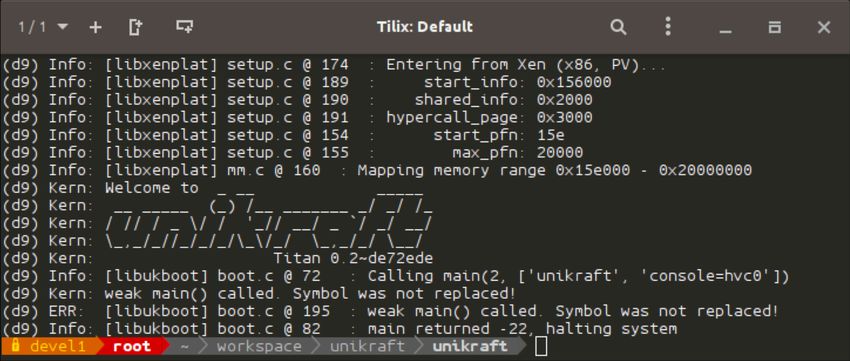
VMs vs. Containers

▌VMs have been around for a long time
    lThey allow consolidation, isolation, migration, …

▌Then containers came and many people LOVED them.
 Why?

      Containers are much easier to create
      and deploy. I just write thisContainers
                                    Dockerfile are much smaller. My VM
      and I’m done.                takes  10toGB,  myupcontainer only a few
             Containers are much     faster    bring    than
             VMs. Did
                    My you
                         VMhear
                              takeshundred
                                     minutes MB.to boot, my
                                  about Unikernels? VMs have
             container  only a  second.
                  they advantages, most importantly strong
                                    isolation.

3         © NEC Corporation 2019
Unikernels as VMs
             Traditional VMs                                Unikernels

           App A                     App B
           Libs A                    Libs B
                                                        App A               App B
           Kernel                    Kernel             Libs A              Libs B

                  Hypervisor                                 Hypervisor
                     Hardware                                    Hardware
▌Unikernels are purpose-built
    l Thin kernel layer, only what application needs
    l Single monolithic binary that contains OS and application
▌No isolation within Unikernel, done with hypervisor
    l One application à Flat and single address space
▌Further advantages from specialization

4           © NEC Corporation 2019
Unikernel Gains

               ▌Fast instantiation, destruction and migration time
                  l10s of milliseconds

               ▌Low memory footprint
                  lFew MB of RAM

               ▌High density
                  l10k guests on a single server node

               ▌High Performance
                  l10-40Gbit/s throughput with a single guest CPU

               ▌Reduced attack surface
                  lLess components exist in Unikernel
                  lStrong isolation by hypervisor

LightVM [Manco SOSP 2017], Elastic CDNs [Kuenzer VEE 2017], Superfluid Cloud [Manco HotCloud 2015] , ClickOS [Martins NSDI 2014]

5             © NEC Corporation 2019
In Numbers: Instantiation Times

                      Docker Boot                  MiniOS
                                                    Debian
                                                Process    Boot
                                                        Create                   MiniOS
                                                                                  Debian Create
                                                                                    Docker
                                                                                 Process   Boot
            105
                                                                                                            Debian:
                                                                                                            2.6-82 secs
            104

            103                                                                                             Mini-OS:
Time [ms]

                                                                                                            63ms-1.4secs

            102                                                                                             Docker:
                                                                                                            150ms-550ms

            101                                                                                             Process:
                                                                                                            0.7ms-10ms

            100
                  0               200               400                600                     800   1000
                                                Number of running guests
  Server: Intel Xeon E5-1630 v3 CPU@3.7GHz (4 cores), 128GB DDR4 RAM, Xen/Linux versions 4.8

       6               © NEC Corporation 2019
In Numbers: Performance

  ▌MiniCache Unikernel: Purpose-built static HTTP Webserver

                                                                                         Legend: MiniCache
                                                                                         (M) versus Debian
                                                                                         (D) and Tinyx (T).
                                                                                         L=lighttpd and
                                             600kreq/s                                   N=nginx.

                                                                                   32Gbit/s

Experiments were conducted on Intel Xeon E5 1630v3 3.7GHz, 32GB DDR4 RAM, Mellanox ConnectX-3 40Git/s
Ethernet, Xen 4.4.2, Debian Jessie with Linux 4.0.0 as Dom0 and booted from RAM
 7          © NEC Corporation 2019
Application Domains

                                                       Minimal SW Stack
Minimal SW Stack
                              Fast boot,               Serverless,
Reactive vNFs,                             Resource
                              migration                (Per-customer) vNFs,
Serverless,                                efficient
                               destroy                 IoT,
Lambda,
                                                       MEC,
etc.
                                                       etc.

                                                       Small code base
Specialization                                         à Low attack surface
                                                       à Cheaper
NFV,                            High       Mission       verification
MEC,                        performance    critical
etc.                                                   Automotive,
                                                       (Industrial) IoT,
                                                       etc.

 8       © NEC Corporation 2019
The Devil is in the Details

▌So, Unikernels:
    lGive similar speed and size of containers
    lBut add strong isolation with virtualization and
     increase security due to smaller code base

▌The problem is Unikernel development:
 Optimized Unikernels are manually built
    lBuilding takes several months or even longer
     •We’ve done it before, multiple times
    lPotentially repeat the process for each target application
     •We’ve done that too…

             That’s not an effective way of doing
             things!

9        © NEC Corporation 2019
Unikraft - A Unikernel Framework

Motivation
▌Support wide range of use cases
▌Simplify building and optimizing
▌Simplify porting of existing applications
▌Common and shared code base for Unikernel creators
▌Support different hypervisors and CPU architectures

▌Concept: “Everything is a library”
     lDecomposed OS functionality
▌Two components:
     lLibrary Pool
     lBuild Tool

10         © NEC Corporation 2019
Unikraft Overview
1) Library Pool

       1              Select/create
                      application                             MyApplication
configure libraries

                                     network stack            filesystems               schedulers                   standard libs
                                         liblwip.o                  libvfs.o                   libcoop.o                   musl.o
                                          libtcpip.o                 libfat.o                  libpreempt.o              libnewlibc.o
                                                                                                                          libopenssl.o
Select and

                                            libhttp.o                 libext3.o                    librt.o
                         main
                         libs
                                     drivers                  memory allocators         runtimes
                                                                                              libocaml.o
                                        libconsole.o
                                          libixgbe.o
                                                                   libbuddy.o
                                                                     libheap.o                 libpython.o             and more…
                                           libvirtio.o              libmempool.o                liberlang.o

     2

                         platform          libxenplat.o        libkvmplat.o                 liblinuxuplat.o             libxenplat.o
                         libs
     Build

                         architecture
                                            libx86_64arch.o                libarm32arch.o                       libmipsarch.o
                         libs
     3
     Run

                         Unikernels             myapp_xen_x86-64           myapp_kvm_x86-64                   myapp_bare_arm64           etc.
    4

       12                  © NEC Corporation 2019
Example System
▌Python Unikernel for KVM on x86_64
My Python App libmicropython.o
liblwip.o libvfscore.o
libschedcoop.o liballocbbuddy.o
libkvmplat.o libx86_64arch.o Unikernel
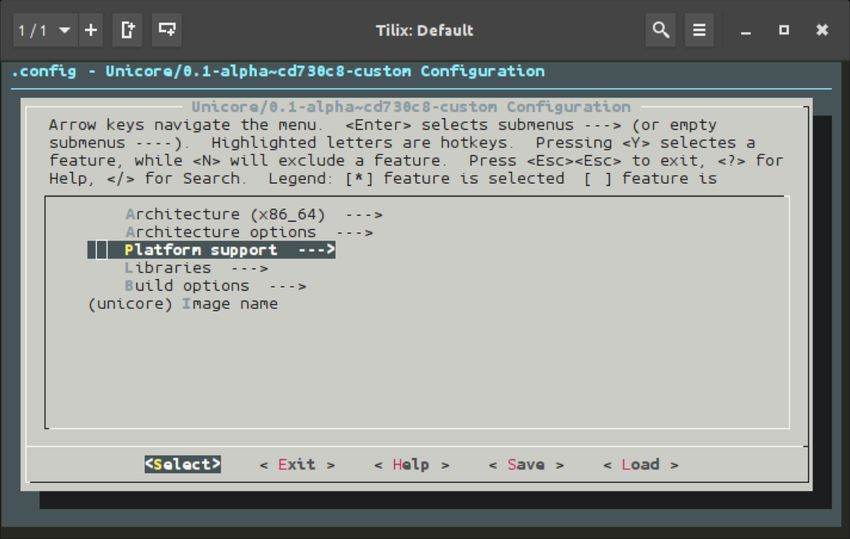
13 © NEC Corporation 20192) Build Tool ▌KConfig based and Makefile “Magic” ▌Type “make menuconfig” l Choose options in the menu that you want for your application l Choose your target platform(s), e.g., Xen, KVM, bare-metal, Linux ▌Save your config and type “make” 14 © NEC Corporation 2019
An Baseline Example…
▌Xen PV x86_64 binary
▌Compiles to a 32.7kB image
     unikraft_xen-x86_64.o (50,2kB)

                                    libnolibc.o

                                             libukboot.o
                                                             Final
                                            libukdebug.o   linking
                                                                     unikraft_xen-x86_64
                                                                           (32,7kB)
       libxenplat.o

▌Boots and prints messages to debug console (with min. 208kB RAM)

15         © NEC Corporation 2019
Unikraft 0.3 Iapetus Upcoming Release
Supported Features
▌Target support
 l Xen: x86_64, Arm32
 l KVM: x86_64, Arm64
 l Linux userspace: x86_64, Arm32
 l Bare-metal: x86_64 (with KVM target)
▌Core Functionality
 l Cooperative scheduler
 l Binary buddy heap
▌Networking
 l Low-level API for high-speed I/O
     • virtio-net
 l TCP/IP stack: Lightweight IP (lwIP)
▌Filesystems
 l VFS
▌Libc’s
 l nolibc (Unikraft internal)
 l Newlib

17           © NEC Corporation 2019
Roadmap
▌Concentrating effort on:
lCompleting Arm64 support
• (Virtual) Device drivers for Arm platforms
• Other platforms
lMore standard libraries
• musl, libuv, zlib, openssl, libunwind, libaxtls (TLS), etc.
lLanguage environments
• Javascript (v8), Python, Ruby, C++, etc.
lOCI container target support
lFilesystems
• In-RAM and (Virtual) Disk filesystems
lNetwork drivers
• Xen (netfront), Linux (tap)
lFrameworks:
• Node.js, PyTorch, Intel DPDK, etc.
18 © NEC Corporation 2019It is Open Source! We need you!
Join Us!

▌Unikraft is OpenSource since Dec 2017 and under the umbrella of

▌Community is growing!
     l Active contributors rose 91%, from 2 contributors to 23.
▌External contributors from
     lRomania: networking, scheduling; from University Politechnica Bucharest
     lIsrael: bare-metal support, VGA driver
     lChina: Arm64 support from Arm

     …but there is still a lot to do!
     Get in touch with us!
     Drop us a mail
         minios-devel@lists.xen.org
     Join our IRC channel
         #unikraft on Freenode
20          © NEC Corporation 2019
Example Demo Time
Unikraft Resources

▌Wiki
     lhttps://wiki.xenproject.org/ (Search for Unikraft)
▌Documentation
     lhttp://www.unikraft.org
▌Sources (GIT)
     lhttp://xenbits.xen.org/gitweb/ (Namespace: Unikraft)
▌Mailing list (shared with Mini-OS)
     lminios-devel@lists.xen.org
▌IRC Channel on Freenode
     l#unikraft
▌NEC-Team
     lhttp://sysml.neclab.eu

22         © NEC Corporation 2019
You can also read


