Upcoming Virtual Programs at the National Archives - National Archives
←
→
Page content transcription
If your browser does not render page correctly, please read the page content below
June 2018

       Upcoming Virtual Programs at the National Archives                                         April 2021

The National Archives is continuing to offer a full slate of public programs in April. An         Inside This Issue
extensive list can be found here. Below are several highlights on a variety of topics. All
programs are scheduled according to Eastern Standard Time.                                        APRIL VIRTUAL         1
                                                                                                  PROGRAMS
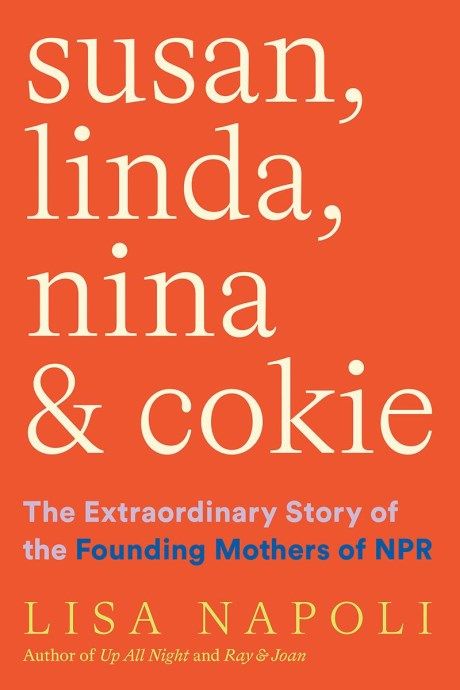
Susan, Linda, Nina & Cokie: The Extraordinary Story of the Founding Mothers of NPR                HIDDEN TREASURES     2-3
                         On Tuesday, April 13 at 6:00 p.m. EST, the National Archives will        FROM THE STACKS
                         host Lisa Napoli for a discussion of her book, Susan, Linda, Nina &
                         Cokie. In the years after the Civil Rights Act of 1964, women in the     COVID-19              4
                         workplace still found themselves relegated to secretarial positions      INFORMATION
                         or locked out of jobs entirely. This was especially true in the news
                                                                                                  EDUCATION             4
                         business. But when a pioneering nonprofit called National Public
                                                                                                  RESOURCES
                         Radio came along in the 1970s, four remarkable women blew off
                         the door to serious journalism. Joining Napoli in conversation are
                         NPR’s “Founding Mothers:” Susan Stamberg, Linda Wertheimer,
                         and Nina Totenberg. This free program is available via live
                         stream on the National Archives YouTube Channel.                         Upcoming Events
                                                                                                  Unless noted, all events
                                                                                                  are held at the
                                                                                                  National Archives
From a Whisper to a Rallying Cry: The Killing of Vincent Chin and the Trial that Galvanized the   400 W. Pershing Road
Asian American Movement                                                                           Kansas City, MO 64108
On Tuesday, April 20 at 2:00 p.m. EST, the National Archives will
host Paula Yoo for a discussion of her book, From a Whisper to a
Rallying Cry. In 1982, anti–Asian American sentiment simmered,                                     NOTE: All in-person
especially in Detroit, where U.S. autoworkers believed Japanese                                    public events at
car companies were costing them their jobs. A bar fight turned
fatal, leaving a Chinese American man, Vincent Chin, beaten to                                     National Archives
death at the hands of two white men. Yoo examines the killing and                                  facilities nationwide
the trial. When the killers received a $3,000 fine and probation,                                  are cancelled until
the community outrage led to a federal civil rights trial - the first                              further notice. This
involving a crime against an Asian American - and galvanized                                       includes in-person
what came to be known as the Asian American movement. This free                                    public programs,
program is available via live stream on the National Archives
                                                                                                   tours, school group
YouTube Channel.
                                                                                                   visits, public meetings,
                         The Ledger and the Chain: How Domestic Slave Traders Shaped               external conferences,
                         America                                                                   and facility rentals.
                         On Tuesday, April 27 at 1:00 p.m. EST, the National Archives will
                         host Joshua Rothman for a discussion of his book The Ledger and the
                         Chain. Slave traders are peripheral figures in most histories of
                         American slavery. But these men - who trafficked and sold over
                         half a million enslaved people from the Upper South to the Deep
                         South - were essential to slavery’s expansion and fueled the
                         growth and prosperity of the United States. Rothman recounts
                         the forgotten story of America’s internal slave trade—and its role
                         in the making of America. Moderating this program is Rachel
                         Swarns of the New York Times. This free program is available via
                         live stream on the National Archives YouTube Channel.
                                                                                                                     Page 1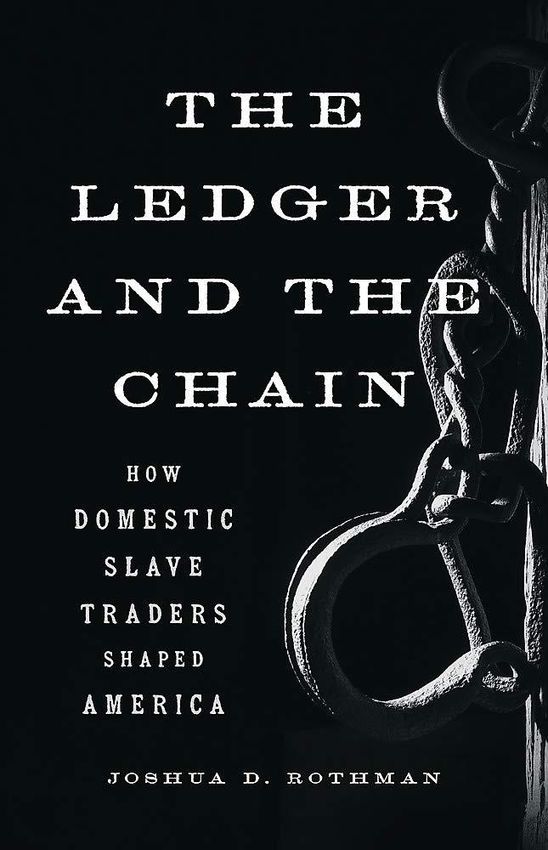
Hidden Treasures from the Stacks
                                Lavatory Luxuries and the Patenting Thereof
In the same way one can spend hours performing internet searches on various topics of history, pop culture, and
innovation, the same can be true for searches performed within the National Archives and Records Administration’s
Record Group 241, Records of the U.S. Patent and Trademark Office. These records run the gamut across consumerism,
manufacturing and improvement to include products such as artificial flowers, bird and rodent guards for building
ledges and porticoes, and even products of a more…personal nature, such as toilet paper. The Patent Case Files offer
a diverse look into nearly any topic imaginable; and there is no denying that the subject of toilet paper has spent more
time at the forefront of our minds this past year, than ever before, in its long history.
The Patent Case Files maintained by the National Archives at Kansas City span the years 1836 to 1978. A close look
at early patent case files relating to the restroom tissue date back to at least the 1880s when some of the earliest
toilet paper related patents were issued. Ranging in utility from the fixture which holds the roll itself, to the use and
                                                            style of the perforations on a traditional toilet paper roll, the
                                                            packaging, and everything in between. Put simply, inventors
                                                            have been contemplating the washroom necessity ever since.
                                                            In 1905, Daniel Underdown of Michigan patented new and
                                                            improved Toilet Paper Packaging. Identified as Patent number
                                                            832,054, the invention sought to make it more obvious to the
                                                            user that the end of the roll is approaching. His patent
                                                            indicated this would be accomplished via a solid black core
                                                            emblazoned with white letters stating “The End” as a means to
                                                            make it visible through the translucent tissue that the end of the
                                                            roll is rapidly approaching. Decades later, inventor Lawrence
                                                            Heinle of San Mateo, California, was also issued a toilet-
                                                            paper related patent. Heinle, who according to the 1940 U.S.
                                                            Federal Census, originally hailed from Ohio where he worked
                                                            as a manager at an engraving company. Heinle filed a patent
                                                            for a Toilet Paper Roll Core and in 1959 he was issued patent
                                                            number 2,889,121 after demonstrating that his new toilet
Above: Excerpt from the specification page of Patent        paper roll core reduced the quantity of material in a toilet
Case File number 832, 054 issued to Daniel W.               paper roll core, was a core which allowed for access through
Underdown on December 25, 1906. Record Group 241,
Records of the Patent and Trademark Office, 1836-
                                                            the core to the mount, and even provided a readily
1978, Utility Patent Case Files, 1836-1978. Patent Case     disintegrating core which would aid in the disposal of the core
File 832,054, National Archives at Kansas City (National    once the roll of toilet paper had been emptied.
Archives Identifier 302050).
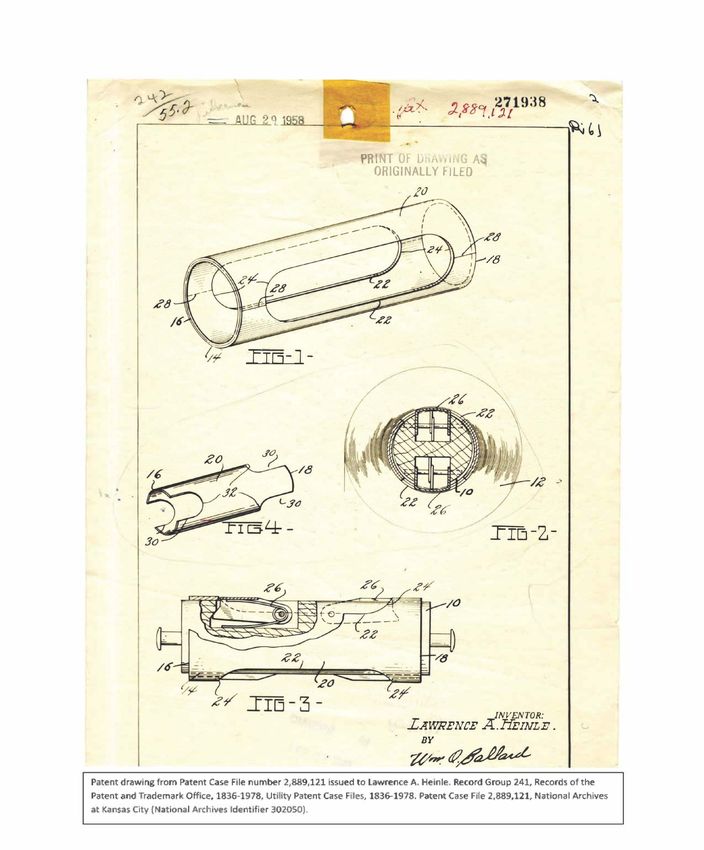
                                                        Visible in the drawing Heinle submitted with his patent
application are long, wide openings which would thus allow for access to the spindle of the toilet paper holder creating
ease by which the spent core can be removed from the holder. By nature, the openings in the core meant that less
material would be used in the creation and manufacture of the core, and certain score lines marked on the interior of
the core would allow for a more rapid disintegration should the core be tossed into the toilet, thus preventing clogging
or possible plumbing damage.
There is no doubt that the Patent Case Files allow for a rather thorough examination of the history of toilet paper, its
constructs, its dispensers and holders, and at the core, the very core itself. A plethora of inventors have spent valuable
time improving, creating and ultimately contemplating the role that toilet paper plays in our everyday life. There are
thousands of patent case files to support this claim, all submitted in the name of bringing improvements and innovation
to the ever valuable lavatory commodity.
If the improvements and innovations that have led to the formation and accessibility of toilet paper as we know it
today - or improvements in any manufactured modern convenience - intrigues you, consider searching Google Patents
(a patent-specific search engine) for a wide range of inventions that have been issued patent protection by the United
States Patent and Trademark Office. Additionally, research in other types of patent records currently held by the
National Archives at Kansas City and other National Archives locations can be accomplished by visiting the Catalog.
Such records include Patent Case Files, Design Patent Case Files, Plant Patent Case Files, Patent Interference Case Files
and other records of the U.S. Patent and Trademark Office.
                                                                                                                       Page 2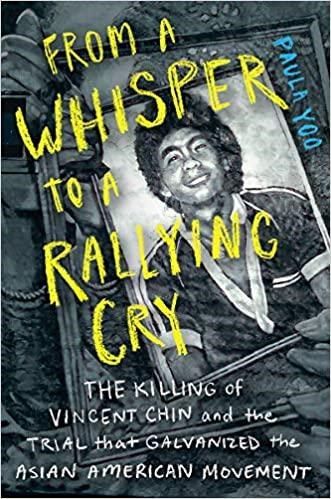
Above: Patent drawing from Patent Case File 2,889,121 issued to Lawrence A. Heinle. Record Group 241, Records of the Patent
and Trademark Office, 1836-1978, Utility Patent Case Files, 1836-1978. Patent Case File 2,889,121, National Archives at
Kansas City (National Archives Identifier 302050).
                                                                                                                      Page 3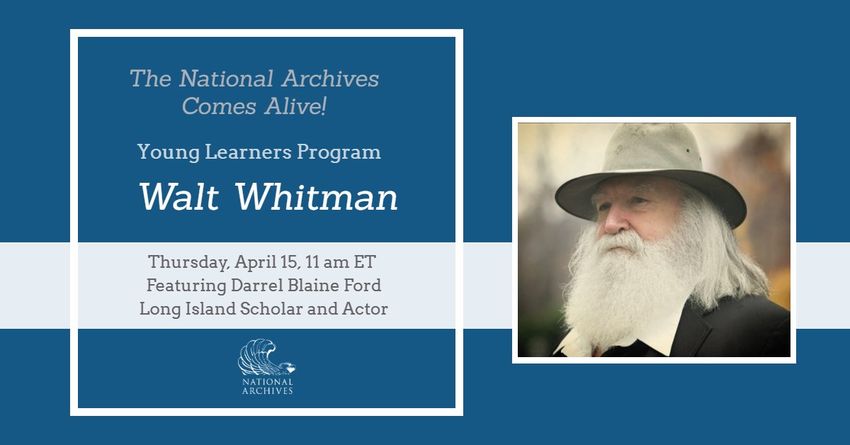
April Virtual Programs for Educators and Students
Young Learners Program - Meet Walt Whitman on Thursday, April 15 at 11:00 a.m. EST
Walt Whitman is best known as a poet
and for his unique style found in Leaves
of Grass. Overcome by the suffering he
saw during the Civil War, Whitman
lived in Washington, DC, to help in the
hospitals and then stayed for 10 more
years working as clerk for the federal
government. Whitman was deeply
affected by the assassination of
President Abraham Lincoln and wrote
several poems memorializing President
Lincoln, including “O Captain! My
Captain!” A question-and-answer
session with Walt Whitman, portrayed
by scholar and actor Darrel Blaine,
will follow the presentation. This free
program is available via live stream
on the National Archives YouTube Channel.

               National Archives Facility Information Regarding COVID-19
                                            (updated as of March 31, 2021)
The National Archives is committed to the health and safety of our visitors and staff. We are continuing to monitor the
situation regarding COVID-19. National Archives staff will continue to serve the public remotely by responding to
emailed requests for records and History Hub inquiries. Finally, all in-person public programs and events are
suspended until further notice. We will continue to update the public as agency guidance becomes available. Follow
the National Archives at Kansas City on Facebook or on Twittter @KCArchives.

                           GENERAL INFORMATION: The National Archives is open Monday through Friday 8:00 a.m.
                           to 4:00 p.m. Closed on weekends and Federal holidays. Hours are subject to change due to
                           special programs and weather.
                           The National Archives is located at 400 West Pershing Road, Kansas City, Missouri, 64108,
                           and is home to historical records dating from the 1820s to the 1990s created or received
                           by Federal agencies in Iowa, Kansas, Minnesota, Missouri, Nebraska, North Dakota, and
                           South Dakota.

                           For more information, call 816-268-8000, email kansascity.educate@nara.gov or visit
                           www.archives.gov/kansas-city. Tweet us @KCArchives. Follow us on Instagram at:
                           kansascity.archives. Find us on Facebook www.facebook.com/nationalarchiveskansascity.

                                                                                                                  Page 4
You can also read


