Xilinx Machine Learning Strategies with Deephi Acquisition - Presented By Yi Shan, Sr. Director, AI Engineering & Former CTO of DeePhi
←
→
Page content transcription
If your browser does not render page correctly, please read the page content below

Xilinx Machine Learning Strategies
                   with Deephi Acquisition
Presented By

Yi Shan, Sr. Director, AI Engineering & Former CTO of DeePhi

                                      © Copyright 2018 Xilinx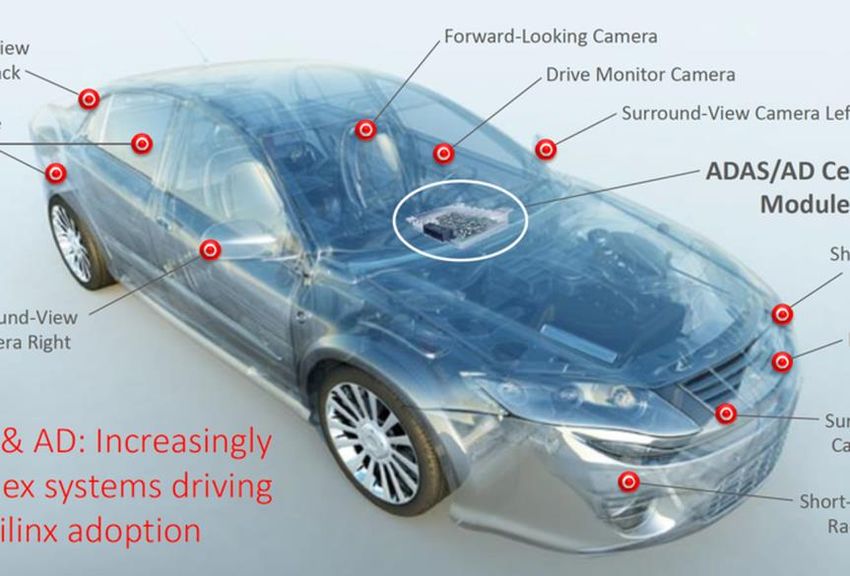
The Hottest Research: AI / Machine Learning

                  Nick’s ML Model
                  Nick’s ML Framework

                                                    copyright sources: Gospel Coalition

                          © Copyright 2018 Xilinx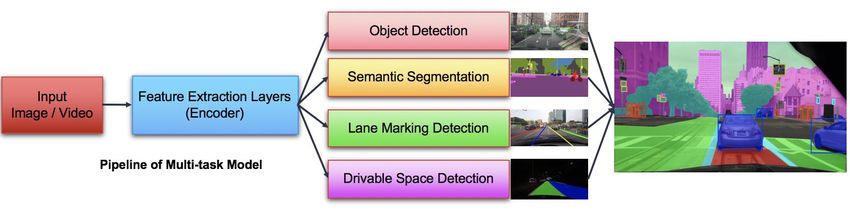
AI/ML Monetization Is Here and Growing

                       copyright
                       © Copyrightsources:
                                  2018 XilinxAvigilon, Amazon GO, Daimler, SK Telecom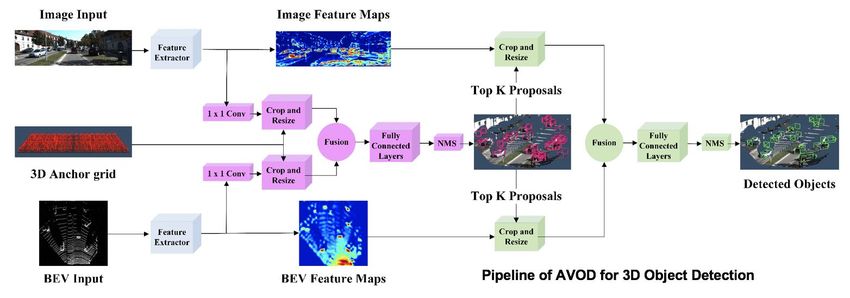
Challenges in Monetizing AI/ML

                                         43 TOPS                   ?

 1080p Object Detection (SSD) @ 30 FPS                                 < 10W, < 50 ms latency,
Who is Xilinx? Why Should I Care for ML?

               Only HW/SW configurable device             2      High performance / low power with
           1
               for fast changing networks                        custom internal memory hierarchy

3   Future proof to lower            4   Low latency end-to-end              5   Scalable device family for
    precisions                                                                   different applications
    >> 5
                                            © Copyright 2018 Xilinx
Integrated Xilinx-Deephi Roadmap
                                                            Xilinx AI Development

                                 Edge/Embedded                                                              Cloud/DC

         Models                                        20+ pruned / customized / basic models

                                                                       Deephi Pruning

                                   Deephi Quantizer                                                   Deephi Quantizer
Software Stack
                                   Deephi Compiler                                                     xfDNN Compiler
                                                                  SDSoC         SDAccel
                                   Deephi Runtime                                                      xfDNN Runtime

         FPGA IP                     Deephi DPU                         Deephi LSTM                          xDNN

    Platforms      Z7020 Board Z7020 SOM   ZU2/3 SOM         ZU2/3 Card

                                                                                  Xilinx U200, U250, U280
  >> 6
                     ZU9 Card         ZCU102          © CopyrightUltra96
                                                  ZCU104          2018 Xilinx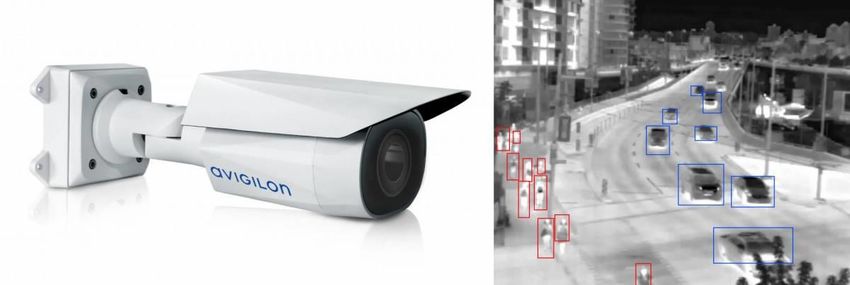
Deephi as key part of Embedded Vision Development

  Frameworks
  & Libraries

                      Machine Learning

  Development tools

                      USB3

  Platforms
                      HDMI

                      MIPI

                             © Copyright 2018 Xilinx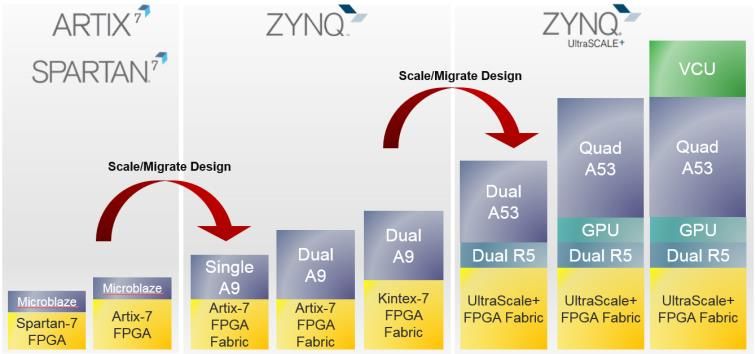
© Copyright 2018 Xilinx
Long History, Close Collaboration, and Better Future

                               Development of products on
 Collaboration with Xilinx                                                  Co-Marketing and Co-Sales
                                Xilinx FPGA platform since
   University Program                                                           with Xilinx Team
                                    inception of DeePhi

  Deep learning acceleration           Face recognition                            Data Center
     Time series analysis               Video analysis                             Automotive
        Stereo vision           Speech recognition acceleration                 Video surveillance
            ……                               ……                                       ……

                                                  © Copyright 2018 Xilinx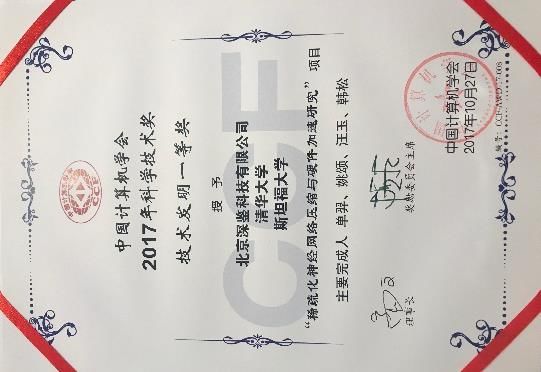
Now Part of Xilinx

    Provide DPU IP + software tools                                  Xilinx owns massive industry customers
  AI performance level up significantly                                  Provide wide range of applications

                                                                          Cloud      Intelligent   Embedded
   Telecom & Data center   Automotive                                   computing      driving      devices

        Industry IoT       Consumers                                        No. 2 semi-
                                                               Cooperation              Industry,
                                             FPGA No. 1                     conductor
                                                                 with IT
                                        Market and tech leader              vendor for consumer,
    Aerospace & Defense    Broadcast                             giants                    etc.
                                        Annual revenue of 2.5              global ADAS
                                          billion US dollars
           Xilinx’s main area                                           Typical application scenarios for AI

                                           © Copyright 2018 Xilinx
Pioneer in sparse-neural-network-based AI computing,
explorer from theory to commercialization
First Paper in the World on Compressed and Sparse Neural Networks
“Learning both Weights and Connections for Efficient Neural Networks”, NIPS 2015
“Deep Compression”, ICLR 2016 Best Paper
First Paper in the World on Sparse Neural Network Accelerator
NIPS 2015: Top conference in neural information processing “EIE: Efficient Inference Engine on Compressed Deep Neural Network”, ISCA 2016
FPGA 2016 & 2017: Top academic conference in FPGA
ICLR 2016 : Top academic conference in machine learning
ISCA 2016 : Top academic conference in computer architecture
Hot Chips 2016 : Top academic conference in semiconductor First Practical Case Using Sparse Neural Network Processor
First prize of tech innovation China Computer Federation Collaboration with Sogou Inc, partly revealed in:
“ESE: Efficient Speech Recognition Engine with Compressed LSTM on FPGA”,
Registering more than 100 invention patents
FPGA 2017 Best Paper
both in China and US
© Copyright 2018 XilinxLeading Solution for Deep Learning Acceleration
Applications Compilation
Algorithm
Surveillance Data center ADAS/AD Compiler Assembler
General Scheduling Framework Runtime
Software DNNDK Loader
Deep Learning Library Core API
Core
Communication
Core Acceleration Library Library
Driver Tracer
B1024/B1152
Deep Compression ► Suitable for ZYNQ7020
DPU \ZU2\ZU3\ZU5\ZU7\ZU9
Pruning Architecture B4096
LSTM
► Suitable for ZU5\ZU7\ZU9
\KU115\VU9P
FPGA Being verified: B512, B2304
Quantization
ZYNQ7020 ZYNQ7020 ZU2 ZU2 ZU9 (http://www.deephi.com/ddese.html)
Designed by DeePhi
Being designed: ZU2 AI box, ZU3,
© Copyright ZU5ev/ZU7ev, ZU15
2018 XilinxCore advantage | Deep compression algorithm
1/3 1/10 1/10 3X
Deep compression Highlight
Makes algorithm smaller and lighter Weight Bandwidth Model Perfor-
number load size mance
Compression Deep Compression Tool can achieve
efficiency significant compression on CNN and
RNN
Algorithm can be compressed 7 times
Accuracy without losing accuracy under SSD
object detection framework
Simple software development kit need
Easy to use only 50 lines of code to run ResNet-
50 network
© Copyright 2018 XilinxPruning Results
Baseline Pruning Result 1 Pruning Result 2
Classification Networks
Top-5 Top-5 ΔTop5 ratio Top-5 ΔTop5 ratio
Resnet50 [7.7G] 91.65% 91.23% -0.42% 40% 90.79% -0.86% 32%
Inception_v1 [3.2G] 89.60% 89.02% -0.58% 80% 88.58% -1.02% 72%
Inception_v2 [4.0G] 91.07% 90.37% -0.70% 60% 90.07% -1.00% 55%
SqueezeNet [778M] 83.19% 82.46% -0.73% 89% 81.57% -1.62% 75%
Baseline Pruning Result 1 Pruning Result 2
Detection Networks
mAP mAP ΔmAP mAP ΔmAP
ratio ratio
DetectNet [17.5G] 44.46 45.7 +1.24 63% 45.12 +0.66 50%
SSD+VGG [ 117G] 61.5 62.0 +0.5 16% 60.4 -1.1 10%
[A] SSD+VGG [ 173G] 57.1 58.7 +1.6 40% 56.6 -0.5 12%
[B] Yolov2 [ 198G] 80.4 81.9 +1.5 28% 79.2 -1.2 7%
Baseline Pruning Result 1 Pruning Result 2
Segmentation Networks
mIoU mIoU ΔmIoU ratio mIoU ΔmIoU ratio
FPN [163G] 65.69% 65.21% -0.48% 80% 64.07% -1.62% 60%
© Copyright 2018 XilinxPruning Speedup Example – SSD
Pruning Speedup on Hardware (2xDPU-4096@Zu9)
SSD+VGG 4 classes detection @Deephi surveillance data
200 150
180 100
103
160 50
71
Operations(G) / mAP
140
0
18
120
117 -50
FPS
100
-100
80
61.5 63.4 63.5 63.4 62.4 62 61.5 61.1 61 60.8 59.2 60.4 -150
60
57 -200
40
37 -250
20 27 23 19 17 15.6 14.6 13.6 12.2 11.6
0 -300
baseline 1 2 3 4 5 6 7 8 9 10 11
Pruning procedure
Operations(G) mAP(%) fps
© Copyright 2018 XilinxPruning Speedup Example – Yolo_v2
Pruning Speed up on Hardware (2xDPU@Zu9)
YoloV2 single class detection @ Customer's data
4x 60
46.4
43.6 50
200
2.8x 37.2
41.6
32.4 40
26.8 28.4
Operations(G) / mAP
21.2 30
173 18.4
150 14.4 20
11.6
FPS
10
122
100 0
57.9 86 58.3 58.7 58.1 57.9 57.8 56.9 -10
56.7 56.6 55.4 54.4
69
50 -20
52
45
34 -30
26.4 21.2 16.8 12.8
0 -40
Baseline 1 2 3 4 5 6 7 8 9 10
Pruning procedure
Operations(G) mAP(%) fps
© Copyright 2018 XilinxCompression perspective
˃ Low-bit and hybrid low-bit quantization
Some simple hybrid low-bit experiments [Compared to 8bit results, without finetune]
20% model size reduce, Better performance
For low-bit quantization, non-uniform quantization with lookup tables is possible
Some layers can run without quantization
˃ AutoML for quantization
Automated quantization for hybrid low-bit quantization
˃ AutoML for pruning
Pruning
Automated pruning by reinforcement learning
Tools
˃ Unified compression tool supporting different frameworks
˃ Fully tested tools, ease of use
˃ Improved speed for pruning tool, supporting cluster
© Copyright 2018 XilinxCore advantage | Instruction set and DPU architecture
DPU Aristotle CNN accelerator DPU/FPGA v.s. Sophon BM1680 (ASIC-Bitmain)
Very high hardware utilization Under the same computing power performance,DeePhi’s FPGA lead
Sophon significantly both in power consumption and hardware utilization
50 60%
52%
ResNet-50
GoogleNet-V3 23% 51% 50%
40 37.5
14%
40%
51% 30
ResNet-50 24% 30%
13%
20
20%
85%
VGG16 40%
10
10%
3
18% 5%
0 0%
0% 10% 20% 30% 40% 50% 60% 70% 80% 90% Aristotle on 7020 FPGA BM1680
Aristotle on 7020 FPGA Iphone8plus Kirin 970 Power consumption (W) Hardware utilization
Source: Published results from Huawei Source: https://sophon.ai/product/sc1.html
Note: *For ResNet-50, Sophon is 112GOPS with 2TOPS at peak, utilization is 5.5%. Aristotle is 117GOPS with 230GOPS at peak, utilization is 51%
© Copyright 2018 XilinxCurrent Ceiling of CNN Architecture
The Ceiling of INT8 Inference Energy Efficiency
Source:http://nics-efc.org/projects/neural-network-accelerator/
INT8 improvements are Solutions Sparsity
slowing down and
approaching the ceiling. Low Precision
© Copyright 2018 XilinxSparsity architecture exploration
for end-to-end
speech recognition
Partners Features
✓ On clouds, aiming at customers all Low storage Model compressed more than 10X
with negligible loss of accuracy
over the world
Low latency More than 2X speedup compared to GPU (P4)
✓ Already officially launched in AWS
Marketplace and HUAWEI cloud
Programmable Reconfigurable for different requirements
(http://www.deephi.com/ddese.html)
✓ Now transplanting to Alibaba cloud
© Copyright 2018 XilinxChallenges of Sparse NN Accelerator
The conflicts of the irregular pattern of
mem access and the regular pattern of
calculating
Difficult to take account of the sparsity of Cambricon-X, MICRO,2016 Cnvlutin, ISCA,2016
both activation and weights at the same
time.
Additional on-chip memory requirements
for indexes SCNN, ISCA,2017 EIE, FPGA,2017
Typical Work of Sparse NN Accelerators
© Copyright 2018 XilinxPotentials of low precision
Scales performance
Reduces hardware resources
Less bandwidth/on-chip memory
ISSCC,2017 ISSCC,2018
requirement
Low Precision Becomes Popular
Regular memory access pattern
and calculating pattern
FPGA benefits a lot from low-precision.
© Copyright 2018 XilinxArchitecture perspective: Mixed Low-Precision
Accelerator(1)
Relative Performance
12.0
Relative Improvement
10.0
8.0
INT8 INT5
INT6 6.0
Source:Weighted-Entropy-based Quantization, Eunhyeok, CVPR, 2017- INT4 INT2 4.0
INT3
2.0
Fixed low-precision quantization already 0.0
showed competitive results.
Next generation: Variable precision of
activation/weights among layers
*accuracy drop less than 1%
9 BW 2 3 4 5 6 7 8
wgt 0 3 4 6 0 0 3
8
act 0 0 0 2 5 10 5
7
Preliminary experiments on
6 BW 2 3 4 5 6 7 8
popular networks.
Bit width
5 wgt 0 0 3 22 17 10 2
4 act 0 0 0 16 41 13 3 (vgg-16,resNet-50,inception-
8bit X bit Y bit Z bit 8 bit
3 v4)
BW 2 3 4 5 6 7 8
2 wgt 0 0 0 15 84 38 13
1 act 0 0 0 0 6 84 99
0
1 2 3 4 5 6 7 8 9 10 11 12 13
Layer Num
© Copyright 2018 XilinxArchitecture perspective: Mixed Low-Precision CNN
Small-core
˃ Mixed Precision Support Small-core
Reconfig
Large-core
INT8/6/5/4/3/2 Small-core
Small-core No RTL
Change
Optimized for High Optimized for
˃ Flexible Between Throughput and Latency Throughput Low Latency
Switch between Throughput-Opt-Mode and
Latency-Opt-Mode without RTL change LOAD TIME
COMPUTING TIME
Layer-1 Layer-2 Layer-3 Layer-4
˃ Enhanced Dataflow Techniques Computing Bound
Memory Bound
Make the balance among different layers. Do
NOT require the model can be fully placed on Balance BandWidth
chip, but load the data at the right time. Requirements among layers
Physical-aware data flow design to meet higher
frequency. Less Latency
Supports high-resolution images at high
utilization. LOAD TIME
COMPUTING TIME
Layer-1 Layer-2 Layer-3 Layer-4
© Copyright 2018 XilinxSoftware perspective
˃ Continuous supporting customers for products and solutions Software team will provide full stack
Application
Improving surveillance products and providing more solutions for AI applications
ADAS/AD demonstration to customers
˃ System-level optimization for applications Applications
Accelerating time-consuming operations by FPGA and Surveillance ADAS/AD Data center
optimizing memory access
˃ Providing complete SDK for surveillance customers User-space libraries
Such as face and vehicle related SDK Application-specific AI library
SDK
˃ Constructing ADAS/AD libraries for internal developers and
customers Acceleration library
Such as vehicle detection, segmentation etc. Communication library DPU runtime
˃ Providing system for evaluation and product boards IO drivers OS DPU kernel module
Embedded
From ZU2 to ZU11
DPU architecture
˃ Developing more IO drivers
Such as USB 3.0, MIPI etc. FPGA
˃ Researching other system related with our products
© Copyright 2018 XilinxDNNDK perspective
Solid Toolchain Stack for XILINX ACAP
› Most efficiency solution for ML on XILINX next
generation computing platform
› Most easy-to-use & productive toolchain for ML
algorithms deployment
CPU DPU Math Engine
XILINX 7nm Everest Architecture
© Copyright 2018 XilinxSystem perspective: schedule ADAS tasks in single FPGA
˃ Multi-task Models
Training:
‒ Knowledge sharing
‒ Reduce computation cost
Pruning:
‒ Balance different objective
functions
˃ Sensor Fusion
Sensor alignment & Data Fusion
˃ Task scheduling
Resource constrained scheduling:
Serialization & Parallelization
Task scheduling and memory
management framework with low
context-switching cost
Support new operations with runtime
variable parameter by software and
hardware co-design
© Copyright 2018 XilinxSystem perspective: Video Surveillance in single FPGA
˃ Platform:ZU4EV
˃ DPU:B2304_EU ML+X HUB
˃ Peak perf.: 921Gops (400Mhz)
˃ Power: 7.7W (XPE)
Single Chip Solution Computer Ethernet
MIPI VCU Video
ISP NV12 Stream
Encoder
Sensor
Normalize RTSP
YUV2BGR Resize BGR Norm. data BBox
CNN (detect,
Memory recognition,
attributes)
PL
This solution needs to2018
© Copyright further
Xilinx enhance ISP functionalityAttend presentations and workshops for more details
DAY 1 DAY 2
Crystal Piedmont Regency 1 Sacramento
9am-10am 9am-10am
10am-11am Machine learning 10am-11am
for embedded
11am-12pm systems 11am-12pm
Building ML
12pm-1pm 12pm-1pm Machine learning with
vision systems
DeePhi
with SDSoC
Machine learning 1pm-2pm Ford ADAS
1pm-2pm
with DeePhi
Building ML
2pm-3pm Machine learning 2pm-3pm Machine learning for vision systems
Machine learning for embedded
for embedded with SDSoC
embedded
systems
3pm-4pm 3pm-4pm Machine Learning
Machine learning Machine Learning Machine learning
with SDSoC for EV
for embedded with SDSoC for EV for embedded
4pm-5pm systems 4pm-5pm systems
ML Expert panel
Presentation 5pm-6pm
Lab
Interactive (own laptop required) © Copyright 2018 Xilinx© Copyright 2018 Xilinx
Architecture perspective: Mixed Low-Precision CNN
˃ Mixed Precision Support                                                                    Small-core
                                                                                                             Reconfig
      INT8/6/5/4/3/2                                                                         Small-core
                                                                                                                                     Large-core
                                                                                             Small-core
˃ Flexible Between Throughput and Latency                                                    Small-core         No RTL
                                                                                                                Change
      Switch between Throughput-Opt-Mode and Latency-
      Opt-Mode without RTL change                                                       Optimized for High                          Optimized for
                                                                                        Throughput                                  Low Latency
˃ Enhanced Dataflow Techniques
      Make the balance among different layers. Do NOT                            LOAD TIME
      require the model can be fully placed on chip, but load               COMPUTING TIME
      the data at the right time.                                                                 Layer-1       Layer-2       Layer-3             Layer-4

      Physical-aware data flow design to meet higher                                          Computing Bound
                                                                                                                           Memory Bound
      frequency.
      Supports high-resolution images at high utilization.                               Balance BandWidth
˃ Performance Target (googlenet_v1)                                              Requirements among layers
      3103 FPS (INT8)
      5320 FPS (INT8/4/2 mixed)                                                                                           Less Latency
      12412 FPS (INT2 only)                                                      LOAD TIME

                                                                            COMPUTING TIME
˃ Release Plan                                                                                    Layer-1       Layer-2   Layer-3       Layer-4
      First version: 2019Q1
                                                  © Copyright 2018 Xilinx
You can also read


