Use of Vegetable Oils to Improve the Sun Protection Factor of Sunscreen Formulations - MDPI
←
→
Page content transcription
If your browser does not render page correctly, please read the page content below
cosmetics
Article
Use of Vegetable Oils to Improve the Sun Protection
Factor of Sunscreen Formulations
Lucia Montenegro *          and Ludovica Maria Santagati
 Department of Drug Sciences, University of Catania, Viale A. Doria 6, 95125 Catania, Italy;
 ludovica.santagati@icloud.com
 * Correspondence: lmontene@unict.it; Tel.: +39-095-7384010

 Received: 11 March 2019; Accepted: 1 April 2019; Published: 8 April 2019

 Abstract: Some vegetable oils have many biological properties, including UV-absorbing capacity.
 Therefore, their use has been suggested to reduce the content of organic UV-filters in sunscreen
 products. In this work, we investigated the feasibility of developing oil-based vehicles with a high sun
 protection factor (SPF) using pomegranate oil (PMG) and shea oil (BPO) in association with different
 percentages of organic UV-filters (octyl– methoxycinnamate, butyl methoxydibenzoylmethane, and
 bemotrizinol). We characterized the spreadability, occlusion factor, pH, and required hydrophilic
 lipophilic balance of the resulting formulations, and did not observe relevant differences due
 to the incorporation of vegetable oils. The in vitro spectrophotometric determinations of SPF
 values highlighted that the addition of BPO (1% (w/w)) and PMG (1% (w/w)) resulted in an
 increase in SPF in comparison with the same formulations that contained only organic UV-filters.
 The SPF increase was more significant for the formulations that contained lower amounts of organic
 UV-filters. The results of this study supported the hypothesis that including suitable vegetable oils in
 sunscreen formulations could be a promising strategy to design products with a lower content of
 organic UV-filters.

 Keywords: sunscreens; vegetable oils; sun protection factor; oil-based vehicles; occlusion;
 spreadability

1. Introduction
     The demand for cosmetic products based on natural ingredients is constantly growing,
thus prompting researchers to find new compounds that could fulfil the requirements of consumers.
Therefore, a significant amount of attention has been focused on vegetable oils, owing to their
many biological activities and attractive technological properties, such as easy skin absorption and
good spreadability [1–3]. Recently, selected herbal oils have been investigated to develop sunscreen
formulations with a reduced content of organic UV-filters while still maintaining a high sun protection
factor (SPF) [4–6]. Indeed, the safety of organic UV-filters has been widely debated because some
studies on the skin penetration and permeation of these molecules have reported that they are able
to permeate the skin at sufficient rates to be recovered from systemic circulation [7–9]. Therefore,
to address the safety issue of organic UV-filters, several researchers performed in vivo toxicity studies
from which the margin of safety (MoS) was calculated by comparing the potential human systemic
exposure with the no adverse effect level (NOAEL) [10,11]. These studies revealed that the MoS of the
investigated sunscreen agents was high enough to guarantee their safety after topical application in
humans. These conclusions were also supported by in vitro studies pointing out that the penetration
through human skin from the mineral oil of widely used sunscreen agents is so poor that it could not
lead to any toxic effects [12].

Cosmetics 2019, 6, 25; doi:10.3390/cosmetics6020025                             www.mdpi.com/journal/cosmetics
Cosmetics 2019, 6, 25 2 of 10
The use of vegetable oils with photoprotective activity in sunscreen formulations would allow
for decreasing the amounts of organic UV-filters, thus reducing the safety concerns and fulfilling the
consumer demand for more natural products. Many herbal oils have been reported to show significant
SPF values. Using an in vitro method, Kaur and Saraf [4] revealed that the SPF value for both olive oil
and coconut oil was around 8, while that of castor oil and almond oil was around 6 and 5, respectively,
thus highlighting the usefulness of these oils as UV-filters. Cosmetic O/W creams containing basil
essential oil (5% (w/w)) have been proposed as potential sunscreen formulations for cosmetic and
cosmeceutical uses [5]. Andréo-Filho et al. [6] investigated the photoprotective effect of solid lipid
nanoparticles loaded with an organic sunscreen agent (octyl methoxycinnamate) and urucum oil,
and concluded that the use of vegetable oils could allow sunscreen formulations to contain reduced
amounts of organic UV-filters while maintaining the same SPF.
Other vegetable oils and plant or fruit extracts have been reported to show antioxidant and
photoprotective effects [13–15]. Recently, pomegranate (Punica granatum) extracts have gained
significant attention because of their beneficial effects, including anti-inflammatory, anticancer, and
antimicrobial activity [16]. In addition, in vitro studies on cell cultures of normal human epidermal
keratinocytes highlighted the protective effects of pomegranate fruit extract against UV-A and UV-B
radiation [17,18]. The widespread cosmetic ingredient, shea butter (Butyrospermum parkii or Vitellaria
paradoxa), has also been credited as being responsible for several effects after topical application,
including photoprotective activity, but its real efficacy as a sunscreen agent has not yet been clearly
demonstrated [19,20].
Therefore, in this work, we investigated the feasibility of using pomegranate and shea oil as
natural UV-filters to improve the SPF value of sunscreen formulations.
As widely reported in the literature, vehicles can strongly affect the performance of cosmetic
products, including sunscreen formulations [8,9,21–26]. The effectiveness of sunscreens and their
compliance with consumer expectations requires that the product be easily spread onto skin,
leaving a thin, uniform, adhering, and water-resistant film on the cutaneous surface. Among
the different vehicles that could be used to prepare sunscreen formulations (O/W and W/O
emulsions, oily lotions, and hydroalcoholic and oil-based vehicles), oil-based vehicles are most suitable
for fulfilling the abovementioned requirements, owing to their ability to form a continuous and
long-lasting film on the skin, and to their emollient properties that prevent skin dehydration caused by
environmental exposure.
Hence, pomegranate and shea oil were incorporated into oil-based vehicles containing different
percentages of organic UV-filters, and the technological properties as well as in vitro SPF values of the
resulting cosmetic formulations were assessed.
2. Materials and Methods
2.1. Materials
Tocopheryl acetate (TA), argan oil, ethylhexyl stearate (EHS), C12–15 alkyl benzoate (Acemoll
TN), wheat germ oil (WGO), sorbitan monooleate (Span 80), and polyoxyethylene sorbitan monooleate
(Tween 80) were purchased from ACEF (Fiorenzuola d'Arda, PC, Italy). Span 85 was obtained
from Sigma-Aldrich (Milan, Italy). Pomegranate seed oil (PMG) was supplied by Aroma-Zone
(Cabrières-d’Avignon, France). Coconut alkanes (and) coco-caprylate/caprate (Vegelight 1214LC) was
obtained from Grant Industries (Elmwood Park, NJ, USA).
BASF (Ludwigshafen, Germany) provided propylheptyl caprylate (Cetiol Sensoft), coco-caprylate
(Cetiol C5), dicaprylyl ether (Cetiol OE), bis-ethylhexyloxyphenol methoxyphenyl triazine (Tinosorb S,
BEMT), ethylhexyl methoxycinnamate (Uvinul MC 80, OMC), and butyl methoxydibenzoylmethane
(Uvinul BMBM, BMBM). Butyrospermum parkii oil (BPO) was purchased from Esperis (Milan, Italy).Cosmetics 2019, 6, 25 3 of 10
2.2. Oil-Based Vehicle Preparation
The compositions (% (w/w)) of the oil-based sunscreen vehicles investigated in this study are
reported in Table 1. We chose organic UV-filter concentrations that would obtain vehicles with high
SPF values and simultaneously guarantee UVA protection according to the data obtained using the
BASF Sunscreen Simulator (www.basf.com/sunscreen-simulator). We adjusted the percentages of oil
ingredients in the formulations containing higher percentages of UV-filters to obtain vehicles with
similar technological properties. The oil-based vehicles were prepared by mixing all oily ingredients,
including liquid UV-filters, at room temperature. Then, the solid organic UV-filters (BEMT and BMBM)
were added and the mixture was stirred until a clear solution was obtained. The resulting formulations
were stored at room temperature, in airtight glass containers, and sheltered from the light. The pH
value of oil-based vehicles were determined 24 h after their preparation using a calibrated pH-meter
(Crison pH-meter, model Basic 20, Crison Instruments, Alella, Barcelona, Spain) at room temperature.
Table 1. Composition (% (w/w)) of sunscreen oil-based vehicles. EHS: ethylhexyl stearate;
TA: tocopheryl acetate; WGO: wheat germ oil; BPO: shea oil; PMG: pomegranate seed oil; BEMT:
bis-ethylhexyloxyphenol methoxyphenyl triazine; BMBM: butyl methoxydibenzoylmethane; OMC:
ethylhexyl methoxycinnamate.
% (w/w)
Ingredient Formulation Code
Ac1 A1 Ac2 A2 Bc1 B1 Bc2 B2 Cc1 C1 Cc2 C2
Acemoll TN 17 16 16 15 16 16 16 14 17 16 16 15
Cetiol C5 12 12 12 12 12 12 12 12 12 12 12 12
Cetiol Sensoft 10 10 10 10 10 10 10 10 10 10 10 10
Vegelight 20 19 19 18 20 18 18 18 18 17 18 17
Cetiol OE 14 14 14 14 14 14 14 14 14 14 13 13
EHS 6 6 6 6 6 6 6 6 6 6 6 6
TA 1 1 1 1 1 1 1 1 1 1 1 1
Argan oil 1 1 1 1 1 1 1 1 1 1 1 1
WGO 1 1 1 1 1 1 1 1 1 1 1 1
BPO - 1 - 1 - 1 - 1 - 1 - 1
PMG - 1 - 1 - 1 - 1 - 1 - 1
BEMT 5 5 5 5 6 6 6 6 7 7 7 7
BMBM 3 3 5 5 3 3 5 5 3 3 5 5
OMC 10 10 10 10 10 10 10 10 9 9 10 10
2.3. Determination of Required Hydrophilic Lipophlic Balance (rHLB)
To determine the rHLB values of the oil-based vehicles, we prepared a series of jars containing
non-ionic surfactant blends with HLB values ranging from 2 to 14 (Span 80 8%/Span 85 92% HLB
= 2; Span 80 88%/Span 85 12% HLB = 4; Span 80 83%/Tween 80 17% HLB 6; Span 80 65%/Tween
80 35% HLB 8; Span 80 46%/Tween 80 54% HLB10; Span 80 28%/Tween 80 72% HLB 12; Span 80
9%/Tween 80 91% HLB 14). Then, for the same oil-based vehicle, we prepared seven simple emulsions,
each with the same amount of oil-based vehicle (20% (w/w)), the same amount of surfactant blend
(5% (w/w)) but with a different HLB value, and the same amount of water (75% (w/w)). After mixing,
we evaluated which emulsion appeared to be the most stable. The HLB of the surfactant blend used in
the most stable emulsion was considered the rHLB value of that oil-based vehicle.
2.4. Spreadability
Sample spreadability was determined using the parallel plate method [27–29]. Two circular glass
plates (diameter 9 cm) were used. One gram of the sample was placed on the lower plate and covered
with the upper plate. Then, a 200 g weight was placed in the center of the upper plate, and after 1 min,
the spreading diameter reached by the sample was measured (in centimeters). The spreadability was
expressed as percentage (S%) according to the following equation:
S% = (A2/A1) × 100, (1)Cosmetics 2019, 6, 25 4 of 10
where A1 was the surface area of the glass plate and A2 was the surface area covered by the oily
formulation after 1 min.
2.5. Occlusive Properties
In vitro occlusion tests were performed according to a previously reported method [30,31].
Beakers (100 mL) were filled with 50 mL of water, covered with filter paper (cellulose acetate filter,
90 mm, cutoff size: 4–7 µm, VWR, Fontenay sous Bois, France), and sealed. Then, 200 mg of the sample
was uniformly spread onto the filter surface (18.8 cm2 ; applied amount 10.6 mg/cm2 ). The samples
were then weighed and stored at 32 ◦ C (50%–55% RH) for 48 hours. At the end of experiment, the
samples were weighed to determine the water loss due to evaporation. Beakers covered with filter
paper but without any applied sample were used as a reference. Each experiment was performed in
triplicate. The occlusion factor (F) was calculated according to Equation (2):
F = 100 × [(A − B)/A] (2)
where A is the water loss without the sample (reference) and B is the water loss with the sample.
2.6. In Silico and In Vitro Sun Protection Factor (SPF) Determination
The sun protection factor (SPF) is the ratio of the minimum ultraviolet dose that produces
erythema with and without sunscreen. According to Sayre et al. [32], this ratio can be conceptualized
as the ratio of areas between the erythemal weighted solar radiation intensity with and without
sunscreen. This basic concept has been applied to develop the BASF Sunscreen Simulator (www.basf.
com/sunscreen-simulator) that we used to calculate the SPF values of oily formulations containing
organic UV-filters.
In vitro SPF values of oily formulations containing vegetable oils and/or organic UV-filters were
calculated spectrophotometrically according to Equation (3):
320
SPFspectrophotometric = CF × ∑290 × EE(λ) × I(λ) × Abs(λ), (3)
where CF is the correction factor (= 10), EE(λ) is the erythemal effect of the radiation with wavelength λ,
I(λ) is the solar intensity of radiation with wavelength λ, and Abs(λ) is the absorbance of the sunscreen
product at wavelength λ.
Sayre et al. [32] determined the relationship between the erythemal effect EE(λ) and the radiation
intensity I(λ) at each wavelength. These authors reported that the values of EE(λ) × I(λ) were constant
at each wavelength (see Table 2). The absorption spectra of oily sunscreen formulations were obtained
using a spectrophotometer (Shimadzu mod. UV-1601, Milan, Italy). The samples of each formulation
were appropriately diluted with ethanol, and the same vehicle without organic and vegetable UV-filters
was used as the blank (after dilution with ethanol as well as the related sample) to avoid interference
due to the vehicle components. The absorption data were acquired every 5 nm in the range 290–320 nm,
and three determinations were made for each sample.
Table 2. Relationship between erythemal effect (EE) and radiation intensity (I) at each wavelength (λ).
λ EE × I
290 0.0150
295 0.0817
300 0.2874
305 0.3278
310 0.1864
315 0.0839
320 0.0180
Total 1Cosmetics 2019, 6, 25 5 of 10
3. Results and Discussion
Octyl methoxycinnamate (OMC) and butyl methoxydibenzoylmethane (BMBM) are among
the most common UV-filters found in cosmetic sunscreen products. Although BMBM is one of
the most commonly used UVA filters due to its strong absorption at 360 nm, this molecule shows
poor stability after exposure to UV radiation [33,34]. When BMBM is in the presence of OMC,
BMBM photodegradation products can react with OMC, thus reducing the photoprotective activity
of OMC [35]. Chatelain and Gabard [36] demonstrated that the addition of bis-ethylhexyloxyphenol
methoxyphenyl triazine (bemotrizinol, BEMT) to mixtures of BMBM and OMC was able to prevent
BMBM photodegradation, thus improving the efficacy of sunscreen formulations containing BMBM
and OMC. Therefore, in this work, we chose to use different percentages of BMBM and OMC in
combination with BEMT to prepare oil-based vehicles with high SPF values.
It is well known that consumer acceptance is a key factor in determining the success of a cosmetic
product [29,37]. As the sensory properties of the formulation strongly affect consumer opinion, the
determination of parameters influencing both the efficacy and aesthetic characteristic of the final
product plays a fundamental role in the design of a cosmetic formulation.
As far as sunscreen formulations are concerned, features such as spreadability, occlusion factor,
and polarity may significantly influence both the efficacy and consumer acceptance of the product.
Such parameters, as well as pH values, are reported in Table 3 for the oil-based vehicles Ac1, A1, Ac2,
A2, Bc1, B1, Bc2, and B2. We did not perform the evaluation of the previously mentioned features
on the formulations Cc1, C1, Cc2, and C2 because these formulations proved unstable, since a slight
precipitate was observed 48 h after their preparation.
Table 3. Technological parameters, pH, required hydrophilic lipophilic balance (rHLB), spreadability
(S%), and occlusion factor (F) of sunscreen oil-based vehicles.
Formulation pH rHLB S% F
Ac1 6.08 10 35.63 ± 2.45 26.55 ± 14.38
A1 6.90 10 40.91 ± 5.02 26.84 ± 13.45
Ac2 6.80 12 36.17 ± 2.84 21.94 ± 0.40
A2 6.27 12 34.16 ± 0.10 24.39 ± 3.59
Bc1 6.84 10 42.58 ± 2.66 34.94 ± 1.20
B1 6.86 10 26.96 ± 1.14 27.14 ± 2.43
Bc2 6.50 12 31.76 ± 2.93 28.82 ± 11.45
B2 6.10 12 39.17 ± 2.56 16.95 ± 4.00
As shown in Table 3, the spreadability values for the oil-based vehicles under investigation ranged
from 27% to 42.5%. The incorporation of vegetable oils (BPO and PMG) into the formulation Bc1
significantly decreased the spreadability value while changes lower than 10% were observed after
adding BPO and PMG to the other formulations. The range of pH values for all oily formulations
was 6.1–6.9, thus pointing out that these formulations had pH values compatible with that of the
skin surface.
The in vitro determination of the occlusion factor (F) provides an estimation of the ability of the
formulation to prevent water loss from the skin [30]. All of the oil-based vehicles under investigation
showed similar F values, apart from formulations Bc1 and B2, which had the highest and the lowest
values, respectively.
Oil polarity is a factor involved in consumer acceptance of cosmetic products as polar oils
often improve both skin feel and cosmetic aesthetics. As reported in the literature [38], the required
hydrophilic–lipophilic balance (rHLB) can be used to estimate the polarity of natural and synthetic
oils. By determining the rHLB values of the oily formulations under investigation, we observed that
the incorporation of vegetable oils did not affect such parameters. It is interesting to note that the
formulations with the lowest content of BMBM had lower rHLB values in comparison to those whoseCosmetics 2018, 5, x FOR PEER REVIEW 6 of 10
Cosmetics 2019, 6, 25 6 of 10
we selected the formulations Ac2, A2, Bc2, and B2 to carry out the in vitro and silico determination
of SPF.
BMBM content
Prior was higher.the
to determining Based on pH,
in vitro spreadability,
SPF rHLB,
values of oily and occlusion
sunscreen factor values,
formulations, we selected
we assessed the
UV-absorbing capacity of BPO and PMG in the range 290–320 nm. BPO and PMG showedSPF.
the formulations Ac2, A2, Bc2, and B2 to carry out the in vitro and silico determination of different
Prior to determining
UV-absorbing the
profiles in the in vitro
range SPF nm,
290–305 values of oily
while bothsunscreen formulations,
oils were not weUV
able to absorb assessed the
radiation
UV-absorbing capacity of BPO and PMG in the range 290–320 nm. BPO and PMG
with wavelengths higher than 305 nm (Table 4). Both oils had the highest absorbing ability at 290 showed different
UV-absorbing
nm, but PGM was profiles
aboutintwo-fold
the rangemore
290–305 nm, while
effective bothatoils
that BPO thiswere not able At
wavelength. to absorb
higher UV radiation
λ values, the
with wavelengths higher than 305 nm (Table 4). Both oils had the highest
UV-absorbing capacity of both BPO and PMG decreased with a different trend, as PGO absorbance absorbing ability at
290 nm, but PGM was about two-fold more effective that BPO at this
showed a 40% reduction from 295 to 300 nm, while PGO absorbance only decreased by 20%.λwavelength. At higher
values, theasUV-absorbing
Therefore, BPO and PGM capacity
showedofdifferent
both BPO and PMG
absorbing decreased
profiles, with aa 1:1
we used different trend,
mixture as PGO
of these oils
absorbance showed a 40% reduction from 295 to 300 nm, while PGO
to improve the SPF values of oil-based vehicles containing organic UV-filters. absorbance only decreased by
20%. Therefore, as BPO and PGM showed different absorbing profiles, we used a 1:1 mixture of these
oils toTable
improve the SPF values
4. Absorbance ofdifferent
values at oil-based vehicles containing
wavelengths organic
of shea oil (BPO) andUV-filters.
pomegranate oil (PMG).
Table 4. Absorbance values at different λ BPO of
wavelengths PMG
shea oil (BPO) and pomegranate oil (PMG).
290 1.486 3.198
λ 295 BPO
1.001 2.161 PMG
290 300 1.486
0.620 1.837 3.198
295 305 1.001
0.166 0.403 2.161
300 0.620 1.837
305
310 0.000
0.166
0.000 0.403
310 315 0.000
0.000 0.000 0.000
315 320 0.000
0.000 0.000 0.000
320 0.000 0.000
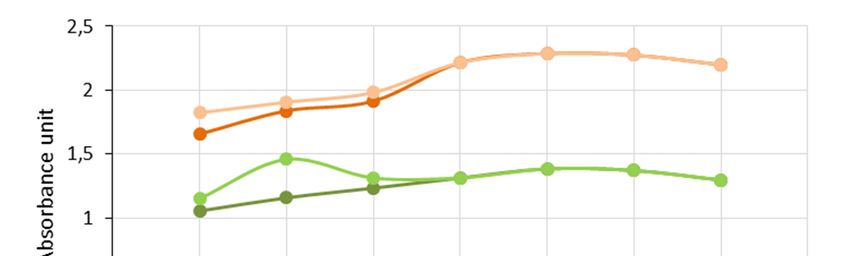
In Figure 1, we depicted the UV-absorbing profile of the oily formulations Ac2, A2, Bc2, and B2
in the In UV-B
Figure range (290–320thenm).
1, we depicted As expected,
UV-absorbing theof UV-absorbing
profile abilityAc2,
the oily formulations of A2,
the Bc2,
formulations
and B2 in
containing vegetable oils and organic UV-filters (A2 and B2) did not show any
the UV-B range (290–320 nm). As expected, the UV-absorbing ability of the formulations containing difference in
comparison
vegetable oils with
andthe formulations
organic UV-filterscontaining only
(A2 and B2) didorganic
not showfilters
any(Ac2 and Bc2)
difference at wavelengths
in comparison with
higher than 300 nm. In the range 290–305 nm, the UV-absorbing capacity of formulations
the formulations containing only organic filters (Ac2 and Bc2) at wavelengths higher than 300 nm. containing
BPO
In theand PMG
range was greater
290–305 nm, the than that of the
UV-absorbing corresponding
capacity vehicles
of formulations without vegetable
containing BPO and PMG oils. was
UV
absorbance
greater thandata
thatinofthe
therange 290–320 nm
corresponding were used
vehicles withoutto calculate
vegetableinoils.
vitroUV
SPF values as previously
absorbance data in the
reported by others [39,40].
range 290–320 nm were used to calculate in vitro SPF values as previously reported by others [39,40].
Figure 1. UV-absorbing profile of the oily formulations Ac2, A2, Bc2, and B2 in the range 290–320 nm.
Figure 1. UV-absorbing profile of the oily formulations Ac2, A2, Bc2, and B2 in the range 290–320
nm.
As shown in Table 5, the in vitro SPF value of the formulation Bc2 was higher than that of Ac2
due to its higher BEMT content.
As shown in Table 5, the in vitro SPF value of the formulation Bc2 was higher than that of Ac2
due to its higher BEMT content.The addition of BPO and PMG to the formulation Ac2 provided a significant improvement in
SPF value (10.3%), while only a very slight increase (1.3%) was observed when the same oils were
included in the formulation Bc2. The lower photoprotective effect of BPO and PMG in the
formulation containing a higher amount of organic UV-filters could be due to the interactions
occurring between the vegetable oils and the synthetic sunscreen agents. Such interactions have
Cosmetics 2019, 6, 25 7 of 10
already been reported for other vegetable oils in the literature [41].
Table5.5.InInvitro
Table vitrosun
sunprotection
protectionfactor
factor(SPF)
(SPF)values
valuesofofformulations
formulationscontaining
containingonly
onlyorganic
organicUV-filters
UV-filters
(Ac2 and Bc2) or organic UV-filters and vegetable oils (A2 and B2) and the percentage ofofSPF
(Ac2 and Bc2) or organic UV-filters and vegetable oils (A2 and B2) and the percentage SPF
enhancement(E%)
enhancement (E%)ofofthe
theformulation
formulation containing
containing organic
organic UV-filters
UV-filters andand vegetable
vegetable oilsoils in comparison
in comparison to
to the
the samesame formulation
formulation without
without vegetable
vegetable oils.oils.
Formulation SPF
Formulation SPF E% E%
Ac2
Ac2 12.91
12.91
--- —
A2 A2 14.39
14.39 10.3 10.3
Bc2 Bc2 21.08
21.08 --- —
B2 B2 21.35
21.35 1.3 1.3
SPFaddition
The values calculated
of BPO and using
PMG thetoBASF Sunscreen Simulator
the formulation Ac2 provided for the oil-based vehicles
a significant Ac1, Ac2,
improvement in
Bc1, and Bc2 are reported in Figure 2. As only organic UV-filters were included
SPF value (10.3%), while only a very slight increase (1.3%) was observed when the same oils were in this SPF simulator,
we couldinnot
included thedetermine
formulation theBc2.
SPFThevalues
lowerof photoprotective
the oil formulationseffectcontaining
of BPO and vegetable
PMG in oils using this in
the formulation
containing a higher amount of organic UV-filters could be due to the interactions occurringincrease
silico method. All oil-based vehicles showed high SPF values ranging from 34 to 39. The betweenin
BMBM
the percentage
vegetable oils andinthe thesynthetic
vehicle sunscreen
(formulation Ac1Such
agents. vs. Ac2 and Bc1have
interactions vs. Bc2)
alreadydidbeen
not reported
significantly
for
affect the resulting SPF value, while
other vegetable oils in the literature [41]. a higher percentage of BEMT (formulation Ac1 vs. Bc1 and Ac2
vs. Bc2) provided
SPF values about ausing
calculated 10% theimprovement
BASF Sunscreenin SPF. It is interesting
Simulator to note vehicles
for the oil-based that for Ac1,
the same
Ac2,
formulation,
Bc1, and Bc2 are thereported
SPF value determined
in Figure 2. As spectrophotometrically
only organic UV-filters were and in vitro was
included significantly
in this lower
SPF simulator,
than
we thatnot
could obtained
determine in silico
the SPFusing the of
values BASF Sunscreen
the oil Simulator.
formulations The discrepancy
containing vegetable oils between thein
using this in
vitro and in vivo predicted SPF values has been already pointed out by other
silico method. All oil-based vehicles showed high SPF values ranging from 34 to 39. The increase in authors who reported
that interactions
BMBM percentageamong sunscreen
in the vehicle agents and
(formulation Ac1 vehicle
vs. Ac2components
and Bc1 vs.might interfere
Bc2) did with the inaffect
not significantly vitro
SPF spectrophotometric determination [42]. Therefore, the addition of
the resulting SPF value, while a higher percentage of BEMT (formulation Ac1 vs. Bc1 and Ac2 vs. Bc2)vegetable oils to the oil
formulations
provided aboutcontaining organic UV-filters
a 10% improvement in SPF. Itcould providetoanote
is interesting higherthatincrease in in formulation,
for the same vivo SPF values the
than was determined in vitro.
SPF value determined spectrophotometrically and in vitro was significantly lower than that obtained in
In conclusion,
silico using the BASFthe results of
Sunscreen our studyThe
Simulator. highlight that the
discrepancy incorporation
between of pomegranate
the in vitro and shea
and in vivo predicted
oil into
SPF oil-based
values has been vehicles
already containing
pointed out different
by otherpercentages
authors whoof organic
reported UV-filters could be aamong
that interactions useful
strategy to improve SPF values. However, the ability of such vegetable
sunscreen agents and vehicle components might interfere with the in vitro SPF spectrophotometric oils to act as natural
sunscreen agents
determination [42].should
Therefore,be further investigated
the addition to assess
of vegetable oils their
to theactual potential incontaining
oil formulations different cosmetic
organic
vehicles, such
UV-filters couldasprovide
O/W emulsions.
a higher increase in in vivo SPF values than was determined in vitro.
Figure 2. Sun protection factor (SPF) values of formulations Ac1, Ac2, Bc1, and Bc2 calculated using
the BASF Sunscreen Simulator.
In conclusion, the results of our study highlight that the incorporation of pomegranate and shea
oil into oil-based vehicles containing different percentages of organic UV-filters could be a useful
strategy to improve SPF values. However, the ability of such vegetable oils to act as natural sunscreenCosmetics 2019, 6, 25 8 of 10
agents should be further investigated to assess their actual potential in different cosmetic vehicles,
such as O/W emulsions.
In addition, Korkina et al. [41], reviewing the sun protection activity of secondary plant
metabolites, suggested that the encapsulation of such plant derivatives into solid lipid nanoparticles
(SLN) and nanostructured lipid carriers (NLC) could be a promising strategy to formulate sunscreen
products with a lower organic UV-filter content. Several works have reported the successful loading
of vegetable oils into SLN and NLC to improve the physicochemical and biological properties of
these natural ingredients [43–46]. Therefore, further studies have been planned to assess the effect of
co-loading pomegranate oil, shea oil, and organic UV-filters into lipid nanoparticles and the SPF of the
resulting formulations.
Author Contributions: Conceptualization, L.M.; methodology, L.M.; validation, L.M., and L.M.S.; formal analysis,
L.M.; investigation, L.M.S.; resources, L.M.; data curation, L.M.; writing—original draft preparation, L.M., and
L.M.S.; writing—review and editing, L.M.; visualization, L.M.S.; supervision, L.M.; project administration, L.M.
Funding: This research received no external funding.
Conflicts of Interest: The authors declare no conflict of interest.
References
1. Lin, T.K.; Zhong, L.; Santiago, J.L. Anti-inflammatory and skin barrier repair effects of topical application of
some plant oils. Int. J. Mol. Sci. 2018, 19, 70. [CrossRef]
2. Burnett, C.L.; Fiume, M.M.; Bergfeld, W.F.; Belsito, D.V.; Hill, R.A.; Klaassen, C.D.; Liebler, D.; Marks, J.G., Jr.;
Shank, R.C.; Slaga, T.J.; et al. Safety Assessment of Plant-Derived Fatty Acid Oils. Int. J. Toxicol. 2017, 36,
51S–129S. [CrossRef] [PubMed]
3. Chanchal, D.; Swarnlata, S. Novel approaches in herbal cosmetics. J. Cosmet. Dermatol. 2008, 7, 89–95.
[CrossRef] [PubMed]
4. Kaur, C.D.; Saraf, S. In vitro sun protection factor determination of herbal oils used in cosmetics. Pharmacogn.
Res. 2010, 2, 22–25. [CrossRef]
5. Kale, S.; Sonawane, A.; Ansari, A.; Ghoge, P.; Waje, A. Formulation and in-vitro determination of sun
protection factor of Ocimum basilicum, linn. leaf oils sunscreen cream. Int. J. Pharm. Pharm. Sci. 2010, 2,
147–149.
6. Andréo-Filho, N.; Bim, A.V.K.; Kaneko, T.M.; Kitice, N.A.; Haridass, I.N.; Abd, E.; Santos Lopes, P.;
Thakur, S.S.; Parekh, H.S.; Roberts, M.S.; et al. Development and evaluation of lipid nanoparticles containing
natural botanical oil for sun protection: Characterization and in vitro and in vivo human skin permeation
and toxicity. Skin Pharmacol. Physiol. 2018, 31, 1–9. [CrossRef]
7. Varvaresou, A. Percutaneous absorption of organic sunscreens. J. Cosmet. Dermatol. 2006, 5, 53–57. [CrossRef]
[PubMed]
8. Montenegro, L.; Puglisi, G. Evaluation of sunscreen safety by in vitro skin permeation studies: Effects of
vehicle composition. Die Pharmazie 2013, 68, 34–40. [CrossRef]
9. Montenegro, L.; Turnaturi, R.; Parenti, C.; Pasquinucci, L. In Vitro Evaluation of Sunscreen Safety: Effects of
the Vehicle and Repeated Applications on Skin Permeation from Topical Formulations. Pharmaceutics 2018,
10, 27. [CrossRef]
10. Nash, J.F. Human safety and efficacy of ultraviolet filters and sunscreen products. Dermatol. Clin. 2006, 24,
35–51. [CrossRef]
11. Nohynek, G.J.; Schaefer, H. Benefit and risk of organic ultraviolet filters. Regul. Toxicol. Pharmacol. 2001, 33,
285–299. [CrossRef]
12. Hayden, C.G.J.; Cross, S.E.; Anderson, C.; Saunders, N.A.; Roberts, M.S. Sunscreen penetration of human
skin and related keratinocyte toxicity after topical application. Skin Pharmacol. Physiol. 2005, 18, 170–174.
[CrossRef]
13. Montenegro, L. Nanocarriers for skin delivery of cosmetic antioxidants. J. Pharm. Pharmacogn. Res. 2014, 2,
73–92.
14. Korać, R.R.; Khambholja, K.M. Potential of herbs in skin protection from ultraviolet radiation. Pharm. Rev.
2011, 5, 164–173. [CrossRef]Cosmetics 2019, 6, 25 9 of 10
15. Montenegro, L. Lipid-based nanoparticles as carriers for dermal delivery of antioxidants. Curr. Drug Metab.
2017, 18, 469–480. [CrossRef]
16. Bassiri-Jahromi, S. Punica granatum (Pomegranate) activity in health promotion and cancer prevention.
Oncol. Rev. 2018, 12, 345. [CrossRef]
17. Afaq, F.; Malik, A.; Syed, D.; Maes, D.; Matsui, M.S.; Mukhtar, H. Pomegranate fruit extract modulates
UV-B-mediated phosphorylation of mitogen-activated protein kinases and activation of nuclear factor kappa
B in normal human epidermal keratinocytes paragraph sign. Photochem. Photobiol. 2005, 81, 38–45. [CrossRef]
18. Syed, D.N.; Malik, A.; Hadi, N.; Sarfaraz, S.; Afaq, F.; Mukhtar, H. Photochemopreventive effect of
pomegranate fruit extract on UVA-mediated activation of cellular pathways in normal human epidermal
keratinocytes. Photochem. Photobiol. 2006, 82, 398–405. [CrossRef]
19. Alander, J. Shea Butter—A multi-functional ingredient for food and cosmetics. Lipid Technol. 2004, 16,
202–205.
20. Israel, M.O. Effects of topical and dietary use of shea butter on animals. Am. J. Life Sci. 2014, 2, 303–307.
[CrossRef]
21. Otto, A.; du Plessis, J.; Wiechers, J.W. Formulation effects of topical emulsions on transdermal and dermal
delivery. Int. J. Cosmet. Sci. 2009, 31, 1–19. [CrossRef]
22. Montenegro, L.; Paolino, D.; Puglisi, G. Effects of silicone emulsifiers on in vitro skin permeation of
sunscreens from cosmetic emulsions. J. Cosmet. Sci. 2004, 55, 509–518.
23. Chatelain, E.; Gabard, B.; Surber, C. Skin penetration and sun protection factor of five UV filters: Effect of the
vehicle. Skin Pharmacol. Physiol. 2003, 16, 28–35. [CrossRef]
24. Kurul, E.; Hekimoğlu, S. Skin permeation of two different benzophenone derivatives from various vehicles.
Int. J. Cosmet. Sci. 2001, 23, 211–218. [CrossRef]
25. Hilton, J.; Woollen, B.H.; Scott, R.C.; Auton, T.R.; Trebilcock, K.L.; Wilks, M.F. Vehicle effects on in vitro
percutaneous absorption through rat and human skin. Pharm. Res. 1994, 11, 1396–1400. [CrossRef]
26. Montenegro, L.; Carbone, C.; Paolino, D.; Drago, R.; Stancampiano, A.H.; Puglisi, G. In vitro skin permeation
of sunscreen agents from O/W emulsions. Int. J. Cosmet. Sci. 2008, 30, 57–65. [CrossRef]
27. Chaudhary, B.; Verma, S. Preparation and evaluation of novel in situ gels containing acyclovir for the
treatment of oral herpes simplex virus infections. Sci. World J. 2014, 2014, 280928. [CrossRef]
28. Garg, A.; Aggarwal, D.; Garg, S.; Singla, A.K. Spreading of semisolid formulations: An update. Pharm. Technol.
2002, 26, 84–105.
29. Montenegro, L.; Rapisarda, L.; Ministeri, C.; Puglisi, G. Effects of lipids and emulsifiers on the
physicochemical and sensory properties of cosmetic emulsions containing Vitamin E. Cosmetics 2015, 2,
35–47. [CrossRef]
30. Wissing, S.; Lippacher, A.; Müller, R. Investigations on the occlusive properties of solid lipid nanoparticles
(SLN). J. Cosmet. Sci. 2001, 52, 313–324.
31. Montenegro, L.; Parenti, C.; Turnaturi, R.; Pasquinucci, L. Resveratrol-Loaded Lipid Nanocarriers:
Correlation between In Vitro Occlusion Factor and In Vivo Skin Hydrating Effect. Pharmaceutics 2017,
10, 58. [CrossRef]
32. Sayre, R.M.; Agin, P.P.; LeVee, G.J.; Marlowe, E.A. Comparison of in vivo and in vitro testing of sunscreen
formulas. Photochem. Photobiol. 1979, 29, 559–566. [CrossRef]
33. Allen, J.M.; Gosset, C.J.; Allen, S.F. Photochemical formation of singlet molecular oxygen (1 O2 ) in illuminated
aqueous solutions of several commercially available sunscreen active ingredients. Chem. Res. Toxicol. 1996, 9,
605–609. [CrossRef]
34. Afonso, S.; Horita, K.; Sousa e Silva, J.P.; Almeida, I.F.; Amaral, M.H.; Lobão, P.A.; Costa, P.C.; Miranda, M.S.;
Esteves da Silva, J.C.; Sousa Lobo, J.M. Photodegradation of avobenzone: Stabilization effect of antioxidants.
J. Photochem. Photobiol. B Biol. 2014, 140, 36–40. [CrossRef]
35. Sayre, R.M.; Dowdy, J.C.; Gerwig, A.J.; Shields, W.J.; Lloyd, R.V. Unexpected photolysis of the sunscreen
octinoxate in the presence of the sunscreen avobenzone. Photochem. Photobiol. 2005, 81, 452–456. [CrossRef]
36. Chatelain, E.; Gabard, B. Photostabilization of butyl methoxydibenzoylmethane (Avobenzone) and
ethylhexyl methoxycinnamate by bis-ethylhexyloxyphenol methoxyphenyl triazine (Tinosorb S), a new UV
broadband filter. Photochem. Photobiol. 2001, 74, 401–406. [CrossRef]
37. Almeida, I.F.; Gaio, A.R.; Bahia, M.F. Hedonic and descriptive skin feel analysis of two oleogels: Comparison
with other topical formulations. J. Sens. Stud. 2008, 23, 92–113. [CrossRef]Cosmetics 2019, 6, 25 10 of 10
38. Yamashita, Y.; Miyahara, R.; Sakamoto, K. Emulsion and emulsification technology. In Cosmetic Science and
Technology—Theoretical Principles and Applications; Sakamoto, K., Lochhead, R., Maibach, H.I., Yamashita, Y.,
Eds.; Elsevier: Amsterdam, The Netherlands, 2017; pp. 489–506. ISBN 978-0-12-802005-0.
39. Fonseca, A.P.; Rafaela, N. Determination of sun protection factor by UV-Vis spectrophotometry. Health Care
Curr. Rev. 2013, 1, 108. [CrossRef]
40. Yang, S.I.; Liu, S.; Brooks, G.J.; Lanctot, Y.; Gruber, J.V. Reliable and simple spectrophotometric determination
of sun protection factor: A case study using organic UV filter-based sunscreen products. J. Cosmet. Dermatol.
2018, 17, 518–522. [CrossRef]
41. Korkina, L.; Kostyuk, V.; Potapovich, A.; Maye, W.; Talib, N.; De Luca, C. Secondary Plant Metabolites for
Sun Protective Cosmetics: From Pre-Selection to Product Formulation. Cosmetics 2018, 5, 32. [CrossRef]
42. Dutra, E.A.; Oliveira, D.A.G.C.; Kedor-Hackman, E.R.; Santoro, M.I.R.M. Determination of Sun Protection
Factor (SPF) of sunscreens by ultraviolet spectrophotometry. Braz. J. Pharm. Sci. 2004, 3, 381–385. [CrossRef]
43. Bilia, A.R.; Guccione, C.; Isacchi, B.; Righeschi, C.; Firenzuoli, F.; Bergonzi, M.C. Essential oils loaded
in nanosystems: A developing strategy for a successful therapeutic approach. Evid. Based Complement.
Altern. Med. 2014, 2014, 651593. [CrossRef]
44. Moghimipour, E.; Ramezani, Z.; Handali, S. Solid lipid nanoparticles as a delivery system for Zataria
multiflora essential oil: Formulation and characterization. Curr. Drug Deliv. 2013, 10, 151–157. [CrossRef]
45. Montenegro, L.; Pasquinucci, L.; Zappalà, A.; Chiechio, S.; Turnaturi, R.; Parenti, C. Rosemary Essential
Oil-Loaded Lipid Nanoparticles: In Vivo Topical Activity from Gel Vehicles. Pharmaceutics 2017, 9, 48.
[CrossRef]
46. Alhaj, N.A.; Shamsudin, M.N.; Alipiah, N.M.; Zamri, H.F.; Bustamam, A.; Ibrahim, S.; Abdullah, R.
Characterization of Nigella sativa L. essential oil-loaded solid lipid nanoparticles. Am. J. Pharm. Toxicol.
2010, 5, 52–57. [CrossRef]
© 2019 by the authors. Licensee MDPI, Basel, Switzerland. This article is an open access
article distributed under the terms and conditions of the Creative Commons Attribution
(CC BY) license (http://creativecommons.org/licenses/by/4.0/).You can also read


