VV17 SEOSAT-Ingenio TARANIS - November 2020 - Arianespace
←
→
Page content transcription
If your browser does not render page correctly, please read the page content below
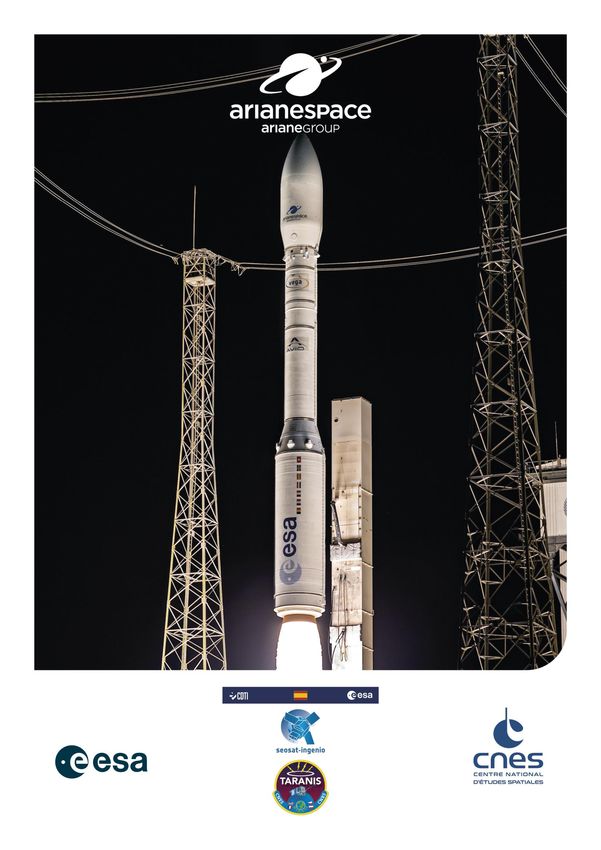
LAUNCH KIT

   November 2020

  VV17
SEOSAT-Ingenio
     TARANIS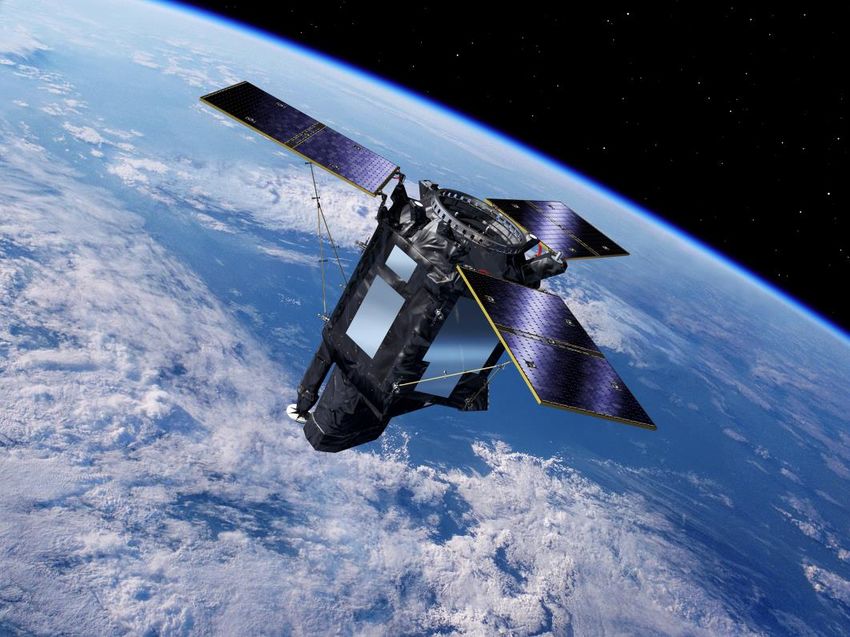
VV17
        SEOSAT-Ingenio
        TARANIS

                                          FLIGHT VV17: A NEW VEGA MISSION AT THE
                                          SERVICE OF EUROPEAN INSTITUTIONS DEDICATED
                                          TO INNOVATIVE EARTH OBSERVATION AND
                                          SCIENCE SOLUTIONS
                                          For its seventh launch of the year - and the 17th to be performed by the Vega
                                          launcher since its first liftoff from the Guiana space center in 2012 - Arianespace
                                          will orbit two satellites: SEOSAT-Ingenio for ESA, on behalf of Spain’s Center for
                                          Development of Industrial Technology (CDTI), and TARANIS for CNES, the French
                                          space agency.

                                          With this launch, Arianespace reasserts its primary mission by ensuring
                                          European independent access to space.

CONTENTS
                                           SEOSAT-Ingenio satellite

> THE LAUNCH                              By launching SEOSAT-Ingenio, the first Spanish Earth observation satellite,
                                          Arianespace reinforces its relationship with Spain (fifth contributor at ESA) – a
VV17 mission                              country that also is very involved in European launchers program.
Page 4
SEOSAT-Ingenio satellite                  SEOSAT-Ingenio is a high-resolution optical imaging mission of Spain – the flagship
Page 5                                    mission of the Spanish space strategic plan. Its mission is devoted to ensure an even
                                          coverage of the areas of national interest, providing a large operational capability in the
TARANIS satellite
                                          capture of high-resolution multi-spectral land optical images for numerous user groups,
Page 6
                                          as well as supporting and optimizing the development in Spain of teledetection-based
                                          applications in Spain.
> FURTHER INFORMATION
                                          The overall mission objective is to provide information for applications in cartography,
Vega launch vehicle                       land use, urban management, water management, environmental monitoring, risk
Page 7
                                          management and security.
VV17 launch campaign                      With its capability to look sideways, it can access any point on Earth within three days,
Page 8
                                          and will be used to help map natural disasters such as floods, wildfires and earthquakes
Countdown and flight                      – as well as help with one of humankind’s biggest challenges: understanding and
sequence                                  responding to climate change.
Page 9
                                          SEOSAT-Ingenio will be the 57th mission (79th satellite) to be launched by Arianespace
Arianespace and the Guiana                for ESA (ESA/Earth observation programs directorate) at the benefit of Spain's Center
space center                              for Development of Industrial Technology (CDTI - Centro para el Desarrollo Tecnológico
Page 10                                   Industrial). INTA, the National Institute of Aerospace Technology (in Torrejon de Ardoz-
                                          Madrid) will own and operate the satellite.
                                          The SEOSAT-Ingenio spacecraft is the first built by an industrial consortium of the Span-
                                          ish space sector companies led by Airbus Defence and Space. SEOSAT-Ingenio will be
                                          the 128th Airbus Defence and Space satellite to be launched by Arianespace.

                                          There are currently 20 Airbus Defence and Space satellites in Arianespace’s backlog.
                                          In addition, Airbus Defence and Space is also involved in the design and manufacturing
                                          of the OneWeb satellites to be deployed by Arianespace.
                                          There are seven additional ESA missions (for nine satellites) in the Arianespace
                                          backlog.

For more information, visit us on arianespace.com                    2                                                  @arianespace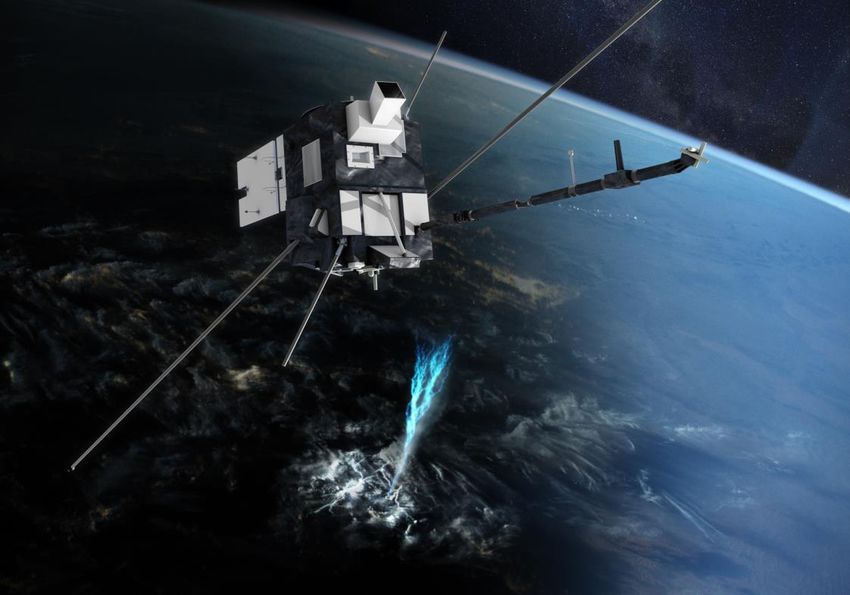
VV17
SEOSAT-Ingenio
TARANIS
TARANIS satellite
Arianespace at the service of the French space program with TARANIS, the CNES
scientific satellite.
TARANIS (Tool for the Analysis of RAdiation from lightNIng and Sprites), the Celtic god
of thunder and lightning, is the first satellite designed to observe luminous, radiative and
electromagnetic phenomena occurring at altitudes of 20 to 100 km over thunderstorms.
Discovered 20 years ago, such transient luminous events (TLEs) such as red sprites,
blue jets, elves, sprite halos, etc. remain shrouded in mystery. They are sometimes
accompanied by terrestrial gamma-ray flashes (TGFs). The correlation between these
TLEs and TGFs is one of the scientific questions the TARANIS mission hopes to an-
swer. TLEs has been observed for the first time since the ROCSAT-2 satellite, renamed
FORMOSAT-2, the second high-resolution Earth Observation satellite for the Taiwan-
ese National Space Program Office (NSPO), manufactured Airbus Defence and Space.
The TARANIS microsatellite will fly over thousands of TLEs and TGFs for at least four
years and will be capable of detecting these events and recording their luminous and
radiative signatures at high resolution, as well as the electromagnetic perturbations they
set off in Earth’s upper atmosphere. The payload includes numerous sensors to observe
the TLEs and to perform in-situ measurements of perturbations caused on the local
plasma (fields, waves and particles).
The TARANIS mission has three main objectives:
Advance physical understanding of the links between TLEs (red sprites, blue jets,
elves, sprite halos… currently named “Transient Luminous Events”) and TGFs (Ter-
restrial Gamma ray Flashes), in their source regions, and the environmental condi-
tions (lightning activity, variations in the thermal plasma, occurrence of extensive
atmospheric shower…).
Identification of the generation mechanisms for TLEs and TGFs and, in particular,
the particle and wave field events, which are involved in the generation processes
or which are produced by the generation processes.
Evaluation of the potential effects of TLEs, TGFs, and bursts of precipitated and
accelerated electrons (in particular lightning induced electron precipitation and run-
away electron beams) on the Earth atmosphere or on the radiation belts.
TARANIS will be the 18th satellite (including Pleiades satellites) to be launched by Ari-
anespace for CNES as a customer.
TARANIS will be the seventh satellite to be launched by Arianespace for CNES as a
manufacturer.
PRESS CONTACT Gregory Gavroy #VV17 @arianespace @arianespaceceo
g.gavroy@arianespace.com
+33 (0) 6 42 30 22 34 arianespace.com youtube.com/arianespace arianespace
For more information, visit us on arianespace.com 3 @arianespace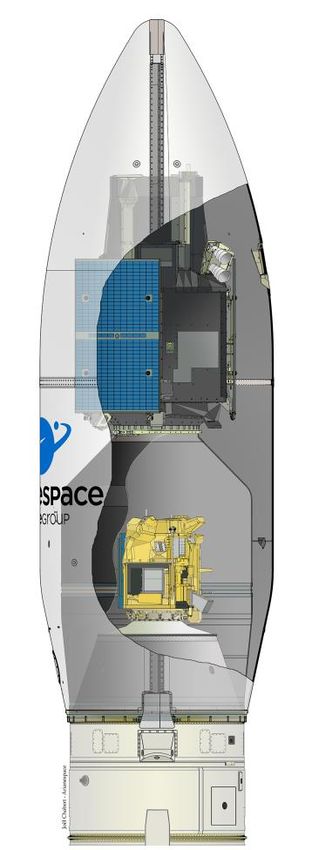
VV17
       SEOSAT-Ingenio
       TARANIS

MISSION DESCRIPTION
The 17th Arianespace Vega launch from the Guiana space center (CSG) will place
the satellites into a Sun-Synchronous Orbit (SSO).
The launcher will be carrying a total payload of approximately 1,192 kg.

The launch will be performed from the Vega Launch Complex (ZLV) in Kourou, French
Guiana.

DATE AND TIME
        Lift-off is scheduled for Monday, November 16, 2020, at exactly:
        > 08:52 p.m., Washington D.C., USA time,
        > 10:52 p.m., Kourou, French Guiana time,
        > 01:52 Universal Time (UTC) on November 17,
        > 02:52 a.m., Paris, and Madrid time, on November 17.

MISSION DURATION
                  The nominal mission duration (from lift-off to separation of the satellites) is:
                                    1 hour and 42 minutes.

TARGETED ORBIT FOR SEOSAT-Ingenio
        Orbit                                Altitude at separation                   Inclination
        SSO                                  APPROX. 670 KM.                          98,09
        (Sun-synchronous orbit)                                                       DEGREES

TARGETED ORBIT FOR TARANIS
        Orbit                                Altitude at separation                   Inclination
        SSO                                  APPROX. 676 KM.                          98,19
        (Sun-synchronous orbit)              Semi major axis: 7054 km.                DEGREES

THE LAUNCH AT A GLANCE
Following liftoff from the Guiana space center, the powered phase of Vega's first three stages will last
seven minutes. After this first phase, the launcher’s third stage will separate from the upper composite,
which includes the AVUM upper stage, a payload adapter and the satellites. The lower three stages
will fall into the sea. The AVUM upper stage will ignite its engine for the first time, operating for about
seven minutes, followed by a ballistic phase lasting approximately 37 minutes. The AVUM stage will
then reignite its engine for about two minutes, prior to releasing the SEOSAT-Ingenio satellite after the
engine is shut down.
The AVUM upper stage will ignite its engine for the third time, operating for a few seconds, followed by
a new ballistic phase lasting approximately 36 minutes. The AVUM stage will then reignite its engine
for few seconds, prior to releasing the TARANIS satellite about four minutes after the engine is shut
down. The TARANIS satellite will be released at 1 hour and 42 minutes after liftoff.

VEGA PAYLOAD CONFIGURATION
  Payload: SEOSAT-Ingenio
  Weight at liftoff: 788 kg.

  Payload: TARANIS
  Weight at liftoff: 175 kg.
  > VESPA - Vega Secondary Payload Adaptor (dual launch carrying structure)

For more information, visit us on arianespace.com                        4                                    @arianespace
VV17
       SEOSAT-Ingenio
       TARANIS

SEOSAT-Ingenio SATELLITE

CUSTOMER                                     ESA on behalf of CDTI
PRIME CONTRACTOR                             Airbus Defence and Space
MISSION                                      Earth observation
PLATFORM                                     AstroSat-250
MASS                                         788 kg
BATTERIES                                    1 x Li-ion (156 Ah)
PAYLOADS                                     S-band and X-band
DESIGN LIFE                                  7 years

PRESS CONTACTS       ESA                                           CDTI                             AIRBUS DEFENCE AND SPACE
                     Ninja MENNING                                 Ignacio A.LLORENTE               Francisco LECHON
                     Head of Newsroom and Media Relations          Head of Communications           Manager Media Relations - Spain
                     Tel: +31 71 565 6409                          Tel: + 34 649 997477             Tel: +34 630 196 993
                     E-mail: media@esa.int                         E-mail: ignacio.andres@cdti.es   E-mail: francisco.lechon@airbus.com
                     Website: www.esa.int                          Website: www.cdti.es             Website: www.airbus.com

For more information, visit us on arianespace.com                          5                                                     @arianespace
VV17
       SEOSAT-Ingenio
       TARANIS

TARANIS SATELLITE

CUSTOMER                                    CNES
PRIME CONTRACTOR                            CNES
MISSION                                     Scientific mission
PLATFORM                                    MYRIADE 200 kg
MASS                                        175 kg
BATTERIES                                   80 Li-ion cells (13.5 Ah)
PAYLOADS                                    S-band and X-band
DESIGN LIFE                                 4 years

PRESS CONTACTS          CNES                                            CNES
                        Raphael SART                                    Pascale BRESSON
                        Press Manager                                   Press Officer
                        Tel: +33 1 44 76 74 51                          Tel: +33 1 44 76 75 39
                        E-mail: raphael.sart@cnes.fr                    E-mail: pascale.bresson@cnes.fr
                        Website: www.cnes.fr                            Website: www.cnes.fr

For more information, visit us on arianespace.com                         6                               @arianespace
VV17
SEOSAT-Ingenio
TARANIS
THE VEGA LAUNCHER
Avio, the production prime contractor, delivers the Vega launcher to Arianespace.
Payload fairing
(RUAG Space)
Payload(s)
Payload adaptor
(Airbus Defence and Space)
AVUM structure
AVUM integration & testing (Airbus Defence and Space)
(Avio) AVUM engine
(KB Yuzhnoye)
Interstage - 3/AVUM
(Airbus Defence and Space)
ZEFIRO 9 production, integration & testing
(Avio)
Interstage - 2/3
(Rheinmetall)
ZEFIRO 23 production, integration & testing
(Avio)
Interstage - 1/2
(Airbus Defence and Space)
P80 integration & testing
(Europropulsion)
P80 motor case
(Avio)
Thrust vector control system
(P80, Zefiro 9, Zefiro-23 & AVUM)
S.A.B.C.A
Interstage - 0/1
Igniters (P80, Zefiro-9 & Zefiro-23) (S.A.B.C.A)
APP P80 nozzle
(ArianeGroup)
Avionics
Thales, IN-SNEC, Selex Avionica,
CRISA, RUAG Space, SAFT
For more information, visit us on arianespace.com 7 @arianespaceVV17
SEOSAT-Ingenio
TARANIS
LAUNCH CAMPAIGN: VEGA – SEOSAT-Ingenio / TARANIS
SATELLITES AND LAUNCH VEHICLE CAMPAIGN TIMETABLE
DATE SATELLITE ACTIVITIES LAUNCH VEHICLE ACTIVITIES
September 24, 2020 Arrival of the satellites in French Guiana
Transfer of the SEOSAT-Ingenio satellite to the S5C
payload preparation facility and transfer of the
TARANIS satellite to the S5B payload preparation
facility
October 5, 2020 Campaign start review - Transfer of P80 stage
October 8, 2020 Interstage 1/2 integration
October 9, 2020 Z23 integration
October 13, 2020 Fueling operations of the TARANIS satellite Z9 integration
October 15 and 16, 2020 Fueling operations of the SEOSAT-Ingenio satellite
October 16, 2020 AVUM integration
October 28, 2020 Integration of the TARANIS satellite on the payload
adaptor
October 29, 2020 Integration of the TARANIS satellite inside the
VESPA (Vega Secondary Payload Adaptor) lower
part
October 30, 2020 Integration of the SEOSAT-Ingenio satellite on the
VESPA upper part
November 2, 2020 Synthesis control test
November 4, 2020 Integration of SEOSAT-Ingenio onto the VESPA
lower part
November 6, 2020 Fairing encapsulation
SATELLITES AND LAUNCH VEHICLE CAMPAIGN FINAL TIMETABLE
DATE SATELLITE ACTIVITIES LAUNCH VEHICLE ACTIVITIES
From Saturday, November 7 to Fueling operations for AVUM (Attitude and Vernier
Tuesday, November 10, 2020 Upper Module) and RACS (Roll and Attitude
Control Subsystem)
Tuesday, November 10, 2020 Transfer upper part onto PFRCS (Upper
Composite Rolling Platform)
Wednesday, November 11, 2020 Transfer of upper part to the VLZ (Vega Launch
Zone)
Thursday, November 12, 2020 Upper composite integration on the launcher Functional checks on launcher
Saturday, November 14, 2020 Dress rehearsal
Arming of launch vehicle and fairing
Sunday, November 15, 2020 Launch readiness review (LRR), final preparation
and inspection of launcher and the fairing
Monday, November 16, 2020 Final launch countdown
For more information, visit us on arianespace.com 8 @arianespaceVV17
SEOSAT-Ingenio
TARANIS
COUNTDOWN AND FLIGHT SEQUENCE
The countdown comprises all final preparation steps for the launcher, the satellites and the launch site, includ-
ing the steps leading up to authorization of P80 first-stage ignition.
TIME EVENT
- 09 h 10 min Start of final countdown
- 06 h 25 min Activation of Multi-Functional Unit (MFU)
- 05 h 55 min Activation of Inertial Reference System (IRS)
- 05 h 38 min Activation of telemetry
- 05 h 38 min Activation of Safeguard Master Unit (SMU)
- 05 h 25 min Removal of safety devices
- 05 h 05 min Activation of onboard computer and loading of flight program
- 04 h 50 min IRS alignment and checks
- 03 h 40 min Mobile gantry withdrawal (45 min.)
- 02 h 50 min IRS alignment and checks after withdrawal of gantry
- 01 h 15 min Activation of the telemetry transmitter after withdrawal of gantry
- 01 h 15 min Activation of transponders and receptors
- 01 h 05 min Launcher system ready
- 00 h 10 min Final weather report prior to launch
- 00 h 04 min Start of synchronized sequence
T-O LIFTOFF
+ 00 h 02 min 1st stage (P80) separation
+ 00 h 02 min 2nd stage (Zefiro-23) ignition
+ 00 h 04 min 2nd stage (Zefiro-23) separation
+ 00 h 04 min 3rd stage (Zefiro-9) ignition
+ 00 h 04 min Fairing separation
+ 00 h 07 min 3rd stage (Zefiro-9) separation
+ 00 h 08 min 1st ignition of AVUM
+ 00 h 15 min 1st cut-off of AVUM
+ 00 h 52 min 2nd ignition of AVUM
+ 00 h 54 min 2nd cut-off of AVUM
+ 00 h 54 min Separation of SEOSAT-Ingenio
+ 01 h 01 min Separation of VESPA upper part
+ 01 h 02 min 3rd ignition of AVUM
+ 01 h 02 min 3rd cut-off of AVUM
+ 01 h 38 min 4th ignition of AVUM
+ 01 h 38 min 4th cut-off of AVUM
+ 01 h 42 min Separation of TARANIS
+ 01 h 52 min 5th ignition of AVUM
+ 01 h 53 min 5th cut-off of AVUM
For more information, visit us on arianespace.com 9 @arianespaceVV17
SEOSAT-Ingenio
TARANIS
ARIANESPACE AND THE GUIANA SPACE CENTER
ARIANESPACE, THE EUROPEAN LAUNCH SERVICES COMPANY
*
Arianespace was founded in 1980 as the world’s first commercial launch company. Arianespace is a subsidiary of ArianeGroup, which
holds 74% of its share capital; the balance is held by 15 other shareholders from the European launcher industry. Since the outset,
Arianespace has signed over 650 launch contracts and launched more than 740 satellites. More than half of the commercial satellites
now in service around the globe were launched by Arianespace.
The company’s activities are worldwide, with the headquarters in Evry, France (near Paris); the Guiana space center in French Gui-
ana, where the Ariane, Soyuz and Vega launch pads are located; and offices in Tokyo, Singapore and Washington DC. Arianespace
offers launch services of any mass, to any orbit, at any time. These services call on three different launch vehicles:
> The Ariane 5 heavy-lift launcher, operated from the Guiana space center in French Guiana.
> The Soyuz medium-lift launcher, currently in operation at the Guiana space center and Russian cosmodromes in Baikonur and
Vostotchny.
> The Vega light-lift launcher, operated from the Guiana space center.
THE GUIANA SPACE CENTER: EUROPE’S SPACEPORT
For more than 50 years, the Guiana cpace center, Europe’s spaceport in French Guiana, has offered a complete array of facilities for
rocket launches. It comprises primarily the following:
> CNES, the French space agency, including various resources and facilities that are critical to launch base operations, such as
radars, the telecom network, weather station, receiving sites for launcher telemetry, etc.
> Payload processing facilities (EPCU), in particular, the S5 facility.
> Ariane, Soyuz and Vega launch complexes, comprising the launch zones and launcher integration buildings.
> Various industrial facilities, including those operated by Regulus, Europropulsion, Air Liquide spatial Guyane and ArianeGroup. A
total of 40 European manufacturers and local companies are involved in launcher operations.
Europe’s commitment to independent access to space is based on actions by three key players: the European Space Agency (ESA),
CNES, the French space agency, and Arianespace. ESA was responsible for the Ariane, Soyuz and Vega development programs.
Once these launch systems are qualified, ESA transfers responsibility to Arianespace as the operator. ESA has helped change the
role of the Guiana space center, in particular by funding the construction of the launch complexes, payload processing buildings and
associated facilities. Initially used for France’s space program, the Guiana space center has evolved into Europe’s own Spaceport,
according to the terms of an agreement between ESA and the French government. To ensure that the spaceport is available for its
programs, ESA takes charge of the lion’s share of the CNES/CSG fixed expenses, and also helps finance the fixed costs for the ELA
launch complexes.
CNES has several main responsibilities at the Guiana space center. It designs all infrastructure and, on behalf of the French govern-
ment, is responsible for safety and security. It provides the resources needed to prepare the satellites and launchers for mi ssions.
Whether during tests or actual launches, CNES is also responsible for overall coordination of operations and it collects and processes
all data transmitted from the launcher via a network of receiving stations to track Ariane, Soyuz and Vega rockets throughout their
trajectories.
ARIANESPACE IN FRENCH GUIANA
In French Guiana, Arianespace is the contracting authority in charge of operating the family of three launchers: Ariane, Soyuz and
Vega.
For Vega, Arianespace supervises the integration and inspection of the launcher constructed by ELV/Avio, the production prime
contractor. At the same time, Arianespace coordinates the preparation of satellites in the payload preparation facility (EPCU) operated
by CNES/CSG, handles the integration of satellites and preparation of the payload composite up to its transfer on the launcher to the
Vega launch zone (ZLV), and also works with ELV/Avio teams in charge of the launcher to conduct the final countdown and launch
from Launch Control Center No. 3 (CDL3).
Arianespace deploys a top-flight team and technical facilities to get launchers and satellites ready for launch. Building on this unrivalled
expertise and outstanding facilities in French Guiana, Arianespace is the undisputed benchmark in the global launch services market.
For more information, visit us on arianespace.com 10 @arianespaceYou can also read


