Wake up, Almanya! - Centre ...
←
→
Page content transcription
If your browser does not render page correctly, please read the page content below
Wake up, Almanya!
- Germany’s political will to ignore institutional racism

A Centre for Feminist Foreign Policy Briefing

This document contains vocabulary, photos, and topics which could lead to racial trauma.

We encourage our BIPoC readers to discuss the content of this briefing in safe(r) spaces.

The Issue
At the Centre for Feminist Foreign Policy (CFFP), we understand that the political normalisation and

continuing democratic legitimisation of racism are pressing issues. CFFP believes that foreign policy is a

mechanism for equality, justice, solidarity, and peace, based on an intersectional feminist framework that

rethinks security with a human-centred approach at its core. Along with other feminist organisations, we
                                                                                                                      1
have signed the "Statement of Solidarity to End Systemic Racism in Foreign Policy" initiated by Women of

Color Advancing Peace and Security. We believe that this initiative is imperative. Racism extends to actors

leading   and     working      within   politics    and     political       institutions   themselves.      In    many       democratic          states,

including Germany, the existence of racism within political institutions is often denied. CFFP believes that

feminism      and   anti-racism     are   inseparable,          and   governments          must    urgently       employ        an        intersectional
                                                                                                   2
feminist approach to tackle institutional racism in its security structures. This is directly linked to our mission

to pave the way for a Feminist Foreign Policy with human security at its core. This briefing introduces

measures states should adopt in law and policy to ensure the unlearning and dismantling of institutional

patterns that lead to (un)intended racist and marginalising practices.

                       "There is no such thing as a single-issue struggle
                          because we do not live single-issue lives."
                                         Audre Lorde

   I. Feminism must be anti-racist to meet the demands of our time
  Audre Lorde’s words inspire the feminist values that CFFP upholds and strives to promote. Patriarchy and

  white supremacy are interconnected systems of oppression, and one cannot be eradicated without the
          3
  other. Therefore, the call for a Feminist Foreign Policy must be anti-racist. The status quo of (Feminist)

  Foreign Policy does not correspond with making the lives of Black, Indigenous and People of Colour

  (BIPoC)     safer.    Historically,   many       public    policies       often      render   BIPoC   insecure,         and        if   policy-makers

  continue to ignore intersecting forms of discrimination, they actively contribute to systemic oppression

  enforced by institutions. As feminists, we recognise that to address the complexities of structurally-

  endured      injustices      on   a   domestic      and       global        level,    foreign    policy     must        put    an        intersectional
                                                            4
  understanding of (in)securities at its core. This is also the case for establishing a Feminist Foreign Policy

  for   Germany        which    must    involve:    divestment        from      power      and    privilege      as   well      as    unlearning     and

  relearning the histories of colonialism,             and the constructed hierarchisation of race in Germany's political

  institutions.
  www.centreforfeministforeignpolicy.com                                                                                                   March 2021

                                                                        1
II. Germany’s colonial amnesia proves dangerous for its present and future
Germany’s    political        ignorance         of       institutionalised         racism   is   strongly         rooted      in     the     nation’s     historical

neglect of its politicisation of race decades before the Nazi regime came to power. Emilia Roig, Founder

and   Executive        Director     of   the        Center     for       Intersectional     Justice,        refers       to   this      historical       neglect   as

“Germany’s selective amnesia” and further posits that this amnesia contributes to dismissing and rebuking
                                                                                                                     5
the   salience    of    race    as   an        ideological,      political         and   social       concept”.          Germany’s           colonial      amnesia

becomes apparent in the limited self-awareness of Germany’s role as an active driver of colonialism and
                                                                     6
the   dehumanisation           of    non-white            bodies.        One       example       of   Germany's           colonial           era    is   the   Berlin

Conference of 1884, initiated by the country’s first chancellor Otto von Bismarck. It was a key event in

global   colonial      history.     Representatives            from        fourteen      countries          and    empires         met       to    violently   force

themselves on the Global South, which, amongst many cruelties, enabled the genocide in Namibia
                                           7
ordered by the German state. Upon further examination of Germany’s colonial past, it becomes evident

how political institutions have instrumentalised women’s empowerment for realising security policies.

According to the Cultural Anthropologist Jacqueline Mayen, German white women were sent to the
                                                                               8
German colonies as bearers of German culture. For example, the Women's League of the German

Colonial Society, founded in 1908, was one of the largest colonial societies at the time. Around 19,000
                                                                                                 9
women were members, and over 145 offices were established. Through their work in the Women's League

of the German Colonial Society, white German women at home and abroad contributed to a racist

hierarchisation of people during Germany’s colonial era. Women’s initiatives, like the Women's League of

the German Colonial Society, were running under the umbrella of delivering progress and civilisation to

the Global South.           These initiatives mirror the extent to which instrumentalisation of gender was a crucial

part of Germany’s domestic and foreign strategy to pursue a racist political agenda as a colonial power.

An example of how colonial policies had an impact on domestic policy is the forced sterilisation of Black
                                                    10

children in the West of Germany. After Germany's defeat in World War I and the decolonisation process

mandated     in       the   Treaty    of   Versailles          (1919),      the    German        government              began          to   register     so-called

“Rhineland children'' in 1923 with the objective to sterilise them later. These Black German children were

defamed as “bastards” and, for government officials, they represented a visible result of defeat in the
                                                                                                       11
war. They were perceived as a threat that needed to be erased. This is an example of Othering Black

Germans, which continued until the end of the Nazi regime and has not been even remotely adequately

addressed since then. In 2019, German scholars Prof Fatima El-Tayeb and Dr Vanessa Eileen Thompson

highlighted that Germany's security units have institutionalised the colonial practice of Othering non-
                 12

white bodies. In practice, this includes border control security checks but also street patrols where BIPoC

are often identified as non-German, as foreign. The dominant understanding of Germanness complies

with a certain set of characteristics deeply rooted in its unprocessed colonial hierarchisation of race that
                                               13
Germany has yet to overcome.                        Both examples are not well known in Germany and illustrate the limited

awareness of Germany’s role as an active driver of colonial politics. Moreover, both colonial practices

describe instances of Othering that Germany has failed to address. The consequence of this inaction is

that non-white people are still Othered in Germany.

There are a few attempts from the German government to address its colonial past and move towards a
                                                                                                                                                                   14

decolonial future, for example with the current Federal Cultural Foundation’s "Dekoloniale Programme",
                                                                                                                                   15
the launch of the "German Contact Point for Collections from Colonial Contexts, and the "International
                                                                                                       16
Conference: Colonialism as Shared History. Past, Present, Future".                                          However, the late political discussion

about Germany’s colonial past is a missed opportunity to tackle Germany’s historical hierarchisation of

race. Moreover, it is a missed opportunity to understand the significant interdependencies between the

German colonial state, the Nazi regime and the normalisation of racism in politics today.

 www.centreforfeministforeignpolicy.com                                                                                                             March 2021

                                                                                   2
III. Germany’s political ignorance reproduces (neo-)colonialism in foreign policy
Germany’s ignorance of its colonial history is embedded in the way it understands its domestic and
foreign policy. Public policy fails to address the implications of such history on both the domestic and
foreign policy levels. The political consequences of ignoring Germany’s colonial past become particularly
visible in the German self-perception as a global peacebuilder. Today, Germany presents itself as a
mediator and global peace power. However, the nation’s leaders continue to neglect Germany’s role in
producing global imbalances created through a systematic and continuous devaluation of those deemed
Other. Prof E. Tendayi Achiume, the United Nations Human Rights Council’s fifth Special Rapporteur on
Contemporary Forms of Racism, Racial Discrimination, Xenophobia and Related Intolerance, highlights in
her essay "Putting Racial Equality Onto the Global Human Rights Agenda" that "leaders in the highest
level of political office in countries that have long viewed themselves as the vanguard of liberal
constitutional democracy openly profess racist and xenophobic views as they adopt policies that
17
entrench them". Germany's role as a global promoter of democracy and human rights opens itself to this
critique. Hence, it is not enough to promote human rights policies if the individuals designing these
policies do not embrace anti-racist approaches. Instead of countering Germany's political normalisation
of racist behaviour, high-level politicians keep contributing to the selective colonial amnesia. The lack of
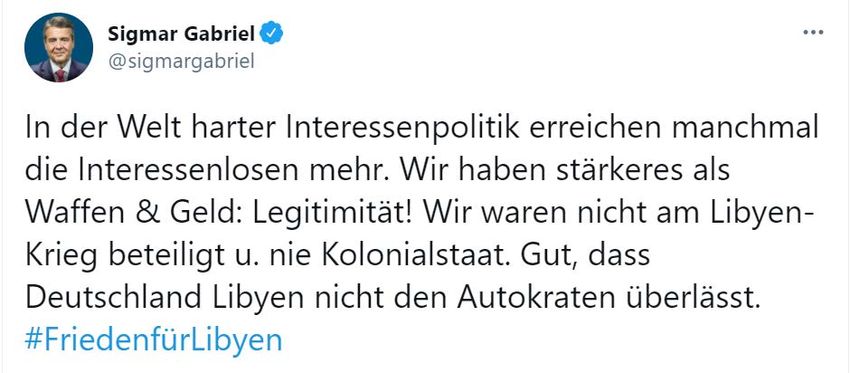
political sensibility of Germany’s colonial past became evident when former Foreign Minister Sigmar
Gabriel (from 2017 to 2018) tweeted at the "Berlin International Conference on Libya" in 2020:
“In a world with hard interest politics, those without interests can sometimes reach more. We have more
18
than weapons and money: legitimacy! […] [Germany has] never been a colonial state […]”. Even if the
former Foreign Minister’s tweet referred to the fact that Germany has not had a colonial administration in
Libya, it is a fact that Germany has been a colonial state officially from 1884 to the end of World War I.
The political ignorance demonstrated by the Foreign Minister exemplifies Roig’s "colonial amnesia". If
Germany seeks to realise a foreign policy in line with the political realities of the past and the present, it
must be informed by an understanding of the nation’s colonial past. Another layer to Germany’s role
globally, coupled with its neglect to effectively acknowledge colonial assumptions, is Germany's
approach to the Marshall Plan with Africa since 2017. Despite the strong call for a paradigm shift by the
Minister of Development Gerd Müller and his emphasis that “African ownership must be strengthened and
19
the days of ‘aid’ and of ‘donors and recipients’ [are] put behind us”, the potential of African diaspora
living in Germany as a critical driver for the realisation of this development plan remains overlooked by
policy-makers. Decolonisation is a collective and participatory process that requires people to face the
(un)intended consequences of racist assumptions. Though it is difficult, it is crucial and necessary. Thus
far, Germany has failed to decolonise its political institutions and continues to not recognise people of
African descent in Germany as suitable actors for economic and political growth. This presents a case of
how the Othering of People of African Descent hinders the realisation of Germany’s foreign policies. The
widespread ignorance of Germany’s colonial past, its effects on the present, and the lack of awareness
from German leaders have (un)intended consequences for Germany’s role in current global politics. By
taking a leading role in unlearning harmful practices from its colonial past, a powerful democracy like
Germany has the potential to tackle institutional racism in foreign policy and on a domestic level, and
contribute to anti-racist domestic and foreign structures, which will consequently enable an intersectional
feminist approach to policy, domestic and foreign.
www.centreforfeministforeignpolicy.com March 2021
3IV. Racism is not just a foreign issue
When racism is discussed within Germany’s political discourse, it is often perceived as an issue that has to
be tackled in other countries like the U.S. Nevertheless, Germany’s political ignorance towards its
shortcomings and responsibility to fight racism within its own country has been on display since the end of
World War II in 1945. Severe instances of racist interactions have been met with a critical lack of response
from officials, further alienating those affected. For example, migrant and refugee communities continue
20
to remember the racist attacks of Rostock-Lichtenhagen, where Roma and Vietnamese were targeted.
Security forces failed to protect the targeted communities even though there had been evidence of plans
days prior to the attacks. Violence spilt over to other cities in the form of attacks on asylum centres,
immigrants’ housing and racialised neighbourhoods. Among BIPoC, these attacks presented a collective
shock and, at the same time, were a violent wake-up call that racism in Germany exists and that there is
a lack of protection towards marginalised groups. Decades later, the collective shock re-emerged by the
21
murders committed by the neo-Nazi terror group National Socialist Underground (NSU) (2000-2007), the
22
antisemitic attack in Halle (October 2019), and the most recent racially-motivated terror attack in Hanau
23
(February 2020). All attacks revealed the dimension of right-wing terrorism and extremism in Germany
and they have shed light on the extent of discriminatory behaviour as a structural procedure within
Germany's law enforcement. Put simply, racism is not only a foreign issue - racism does exist in Germany.
i. Right-Wing Extremism and Terrorism: The NSU Complex
The murders perpetrated by the neo-Nazi terrorist network NSU are arguably the most significant
known cases of terrorism in Germany after 1945. The core trio consisted of three neo-Nazis, two men
and one woman. The complete vastness of the network remains unknown. In total, ten people were
killed between 2000 and 2007, including individuals with Turkish, Kurdish, Greek backgrounds and a
white policewoman. During each NSU murder follow-up, police investigators criminalised the PoC
victims. The investigators of the NSU murders first framed the murders as clan disputes and called the
investigation after the strait of Istanbul, Bosporus. Based on racist stereotypes, this decision had
prevented an adequate and, most importantly, unbiased investigation. Instead of following leads
which indicated racist-motivated killings, the investigators were convinced that the murders were
linked to drugs or money laundering and even conducted interviews with relatives and friends in
Turkey. This pattern of institutionalised racism executed by white security actors follows the
24
criminalisation of men of Colour in Germany. The extent of racist patterns keeps reproducing
themselves during the whole NSU process. Until today, memorial monuments for the victims have been
denied, for example in Cologne where a nail bomb attack injured twenty-two people in 2004.
Although the communities affected by the NSU attacks repeatedly requested to reduce the state's 120
years embargo on the documents, it took the murder of the white male politician Walter Lübcke to
reduce the embargo of the documents to 2044. Walter Lübcke was murdered for his "refugee-
25
friendly" politics in 2019, the first murder of this kind in recent German history.
Confronting acts of violence resulting from institutional racism requires an uncomfortable process for
white people in power because for social change to happen, uncomfortable questions must be asked
and acted upon. This is imperative because discriminatory practices by the state represent a threat to
Germany’s democracy itself. If Germany continues to neglect its historic contribution to the colonisation
of the Global South and ignores the institutional racism in its domestic policies, it will not be able to
investigate the extent current structures are inherited from the past failed ones.
www.centreforfeministforeignpolicy.com March 2021
4V. Institutional racism is a threat to Germany’s democracy
The UN’s Special Rapporteur on Contemporary Forms of Racism continues to emphasise racial
26
inequalities are a threat to all democracies. Nonetheless, racism in Germany is rarely understood as a
threat to its democracy. Racist behaviour within German institutions is often portrayed “first and foremost
27
as an aggregate of individual, interpersonal and intentional acts”. The truth is that racism in Germany is
structurally rooted in its public institutions. Institutional racism refers to the practices within and across
institutions that (un)intentionally reproduce racist patterns. Understanding racism as embedded solely on
an individual level has led to the common practice of neglecting institutional racism in Germany’s
democratic branch of law enforcement. During the Black Lives Matter protests 2020 in Germany, civil
society advocated strongly for a study on racial profiling in Germany. However, the German Minister
Federal Minister of the Interior, Building and Community, Horst Seehofer, refused to conduct a study on
racial profiling within the German police. According to the Ministry, this decision was based on the fact
28
that “racial profiling is forbidden and therefore does not exist”. Racial profiling is often based on
external characteristics such as skin colour, characteristics, or symbols perceived as non-white and non-
Christian. For example, in 2019, a group of men of Colour were stopped by the German police in
Cologne on their way to celebrate Eid al-Fitr, a celebration marking the end of Ramadan. According to
the police, they were reacting to a situation "that makes people afraid", which may present "considerable
29
danger". However, the police's framing of a perceived non-white cultural tradition as a dangerous threat
to society did not result in any significant repercussions for the German police. The massive Othering
suggests that the German police's reference point for a non-risk person continues to be white, Christian
Germans. Everything that deviates from this reference point is treated by different standards, in this case
as a security risk. As a result, racial profiling as a security practice of Othering is deeply internalised by
institutions, widely accepted and not understood as a threat to an equal, democratic society.
ii. Racial Profiling: The "Nafri" Case
In 2016, the common practice of the German Police to describe men of Colour "looking North African"
as “Nafris”
become public because the police itself has used this term for internal and external
30
communication. Using this derogative term and heavy policing has been a political response after
numerous cases of sexualised violence during the New Year’s celebrations 2015/16 in Cologne and
31
other cities. Additionally, the political discourse regarding law enforcement has shifted heavily into a
racist narrative. This was based on the racist assumption that men of Colour associated with Islam are
a threat to white women. However, this is problematic as it manifests a white, Christian-based, and
Eurocentric understanding of security and cultures that blatantly ignores its own embedded
shortcomings in gender equality. Sexism is not an imported issue but has always been part of German
society. In their nation-wide campaign #ausnahmslos, critical feminist voices in Germany like Gizem
Adıyaman, Emine Aslan, Keshia Fredua-Mensah, and CFFP Co-founder Kristina Lunz have warned
against putting sexualised violence on the political agenda only when the perpetrators are perceived,
32 32
positioned, and constructed as Others and regarded as non-Germans. Journalists, like Mohamed
Amjahid, continue to illustrate the extensive dimension of institutionalised racism on all levels within
the German police force. Amjahid has publicly criticised the reproduction of gendered racism
embedded in the education of the German police force. For example, the book "Understanding and
Investigating Turkish and Arab People" published by the Publishing House for Police Science reproduces
the racist stereotype of ‘Turkish and Arab’ men not being able to express themselves.
33
dna hsikruT gnitagitsevnI dna gnidnatsrednU"
"elpoeP barA
: revoc kooB
www.centreforfeministforeignpolicy.com March 2021
5iii. Death in Custody: The Oury Jalloh Case
In 2005, the burnt body of Black asylum-seeker Oury Jalloh from Sierra Leone was found in a German
jail cell after he was taken into custody. He allegedly harassed two women while under the influence
of drugs. State officials claimed that he had taken his own life by igniting his fire-safe mattress with
a lighter while cuffed to it with his hands and feet. However, the International Independent
Commission, which investigated Oury Jalloh's death, claims that the evidence suggests that the
police force murdered him. The medical report commissioned by the family of Jalloh indicated
several bones were fractured before he died, suggesting he sustained significant violence before his
34
death. Moreover, police investigations could not answer why the fire was not discovered by the
police and why the fire alarm had been ignored or disengaged. It was also unclear where Jalloh had
acquired the lighter, and police could not immediately produce the lighter as evidence. Despite the
fact that most of the evidence has been identified as inadmissible
and systemic failures from law
35
enforcement, the federal investigation was closed in 2020. Dr Vanessa Thompson was part of the
International Independent Commission to investigate Oury Jalloh's death. She criticises that the
German state upholds the constant criminalisation of Oury Jalloh instead of investigating his murder.
In Oury Jalloh’s case, the protection of women from non-white men has been instrumentalised and
used to justify violence executed by law enforcement.This pattern of institutionalised racism
executed by white security actors follows the hyper-masculinisation of Black bodies.
VI. The hierarchisation of (in)securities is a harmful practice
Across the whole party spectrum in Germany, political discourse is geared towards heavy policing and
controlling minorities. Yet, the protection of minorities from discriminatory practices executed by law
36
enforcement remains unprioritised. The institutionalised racism within German law enforcement implies
37
that the security of white people tends to be prioritised over the security of BIPoC in German politics. This
lack of protection of minorities is a problem in a country that portrays itself as a democracy pushing for
human rights on a global stage. It is disingenuous - the nation is more eager to address inequality abroad
than look within. It also shows a lack of credibility because the nation is imbuing hypocritical behaviour.
Whiteness is the set norm, and security structures are deliberately designed to safeguard those who
38
ascribe to this enshrined norm. This prioritisation amplifies the marginalisation of BIPoC perspectives in
terms of their security. As a consequence, security risks specific to BIPoC are rarely of interest to political
actors in Germany although civil society keeps pointing to a strong connection of the German state
39
apparatus to influential right-wing extremists like the Ku Klux Klan or close ties to the NSU network. In the
summer of 2020, several public figures received threats, signed "NSU 2.0 ", signalling fanware and revival
of the NSU which indicates the right-wing extremist motivation behind those threats. A month's long
investigation of the incident led to the discovery that several Frankfurt police officers had shared
40
people’s personal data with those behind the hate messages. These cases involved mainly women that
either have a migration history or who actively speak out in favour of migration and against racism like
the comedian Idil Baydar. Within the same year, journalists discovered that the former Minister for Interior
Affairs of Mecklenburg-Western Pomerania, Lorenz Caffier, had purchased a gun in 2018 from someone
41
with suspected links to the far-right group Nordkreuz. Despite the minister's political mandate to oversee
all police and intelligence operations against right-wing groups, he denied having any knowledge about
the purchaser's ties to a far right-group. These are examples of German security institutions not having
appropriately scrutinised their embedded racist behaviours. Furthermore, they have perpetuated such
practices by actively demonstrating willful ignorance. Democracies are meant to serve and protect all
members of society. The various racist incidents raise the question: whose security does the German state
protect?
www.centreforfeministforeignpolicy.com March 2021
6In 2014, the director of the European Network Against Racism, Michaël Privot, called Germany’s lack of
protection of minorities in the context of specific discriminatory patterns "an obsession with the
42
securitisation of Muslim communities". A recent example of this "obsession" was mirrored shortly after the
Hanau terrorist attack in 2020. The police reached out to the victims and survivors' families to ensure they
43
were not planning acts of revenge or retaliation. The extent to which the German security apparatus
identifies non-white people in Germany as potential threats and deems BIPoC neighbourhoods
dangerous has become more evident in December 2020. Journalists revealed that the father of the
Hanau terrorist subscribes to the same racist belief system as his son and poses a potential threat to
44
those in his immediate environment. For example, the father of the deceased terrorist has officially filed
a complaint against the memorial sites, and has asked for the return of the murder weapon his son used
to kill his victims. However, none of the family members of the victims who are still living close to the
father were informed, nor are they currently receiving specific protection. The lack of protection requires
examining how much more exposure to racist violence is tolerated by the German law enforcement.
In 2021, the political normalisation of racism has reached a point where it presents a threat to Germany's
democracy. In particular, the numerous cases of neglecting institutional racism in Germany's law
enforcement have revealed that Germany's democracy is facing systemic failure when it comes to the
fight against racism. This systemic failure manifests itself in racial profiling (i), death in custody (ii) or
right-wing extremism and terrorism (iii). Due to the political ignorance towards racist patterns, the actual
dimension of institutional racism in Germany remains unknown. Despite the lack of official statistics,
various examples show that institutional racism is a reality in Germany. Therefore, it is necessary to
employ an intersectional analysis of the existing cases to prevent the normalisation of racism, the
hierarchisation of (in)securities, and Germany's colonial amnesia in the future. Hence, it is a democracy's
responsibility to unlearn and dismantle practices that reproduce racism, and lead by example.
“In a racist society,
it is not enough to be non-racist,
we must be anti-racist.”
Angela Y. Davis
VII. CFFP’s Demands for the German Elections 2021
Racism is not simply perpetrated by an individual. It is deeply ingrained into our systems. If the German
government wants to genuinely uphold its democratic principles, it can no longer ignore the harmful
impact of institutionalised racism in its own security ranks. Political institutions must actively address all
forms of racism. Our demands are centred around the following solution-driven approaches for
governmental bodies and officials:
www.centreforfeministforeignpolicy.com March 2021
7Understanding of racism as a threat to democracy
Expand the planned study by the Federal Ministry of the Interior, Building and Community on the daily
life within the police force by conducting a separate study on racial profiling and seek advice from
the expertise of the civil society groups affected.
Create an evidence-based database illustrating how the gendered dimension of terrorism and
extremism is being tackled within the Federal Office for the Protection of the Constitution
(Verfassungsschutz).
Ensure that an independent expert group tasked with developing an EU Code of Police Ethics is
created, as mandated by the European Commission following the anti-racism protests in June 2020.
Strengthening accountability mechanisms
Adjust existing anti-racism laws for all institutions involved in law enforcement.
Ensure that politicians face legal consequences and lose their mandate when affiliated with racist
networks and their members.
Appoint an objective external police commissioner with a legal mandate in all states and at the
federal level to ensure that structures are critically observed and questioned at all times.
Revise the National Action Plan Against Racism (2018) to incorporate an intersectional legal
approach and add measurable indicators of progress.
Securing sustainable funding
Provide institutional funding for governmental bodies to realise the UN’s Convention on the
Elimination of All Forms of Racial Discrimination, in particular regarding the General recommendation
No. 36 (2020) on preventing and combating racial profiling by law enforcement officials adopted on
the 24th of November 2020.
Contribute significant funding for the EU justice, rights and values fund, for which funding decreased
significantly in the revised multiannual financial framework proposals of the Commission.
Reduce institutional barriers within grant applications for community-based projects working with
survivors of right-wing crimes.
Secure legal funds for BIPoC initiatives and Human Rights Defenders to ensure legal protection
against further hate crimes.
Learn More
Amnesty International and the Open Society Initiative for Europe. A Human Rights Guide for Researching
Racial and Religious Discrimination in Counterterrorism in Europe. 2020.
Aysun Bademsoy. Spuren - Die Opfer des NSU. Documentary by Aysun Bademsoy. 2020.
Statement by the German Comedian Idil Baydar. 2020.
Center for Intersectional Justice and the Gunda Werner Institut. Reaching Everyone on the Planet… .
Kimberlé Crenshaw. 2019.
List of people who have died in custody in Germany by Death in Custody.
Semra Ertan. Mein Name ist Ausländer | Benim Adım Yabancı. Poem. 2020.
European Network Against Racism (ENAR). 2014-2018 ENAR Shadow Report on racist crime and
institutional racism in Europe. 2019.
Sham Jaff, Alena Jabarine, Şeyda Kurt and Viola Funk. 190220 – Ein Jahr nach Hanau. Podcast. 2021.
www.centreforfeministforeignpolicy.com March 2021
8References
1. WCAPS. Statement of Solidarity to End Systemic Racism in Foreign Policy. Statement. 2020.
2. Following the definition of the “Center for Intersectional Justice” the concept of intersectionality
describes the ways in which systems of inequality based on gender, race, ethnicity, sexual
orientation, gender identity, disability, class and other forms of discrimination ‘intersect’ to create
unique dynamics and effects.
3. CFFP. Feminist foreign policy - imperative for a more secure and just world. 2019.
4. Chandra Talpade Mohanty. CFFP event Foreign Policy So White. CFFP. 2020.
5. Emilia Roig. Uttering “race” in colorblind France and post-racial Germany. 2017.
6. John Eligon. The Big Hole in Germany’s Nazi Reckoning? Its Colonial History. The New York Times.
2018. [Accessed: 18/02/2021].
7. Christoph Hasselbach. Germany's colonial era brought to light amid global protest. Deutsche Welle.
2020. [Accessed: 18/02/2021].
8. Interview with Jacqueline Mayen. Young European Federalists. 2020. [Accessed: 18/02/2021].
9. Martha Mamozai. Schwarze Frau, weiße Herrin: Frauenleben in den deutschen Kolonien. 1989.
10. Katharina Oguntoye. Schwarze Wurzeln: Afro-deutsche Geschichte. 1997.
11. “Othering” is a process that distinguishes a group of people as “we” and "others". Examples of
“othering” in the European context are given by Fatima El-Tayeb’s European Others from 2017.
[Accessed: 18/02/2021].
12. Fatima El-Tayeb and Vanessa Eileen Thompson. Alltagsrassismus, staatliche Gewalt und koloniale
Tradition. Ein Gespräch über Racial Profiling und intersektionale Wider stände in Europa. 2019.
13. Natasha A. Kelly. Speech at the 6th Annual National Conference of the National Council for Black
Studies about Facts of White Germanness. 2012.
14. Dekoloniale: Memory Culture in the City. 2021. [Accessed: 16/02/2021].
15. The Cultural Foundation of the German Federal States. German Contact Point for Collections from
Colonial Contexts. 2019. [Accessed: 22/02/2021].
16. International Conference: Colonialism as Shared History: Past, Present, Future. [Accessed:
16/02/2021].
17. E. Tendayi Achiume. Putting Racial Equality onto the Global Human Rights Agenda. 2018. [Accessed:
18/02/2021].
18. Twitter handle: @sigmargabriel. 16/01/2020. [Tweet Accessed: 17/02/2021].
19. Federal Ministry for Economic Cooperation and Development. A new partnership for development,
peace and a better future A Marshall Plan with Africa. [Accessed: 18/02/2021].
20. Interview with Kien Nghi Ha. Migazin, 2012. [Accessed: 18/02/2021].
21. Deutsche Welle. Germany's right-wing terror network - the NSU on trial. DW Documentary. 2018
[Accessed: 18/02/2021].
22. France24. German man goes on trial for deadly 2019 attack on synagogue in Halle. 2020. [Accessed:
18/02/2021].
23. Özlem Gezer and Timofey Neshitov. The Hanau Protocols. Spiegel. 2020. [Accessed: 18/02/2021].
24. Vanessa E. Thompson. Intersektionale Kritik der Polizei. Racial Profiling und abolitionistische
Alternativen. Online lecture at the Cornelia Goethe Colloquium. 2020.
25. Jenny Hill. German politician's murder raises spectre of far-right attacks. BBC. 2019.
26. Interview with E. Tendayi Achiume. Financial Times. 2019. [Accessed: 18/02/2021].
27. Shadow Report from 2015 on the 19th–22nd Report submitted by Germany to the UN Committee on
the Elimination of Racial Discrimination. 2015.
28. German Bundestag. Studie zu Racial Profiling bei Polizei zu eindimensional. Press release. 2021.
[Accessed: 18/02/2021].
www.centreforfeministforeignpolicy.com March 2021
9References
29. Zeit Online. Zentralrat der Muslime kritisiert Kölner Polizei. 2019. [Accessed: 18/02/2021].
30. Twitter handle: @polizei_nrw_k. 31/12/2016. [Tweet Accessed: 17/02/2021].
31. Nadine Schmidt and Lauren Said-Moorhouse. Cologne police under fire for alleged racial profiling on
New Year's Eve. CNN. 2017. [Accessed: 18/02/2021].
32. Julia Korbik. Sexualisierte Gewalt: Schützt die deutsche Frau! Vorwärts. 2016. [Accessed: 22/02/2021].
3 3 . Initiative #ausnahmslos. Against sexualised violence and racism. Always. Anywhere. #ausnahmslos
(“noexcuses”). [Accessed: 18/02/2021].
34. Heubrock et al. Türken und Araber verstehen und vernehmen Empfehlungen zur interkulturellen
Vernehmung arabisch-türkischer Personen. Verlag für Polizeiwissenschaft. 2012.
35. Initiative Oury Jalloh. Neue Erkenntnisse im Fall Oury Jalloh. Press Conference. 2019.
36. Landtag Sachsen-Anhalt. Bericht der vom Ausschuss für Recht, Verfassung und Gleichstellung des
Landtags Sachsen-Anhalt beauftragten. Report. 2020.
37. Vanessa E. Thompson. Intersektionale Kritik der Polizei. Racial Profiling und abolitionistische
Alternativen. Online lecture at the Cornelia Goethe Colloquium. 2020.
38. Vanessa E. Thompson. Turn white or disappear. On the Everyday of Racist Policing. 2018.
39. Florian Gathmann. German Police Kept Jobs Despite KKK Involvement. Spiegel. 2012. [Accessed:
18/02/2021].
40. David Crossland. Frankfurt police accused of neo-Nazi cabal. Handelsblatt. 2018. [Accessed:
18/02/2021].
41. BBC News. German regional minister resigns over far-right links to gun purchase. 2020. [Accessed:
18/02/2021].
42. Michaël Privot. Racism: troubling truths. Open Democracy. 2014. [Accessed: 18/02/2021].
43. Özlem Gezer and Timofey Neshitov. Vater des Attentäters stellt rassistische Anzeigen – und fordert
Tatwaffen zurück. Spiegel. 2020. [Accessed: 18/02/2021].
43. ibid.
Authored by Dilek Gürsel, Miriam Mona Müller & Ambika Varma
Edited by Antonia Baskakov, Kristina Lunz, Sheena Anderson & Katie Washington
For any questions or inquiries regarding "Wake up, Almanya!" or for permission to reproduce any
part of this briefing, please contact Miriam Mona Müller, Strategic Policy and Research Advisor at
the Centre for Feminist Foreign Policy.
www.centreforfeministforeignpolicy.com March 2021
10You can also read


