Walking and Cycling Strategy - Council 18 June 2020 Appendices B and C Item 11.1 - Manawatū District Council
←
→
Page content transcription
If your browser does not render page correctly, please read the page content below
Council 18 June 2020
Appendices B and C
Item 11.1

        Walking and
        Cycling Strategy
        Adopted: 2 July 2020

        www.mdc.govt.nz
Manawatū District Council - Walking and Cycling Strategy 2020
2
Foreword
Whakarērea ngā manu ōna here kia hua mai ōna āhua ki te ao. Whakanikotia ki runga, takatakahia ki raro. Mai i
ngā wai māori o Maewa ki ngā wairere o Te Awahuri, hīkina te tapu, hīkina te mauri a Tāne kia tū, kia oho, kia ora!

The birds have been freed from their bonds so their likeness may be seen in the world. Let the skies be adorned
and the pathways below traversed. From the pristine waters of Maewa to the turning waters of the Awahuri,
amplify the sanctity and the life force of our natural environment that we may arise, awaken, and thrive!

                           Manawatū District Council - Walking and Cycling Strategy 2020
                                                                                                                 3
Manawatū District Council - Walking and Cycling Strategy 2020
4
Contents
1. INTRODUCTION                                                                              6
   1.1 Purpose of the Strategy                                                                6

   1.2 Developing the Strategy                                                                6

   1.3 What will the Strategy Achieve                                                         6

2. VISION AND GOALS                                                                           7
2.1 Goals and Strategic Outcomes                                                              8

3. CONTEXT OF THE STRATEGY                                                                   9
   3.1 Strategic Context                                                                      9
   3.2 The District                                                                          10
   3.3 Existing Walking and Cycling Network                                                  10
        Cycling in the District                                                              10
        Pedestrian Network                                                                   14
        Recreational Work                                                                    14
        Regional Network                                                                     15
4. CHALLENGES AND OPPORTUNITIES                                                              16
   4.1 Issues and Trends                                                                     16
        Walking and Cycling as a Mode of Transport                                           16
        Safety                                                                               17
        Population Growth                                                                    18
        Aging Population                                                                     18
   4.2 Opportunities                                                                         19
5. ACTION PLAN                                                                               24

6. MONITORING AND REPORTING                                                                  25

7. NEXT STEPS                                                                                28
   7.1 Implementation Plan                                                                   28
   7.2 Scheme Prioritisation                                                                 28
        Footpath Prioritisation Criteria                                                     29
        Cycleway Prioritisation Criteria                                                     30
   7.3 Strategy Review                                                                       30

                             Manawatū District Council - Walking and Cycling Strategy 2020
                                                                                                  5
1. Introduction
1.1 Purpose of Strategy
This Strategy provides a framework to increase participation in walking and cycling within the Manawatū District.
Walking and cycling provides social, environmental, economic and health benefits that are well understood, and
there is continuing growth in investment and support for developing walking and cycling at a local, regional and
national level.
The previous Walking and Cycling Strategy (the “Manawatū Active Transport Strategy”) was developed in 2007.
This Strategy was the first of its kind for the District, providing direction for the development of walking and
cycling infrastructure and its promotion.
The 2019 Walking and Cycling Strategy (“the Strategy”) establishes a new set of visions and goals for walking
and cycling within the Manawatū District over the next 10 years. The Strategy will assist Council in co-ordinating
and prioritising the many requests for footpaths and cycleways received by the community, and enable a co-
ordinated approach to delivering wider initiatives that will encourage people to travel by foot or by bike more
often.
The strategy will also contribute towards Council’s vision and strategic objectives for developing a “Connected,
vibrant and thriving Manawatū District”.
1.2 Developing the Strategy
The Strategy has been developed by the District Council through engagement with the local community and key
partners including the NZ Transport Agency, Horizons Regional Council and Sport Manawatū.
Encouraging walking and cycling at a local and regional level is a key strategic priority for all partners, and this
Strategy provides opportunities to improve co-ordination and delivery of walking and cycling initiatives between
key regional stakeholders. Working in partnership will allow Council to maximise the benefit from its current and
future investment in walking and cycling, by taking advantage of new opportunities as they arise.
The Strategy has also considered feedback from the community during the development of the Council’s Long-
Term Plan (2018-2028), which included multiple requests for improved walking and cycling facilities across the
District. The Strategy has also considered and responded to community views on issues and opportunities for
walking and cycling within the District; in particular, barriers to walking and cycling identified through public
consultation in April 2019.
1.3 What Will the Strategy Achieve?
The Strategy recognises the need to improve accessibility, connectivity and safety for those walking and cycling
within the District. This will ensure Council responds to current and future transport demands, and encourage
walking and cycling as a safe, enjoyable and healthy activity that becomes part of daily life whether for transport
or recreation.
Through the development of the Strategy, the outcomes sought are:
• Encourage and support our communities to walk and cycle more for work, wellbeing and recreation
• Develop and grow a range of unique and diverse walking and cycling facilities and services to meet the
changing needs of residents and visitors
Manawatū District Council - Walking and Cycling Strategy 2020
6• Improve safety and accessibility for cyclists and pedestrians of all ages and abilities within the
community;
• Increase awareness and improve connectivity of the District’s recreational walking and cycling
infrastructure; and
• Work collaboratively with key partners in delivering this Strategy, including other authorities,
community organisations and the private sector.
2. Vision and Goals
The vision of the Walking and Cycling Strategy is:
“walking and cycling in the Manawatū District is attractive, safe and fun for our
community and its visitors”.
Four key delivery goals and strategic outcomes have been identified to achieve the vision, these being:
Our communities are connected by
1 Connected and Integrated quality walking and cycling infrastructure
that links people to key destinations
Our walking and cycling network is safe
2 Safe and Accessible and accessible by people of all ages and
abilities
Our communities are encouraged and
3 Encourage and Support supported to walk and cycle more for
work, wellbeing and recreation
Our District offers a range of unique and
4 Develop and Grow diverse walking and cycling experienes
for residents and visitors
Walking and Cycling Strategy
7Figure 2-1: Goals and Strategic Outcomes
The enabling actions to support the delivery of the Strategy’s goals and strategic outcomes are shown within
Table 2-1.
Vision, Goals and Enabling Actions
Walking and cycling within the Manawatū District is attractive, safe and fun for all
Goals Connected Safe and Encourage Develop
and Integrated Accessible and Support and Grow
Our communities are Our communitues are Our District offers a range
Strategic connected by quality Our walking and cycling
encouraged and supported of unique and diverse
network is safe and
Outcome walking and cycling
infrastructure that links accessible by people of all
to walk and cycle more walking and cycling
for work, wellbeing and experiences for residents
people to key destinations ages and abilities
recreation and visitors
Enabling • Develop strategic urban • Improve perception that • Appoint a Walking • Recognise the role that
walking and cycling walking and cycling is and Cycling Co- walking and cycling
Actions routes that provide unsafe, unattractive and ordinator to facilitate, can play in contributing
connections between inconvenient administer and drive the towards economic
neighbourhoods, implementation of the development within the
schools, community • Identify and address Strategy District
facilities anf safety issues relating to
employment centres walking and cycling • Encourage people to • Support the
choose walking and development of
• Ensure convenient and • Ensure new and existing cycling for everyday regional connections
attractive linkages are roads and footpaths activites that enhance nationally
provided to and through (where practical) are
recognised walking and
new subdivisions and compatible with the • Actively promate
cycling routes
growth areas needs of pedestrians walking and cycling
and cyclists of all ages as a desirable and • Diversify the range of
• Provide good linkages and abilities mainstream mode of walking and cycling
between rural transport experiences avaliable to
communities within the • Provide consistency in
our communities and
District branding, directional • Support community
visitors
signage and wayfinding projects and events that
• Support access and to ensure networks increase walking and • Raise the profile of the
integration to the public are legible and easily cycling in daily activites District as a destination
transport network understood for walking and cycling
• Improve access to
• Adopt best practice information relating
guidelines and to walking and cycling
standards for the within the District
design, construction
and maintenance of • Investigate ways to
all walking and cycling monitor trends and use
facilities of the network
• Develop safety, • Publish, promote,
educational and implement, monitor and
trainng programmes maintain this strategy
for walking and cycling
in partnership with
NZ Transport Agency,
Horizons Regional
Council and Sport
Manawatū
Manawatū District Council - Walking and Cycling Strategy 2020
83. Context of the Strategy
3.1 Strategic Context
The vision for the Strategy aligns strongly with Council’s overarching vision for the Manawatū District as
outlined within the Long-Term Plan (2018-2028), which is:
Connected, Vibrant and Thriving Manawatū District – the best lifestyle in New Zealand
In delivering on its goals, the Strategy strongly aligns with the desired outcomes of the 2018-2028 Long Term
Plan, as shown in Table 3-1.
Table 3-1: Long Term Plan (LTP) 2018-28 Community Outcomes
LTP 2018-28 Community Outcomes
Manawatū District protects the natural environment through stewardship
of the District's natural and physical resources.
Manawatū District attracts and retains residents and business.
Manawatū District develops a broad economic base from its solid
foundation in the primary sector.
Manawatū District is connected via quality infrastructure, services and
technology.
Manawatū District's built environment is safe, resilient and attractive.
Manawatū District Council is a customer-focused and efficient
organisation.
In addition to the LTP, Council’s planning for cycling and walking takes place within the context of a number of
national, regional and local strategies and plans.
The relevance of a number of these documents to the Strategy are summarised within Appendix 2.
Manawatū District Council - Walking and Cycling Strategy 2020
93.2 The District
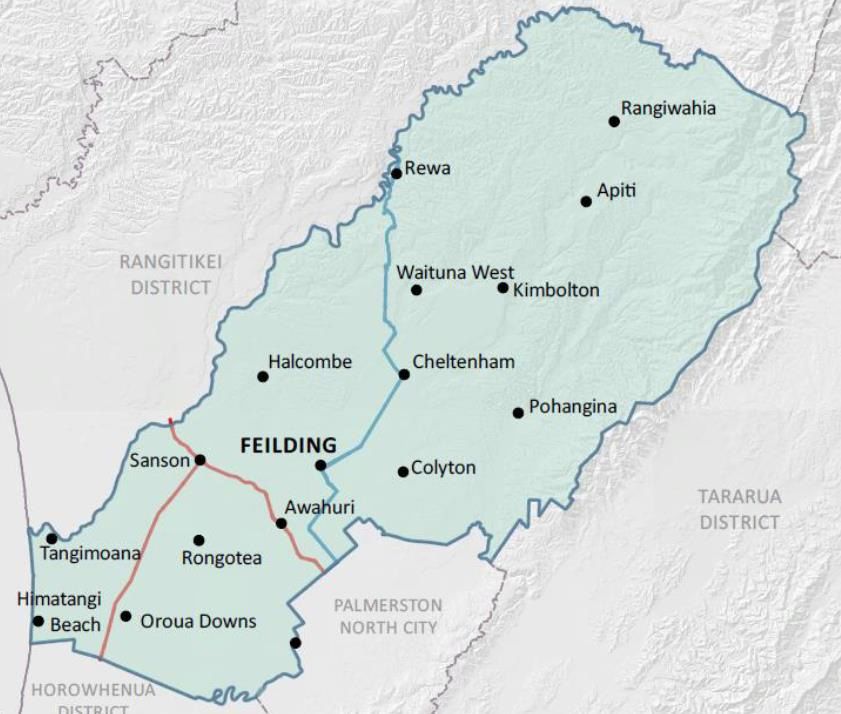
The Manawatū District covers an area of 256,300 hectares, stretching from Rangiwahia in the north to
Himatangi Beach and Palmerston North in the south. The western boundary is the Rangitikei River (see
Figure 4-1). In 2018 the Manawatū District had an estimated population of 30,800. Approximately half of
the population lives in Feilding (the largest town and main service centre for the district), with the remainder
dispersed across townships, villages and rural communities.
Figure 3-2: The Manawatū District
3.3 Existing Walking and Cycling Network
Additional detailed information on this section can be found in Appendix 3.
Cycling in the District
Most of the Manawatū area is relatively flat which lends itself to be being conducive for cycling. The existing
cycle network within the ManawatŪ District is relatively undeveloped, however since the development of the
2007 Strategy progress has been made to increase the amount of cycle facilities provided in urban areas.
Much of this has centred within Feilding as the primary urban area where the most cycling for transport
purposes is undertaken. Despite investment in these routes, the existing network within Feilding is fragmented
and lacks connectivity (See Appendix 3, Figure 3A).
A comprehensive cycle network has been identified within Feilding that would provide connections between
existing and future residential growth areas and key local destinations such as centres of employment, schools,
and recreational spaces (See Appendix 3, Figure 3B).
Manawatū District Council - Walking and Cycling Strategy 2020
10Manawatū District Council - Walking and Cycling Strategy 2020
11The Feilding cycling network will include:
• Urban Cycle Routes: cycle routes that are generally within the road reserve which may include: on-
road marked cycle lanes, shared off-road cycle/pedestrian facilities, treatments at intersections, parking
restrictions and signposting of key routes.
• Recreational Routes: walking and cycle facilities that are generally located within parks and reserves;
and
• Cycle Touring Routes: routes that provide connections to rural recreational, sporting or touring routes.
Table 3-3: Future cycle routes identified within the Feilding urban area
Routes Map ID From To
Makino Road / Reid Line Connection (Precinct 4) 1 Lethbridge Street Arnott Street
Makino Stream Walkway (Precinct 4) 2 Reid Line North Street
Roots Street 3 Pharazyn Street Makino Road
Lethbridge Street 4 Almond Grove Makino Road
Pharazyn Street 5 North Street Reid Line
Arnott Street 6 Pharazyn Street Reid Line
North Street 7 West Street Kimbolton Road
West Street 8 South Street North Street
Manchester Street 9 West Street Kimbolton Road
Aorangi Street (Green Spine) 10 Grey Street East Street
Derby Street 11 North Street Kimbolton Road
Kimbolton Road (West) 12 South Street Manchester Street
South Street 13 West Street Aorangi Street
Manchester Street 14 Kimbolton Road South Street
Derby Street 15 Kimbolton Road East Street
East Street 16 Kimbolton Road Aorangi Street
Oroua River Walkway 17 Aorangi Street Kitchener Park
Other Cycle Route Requests
Routes From To
Feilding to Palmerston North Cycleway Feilding Palmerston North
City to Sea Rail Trail Cycleway Palmerston North Himatangi Beach
Cheltenham to Feilding Cycleway Cheltenham Feilding
Halcombe to Feilding Cycleway Halcombe Feilding
Kitchener Park Cycleway Loop Track through Kitchener Park Reserve
Manawatū Village Loop Loop track linking villages through Manawatu District
Beyond Feilding, provisions for cyclists in rural areas are generally limited to direction signage with few
dedicated cycling facilities provided within or between rural townships; however, new cycle facilities
have recently been developed in some rural communities to support safe access to school, including the
development of a shared path facility within Hiwinui.
Manawatū District Council - Walking and Cycling Strategy 2020
12Figure D1: Identified Future Feilding Routes
Manawatū District Council - Walking and Cycling Strategy 2020
13Pedestrian Network
The District has over 132km of formed footpaths. Feilding has a well-developed network of footpaths, with a
programme of new footpaths identified within the Precinct 4 residential growth area. There are opportunities
to enhance access and safety of existing facilities through improved pedestrian crossing facilities, upgrading
footpaths and crossing points to modern standards and providing improved linkages to residential areas located
within the urban fringe or future growth areas.
Existing footpath provisions within rural communities are varied. Where footpaths are not provided, pedestrians
are required to walk on grass berms or share the road with vehicles. This raises both perceived and actual safety
concerns and can be particularly challenging for more vulnerable road users such as the elderly or children.
Recreational Network
The District has over 200 hectares of parks, reserves and open spaces for community use that are
administered and managed through Reserve Management Plans.
Significant investment has been undertaken in recent years to improve walking and cycling connectivity to and
through these spaces, such as the recent development of the Timona Park to Johnston Park and the Makino
Stream walkways. Opportunities to further enhance the walking and cycling recreational network are currently
being considered through the Reserve Management Plan review process.
Walking and Cycling Strategy
14Regional Network
The District is well connected to walking and cycling routes of regional significance (see Figure 4-4). The
Nga Haerenga The New Zealand National Cycle Trail is a set of premiere grade Great New Zealand Rides and
Heartland Rides developed by the Ministry of Business, Innovation and Employment (MBIE) that will develop a
nationwide cycling network, enabling locals and international visitors to explore all of New Zealand by cycle.
The Manawatū Cycleway is identified as a “Heartland Ride” within the New Zealand Cycle Trail (NZCT). The
route follows the official Manawatū Scenic Route between Mangaweka (on SH1) and Palmerston North, and
forms part of the Tour Aotearoa route. The route provides a link to other adjacent or nearby Heartland Rides,
including Gentle Annie to Hawke’s Bay, the Ohakune to Taihape Trail, and the Tararua Traverse which heads
over to the northern Wairarapa.
Potential future Heartland Rides within the District include the Gorges to Sea Cycleway, which would provide
linkages between the Manawatū Cycleway and Himitangi (via Ohakea, Tangimoana and Himitangi Beach).
The Te Araroa Trail is a walking route of national significance that passes through the District. The Te Araroa
Trail is a 3,000km walking route from Cape Reinga (North Island) to Bluff (South Island). Within the Manawatū
District the route primarily runs along local roads from Bulls to Palmerston North via Feilding. It is estimated
the route had 1,000 people walking its full length, with many more walking individual sections each year.
The proposed City to Sea Cycleway is a 30km route that would connect existing cycling facilities between
Longburn and Palmerston North city centre to Himitangi Beach. The project is currently being driven by the
Bainesse and Districts Community Development Trust. Although Council has not allocated any funding to this
project, it is supportive of the proposal to construct a cycleway from the City (Palmerston North) to the Sea
(Himatangi). Requests for funding will be considered in the future as the plans become finalised.
Figure 4-4: Manawatū District’s Regional Walking and Cycling Network
Manawatū District Council - Walking and Cycling Strategy 2020
154. Challenges and Opportunities
The Strategy recognises the following key challenges and opportunities relating to the role of walking and
cycling within the District:
• Reversing declining participation rates in walking and cycling for transport
purposes;
• Increasing physical activity and supporting the health and wellbeing of the
community;
• Responding to changing mobility and access needs of an aging population;
• Supporting sustainable population growth through the provision of transport
choices;
• Improving the perceived and actual safety of walking and cycling;
• Leveraging the economic potential of regionally significant walking and
cycling routes within the District
4.1 Issues and Trends
Walking and Cycling as a Mode of Transport
Walking and cycling as a mode of transport has declined over the past 20 years both at a local and national
level. Lifestyle changes have played a part, and the convenience and availability of low-cost vehicles and
consequent traffic growth have contributed to this decline.
The community perception that active modes are unattractive, unsafe and inconvenient means they are not
effectively contributing to the overall transport system, despite the overwhelming health and other benefits of
travelling by this mode. The dispersed nature of the community and large commuting distances means there
is a greater reliance on private car for day-to-day access to key services, including employment, shopping,
leisure, health and education.
As of the 2013 Census, walking and cycling in the District as a mode of travel for work comprised 5.3% of all
trips, significantly lower than the national average of 7.8%. Census data indicates that walking and cycling to
work within the District has steadily declined since 2001, when 7.3% of all commuter trips were undertaken by
these modes (see Figure 5-1). In contrast, vehicle ownership and the use of private vehicles for commuting has
increased over this period (see Appendix 5).
National travel surveys have also shown a dramatic reduction in children travelling to school by foot or by bike.
In 1990, 54% of children travelled to school by these modes, compared with 31% in 2014. Within the Mid-
Central District, approximately 48% of children aged 5-14 years of age travel to school by foot or on bike.
Walking and Cycling Strategy
16Figure 5-1: Percentage of Manawatū Residents Walking and Cycling to Work (2001 to 2013)
60.0% 6.0%
5.1%
5.0% 4.5%
4.0%
50.0% 4.0%
3.0%
2.2%
1.8%
2.0%
40.0% 1.3%
1.0%
0.0%
30.0%
Bicycle Walked or jogged
20.0%
10.0%
0.0%
Worked Did not Drove a Drove a Passenger Public Train Motor Bicycle Walked Other
at home go to private company in a car, bus cycle or or jogged
work car, truck car, truck truck, power
today or van or van van or cycle
company
bus
2001 2006 2013
Safety
Perceived and actual safety for users is a key barrier for encouraging uptake of walking and cycling within the
District. In consulting with the community, safety was identified as the primary barrier to people walking and
cycling more often. The perception of poor safety is not unique to the District, with the Cycling Safety Panel’s
Safer Journeys for People who Cycle (2014) notes:
“cycling surveys consistently state the number one reason people do not cycle, or do not let
their children cycle, is they believe it is too dangerous”.
Whilst the District is not identified as an area of concern area compared with other Districts at a national
level3, any crashes involving vulnerable road users are undesirable, and safety concerns will deter people from
travelling by foot or on bike.
3
NZTA Communities at Risk Register 2018
Walking and Cycling Strategy
17Since 2008, 74 reported crashes involving pedestrians or cyclists have resulted in an injury within the District,
of which six resulted in a fatality and 16 resulted in serious injuries. Vehicle speeds are a significant factor in the
severity of injuries, with all recorded fatalities involving pedestrians and cyclists occurring on high speed, open
rural roads.
More information on the issue of safety can be found in Appendix 4.
Population Growth
The resident population of the Manawatū District as of 2018 is estimated to be 30,800. The District is
expected to experience steady population growth for the foreseeable future, with medium population growth
projections forecasting the District’s population will increase to 40,300 by 2048. In response, household
growth is expected to increase from 12,300 households in 2018 to 17,500 households by 2048. Most future
growth is expected to be centred within Feilding, however, strong growth has also been experienced in recent
years in rural townships.
Further population growth combined with a high level of dependency on private motor vehicles will lead to
adverse impacts on the efficiency and safety of the network if not adequately planned for. Population growth
will also increase demand for local recreational opportunities, including walking and cycling. Increasing
participation and accessibility for walking and cycling both as a mode of transport and for recreation is
important in supporting an efficient, sustainable and affordable transport system.
Aging Population
The Manawatū District is expected to experience an increase in population of elderly residents (aged over 65
years), from 17.8% of the District’s population in 2018 to over 28% by 2048.
Elderly populations have different access needs to the rest of the community. They are generally less mobile,
more susceptible to trip hazards and more vulnerable when crossing the road; in particular those with declining
vision, hearing or cognitive functions. Older communities are also less likely to have access to private vehicles,
increasing reliance on travelling by foot or other modes such as public transport for day to day activities;
therefore, being able to walk or cycle safely can mean access services and retain social connections.
As the growing population continues to age, there will be greater need for improved pedestrian facilities that
are accessible and provide transport options to ensure residents do not become socially excluded. This places
additional emphasis on maintaining footpath conditions, ensuring safe and effective crossings are provided and
footpaths that are wide enough to support wheelchairs or other walking aids.
Changing technology and the growing use of mobility scooters and e-bikes has the potential to significantly
change the way communities travel. There is the potential for e-bikes to change the demographics of cyclists
by making cycling more accessible to a wider age group. As the prevalence of, and access to, new technologies
increase there is a need to consider how best to adapt infrastructure to safely support this developing technology.
Health and Wellbeing
The New Zealand Health Survey (2018) is an annual survey that provides a snapshot of community health over
time. The surveys indicate that the community is less physically active compared with national averages; only
33% of responses within the Mid-Central District population stated they are physically active compared to 50.2%
nationally.
Physical activity within the Mid-Central District also appears to be declining; in 2012, 53% of responses noted
they were physically active. The surveys also show more adults than national average are overweight or
obese, and suffering from conditions such as high blood pressure, heart disease, diabetes and mood or anxiety
disorders.
Manawatū District Council - Walking and Cycling Strategy 2020
18Tourism and Economic Growth
The Manawatū District Economic Development Strategy seeks to actively grow tourism and visitation to
the District by attracting more visitors to enjoy the outstanding rural landscape and the Country Road, and
encouraging development of additional visitor/tourism infrastructure that supports economic growth.
There is a growing focus on the development of walking and cycling tourism at a national level. Statistics
provided by Tourism New Zealand indicate 73% of holiday visitors participate in walking or hiking and nearly 10%
participate in some form of cycling whilst in New Zealand. These visitors generally stay longer, visit more regions
and spend more in the economy .
Studies of other national cycle routes within New Zealand indicate the development of cycle trails have
assisted in revitalising small communities, increased and expanded the number of local businesses, and
created new jobs close to the locality of the trails . Evidence from other cycle trails within New Zealand indicate
international visitors spend between $60-$330 per person, per day when travelling on nationally recognised
cycleways .
The Manawatū is well situated to leverage the economic benefits of the growing demand for walking and
cycling tourism. There are several regionally significant walking and cycling routes that pass through the District;
however, Manawatū District is not realising the benefits of these facilities to their full potential. For example,
feedback from the Te Araroa Trust suggests as many as 50% of those walking the full route avoid sections in the
Manawatū due to the high proportion of roadside walking .
4.2 Opportunities
Providing safe and convenient walking and cycling networks that are connected and coherent will increase the
attractiveness of walking and cycling both as a mode of transport and for leisure.
It is also recognised that to successfully develop a culture change where more people choose to walk or cycle,
a more holistic approach is required beyond the delivery of infrastructure. Delivering educational, behaviour
change and promotional activities that complement infrastructure development will inform, encourage and
support communities in choosing to travel on foot or by bike, and help to maximise the benefits of investing
in the network.
The opportunities and identified strategic responses to identified issues within the District are summarised
within Table 5-1.
Walking and Cycling Strategy
19Table 5-1: Identified Opportunities and Strategic Responses
Issue Opportunities Strategic Responses
Declining numbers of Towns and villages are relatively flat and Connected and Integrated
people travelling to work on compact, meaning walking and cycling
• Provide a connected
foot or by bike across the can be an attractive and practical option
network of safe and
District for shorter journeys
convenient cycle paths
Delivering a connected and integrated within Feilding and
network will increase the convenience between Feilding and
and attractiveness of walking and cycling. Palmerston North.
There is significant potential to grow • Provide walking and
commuter cycling within Feilding, with cycling connections
more than half of its residents com between townships;
muting short distances to employment in particular, where
destinations within the town. they support regionally
significant facilities.
Beyond Feilding, there are opportunities
to deliver critical links within the walking • Deliver footpath
and cycling network that create barriers improvements in
for communities travelling to local townships that connect
destinations such as schools, workplaces the “missing gaps” in the
and recreational facilities. network, and minimise
the need for walking or
There are also opportunities to provide
cycling on the road.
better walking and cycling connections
between urban areas with growing Safe and Accessible
populations.
• Deliver wayfinding
signage and bicycle
stands that support
access to key
destinations.
Declining number of Motivating school age to walk and cycle Safe and Accessible
children travelling to school creates lifetime travel habits. Road skills
• Provide safe cycle and
on foot or by bike across the that can have a long-lasting effect on
walking routes around
District future travel choices and encourage
schools.
younger communities to be more active
and lead more healthier lifestyles. Encourage and Support
Encouraging more children to walk and • Develop school travel
cycle can reduce congestion and improve plans and training
safety outside the school gates. programmes to support
increased walking and
cycling amongst school
children.
Manawatū District Council - Walking and Cycling Strategy 2020
20Declining health and Enabling more people to use active Support and Encourage
wellbeing within the District modes can contribute to improved health
• Promote the benefits
outcomes as people regularly incorporate
of walking and cycling
active travel into their daily life, increasing
for health to our
levels of physical activity.
communities.
Improved fitness lowers the risks of
• Provide improved access
health-related issues such as obesity,
to information about
heart disease and diabetes, and can
walking and cycling
positively impact on mental health.
within the District.
Improved fitness is also beneficial to the
Develop and Grow
economy, with studies showing increased
productivity within the workforce and a • Work with communities
reduction in staff absences at work. to deliver local walkways
and loop tracks identified
in Community Plans.
• Enhance access to parks
and reserves through
recreational walking and
cycling routes.
• Explore new recreational
opportunities such as
mountain biking and
BMX tracks.
Changing access and Ensuring that walking and cycling Safe and Accessible
mobility needs of an ageing networks are inclusive and accessible
• Plan, design and maintain
population (including the promotion of disability
the built environment to
access for all members of the
cater for future changes
community) will support mobility to
in mobility, including the
services and retain social connections.
provision appropriate
Applying best practice design standards amenities (i.e. seating,
in developing new infrastructure or rest stops).
future maintenance and renewal work
• Engage with mobility
will ensure the transport network is
groups and undertake
compatible with the needs of all users.
accessibility audits in key
Responding to future changes in destinations (i.e. town
mobility and growing use of technology centres) to identify and
(scooters and e-bikes) has the potential resolve local issues or
to significantly change the way aging barriers to access.
communities travel.
• Review and enhance
access to mobility
parking provisions within
the District.
• Investigate and identify
the need for facilities that
support the growing use
of e-bikes.
Manawatū District Council - Walking and Cycling Strategy 2020
21Supporting and enabling Providing connected and integrated Connected and Integrated
sustainable growth walking and cycling networks
• Implement proposed
within future growth areas provides
walking and cycling
communities with transport choices,
facilities identified within
access to recreational opportunities and
the Urban Growth
support in reducing the impacts of future
Precinct Plan.
growth on the transport network.
• Ensure new
Working closely with developers and
developments provide
key service delivery partners will ensure
safe, convenient and
connected and integrated walking and
attractive linkages for
cycling networks are achieved within
pedestrians and cyclists.
future growth areas.
• Enhance access to public
Key mechanisms for support sustainable
transport when reviewing
growth include the District Plan, Structure
services to future growth
Plans and other strategies (such as Town
areas within the District.
Centre Plans) to ensure land-use planning
is effectively integrated with the existing Encourage and Support
and future transport network. • Review District Plan rules
for new developments
to promote end of
trip facilities for cyclist
and pedestrians in
workplaces (i.e. cycle
parking).
Improving the perceived and Improving the safety of cycling and Safe and Accessible
actual safety of walking and walking is a key part of improving • Develop and maintain
cycling accessibility and encouraging uptake of
safe and connected
cycling and walking as a transport mode
routes by applying
and for leisure.
‘best practice’ urban
Investment in the provision of design and engineering
appropriately designed and maintained standards.
infrastructure and speed management is
• Identify and undertake
particularly important to increase access
remedial work in areas
to, and uptake of, active forms of travel.
with high crash or safety
Other initiatives such as education, concerns.
promotion and regulation activities can
• Provide safe crossing
be delivered collaboratively with key
points for pedestrians on
partners, which could contribute towards
state highways, arterial
improving the safety of travelling by these
roads and areas with high
modes.
pedestrian activity (i.e.
town centres).
• Review speed limits on
open roads and around
sensitive land uses such
as schools and town
centres.
Manawatū District Council - Walking and Cycling Strategy 2020
22• Enhance cycle touring
routes through signage,
shoulder widening
and removal of pinch-
points through future
maintenance / renewal
works.
Encourage and Support
• Promote and support
safety for vulnerable road
users through education,
training and enforcement
programmes.
Leveraging the economic Enhancing, developing and promoting Develop and Grow
potential of regionally regionally significant walking and cycling
• Deliver a shared path
significant walking and routes, as well as diversifying the range of
connection between
cycling routes active mode activities available for visitors
Feilding and Palmerston
to the District, would attract more visitors
North to support tourist
and contribute towards fully realising
opportunities (i.e. Te
Manawatū’s economic potential.
Araroa Trail).
Raising the profile of the District as a
• Provide connections to
destination for walking and cycling
new recreational facilities
through promotional activities that
proposed within Te Apiti
actively encourages residents and visitors
as part of NZTA’s Te Ahu
to make use of the District’s offerings.
a Taranga (Manawatū-
Tararua Highway
replacement project).
• Support the expansion of
proposed regional cycle
routes within the District,
such as the City to Sea
Cycleway and NZCT
Heartland Rides.
• Provide connections
between the regional
cycle network and local
townships, services and
other key attractions
within the District.
• Market the District’s
regional and recreational
network in co-ordination
with other agencies.
Manawatū District Council - Walking and Cycling Strategy 2020
235. Action Plan
Appendix 1 identifies a range of prioritised actions that aim to take the vision identified within this Strategy
through to an achievable reality. The Action Plan provides staged approach in achieving the overarching vision
and supporting goals of the Strategy.
Actions identified within the Strategy are primarily the responsibility of Manawatū District Council, although it
is recognised that some actions will be led, or require collaboration with, key strategic partners or community
groups.
Each action identified within the Action Plan has been prioritised based on the following:
Priority Description
Business As Usual “Business as Usual” actions include activities, plans or policies that are already
delivered by Council or other strategic partners. Continuing to deliver these
actions will contribute towards achieving the strategic objectives.
Immediate Actions These include projects or initiatives that are proposed for immediate focus.
Immediate actions include:
• Quick-win projects that could be implemented in the short-term.
• Capital programmes that require additional investigation, planning and
consultation in the short-term to inform an implementation plan for
inclusion within the 2021-31 10 Year Plan.
• Regionally significant projects that are currently programmed for
delivery within Council’s 10 Year Plan.
Medium Priorities Medium priority actions are projects and initiatives that would strongly
contribute towards the strategic objectives of the Strategy that could be
delivered over the lifecycle of the next 10 Year Plan.
These include complementary initiatives that could be delivered once
strategic infrastructure improvements have been delivered to maximise
the benefit of physical infrastructure investment (such as behaviour change
programmes).
Future Priorities Future priorities are actions that will contribute to the identified strategic
objectives; however, they not considered critical within for delivery within
the next three years and have been included to provide a future “line of sight”.
The priority allocated to these actions may change in future revisions of the
Strategy.
Manawatū District Council - Walking and Cycling Strategy 2020
246. Monitoring and Reporting
Monitoring is important in evaluating the progress of the Strategy in achieving the vision and the desired
strategic outcomes for the District. The success in delivering the vision of the Strategy will be assessed against
a range of measures, including walking and cycling participation; health related indices; pedestrians and cyclist
safety trends on the network; and resident satisfaction relating to existing facilities. Progress towards realising
the vision, goals and objectives of the strategy will be measured by the following indicators:
Goal 2019 Figure8 Metric
Walking and Cycling Increase in the number Total Active Modes: 5.3% NZ Census
Participation of people who travel to Walking: 4.0% (2013)
work by foot or by bike. Cycling: 1.3% (2013)
Participation rates for Walking – 57% Annual Active
walking and cycling Running – 34% NZ Surveys
within the Manawatū
Road Cycling - 21%
District (weekly).
Mountain bike/BMX – 15%
Increase in numbers Benchmark to be Annual Reporting
of children cycling and established
walking to school.
Percentage completion Benchmark to be Annual Reporting
of the strategic cycle established
network.
Increase in pedestrians Benchmark to be MDC Monitoring
and cyclist volumes on established
key strategic routes (once
counting stations have
been established).
Increase in the number of Benchmark to be Counting Stations
visitors who cycle or walk established
Annual Surveys
on key regional facilities
in the Manawatū District.
Health Decrease in levels 36.2% (2017) NZ Health
of obesity within the Annual Surveys
Manawatū District.
Safety Decrease in the 36.2% (2017) NZ Health
proportion of crashes Annual Surveys
involving pedestrians
and cyclists, relative to
all crashes within the
Manawatū District Council - Walking and Cycling Strategy 2020
25Safety District. Reduction in 8.7 crashes per annum NZTA Crash Database
the number of crashes (2008-2018)
involving pedestrians and
cyclists
Resident satisfaction Increase in the level of Walkways / Cycleways – Annual Resident Surveys
satisfaction expressed by 72% (2017) Footpaths/
residents regarding active Crossings – 65% (2017)
transport infrastructure
Increase in resident Benchmark to be Resident Surveys
perception of safety established
for walking and cycling
within the District
Network Condition Percentage of footpaths 95% of the District's Activity Management Plan
within the District footpaths are within Target
classified as complying acceptable defect levels
with defined level of
service
In developing the benchmarks, it is recognised that the availability of baseline data on the number of people
walking and cycling within the District is relatively limited. The collation of baseline and on-going data is essential
in monitoring the progress of the Strategy in achieving its intended objectives. Census data provides a useful
snapshot of information and uptake of walking and cycling at a local, regional and national level; however, there
are limitations in using this data (i.e. data is only collated at 5-year intervals). Other data, such as annual counts
of pedestrian and cycling volumes on key strategic routes could be collated and reviewed on an annual basis.
9
Potential third party funding opportunities may include existing or future funding sources such as the Urban Cycleways
Funds, Provincial Growth Funds, charitable funds or community funding where applicable.
Manawatū District Council - Walking and Cycling Strategy 2020
26Manawatū District Council - Walking and Cycling Strategy 2020
277. Next Steps
7.1 Implementation Plan
Priorities for walking and cycling are set around the 3-year review cycles of the Ten Year Plan (10YP). The LTP
sets out the direction of Council and the funding needed over a 10-year period. Setting the walking and cycling
priorities to the LTP cycle ensures that projects and infrastructure requirements coincide with Council’s major
funding rounds.
The implementation of physical infrastructure and supporting programmes is dependent on funding
availability, based on Council’s capital expenditure budget (from rates) as well as other sources such as NZTA
funding contributions (through the National Land Transport Fund), or (where eligible) other Government or third
party funding sources9.
A key next step in delivering the Strategy is the development of an Implementation Plan, which will provide the
framework for identifying specific projects and budgeting requirements for inclusion within future Long Term
Plans. The Implementation Plan will focus primarily on delivering projects identified as immediate and medium
priorities within the Action Plan. The Implementation Plan will be reviewed and assessed annually, in line with
Council’s annual plan process.
Larger programmes of capital work identified within the Strategy will require further investigation, feasibility
and costing before schemes are programmed for inclusion within the next LTP (2021-2024). Programmes of
work identified within the Strategy that require planning and prioritisation in the immediate short-term to inform
future implementation plans include:
• Planning and delivering the urban cycle network within Feilding
• Planning and delivering a district-wide programme of new footpaths; and
• Planning and delivering a district-wide programme of recreational walkway projects
7.2 Scheme Prioritisation
In delivering these immediate priorities, a proposed prioritisation matrix has been developed to assist
in assessing the benefits and relative merits offered by proposed new walking and cycling facilities (see
Appendix 6), to ensure future funds are spent on projects that achieve the greatest community benefit. The
matrix will also allow Council to re-evaluate and/or re-prioritise projects when new or additional projects are
identified, or formal requests for facilities are received by the community.
The intention of the prioritisation matrix is to:
• Score and rank walking and cycling projects into a prioritised list
• Identify higher priority footpaths/cycleway projects for inclusion within future 10YPs
• Ensure funds are spent on projects that achieve the greatest community benefit
• Provide a consistent and transparent system for assessing projects
• Provide prompt feedback from Council on the likely status of any community requests.
The prioritisation approach allows identified projects to be assessed against the following:
• Project cost (based on rough order estimates)
• Prioritisation score (based on prioritised criteria)
• Additional factors, such as availability of external funding
The scores established through the prioritisation matrix will provide an indication of the relative priority that
Manawatū District Council - Walking and Cycling Strategy 2020
28could be afforded to projects for future delivery programming; however, in prioritising routes, some may be
given additional priority as a result of:
• External Funding Availability – where projects attract external funding (i.e. NZTA subsidy) and would
reduce delivery costs for Council, additional priority could be given to these projects.
• Works Integration – where wider work is being undertaken on the network (such as road renewals
and maintenance), walking and cycling projects could be accelerated for cost and delivery efficiencies.
The prioritisation matrix is intended to operate as a “live” database for future improvements. It enables Council
to consider new facilities at any time, and also allows the priority of any route to be easily re-evaluated if
circumstances change (e.g. new bus stops are provided). The prioritisation matrix therefore should only be
used as an indicator of project priority and should be reviewed on an ongoing basis as projects are identified for
inclusion.
Footpath Prioritisation Criteria
Table 8-1 outlines potential assessment criteria that could be used in the development of the proposed footpath
prioritisation matrix. Further detail of proposed criteria and potential scoring system is outlined within Table 6A
in Appendix 6.
Table 8-1: Proposed Footpath Project Prioritisation Criteria
Criteria Factor
Road and Land Use • Likely pedestrian demand
Environment • Road function
• Posted speed limit
• Safety record
Existing Pedestrian • Presence of existing footpath provisions
Provisions • Connections to existing footpaths (i.e. completes a link)
Implementability • Availability of berm space
• Terrain or engineering complexity
Connections to • Proximity to local schools
Destinations • Proximity to key community facilities
• Connectivity to the public transport network
• Linkages to regionally significant routes or tourism routes
• Linkages to identified growth areas
Manawatū District Council - Walking and Cycling Strategy 2020
29Cycleway Prioritisation Criteria
Table 8-2 outlines potential assessment criteria that could be used in the development of the proposed
cycleway prioritisation matrix. Further detail of proposed criteria and potential scoring system is outlined
within Table 6B in Appendix 6.
Criteria Factor
Road and Land Use • Likely usage
Environment • Likely user type
• Traffic volumes on route
• Traffic speeds/heavy vehicle presence
• Safety record
Strategic Alignment • Recognised strategic route
• Connections to existing cycleways (i.e. completes a link)
• Existing route barriers
Implementability • Proximity to local schools
• Proximity to key community facilities
• Linkages to regionally significant routes or tourism routes
7.3 Strategy Review
It is expected that the Walking and Cycling Strategy will be reviewed every three years, in alignment with the
review process of the 10 year plan. This will ensure that the Strategy remains aligned with national and regional
policy, and allow Council to monitor the effectiveness of the projects delivered through the Strategy against its
strategic outcomes.
Walking and Cycling Strategy
30Manawatū District Council - Walking and Cycling Strategy 2020
31ManawatŪ District Council P 06 323 0000
135 Manchester Street F 06 323 0822
Private Bag 10001 E public@mdc.govt.nz
Feilding 4743 www.mdc.govt.nz
Manawatū District Council - Walking and Cycling Strategy 2020
32Walking and
Cycling Strategy
Appendices
www.mdc.govt.nz
Manawatū District: Walking and Cycling Strategy 12 Manawatū District: Walking and Cycling Strategy
Contents
APPENDIX 1 - Action Plan                                                       4-9

APPENDIX 2 - Plans and Strategies                                             10-16

APPENDIX 3 - Existing Walking and Cycling Network                             17-19

APPENDIX 4 - Safety                                                             20

APPENDIX 5 - Trends                                                           21-25

APPENDIX 6 - Route Prioririsation Matrices                                    26-32

APPENDIX 7 - List of Community Requests for Walking and Cycling Facilities    33-37

Appendix 1: Action Plan

Starts on following page

                            Manawatū District: Walking and Cycling Strategy           3
Goal 1: Connected and Integrated
Strategic Outcome: Our communities are connected by quality walking and cycling infrastructure that links people to key destinations
Action Enabling Priority
Action Timeframe Responsibility
# Action Ref
Urban Cycle Network
Investigate primary urban cycling routes included within the Feilding urban cycle network plan. 2020
1 1.1 MCD Immediate
2021
Evaluate potential projects against the prioritisation matrix and programme delivery of key urban routes through future
phases of the LTP.
New Footpath Programme
Identify locations for new footpaths and evaluate potential projects against the prioritisation matrix.
2 1.1,1.3
Adopt a prioritised programme for new footpath provisions on streets that currently have no pedestrian infrastructure 2020 MCD Immediate
where there is demonstrable demand (i.e. residential streets and destinations such as schools, retails areas etc)
Recreational Walkways through Parks and Reserves
3 1.1,1.4 Identify and prioritise walking and cycling linkages through and to parks and open spaces based on the outcomes of the 2020 MCD Immediate
Reserve Management Plans (currently under revision).
Township Connections
Identify opportunities to develop potential walking and cycling linkages between rural townships, prioritising projects that MCD
4 1.3 Ongoing Medium
Communities
contribute to or link with identified regionally significant facilities.
Supporting Future Growth
Continue with the phased development of walking and cycling within key growth areas within the District (i.e. Precinct 4).
5 1.2 Ensure a connected and integrated walking and cycling network is provided within future growth areas through the Ongoing MCD Medium
development of Structure Plans and consenting procedures.
Township Connections
Identify opportunities to develop potential walking and cycling linkages between rural townships, prioritising projects that MCD Business
6 1.1, 1.4 Ongoing
Communities as Usual
contribute to or link with identified regionally significant facilities.
Pedestrian Crossing Programme
Business
7 1.4 Continue to investigate and deliver programmes of pedestrian crossing improvements, particularly on urban sections of Ongoing MCD as Usual
the State Highway and arterial road network.
Public Transport Integration
Business
8 1.5 Work in partnership with Horizons Regional Council to identify opportunities to support and enhance access to public Ongoing MCD, HRC as Usual
transport when reviewing services within the District.
4 Manawatū District: Walking and Cycling StrategyGoal 2: Safe and Accessible
Strategic Outcome: Our walking and cycling network is safe and accessible by people of all ages and abilities
Action Enabling Priority
Action Timeframe Responsibility
# Action Ref
Bicycle Parking
9 2.1, 2.3 Undertake a review of existing end-of-trip facilities at key trip destinations (i.e. town centres, public buildings, shopping 2020 MCD Immediate
districts) and develop a staged implementation programme for delivering bicycle parking facilities.
Branding and Wayfinding
10 2.4 Develop consistent branding and wayfinding of key pedestrian and cycle routes to improve network legibility and access 2020 MCD Immediate
through the District.
Communities on State Highway
11 2.1, 2.2, 2.3 Engage with NZTA in developing improved walking and cycling provisions on the State Highway network, particularly Ongoing MCD Medium
where they interact with local townships or villages.
E-Bikes
12 2.1,2.3 Investigate and identify the need for new facilities that support the growing use of e-bikes for commuting and leisure Ongoing MCD Medium
purposes (i.e. dedicated cycle parking, charging stations etc).
Mobility Parking
13 2.3 Review existing mobility parking provisions within the District and identify opportunities to enhance access for mobility
Ongoing MCD Medium
impaired users (i.e. accessibility ramps).
Neighbourhood Accessibility Audits
2.1, 2.2, Ongoing MCD
14 Undertake accessibility audits at key destinations (such as town centres). Identify and prioritise minor works programmes
2.3, 2.5 that support safe and accessible routes based on audit findings. Medium
Speed Limit Reviews
15 2.1, 2.2 Review opportunities to reduce existing speed limits on open roads and around sensitive land-uses (i.e. schools) to ensure
consistency with the NZTA's Speed Management Guidelines. Ongoing MCD
Medium
Investigate opportunities to reduce speed limits below 50km/hr in high pedestrian/cycle areas (i.e. town centres).
Cycle Training Routes
16 2.2, 2.3, 2.5 Identify routes for long distance cycling and seek opportunities to increase width/seal shoulders during road rehabilitation/ Ongoing MCD Future
pavement reconstruction.
Traffic Calming
17 2.1, 2.2 Ongoing MCD, HRC Future
Develop a policy for traffic calming within the District and identify priority routes for implementing initiatives.
Liaison with Mobility Groups
Business
18 2.2, 2.2, 2.3 Engage with mobility groups to identify local issues or barriers to access. Identify, prioritise and implement improvements Ongoing MCD as Usual
in minor works programme.
Manawatū District: Walking and Cycling Strategy 5Safe Routes to School
Business
19 2.1, 2.2 Continued delivery of road safety educational campaigns that raise awareness of safety issues for pedestrians and cyclists, Ongoing MCD, HRC
as Usual
in particular on rural roads.
Safety Education
Business
20 2.6, 2.1 Develop consistent branding and wayfinding of key pedestrian and cycle routes to improve network legibility and access 2020 MCD as Usual
through the District.
Footpath Widening
Ensure all new footpaths and walkways are planned and designed to provide at least minimum widths outlined within best Business
21 2.3, 2.5 practice / MDC Engineering Standards. Ongoing MCD
as Usual
Ensure existing footpaths are widened to minimum standards (where practical) as part of maintenance and renewal works.
Design for Accessibility
Review suitability of existing and future footpath provisions for older age groups, including provisions for mobility scooters,
drop-kerbs, sensory aids, path widths and grading.
22 2.1,2.3, 2.5 Provide additional supporting infrastructure and facilities (such as seating, rest stops, toilets, water fountains etc) on Business
Ongoing MCD
existing and future routes where appropriate. as Usual
Ensure that best practice urban design principles are applied that create environments that support pedestrians and
cyclists, particularly within high use spaces (such as town centres).
Ensure CPTED principles are applied when developing walking and cycling infrastructure within the District
Routine Maintenance
23 2.3, 2.5 Ensure existing footpaths are maintained to the required levels outlined within the Asset Management Plan. Business
Ongoing MCD
as Usual
Ensure cycleways and roads with high cycle demands are regularly maintained (i.e. road sweeping, edge seal conditions) to
maintain a safe environment for users.
6 Manawatū District: Walking and Cycling StrategyYou can also read


