WATER 2018 MARKET INTELLIGENCE REPORT - GREENCAPE
←
→
Page content transcription
If your browser does not render page correctly, please read the page content below
Water
–
2018
Market Intelligence Report
–
GreenCape
                                              GreenCape is a non-profit organisation that drives the widespread
                                              adoption of economically viable green economy solutions from
                                              the Western Cape. We work with businesses, investors, academia
                                              and government to help unlock the investment and employment
                                              potential of green technologies and services, and to support
                                              a transition to a resilient green economy.

                                              Acknowledgments
                                              We thank Jane Reddick (lead author) and Bridget Fundikwa
                                              (contributor) for the time and effort that went into compiling
                                              this market intelligence report. We also thank Raymond Siebrits,
                                              Helen Seyler and Jonny Harris for their feedback on draft versions
                                              of the report.

                                              Disclaimer
                                              While every attempt was made to ensure that the information
                                              published in this report is accurate, no responsibility is accepted
                                              for any loss or damage to any person or entity relying on any
                                              of the information contained in this report.

                                              Copyright © GreenCape 2018

                                              This document may be downloaded at no charge
                                              from www.greencape.co.za. All rights reserved.

                                              Subscribe to receive e-mail alerts or GreenCape news, events
                                              and publications by registering as a member on our website:
                                              www.greencape.co.za.

                                              Image courtesy of: Bruce Sutherland

                                              18 Roeland Street, Cape Town, 8001, South Africa

                                              Editorial and review: Lauren Basson, Salomé Bronkhorst, Nicholas Fordyce
                                              			and Claire Pengelly
                                              Images: 			           GreenCape, Western Cape Department of Agriculture
                                              			and Bruce Sutherland
                                              Layout and design: 		 Deep Agency

II   Water: Market Intelligence Report 2018   Water: Market Intelligence Report 2018                                     III
Contents                                                                                                        List of figures
Executive summary                                                                                              1     Figure 1
What’s new?                                                                                                    2     Opportunities to reduce reliance on traditional surface water supply                                      3
1. Introduction and purpose                                                                                    3     Figure 2
2. Sector overview                                                                                             4     Water sources in South Africa                                                                             4
    2.1. South African context 		                                                                              4     Figure 3
    2.2. Western Cape context                                                                                  5     Water use in South Africa by sector                                                                       4
         2.2.1. Western Cape Water Supply System 		                                                            7     Figure 4
         2.2.2. Long-term planning 		                                                                         12     Water Management Areas in South Africa (Western Cape outlined in black)                                   6
3. Policies and regulations 		                                                                                15     Figure 5
    3.1. National legislation 		                                                                              15     Water use by type for the two main Western Cape water management areas                                    6
         3.1.1. The National Water Act		                                                                      15     Figure 6
         3.1.2. The National Building Regulations and Building Standards Act 		                               16     Drought status of Western Cape municipalities (November 2017)                                             7
         3.1.3. Other key national legislation and standards 		                                               17     Figure 7
    3.2. Municipal by-laws and tariffs		                                                                      17     Municipalities supplied by the Western Cape Water Supply System (WCWSS)                                   8
         3.2.1. Water restrictions 		                                                                         17     Figure 8
         3.2.2. Water tariffs 		                                                                              18     Overview of WCWSS allocations by type                                                                     9
         3.2.3. Alternative water use 		                                                                      20     Figure 9
    3.3. Municipal procurement 		                                                                             20     Accumulated daily rainfall at Cape Town Airport                                                           9
         3.3.1. City of Cape Town procurement 		                                                              21     Figure 10
         3.3.2. Procurement in emergency situations 		                                                        21     Water availability in the six largest dams in the WCWSS                                                   10
4. Opportunities and barriers		                                                                               23     Figure 11
    4.1. Water metering and monitoring		                                                                      24     WCWSS planning scenario reconciliation of supply and demand                                               13
         4.1.1. Industrial, commercial and residential markets: water metering and monitoring 		              24     Figure 12
         4.1.2. Municipal market: water metering and monitoring 		                                            25     Maximum abstraction rates permitted under the General Authorisation for Taking and Storing Water (2016)   16
    4.2. Water efficiency and reuse 		                                                                        29     Figure 13
         4.2.1. Industrial market: water efficiency and reuse 		                                              29     Breakdown of municipal operating revenue in South Africa                                                  18
         4.2.2. Commercial and residential markets: water efficiency and reuse 		                             31     Figure 14
         4.2.3. Municipal market: water efficiency and reuse		                                                36     Commercial and industrial water tariffs for CoCT                                                          19
    4.3. Alternative water supply 		                                                                          39     Figure 15
         4.3.1. Industrial, commercial and residential markets: alternative water supply 		                   39     Residential water tariffs for CoCT                                                                        19
         4.3.2. Municipal market: alternative water supply 		                                                 41     Figure 16
5. Funding and incentives 		                                                                                  47     Overview of the key opportunity areas outlined in this report                                             22
    5.1. Water sector funding and incentives 		                                                               48     Figure 17
    5.2. General funding opportunities 		                                                                     48     Municipal non-revenue water at the 2012 baseline                                                          26
         5.2.1. Green Finance Database 		                                                                     48     Figure 18
         5.2.2. Other databases 		                                                                            48     Water reuse opportunities across the water value chain                                                    30
         5.2.3. Ecosystem observations 		                                                                     49     Figure 19
         5.2.4. How the GreenCape Green Finance Desk assists investors 		                                     50     Breakdown of CoCT municipal potable water consumption by use category (1/07/16 – 30/06/17)                33
    5.3. Manufacturing incentives		                                                                           50     Figure 20
6. The Western Cape: Africa’s growing green tech hub 		                                                       51     Typical pre-restriction indoor water use in mid- to high-income households                                33
7. GreenCape’s support to businesses and investors 		                                                         55

IV                                                                          Water: Market Intelligence Report 2018   Water: Market Intelligence Report 2018                                                                     V
List of figures                                                                                                       List of tables
     Figure 21                                                                                                   Table 1
     Typical end uses of water in various types of commercial and institutional facilities             34        Required and available public sector funding for water services infrastructure in 2017    5
     Figure 22                                                                                                   Table 2
     Global increase in potable reuse plants                                                           36        City of Cape Town’s water augmentation programme                                         11
     Figure 23                                                                                                   Table 3
     Groundwater availability in the Western Cape                                                      38        Summary of CoCT Water Restrictions                                                       17
     Figure 24                                                                                                   Table 4
     Estimated rainwater harvesting potential for Claremont, Cape Town (top) and George (bottom)       40        Overview of non-revenue water in South Africa                                            25
     Figure 25                                                                                                   Table 5
     Global installed desalination capacity, 2010 – 2016                                               43        Commercial and residential property market growth (Jan – Aug 2017)                       32
     Figure 26                                                                                                   Table 6
     Energy required for seawater desalination                                                         45        Indicative costs and timeframes for various water treatment projects                     44
                                                                                                                 Table 7
                                                                                                                 Water sector funding and incentives                                                      48

VI                                                                      Water: Market Intelligence Report 2018   Water: Market Intelligence Report 2018                                                   VII
List of acronyms
           and abbreviations
B-BBEE    Broad-based Black Economic Empowerment                                                     TCTA		              Trans-Caledon Tunnel Authority
CCA		     Customs-Controlled Area                                                                    VAT		               Value Added Tax
CCCI		    Cape Chamber of Commerce and Industry                                                      WCWSS		             Western Cape Water Supply System
CoCT		    City of Cape Town                                                                          WC		                Western Cape
CSAG		    Climate System Analysis Group                                                              WCWDM               Water Conservation and Water Demand Management
DEADP		   Department of Environmental Affairs and Development Planning                               WEF		               World Economic Forum
dti		     Department of Trade and Industry                                                           WMA		               Water Management Area
DWA		     Department of Water Affairs (now DWS)                                                      WRC		               Water Research Commission
DWAF		    Department of Water Affairs and Forestry (now DWS)                                         WUL		               Water Use Licence
DWS		     Department of Water and Sanitation                                                         WWF		               World Wide Fund for Nature
EME		     Exempted Micro Enterprise                                                                  WWTW		              Waste Water Treatment Works
GA		      General Authorisation
GDP		     Gross Domestic Product
GVA		     Gross Value Add
MAR		     Managed Aquifer Recharge

                                                                                                     Conversions
MFMA		    Municipal Finance Management Act
MIR		     Market Intelligence Report
MLD		     Megalitres (million litres) per day
MPA		     Marine Protected Area                                                                      1 Megalitre = 1 million litres = 1 000 kl = 1 000m3
NBR		     National Building Regulations
NRW		     Non-Revenue Water
NWA		     National Water Act
O&M 		    Operations and Maintenance
PACE		    Property Assessed Clean Energy
PAYS		    Pay As You Save
PPP		     Public Private Partnership
QSE		     Qualifying Small Business Enterprise
RFQ		     Request for Quotation
SANS		    South African National Standard
SEZ		     Special Economic Zone
SUDS		    Sustainable Urban Drainage Systems

VIII                                                        Water: Market Intelligence Report 2018   Water: Market Intelligence Report 2018                               IX

Executive summary
         This market intelligence report (MIR) is aimed at investors interested
         in the South African urban water sector, with particular emphasis on
                               the Western Cape region.

The current drought and the expected longer                    New residential and commercial property

                                                                                                                                                          What’s new?
                                                          ■■

term water constraints in the region are key drivers           developments in the province are a key market
for investment in this sector. The demand for                  for water efficient devices and greywater
technologies and services that enable resilience               reuse systems, presenting a potential market of
to water scarcity has substantially increased                  ~R900 million per year.
across all urban markets, and new investment
opportunities have opened up in four key areas:           ■■   Municipalities are increasingly interested in
                                                               potable water reuse of their municipal wastewater.
■■   water metering and monitoring                             In Cape Town there is a potential market of around
■■   water efficiency                                          R2 billion.
■■   water reuse
■■   alternative water supply                             ■■   There are a number of opportunities relating
                                                               to groundwater and rainwater systems across
The drought has placed considerable strain on water            all private sector markets. The potential residential
resources across the province, leading to risks of             market in the Western Cape could be worth                         Since the publication of the 2017 Water Market Intelligence Report
insufficient supply, business shutdown, financial              ~R5.8 billion.
                                                                                                                                 (MIR) there have been substantial developments in investment
losses and retrenchments. In addition, water
restrictions are becoming more and more stringent         ■■   Large-scale seawater desalination is an emerging                  opportunities in the urban water sector in the Western Cape.
across the province, and businesses and residents are          market that presents a number of opportunities for                The drought has had a severe impact on business, has resulted in
under increasing pressure to reduce their demand               investors. Globally, equity returns in desalination               water restrictions, and has led to efforts by the private sector and
of municipal water supply. The drought has also                projects are typically at least 14%, with higher
resulted in municipalities procuring emergency                 returns (up to 18%) expected in higher risk countries.
                                                                                                                                 municipalities to avoid acute water shortages. This has opened
augmentation supplies, and re-assessing their longer                                                                             investment opportunities for technologies and services that enable
term plans for drought resilient supply options.          Some general barriers to these opportunities include:                  resilience to drought and longer-term water constraints caused
                                                                                                                                 by climate change. This year’s report focuses specifically on these
As a result, numerous opportunities have been             ■■   Public perceptions can prevent market growth,
identified:                                                    particularly in the case of water reuse.                                                investment opportunities.

■■   The demand for smart water metering systems          ■■   Property leasing creates complexity around                        Readers of last year's MIR are encouraged to read this year's report
     is increasing across the private sector, as a tool        implementing water-related projects.
                                                                                                                                  in full, as the market intelligence has been updated substantially.
     for improved water management in the context
     of the drought.                                      ■■   There is currently a shortage of qualified
                                                               plumbers experienced in installing alternative
■■   The potential market for Water Conservation               water supply systems.
     and Water Demand Management (WCWDM)
     projects that reduce non-revenue water in            ■■   Capital costs are often a constraint, particularly
     South African metros is estimated at ~R2 billion          in the residential market.
     a year, of which ~R500 million is unfunded (DWS
     & SWPN 2015b).                                       The municipal sector also has a number of barriers
                                                          specific to this market, which relate to access to funding,
■■   Water reuse in the industrial sector presents        capacity constraints, municipal creditworthiness, and
     opportunities for both technology and service        procurement processes.
     providers. The total Gross Value Add (GVA)
     for moderate and highly water intense users          Both the general barriers and some of municipality-
     in the WC in 2016, excluding agriculture, was        specific ones also represent opportunities for investors.
     R155 billion (Quantec 2017).                         They suggest good prospects in the Western Cape,
                                                          and more widely in South Africa, for investment
                                                          in technologies that enable resilience to drought and
                                                          adaptation to longer-term water scarcity.

1                                                                             Water: Market Intelligence Report 2018    Water: Market Intelligence Report 2018                                          2
1–                                                                                                                                                       2–
      Introduction and purpose                                                                                                                                      Sector overview
           This market intelligence report (MIR) has been compiled by                                                                         Water scarcity is a major challenge in South Africa that also
           GreenCape’s Water Sector Desk. It is aimed at investors interested                                                                 represents a substantial opportunity for investors and businesses
           in the South African urban water sector, with particular emphasis                                                                                         in the water sector.
                              on the Western Cape region.

Water scarcity is currently a key driver for investment              scarcity related investment opportunities and                The section provides an overview of the sector in                                Current usage is estimated to be 15-16 billion
in this sector in the Western Cape due to the                        barriers (Section 4). The final sections outline             the South African and the Western Cape contexts                                  m3/year, and in many water supply systems the
current drought and the expected longer-term                         various finance and investment incentives (Section           with the focus on aspects relevant to water scarcity.                            water usage exceeds the reliable yield (DWS
water constraints in the region. This year’s report                  5), present the case for the Western Cape as a                                                                                                2017b). This essentially means that while the water
focuses on the immediate opportunities in four key                   potential greentech hub for Africa (Section 6), and          2.1. South African context                                                       supply sources can meet this increased usage, the
areas (Figure 1) that promote drought resilience by                  explain GreenCape’s work within the green economy            The ‘water crises’ challenge was ranked by the                                   assurance of supply is less than 98%. Thus water
reducing reliance on supply sources traditionally                    (Section 7).                                                 World Economic Forum (WEF) as the third highest                                  shortages are likely to be experienced more often
dominated by surface water. These opportunities                                                                                   risk for doing business in South Africa in 2017, and                             than two out of every 100 years. As indicated
relate specifically to a) water metering and                         There is a strong link between agriculture and               is also one of the top risks globally (WEF 2017).                                in Figure 3, agriculture is the largest water-use
monitoring, b) water efficiency, c) water reuse and                  water, particularly in water constrained contexts.           South Africa is ranked as the 30th driest country                                sector (62%), followed by municipal water use
d) alternative (non-traditional) water supply.                       For investment opportunities in the agricultural             in the world. It is a highly water-stressed country,                             (27%), which includes residential, commercial and
                                                                     sector, including technology opportunities for               with extreme climate and rainfall fluctuations                                   industrial users supplied by municipalities (DWS
Alternative water supply includes groundwater,                       improved water efficiency, please consult the 2017           (WRI 2015). Despite being a water-scarce country,                                2017b).
rainwater and desalinated seawater. More general                     and 2018 Agriculture Market Intelligence Reports1,           consumption is around 233 litres/capita/day (l/c/d),
information on the South African water value                         as well as the GreenAgri2 portal.                            compared to the international benchmark of around                                The relative proportion of urban and agricultural
chain, water policy and governance, and wider                                                                                     180 l/c/d (DWS 2017a)4. South Africa has a reliable                              use differs between provinces and municipalities,
value chain opportunities can be obtained from                       While every effort has been made to ensure the               yield (i.e. the supply from current infrastructure)                              depending on settlement patterns and the local
GreenCape’s 2017 Water MIR.                                          information in this report is correct and as up              of around 15 billion m3/year (at 98% assurance of                                economy.
                                                                     to date as possible at the time of publishing in             supply), of which the majority is from surface water
The report provides a sector overview (Section 2),                   February 2018, readers should be aware that the              (68%) and return flows that support surface water
which outlines the issue of water scarcity in both                   market is changing rapidly. For up-to-date market            (13%), as shown in Figure 2 (DWS 2017b).
the South African and Western Cape context.                          information, please visit GreenCape’s drought
This is followed by an overview of policies and                      support webpage3.
regulations (Section 3) that are relevant to water

                                                                                                                                                                             68%        • SURFACE WATER                                                        27%        • MUNICIPAL
                                                                                                                                                                             13%        • RETURN FLOWS                                                          3%        • MINING
          Water metering                                                                              Alternative water                                                      13%        • GROUNDWATER                                                           3%        • INDUSTRY
                                                 Water efficiency          Water reuse
          and monitoring                                                                                   supply                                                             6%        • OTHERS                                                                3%        • AFFORESTATION
                                                                                                                                                                                          (seawater/                                                            2%        • ENERGY
                                                                                                                                                                                          brackish water
Figure 1: Opportunities to reduce reliance on traditional surface water supply                                                                                                            desalination)                                                        62%        • AGRICULTURE

                                                                                                                                  Figure 2: Water sources in South Africa                                          Figure 3: Water use in South Africa by sector

1   www.greencape.co.za/market-intelligence
2   www.greenagri.org.za                                                                                                          4   These figures are based on the system input volume divided by the population served. The system input volume includes commercial and industrial demand and
3   www.greencape.co.za/content/focusarea/drought-business-support                                                                    water losses through infrastructure leaks, etc.

3                                                                                        Water: Market Intelligence Report 2018   Water: Market Intelligence Report 2018                                                                                                                      4
Water demand in South Africa is expected Table 1: Required and available public sector
to exceed supply by 17% in 2030, with demand funding for water services infrastructure
expected to grow from 15 billion m3 in 2016 to
in 2017 po
18 billion m3 over this period (WWF 2017). po
m
Li s
nt
fa
li hi
O at
Water Services Required Budgeted o m hu
t
k u
Infrastructure Funding Funding In Us
Over the next 10 years, Elements (R bn) (R bn)
R70.4 billion of investment in l
Va a
national water infrastructure Municipal water 27.8 17.1
will be needed infrastructure Pong
o
Mzim lo
ku l
u
Regional bulk 10.1 7.4
Orange
(potable)
infrastructure
In order to address water scarcity and provide
reliable water to all people, businesses and
industries in South Africa, it is estimated that Regional bulk 7.0 4.0 M z i mvu b u -
over the next 10 years an investment of around (non potable) Be
rg
ts
Ts i t s i k a m m a
ifan
R70.4 billion is required each year in water infrastructure Ol Breede
Gouritz
infrastructure (DWS 2017b). This includes refurbishing
and upgrading existing infrastructure, as well Water resources 25.5 14.9
as new infrastructure to support population and infrastructure
economic growth. However, with a budgeted Figure 4: Water Management Areas in South Africa (Western Cape outlined in black)
funding of only R43.4 billion in 2017, there are Total water 70.4 43.4
significant shortfalls in available funding within
infrastructure
the public sector (i.e. R27 billion in 2017) for water
infrastructure, as shown in Table 1 (DWS 2017b).
Sanitation 19.5 13.2
infrastructure
2.2. Western Cape context
The Western Cape Province, in the south-west
Total water 89.9 56.6 Berg-Olifants WMA Breede-Gouritz WMA
corner of South Africa, falls predominantly within
two water management areas (WMAs), the Breede- services
Gouritz and the Berg-Olifants (Figure 4). Irrigation infrastructure
to support agriculture is the major water use in
these two WMAs, followed by urban water use5, as Funding shortfall 33.3 37% 61% • IRRIGATION 87.7% • IRRIGATION
shown in Figure 5 (StatsSA 2010). 36.8% • URBAN 7.9% • URBAN
1.9% • RURAL 2% • RURAL
0.3% • BULK INDUSTRY 0.5% • BULK INDUSTRY
0.1% • AFFORESTATION 1.9% • AFFORESTATION
Figure 5: Water use by type for the two main Western Cape water management areas6
5 Urban water use includes the residential, commercial and industrial use of water supplied by the municipality, whereas bulk industrial refers to mining 6 This figure gives an indication of the relative proportions of water use in the two WMAs. The exact quantities will fluctuate depending on a number of factors,
and industrial use that is not part of urban systems. including water restrictions and curtailments
5 Water: Market Intelligence Report 2018 Water: Market Intelligence Report 2018 6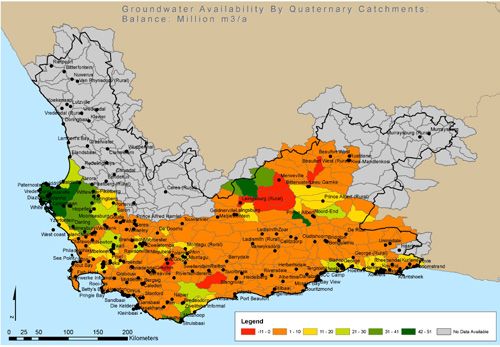
2.2.1. Western Cape Water Supply System
The Western Cape Water Supply System (WCWSS),
Short- and long-term water which supplies water to several municipalities
constraints create significant within the Berg-Olifants WMA, is one of the
private sector investment most important supply systems in the country. It
opportunities in the Western supplies water to a region that produces 84% of
the province’s gross domestic product (GDP) and
Cape’s urban water sector. approximately 11% of national GDP (Quantec
2017).
As shown in Figure 7, the WCWSS is a complex,
The province is currently drought-stricken and water
interlinked system of dams, pipelines and
scarcity is a significant challenge. In May 2017, the
distribution networks that supplies water to
entire province was declared a disaster area. The
CoCT, West Coast District Municipality (which
Western Cape Government regularly assesses the
supplies water to Swartland, Saldanha Bay and
level of risk of each municipality. Figure 6 indicates
Bergrivier local municipalities), Stellenbosch Local
the risk status in November 2017. For more up to
Municipality and certain agricultural users.
date information, please consult the Western Cape
Government website7.
In 2014/15 the total annual consumption within the
WCWSS was estimated at 547 million m3. The total
As in the rest of South Africa, the short- and long-
water allocation for the system is 609 million m3 per
term water constraints in the province represent
year. Figure 8 provides a breakdown of allocation
significant private sector investment opportunities
by end user.
in the region’s urban water sector.
Legend
Western Cape Municipal Drought Risk Hydrological Drought Risk
! High
( Medium
!
( Low
!
High Risk: Water Demand and Availability under
threat that requires urgent interventions in resource Figure 7: Municipalities supplied by the Western Cape Water Supply System (WCWSS)
development and infrastructure establishment.
Medium Risk: Water Demand and Availability under
restriction due to lack of assurance of supply and/or
lack of infrastructure and/or exceeding lawful allocation.
As shown in Figure 7, the WCWSS is a complex, Even without making provision for the ecological
Lutzville
Low Risk: Water Demand and Availability not at risk interlinked system of dams, pipelines and reserve, the total allocations exceed the system
!
!
Vredendal
Klawer
distribution networks that supplies water to yield of 582 million m3 per year. There are no
!
Murraysburg
CoCT, West Coast District Municipality (which further opportunities to build additional large dams
(
!
Lamberts Bay
(
!
(
!
Graafwater supplies water to Swartland, Saldanha Bay and to augment the supply (DWS 2015). Consequently,
Clanwilliam (
!
(
!
Wuppertal
(
!
Beaufort West Bergrivier local municipalities), Stellenbosch Local even prior to the drought, the system was
Municipality and certain agricultural users. considered to be relatively constrained.
Redelinghuys Citrusdal
(
! (
!
±
Dwarskersbos Eendekuil Merweville
Aurora
! (
! (
! Leeu-Gamka
!!
Paternoster (
!
! Saint
! Prince (
!
! Piketberg
In 2014/15 the total annual consumption within the The drought, which is linked to below-average
Helena Bay Albert
Jacobsbaai
! ! Road
! Porterville
!!
Louwville ! Langebaanweg (
! (
!
! Langebaan
!
!
!
Moorreesburg
Gouda (
!
Matjiesfontein
(
! (
!
Prince Albert WCWSS was estimated at 547 million m3. The total rainfall, particularly in 2016 and 2017 (CSAG 2017),
Churchhaven
water allocation for the system is 609 million m3 per has placed additional strain on the WCWSS. The
Yzerfontein Riebeek-Wes Touwsrivier Laingsburg
( !
! (
(
!
(Darling !
! Riebeek-Kasteel!
(!
( (Hermon (
!
( Ceres
! De Doorns Ladismith De Rust
(
! Zoar Calitzdorp
( Malmesbury
!
year. Figure 8 provides a breakdown of allocation accumulated daily rainfall at Cape Town Airport is shown in
Wolseley (
! ! (
! ! Oudtshoorn !
(
Wellington Worcester Volmoed (
! (
! Uniondale
(
!
Paarl (
! Van Wyksdorp (
! Dysselsdorp (
! Haarlem 1 : 3 000 000
Cape Town
Klapmuts !
(
!
(
Stellenbosch
Robertson
(
!
McGregor
( Ashton
!
(
!
Montagu
Barrydale
(
!
Ruitersbos Karatara
(
!
by end user. Figure 9. The latest rainfall information can be
( (
! George
accessed from the University of Cape Town’s Climate
! ( Pniel !
! ! (
! Herbertsdale ! (
!
Sedgefield
Plettenberg
Franschhoek Genadendal !( Buffelsjagrivier
(Groot Brakrivier !
( ! Data Source:
(
!
(Bereaville
Bonnievale (!
! (
! Heidelberg (
! (
!
( (
! ! ! Bay !
( (
Natures
Grabouw Villiersdorp!
(! (
! (
Suurbraak ( Hartenbos
! (
! Wilderness (
!
Wittedrif Dept of Water and Sanitation
Greyton (
! (
! Riversdale Knysna Valley
Approximately two-thirds of the allocation is for urban System Analysis Group (CSAG) webpage8. Figure
( Slangrivier
! Dana Bay ! ( Klein Brakrivier Dept of Local Government
(
! ( Riviersonderend
!
( Botrivier
! (
! Klipdale Malgas
Albertinia !
( ( !
Vlees Bay!
(
Mossel Bay
Betty's Bay Caledon ( !
! ( (
! Witsand
Stilbaai (
!
use (including residential, commercial and industrial 10 shows that the levels of the six largest dams in
(
! Onrus Protem
Hawston !(
(!
! (
! (
!
(!
!
( (
Fisherhaven Stanford Napier
(
! (
!
Elim (
! Bredasdorp
use), and the remainder is allocated for irrigation – the WCWSS are considerably lower than in previous
Kleinbaai!
( De Kelders !
(
!(! (
( Franskraal Strand Arniston
Gans Bay! (
! (
!
Pearly Beach L'Agulhas Source: Esri, DigitalGlobe, GeoEye, Earthstar Geographics, CNES/Airbus DS, USDA, USGS,
!!
((
Struis Bay AeroGRID, IGN, and the GIS User Community which is used in the summer months (DWS 2015). years (CoCT 2018a). The last 10% of water stored in
the dams is difficult to access.
Figure 6: Drought status of Western Cape municipalities (February 2018)
7 www.westerncape.gov.za/general-publication/latest-western-cape-dam-levels 8 www.csag.uct.ac.za/current-seasons-rainfall-in-cape-town
7 Water: Market Intelligence Report 2018 Water: Market Intelligence Report 2018 8m3/year Percentage water stored in major dams (WCWSS)
216 • AGRICULTURAL (CAPPED)
358 • URBAN: CITY OF CAPE TOWN
23 • URBAN: WEST COAST
4 • URBAN: OVERBERG WATER
3 • URBAN: STELLENBOSCH
2 • URBAN: DRANKENSTEIN
2 • URBAN: PIKETBERG
2 • OTHER
Figure 8: Overview of WCWSS allocations by type Figure 10: Water availability in the six largest dams in the WCWSS9
Figure 9: Accumulated daily rainfall at Cape Town Airport
9 The six largest dams in the WCWSS are the Theewaterskloof, Voëlvlei, Berg, Wemmershoek, Steenbras Lower and Steenbras Upper dams. This information
is regularly updated and can be accessed at www.capetown.gov.za/Family%20and%20home/residential-utility-services/residential-water-and-sanitation-
services/this-weeks-dam-levels
9 Water: Market Intelligence Report 2018 Water: Market Intelligence Report 2018 10Table 2: City of Cape Town’s water augmentation programme In response, the CoCT, which historically relied on
the WCWSS for 98% of its supply (CoCT 2017a),
Augmentation Projects10 MLD11 Timeframes initiated a water resilience portfolio response.
This includes various measures to further decrease
Short-term temporary water demand (including reduced water pressure,
desalination more communication campaigns, increased water
restrictions and fines, and the installation of water
Strandfontein 7 Full production May 2018 management devices on non-compliant residential
properties). As shown in Table 2 (CoCT 2018b), the
Monwabisi 7 Full production May 2018
City is also in the process of procuring alternative
V&A Waterfront 2 Full production March 2018 water supply from various sources, including
groundwater, seawater desalination and potable
Groundwater water reuse.
Cape Flats aquifer ~80 Underway, incrementally ramping up to an In Saldanha Bay, where industrial and commercial
average demand of 55MLD, peaking at ~80MLD water use accounts for around 60% of the total
municipal water consumption, the municipality 2.2.2. Long-term planning
Atlantis aquifer ~25 5 MLD already refurbished in the system, a is working with the large water users to jointly The current drought can only be broken with
further ~20 MLD underway address water constraints in the region. Through 3-4 years of above-average rain, and the effects of
water efficiency and reuse measures, the demand the drought are long term. The climate projections
Table Mountain Group ~75 Underway, incrementally ramping up to an
for municipal water has reduced from around 41 for the Western Cape indicate a warming trend as
aquifer average demand of 64MLD, peaking at ~75MLD MLD in 2015 to 37 MLD in early 2017 (before well as projected drying in many areas, with longer
Potable Water Reuse water restrictions) and then further to around 28 time periods between increasingly intense rainfall
MLD in late 2017, once restrictions were in place. events (DEADP 2014). Population and economic
Zandvliet WWTW12 10 10 MLD by June 2018 The large water users include three smelter-type growth will place additional burden on water supply
manufacturing facilities located near the Port of systems, which in turn will have a negative impact
Other ~75 Investigating permanent reuse in the order of Saldanha, collectively using 7-8 MLD, and four fish on the province and consequently the country’s
75MLD processing factories (three of them in St Helena economy, and particularly the contribution of the
Bay), using around 2.5-4 MLD. Groundwater agricultural sector13. It is therefore likely that water
Permanent desalination abstraction, upgrading treated effluent, industrial scarcity will continue to be a challenge in the
wastewater reuse and seawater desalination, are province in the long term, and has been termed
Site to be confirmed 120-150 Optimum site is being explored. Pilot (20 MLD) among the options being explored and procured ‘the new normal’.
being constructed at Koeberg. by both the municipality and the companies
Other themselves. Reconciliation strategy studies forecast future
demand and then provide recommendations on how
Albion spring 3 Operational Stellenbosch Municipality, which has been on to reconcile the gap between demand and supply
Level 5 water restrictions since September 2017, by developing new water resources or reducing
Oranjezicht spring 1 Operational has reduced its consumption (of municipal water) demand. These recommendations form the long-
from 38 MLD to 25 MLD, as of December 2017. Of term reconciliation strategies of municipalities.
Water transfers 8 million m3 is being transferred from the the 25 MLD, ~23 MLD is urban use and ~3 MLD
Groenland Water User Association in the is rural use. In addition to various demand-side Figure 11 presents the reconciliation strategy for
first half of 2018. Further transfers under measures, augmentation interventions have also the WCWSS under the ‘planning scenario’14 from
investigation. been initiated to increase the water supply, mainly the latest publicly available data on the WCWSS
by adding to the existing 30 boreholes that extract Reconciliation Strategy (2015). Solid lines show
water from the Stellenbosch aquifer. water demand projections (high growth scenario =
yellow and low growth = blue) with the red solid
Most of the remaining municipalities are looking at line indicating current usage. Solid fills show the
groundwater to supply their emergency and long- planned water supply interventions, along with
term requirements. their height (or stacked thickness) indicating the
estimated yields for the different interventions.
13 The GVA of agriculture in the Western Cape is R18.6 billion (which is 22% of South Africa’s agricultural GVA) and export revenues exceed R40 billion per year.
Around 216 000 people are employed in primary agriculture and 250 000 employed in agri-processing in the province (WCG 2017).
10 This is the anticipated programme as of March 2018, and is subject to change.
11 MLD = million litres per day 14 The ‘planning scenario’ assumes that the City of Cape Town achieves 50% of its WCWDM strategy, that climate change does not impact water availability,
12 WWTW = Wastewater treatment works and that the ecological reserve has not been implemented.
11 Water: Market Intelligence Report 2018 Water: Market Intelligence Report 2018 12The strategy is expected to be revised in the near
future. Planned interventions may change, along
with a potential recalculation of system yield
on the basis of the current drought experience.
Nevertheless, the strategy gives an indication of
the interventions being considered and planned
for the WCWSS. These interventions include
potable water reuse (from wastewater treatment
plants), groundwater development (new resources
and artificial recharge) and large-scale permanent
seawater desalination. In this regard, long-term
plans have already been in place for several years.
Many of the planned projects are now being fast-
tracked and re-assessed, e.g. through the CoCT’s
water resilience water augmentation programme.
1000
10
ANNUAL REQUIREMENTS (MILLION M3 PER YEAR)
900
9
8
800
7
5
700
4
3
2
600
500
EXISTING SYSTEM YIELD
400
2010
2012
2014
2016
2018
2020
2022
2024
2026
2028
2030
2032
2034
2036
2038
10 - Voëlvlei Phases 2 & 3 6 - Artificial Groundwater Recharge 2 - Re-Use Phase 1 HIGH-GROWTH SCENARIO (3.38%/A)
9 - Desalination Phase 3 5 - Table Mountain Group Aquifer 2 1 - Voëlvlei Phase 1
LOW-GROWTH SCENARIO (2.3%/A)
8 - Desalination Phase 2 4 - Re-Use Phase 2
7 - Desalination Phase 1 3 - Table Mountain Group Aquifer 1 ACTUAL WATER USE
Figure 11: WCWSS planning scenario reconciliation of supply and demand
13 Water: Market Intelligence Report 2018 Water: Market Intelligence Report 2018 143– Figure 12
Policies and regulations
There are a number of laws and regulations that are relevant to the
opportunities in the water sector. 15
3.1. National legislation
3.1.1. The National Water Act
National legislation provides the framework of In order to qualify for GA registration, the user
law that is to be applied throughout the country. must comply with all the conditions listed in the
The National Water Act (NWA) of 1998 is the relevant GA. For example, in the case of the GA
key legislation that regulates and protects water for the Taking and Storing of Water (published 2
resources and has effectively transferred all September 2016), one of the conditions limits the
water ownership to the state. Water is a national volume of water that can be abstracted per year.
competence, and the primary responsible authority Figure 12 shows the maximum abstraction rates for
is the Department of Water and Sanitation (DWS). the Western Cape for this GA17.
The Act regulates 11 different ‘uses’ of water, such Seawater desalination does not require permission
as taking water from a resource, storing water, and from DWS for abstraction, provided it is not in an
discharging waste or effluent into a water resource. estuary or river mouth. Similarly, the discharge of
It stipulates that no person can use water without a brine in the ocean does not require permission
water use licence unless: from DWS. However, a coastal water discharge
permit is required from the Oceans and Coasts
■■ it is permissible under Schedule 1 of the Branch18, Department of Environmental Affairs. Figure 12: Maximum abstraction rates permitted under the General Authorisation for Taking
Act (such as reasonable domestic use, non-
and Storing Water (2016)
commercial irrigation, and roof-top rainwater 3.1.2. The National Building Regulations and
harvesting); Building Standards Act
■■ it is a continuation of an existing lawful use; In terms of design and construction, water systems
■■ it is in terms of a general authorisation (GA); or must be consistent with the National Building
3.1.3. Other key national legislation and standards It should be noted that during emergency
■■ the responsible authority has dispensed with Regulations (NBR) SANS 10400. The NBRs fall
Some of the other key national laws and regulations situations (e.g. disasters due to drought) certain
the requirement for a licence. under the National Building Regulations and
that may be relevant to projects in the water sector authorisations can be fast-tracked or are no longer
Building Standards Act (Act 103 of 1977), which
include: required. For example, Section 30A of the National
The above is particularly relevant to alternative governs all building and construction work in South
Environmental Management Act of 1998 states,
water supply projects, including groundwater use. Africa. However, no chapter of the SANS 10400
■■ Water Services Act, Act 108 of 1997
Residents are typically allowed to use groundwater regulations deals directly with water installations
(relevant to the regulation of water and “The competent authority may on its own initiative
on their properties for reasonable domestic in buildings other than those relating to fire
sanitation services provided by municipalities) or on written or oral request from a person,
use without a licence (as per Schedule 1 of the installations. Although it is intended that SANS
■■ South African National Standard for direct a person verbally or in writing to carry out
NWA)16. Businesses that want to use groundwater 10400-XB will cover water efficiency in buildings,
Drinking Water (SANS 241: 2015) a listed or specified activity, without obtaining
must either register the use(s) under a general this section has not yet been developed.
■■ Legal Metrology Act, Act no 9 of 2014 an environmental authorisation contemplated in
authorisation with DWS (which typically takes a few
(relevant to smart metering) section 24(2)(a) or (b), in order to prevent or contain
weeks) or must apply for a water-use licence with
■■ National Environmental Management Act, an emergency situation or to prevent, contain or
DWS (which takes up to 300 working days).
Act 107 of 1998 (relevant to environmental mitigate the effects of the emergency situation.”
authorisations)
Further information can be obtained from the
responsible authorities.
15 The section does not comprehensively cover all legislation relevant to the opportunity ares (water monitoring, efficiency, reuse and alternative water supply).
Instead, it highlights key information that may be useful to potential investors.
16 However, municipalities may still require the registration of boreholes or wellpoints, see Section 3.2.3.
17 In addition to these limits, no more than 40 000 m3 may be taken in terms of the general authorisation per year on a property, regardless of location.
18 www.environment.gov.za/branches/oceans_coast
15 Water: Market Intelligence Report 2018 Water: Market Intelligence Report 2018 163.2. Municipal by-laws and tariffs 3.2.1. Water restrictions
Municipalities have the constitutional competence Water restrictions are currently in place in most
to enact laws (known as by-laws) in respect of water of the municipalities in the province, and up-to- 23% • TRANSFERS RECOGNISED
and sanitation services. date information can be found on the Western 13% • WATER REVENUE
Cape Government website19. Restriction levels, 6% • SANITATION REVENUE
The Department of Water Affairs and Forestry and their requirements, vary from municipality 4% • REFUSE REVENUE
(DWAF), as it was known at the time, developed to municipality, but in general the restrictions
have become progressively stringent over the
46% • ELECTRICITY REVENUE
model water services by-laws for municipalities.
The model by-laws included provisions to course of the drought. Restrictions generally 1% • OTHER SERVICE CHARGES
empower municipalities to prevent wasteful use apply to residential water users, but businesses 7% • OTHER OWN REVENUE
of water, impose water restrictions, require large are increasingly being required to reduce their
users to submit annual water audits, and specify consumption. Table 3 provides an overview of
standards relating to the quality of fittings. The by- how water restrictions have progressed in CoCT
laws contained general clauses relating to water (adapted from 2017b). Figure 13: Breakdown of municipal operating revenue in South Africa
efficiency, but left the specifics to the municipality
to decide. Several municipalities have water by- 3.2.2. Water tariffs In general, municipal water tariffs are not cost-
laws, based on these model by-laws. Municipalities either purchase untreated raw water, reflective (DWS 2017b) and most municipalities
which is taken directly from dams, springs, rivers are reluctant to significantly raise water tariffs,
Table 3: Summary of CoCT Water Restrictions and boreholes, or purchase bulk water from bulk largely for equity and political reasons. However,
water providers (e.g. Water Boards) which is usually the pricing strategy and associated norms and
Level Date Key restrictions Target treated to a potable standard. The CoCT and other standards are being updated by DWS with the
municipalities in the WCWSS purchase raw water drive to ensure that water is more cost reflective
Level 1 2005 ■■ No irrigation 10:00-16:00 10% savings from DWS-owned dams and then treat water in and the water business of a municipality is more
■■ Spray nozzles for hosepipes municipal-owned facilities. In 2015/16 raw water sustainable.
■■ No hosing down hard surfaces charges (which include water management and
■■ No dampening of building sand
infrastructure charges and a water research fund Drought situations, where water augmentation
Level 2 01 Jan 2016 ■■ Irrigation for 1 hour on Tue, Wed, Thurs 20% savings levy) averaged R1.98/kl nationally (DWS 2017b). is required, present additional tariff-related
■■ No irrigation 9:00-16:00 The bulk water tariffs averaged R7.44/kl (R7.44/m3), challenges to municipalities. Water consumption
but varied from R4.18/kl to R15.86/kl, depending decreases, which can lead to a reduction in
Level 3 01 Nov 2016 ■■ Car washing with buckets only 30% savings on various factors including the availability of revenue. For example, by January 2018 the City
■■ Pool covers must be installed water, water quality and distance of distribution of Cape Town had lost around R1.6bn in revenue
Level 3B 01 Feb 2017 ■■ No private car washing with municipal 30% savings (DWS 2017b). due to reduced water consumption. In addition,
water the cost of water increases due to the introduction
Municipalities then distribute potable water to of new water supply sources. Therefore significant
Level 4 01 June 2017 ■■ No irrigation with municipal water 100 litres/person/day their consumers and charge a retail tariff. Revenue increases in tariffs, rates and/or levies can be
■■ No topping up of private pools with from water sales accounts for around 13% of expected in 2018.
municipal water municipal operating revenue, as shown in Figure
Level 4B 01 July 2017 ■■ No topping up of public pools 87 litres/person/day 13 (DWS 2017b). The CoCT has already increased its water and
sanitation tariffs significantly, through its Level 6
Level 5 03 Sept 2017 ■■ Residential: Fines if use > 87 litres/person/day Each municipality is responsible for setting its tariffs that came into effect on 1 February 2018
20kl/month (20m3/month) tariffs and is able to differentiate between users. In (see Figures 14 and 15).
■■ Commercial: 20% less than same general, most municipalities have separate tariffs
month previous year for residential, commercial and industrial water
Level 6 01 Jan 2018 ■■ Residential: Fines if use > 87 litres/person/day users, and will provide a free basic allowance of
10.5 kl/month (10.5 m3/month) water to indigent households. The CoCT’s water
■■ Non-residential properties: and sanitation tariffs are shown in Figure 14 and
45% less than in 2015 Figure 1520. The domestic tariffs are stepped,
whereas commercial and industrial tariffs are a
Level 6B 01 Feb 2018 ■■ Residential: Fines if use > 50 litres/person/day fixed rate.
6kl/month (6m3/month)
■■ Non-residential properties:
■■ 45% less than in 2015
19 www.westerncape.gov.za/general-publication/latest-western-cape-dam-levels 20 The Level 4 tariffs remained in place until 1 February 2018, even though Level 5 restrictions came into effect on 3 September 2017.
17 Water: Market Intelligence Report 2018 Water: Market Intelligence Report 2018 1860
3.2.3. Alternative water use
In order to address the absence of national While alternative water installation guidelines have
50
standards for the installation of alternative not yet been published by other WC municipalities,
water systems (such as greywater, rainwater and many do require prospective groundwater users to
groundwater systems), the CoCT has developed register, and/or get permission to drill boreholes or
40 summary installation guidelines21 for commercial install wellpoints.
and residential properties. The guidelines outline
the required measures to protect the municipal 3.3. Municipal procurement
R/KL (INCL VAT)
30 supply and the water users within the property. They Municipal procurement is regulated by the Municipal
also highlight that approvals are required from the Finance Management Act No. 56 of 2003 (MFMA) and
CoCT for drilling a borehole and for all plumbing its regulations, including the Municipal Supply Chain
20 installations for alternative water systems. Management Regulations (2005). These regulations
specify the minimum requirements, but municipalities
The CoCT’s 2010 Water by-law states that no are allowed to have stricter standards. National Treasury
10 person may use or permit to be used any water also sets further requirements. The MFMA outlines the
obtained from a source other than the water competitive procurement processes, and unsolicited
supply system of the City for ‘domestic’ (defined bids are not encouraged.
0
as cooking, body-washing and drinking) purposes.
LEVEL 1 RESTRICTIONS LEVEN 2 RESTRICTIONS LEVEL 3 RESTRICTIONS LEVEL 4 RESTRICTIONS LEVEL 6 RESTRICTIONS However, certain entities (including residential As stipulated by National Treasury (2017), for projects
(NORMAL YEARS) (SINCE 01/2016) (SINCE 12/2016) (SINCE 07/2017) (SINCE 02/2018)
developments and businesses) may be permitted worth more than R30 000 but less than R50 million (incl.
• POTABLE • SANITATION to use alternative water sources on-site for these VAT), the price contributes 80 points of the total score
purposes, provided they enter into an agreement and the Broad-based Black Economic Empowerment
Figure 14: Commercial and industrial water and sanitation tariffs for CoCT with the City to become a Water Services (B-BBEE) status contributes 20 points. For projects
Intermediary (WSI). Further information is available above R50 million, the price contributes 90 points and
on the City's website. B-BBEE status 10.
1000
The CoCT Water by-law is being amended and the Municipalities can also specify prequalification criteria
900 proposed revisions include a requirement that all to limit the competition to certain groups. These
new developments provide for the installation of groups include companies with higher B-BBEE scores,
800
alternative water systems for certain uses, which exempted micro enterprises (EME22) and qualifying
include toilet flushing, irrigation and laundries. small business enterprises (QSE)23.
700
600
R/KL (INCL VAT)
500
400
300
200
100
0
STEP 1 (>0 ≤ 6KL) STEP 2 (>6 ≤ 10.5KL) STEP 3 (>10.5 ≤ 20KL) STEP 4 (>20 ≤ 35KL) STEP 5 (>35 ≤ 50KL) STEP 6 (>50KL)
• LEVEL 1 (2017/18) RANDS (INCL VAT) • LEVEL 3 (2017/18) RANDS (INCL VAT) • LEVEL 6 (2018) FROM 1/2/2018 RANDS
• LEVEL 2 (2017/18) RANDS (INCL VAT) • LEVEL 4 (2017/18) FROM 1/7/2017 RANDS (INCL VAT) (INCL VAT)
Figure 15: Residential water tariffs for CoCT
21 http://cct.gov.za/bC2nV
19 Water: Market Intelligence Report 2018 Water: Market Intelligence Report 2018 203.3.1. City of Cape Town procurement New Technology Committee
Companies wishing to do business with CoCT
must first register with the City’s supplier The Western Cape Government has partnered
database and the national Central Supplier with the CoCT’s New Technology Committee.
Database (CSD). This committee meets regularly to review and
understand new technologies in the market.
For goods and services less than R200 000, It gives companies the opportunity to present
CoCT publishes Requests for Quotations their products and services to government in a
(RFQs) on its procurement portal24. Companies fair manner. For information on how to submit
must first register as a supplier and then information to the committee, please contact
register on the portal. openinnovation@capetown.gov.za
For goods and services exceeding R200 000
(VAT included), a formal bidding (tender)
process is required. Companies must be
registered as a supplier and registered
on the tender portal25, where tenders are
advertised. Tenders are also advertised in
local newspapers. For tenders valued at more
than R10 million there is a more extensive
process, including additional documentation
requirements.
For more information on the procurement
processes, please visit the CoCT website26.
The list of tenders received by the City, and
their prices, can be viewed here27.
3.3.2. Procurement in emergency situations
Section 55(2) of the Disaster Management Act
(2002) states that ‘if a local state of disaster has
been declared…the municipal council concerned
may…make by-laws or issue directions, or authorise
the issue of directions, concerning…emergency
procurement procedures’. These powers may be
exercised only to the extent that it is necessary for
the purpose of assisting and protecting the public,
providing relief to the public, protecting property,
preventing or combating disruption or dealing with
the destructive and other effects of the disaster.
In October 2017 and in terms of the Disaster
Management Act, the CoCT Council delegated
its authority to the city manager, who is now
able to issue directions without following the
Council’s usual statutory procedures or permission
requirements.
22 Enterprises with an annual turnover of less than R10 million, or recently formed or incorporated entities that have been in operation for less than one year.
23 A business with an annual turnover of more than R10 million but less than R50 million.
24 web1.capetown.gov.za/web1/procurementportal
25 web1.capetown.gov.za/web1/TenderPortal
26 goo.gl/zAjjhj
27 www.capetown.gov.za/Work%20and%20business/Doing-business-with-the-city/Tenders-RFQs-and-supply/Tenders-received
21 Water: Market Intelligence Report 2018 Water: Market Intelligence Report 2018 224–
Opportunities and barriers 4.1. Water metering and monitoring Drivers
The opportunities, drivers and barriers relating to ■■ Water scarcity: Water shortages and intermittent
water metering and monitoring are discussed in this supply are significant risks for many businesses.
section. In 2016/17 the CoCT budgeted almost R200 Businesses are increasingly valuing the importance
There are opportunities for technology and service providers million for meter replacement and new water meter of water metering and monitoring as a tool to
in water metering and monitoring, water efficiency, reuse and connections, and similar amounts are expected for manage their water use.
alternative (non-surface) water supply in the Western Cape. Water the 2017/18 and 2018/19 financial years (CoCT 2016).
scarcity is currently a key driver for investment in the urban water While many of these meters will not be smart meters, ■■ Regulation: Water restrictions and fines (see
sector in the Western Cape. it gives an indication of the budget allocation and Section 3.2.1) have been stimulating the market
market potential for municipal-scale metering. for smart meters in the private sector, as businesses
are increasingly under pressure to better manage
4.1.1. Industrial, commercial and residential their water consumption. In addition, as of 12
Where applicable in this section, the technologies markets: water metering and monitoring January 2018, all groundwater users are required
are discussed according to their end-user markets, to meter their groundwater abstractions and
i.e. the industrial, commercial, residential and Opportunities report readings to DWS on a weekly basis.
municipal sectors. Figure 16 provides an overview Smart water meters: There are opportunities in
of the opportunity areas in the context of this Level 6 water restrictions in all urban private sector markets for smart meters. ■■ Leak detection: Unlike traditional meters, smart
chapter. Cape Town require that all non- The water meter industry has seen substantial metering enables real-time monitoring and
development in the last two decades, with many new analysis, which can be used to detect leaks. This
residential users reduce their ‘smart’ capabilities added to water meters. Many function is increasingly being viewed as a useful
In the industrial and commercial markets,
businesses are re-prioritising their budgets and consumption by 45% compared are now able to communicate with the municipality tool for businesses to realise quick and cost-
directing spending towards technologies in these to 2015 usage, creating or user, monitor consumption patterns, dispense effective water savings.
opportunity areas. For example, several companies prepaid water, provide leakage alerts and restrict
that had planned to invest in solar photovoltaics
appreciable opportunities flows remotely (WRC 2011 and 2015). ■■ Billing inaccuracies: Businesses are installing
have now de-prioritised these projects in favour for the entire water value chain their own ‘check’ meters to verify municipal water
of those that reduce their reliance on municipal The current market lies predominantly in sub- meter readings.
water supply (GreenCape analysis). AAccording to metering (billing) for large residential estates, and
a survey of the members of the Cape Chamber of multi-tenanted/sectional title buildings, as well as the ■■ Water audits: Several municipalities require
Commerce and Industry (CCCI) in October 2017, commercial sector. However, the demand for these large water users to submit audits of their water
65% of the respondents had made changes or systems is increasing across the private sector as a usage on an annual basis. The threshold varies
Figure 16
investments in their business to ensure they will tool for improved water management in the context of between municipalities but, in the case of the
use less water, and 45% have developed long-term the drought. Several local smart metering companies CoCT, those using more than 10 000 kilolitres a
plans to make their business less dependent on have noted a significant increase in sales since around year are required to submit water audits, as per
municipal water supplies (CCCI 2017). the middle of 2017, coinciding with lower dam levels, the City of Cape Town Water By-law (2010). The
higher tariffs and more stringent water restrictions. City is increasingly enforcing this provision, which
compels businesses to better understand their
Water metering & Alternative water Water quality monitoring: There are opportunities water consumption.
Water metering
monitoring Water efficiency Water reuse supplyAlternative water
Water efficiency Water reuse for businesses to offer fast and efficient water quality
and monitoring supply
testing services. With the increasing adoption of Barriers
decentralised alternative water systems (such as ■■ Awareness: In general, there is a lack of customer
Market Section 4.1 Section 4.2 Section 4.3
groundwater and rainwater harvesting), the demand knowledge of smart meters, as well as a lack of
for water quality monitoring has grown significantly. appreciation of their benefits. This is partly due to
Section 4.2.1 In Cape Town, analytical laboratories are struggling
• Industrial effluent treatment
historically underpriced water and low sanitation
Industrial to meet demand, and there are reports of samples tariffs. However, this will likely change as water
• Upgrading treated effluent Section 4.3.1
Section 4.1.1.
• Smart water metering
• Water exchange networks • Groundwater supply being turned away. In addition, water quality tests tariffs increase.
• Rainwater harvesting
Commercial • Water quality monitoring Section 4.2.2 are expensive. Many laboratories offer water quality
• Greywater reuse assessment for between R1 500 and R2 000, with a ■■ Capital costs of smart meters and the
Residential • Water efficient devices
complete SANS241 drinking water quality analysis associated metering infrastructure can be a
Section 4.1.2 Section 4.2.3
Section 4.3.2 costing up to ~R10 000. barrier, particularly for the residential market,
Municipal • Groundwater
• Non-revenue water • Potable water reuse
• Seawater desalination
representing an opportunity for innovative private
sector financing.
Figure 16: Overview of the key opportunity areas outlined in this report
23 Water: Market Intelligence Report 2018 Water: Market Intelligence Report 2018 24You can also read


