Wiki as a professional development tool
←
→
Page content transcription
If your browser does not render page correctly, please read the page content below
AERA 2006

                     Wiki as a professional development tool
Brian Foley & Tae Chang
California State University, Northridge
brian.foley@csun.edu; tae.chang@csun.edu

Abstract:
      This paper examines how wiki technology can be used to support teacher
      professional development. Wiki is a type of interactive web site that
      allows users to contribute content and editing to the site. This technology
      can be used in a number of ways, but in each case the contributions of the
      participants are the key source for information on the site. Wiki
      technology can provide a space for the social construction of knowledge
      of a community. The study looks at wiki use in the teacher professional
      development and by a class of high school students. All users had some
      concerns about the process but most viewed it favorably. Teachers were
      much more reluctant to edit each others’ work than the high school
      students. Recommendations for future use include strong scaffolding of
      the process in the early stages on what to contribute and when to edit
      pages.

Effective teacher preparation should help teachers improve their knowledge of their
subjects, their understanding of students thinking, and of different instructional practices.
A key component of many successful teacher preparation programs is the development of
a community of teacher-learners (Borko, 2004). Several projects have used technology
as a way to support communities of teachers (Barab et al, 2001; Renninger & Shumar,
2002; Schlager, Fusco, & Schank, 2002). This paper looks at wiki, a new technology for
online communities. Wiki describes a type of web site (or a feature of a site) in which
users are allowed to add and edit the content on the site. Many wikis are collections of
information, such as the popular Wikipedia (www.wikipedia.org – an encyclopedia
created by web users). Rather than relying solely on experts, wiki resources are created
and edited by users until the community is satisfied with the information on the site.
Putting together information on a particular topic requires research, synthesis and
presentation of the idea for others, which can also be a powerful learning activity for
members of a community.

The purpose of this paper is to explore how wiki technology can be used to support
preservice teachers as they learn about teaching. Although not developed for education,
wiki technology has features that can be particularly helpful for teachers. We discuss the
implications of the wiki technology for learning and look at an example of how it is being
used in teacher professional development at California State University, Northridge
(CSUN).

                                              1
AERA 2006
Online Communities for Teacher Preparation
In her review of research on teacher professional development, Borko (2004) cites the
need for teachers to develop their knowledge of the content, or their students, and the
practice of teaching. She also notes the success of programs that emphasize creating a
community of teacher-learners. Such communities can provide a way for teachers to
exchange ideas and experiences as they consider new ideas. Successful learning
environments emphasize the participation of the teacher-learners rather than the role of
the professional development instructor. Barab et al. (2001) argue that this approach is
superior to more didactic instruction because it acknowledges the complexity of real
classrooms and supports teachers taking ownership of pedagogical ideas. One goal for
teacher preparation is to develop teachers to be leaders in the classroom and among their
peers. Having teachers take more responsibility for their learning supports this goal.
Technology can be an important tool for supporting communities of teacher-learners. The
first research to explore technology to support learning communities was Scardamalia
and Beriter’s work on CSILE (Scardamalia & Beriter, 1994; Scardamalia, 2004). Their
research demonstrated how computer networks and collaboration software enabled
student groups to work cooperatively and publish their work to the community. Both
aspects of the software served to motivate students. This ground breaking research
identified key features of knowledge building software. Researchers found that having
students publish their work was actually more motivating for many students than turning
work in for a grade. Students often value their standing within their peer group more
than the opinion of an instructor. CSILE used networks and collaboration software to
support community building.
As the internet has grown, new technologies such as blogs and wikis provide new ways to
help people communicate and learn (Goodwin-Jones, 2003). Researchers have begun to
take lessons of CSILE and apply it to different types of learning communities including
preservice teachers. The Inquiry Learning Forum (ILF, ilf.crlt.indiana.edu; Barab et al.
2001) provides an environment for teachers to share information about their classroom
including videos of their teaching and reflect on it with other teachers through the use of
discussion forums. TAPPED-IN (tappedin.org; Schlager, Fusco, & Schank, 2002) is a
site for teachers to chat with other teachers and exchange ideas. Both the ILF and
TAPPED-IN provide opportunities for working teachers to connect with others with
similar experiences and challenges. In both of these programs, a great deal of the
information on the site is provided by the teachers themselves. This is seen as a critical
part of community building and allowing the users to take ownership of the online
environment.
In contrast to the tools for inservice teachers, technology to support preservice teachers
often focuses on instruction and providing examples of teaching for teachers to explore.
Videos of classroom situations and examples of different teaching styles are often used to
support novice teachers with limited knowledge of theory or practice (Hiebert, Gallimore,
& Stigler, 2002; Foley, Livne & Beck, 2004). One of the most comprehensive tools for
preservice teachers, eSTEP (www.estepweb.org; Derry et al., 2004) combines videos as
part of an extensive web of knowledge about teaching and learning for teachers and
2AERA 2006
support for project based learning. The eSTEP site integrates many of the community
development tools with the information that novice teachers need. But unlike the tools
for inservice teachers, the preservice teachers are not able to add to the knowledge base.
Many of these projects (CSILE, ILF, eSTEP) have a number of different features to help
teachers share their experiences and learn more about instruction. But the complexity of
the sites also create inflexibility. It is not easy to adapt these tools to specific needs of a
group of students. The motivation for using wikis in professional development is the
ability to provide some of the same interactions while remaining flexible for different
situations and contexts.
Wiki: Editable Web Pages
Wiki technology provides a way for groups to collaborate on the generation of online
resources and documents. The term ‘wiki’ describes a type of interactive website where
the webpages are editable by the users of the site. Users are able to append or edit
existing pages and add new pages to the site. This allows groups to collaborate on the
generation of web based information. Technically, a wiki is a dynamic website created
with a scripting language such as perl or php, and database on the web server. A large
number of wiki systems (>40) have been created and many are distributed freely as open
source projects. Some of the more popular wiki systems include MediaWiki
(www.mediawiki.org), TWiki (twiki.org) and Moinmoin (moinmoin.wikiwikiweb.de).
Wiki technology has been in limited use for several years, but is now gaining widespread
use with the popularity of Wikipedia. All the wiki systems share the two central features
which define wikis: the ease of adding information to the web, and the ability for
different people to contribute to the same site.
Wikis can be used by single users or groups to collect and present information. The
strength of wiki is the ease with which users can add and edit the content (‘wiki’ comes
from a Hawaiian word for fast). Linking within a wiki is as simple as putting a work into
“camel case” (words with alternating capitol and lowercase letters, e.g. CamelCase) or
with double brackets (‘[[double brackets]]’). Including this code within a page generates
a blank page ready for editing. A similar method allows users to add pictures and other
media or to link to websites outside of the wiki. So an entire site can be developed
without needing to use a web page editor or upload any files. This ease of generating
pages and adding linked content in wiki systems make it easy to create a web of related
information. Similar to a concept map tool, a wiki can be a useful tool for brainstorming,
collecting the thoughts of a group or organizing knowledge (Tonkin, 2005).
The truly revolutionary feature of wikis is their openness to be edited by different people.
While most websites on the internet are secured from editing, wikis are open to the
world, allowing anyone to alter the content. Because every page is open to editing, every
reader is also a potential writer. Thus the structure of the wiki supports and encourages
everyone to contribute. This is in contrast to traditional websites where the instructor –
as the source of information – creates the web site and the students are simply readers.
Wiki can be used in a class to get students to take an active role in creating the content of
the site. Students can summarize readings, make arguments, interpret data, or post
3AERA 2006
questions onto a wiki. On a traditional discussion board, when a student posts
information, other students can only reply. On a wiki, students do not reply, but edit the
information. They edit what is written to add what they think is missing or create new
pages on related topics†. The resulting website is a social construction of the knowledge
within the community (Goodwin-Jones, 2003). By creating a tangible representation for
this knowledge, the wiki supports reflection and consensus building within the class.
This is particularly supportive of the teacher-learner community in its effort to develop
socially constructed knowledge about teaching practice.
Because wikis are public documents, any work that students do on the site is viewed, not
just by the instructor, but by the entire community. Publishing work in this way can be
more motivating for many students than simply turning in writing for a grade
(Scardamalia & Beriter, 1994). Wiki may put more pressure on the writer because they
know that others may come and edit their page if they see mistakes. Wiki users report
that creating pages that do not require significant editing is a point of pride among wiki
users (Wales, 2005). Unlike discussion boards where each person’s writing is clearly
identified, there is no clear identification on a wiki page of whose work is whose. This
has the advantage of creating a public document which everyone can share. But this also
can cause problems for a teacher who wants to assess student’s contributions to the site.
Most wiki systems provide ways of looking at the history of edits of an individual page.
This can be used to see who contributed to an individual page. The history feature also
makes it easy to recover a page in case information is deleted inadvertently (or
intentionally).
Wikis for Learning
The features of wikis create a number of possible uses for education. At the simplest
level, a wiki page can be a useful tool for an instructor who wants to put information
about classes on the web. It is possible to add information to the web site often from
almost anywhere, even in the middle of class (wiki as a presentation tool). It can be used
for individual students to post work to the class, or for groups to collaborate on creating
reports (wiki as a collaboration and publishing tool). Beyond groups, the wiki could be
used to create a knowledge base for the entire class or larger community. The use of
wikis for education may be a powerful tool for students at every level. But it is
particularly appropriate for preservice teachers to be engaged in this activity because they
have a great deal of personal experience to contribute, and because we expect them to
take a leadership role in understanding pedagogical principles in our preservice classes.
Would information generated by students be as good or accurate as that generated by the
instructor? Probably not on the initial attempt, but the process of continued editing by
others, including the instructor, has the potential to create a more accurate and complete
document than the instructor would have done themselves. Wikipedia demonstrates this
principle. Anyone is able to provide information to the online encyclopedia regardless of
their knowledge or experience. But each post is subject to editing by other users,
allowing mistakes to be identified and corrected. A recent study of the accuracy of
†
Most wiki systems include discussion boards so people can discus issues where there is a disagreement on
what information should be posted.
4AERA 2006
Wikipedia found it to be as accurate as the professionally created Britanica and Encarta
encyclopedias (Giles, 2005). Another common concern about wikis is the potential for
abuse or loss of information by careless or malicious users. Many wiki systems include
tools for locking pages or saving editing information to make it easy to retrieve previous
versions. Such abuse is probably not common in many situations. Wikipedia reports
very few incidents of problems on their system which is open to all users (Wales, 2005).
But the Los Angeles Times had to shut their wiki after only a few days because of
offensive comments (Kinsley, 2005). In a classroom situation, editing of wikis may need
to be limited to students (who would have to login to the system). This may eliminate
most of the abuse seen by the Times.
Wiki use at CSUN
In an effort to explore ways of using wikis in different types of classes, instructors at
California State University, Northridge have been using wikis in five different teacher
preparation classes. The classes included both preservice courses and masters level
courses for both single subject and multiple subject teachers. In addition the wiki was
tested in a local high school history class. The classes completed a survey about the wiki
asking about the pros and cons of using wiki, and how it compared to discussion boards.
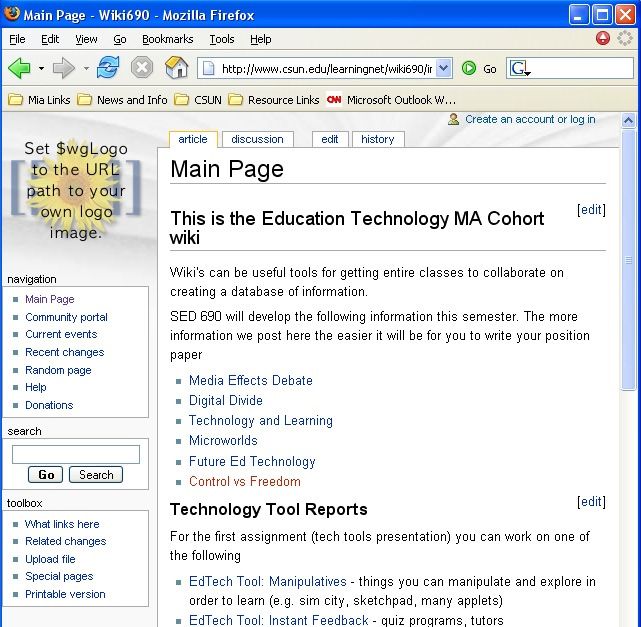
MediaWiki (mediawiki.org) was used for all the CSUN wikis to date. The MediaWiki
system provides several features valuable for teachers including several ways to look at
the history of a page and the total edits made by an individual user. In most cases each
class had a separate wiki, but two classes (SED514 and SED619) shared a single wiki.
Having a separate wiki is easier for the teacher to get a report on who has been working
on the site. Sharing a wiki is useful in cases where you want to be able to cross link
pages created by the classes. It is also less work to set up a sub page within a wiki than to
install a separate wiki for a class.
Course Description Wiki Use
(N of students completing
the survey)
SED514 Educational Technology for Student groups used a wiki for a
Secondary Teachers* collaborative creative writing exorcize
SED619 Developing Educational Teacher used a wiki for class notes
Websites (N=7) kept including notes on class
discussions
SED690 Educational Technology Students used a wiki to create a
Seminar (N=19) knowledge base from the class
readings and to document research
done by groups
EED602 Applications of Educational Students used a wiki to produce
Technology for Elementary guides for using different technology
Teachers (N=13) tools.
AP US High school class (N=34) Student groups used a wiki to produce
History reports on presidents during track
break.
Table 1: Descriptions of the different courses and wiki applications (N=73)
*These students were not asked to complete the survey of wiki use.
5AERA 2006
Wiki Usage
Each class used the wiki in a different way so that we could compare different types of
implementations. Table 1 shows the different types of implementations and the different
class types. The four different applications of wikis ranged from a short demonstration of
the software to a semester long project to create a knowledge base. Key aspects of wiki
use included the ability to support group work and the creation of information resources
for the class.
Group work
Three of the classes had groups of students working together on wiki tasks. In the
creative writing assignment (SED514), students took turns contributing to a story of their
choice. The wiki helped students to take turns with the story and continue the process
outside of class. These stories ended up being rather short, but the students reported that
process was fun. Groups in the SED690 class prepared reports on topics in education
technology (e.g. integrated learning environments). Groups used the wiki to store their
notes as they went and when finished as a written product to go with their oral report.
The US History class used the wiki for group reports on US Presidents. They did the
initial work in class, but most of the assignment was completed over the break (in a year
round school, students break for 6 weeks at a time). The classroom teacher was very
impressed with the work that these students produced.
Producing Resources:
The goal of the SED690 class and the US History class was the creation of an online
resource that would be a useful resource. In SED690 the wiki was intended to be a
knowledge base for the course. All of the readings and discussion topics had a section on
the wiki to document the ideas. The instructor created the structure for the pages and did
some editing, but students were expected to contribute the content of the pages. This
approach attempted to recreate the Wikipedia model within the class. The resulting
resources in SED690 include a large amount of student generated work with several good
insights. But the instructor felt that the pages that the class produced were neither very
coherent nor complete in their description of course readings and discussion topics. The
work of small groups in US History seemed to be better.
Students Taking Leadership
The goal of the EED602 class was to create instruction pages for different educational
technologies. This class used an alternative approach by designating individuals to
“facilitate” on specific pages. The facilitator set up the initial structure of the page with
questions that they felt needed to be answers. Facilitators monitored what was added and
edited when necessary. All students were required to contribute to several different pages
about technologies that had already learned. The facilitator was expected to complete the
page and add any missing information.
Each class had different requirements in terms of the amount of use of the wiki. Wiki use
or the resulting work was graded in all classes except SED514 and SED619. In SED690,
where the students collaborated on the knowledge base, the instructor looked at the log of
6AERA 2006
edits to assess student’s participation on the wiki assignment. In other classes the
instructor simply judged the completed work of the groups or individuals. Actual
information produced by the different classes varied greatly.
Students’ Reaction to the Wiki
The work produced by students on the wikis was generally good. But there was a range
in the number, depth and frequency of contributions made by different users. In order to
understand some of the reasons for the different uses and to get students overall
impressions of the tool, we created a survey of wiki use. Survey questions asked students
about their contributions and what problems as well as advantages they see with wiki use
in their class. Students were asked to compare wiki use to discussion boards and which
type of tool they would prefer to use in the future. Questions included both multiple
choice and free response. Free response questions were categorized to see the
frequencies of the comments.
Students from the classes described above, except for the SED514 class, were asked to
complete a survey about their use of the wiki within the class (SED514 had only a single
class with the wiki – not enough experience for the survey). A total of 39 teachers and 34
high school students completed the survey. The survey for high school students did not
include any questions about teaching with wiki or comparison with discussion boards.
Teachers reported using the wiki less than the high school students. Only 23% of the
Teachers (students in SED619, SED690 and EED602) reported using the wiki more than
twice a week. In contrast, 50% of the high school students (AP US History) used the
wiki more than twice a week. The lowest usage was in the SED619 class where the wiki
was used for the teacher’s notes and the student’s input was optional.
Students’ Concerns
Students were divided in their thoughts about the wiki. Some (especially the high school
students) were mostly positive about the experience while others felt out of their comfort
zone. Two things were particularly problematic, learning the syntax for formatting
information on the wiki and knowing what to contribute on a site that is completely open.
In a multiple choice question asking what the hardest part was about using a wiki, 44%
found the text-formatting syntax to be the hardest while 32% said that knowing what to
write was the hardest part. An open ended question (“What problems do you see with
using the wiki?”) also noted the problems with knowing the software but less people
mentioned knowing what to write (see Table 2). Another problem was issues with
connecting to the website or bugs in the software. In the open ended question few
students (4%) mentioned confusion about what to write.
Main Problems with % Example Quote
Wiki Responding
Technical problems 24% “Couldn't figure out how to get an
with formatting image in. Can't figure out how to
show a link with words; it inserts a
number.” (EED602)
Other technical 33% “Sometimes the Wiki page was down
problems (e.g. and people were unable to get to
7AERA 2006
connecting to server) there page.” (US History)
Knowing what to 4% “It is often too vague as to what to
write post where. There does not seem to
be discussion, or a list of what has
been talked about.” (SED690)
Problems with other 3% “many contributers were overly
users contributions or verbose there wasn't much room to
edits add to discussions “ (SED690)
None (Stated) 15% “none” (SED619)
Other 5% “Access to a computer for long
periods of time is difficult. Having to
spend long hour at the library is a
nuisance.” (US History)
Blank 16%
Total 100%
Table 2: Descriptions of the problems students had with the wiki (all quotes sic)
We also asked students what they felt the advantages and disadvantages of using the
wiki. The disadvantages question (see Table 3) could be interpreted as similar to the
question about what problems (Table 2). But on this question students tended to write
about the fundamental attributes of wikis. Students were more likely (29%) to talk about
conflicts or discomfort with the collaboration on the wiki pages. The concern about their
peers work was especially true of the US History students (38% cited it as a disadvantage
compared to 23% for the other classes).
Main Disadvantage % Example Quote
of Wiki Responding
Technical problems 5% “Because it is rather frustrating with
with formatting trying to guess how to get text to
appear differently (I can't even find a
way to change the font, maybe it's not
possible)” (SED690)
Other technical 12% “It\'s frustrating when the system is
problems (e.g. slow.” (SED690)
connecting to server)
Knowing what to 5% “I believe the main disadvantage is
write that the wiki is too undirected and
unfocused.” (SED690)
Problems with other 29% “A disadvantage is that people could
users contributions or delete or change what you have
edits written. Also that your name isn't on
your work.” (US History)
None (Stated) 19%
Other 8% “I think we wasted a lot of valuable
time looking at the Wiki rather than
having real, live discussions.”
(SED690)
Blank 21%
Total 100%
Table 3: Descriptions of the disadvantages of using the wiki in class
8AERA 2006
The issues related to the collaborative nature of wikis are fundamental to the value of this
tool. Students articulated three types of concern about the collaboration: 1) that another
student would delete or change their work, 2) the lack of direct feedback on their ideas 3)
that they would be the only one taking the assignment seriously. These issues are
highlighted by the comparison of the wiki to online discussion boards (e.g. Yahoo
groups) where each contribution is identified as new or a reply to a specific post and
identified by time and who the author is. Several students commented on the limitations
of the wiki in contrast to discussion boards.
Because the discussion board is more clearly definied, and doesn't require constantly
rereading the entire thing to know what was changed. Changes are usually at the
bottom, and what was said earlier is usually still visibile. It's very chronological.
(SED690)
Others saw advantages in wikis as well as discussion boards. Several articulated that
there is a place for both types of communication tools. Some articulated how the wiki
board is intended to forge consensus and produce a finished statement.
I think that as I become more fluent with the syntax of the wiki, it will be useful in
ways that a discussion board cannot. For example, if a group is building a reference
page for something, any member can insert information at any time. As time passes
and new ideas are presented, it can easily be inserted appropriately to give the wiki
page a ‘complete’ look. (SED690)
A second key concern fundamental to wikis is that students were not clear what they
were expected to do. This was particularly common in the SED690 class where students
were expected to “contribute” to the wiki without any specific assignment. The
intentionally vague assignment was intended to force students to be the editors and
decide what was needed on the page. However not all students embraced this role. Some
students were uncomfortable editing others work. One student wrote, “I do not like to
change others words. They have a right to express themselves the way that they prefer.
The whole premise is to have many editors. i was not much of an editor” (SED690)
Another comment simply stated “It seems unprofessional” (SED690). Clearly this role of
shaping the outcome of a collaborative document was uncomfortable for some students.
We realized that the editing of peers work would be a particularly difficult aspect of wiki
use, so we asked specifically if the users had an occasion to edit others’ work and why.
On this question we see a clear difference between the teachers and high school students.
Teachers were very reluctant to edit each other’s work. For the teachers 38% never
edited another and 18% did several times. In terms of what reasons they gave for editing,
only one comment (1 of 20) indicated that they saw something factually wrong that
needed correcting (3 of 20 edited to add missing information). Most of the comments
referenced grammar, formatting, moving text from one section to another. One teacher
articulated the problem:
A major problem for me with the editing aspect is that I don't have the mindset or
ethos that I am inherently entitled or obligated to change someone else's ideas or
writing without some kind of specific reason or permission. Editing someone
else\'s contribution seems to put me in a judgmental role that I don't feel inclined
9AERA 2006
to assume with peers. Do I need a bigger ego? Another major problem with the
wiki concept in general is that I'm also not inclined to utilize other people's
contributions simply because I don't know who they are. How can I assess their
background in the subject area, and therefore, the quality of their knowledge?
And how do I know, in short, their contributions are equal to or superior to other
sources where I can more easily check and evaluate credentials and credibility…
(SED690)
In contrast, the high school students were more comfortable with changing others work.
Only 24% of the high school students had “never” edited another’s work and 47% edited
others “several times”. This may be due to these students working in small groups and
the getting a grade which would depend on the accuracy of their pages. These students
were more likely to mention correcting incorrect information (4 or 23) or seeing missing
information (14 of 23). Two student comments:
I deleted some information that was incorrect and something that I thought was
needed. (US History)
I changed/edit someone else's information on wiki because i felt that it needed more
specific details and that they were missing some important information on their page
(US History).
Students’ Positive Reactions
While the emphasis of the survey was to identify problems so they could be addressed in
future wiki uses, students had a number of positive things to say about the wiki. Students
were asked what the advantages of the wiki are, how difficult the wiki is to use, and
whether they are interested in using wikis in the future. Most of the students found using
the wiki to be “very easy” (29%) or “easy” (51%), suggesting that only a few of the
students had difficulty.
Main Advantage of Wiki % Example Quote
Responding
Creates a useful resource 21% “At the end of the class you have a
for students good record of all that was learned
or researched.” (SED690)
Encourages students to 12% “… students are challenged to be
contribute or participate in creative in designing their pages
learning activity and they also improved as
researchers.” (US History)
Allows students to 21% “It involves students that are too
communicate and get shy to participate verbally.“
feedback (SED690)
No advantages (stated) 9% “None compared to other available
technologies, maybe cost I guess.”
(SED690)
Other 17% “It's better than writting the essays
on a paper. You can just post it
and not worry about the computer
not printing.” (US History)
Blank 19%
Total 100%
Table 4: Descriptions of the advantages of using the wiki in class
10AERA 2006
Table 4 shows the types of advantages that Teachers and students see with the wiki in
their class. Many of the students mentioned the ability to create an online resource (21%
- including 32% of US History students). They indicated that the results of their work
would then be useable for themselves and others. Students were also encouraged by the
ability to communicate with other students and to have their voice heard (21% - including
28% of teachers). Other comments included noting that the tool in inexpensive and easy
to make pages. The follow quote cites several of these reasons as well as the ability to
collaborate without being physically together:
“I enjoy hearing other people's thoughts and ideas and that definitely occurs on the
wiki. I also like how a group of people can create a project or a report without
everyone being present. I also feel the wiki page ends up being a great resource for
everyone in the class.” (SED690)
All the teachers (SED619, SED690, EED602) were asked how interested they were in
using the wiki again in future classes. The question asked students to respond on a 5-
point scale (5 very interested - 1 not interested at all). All the classes gave a mixed
response to this question (Table 5). Despite many negative comments, the SED690 class
was actually more positive about using wikis in the future. The other classes rated
discussion boards higher than wikis though both had a slightly positive impression (mean
greater than 2.5).
Class Interested in using wiki in Interested in using
future discussion boards in
future
EED602 2.85 (1.8) 3.38 (1.3)
SED619 2.86 (1.2) 3.86 (0.7)
SED690 3.21 (1.4) 3.21 (1.2)
Table 5: average ratings for the questions about using wiki or discussion
boards in future classes
Discussion
Wiki is not really a new technology – simply web pages that include tools to allow users
to edit the content. But this deceptively simple idea can have powerful implications for
students. By distributing the responsibility for developing content for the site, the wiki
empowers the students and creates a forum for socially constructed knowledge. It seems
likely that wikis will find a number of uses in education at many levels. Teacher
professional development in particular may benefit from wiki technology because of the
sophistication of the students, the value of developing a community with common
language and standards and the need to empower teachers to take ownership of the ideas
discussed in their classes.
This study shows that wikis have a number of professional uses in education, but there
are a number of issues to be addressed when using this technology. Integrated systems
such as CSILE or eSTEP are far more powerful, but do not have the same range of uses
as wikis do. Users new to wikis need support both for the technical aspects of the tools
11AERA 2006
(esp. syntax for formatting) and in how to participate in the collaborative editing process.
Small groups and designated editor/facilitator roles may be the most effective use of this
technology. The results of this study should be taken as initial data points rather than a
final statement about the value of wikis for professional development.
Of the different ways in which the wiki was used, the open-ended contribution to the
knowledge base in SED690 was most problematic. The attempt here was to recreate the
model of the Wikipedia in a smaller scale. For something like this to be highly effective,
the users need much more guidance in how and when to edit each others work. In order
for this knowledge base approach to work, students will need to take greater ownership of
the ideas and recognize that there are incorrect statements and misinterpretations of
education literature that should be corrected. But this is precisely the type of perspective
that we are looking for teachers to obtain with their experience in professional
development courses. They need to go beyond communication and develop consensus
about key topics. A free sharing of ideas is valuable, but a critical examination of differ
rent perspectives affords more learning possibilities. Online chat and discussion boards
can be valuable tools, but they do not require the development of consensus. The
challenge of using wiki in this way may be a valuable tool in pushing teachers in a
positive direction.
Paper presented at the American Education Research Association annual meeting, April
10, 2006 in session “Technology and Teacher Learning”
The authors thank Scott Cooper for his help with this study.
References
Barab, S. A., Makinster, J. G., Moore, J. A., Cunningham, D. J., & the ILF Design Team
(2001) Designing and Building an On-ling Community: The struggle to support
sociability in the Inquiry Learning Forum, in Educational Technology, Research
& Development, 49 (4)
Derry, S. J., Seymour, J., Steinkuehler, C. A., Lee, J., & Siegel, M. (2004). From
ambitious vision to partially satisfying reality: An evolving sociotechnical design
supporting community and collaborative learning in teacher education. In S. A.
Barab, R. Kling, & J. H. Gray (Eds.), Designing for Virtual Communities in the
Service of Learning. Cambridge: Cambridge University Press, pp. 256-295.
Foley, B., Livne, N.L. & Beck, R. J. (2004), “Scaffolding Preservice Teachers’ Analysis
of Classroom Scenes: Building Feedback into Online Lessons” presented at the
AERA annual meeting 2004, San Diego, California
Giles, Jim (2005) Internet encyclopedias go head to head, Nature, v.438, p.900-901
Goodwin-Jones, Bob (2003) Blogs and Wikis: Environments for On-Line Collaboration
Language Learning & Technology, 7 (2) p12-16
Hiebert, J., Gallimore, R., and Stigler, J. W. (2002). “A Knowledge Base for the
Teaching Profession: What Would it Look Like and How Can We Get One?,” In
Educational Researcher, 31(5), pp. 3–15.
12AERA 2006
Kinsley, M. (July 24, 2005) Information wants to be rude. Los Angeles Times, Editorial
section.
Renninger, K.A. & Shumar, W. (2002) Community Building with and for Teachers at the
Math Forum, in Renninger, K.A. & Shumar, W.(eds.) Building Virtual
Communities, Cambridge University Press, Cambridge UK
Schlager, M. S., Fusco, J. & Schank, P. (2002) Evolution of an Online Education
Community of Practice, in Renninger, K.A. & Shumar, W.(eds.) Building Virtual
Communities, Cambridge University Press, Cambridge UK
Scardamalia, M., & Bereiter, C. (1994). Computer support for knowledge-building
communities. The Journal of The Learning Sciences, 3, 265-283.
Scardamalia, M. (2004). CSILE/Knowledge Forum®. In Education and technology: An
encyclopedia (pp. 183-192). Santa Barbara: ABC-CLIO.
Tonkin, E. (2005) Making the case for Wiki, Ariadne, 42
Vygotsky, L. (1978). Mind in Society: The development of higher psychological
processes. Cambridge. Harvard University Press.
Wales, J. (2005) Wikipedia. Presentation made to the Web Designs for Interactive
Learning workshop, Ithica NY, June 17, 2005
13You can also read


