Online Enrolment Guide - Foundation - deakincollege.edu.au
←
→
Page content transcription
If your browser does not render page correctly, please read the page content below

Online Enrolment Guide
Foundation

deakincollege.edu.au


Enrolment guide introduction and checklist
This enrolment guide contains:
Your instructions for logging onto the portal and choosing your timetable.
Your course guide to help you work out which units to choose.
Instructions on how to do the English Diagnostic Activity.
Instructions on how to set up your Deakin University username and password.
Online Enrolment for new students in will start from 10 June, 2020.
Follow these steps:
View your course video
Read this ‘Enrolment Guide’ booklet
View the ‘Enrolment Guide’ video
(see link in the email)
Login & enrol in your modules
(refer to course outlines on page 19 to help you enrol in the correct modules)
Complete the English Diagnostic Activity (Task 1)
(refer to page 12)
Set-up Deakin Username & Password (Task 2)
(refer to page 13) *only after 24th June
Read the Frequently Asked Questions (FAQ)
(refer to page 16)
3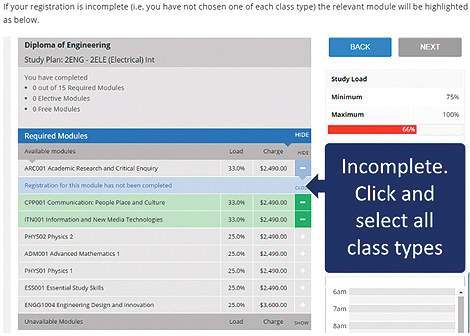
PLEASE READ THIS IMPORTANT INFORMATION CAREFULLY.
Step 1 - Login
Type the following link - http://learning.deakincollege.edu.au
Login using:
Username         – Student ID (look in your letter of offer)
Password         – Date of Birth (yyyymmdd)
(example: if your date of birth is 6 January 1991, type 19910106)
(If you are locked-out for any reason, try again in 15 mins.)

Step 2
Click on the ‘Account Administration’ tab at the top of the screen.

Step 3 - Click on the ‘Update my Profile’ tile.
The Personal Details tab will be highlighted. Click ‘Edit’ (see black
arrow below), complete/update the details and Save.

You will need to click on all the tabs at the top of the screen
(see red arrows below) and add or update your information.

      Once you have completed/updated information in all the tabs and saved, close the screen and
      click on the ‘Enrolment & Registration’ tile.

                                                                                              4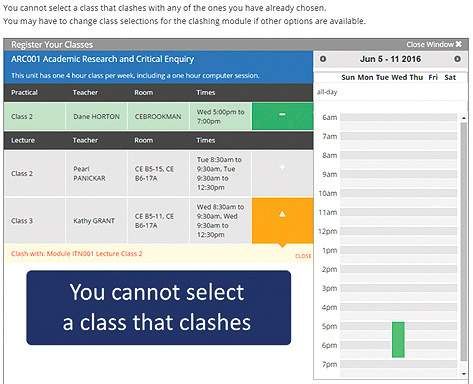
ENROLMENT & REGISTRATION GUIDE (refer to Course Outlines under ‘Resources’ )

Step 1
First, check that the trimester displayed is correct, then ensure that your program is selected (see red
arrows).

Step 2
Select             (see black arrow)

                                        SAMPLE

PLEASE NOTE:
You will now be directed to a ‘Class Times’ page to choose your modules and class times.
Refer to the Course Outlines on page 19. Look for the Bachelor course that you intend to do. Based
on the Bachelor course, follow the recommendation that is shown.

 - Domestic students can enrol in one to four modules each trimester.

 - A full-time study load at Deakin College for international students is a minimum of 3 units or
   a maximum of 4 units each trimester. Our recommendation is that you enrol in 3 or 4 units in
   order to meet progression requirements to Deakin University, as outlined in your offer letter.
  If you cannot take full time study load you must contact your Academic Coordinator (see page
  18, no. 16) prior to your scheduled enrolment date for a discussion. You will not be able to use
  our enrolment portal if you try to enrol in 1 or 2 units and will need to seek assistance from your
  Academic Coordinator.

                                                                                                    5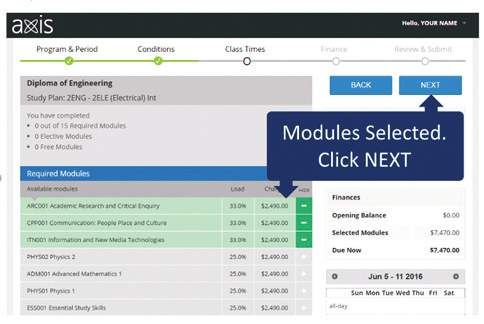
ENROLMENT & REGISTRATION GUIDE

Step 3 - ‘Class Times’ page,
Ensure that you register in the ‘Free Modules’ (see red arrow below) before you register in your
Core/Optional modules.

Then, click the ‘+’ sign to add a module. (see blue arrow below)

                                  SAMPLE

                                                                                                   6
ENROLMENT & REGISTRATION GUIDE
Step 4 - Register your Classes
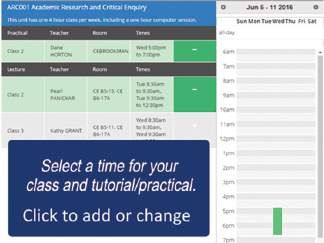
A pop-up window will appear and you will be required to choose a class time for the lecture and
practical/tutorial for the module that you have selected (click on the row to add or change classes).

Note: You will have to do this for each module that you select.

Once you have selected the class time your modules will be highlighted and a ‘-’ sign will be displayed
next to the module. (see example below)

                                                                                                 7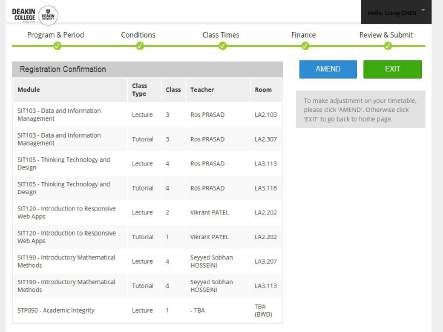
8
When all your modules are selected, click ‘Next’. As long as the ‘NEXT’ button is highlighted in blue
(you have completed this step). Click on it to proceed.

This button will not be available (greyed out) if your registration is incomplete.

                                                                                              9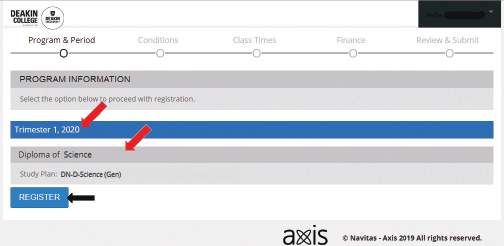
Step 5
You will now be directed to the Finance screen. Check that the modules you have selected and the
payment is correct. For Domestic students, a sponsor (‘Fee-help’) charge will be shown.

                                                                 If this button is green, click
                                                                 on it to proceed to the next
                                                                 step.

                                                                 If the button is not available
                                                                 (greyed out), please contact
                                                                 “Live Chat” for assistance.

                   You can then review your registration (below) before exiting.

                                                                                                  10
Check your timetable by clicking on the Class Timetable tile on the Home screen
11Task 1 – English Diagnostic Activity
To personalise study support services at Deakin College, we use an English Diagnostic Activity. It is not a
test. It is an activity to help you see what you might find difficult in your studies at College and how we can
help you be successful.
This exercise is required and all new students must attempt it.
What is it?
A 30-minute online exercise to show you (and us) what you might need help with.
This is not assessing your English language ability, but it is an exercise using various academic skills
designed for both native English speakers and English as an alternate language (EAL) speakers.
There are 38 required questions, which are mostly multiple choice.
Steps:
1. Use this link: https://forms.gle/59DxQAAEn1w37hcu7 (Chrome works best).
2. Have a look at your results and feedback (bookmark the results page to access info later).
3. Contact a Student Learning Advisor if you need help.
Why is it important?
Throughout your time at Deakin College, you will be expected to participate in class discussions and
presentations, listen and take notes in lectures, and research and write assignments and exams. These are
all skills that require a good understanding of academic English. Improving your language skills will help you
to get better grades in assignments and exams.
The results
The results will not affect your grades at Deakin College and do not appear on your academic transcript.
They are used to identify areas for help and improvement. You will get emails throughout the trimester with
suggestions of ways to improve your academic English.
What academic support does Deakin College offer?
One-on-one appointments with the Student Learning Advisors:
https://studentlearningadvisors.setmore.com/
Study Skills workshops
Moodle Online Study Skills page
One-on-one appointments with Learning Mentors: https://deakincollegepalm.setmore.com/
12Task 2 (available after 24 June, 2020)
Deakin University username and password
You will need to obtain a Deakin University password to use the computers on-campus, in the
computer labs and to access Deakin University’s online services.
Visit https://sync.deakin.edu.au/activate/password
You will see this window:
Follow these instructions:
1. Enter your details in the fields highlighted in yellow
Your Student ID number is your Deakin College ID, which can be found in your Letter of Offer in
the top right hand corner. It will be either 7 numbers starting with a 5 (eg. 500----) or an
alphabetical and numerical combination (eg. TOBRET1201).
13The Course codes are as follows:
Course Deakin College Course Code
Foundation Program X088
Diploma of Business X089
Diploma of Commerce X081
Diploma of Health Sciences X084
Diploma of Communication X090
Diploma of Design X097
Diploma of Film, Television and Animation X098
Diploma of Information Technology X099
Diploma of Science X087
Diploma of Engineering X085
Diploma of Construction Management X096
2. Enter your postcode
If you are currently in Australia, use the Melbourne postcode that you entered in the Deakin
College Student Portal and should reflect where you will be living while you are studying. It
is a 4-figure number.
If you are living outside of Australia or unsure of your postcode, use the Burwood postcode,
3125.
3. Click “CONTINUE”.
If successful, you’ll be presented with a new username. Please select the option for the system
to automatically generate a password for you. You can change the password later. The system
will continue setting up your email account. Wait for this to be created, then take down all of
the details.
Please note that you will not be able to change your password for approximately one hour
after activating your account.
If unsuccessful, please check the details you have entered. There should be a message that the
course code, birthdate or postcode do not match and that you must re-enter the details.
If you receive a message that the student ID could not be found, firstly please check there are
no spaces before or after the student ID.
If the student ID still cannot be found please email dcoll-ithelp@deakin.edu.au for assistance.
14Resources
15Frequently Asked Questions (FAQ)
New Students -Trimester 2, 2020
1. I am currently overseas and have accepted my offer with Deakin College. Am I expected to
arrive in Australia to enrol and commence my course?
No, you are not expected to be in Australia. For all students commencing in trimester 2, 2020
enrolment and classes will be fully online.
2. What is online learning?
Online learning refers to learning delivered on a computer via the internet and therefore does
not require students to be physically present at a school, college or university in order to attain
an education. Classes, assessments, and exams are conducted online.
3. Will Deakin College organise online orientation sessions for new students?
Yes, you will be invited to an ‘Online Orientation’ via email, where you will be able to attend and
participate in online information sessions and social events.
4. Why can I not come to Australia to study?
International travel to Australia is not allowed due to the COVID-19 pandemic.
5. How long will I be studying online?
Deakin College will continue to follow the advice of the Australian Government and will be
providing online classes until further notice. Our priority remains the health and safety of our
students and staff. The return to on campus teaching will be in line with Government regulations
and consistent with Deakin University’s practices.
6. Online learning is all new to me and I am not sure if I can cope.
The shift to online teaching and learning is a change for both staff and students. However, it is
important to know that Deakin College is offering more than lectures and tutorials - we provide
webinars, workshops and individual study support through learning mentors and learning
advisors. We also conduct social activities to support and maintain your wellbeing. The staff at
Deakin College encourage you to ask questions and are ready to provide support and guidance
as needed.
7. How do I enrol?
Once you have accepted your offer to study with us, we will send you instructions about how to
enrol online in your course.
168. Where do I find my student ID?
Please refer to your letter of offer. You will find your ID in the top right-hand corner: either 7
numbers starting with a 5(eg. 500----) or an alphabetical and numerical combination (eg.
TOBRET1201).
9. How many modules should I enrol in?
A full-time study load at Deakin College for international students is a minimum of 3 units or a
maximum of 4 units each trimester. Our recommendation is that you enrol in 3 or 4 units in
order to meet progression requirements to Deakin University, as outlined in your offer letter.
If you cannot take a full time study load, you must contact the Academic Coordinator for your
course (for contact details, see No.16 below) prior to your scheduled enrolment date for a
discussion. You will not be able to use our enrolment portal if you try to enrol in 1 or 2 units and
will need to seek assistance from your Academic Coordinator.
Domestic students can enrol in one to four modules each trimester.
10. Which modules do I choose?
Refer to the Course Outlines on page 19 of this booklet. Look for the Bachelor course that you
intend to study. Based on the Bachelor course, follow the recommendations that are shown in
the Course Outline.
11. I am trying to enrol, but my enrolment is blocked.
Your enrolment may be blocked for a number of reasons:
You may not have accepted your offer – complete section 2, 3 & 4 of your offer letter.
You may not have paid your fees.
You may not have submitted your release letter from your previous college or any other
documents requested by Admissions.
If you are a sponsored student, you may not have submitted your financial guarantee.
Contact us by using the ‘help chat’ function in the student portal if you experience any issues
enrolling.
12. There is a clash in the classes that I want to enrol in. What do I do?
Choose another class that does not have any clashes. If the class that you have chosen is full,
there is no choice but to choose another class/time-slot.
13. Who do I contact with questions about Finance, fees or FEE-HELP?
Send your question to Deakin College Finance, at email: DeakinFinance@navitas.com
1714. How is my Visa or CoE affected by online learning?
Visit the Department of Home Affairs website for updates to Australia's immigration and border
arrangements during the COVID-19 (Coronavirus) outbreak. https://covid19.homeaffairs.gov.au/
Visit the Department’s Staying in Australia webpage for information about student visas.
https://covid19.homeaffairs.gov.au/staying-australia
15. What are the key dates for Trimester 2?
Online enrolment for Trimester 2, 2020 start from Wednesday, 10th June 2020. You are
encouraged to enrol early as classes fill up quickly.
Classes for Trimester 2, 2020 start on Monday, 29th June 2020.
The last day to change units enrolled for Trimester 2 is 5.00 pm Friday 10th July 2020 (if
available).
Census date for Trimester 2, 2020 is Friday, 24th July 2020.
16. Who is my Academic Coordinator?
Academic Coordinator Course Email
Diploma of Communication
Diploma of Design
Wendy Beatty wendy.beatty@deakin.edu.au
Diploma of Film, Television and
Animation
Tamara Camilleri Diploma of Science tamara.camilleri@deakin.edu.au
Liam Lyons Diploma of Engineering liam.lyons@deakin.edu.au
Owen Makin Diploma of I.T. owen.makin@deakin.edu.au
Kristy Nikas Diploma of Commerce kristyn@deakin.edu.au
Catherine Sicurella Diploma of Health Sciences catherine.sicurella@deakin.edu.au
Jeff Skolnick Diploma of Business jeffrey.skolnick@deakin.edu.au
Shanal Uduwana Foundation Program shanal.uduwana@deakin.edu.au
Jo Williams Diploma of Construction Management jo.w@deakin.edu.au
18Foundation Program (Geelong)
Course Outline (T2 2020)
Campus Geelong Waterfront Campus
Intake March, June, October
CRICOS Standard Program: 089916J
Extended Program: 089917G
Course Standard Program: 8 units delivered over 2 trimesters
Duration Extended Program: 12 units delivered over 3 trimesters
Teaching Instruction for all units are a combination of classroom based, consultation hours,
Methods homework hours and on-line learning hours.
Assessment Assessment for all units is ongoing and continuous consisting of tests, assignments, practical,
case study analysis and final examinations.
Course Standard: The course comprises eight units (five core units and three elective units). To be
Structure awarded the Foundation Program you must complete and pass eight units.
Extended: The course comprises of twelve units (eight core units and 4 elective units in the
relevant stream). To be awarded the Foundation Program you must complete and pass
twelve units.
In addition, a number of support tutorials are available to help students with their academic
units.
Further Studies Students who complete the Foundation Program are eligible to enter the Diploma courses.
19Foundation Program
Example Course Plans for Students
Example Course Plans for Students
The following are a series of example course plans for students studying in the Foundation Program. Please note
that core and elective units must be taken in a specified order.
The following course plans should be used as a guide only.
Electives for students with a Deakin University Bachelor Degree listed in the Provisional Offer 2 section of the
Letter of Offer:
Please note students with direct path offers to Deakin University Bachelor Degrees in the Engineering and Science
streams have prescribed subjects and electives.
There is one zero credit point unit offered in the Foundation Program. It does not count towards your units
undertaken as a part of your program and is offered at no cost.
Subject Required for Trimester 2 Trimester 3 Trimester 1
2020 2020 2021
SLE010 Laboratory and Students should
Fieldwork safety unit enrol in SLE010 if
✓ ✓ ✓
they are enrolling in
FNDE022
20Before you choose your subjects please read these instructions
It is important to look at your letter of offer carefully before selecting your subjects.
The Letter of Offer provides information on your pathway. The Letter of Offer was sent to you congratulating you
on your acceptance into Deakin College. The letter of offer looks like this:
Some students will be going from Foundation to a Diploma course and then to Deakin University to complete a
Bachelor Degree. Other students will have been provided the chance to go from Foundation directly to Deakin
University to complete the bachelor degree. These students may have specific subjects they need to complete.
There are two sections you must check:
Provisional Offer 2 and Conditions of this offer and/or explanatory notes.
The above example shows a student with a direct 2nd stage path to Diploma so they would follow the regular
course subject example in their stream.
If you have Deakin University and a Bachelor Degree listed in your Provisional Offer 2 section then please check
the Conditions of this offer and/or explanatory notes section for instructions of specific subjects you must choose.
Your degree identification code which will be a letter with 3 numbers following it (example S460) and will be
listed in the course section of the offer may have a separate course guide page for it. Please ask for assistance to
find this in the following pages.
21Business Stream (WF)
Progressing in to the Diploma of Commerce or Diploma of Business:
Weighted Average Mean: B 50, WF 50
Standard Program (Completing In 8 months/ 2 trimesters)
1st CORE CORE CORE CORE
Trimester FNDS013 FNDS014 FNDS015 FNDH023
Advanced Academic Intercultural Studies Information Essential
Communication Technology Mathematics
Skills
2nd CORE
Trimester FNDS016
Advanced Academic Elective Elective Elective
Writing & Research
Skills
Extended Program (Completing course in 12 months/ 3 Trimesters)
1st CORE CORE CORE
CORE
Trimester FNDS010 FNDS011 FNDS012
Essential
Introduction to Introduction to Computer Skills
Mathematics
Academic Academic Writing
Communication
2nd CORE CORE CORE
Trimester FNDS013 FNDS014 FNDS015
Advanced Academic Intercultural Studies Information Elective
Communication Technology
Skills
3rd CORE
Trimester FNDS016
Advanced Academic Elective Elective Elective
Writing & Research
Skills
Program Electives:
Students can choose four (4) of the following units:
• FNDA021 Law • FNDB023 Marketing
• FNDB020 Accounting • FNDE021 Mathematics I
• FNDB021 Economics • FNDH023 Essential Mathematics
• FNDB022 Management
22Engineering Stream (WF)
To transfer to the Diploma of Engineering:
Weighted Average Mean: WF 50
Standard Program (Completing In 8 months/ 2 trimesters)
1st CORE CORE CORE CORE
Trimester FNDS013 FNDS014 FNDS015 FNDE021
Advanced Academic Intercultural Studies Information Mathematics I
Communication Technology
Skills
nd
2 CORE CORE Prescribed Elective
Trimester FNDS016 FNDE023 FNDE022
Advanced Academic Mathematics II *** Physics Elective
Writing & Research
Skills
Extended Program (Completing course in 12 months/ 3 Trimesters)
1st CORE CORE CORE CORE
Trimester FNDS010 FNDS011 FNDS012 FNDH023
Introduction to Introduction to Computer Skills Essential
Academic Academic Writing Mathematics
Communication
2nd CORE CORE CORE CORE
Trimester FNDS013 FNDS014 FNDS015 FNDE021
Advanced Academic Intercultural Studies Information Mathematics I
Communication Technology
Skills
3rd CORE CORE Prescribed Elective
Trimester FNDS016 FNDE023 FNDE022
Advanced Academic Mathematics II *** Physics Elective
Writing & Research
Skills
*** You must successfully complete FNDE021 Mathematics I before enrolling in FNDE023 Mathematics II (Pre-
requisite)
Restricted Elective:
Students must choose one (1) of the following units in their second or third trimester
• FNDE024 Biology • FNDH021 Chemistry
• FNDH022 Human Biology
23Health Stream (WF)
Progressing in to the Diploma of Health Science:
Weighted Average Mean: B 50, WF 50
Standard Program (Completing In 8 months/ 2 trimesters)
1st CORE CORE CORE CORE
Trimester FNDS013 FNDS014 FNDS015 FNDH023
Advanced Academic Intercultural Studies Information Essential
Communication Technology Mathematics
Skills
nd
2 CORE
Trimester FNDS016
Advanced Academic Elective Elective Elective
Writing & Research
Skills
Extended Program (Completing course in 12 months/ 3 Trimesters)
1st CORE CORE CORE CORE
Trimester FNDS010 FNDS011 FNDS012 FNDH023
Introduction to Introduction to Computer Skills Essential
Academic Academic Writing Mathematics
Communication
2nd CORE CORE CORE
Trimester FNDS013 FNDS014 FNDS015
Elective
Advanced Academic Intercultural Studies Information
Communication Technology
Skills
3rd CORE
Trimester FNDS016
Advanced Academic Elective Elective Elective
Writing & Research
Skills
Program Electives:
Students must choose four (4) of the following units:
• FNDE021 Mathematics I • FNDH021 Chemistry
• FNDE022 Physics • FNDH022 Human Biology
• FNDE024 Biology • FNDH023 Essential Mathematics
24Science Stream (WF)
To transfer to the Diploma of Science or Diploma of Construction Management or to progress to the Bachelor
of Architecture:
Weighted Average Mean: WF 50
Weighted Average Mean for Bachelor of Architecture: B 70, WF 70
English Requirement: 60% in FNDS013, 60% in FNDS016
Standard Program (Completing In 8 months/ 2 trimesters)
1st CORE CORE CORE CORE
Trimester FNDS013 FNDS014 FNDS015 FNDH023
Advanced Academic Intercultural Studies Information Essential
Communication Technology Mathematics
Skills
nd
2 CORE Prescribed Elective Prescribed Elective
Trimester FNDS016 FNDE021 FNDH021
Advanced Academic Mathematics I Chemistry Elective
Writing & Research
Skills
Extended Program (Completing course in 12 months/ 3 Trimesters)
1st CORE CORE CORE CORE
Trimester FNDS010 FNDS011 FNDS012 FNDH023
Introduction to Introduction to Computer Skills Essential
Academic Academic Writing Mathematics
Communication
2nd CORE CORE CORE Prescribed Elective
Trimester FNDS013 FNDS014 FNDS015 FNDE021
Advanced Academic Intercultural Studies Information Mathematics I
Communication Technology
Skills
3rd CORE Prescribed Elective
Trimester FNDS016 FNDH022
Advanced Academic Chemistry Elective Elective
Writing & Research
Skills
Elective:
Students can choose one (1) of the following units in their third trimester:
• FNDH022 Human Biology
• FNDE022 Physics
• FNDE023 Mathematics II
• FNDE024 Biology
25When I transfer direct to Deakin University I want to study:
E330 Bachelor of Education (Early Years)
E359 Bachelor of Education (Primary)
E377 Bachelor of Health & Physical Education
Weighted Average Mean: B 70, WF 70
English Requirement: 73% in FNDS013, 73% in FNDS016
Course plan for students with a Provisional Offer 2 for any of the following Deakin University courses:
Standard Program (Completing In 8 months/ 2 trimesters)
1st CORE CORE CORE CORE
Trimester FNDS013 FNDS014 FNDS015 FNDH023
Advanced Academic Intercultural Studies Information Essential
Communication Technology Mathematics
Skills
nd
2 CORE
Trimester FNDS016
Advanced Academic Elective Elective Elective
Writing & Research
Skills
Extended Program (Completing course in 12 months/ 3 Trimesters)
Refer to the Extended Program for the Health Stream
Program Electives:
You can choose two (2) of the following:
• FNDE022 Physics
• FNDE024 Biology
• FNDH021 Chemistry
• FNDH022 Human Biology
26When I transfer direct to Deakin University I want to study:
H326 Bachelor of Nursing
Weighted Average Mean: B 70
English Requirement: 75% in FNDS013, 75% in FNDS016
Course plan for students with a Provisional Offer 2 for any of the following Deakin University courses:
Standard Program (Completing In 8 months/ 2 trimesters)
1st CORE CORE CORE CORE
Trimester FNDS013 FNDS014 FNDS015 FNDH023
Advanced Academic Intercultural Studies Information Essential
Communication Technology Mathematics
Skills
nd
2 CORE
Trimester FNDS016
Advanced Academic Elective Elective Elective
Writing & Research
Skills
Extended Program (Completing course in 12 months/ 3 Trimesters)
Refer to the Extended Program for the Health Stream
Program Electives:
Students must choose four (4) of the following units:
• FNDE021 Mathematics I
• FNDE022 Physics
• FNDE024 Biology
• FNDH021 Chemistry
• FNDH022 Human Biology
27Unit Overviews
PLEASE ENSURE YOU CHECK THE TRIMESTER 3 2019 UNIT OUTLINES FOR PRESCRIBED TEXTBOOKS AND
ASSESSMENT UPDATES.
FNDA020 Society and Culture
This unit is the study of culture, sub-culture and institutions in society. It considers culture, sub-culture and
institutions from an Australian sociological perspective and investigates their impact in society. This subject
explores the nature of power, ethics, and equity as social and cultural issues. It facilitates intercultural
understanding and enhances the premise responsible citizenship whilst recognising points of difference and
context. This unit provides students with the skills to critically analyse a variety of opinions and attitudes towards
and within various sub-cultures, societies and environments.
FNDA021 Law
This unit focuses on the way in which law is generated, how it is structured and how it operates in Australian and
international contexts. This unit aims to introduce you to the Australian legal system and allows you to investigate
the way our society operates and the influences that shape it. It encourages you to engage your analytical and
critical skills and reflect on a diverse range of controversial legal issues.
FNDA022 Media
This unit will prepare students for studies in media and communications studies at tertiary level. Students will
develop skills in viewing, analysing and composing diverse media, including social media, new and online media,
contemporary advertising, and recent forms of auditory and visual media. Initially, students will focus on
familiarizing themselves with different media industries and specific texts to help understand some of their
features, how they are composed, and how they function within culture. In this context, students will then be
asked to produce their own forms of media and encouraged to read, reflect and engage with the tools of
contemporary media.
FNDA023 Mass Communication
This unit allows students to analyse media texts in their technical relationships to changing media contexts as well
as develop skills in media production, analysis and assessment. The means of mass communication are explored
with a critical view about how they produce meaning, how they engage mass users, how they produce meaning,
how they are organized, and how they go about the business of constructing cultural shifts and new forms of
social connections and understandings in an increasingly mobile world.
FNDB020 Accounting
This unit provides an introduction to the operation of financial accounting systems. Together we will explore the
accounting process predominantly for sole traders who buy and resell goods or provide services. We study some
of the principles of Accounting, the Accounting Equation, entering business transactions into Journals; including
balance day Adjustments and Closing entries, posting to Ledgers, extracting Trial Balance and preparation of
Financial Statements. We also work with cash management including Bank Reconciliation.
FNDB021 Economics
The purpose of this unit is to provide you with a broad understanding of theoretical Micro and Macroeconomic
concepts and to introduce the relevance and importance of Economics in todays’ society. You will be equipped to
apply these concepts to a modern market economic system. The unit will explore basic economic issues and
problems and apply policies to overcome these problems. You will develop skills and confidence to explain
individual and firm decision-making and be provided with a basic understanding and ability to explain government
policies that influence the workings of a modern economy like Australia, and its relation to the global
marketplace.
28FNDB022 Management
This unit will provide an introductory understanding of the principles and practices of management in the
contemporary world. The course will cover background information on how theories of management have
developed, the environment in which a manager operates, basic managerial principles and practices along with
important issues related to organisational behaviour in the context of management in 2019.
FNDB023 Marketing
This unit will provide a broad understanding of theoretical principles and practices relating to marketing in a
dynamic environment. It provides an introduction to fundamental marketing concepts used within a range of
industries (public/private business, agriculture, government, manufacturing, services and not-for-profit sectors).
The unit also provides insights into how these marketing concepts are being applied by marketers in the real
world.
FNDE020 Introduction to Systems Analysis
This unit is intended to give you an understanding of the underlying theory of project management as well as an
opportunity to practically plan, design and implement an information system that achieves a business goal. The
unit provides both a theoretical and practical approach covering the phases involved in Project Management
using the PMBOK guide.
FNDE021 Mathematics I
This module consolidates background in calculus and prepares students for further calculus studies for academic
and professional purposes. Students will use critical thinking and cognitive skills to identify, analyse, compare and
assess mathematical concepts in order to apply them to technical and engineering problems
FNDE022 Physics
This unit is designed to provide you with knowledge in a broad range of physics concepts, and to help you
appreciate the impact of physics and technology on society. This unit involves practical investigations that require
logical and analytical thinking, as well as the communication of scientific information and ideas. Through the
development of knowledge of the basic principles of physics, you will be able to explain many natural
phenomena. It will also enable you to apply these phenomena in technologies that are important to modern day
society.
FNDE023 Mathematics II
This module consolidates background in Calculus and prepares students for further calculus studies for academic
and professional purposes. Students will use critical thinking and cognitive skills to identify, analyse, compare and
assess mathematical concepts in order to apply them to technical and engineering problems.
FNDE024 Biology
This module is designed to develop a broad scientific knowledge of the living world. It will focus on concepts
relating to biological structure, function, diversity, distribution, genetics, and interactions of living organisms.
FNDH021 Chemistry
This unit introduces students to the study of matter and its interactions, therefore providing a link with other
branches of natural science. The course is designed to assist students in coming to appreciate the impact of
chemical knowledge and technology on society.
FNDH023 Essential Mathematics
This unit is designed for those of you who require a general mathematics background suitable for studies in
Business, Health Sciences and Computing/IT/Engineering courses. It includes basic arithmetic, statistics, algebra,
functions and their graphs, optimisation, sequences, series, growth and decay.
29FNDH022 Human Biology
This unit aims to give students a broad understanding of the human body from the biological molecules, cells and
tissues that make up the human body, to the organ systems they form. Students will gain a solid grounding in the
structure and function of each of the different systems that must function to sustain human life, including the
skeletal and muscular systems, the digestive system, the respiratory and cardiovascular systems, the urinary
system and endocrine and nervous systems.
FNDS010 Introduction to Academic Communication
This unit responds to the need to develop speaking and listening skills that will provide a basis for successful
academic achievement and effective engagement in academic, business and social environments. You will
improve these skills through exploring and analysing current topics and issues. This unit is designed to
complement writing skills’ development in Introduction to Academic Writing as preparation for future subjects.
FNDS011 Introduction to Academic Writing
This unit develops students’ written language skills through exploration of two key academic writing genres and
production of sophisticated academic writing. You will analyse key linguistic and organisational aspects of
comparative and contrastive texts, and cause and effect texts in particular, and then produce your own pieces of
writing.
FNDS012 Computer Skills
This unit is an introductory unit in computing and information technology. This subject has the overall objectives
of delivering an accurate snapshot of the state of IT as it exists in our current times, as well as to equip you with a
useful set of skills in the use of common productivity software.
FNDS013 Advanced Academic Communication Skills
This unit builds linguistic and tactical skills for participation in academic contexts typical of the Australian tertiary
education system. The main focus is on enabling you to actively and effectively partake in lectures and tutorials.
This unit fosters a collaborative environment in which you can practice and apply your active listening, note taking
and discursive skills. Presentation delivery and leading a formal job interview form the main assessments in this
unit.
FNDS014 Intercultural Studies
This unit is designed to enhance students’ knowledge of their own culture in order to reflect on how they formed
their perceptions, value and beliefs. Students will also gain knowledge and skills about living in the multicultural
Australian environment, so that they are able to effectively communicate in the contexts of educational, health,
legal, political, religion/faith, and human rights. Students will identify the differences between these contexts in
their own culture and those in the Australian culture, in order to come to a better understanding of their position
in both.
FNDS015 Information Technology
Information systems and technology are vital components of today’s business environments and everyday life.
This unit will give the student an understanding of the various types of systems and supporting technology and
how they apply to different business environments. The effects of these systems on society and some ethical
issues associated with the implementation and use of these systems will also be explored. Upon completion of
this unit students will be able to critically analyse business cases and develop needed skills to solve problems and
recommend solutions using appropriate technology. Additionally, students will be able to understand and relate
the role of technology and systems in organisations and society in general.
30FNDS016 Advanced Writing and Research Skills
This unit will acquaint you with academic literature and the essay writing process, producing a lengthy argument
essay of your own, drawing on previous research to make lucid and academically supported arguments. You will
also gain the ability to retrieve, interpret and summarise academic journal articles and produce an annotated
bibliography, and literature review with ideas for future research. This unit will thus provide you with a solid basis
in academic writing and research, which are which pivotal in tertiary contexts.
31Foundation Program (Burwood)
Course Outline (T2 2020)
Campus Melbourne Burwood Campus
Intake March, June, October
CRICOS Standard Program: 089916J
Extended Program: 089917G
Course Standard Program: 8 units delivered over 2 trimesters
Duration Extended Program: 12 units delivered over 3 trimesters
Teaching Instruction for all units are a combination of classroom based, consultation hours,
Methods homework hours and on-line learning hours.
Assessment Assessment for all units is ongoing and continuous consisting of tests, assignments, practical,
case study analysis and final examinations.
Course Standard: The course comprises eight units (five core units and three elective units). To be
Structure awarded the Foundation Program you must complete and pass eight units.
Extended: The course comprises of twelve units (eight core units and 4 elective units in the
relevant stream). To be awarded the Foundation Program you must complete and pass
twelve units.
In addition, a number of support tutorials are available to help students with their academic
units.
Further Studies Students who complete the Foundation Program are eligible to enter the Diploma courses.
32Foundation Program
Example Course Plans for Students
Example Course Plans for Students
The following are a series of example course plans for students studying in the Foundation Program. Please note
that core and elective units must be taken in a specified order.
The following course plans should be used as a guide only.
Electives for students with a Deakin University Bachelor Degree listed in the Provisional Offer 2 section of the
Letter of Offer:
Please note students with direct path offers to Deakin University Bachelor Degrees in the Engineering and Science
streams have prescribed subjects and electives.
There is one zero credit point unit offered in the Foundation Program. It does not count towards your units
undertaken as a part of your program and is offered at no cost.
Subject Required for Trimester 2 Trimester 3 Trimester 1
2020 2020 2021
SLE010 Laboratory and Students should
Fieldwork safety unit enrol in SLE010 if
✓ ✓ ✓
they are enrolling in
FNDE022
33Before you choose your subjects please read these instructions
It is important to look at your letter of offer carefully before selecting your subjects.
The Letter of Offer provides information on your pathway. The Letter of Offer was sent to you congratulating you
on your acceptance into Deakin College. The letter of offer looks like this:
Some students will be going from Foundation to a Diploma course and then to Deakin University to complete a
Bachelor Degree. Other students will have been provided the chance to go from Foundation directly to Deakin
University to complete the bachelor degree. These students may have specific subjects they need to complete.
There are two sections you must check:
Provisional Offer 2 and Conditions of this offer and/or explanatory notes.
The above example shows a student with a direct 2nd stage path to Diploma so they would follow the regular
course subject example in their stream.
If you have Deakin University and a Bachelor Degree listed in your Provisional Offer 2 section then please check
the Conditions of this offer and/or explanatory notes section for instructions of specific subjects you must choose.
Your degree identification code which will be a letter with 3 numbers following it (example S460) and will be
listed in the course section of the offer may have a separate course guide page for it. Please ask for assistance to
find this in the following pages.
34COURSE MAP:
Progressing into a Deakin College Diploma *:
Weighted Average Mean: B 50
Standard Program (Completing In 8 months/ 2 trimesters)
1st CORE CORE CORE CORE
Trimester FNDS013 FNDS014 FNDS015 FNDH023
Advanced Academic Intercultural Studies Information Essential
Communication Technology Mathematics
Skills
2nd CORE
Trimester FNDS016
Advanced Academic Elective Elective Elective
Writing & Research
Skills
Extended Program (Completing course in 12 months/ 3 Trimesters)
1st CORE CORE CORE
CORE
Trimester FNDS010 FNDS011 FNDS012
Essential
Introduction to Introduction to Computer Skills
Mathematics
Academic Academic Writing
Communication
2nd CORE CORE CORE
Trimester FNDS013 FNDS014 FNDS015
Advanced Academic Intercultural Studies Information Elective
Communication Technology
Skills
3rd CORE
Trimester FNDS016
Advanced Academic Elective Elective Elective
Writing & Research
Skills
*This course outline does not apply for students progressing into the Diploma of Engineering, due to prerequisite Maths units. For Diploma
of Engineering, please see the Course outline for Waterfront Campus.
35ELECTIVES BY AREA OF STUDY:
Refer to the table below for recommended electives for your chosen area of study:
STANDARD and Arts (B)
EXTENDED PROGRAM
• FNDA020 Society and Culture
Elective Units
• FNDA021 Law
(4 Units)
• FNDA022 Media
Choose one • FNDA023 Mass Communication
• FNDB021 Economics
• FNDB022 Management
• FNDB023 Marketing
Business (B, WF)
• FNDA021 Law
• FNDB020 Accounting
• FNDB021 Economics
• FNDB022 Management
• FNDB023 Marketing
• FNDE020 Introduction to Systems Analysis
• FNDE021 Mathematics I
• FNDE023 Mathematics II
Health (B, WF)
• FNDB022 Management
• FNDE021 Mathematics I
• FNDE023 Mathematics II
• FNDE022 Physics
• FNDE024 Biology
• FNDH021 Chemistry
• FNDH022 Human Biology
Information Technology (B)
• FNDB022 Management
• FNDE020 Introduction to Systems Analysis
• FNDE021 Mathematics I
• FNDE023 Mathematics II
• FNDE022 Physics
• FNDE024 Biology
• FNDH021 Chemistry
36Transferring Directly Into Deakin University:
E330 Bachelor of Education (Early Years)
E359 Bachelor of Education (Primary)
E377 Bachelor of Health & Physical Education
Weighted Average Mean: B 70, WF 70
English Requirement: 73% in FNDS013, 73% in FNDS016
Course plan for students with a Provisional Offer 2 for any of the following Deakin University courses:
Standard Program (Completing In 8 months/ 2 trimesters)
1st CORE CORE CORE CORE
Trimester FNDS013 FNDS014 FNDS015 FNDH023
Advanced Academic Intercultural Studies Information Essential
Communication Technology Mathematics
Skills
2nd CORE
Trimester FNDS016
Advanced Academic Elective Elective Elective
Writing & Research
Skills
Extended Program (Completing course in 12 months/ 3 Trimesters)
1st CORE CORE CORE
CORE
Trimester FNDS010 FNDS011 FNDS012
Essential
Introduction to Introduction to Computer Skills
Mathematics
Academic Academic Writing
Communication
2nd CORE CORE CORE
Trimester FNDS013 FNDS014 FNDS015
Advanced Academic Intercultural Studies Information Elective
Communication Technology
Skills
3rd CORE
Trimester FNDS016
Advanced Academic Elective Elective Elective
Writing & Research
Skills
Program Electives:
It is recommended that you choose from the following elective units:
• FNDA020 Society and Culture • FNDE021 Mathematics I
• FNDA021 Law • FNDE023 Mathematics II
• FNDA022 Media • FNDE022 Physics
• FNDA023 Mass Communication • FNDE024 Biology
• FNDB021 Economics • FNDH021 Chemistry
• FNDB022 Management • FNDH022 Human Biology
37Transferring into H326 Bachelor of Nursing
Weighted Average Mean: B 70
English Requirement: 75% in FNDS013, 75% in FNDS016
Course plan for students with a Provisional Offer 2 for any of the following Deakin University courses:
Standard Program (Completing In 8 months/ 2 trimesters)
1st CORE CORE CORE CORE
Trimester FNDS013 FNDS014 FNDS015 FNDH023
Advanced Academic Intercultural Studies Information Essential
Communication Technology Mathematics
Skills
2nd CORE
Trimester FNDS016
Advanced Academic Elective Elective Elective
Writing & Research
Skills
Extended Program (Completing course in 12 months/ 3 Trimesters)
Extended Program (Completing course in 12 months/ 3 Trimesters)
1st CORE CORE CORE
CORE
Trimester FNDS010 FNDS011 FNDS012
Essential
Introduction to Introduction to Computer Skills
Mathematics
Academic Academic Writing
Communication
2nd CORE CORE CORE
Trimester FNDS013 FNDS014 FNDS015
Advanced Academic Intercultural Studies Information Elective
Communication Technology
Skills
3rd CORE
Trimester FNDS016
Advanced Academic Elective Elective Elective
Writing & Research
Skills
Program Electives:
Students must choose from the four (4) following units:
• FNDE021 Mathematics I
• FNDE022 Physics
• FNDE024 Biology
• FNDH021 Chemistry
• FNDH022 Human Biology
38Unit Overviews
PLEASE ENSURE YOU CHECK THE TRIMESTER 3 2019 UNIT OUTLINES FOR PRESCRIBED TEXTBOOKS AND
ASSESSMENT UPDATES.
FNDA020 Society and Culture
This unit is the study of culture, sub-culture and institutions in society. It considers culture, sub-culture and
institutions from an Australian sociological perspective and investigates their impact in society. This subject
explores the nature of power, ethics, and equity as social and cultural issues. It facilitates intercultural
understanding and enhances the premise responsible citizenship whilst recognising points of difference and
context. This unit provides students with the skills to critically analyse a variety of opinions and attitudes towards
and within various sub-cultures, societies and environments.
FNDA021 Law
This unit focuses on the way in which law is generated, how it is structured and how it operates in Australian and
international contexts. This unit aims to introduce you to the Australian legal system and allows you to investigate
the way our society operates and the influences that shape it. It encourages you to engage your analytical and
critical skills and reflect on a diverse range of controversial legal issues.
FNDA022 Media
This unit will prepare students for studies in media and communications studies at tertiary level. Students will
develop skills in viewing, analysing and composing diverse media, including social media, new and online media,
contemporary advertising, and recent forms of auditory and visual media. Initially, students will focus on
familiarizing themselves with different media industries and specific texts to help understand some of their
features, how they are composed, and how they function within culture. In this context, students will then be
asked to produce their own forms of media and encouraged to read, reflect and engage with the tools of
contemporary media.
FNDA023 Mass Communication
This unit allows students to analyse media texts in their technical relationships to changing media contexts as well
as develop skills in media production, analysis and assessment. The means of mass communication are explored
with a critical view about how they produce meaning, how they engage mass users, how they produce meaning,
how they are organized, and how they go about the business of constructing cultural shifts and new forms of
social connections and understandings in an increasingly mobile world.
FNDB020 Accounting
This unit provides an introduction to the operation of financial accounting systems. Together we will explore the
accounting process predominantly for sole traders who buy and resell goods or provide services. We study some
of the principles of Accounting, the Accounting Equation, entering business transactions into Journals; including
balance day Adjustments and Closing entries, posting to Ledgers, extracting Trial Balance and preparation of
Financial Statements. We also work with cash management including Bank Reconciliation.
FNDB021 Economics
The purpose of this unit is to provide you with a broad understanding of theoretical Micro and Macroeconomic
concepts and to introduce the relevance and importance of Economics in todays’ society. You will be equipped to
apply these concepts to a modern market economic system. The unit will explore basic economic issues and
problems and apply policies to overcome these problems. You will develop skills and confidence to explain
individual and firm decision-making and be provided with a basic understanding and ability to explain government
policies that influence the workings of a modern economy like Australia, and its relation to the global
marketplace.
39FNDB022 Management
This unit will provide an introductory understanding of the principles and practices of management in the
contemporary world. The course will cover background information on how theories of management have
developed, the environment in which a manager operates, basic managerial principles and practices along with
important issues related to organisational behaviour in the context of management in 2019.
FNDB023 Marketing
This unit will provide a broad understanding of theoretical principles and practices relating to marketing in a
dynamic environment. It provides an introduction to fundamental marketing concepts used within a range of
industries (public/private business, agriculture, government, manufacturing, services and not-for-profit sectors).
The unit also provides insights into how these marketing concepts are being applied by marketers in the real
world.
FNDE020 Introduction to Systems Analysis
This unit is intended to give you an understanding of the underlying theory of project management as well as an
opportunity to practically plan, design and implement an information system that achieves a business goal. The
unit provides both a theoretical and practical approach covering the phases involved in Project Management
using the PMBOK guide.
FNDE021 Mathematics I
This module consolidates background in calculus and prepares students for further calculus studies for academic
and professional purposes. Students will use critical thinking and cognitive skills to identify, analyse, compare and
assess mathematical concepts in order to apply them to technical and engineering problems
FNDE022 Physics
This unit is designed to provide you with knowledge in a broad range of physics concepts, and to help you
appreciate the impact of physics and technology on society. This unit involves practical investigations that require
logical and analytical thinking, as well as the communication of scientific information and ideas. Through the
development of knowledge of the basic principles of physics, you will be able to explain many natural
phenomena. It will also enable you to apply these phenomena in technologies that are important to modern day
society.
FNDE023 Mathematics II
This module consolidates background in Calculus and prepares students for further calculus studies for academic
and professional purposes. Students will use critical thinking and cognitive skills to identify, analyse, compare and
assess mathematical concepts in order to apply them to technical and engineering problems.
FNDE024 Biology
This module is designed to develop a broad scientific knowledge of the living world. It will focus on concepts
relating to biological structure, function, diversity, distribution, genetics, and interactions of living organisms.
FNDH021 Chemistry
This unit introduces students to the study of matter and its interactions, therefore providing a link with other
branches of natural science. The course is designed to assist students in coming to appreciate the impact of
chemical knowledge and technology on society.
FNDH023 Essential Mathematics
This unit is designed for those of you who require a general mathematics background suitable for studies in
Business, Health Sciences and Computing/IT/Engineering courses. It includes basic arithmetic, statistics, algebra,
functions and their graphs, optimisation, sequences, series, growth and decay.
40FNDH022 Human Biology
This unit aims to give students a broad understanding of the human body from the biological molecules, cells and
tissues that make up the human body, to the organ systems they form. Students will gain a solid grounding in the
structure and function of each of the different systems that must function to sustain human life, including the
skeletal and muscular systems, the digestive system, the respiratory and cardiovascular systems, the urinary
system and endocrine and nervous systems.
FNDS010 Introduction to Academic Communication
This unit responds to the need to develop speaking and listening skills that will provide a basis for successful
academic achievement and effective engagement in academic, business and social environments. You will
improve these skills through exploring and analysing current topics and issues. This unit is designed to
complement writing skills’ development in Introduction to Academic Writing as preparation for future subjects.
FNDS011 Introduction to Academic Writing
This unit develops students’ written language skills through exploration of two key academic writing genres and
production of sophisticated academic writing. You will analyse key linguistic and organisational aspects of
comparative and contrastive texts, and cause and effect texts in particular, and then produce your own pieces of
writing.
FNDS012 Computer Skills
This unit is an introductory unit in computing and information technology. This subject has the overall objectives
of delivering an accurate snapshot of the state of IT as it exists in our current times, as well as to equip you with a
useful set of skills in the use of common productivity software.
FNDS013 Advanced Academic Communication Skills
This unit builds linguistic and tactical skills for participation in academic contexts typical of the Australian tertiary
education system. The main focus is on enabling you to actively and effectively partake in lectures and tutorials.
This unit fosters a collaborative environment in which you can practice and apply your active listening, note taking
and discursive skills. Presentation delivery and leading a formal job interview form the main assessments in this
unit.
FNDS014 Intercultural Studies
This unit is designed to enhance students’ knowledge of their own culture in order to reflect on how they formed
their perceptions, value and beliefs. Students will also gain knowledge and skills about living in the multicultural
Australian environment, so that they are able to effectively communicate in the contexts of educational, health,
legal, political, religion/faith, and human rights. Students will identify the differences between these contexts in
their own culture and those in the Australian culture, in order to come to a better understanding of their position
in both.
FNDS015 Information Technology
Information systems and technology are vital components of today’s business environments and everyday life.
This unit will give the student an understanding of the various types of systems and supporting technology and
how they apply to different business environments. The effects of these systems on society and some ethical
issues associated with the implementation and use of these systems will also be explored. Upon completion of
this unit students will be able to critically analyse business cases and develop needed skills to solve problems and
recommend solutions using appropriate technology. Additionally, students will be able to understand and relate
the role of technology and systems in organisations and society in general.
41FNDS016 Advanced Writing and Research Skills
This unit will acquaint you with academic literature and the essay writing process, producing a lengthy argument
essay of your own, drawing on previous research to make lucid and academically supported arguments. You will
also gain the ability to retrieve, interpret and summarise academic journal articles and produce an annotated
bibliography, and literature review with ideas for future research. This unit will thus provide you with a solid basis
in academic writing and research, which are which pivotal in tertiary contexts.
42BOOKLIST: Foundation Program
Trimester 2 2020
Foundation Program students must purchase all textbooks listed for the units they are enrolled in.
All hard-copy textbooks listed are available on campus from the DUSA Bookshop. The price of prescribed books can be
obtained from the bookshop website: http://www.dusabookshop.com.au. Please ensure you have purchased a copy in
the first week of class.
Unit Code Book name
FNDA021 Gibson (2017). Business Law. Edition 10, Pearson ISBN 9781488687952
FNDS010
Dummett and Hird (2015). Oxford EAP: A course in English for Academic
Purposes (B1/Pre-Intermediate). Oxford University Press IBSN 9780194002073
Dummett and Hird (2015). Oxford EAP: A course in English for Academic
Purposes (B1/Pre-Intermediate). Oxford University Press IBSN 9780194002073
FNDS011
Chazal and McCarter (2013). Oxford EAP: A course in English for Academic
FNDS013 Purposes (B1+/ Intermediate). Oxford University Press
IBSN 9780194002011
Chazal and McCarter (2013). Oxford EAP: A course in English for Academic
FNDS016 Purposes (B1+/ Intermediate). Oxford University Press
IBSN 9780194002011
Hunt and Clemens (2017). Illustrated Microsoft Office 365 and Office 2016:
FNDS015 Fundamentals. Cengage Learning US
IBSN 9781305878945
This document is current at 08/05/2020. Once printed this document is no longer a controlled document. V17 – 05/20
K: Academic Services\Booklists\Trimester 2 2020- Booklists\Foundation Program Page 1 of 1
43You can also read


